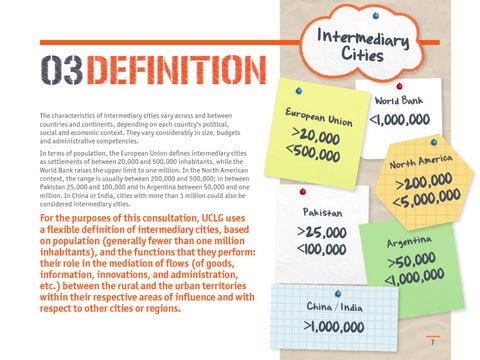
Intermediary Cities The characteristics of intermediary cities vary across and between countries and continents, depending on each country’s political, social and economic context. They vary considerably in size, budgets and administrative competencies. In terms of population, the European Union defines intermediary cities as settlements of between 20,000 and 500,000 inhabitants, while the World Bank raises the upper limit to one million. In the North American context, the range is usually between 200,000 and 500,000; in between Pakistan 25,000 and 100,000 and in Argentina between 50,000 and one million. In China or India, cities with more than 1 million could also be considered intermediary cities.
For the purposes of this consultation, UCLG uses a flexible definition of intermediary cities, based on population (generally fewer than one million inhabitants), and the functions that they perform: their role in the mediation of flows (of goods, information, innovations, and administration, etc.) between the rural and the urban territories within their respective areas of influence and with respect to other cities or regions.
World Bank
Europea
n Union
>20,000 <500,000
Pakistan
>25,000 <100,000
<1,000,000 erica
North Am
>200,000 0 <5,000,00 a
Argentin
>50,000 <1,000,000
China / India
>1,000,000 7