Participants SELÇUT AKINCI Alderman of the City of Breda in the Netherlands and member of the VNG Committee on European and international affairs, with responsibility for the global urban agenda.
HUMAN SCALE These ‘human scale’ advantages of intermediary cities were contrasted with the ‘agglomeration advantages’ of metropolitan areas. There was an unresolved debate about whether intermediary cities should be promoted as the ‘best’ model for sustainable development and wellbeing. However it was agreed that all models provide challenges and opportunities (economic, social, environmental, democratic, etc.). Maintaining and valuing a diversity of models in the system of cities would give people more choice about what kind of city they’d like to live in. In order to take advantage of their scale, intermediary cities need autonomy and good governance, both central themes of the debate.
Arnau Gutierrez Camps Multilateral Relations Adviser of the International Relations Directorate of the Province of Barcelona. He coordinates the UCLG Committee Decentralisation and Local Self-Government.
Nico Keijzer Programme Officer at Shack/ Slum Dwellers International. SDI is a network of community-based organizations of the urban poor in 33 countries in Africa, Asia, and Latin America.
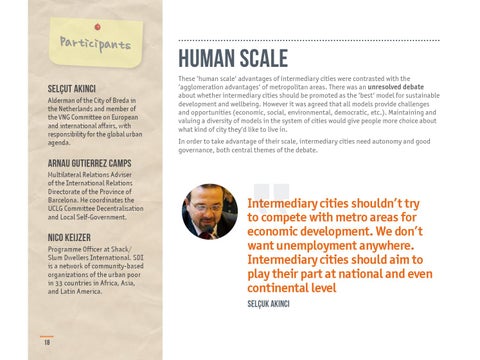
Intermediary cities shouldn’t try to compete with metro areas for economic development. We don’t want unemployment anywhere. Intermediary cities should aim to play their part at national and even continental level Selçuk Akinci
18