Participants SILVIO BARROS Formerly Mayor of Maringa and now acts as Secretary of Planning in the State of Paraná, Brazil. Maringa has been active in UCLG peer-to-peer learning and the dialogues of the intermediary cities group in South Africa and Mozambique.
ECONOMY The idea of a circular, self-sustaining economy was explored, with emphasis placed on its role in endogenous economic development and resilience to shocks. Localizing services will allow intermediary cities to create jobs and promote a circular economy (e.g. food supply, energy production and waste recovery). This will allow intermediary cities to be more self-sustaining and pose a lower risk to the system as a whole. The diversity and scale of intermediary gives them significant capacity for innovation and to act as incubators for entrepreneurship and economic development. There were discussions about the coming “third industrial revolution”, based on small scale production like 3d printing. This will allow intermediary cities to renegotiate their role in the national and global economy, promote transnational collaboration and entrepreneurship. There was tension between calls for specialization and diversification in intermediary city economies.
Oihane Agirregoitia Engineer by training, and currently Councillor for Equality, International Cooperation, and Citizenship and responsible for Open Government in Bilbao, Spain.
We need better ways of measuring the contribution of the informal economy Jagan Shah
Yonka Agalova Director of Culture and Tourism of the City of Gabrovo, Bulgaria. The city is the administrative centre of Gabrovo Province and has a population of around 59,000 inhabitants.
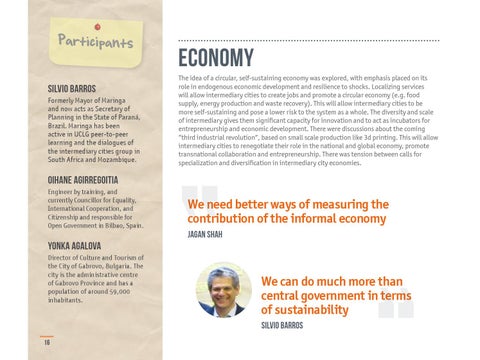
We can do much more than central government in terms of sustainability Silvio Barros
16