COMMUNITY-BASED MONITORING
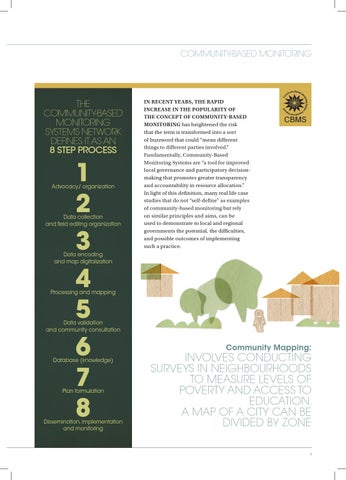
The Community-Based Monitoring Systems Network defines it as an 8 step process
1 2
Advocacy/ organization
Data collection and field editing organization
3
In recent years, the rapid increase in the popularity of the concept of Community-Based Monitoring has heightened the risk that the term is transformed into a sort of buzzword that could “mean different things to different parties involved.” Fundamentally, Community-Based Monitoring Systems are “a tool for improved local governance and participatory decisionmaking that promotes greater transparency and accountability in resource allocation.” In light of this definition, many real life case studies that do not “self-define” as examples of community-based monitoring but rely on similar principles and aims, can be used to demonstrate to local and regional governments the potential, the difficulties, and possible outcomes of implementing such a practice.
Data encoding and map digitalization
4 5
Processing and mapping
Data validation and community consultation
6 7 8
Database (knowledge)
Plan formulation
Dissemination, implementation and monitoring
Community Mapping:
involves conducting surveys in neighbourhoods to measure levels of poverty and access to education. A MAP OF A CITY CAN BE DIVIDED BY ZONE 7