Examples from around the globe
Scaling-up CBM in india
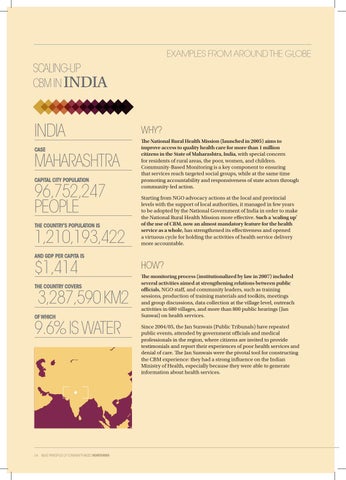
INDIA CaSE
MAHARASHTRA CAPITAL CITY POPULATION
96,752,247 people The country’s population is
1,210,193,422
WHY? The National Rural Health Mission (launched in 2005) aims to improve access to quality health care for more than 1 million citizens in the State of Maharashtra, India, with special concern for residents of rural areas, the poor, women, and children. Community-Based Monitoring is a key component to ensuring that services reach targeted social groups, while at the same time promoting accountability and responsiveness of state actors through community-led action. Starting from NGO advocacy actions at the local and provincial levels with the support of local authorities, it managed in few years to be adopted by the National Government of India in order to make the National Rural Health Mission more effective. Such a ‘scaling up’ of the use of CBM, now an almost mandatory feature for the health service as a whole, has strengthened its effectiveness and opened a virtuous cycle for holding the activities of health service delivery more accountable.
and GDP per capita is
$1,414
The country covers
3,287,590 km2
of which
9.6% is water
16
Basic principles of Community-Based monitoring
HOW? The monitoring process (institutionalized by law in 2007) included several activities aimed at strengthening relations between public officials, NGO staff, and community leaders, such as training sessions, production of training materials and toolkits, meetings and group discussions, data collection at the village level, outreach activities in 680 villages, and more than 800 public hearings (Jan Sunwai) on health services. Since 2004/05, the Jan Sunwais (Public Tribunals) have repeated public events, attended by government officials and medical professionals in the region, where citizens are invited to provide testimonials and report their experiences of poor health services and denial of care. The Jan Sunwais were the pivotal tool for constructing the CBM experience: they had a strong influence on the Indian Ministry of Health, especially because they were able to generate information about health services.