Examples from around the globe
Turning scorecards into
‘community-driven tools’
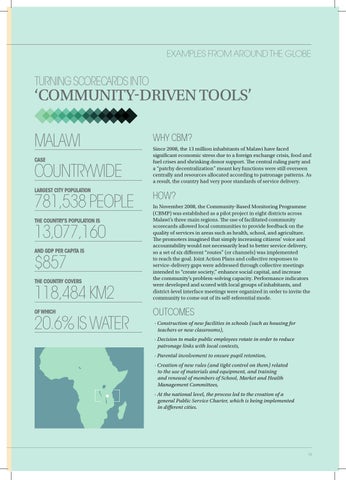
MALAWI CaSE
COUNTRYWIDE LARGEST CITY POPULATION
781,538 people The country’s population is
13,077,160 and GDP per capita is
$857
The country covers
118,484 km2 of which
20.6% is water
WHY CBM? Since 2008, the 13 million inhabitants of Malawi have faced significant economic stress due to a foreign exchange crisis, food and fuel crises and shrinking donor support. The central ruling party and a “patchy decentralization” meant key functions were still overseen centrally and resources allocated according to patronage patterns. As a result, the country had very poor standards of service delivery.
HOW? In November 2008, the Community-Based Monitoring Programme (CBMP) was established as a pilot project in eight districts across Malawi’s three main regions. The use of facilitated community scorecards allowed local communities to provide feedback on the quality of services in areas such as health, school, and agriculture. The promoters imagined that simply increasing citizens’ voice and accountability would not necessarily lead to better service delivery, so a set of six different “routes” (or channels) was implemented to reach the goal. Joint Action Plans and collective responses to service-delivery gaps were addressed through collective meetings intended to “create society,” enhance social capital, and increase the community’s problem-solving capacity. Performance indicators were developed and scored with local groups of inhabitants, and district-level interface meetings were organized in order to invite the community to come out of its self-referential mode.
OUTCOMES · Construction of new facilities in schools (such as housing for teachers or new classrooms), · Decision to make public employees rotate in order to reduce patronage links with local contexts, · Parental involvement to ensure pupil retention, · Creation of new rules (and tight control on them) related to the use of materials and equipment, and training and renewal of members of School, Market and Health Management Committees, · At the national level, the process led to the creation of a general Public Service Charter, which is being implemented in different cities.
13