UCLG Committee on Urban Strategic Planning
CITY PEER LEARNING: Urban planning and management instruments Relevant Brazilian experience for Mozambican cities
Associação Nacional dos Municípios de Moçambique
Why Mozambique and Brazil? THIS PROJECT CONNECTS WITH THE PROCESSES OF DECENTRALIZATION AND STRENGTHENING OF LOCAL GOVERNMENTS. Brazil has made substantial advancements in the decentralization process and local governments’ empowerment. One of the milestones of this process was the creation of the MinistÊrio das Cidades and the development of the Estatuto da Cidade (2001). Brazilian cities have the potential to share their experiences with other cities such as Mozambican ones, thus strengthening decentralized South - South cooperation. In a similar, but more recent way, Mozambique is undergoing an important decentralization process and developing municipal urban management instruments and policies. Nonetheless, municipalities are still constrained in their legal, financial and technical capacity to reduce poverty and directly or indirectly help generate employment and revenue. Despite the natural and foreseen differences between Brazilian and Mozambican policies, there are similar key points that make this South-South cooperation beneficial to the involved parties. Source: Plano de Estructura Urbana, cidade de Inhambane, 2013
Why planning and management? ACCORDING TO UN ESTIMATES, THE LARGE POPULATION GROWTH EXPECTED IN THE COMING DECADES WILL CONCENTRATE IN URBAN AREAS OF THE LESS DEVELOPED COUNTRIES AND AMONG THE POOREST POPULATIONS. This phenomenon will occur in cities of medium profile, whose planning and management capacities are weak, favouring the expansion of urban slums deprived of key basic services, requiring that cities are equipped with urban planning and management instruments that enable them to absorb this growth.
What is the role of associations?
By 2025, it is projected that Mozambique be the fourth most urbanised country in the region, after Botswana, South Africa and Angola (Cities Alliance Country Programme). The country is developing planning tools that are similar to their Brazilian counterparts, for example those defined by the Lei de Ordenamento do Territorio, 2008. For the first time in history, this law enables and obliges local authorities to plan for growth and expansion and to define services. Nevertheless, the fiscal power of municipalities remains very limited.
THE ROLE OF LOCAL AUTHORITIES ‘ ASSOCIATIONS AND NETWORKS IS FUNDAMENTAL TO SUPPORT CITIES to define their needs and priorities, capitalize their knowledge and share with peers, create strategic partnerships to fulfill knowledge gaps and be informed on initiatives and opportunities to support their development. Their role is crucial to create awareness amongst members, partners and politicians of the development agenda.
Project to improve the institutional capacities of Local Authorities and Associations of Local Authorities in Brazil and Mozambique as actors of decentralized cooperation
DESCRIPTION OF THE PROJECT The project begun in January 2013 is scheduled for implementation over a period of 28 months. It aims to enhance development management capacities in eight municipalities in Mozambique and six in Brazil through exchange of good practices, institutional capacity building, and dissemination in Local Authorities’ networks. This project is being jointly coordinated and implemented by United Cities and Local Governments (UCLG), Associação de Municípios de Moçambique (ANAMM), and Frente Nacional de Prefeitos (FNP) in collaboration with Architects Without Borders – Catalonia – and the UNESCO Chair- Intermediary Cities network (CIMES) of the University of Lleida and financed by: the European Union with the following partners: Norwegian Ministry of Foreign Relations, Cities Alliance and the cooperation agency of the city of Barcelona.
More information: Relatório de Nampula, 2013
Estudo Base elaborado pela Articulação Sul, 2013
BRAZIL MOZAMBIQUE
KEY INDICATORS THE SPECIFIC GOALS ARE: To improve Local Authorities’ institutional capacities in management of development, consolidating them as development agents at local level as well as development actors at national and international level in the scope of decentralized South-South cooperation. To consolidate the articulation of a network of Local Authorities in Local Authorities Associations, enabling their projection as cooperation actors; building synergies between Local Authorities and fostering their interaction with other decentralized actors.
URBAN POPULATION: UN-HABITAT MOZAMBIQUE: 40% BRAZIL: 84% RATE OF URBANIZATION: WORLD FACT BOOK (2010-15 EST.) MOZAMBIQUE: 3.05% ANNUAL RATE OF CHANGE BRAZIL: 1.1% ANNUAL RATE OF CHANGE LOCAL EXPENDITURE SHARE OF TOTAL PUBLIC EXPENDITURE (AS % OF GENERAL GOVERNMENT): UCLG GOLD 2010 MOZAMBIQUE: 2% (2009) BRAZIL: 26.3% (2007)
Tools for urban planning and management in Brazil: PLANO DIRETOR: TERRITORIAL MANAGEMENT INSTRUMENT The 1988 Brazilian Constitution established the Plano Diretor as a basic tool for development to address urban sprawling. Municipalities with over 20 thousand inhabitants are obliged to draw up their Plano Director. After that, the Estatuto da Cidade expanded its obligation for municipalities within metropolitan regions, conurbations, areas of special touristic interest, and areas of environmental impact.
The traditional Planos Diretores were not sufficiently sensitive regarding the different range of existing realities within the urban area. Hence, the Plano Diretor Participativo (PDP) aims to correct that with the idea that the participation of the population is essential to plan urban development and to elaborate policies. The PDP’s fundamental goal is to determine how property will fulfill its social task in a way that guarantees the access to regularized and urban land and to ensure recognition by all citizens of the right to housing and urban services.
REQUIRES Governmental commitment, clear definition of the instrument and instances for citizen participation, technical capacities and financial resources for development and implementation of the plan.
PROVIDES Better use of the urban territory, defining a purpose for each area that attends both governmental and local community needs. Lines up and qualifies the use of land. This enables financial resources from planned urban development (licenses, regulations) and taxing of land rights.
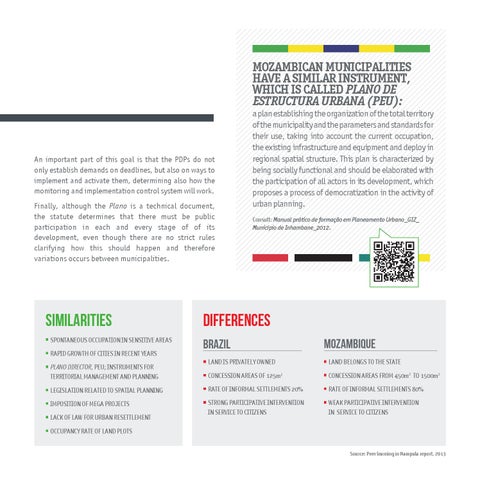
MOZAMBICAN MUNICIPALITIES HAVE A SIMILAR INSTRUMENT, WHICH IS CALLED PLANO DE ESTRUCTURA URBANA (PEU):
An important part of this goal is that the PDPs do not only establish demands on deadlines, but also on ways to implement and activate them, determining also how the monitoring and implementation control system will work. Finally, although the Plano is a technical document, the statute determines that there must be public participation in each and every stage of of its development, even though there are no strict rules clarifying how this should happen and therefore variations occurs between municipalities.
SIMILARITIES SPONTANEOUS OCCUPATION IN SENSITIVE AREAS RAPID GROWTH OF CITIES IN RECENT YEARS
a plan establishing the organization of the total territory of the municipality and the parameters and standards for their use, taking into account the current occupation, the existing infrastructure and equipment and deploy in regional spatial structure. This plan is characterized by being socially functional and should be elaborated with the participation of all actors in its development, which proposes a process of democratization in the activity of urban planning. Consult: Manual prático de formação em Planeamento Urbano_GIZ_ Município de Inhambane_2012.
DIFFERENCES BRAZIL
MOZAMBIQUE
LAND IS PRIVATELY OWNED
LAND BELONGS TO THE STATE
CONCESSION AREAS OF 125m2
CONCESSION AREAS FROM 450m2 TO 1500m2
LEGISLATION RELATED TO SPATIAL PLANNING
RATE OF INFORMAL SETTLEMENTS 20%
RATE OF INFORMAL SETTLEMENTS 80%
IMPOSITION OF MEGA PROJECTS
STRONG PARTICIPATIVE INTERVENTION IN SERVICE TO CITIZENS
WEAK PARTICIPATIVE INTERVENTION IN SERVICE TO CITIZENS
PLANO DIRECTOR, PEU; INSTRUMENTS FOR TERRITORIAL MANAGEMENT AND PLANNING
LACK OF LAW FOR URBAN RESETTLEMENT OCCUPANCY RATE OF LAND PLOTS
Source: Peer learning in Nampula report, 2013
Inclusive Cadastre: territorial, social and fiscal management tool THE NEW CHALLENGES BROUGHT ABOUT BY THE URBANIZATION PHENOMENON MAKE IT ESSENTIAL FOR GOVERNMENTS TO KNOW IN DEPTH THE TERRITORY and its population before making any plans for action. Thus, investment in research is extremely important for obtaining quality information necessary to elaborate public policies and make management decisions. In order to gather this necessary information, it is pivotal to apply the Cadastre not only as a territorial, but also as a social and fiscal tool. Social and fiscal data, for example, related to health and employment, need to be accessed and managed by local governments in order to add value to the analysis and decisions relating to territorial policies. In Brazil, the concept of “cadastre� has evolved on three levels over time: Originally it was focused on taxing revenues and therefore gathered economic and territorial information. Legal data (real estate, insurance, etc.) was then included for spatial planning analysis. Finally, the concept was broadened to include social data (social inclusion and environment) to the former areas, resulting in an integrated planning tool for holistic management (See illustration below and consult:
REQUIRES Investments in qualified staff, technology and urban research. Data collection is sensitive; it is a right that needs to be protected. Developing a political strategy for the gathering and use of data must be clear and accessible to the entire population. It must leave no doubts about the reasons behind the collection of information by the government and the tasks they will enable to be executed. Social policies need to increase and evolve, but it must be evidence based.
PROVIDES Accurate knowledge of the urban areas and social realities, enabling well-structured social and fiscal policies to be elaborated and implemented. Therefore, social data must become instrumental for local government policies and services in order to foresee the provision of services such as, schools in areas where children live, public transport where poor populations accumulate, and protection where vulnerability is high. Social data, for example on health and education, needs to be accessed and managed by local government and brought into value for analysis and decisions regarding the territories. Having this kind of registry enables strategic management behavior in the sense that it makes it easier to articulate between different municipal departments.
SIMILARITIES THE REGISTRY IS A LAND CONTROL AND MANAGEMENT TOOL
DIFFERENCES BRAZIL THE REGISTRY IS UNIFIED AND IT IS UP TO EACH INDIVIDUAL/INSTITUTION TO FIND THE INFORMATION THEY REQUIRE EACH SECTOR MANAGES ITS OWN INFORMATION AND FEEDS INTO THE LAND REGISTRY
MOZAMBIQUE THE REGISTRY IS DISPERSED AND EACH INSTITUTION HAS THEIR OWN LAND REGISTRY· THE REGISTRY IS MANAGED BY THE LOCAL AUTHORITIES THE CONCEPT IS ONLY FOR LAND REGISTRY PURPOSE: TAXES
IN MOZAMBIQUE, MUCH OF SOCIAL DATA IS COLLECTED BY PROVINCIAL GOVERNMENTS (HEALTH DEPARTMENTS, MINISTRIES, ETC). Land cadastre in municipalities in Mozambique is still very much linked to territorial information but remains rather disarticulated from fiscal and social data. Initiatives such as the Millenium Challenge Account (MCA) and current partnerships between municipalities of Brazil: Vitoria, Maringá and Porto Alegre with municipalities of Mozambique: Xai Xai, Lichinga, Manhiça and Inhambane are trying to expand the information scope of the cadastre in Mozambique for a more efficient municipal management approach and a better basis for service policies.
CONCEPT OF LAND AND SOCIAL REGISTRY PURPOSE: IPTU(TAX) AND MANAGEMENT POLICIES Source: Peer learning in Nampula report, 2013
TAX REVENUES Cadastro Técnico Multifinalitário - Rural e Urbano/ Carlos Loch e Diego Alfonso Erba - Cambridge M.A: Lincoln Institute of Land Policy, 2007). The latter type of Cadastre is clearly more efficient than the original as it is useful for urban planning social and fiscal policies, thus facilitating public investments that are focused on promoting poverty reduction and social equality as well as providing basic and social services based on evidence.
SPATIAL PLANNING INTEGRATED PLANNING ECONOMIC Tax equity
PHYSICAL Cadastral Cartography
LEGAL Safe housing market
SOCIAL Social and environmental inclusion
Source: Base study by Articulação Sul, 2013, Adapted from Erba, 2005. Our translation
Participatory Budget THE PARTICIPATORY BUDGET IS A TOOL FOR THE CITY’S DEMOCRATIC MANAGEMENT, directly related to the budget management and represented by a process of debate, public hearing, and consultations on proposals for the application of the municipal budget’s resources. Furthermore, it’s a process that unites representative democracy with direct, voluntary, and universal democracy, in which people can discuss and deliberate about the budget and public policies.
REQUIRES Governmental commitment to involve and make information clear and accessible for the local population. Technical knowledge and capacity in the development of the instrument and process followup. Performance control of the departments in charge of budget implementation.
PROVIDES Participatory democracy, thus directing that budget for an action through consensus with the population. Broad understanding of the needs to prioritize investments vis-à-vis budget limitations.
Its main goal is to be a democratization tool, in other words, ensuring the population’s direct participation on the definition of priorities for public investments. Nevertheless, the Participatory Budget is a management and planning tool and, therefore, has a direct relation to other municipal planning instruments. In view of this, the integration and articulation of the Participatory Budget with the other planning instruments, in particular financial and budgetary, and municipalities’ administration, is an essential aspect as it promotes higher sustainability and effectiveness for the Participatory Budget. For it to be successful, amongst other factors, clear responsibility on the implementation of the decisions is key, such as who does what in what time and with what resources. There are several advantages to the implementation of the Participatory Budget leading to a new governmental approach based on transparency, social control, comanagement, community leadership, empowerment, active citizenship and civic education.
SIMILARITIES THE CITY OF DONDO, with the support of the Austrian Cooperation (Austrian North-South Institute), developed and implemented in 1999 a participatory planning model that has been a national and international reference and already with some replications in some municipalities (Roque, Carlos e Hemma Tengler 2000. Dondo no Dhondo: “Perspectivas de Desenvolvimento Municipal Participativo” Beira: Centro de Serviços de Sofala). The motivation for this was the request by citizens for their interests to be acknowledged. Currently, the Dondo municipality has begun a technical exchange with the city of Guarulhos in Brazil to review and optimize its PB process.
IN BOTH CASES THERE IS PARTICIPATION FROM THE COMMUNITIES IN THE BUDGETARY PROCESS
DIFFERENCES BRAZIL DECENTRALIZED; AUTONOMY OF FINANCES AND ASSETS SOURCE OF BUDGET: FEDERAL GOVERNMENT DIRECTLY TO THE LOCAL AUTHORITIES; OWN REVENUES PERMANENT SOCIAL INCLUSION PACT (SIGNED) FOR ACTIVITIES TO BE CONTINUED. Source: peer learning in Nampula Report, 2013
MOZAMBIQUE CENTRALIZED SOURCE OF BUDGET: CENTRAL GOVERNMENT- PROVINCIAL DIRECTORATE OF PLANNING AND FINANCE-LOCAL AUTHORITY SOCIAL EXCLUSION IN THE PLANNING PROCESS LACK OF CONTINUITY OF ACTIVITIES /UNTARGETED SUPERVISION.
Summary of city partnerships and themes: LICHINGA
MARINGÁ
INCLUSIVE CADASTRE
NAMPULA
GUARULHOS
LAND PLANNING & MANAGEMENT
DONDO
GUARULHOS
PARTICIPATORY BUDGETING
MARINGÁ
INCLUSIVE CADASTRE
PORTO ALEGRE
LAND PLANNING, CADASTRE AND PARTICIPATORY BUDGETING
XAI-XAI
VITÓRIA
LAND PLANNING AND CADASTRE
MATOLA
CANOAS
TBD
MAPUTO
BELO HORIZONTE
INFORMAL SETTLEMENT MANAGEMENT AND REQUALIFICATION
MANHIÇA
INHAMBANE
Partners and contacts United Cities and Local Governments (UCLG) represents and defends the interests of local governments on the world stage, regardless of the size of the communities they serve. Headquartered in Barcelona, the organisation’s stated mission is: To be the united voice and world advocate of democratic local self-government, promoting its values, objectives and interests, through cooperation between local governments, and within the wider international community. More information: www.uclg.org Non-governmental development organization, ASF acts regardless of political, religious and economic criteria. It is made up of people who believe in the defence of human rights to achieve a more just world, through universal access to housing for social transformation. More information: www.asfes.org
Associação Nacional dos Municípios de Moçambique
The FNP is the representative association of the Brazilian municipalities directed exclusively by mayors in effective exercise of warrants. Its mission is to uphold the constitutional principle of municipal autonomy, in order to ensure the full participation of municipalities in the federative pact. More information: www.fnp.org
The UNESCO Chair for Intermediary Cities focuses on the study of Cities of Medium profiles that hold an important role in their territories as linkages and service providers to the rural and urban populations. The Chair has developed the “Plan Base” as a diagnostic tool for analysing and comparing city profiles and strategic projects with the base on territorial data. More information: www.ceut.udl.cat
THE EXCHANGE PROCESS AND METHODOLOGIES The instruments being analysed and contrasted through the project’s implementation process as well as the methodologies that are being implemented to facilitate the exchange between the cities are being developed by the cities with the support of the associations and networks. These will be of great value for similar projects and initiatives to follow.
The National Association of Municipalities of Mozambique, ANAMM provides technical assistance to municipalities and supports their internal organisation and functioning, contracting capacity in service delivery and mobilisation of local resources.
WITH THE FINANCIAL SUPPORT OF:
Contents and editing: Alessa Bennaton, Tuana Neves, Sara Hoeflich · Photos: ASF, Belo Horizonte, Dondo · Design: ggrafic
Recycled paper