How To Make Cities More Resilient A Handbook For Local Government Leaders A contribution to the global campaign 2010-2015 Making Cities Resilient – My City is Getting Ready!
How To Make Cities More Resilient A Handbook For Local Government Leaders A contribution to the Global Campaign 2010-2015 Making Cities Resilient – My City is Getting Ready! Geneva, March 2012
Acknowledgements UNISDR would like to acknowledge and thank everyone who has participated in the development of this Handbook: an extensive number of city representatives, experts and members of the Advisory Panel of the Making Cities Resilient Campaign, not all of whom are mentioned by name. The scope, form and examples contained in the Handbook were collected through interviews with mayors and local government representatives at the Global Platform for Disaster Reduction (Geneva, May 2011); at a validation workshop in the City of Chengdu, China (August 2011); with mayors, parliamentarians and experts at a stock taking workshop on cities’ use of the Local Government Self-Assessment Tool in the City of Incheon (October 2011); and at a workshop in Geneva (October 2011). Subsequent editions of this Handbook will take into account feedback by users. Examples and tools will be updated on the Handbook website: www.unisdr.org/campaign. Project Coordinator and Executive Editor: Helena Molin Valdés, UNISDR Production: Michele Cocchiglia, UNISDR Co-authors: Helena Molin Valdés, Aloysius Rego (Consultant), John Scott (Consultant), Jaime Valdés Aguayo (Collaborator), Patricia Bittner (Editor) Design: Ramon Valle Contributors and Reviewers (who provided written input): Cities: Violeta Seva (Makati City, Phillippines), Yelgi Verley (Mayor of Siquirres, Costa Rica), Paola Trevisan (CORILA, Venice, Italy), Nada Yamout (City Council Beirut, Lebanon). Partners: Fouad Bendimerad, Jose Mari O. Daclan, and Jerome B. Zayas (EMI); Marcus Lee, Dan Hoornweg, Daniel Kull and Zuzana Svetlosakova (World Bank and GFDRR); Alice Balbo and Steve Gawler (ICLEI); Mohamed Boussraoui (UCLG); Bernadia Irawati Tjandradewi (CITYNET); Dan Lewis and Ana Moreno (UNHABITAT); Rajib Shaw (Kyoto University - Asia Urban Risk Reduction Task Force); Janet Edwards (Swedish National Platform); Piyush Ranjan Rout (LG-NET, India); Dilanthi Amaratunga (Salford University, UK), Marcus Moench and Stephen Tyler (ISET); Hachim Badji (CADRI-UNDP); Shailesh Kataria and Boris Zerjav (RICS Disaster Management Commission). Individual Capacity: Murat Balamir (Turkey), Garry de la Pommerai (UK). UNISDR Private Sector Group: Mark Armstrong (Field Secure); Nicerine Bres, Caroline Woolley (Marsh); Jesus “Gary” S.Domingo (Permanent Mission of the Philippines to the United Nations); Peter Gruetter (Cisco Systems, Inc.); Aris Papadopoulos (Titan America); Dale Sands (AECOM); Régis Thepot (EPTB Seine Grands Lacs); Peter Williams (IBM); Sandra Wu (Kokusai Kogyo Holdings). UNISDR: Sandra Amlang, Sanjaya Bhatia (International Recovery Platform), Michele Cocchiglia, Bina Desai, Glenn Dolcemascolo, Craig Duncan, Justin Ginnetti, Vincent Fung, Sarah Landelle, Yuki Matsuoka, Denis McClean, Hang Thi Thanh Pham, Dizery Salim, Julio Serje, Ana Maria Castillo. Interns: UNISDR is grateful to the interns that have helped on the Campaign and with research in 2011: Javier Quero, Jeffrey Makala Ngaka, Shashank Mishra, Rajinder Sagoo, Francesca Salvi, Pierre Branciard. Funding has been provided by the World Bank Global Facility for Disaster Risk Reduction (GFDRR-Track I), the City of Incheon and the Republic of Korea, and the other donors to the UNISDR, including: Sweden; the European Commission; Australia; Norway; Netherlands; Japan; Switzerland; Denmark; Germany; Finland; Spain; the United Kingdom; Luxembourg; Brazil; China; the United States; Argentina; Mexico; Hungary; Cyprus; and the Philippines (ranked in order of the size of their contribution to the UNISDR Trust Fund). See more about the key partners in the Making Cities Resilient campaign on page 71: UNISDR, GFDRR, ICLEI, UCLG, CITYNET, EMI, UNHABITAT.
Table of Contents Foreword 5 Introduction and Purpose of this Handbook 6 Why are Cities at Risk? 8 What is a Disaster Resilient City? 10 A Global Agenda and Campaign to Build Resilient Nations and Communities 13
Chapter 1. Why Invest in Disaster Risk Reduction?
14
Benefits of Investing in Disaster Risk Reduction and Resilience Investing in Resilience is an Opportunity Policy Directions An Opportunity to Strengthen Participation
15 18 19 20
• • • •
Chapter 2. What are the Ten Essentials for Making Cities Disaster Resilient? • • • • • • • • • •
Essential 1: Institutional and Administrative Framework Essential 2: Financing and Resources Essential 3: Multi-hazard Risk Assessment- Know your Risk Essential 4: Infrastructure Protection, Upgrading and Resilience Essential 5: Protect Vital Facilities: Education and Health Essential 6: Building Regulations and Land Use Planning Essential 7: Training, Education and Public Awareness Essential 8: Environmental Protection and Strengthening of Ecosystems Essential 9: Effective Preparedness, Early Warning and Response Essential 10: Recovery and Rebuilding Communities
Chapter 3. How to Implement the Ten Essentials for Making Cities Resilient • • • • • • •
Milestones and Strategic Planning Phase One: Organizing and Preparing to Incorporate the Ten Essentials Phase Two: Diagnosis and Assessment of the City’s Risk Phase Three: Developing a Safe and Resilient City Action Plan Phase Four: Implementing the Plan Phase Five: Monitoring and Follow Up How to Finance Disaster Risk Reduction
24
26 30 33 36 39 41 45 48 51 54
58
59 61 62 63 63 64 65
Partners in the Global Campaign: Making Cities Resilient - My City is Getting Ready 70 Acronyms 74
Annexes Annex 1 Local Government Self-Assessment Tool for Disaster Resilience Annex 2 Disaster Risk Reduction Terminology Annex 3 Trends of Exposure to Disaster Risk and References Annex 4 Tools, Resources and Websites
78 85 86 89
Photo: UCLG
“With its city built on fault lines, the population of Istanbul has suffered greatly from a lack of proper planning, leaving it at risk. Two questions to consider: How to rehabilitate existing settlement areas and how to plan new settlements in light of the dangers. All countries must collaborate, with governments devising the approach and displaying the will to get the job done, aided by non-governmental organisations and the public, who should be aware of the dangers of specific buildings’ potential for collapse. The private sector must also contribute. A clear road map must enable cities to take concrete steps and cooperate with each other because they all face similar dangers. There is no time to lose because the loss of more lives and property is imminent. According to Istanbul’s experience, urban settlements must be transformed and community members must be included in the project. It’s not just top-down; it’s also bottom-up.” Mr. Kadir Tobpas, Mayor of Istanbul, President of the United Cities and Local Governments (UCLG)
From his intervention at the United Nations General Assembly Thematic Debate on Disaster Risk Reduction, February 2011
Photo page 6 from left to right: Margareta Wahlström, SRSG UNISDR, and David Cadman, President of ICLEI with Marcelo Ebrard, Mayor of Mexico City and Chair of World Mayors Council on Climate Change; Jürgen Nimptsch, Mayor of Bonn and Vice Chair of World Mayors Council on Climate Change, Germany; Cheikh Mamadou Abiboulaye Dieye, Mayor of Saint Louis, Senegal; Enrique Gomez, Mayor of Larreynaga-Malpaisillo, Nicaragua; Joey Sarte Salceda, Provincial Governor of Albay, the Philippines; Aake Pettersson Frykberg, Vice Mayor of Karlstad, Sweden; Obed Mlaba, former mayor of the eThekwini Metropolitan Municipality, which includes Durban, South Africa (July 1996 - May 2011). The first Mayors signing up to the Making Cities Resilient Campaign at the Resilient Cities congress in Bonn, Germany, May 2010.
Foreword With over half the world’s population now living in urban areas, making cities safer is a long-term challenge that can be achieved. Cities are engines of national growth and dynamic in their governance systems and capacities. Throughout history, disaster events have disrupted urban life. An extreme and changing climate, earthquakes, and emergencies triggered by man-made hazards are increasingly putting pressure on people and threatening the prosperity of cities. This Handbook for Local Government Leaders provides mayors, governors, councillors and others with a generic framework for risk reduction and points to good practices and tools that are already being applied in different cities for that purpose. It responds to the following key questions: WHY building disaster resilience is beneficial; WHAT kind of strategies and actions are required; and HOW to go about the task. Because cities, towns and municipalities differ in size, social, economic and cultural profiles and exposure to risk, each one will approach the tasks differently. The message is: resilience and disaster risk reduction must be part of urban design and strategies to achieve sustainable development. They require strong alliances and broad participation. Applying the guiding principles of the “Making Cities Resilient” Campaign and the information in this Handbook will help cities and local governments to share learning, access information, develop indicators and performance measures and track progress. We acknowledge the wisdom of all who have participated – and we encourage and welcome many more to join us! An acknowledgement of all who have participated in the development of this Handbook, by providing content, experiences and funding, can be found prior to the Annexes. UNISDR seeks your feedback on the Handbook’s content, examples and format to improve future editions.
Margareta Wahlstrom Special Representative of the Secretary-General for Disaster Risk Reduction, United Nations UNISDR
David Cadman Vice Mayor of Vancouver and President of ICLEI; host of the launch of the Making Cities Resilient Campaign in May 2010
Introduction Photo: UNISDR
Purpose of this Handbook
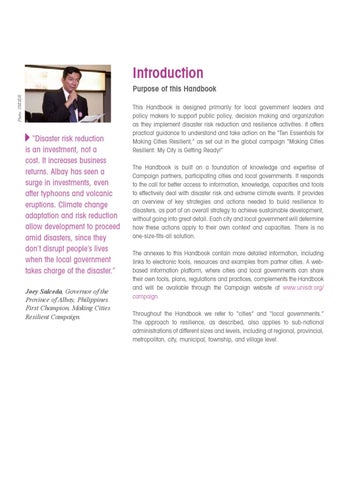
“Disaster risk reduction is an investment, not a cost. It increases business returns. Albay has seen a surge in investments, even after typhoons and volcanic eruptions. Climate change adaptation and risk reduction allow development to proceed amid disasters, since they don’t disrupt people’s lives when the local government takes charge of the disaster.” Joey Salceda, Governor of the Province of Albay, Philippines. First Champion, Making Cities Resilient Campaign.
This Handbook is designed primarily for local government leaders and policy makers to support public policy, decision making and organization as they implement disaster risk reduction and resilience activities. It offers practical guidance to understand and take action on the “Ten Essentials for Making Cities Resilient,” as set out in the global campaign “Making Cities Resilient: My City is Getting Ready!” The Handbook is built on a foundation of knowledge and expertise of Campaign partners, participating cities and local governments. It responds to the call for better access to information, knowledge, capacities and tools to effectively deal with disaster risk and extreme climate events. It provides an overview of key strategies and actions needed to build resilience to disasters, as part of an overall strategy to achieve sustainable development, without going into great detail. Each city and local government will determine how these actions apply to their own context and capacities. There is no one-size-fits-all solution. The annexes to this Handbook contain more detailed information, including links to electronic tools, resources and examples from partner cities. A webbased information platform, where cities and local governments can share their own tools, plans, regulations and practices, complements the Handbook and will be available through the Campaign website at www.unisdr.org/ campaign. Throughout the Handbook we refer to “cities” and “local governments.” The approach to resilience, as described, also applies to sub-national administrations of different sizes and levels, including at regional, provincial, metropolitan, city, municipal, township, and village level.
7 Photo: UNISDR
The City of Kobe, Japan, with 1.5 million inhabitants, suffered great losses during the Great Hanshin-Awaji Earthquake in January 1985 (7.2 Richter scale), disrupting the activities of one of the busiest ports in the region. The recovery focused on creating a safer city, where complex infrastructure and service systems are balanced with human interaction, education and community cooperation.
Context Mayors, local government officials and decision makers frequently must deal with the impact of small- and mediumscale disasters—and less frequently with large-scale events—that arise from natural or man-made hazards. Climate change and extreme weather events are likely to increase the city’s exposure to hazards and risk. Less obvious is the fact that regular development practices may also generate complex environmental change and contribute to increased risk, if they are not taken into account and acted upon. In disasters, local governments are the first line of response, sometimes with wide-ranging responsibilities but insufficient capacities to deal with them. They are equally on the front line when it comes to anticipating, managing and reducing disaster risk, setting up or acting on early warning systems and establishing specific disaster/crisis management structures. In many cases, a review of mandates, responsibilities and resource allocations is needed to increase the capacity of local governments to respond to these challenges. To understand that disasters are “not natural”, it is important to consider the elements of risk. Risk is a function of the hazard (a cyclone, an earthquake, a flood, or a fire, for example), the exposure of people and assets to the hazard, and the conditions of vulnerability of the exposed population or assets. These factors are not static and can be improved, depending on the institutional and individual capacity to cope and/or act to reduce risk. Societal and environmental development patterns can increase exposure and vulnerability and therefore increase risk.
Hazard x Vulnerability x Exposure Resilience or coping capacities
= Disaster Risk
8
Making Cities Resilient – My City is Getting Ready!
Why are Cities at Risk? Drivers of Risk in the City Environment Cities and urban areas represent dense and complex systems of interconnected services. As such, they face a growing number of issues that drive disaster risk. Strategies and policies can be developed to address each of these issues, as part of an overall vision to make cities of all sizes and profiles more resilient and livable. Among the most significant risk drivers are: • Growing urban populations and increased density, which put pressure on land and services, increasing settlements in coastal lowlands, along unstable slopes and in hazard-prone areas. •
Concentration of resources and capacities at national level, with a lack of fiscal and human resources and capacities in local government, including unclear mandates for disaster risk reduction and response.
•
Weak local governance and insufficient participation by local stakeholders in planning and urban management.
•
Inadequate water resource management, drainage systems and solid waste management, causing health emergencies, floods and landslides.
•
The decline of ecosystems, due to human activities such as road construction, pollution, wetland reclamation and unsustainable resource extraction, that threatens the ability to provide essential services such as flood regulation and protection.
•
Decaying infrastructure and unsafe building stocks, which may lead to collapsed structures.
•
Uncoordinated emergency services, which decreases the capacity for swift response and preparedness.
•
Adverse effects of climate change that will likely increase or decrease extreme temperatures and precipitation, depending on localized conditions, with an impact on the frequency, intensity and location of floods and other climate-related disasters.
Globally, the recorded number of hazard events that adversely affect human populations is on the rise (see trends in Figure 1). Each local and urban context is affected differently, depending on the prevailing hazards in each location and the exposure and vulnerabilities as stated above (see more in Chapter 2, Essential 3).
9
Photo: UNISDR
Figure 1 shows recorded disaster events worldwide and indicates an increasing trend as well as number of actual occurrences. The figure indicates that the number of recorded seismic events (deadliest in terms of loss of life) is relatively constant, but points to an increase in the reported number of storms and floods. In many parts of the world, the risks associated with weather-related hazards are on the rise (the risk of economic losses is also on the rise, although fewer deaths have been recorded). The number and intensity of floods, droughts, landslides, and heat waves can have a major impact on urban systems and resilience strategies. Depending on the location, climate change is likely to increase the frequency of precipitation in many regions. This will imply changes in flood patterns and contribute to upward trends in coastal high water levels.
Jakarta: One main reason leading to urban floods during heavy rains is insufficient or clogged drains.
Figure 1: Number of recorded disasters. Source: EMDAT-CRED, Brussels
These extremes need to be factored into future land-use plans and other measures, according to the IPCC Special Report on Managing the Risks of Extreme Events and Disasters to Advance Climate Change Adaptation.The increase in impact will remain largely dependent on human activity in terms of exposure and vulnerability (see Annex 3).
10
Making Cities Resilient – My City is Getting Ready!
What is a Disaster Resilient City? Photo: UNISDR
A disaster resilient city: • Is one where disasters are minimised because the population lives in homes and neighbourhoods with organized services and infrastructure that adhere to sensible building codes; without informal settlements built on flood plains or steep slopes because no other land is available. • Has an inclusive, competent and accountable local government that is concerned about sustainable urbanization and that commits the necessary resources to develop capacities to manage and organize itself before, during and after a natural hazard event. • Is one where the local authorities and the population understand their risks and develop a shared, local information base on disaster losses, hazards and risks, including who is exposed and who is vulnerable. • Is one where people are empowered to participate, decide and plan their city together with local authorities and value local and indigenous knowledge, capacities and resources. • Has taken steps to anticipate and mitigate the impact of disasters, incorporating monitoring and early warning technologies to protect infrastruture, community assets and individuals, including their homes and possessions, cultural heritage, environmental and economic capital, and is able to minimize physical and social losses arising from extreme weather events, earthquakes or other natural or human-induced hazards. San Fransico, Cebu, the Philippines, bringing the Hyogo Framework to local level planning.
• Is able to respond, implement immediate recovery strategies and quickly restore basic services to resume social, institutional and economic activity after such an event. • Understands that most of the above is also central to building resilience to adverse environmental changes, including climate change, in addition to reducing greenhouse gas emissions.
11
A Global Agenda and Campaign to Build Resilient Nations and Communities The Hyogo Framework for Action The Hyogo Framework for Action 2005-2015: Building the resilience of nations and communities to disasters (HFA), was endorsed by the member states of the United Nations in 2005, and has since guided national policy and international organisations in their efforts to substantially reduce losses stemming from natural hazards. This Framework is comprehensive and addresses the roles of states, regional and international organisations, calling on civil society, academia, volunteer organisations and the private sector to join efforts. It promotes the decentralization of authority and resources to promote local-level disaster risk reduction. The expected outcome of the Hyogo Framework is to substantively reduce disaster losses in terms of lives and the social, economic and environmental assets of communities and countries. The five HFA priorities for action are:
1. Build institutional capacity: Ensure that disaster risk reduction is a national and local priority with a strong institutional basis for implementation. 2. Know your risks: Identify, assess and monitor disaster risks and enhance early warning. 3. Build understanding and awareness: Use knowledge, innovation and education to build a culture of safety and resilience at all levels. 4. Reduce risk: Reduce the underlying risk factors through land-use planning, environmental, social and economic measures. 5. Be prepared and ready to act: Strengthen disaster preparedness for effective response at all levels.
Read more: www.unisdr.org/hfa
12
Making Cities Resilient – My City is Getting Ready!
NOTES
1 13
14
Making Cities Resilient – My City is Getting Ready!
CHAPTER 1
Photo: UNISDR
Why Invest in Disaster Risk Reduction?
The reconstruction after the 2008 Sichuan Earthquake built on “twinning” cooperation from other provinces and cities in China that provided economic, technical and psycho-social support to their counterparts. Urban and semi-rural settlements, infrastructure, schools and production were rebuilt and inaugurated within two years time, as in this semi urban area in Dujiangyan, Chengdu.
CHAPTER 1 Why Invest in Disaster Risk Reduction?
15
Benefits of Investing in Disaster Risk Reduction and Resilience There are many reasons for a mayor and the city council to prioritize resilience as part of their political and sustainable development agenda. For local government leaders, reducing disaster risk can be a legacy opportunity—paying attention to protection will improve environmental, social and economic conditions, including combating the future variables of climate change, and leave the community more prosperous and secure than before.
“There is no such thing as “natural disasters.” Natural hazards—floods, earthquakes, landslides and storms—become disasters as a result of human and societal vulnerability and exposure, which can be addressed by decisive policies, actions and active participation of local stakeholders. Disaster risk reduction is a no-regret investment that protects lives, property, livelihoods, schools, businesses and employment.” From the Chengdu Declaration of Action, August 2011
The gains include: A Legacy of Leadership • Strengthened trust in and legitimacy of local political structures and authority. • Opportunities for decentralized competencies and optimization of resources. • Conformity to international standards and practices.
Social and Human Gains • Lives and property saved in disaster or emergency situations, with a dramatic reduction in fatalities and serious injuries. • Active citizen participation and a platform for local development. • Protected community assets and cultural heritage, with less diversion of city resources to disaster response and recovery.
Economic Growth and Job Creation • Assurance for investors in anticipation of fewer disaster losses, leading to increased private investment in homes, buildings and other properties that comply with safety standards. • Increased capital investment in infrastructure, including retrofitting, renovation and renewal. • Increased tax base, business opportunities, economic growth and employment as safer, better-governed cities attract more investment.
16
Making Cities Resilient – My City is Getting Ready!
Truly participatory approaches provide an opportunity for scaling up innovative local initiatives to build resilience. One important factor is the relationship between the city government and those within its jurisdiction who are most at risk, with clear and direct response to community priorities.
More Liveable Communities • Balanced ecosystems that foster services such as fresh water and recreation and that reduce pollution. • Improved education in safer schools and improved health and well-being.
Inter-connected Cities with National and International Expertise and Resources • Access to an expanding network of cities and partners committed to disaster resilience through the Campaign,to share good practices, tools and expertise. • An expanded knowledge base and better-informed citizens.
Examples Venice: Protecting a City’s Cultural Heritage The Mayor of Venice, Giorgio Orsoni, takes his role seriously as custodian of one of the world’s greatest cultural attractions, and consequently the many jobs and businesses it generates. About 20 million tourists pass through the streets of Venice each year and travel its waterways. The city sits at sea level and any change in the mean sea level leaves the city vulnerable to floods, endangering the artistic and cultural heritage of this 1,000-year old UNESCO world heritage site. While this may appear to be a problem of Venice alone, in many ways it is a problem related to climate change and the increase in sea level rise overall. “We were forced in some sense to develop particular care for cultural heritage protection. For this, we were recognized by UNISDR as a role model for other cities,” said Pierpaolo Campostrini, Managing Director of the CORILA research centre in Venice, and the city’s focal point for UNISDR’s “Making Cities Resilient” Campaign. CORILA coordinates scientific research activities concerning the lagoon of Venice, which has long been a topic of debate between the scientific and public policy communities. Mr. Campostrini says the Campaign has expanded the dialogue between these two communities, providing a framework for transferring research results to other cities. A mobile tidal barrier system will be operational in 2014, the result of a number of organisations working together to achieve a sustainable and “flood-proof” Venice. Read more at http://www.corila.it/ENCorila.asp.
CHAPTER 1 Why Invest in Disaster Risk Reduction?
17
San Francisco, California: The Resilience Wheel On the surface, the goal of “resilience” is universally embraced as the ideal at the individual, organisational and community level. Yet, given the diverse network of stakeholders in an organism as complex as a city, it can be difficult to frame the opportunity of resilience in a way that allows all actors to align it to their current mission and goals. San Francisco (California) uses the “Resilience Wheel,” with its eight functional areas, to show partners, both inside and out of government, how their organisation’s mission connects with those of other stakeholders who may work in sectors perceived to be quite different from theirs (i.e. agencies who work to advance financial independence in poor communities and emergency managers doing outreach for disaster preparedness). See more at http://resilientSF.org .
Figure 2:
The Resilience Wheel
18
Making Cities Resilient – My City is Getting Ready!
Investing in Resilience is an Opportunity The risk of not paying attention to disaster risk reduction can lead to serious deterioration of the economy and ecosystems and a loss of trust by the population and investors. Frequent small and medium-impact disasters and single intense events can severely disrupt community lifelines—the systems that provide food distribution, water supply, health care, transportation, waste disposal, and communications—locally and with the rest of the world. Business and private investors may shy away from cities with a perceived indifference to acting to reduce disaster risk. To overcome the perception that the disaster risk management budget competes for scarce resources with other priorities, risk reduction must be an integral part of local development. Holistic disaster risk management is more attractive when it simultaneously addresses the needs of many stakeholders and competing priorities. In general, the incentives are stronger when disaster risk management visibly contributes to improved economic and social well-being. For example: • Well-designed and drained roads that do not trigger landslides or floods will permit the smooth transportation of goods and people at all times. •
Safe schools and hospitals will ensure the security of children, patients, educators and health workers.
Figure 3: Disaster risk reduction and resilience is part and parcel of sustainable development in the environmental, economic, social and political spheres. This figure shows some of the relationships laid out in this Handbook.
Foster interdepartmental coordination and leadership for disaster risk reduction Build institutional capacity and allocate resources Regulate urban and local development with risk reduction principles
Protect, restore and enhance ecosystems, watersheds, unstable slopes, and coastal areas Engage in ecosystem-based risk management Commit to reducing contamination, improving waste management and reducing GHG emissions
Guarantee access to basic services for all and provide post-disaster safety nets Allocate safe land for all strategic activities and housing Encourage multi-stakeholder participation in all stages and strengthen social alliances and networking
Diversify local economic activities and implement poverty reduction measures Plan for business continuity to avoid disruption in case of disaster Put in place incentives and penalties to increase resilience and improve compliance with safety standards
CHAPTER 1 Why Invest in Disaster Risk Reduction?
19
Policy Directions
Building on the benefits of investing in disaster risk reduction, mayors and city councils may consider an incremental approach to prioritizing disaster risk reduction to support other prevention and safety agendas (such as road safety, citizen safety, water resource management, or climate change adaptation). Prevention and risk reduction are seen as long-term and invisible investments in time-bound political terms, although the choices are not between risk reduction and response but rather a combination of the two. The following may help to develop policies that promote risk redution and resilience: • Adopt a resolution that makes your city a “Resilient City,” committed to reducing disaster risk, including the risk of climate change. •
Conduct risk assessments and integrate the outcomes in disaster risk reduction plans and in urban development design and plans.
•
Raise awareness and use knowledge, both scientific and local, in disaster risk reduction practices; ensure that local capacities are enhanced and valued.
•
Actively participate in national, regional and international networks and share experiences for making cities more resilient and join the “Making Cities Resilient - My City is Getting Ready!” campaign.
Example Quito: An Integrated Policy Approach to Safety The population of metropolitan Quito, Ecuador is exposed to a variety of geological and hydrometeorological hazards, yet a general lack of awareness of the potential danger has allowed the city to grow in an uncoordinated and unsafe manner. To address this reality, Quito put policies in place that take an integrated approach to security, addressing situational risks, road safety and risks to natural and technological hazards. With regard to risk reduction, these policies include: •
Making disaster risk reduction a crosscutting issue throughout the city’s planning and development processes.
•
Promoting a culture of disaster prevention and preparedness for natural and manmade disasters to protect the population.
•
Establishing a municipal risk management system with the appropriate human, technical and financial resources and capacities.
By carrying out policies in an integrated manner, working through inter-institutional and cross-departmental commissions, all aspects related to the safety of the population of Quito will be improved. More information at: http://www.quito.gov.ec (Spanish only).
20
Making Cities Resilient – My City is Getting Ready!
An Opportunity to Strengthen Participation Community participation brings better local information to city planners, ensuring clear and direct commitment to community priorities. To be successful, local government leaders should deliver something the community needs first, to demonstrate good faith, and then follow up with practical, low-cost but important commitments to support their efforts.
Disaster risk reduction is everyone’s job. As a team effort, it provides a unique opportunity to strengthen participation. In the city, the local government must lead the effort, as their managerial role offers the best insight into what is needed at the local level. A stakeholder assessment will help public services identify their roles and responsibilities (within their development activities and control mechanisms), identify factors that contribute to risk and adopt appropriate measures to address these. Citizen groups in risk-prone areas, including informal settlements, local business and other groups should participate in risk assessments and the findings must be shared with them. Cities should work with national and local research institutes and hazard monitoring centres, encouraging them to contribute to documenting and assessing past and potential hazards and risk scenarios. These institutions should be part of the coordination mechanism created to deal with disaster risk reduction. Local governments must also coordinate with national authorities, and vice versa, to apply and adapt national policies and legislation to local conditions. To enable them to take a leading position, both responsibility for activities and allocation and use of resources must be decentralized. Where this is not the case, an incremental approach is advisable. The city administration must be the first line of response and responsibility.
CHAPTER 1
21
Photo: J. Valdés
Why Invest in Disaster Risk Reduction?
Three Municiaplities working together with an NGO in Nicaragua: Telica, Quezalguaque and LarreynagaMalpaisillo
Disaster Risk Reduction is a Team Effort • Local Government: Take the lead, convene other actors, regulate, monitor. • Sectors (education, health, transport, environment, etc.): Integrate risk reduction as part of plans and responsibilities, contribute information, and implement activities. • Academia, research centres: Provide research and data analysis; participate. • Citizens, community groups, including indigenous communities and other vulnerable populations: participate, be actively informed, and take individual responsibility. • Private sector/business community: Comply with safety regulations; contribute to the community with know-how and business continuity. • Professional groups, including chartered surveyors, engineers, architects, and planners: Provide technical expertise on the built environment; social workers, teachers and others: organize, raise awareness, collect data; inform the media, etc. • Civil society, non-governmental organisations (community-based, faith-based, voluntary, etc.): Participate, organize communities, coordinate, help oversee, monitor. • National government authorities and parliamentarians: support decentralized capacities with resources, policy and enabling legislation. • International organisations: provide technical cooperation, capacity development, resources, meeting space.
22
Making Cities Resilient – My City is Getting Ready!
NOTES
2 23
24
Making Cities Resilient – My City is Getting Ready!
CHAPTER 2
What are the Ten Essentials for Making Cities Disaster Resilient ?
Port-au-Prince, Haiti, 2010: It is not the earthquakes that kill people, but the buildings collapsing on them.
CHAPTER 2 What are the Ten Essentials for Making Cities Disaster Resilient ?
25
This chapter offers a brief overview of the “Ten Essentials,” including the critical and interdependent steps local governments may take to make their city more disaster resilient. It provides the rationale for each Essential, pointing out strategic areas of intervention and identifying key actions. The actions identified under each Essential should be part of the overall disaster risk reduction planning process and influence urban development planning and design.
The Ten Essentials for Making Cities Resilient Checklist 1. Put in place organisation and coordination to understand and reduce disaster risk, based on participation of citizen groups and civil society. Build local alliances. Ensure that all departments understand their role in disaster risk reduction and preparedness. 2. Assign a budget for disaster risk reduction and provide incentives for homeowners, low income families, communities, businesses and the public sector to invest in reducing the risks they face. 3. Maintain up to date data on hazards and vulnerabilities. Prepare risk assessments and use these as the basis for urban development plans and decisions, ensure that this information and the plans for your city’s resilience are readily available to the public and fully discussed with them. 4. Invest in and maintain critical infrastructure that reduces risk, such as flood drainage, adjusted where needed to cope with climate change. 5. Assess the safety of all schools and health facilities and upgrade these as necessary. 6. Apply and enforce realistic, risk compliant building regulations and land use planning principles. Identify safe land for low income citizens and upgrade informal settlements, wherever feasible. 7. Ensure that education programmes and training on disaster risk reduction are in place in schools and local communities. 8. Protect ecosystems and natural buffers to mitigate floods, storm surges and other hazards to which your city may be vulnerable. Adapt to climate change by building on good risk reduction practices. 9. Install early warning systems and emergency management capacities in your city and hold regular public preparedness drills. 10. After any disaster, ensure that the needs of the affected population are placed at the centre of reconstruction, with support for them and their community organisations to design and help implement responses, including rebuilding homes and livelihoods.
Refer to Annex 1 for a list of key questions to use in benchmarking and monitoring progress in each of the Ten Essentials.
26
Making Cities Resilient – My City is Getting Ready!
Essential 1: Institutional and Administrative Framework “Put in place an organisation and coordination to understand and reduce disaster risk, based on participation of citizen groups and civil society. Build local alliances. Ensure that all departments understand their role in disaster risk reduction and preparedness.”
Why?
Queson City organization for Disaster Risk Management
The tasks of the coordination entity/office may include preparation of awareness campaigns, coordination of risk assessments and disaster risk reduction plans, ensuring that resilience planning is part of the city´s development practices, its strategies and projects for resource mobilization, and tracking of progress.
To be effective and contribute to a city’s development and safety, managing disaster risk and understanding the potential threats of complex events requires a holistic approach and must include the involvement of local government decision makers, city officials and departments, academia, business and citizens groups. Experience gained through the Hyogo Framework for Action has shown that appropriate policies and an institutional framework are preconditions for decision making and sound disaster risk reduction actions. Accompanied by decentralized power and resource allocations and the participation of all major groups and actors in planning, implementation and monitoring mechanisms, this Framework contributes to the city’s development objectives and sustainability.
What? Establish or strengthen the city-level institutional and coordination capacity • Assign a lead entity or establish a designated office within the city administration to lead a coordination mechanism among departments and other actors. • Define and review, on a regular basis, the roles and responsibilities of departments and services involved; clarify the limitation of authority of each. • Involve different actors, volunteers, NGOs, academia, the business community and encourage the involvement of communitybased organisations as early as possible in the process.
CHAPTER 2 Essential 1: Institutional and Administrative Framework
Risk reduction planning should make the operations of all actors run more smoothly in the emergency and recovery phases.
27
Establish a legislative framework for resilience and disaster risk reduction • Identify the obligations, constraints and opportunities that current urban planning and regulations, national laws and regulatory devices impose on the city administration; improve local regulations with resilience criteria. • Generate municipal ordinances that support disaster risk reduction in all sectors (public and private). • Update environmental, building and planning standards and bylaws to support risk reduction and anchor them in recent risk assessments. • Ensure a degree of flexibility in regulations for low-income areas, without compromising safety.
Coordinate all emergency services within the city • Generate a collaborative strategy to integrate and coordinate all existing units responsible for emergency response, relief and recovery, even if under the jurisdiction of multiple authorities. • Use formal protocols to maintain recognition of individual organisations and services (fire departments, ambulance services, health services, police, NGOs and others), increase inter-operability among these units (language, tools, communication) and generate scenarios for coordinated drills.
Create alliances and networks beyond the city • Seek and promote alliances, incorporating a cluster approach among neighbouring municipalities with similar or interdependent risks, to strengthen partnerships, improve decentralized action, plan for common territorial risks and multiply resources. • Develop partnerships with local, national or international universities, NGOs or scientific-technical bodies that can provide data, expertise and research. • Consider an exchange programme with cities in other countries that face similar risk patterns or challenges. • Participate in regional and international fora and in the global campaign “Making Cities Resilient,” to promote initiatives, exchange experiences and increase local-national-international cooperation.
28
Making Cities Resilient – My City is Getting Ready!
Examples Albay Province: Local Government Makes Risk Reduction a Formal and Permanent Priority The Albay provincial government in the Philippines established a permanent disaster risk management office in 1995 to deal with the high risk of typhoons, floods, landslides and earthquakes. Disaster risk reduction was institutionalized, funded properly, and genuinely mainstreamed into local government planning and programmes, making it clear that disaster reduction was a formal and permanent priority within regular planning, governance and local government programmes. As a result, disaster prevention, preparedness and response have been well coordinated and, with the exception of 2006 and 2011, no casualties have resulted in 15 of the last 17 years. Read more at http://www.unisdr.org/we/inform/publications/13627 (page 48) and http://tinyurl.com/ck6btnb.
Beirut: Concerted Action on the Ten Essentials Councilor Nada Yamout, from Beirut, Lebanon’s city council stated at the Third Global Platform for Disaster Risk Reduction (May, 2011): “We are a newly elected council; we are concerned about disaster risk reduction and so we registered as a Campaign City in October 2010. As a first step, the Council looked at allocating a budget to begin risk reduction activities: risk assessment, building a risk database, developing a DRR master plan, etc. We analyzed our needs and took stock of what was available and performed a gap analysis. We have several heritage sites within Beirut and protecting and preserving their character is important. We will move ahead using four pillars: technical support; financial support; involvement of the private sector and civil society; and national government support. If we do not allocate the right resources, we run the risk of not prioritizing projects. Building resilience is not the responsibility of the mayor alone. Action must be taken at the following levels: national and provincial governments, city government politicians—whether elected or appointed; and the municipal administration.” Lebanon’s National Platform for Disaster Risk Reduction is helping small and medium-sized local governments to sign on to the Campaign for Resilient Cities, undertaking baseline studies and stepping up disaster risk reduction actions (November, 2011).
North Vancouver: Innovation and Community Engaagement North Vancouver, Canada formed a natural hazards task force comprised of eight volunteer district residents. Their mandate was to recommend to the Council the community’s tolerable level of risk from natural hazards. After listening to subject matter experts and consulting the public for their input, the resulting recommendations make up the District’s current policy for risk tolerance. Hazards and risks are carefully considered when granting building and development permits. Risk is compared with the risk tolerance criteria and further reduced to as low a level as is reasonable. The District works with residents, private corporations and neighbouring government land owners to collectively reduce risk from landslides and forest fires by taking action to improve drainage on slopes and create defensible spaces along the urban-wild land interface areas.
CHAPTER 2 Essential 1: Institutional and Administrative Framework
29
“North Vancouver is setting a high standard for communities across Canada, and has become a model at engaging municipal and federal government and the private sector in the promotion of a resilient approach to disaster risk reduction,” said Vic Toews, Canada’s Minister of Public Safety, when the District of North Vancouver received the United Nations-Sasakawa Award for Disaster Risk Reduction, in 2011 (the award was shared with San Francisco, Cebu, Philippines and Santa Fe, Argentina). North Vancouver has incorporated risk reduction criteria into its official community plan, strategic planning, and development permit processes, and has instituted early warning systems for landslides and debris flows. The jury for the UN-Sasakawa Award says the District “demonstrates capacity for challenging, absorbing and producing technology, traditional knowledge, new knowledge and products, and innovative practices.” “This international recognition is evidence of the work by the professional staff who serve the citizens of North Vancouver District, the leaders and many volunteers of the North Shore Emergency Management Office, and all agencies dedicated to the public safety needs of their community. It is something our entire community can take pride in,” said North Vancouver District Mayor Richard Walton. “The work is ongoing as we continue to seek best practices and learn from the experience of communities around the world.” Read more at: www.nsemo.org/, www.getprepared.gc.ca/, http://tinyurl.com/d4m85ry.
30
Making Cities Resilient – My City is Getting Ready!
Essential 2: Financing and Resources “Assign a budget for disaster risk reduction and provide incentives for homeowners, low-income families, communities, businesses and the public sector to invest in reducing the risks they face.”
Why? An action plan remains just that—a plan—unless it has dedicated resources to ensure that actions related to the Ten Essentials can be carried out. Local governments require capacities and mechanisms to access and manage resources, including for disaster risk reduction, as part of the city’s vision, mission and strategic plans. Resources can come from city revenues, national disbursements and allocations to sectoral departments, public-private partnerships and technical cooperation, and from civil society and external organisations. Chapter 3 has additional information on how to finance disaster risk reduction.
What? Invest in risk reduction measures and awareness campaigns • Integrate risk reduction measures into the local government budget to increase the resilience of the city’s economy, ecosystems and infrastructure (i.e. schools, hospitals, critical assets, water supply, drainage and solid waste management). • Along with your own funds, seek to access complementary national and provincial funds and programmes to support your actions (i.e. urban infrastructure, environmental management and public works). • Encourage public and private sector participation in developing awareness campaigns and information that promote resilience actions for the general public, home owners, education and health workers, industry, real estate developers and others.
Ensure a budget for preparedness and response • Make provisions in the budget to maintain well-trained and equipped emergency response services, communications, early warning systems and risk assessment capacities. • Institutionalize disaster management and actions, with capacity for decision making and access to funds. • Consider establishing a contingency fund for post-disaster recovery • Build a contingency fund to meet post-disaster needs with stockpiles for relief assistance, response equipment and vehicles, a reserve for post-disaster interventions and rapid recovery, and assign resources to develop toolkits and standard operating procedures for post-disaster and recovery activities.
CHAPTER 2
Essential 2: Financing and Resources
31
• Develop a strategy to access funds from national and international sources, the private sector or individuals to support cash grants, soft loans for restarting livelihoods and to begin more sustainable rebuilding in disasteraffected communities.
Put in place incentives for risk reduction—and penalties • Provide incentives for the construction of safe housing and infrastructure and for local businesses that invest in disaster resiliency and risk reduction. For example, apply lower local taxes, offer grant subsidies, and/or partial cost grants for assessing, strengthening and retrofitting vulnerable housing. • Support safer standards by providing design options and subsidized actions in high-risk areas. Encourage local businesses, banks and insurance companies to reduce the cost of more sustainable building supplies and support low-income communities with insurance and savings and credit schemes that favor them. • Consider penalties and sanctions for those who increase risk and environmental degradation. • Give public recognition and/or awards to good city practices that increase safety.
Improve economic performance • Identify the concerns and priorities of the economic sector, including areas of potential vulnerability such as the location or robustness of its buildings and the sustainability of resources they depend on. • Ensure that city plans are risk-sensitive, for example, by identifying areas suitable or not suitable for human settlement and economic development.
32
Making Cities Resilient – My City is Getting Ready!
Examples Cairns: Regular Budget for Disaster Preparedness and Response The city of Cairns, Australia has an annual operating budget to cover its Disaster Management Unit, Coordination Centre, volunteer emergency services and community awareness programs. Its annual capital budget has, in recent years, covered allocations for building construction, emergency response vehicles and equipment, new risk assessment software, upgrading flood warning network and drainage and flood mitigation investments—a clear demonstration of the city’s commitment to disaster risk reduction. This is complemented by investment and partnerships at national level, for instance, through a review of building codes following Cyclone Yasi in 2011, which also involved built environment professionals, private sector and academic institutions. Read more about their work at: http://tinyurl.com/7qm2vgg.
Manizales: Innovative Financial Measures to Promote Disaster Risk Reduction The government of Manizales, Colombia has taken innovative financial steps to promote disaster risk reduction, including: Tax reduction for those who implement measures to reduce the vulnerability of housing in areas at high risk for landslides and flooding; An environmental tax on rural and urban properties, spent on environmental protection infrastructure, disaster prevention and mitigation, community education, and relocation of at-risk communities; A system of collective voluntary insurance to allow low-income groups to insure their dwellings. The city government has an agreement with an insurance company and allows any city resident to purchase insurance coverage through municipal taxes. For more information consult the 2009 Global Assessment Report on Disaster Risk Reduction (UNISDR), www.preventionweb. net/gar. Click on GAR-2009, Chapter 6.2.
Philippines, China and Sri Lanka: Supporting Investment in Disaster Risk Reduction Since 2001, cities in the Philippines are required to allocate 5% of their local government budget to a calamity relief fund (CRF). Under the Disaster Risk Reduction and Management Act of 2010, they can spend 70% of this allocation for preparedness and procurement of relief /rescue equipment and stockpiles. Sri Lanka’s Disaster Management Ministry announced in 2011 an allocation of Rs. 8 billion for a programme to control floods in the capital, Colombo, while launching a secure town planning programme to minimise disasters as part of the Resilient Cities Campaign. The money will be used to clear canals, reconstruct the drainage system and for other measures to prevent floods. Under the “secure towns” programme, 15 towns have been selected as disaster-free cities. Provincial governors in two of China’s disaster-prone provinces committed additional resources to disaster reduction. Wei Hong, Executive Deputy Governor of Sichuan province, said that 2 billion Yuan will be invested to improve the local geological disaster prevention system. Gu Chaoxi, Deputy Governor of Yunnan province, which is highly at risk for geological disasters, vowed to invest at least 10 billion yuan over 10 years in the local disaster prevention and assessment system. The report on Sri Lanka available at: http://tinyurl.com/7t23osr; the report on China: http://tinyurl.com/858rfyo.
CHAPTER 2 Essential 3: Multi-hazard Risk Assessment—Know your Risk
33
Essential 3: Multi-hazard Risk Assessment— Know your Risk “Maintain up-to-date data on hazards and vulnerabilities, prepare risk assessments and use these as the basis for urban development planning and decisions. Ensure that this information and plans for improving resilience are readily available to the public and fully discussed with them.”
Why?
Satellite pictures of Venice.
Risk assessments provide local authorities, investors and the general community with vetted and updated data, maps and other information on hazards, vulnerabilities and risk in order to take decisions regarding timely interventions before, during and after a disaster.
Unless cities have a clear understanding of the risks they face, planning for meaningful disaster risk reduction may be ineffective. Risk analysis and assessments are essential prerequisites for informed decision making, prioritizing projects, planning for risk reduction measures and identifying high-, medium- or low-risk areas, according to their vulnerability and the cost effectiveness of potential interventions. A well-maintained database of disaster losses and a Geographic Information System to map hazards, vulnerabilities, the exposure of people and assets and capacities will provide the foundation for the risk assessment.
What? Determine the nature and extent of disaster risk • Led by the appropriate city department, prepare a comprehensive risk assessment and risk maps with loss scenarios, including the impact of climate change, using technical expertise available through city entities or local technical institutions. • Enlist, as necessary, technical support from national, regional and international experts. Make sure to consult and involve local stakeholders. Make the information available to the public. • Historic loss data: Prepare and maintain an updated database of disaster losses from past events and current potential hazards in the city. • Hazard assessment: Establish and map the nature, locale, intensity and probability of hazards (including natural events, technological and other man-made hazards).
34
Making Cities Resilient – My City is Getting Ready!
The basic components of a risk assessment include: • Historic loss data: Prepare and maintain an updated database of disaster losses from past events and current potential hazards in the city. • Hazard assessment: Establish and map the nature, locale, intensity and probability of hazards (including natural events, technological and other man-made hazards). • Vulnerability assessment: Determine the degree of vulnerability and exposure to the hazard of the population, development sectors, infrastructure and ongoing or planned city projects. Map and work with populations in highrisk areas. • Capacity assessment: Identify the capacities and resources available institutionally and at neighborhood or district level. • Identify corrective actions and plans to reduce the risks.
• Vulnerability assessment: Determine the degree of vulnerability and exposure to the hazard of the population, development sectors, infrastructure and ongoing or planned city projects. Map and work with populations in high-risk areas. • Capacity assessment: Identify the capacities and resources available institutionally and at neighborhood or district level. • Identify corrective actions and plans to reduce the risks.
Disseminate risk information and apply to development decisions • Prioritize actions based on an analysis of the urban plan, land-use zoning, investment decisions and worst-case scenarios for emergency preparedness plans and exercises. • Make the results available through websites and other means of information. • Update the risk assessment, preferably annually. • Establish a city-wide geographic information and monitoringsystem • Consider creating a geographic information and monitoring system that includes input data from and is accessible to all actors, including civil society, the production sector (for example, agriculture, mining, commerce and tourism) and the scientific and technical community. • Maintain outputs in the city’s Geographic Information System (GIS).
CHAPTER 2 Essential 3: Multi-hazard Risk Assessment—Know your Risk
35
Examples Peru, Cape Town: Reviewing Impact of Disaster Risk on New Development Projects Many countries, particularly in Latin America, have systems for assessing the impact of disaster risk on productive infrastructure. The UNISDR Global Assessment Report 2011 highlights Peru, which established a pioneering legal requirement that all public investment projects be evaluated for disaster risk. If the risk is not addressed, the project will not be funded. Of the US $10 billion investment approved in 2008, about half was to be executed by local governments. Similarly, under its Disaster Risk Management (DRM) framework, the city of Cape Town has mandated that the Municipal DRM Center be involved in the review process of all new development projects. Read more about opportunities and incentives for disaster risk reduction management at: http://tinyurl.com/7sganme and consult Cape Town’s DRM framework at http://tinyurl.com/cw9n22x.
Cuttack: Data Collection and Risk Mapping for Urban Development Planning Mahila Milan is a women’s group taking leadership roles in informal settlements. The mapping process in Cuttack, India is carried out by community organisations comprised of residents of informal settlements and other districts, through a partnership between local Mahila Milan groups and local slum dweller federations. The data gathered is used to generate digital maps for city authorities and to negotiate support for upgrading or relocating houses, thus reducing disaster risk. This process is applied in all informal settlements and results in an accurate, detailed and disaggregated database on risk and vulnerability for the entire city, showing the boundaries of all informal settlements. For more information: http://tinyurl.com/7wg3ktd.
An Urban Risk Assessment Framework The World Bank, with UN-Habitat, UNEP and Cities Alliance, has developed an urban risk assessment (URA) framework based on experiences in many cities. The URA offers a flexible approach that project and city managers can use to identify feasible measures to assess a city’s risk. The methodology focuses on three reinforcing pillars that collectively help to understand urban risk: a hazard impact assessment, an institutional assessment, and a socioeconomic assessment. The assessment is based on four principal building blocks to improve the understanding of urban risk: historical incidence of hazards, geospatial data, institutional mapping and community participation. The URA is flexible in how it is applied, depending on available resources and institutional capacity in a given city. Read more at: http://go.worldbank.org/VW5ZBJBHA0.
36
Making Cities Resilient – My City is Getting Ready!
Essential 4: Infrastructure Protection, Upgrading and Resilience “Invest in and maintain critical infrastructure that reduces risk, such as flood drainage, adjusted where needed to cope with climate change.”
Critical areas for flood risk and landslide prevention include: urban drainage and sewerage systems; disposal and control of solid waste; “green management” of the city with increased flood retention ponds; open permeable spaces and trees; slope stabilization and erosion control; dikes and embankments and coastal protection. Recognize that flood defenses increase risks for those outside the protected area and that residents’ over-reliance on defenses can lead to a false sense of security.
Why? Not all hazards are destined to cause disasters. Preemptive measures can help avoid the disruption, incapacitation or destruction of networks, grids and infrastructure, which can cause severe social, health and economic consequences. Collapsed buildings are the greatest cause of mortality during earthquakes. Poorly planned roads or insufficient drains cause many landslides. Lifelines such as roads, bridges and airports, electric and communications systems, hospital and emergency services and energy and water supplies are essential for a city to function during a response to disaster.
What? Strengthen protective infrastructure • Adopt city policies, management strategies and plans for geological, climate-related and technological hazards and extremes that combine structural and non-structural measures to strengthen protective infrastructure. • Assess the risks to each system, review their operation, effectiveness and functions and develop programmes to redesign or strengthen those that are malfunctioning (these measures will also improve service delivery in general). • Recognize physical environmental changes that could potentially alter flood patterns and take into account future impacts of climate change, such as sea level rise, storm surge, and increased rainfall; establish early warning and monitoring systems that alert crisis management agencies to risks that approach coping threshholds. • Ensure that roads and sites are designed to be accessible in case of emergencies, including fire or earthquakes. Ensure that all public buildings follow seismic codes adapted to the area; promote compliance with these codes by all developers and builders.
CHAPTER 2 Essential 4: Infrastructure Protection, Upgrading and Resilience
Critical infrastructure includes transport (roads, bridges, airports, railway stations and bus terminals), vital facilities (including hospitals and schools that may also double as refugee shelters), the power grid, telecommunications, security and emergency services, and water supply and sanitation, all key assets for a wellfunctioning and healthy city and critical for effective disaster response and quick recovery.
37
Protect critical infrastructure • Assess the vulnerability of existing infrastructure to natural hazards, undertake measures to prevent damage and develop long-term capital investments to retrofit and/or replace the most critical emergency lifelines. • Plan for business continuity to ensure that lifelines and services are quickly restored. • Develop special programmes to protect historic buildings and the city’s cultural heritage.
Develop resilient new infrastructure • Establish minimum criteria and standards of resilience and safety, as part of urban design (see Essential 6). • Invest, design and construct new sustainable infrastructure in appropriate locations and to a higher standard of hazard and climate resilience so they withstand destructive events and function effectively during an emergency. • Conduct an assessment to prioritize maintenance improvements and repair programmes and, if required, the retrofitting, capacity redesign, demolition or replacement of damaged or obsolete structures. • Take preventive measures in buildings that are damaged, not being used, in a state of disrepair or obsolete. Discourage occupation of these buildings to avoid jeopardizing human safety. • If possible, consider demolishing at-risk infrastructure if the building has no cultural or historic value or cannot be repaired.
Figure 4: Three modes of operation of the SMART Tunnel
HOLDING BASIN STORAGE RESERVOIR
HOLDING BASIN
NO STORM STORAGE RESERVOIR
HOLDING BASIN
YEARLY STORM STORAGE RESERVOIR
MAJOR STORM
Kuala Lumpur: Dual-use Drain and Car Tunnel. Source: Mott MacDonald Group 2009.
38
Making Cities Resilient – My City is Getting Ready!
Examples Kuala Lumpur: Dual-use Drain and Car Tunnel Locating infrastructure out of harm’s way is one way to ensure that new infrastructure does not introduce new risk. Where that may not be possible, another way is to execute multipurpose infrastructure projects, such as Kuala Lumpur’s Stormwater Management and Road Tunnel (SMART). Floods from heavy rains are a hazard, and the 9.7 km. long, $514 million tunnel has three levels, the lowest for drainage and the upper two for road traffic. The drain allows large volumes of flood water to be diverted from the city’s financial district to a storage reservoir, holding pond and bypass tunnel. Combining the drain with the road has two advantages: it ensures that this “critical infrastructure” is subject to higher-than-usual margins of safety (the extra strength that engineers build into designs). In 2010, local government officials commented that “the RM 2 billion provided by the government to construct the SMART Tunnel in Kuala Lumpur is a significant investment. But in the three years since its launch in 2007, the SMART operations have successfully averted at least seven flash floods and have saved hundreds of millions of RM in potential losses. Together with the revenue from toll fees, we are very close to recovering the investment cost,” said Datuk Hj Salleh Bin Yusup, Director General of City Hall. A local newspaper reported in 2010 that since SMART operations began in 2007, it was used 114 times to divert excess water and prevented seven potentially disastrous flash floods, which far exceeded the original target of diverting flood waters only two or three times a year. In addition to the SMART Tunnel, another RM 140 million was spent on maintaining flood retention ponds and main drains; RM 40 million is provided for maintenance and cleansing of rivers and main drains; and 300 million has been allocated for river cleansing and beautification. “These substantial investments, both from the Federal Government and City Hall, are the results of efforts to mainstream disaster risk reduction into all policies and development and land use plans such as the Kuala Lumpur Structure Plan 2020, the Kuala Lumpur City Plan and the Flood Mitigation Plan,” said the Lord Mayor to UNISDR. For more information about the SMART tunnel, consult pages 6-7 of: Natural Hazards, UnNatural Disasters: The Economics of Effective Prevention (World Bank- United Nations, GFDRR, 2010). http://tinyurl.com/7aalwlj
Pune: Investing in Measures to Reduce Risk Pune, India, has been affected by severe periodic flooding for decades. Anticipating that the impact of climate change may increase the frequency, the city has put programmes in place to build capacity, assess hazards and vulnerability, and implement a city-wide action plan that contains structural and planning measures for restoring natural drainage, widening streams, extending bridges and applying natural soil infiltration methodologies. Watershed conservation techniques, such as afforestation and building small earthen check dams, were undertaken in the hill zone. Property tax incentives were provided to encourage households to recycle wastewater or to store run-off rainwater for domestic use. These efforts were complemented by improvements in flood monitoring and warning systems and social protection for affected families. The initiative was driven jointly by the elected municipal government, the municipal commissioner and Alert (active citizen groups), and involves many different city departments. Consult Briefing Note 02: Adaptation to climate change by reducing disaster risks: Country practices and lessons (UNISDR 2010) at http://tinyurl.com/6nmww8t.
CHAPTER 2 Essential 5: Protect Vital Facilities: Education and Health
39
Essential 5: Protect Vital Facilities: Education and Health “Assess the safety of all schools and health facilities and upgrade these as necessary.”
While it is true that the collapse of a school or hospital generates severe problems for a disaster-affected city, it is more common to see the “functional” collapse of these facilities, where structures may remain standing but cannot be used for a variety of preventable reasons. To avoid this, hospitals and schools must be constructed to high standards of resilience, access routes must remain open and the water supply, electric power and telecommunications must continue providing services to the facilities to guarantee continuity of operations.
Why? Schools and health facilities provide essential social services. As such, special attention must be paid to their safety and risk reduction efforts must focus on ensuring they can continue providing services when most needed. Not only do they house among the most vulnerable groups in society, schools and hospitals are also places of care, development and well-being. They carry out essential functions during and after a disaster, where they are likely to accommodate and treat survivors. The normal educational routines of children must be restored as soon as possible to avoid social and psychological repercussions.
What? Keep schools and health facilities operating and functional • Establish and implement action plans and programmes, maintain the structural and physical resilience and robustness of these facilities. • Examine the geographical location and investigate capacity requirements in emergency and recovery situations. • Assess disaster risk in schools and hospitals and strengthen/retrofit the most vulnerable • Introduce data on the vulnerability of schools and health facilities into risk assessments and ensure compliance with safety standards when deciding on the location, design and construction of all new infrastructure. • Create an action plan to assess and reduce vulnerability and risk in existing schools and health facilities by selecting and retrofitting the most critical (and vulnerable) facilities and incorporating stringent maintenance and repair programmes.
40
Making Cities Resilient – My City is Getting Ready!
The “One Million Safe Schools and Hospitals Campaign” is a global advocacy initiative to make schools and hospitals safer from disasters. Make a pledge and save a life! www.safe-schools-hospitals.net/
• Generate wider action and more resources by encouraging surveyors, engineers and other built environment professionals, the private sector and communities to participate in this critical risk reduction work.
Recognize the relevance of priority services and operations after a disaster • Improve the safety of public health and educational facilities that have complementary and supporting roles in emergency response and recovery. • Strengthen and motivate private facilities that can contribute to relief efforts and provide complementary services in the emergency and recovery phase. • Provide incentives to eligible private institutions to become partners.
Examples Cayman Islands: Making Health Care Facilities Safer The Cayman Islands are one of the most frequent targets of Atlantic hurricanes, and in 2004, Hurricane Ivan, the worst storm in 86 years, struck the largest island, Grand Cayman, damaging 90% of the buildings. Power, water and communications were disrupted for months in some areas. The island began a major rebuilding process, and within the National Strategic Framework for Disaster Risk Reduction, the Health Services Authority addressed structural, nonstructural, functional and workforce issues. For instance, the 124-bed Cayman Islands Hospital (the territory’s principal healthcare facility), which had been built to Category 5 hurricane standards, remained functional during and after Hurricane Ivan, while providing an impromptu shelter for more than 1,000 people. However, older facilities needed to be upgraded to new local and international building codes and protocols for healthcare facilities. Seismic risk reduction elements were also introduced into the design of new facilities. For more information consult http://www.caymanprepared.gov.ky.
Hospital Safety Index: Will My Hospital Be Able to Function in a Disaster? A growing number of countries worldwide are using the Hospital Safety Index, a low-cost tool that helps health facilities assess their safety and avoid becoming a casualty of disasters. The Hospital Safety Index provides a snapshot of the likelihood that a hospital or health facility can continue to function in emergency situations, based on structural, nonstructural and functional factors, including the environment and the health services network to which it belongs. By determining a hospital’s safety index or score, countries and decision makers will have an overall idea of its ability to respond to major emergencies and disasters. The Hospital Safety Index does not replace costly and detailed vulnerability studies. However, because it is relatively inexpensive and easy to apply, it is an important first step towards prioritizing investments in hospital safety. The Hospital Safety Index is available in English, Spanish, Arabic, Russian and French. Download background information and forms at http://tinyurl.com/c53gdvw.
CHAPTER 2 Essential 6: Building Regulations and Land Use Planning
41
Essential 6: Building Regulations and Land Use Planning “Apply and enforce realistic, risk-compliant building regulations and land use planning principles. Identify safe land for low income citizens and develop upgrading of informal settlements, wherever feasible.”
According to the Pan American Health Organisation, the cost of a building designed and built to withstand hazards such as earthquakes may increase the total cost of the structure by 1% to 5%. When it comes to certain non-structural elements, the cost savings are dramatic. For example, a severely damaged electric generator could result in the loss of power and cost as much as US$50,000 to replace. This situation could be avoided by installing seismic isolators and braces to prevent the generator from moving, at a cost as low as US$250.
Why? Countries and cities will have safer infrastructure when standards are in place through building codes and regulations. The application of construction codes and mechanisms for planning and monitoring the use of city land is a valuable way to reduce disaster vulnerability and risk from extreme events such as earthquakes, floods, fires, the release of hazardous materials and other phenomena. It is the responsibility of local authorities to monitor their application, compliance and follow up. Using resilient design standards and land use planning is cost effective when compared to relocation and/or retrofitting unsafe buildings (a cost/benefit ratio of 4 to 1).
What?? Enforcement of and compliance with risk-sensitive building codes and regulations • Ensure that municipal regulations and laws include building codes that set standards for location, design and construction to minimise disaster risk and ensure enforcement by investing in building capacity of local officials, increasing public awareness and using motivational means to increase compliance. • Ensure adequate clarity about differences in building regulations for critical public infrastructure, engineered buildings and more simple and accessible guidelines for smaller non-engineered homes.
42
Making Cities Resilient – My City is Getting Ready!
Develop city and land use planning based on risk assessments • Incorporate disaster risk reduction and climate change impacts into the urban land use plan and regulations, based on the city risk assessment. Land use planning must incorporate peripheral land around urban developments and the wider rural environment. • Use plans to prevent/control development in extreme-risk areas and to mitigate risk in existing developments; prescribe restrictions on building type, use, occupancy and density in high-risk areas. New regulations leave existing buildings vulnerable, so assess their risks and implement plans for retrofitting or alternative means to reduce risks. • Spread out the location of critical infrastructure, evacuation shelters, emergency services and lifelines. Identify escape routes and routes for delivery of relief supplies. • Maintain an updated inventory of land use classification and vulnerability and an urban spatial and building database to monitor development in hazard-prone areas of the city.
Upgrade informal settlements and promote safe construction of non-engineered buildings • Establish a participatory mechanism to reduce risk in vulnerable settlements; take into account the population’s needs and difficulties of rapidly changing existing building practices. When possible, relocate informal settlements to safer locations, while improving the quality of life, addressing livelihood needs and patterns, and seeking innovative ways to finance improved services on new sites. • Promote resilient design, safer construction and strengthening of non-engineered buildings, using low-cost techniques and locally available materials. • Share know-how through public campaigns and demonstrations of safer construction techniques.
Build local capacities and strengthen participation in urban planning and land use • Build the technical capacity and competence of local enforcement officials, builders, tradesmen and practicing professionals to promote compliance with regulations, plans and building codes and to promote/develop innovative local buildings, plans and technologies. • Build local citizen awareness to monitor and report unsafe building practices and constructions to improve compliance. • Create special technical task forces to conduct independent periodic inspections.
CHAPTER 2
Essential 6: Building Regulations and Land Use Planning
43
Building and Planning Regulations that Facilitate Local Disaster Risk Reduction
Building and Planning Regulations that Impede Local Disaster Risk Reduction
• National mandates that give local governments responsibility for safe construction practices (while contributing technical expertise and resources to make and implement plans and enforce building regulations).
• Safe construction or secure land tenure is unaffordable or unobtainable by the poor.
• Recognition by local government of the needs of the poor and accountability to them. • Plans, codes and standards that are developed with and include the perspectives of businesses, residents and diverse communities. • Flexible regulatory frameworks that accommodate changing economies, environments and building densities. • Recognition of informal building processes and encouragement of safe building practices through education and advocacy.
• Inequalities in access to land or housing. • Forced evictions or reduced security with regard to tenure for inhabitants of informal settlements • Regulations that fail to take into account realities on the ground, where existing density in urban areas is ignored, where the construction of small dwellings or workspaces or the use of more affordable alternative building materials is prohibited.
See more in the 2011 Global Assessment Report on Disaster Risk Reduction (UNISDR), www.preventionweb.net/gar. Click on GAR-2011, Chapter 6.5.
Examples
Thailand: Upgrading Informal Settlements
The government of Thailand has launched an ambitious slum and squatter upgrading initiative. The Baan Mankong (secure housing) programme channels funds in the form of infrastructure subsidies and housing loans directly to community organisations of low-income inhabitants in informal settlements. The funding comes almost entirely from domestic resources—a combination of national government, local government and community contributions. Under this national programme, illegal settlements can obtain legal land tenure through a variety of means such as direct purchase from the landowner (supported by a government loan), negotiating a community lease, agreeing to move to another location provided by the government or agreeing with the landowner to move to part of the site they are occupying in return for tenure of that site (land sharing). For more information consult http://tinyurl.com/72p7375.
44
Making Cities Resilient – My City is Getting Ready!
Santa Tecla: A Risk-Sensitive City Development Plan Santa Tecla is part of the metropolitan area of El Salvador’s capital, San Salvador. “Santa Tecla suffered two earthquakes in 2001. In just five seconds, a mudslide caused more than 700 deaths, displaced 20% of the city, and badly damaged 38% of the infrastructure. Real estate prices plummeted. We had to think deeply about what we could do,” says Oscar Ortiz, the Mayor. “In order to turn our city around and make it disaster resilient, we realized we needed to stop improvising when disaster strikes and start planning ahead. We need to manage our land in a responsible and sustainable manner. We developed a ten-year plan to redevelop the city and now have a longer-term plan for a sustainable future through 2020. Citizens need to understand the significance of what we are doing or very little change will take place. We try to do this by encouraging participation in “Mesas de Ciudadanos” (citizens groups), which bring a wide cross section of stakeholder organisations together in periodic discussions and decision making. They soon come to understand that these are issues and decisions that concern their livelihood, their children, their schools and their productivity.” (Source: Interview with Mayor Oscar Ortiz, February 2011, UNISDR) For more information consult http://www.santatecladigital.gob.sv/ Click on: Gestión de Riesgos 13.11 (in Spanish).
Kabul Municipality, Afghanistan: before and after urban improvement works with drains and sanitation.
CHAPTER 2 Essential 7: Training, Education and Public Awareness
45
Essential 7: Training, Education and Public Awareness “Ensure education and training programmes on disaster risk reduction are in place in schools and local communities.”
Why?
Learning for life in schools
Focus on people-topeople communication; involve children and youth in hands-on learning activities; use credible and influential spokespersons to serve as safety and disaster risk reduction advocates; and learn from documented good practices from other cities/ programs.
If citizens are to take part in the collective responsibility of creating disasterresilient cities, training, education and public awareness are critical (these must also be incorporated into all Ten Essentials). The entire community must know about the hazards and risks to which they are exposed if they are to be better prepared and take measures to cope with potential disasters. Awareness, education and capacity building programmes on disaster risk and mitigation measures are key for mobilizing citizen participation in the city’s disaster risk reduction strategies. This will improve preparedness and help citizens respond to local early warnings.
What? Raise public awareness in the city • Conduct and promote a public awareness campaign on citizen safety and disaster risk reduction, with messages on local hazards and risk and steps the city is taking to mitigate and manage these, including the potential effects of climate change. • Encourage local citizens’ groups, schools, the mass media and the private sector to join/support the global Campaign by spreading awareness of these messages.
Integrate disaster risk reduction into formal education programmes • Work with educational authorities, professors, students and advocates to include disaster risk reduction at all levels of the school curriculum and in all public and private institutions. • Seek necessary technical support for curriculum development from related institutions and agencies. Collect and learn from past experiences.
46
Making Cities Resilient – My City is Getting Ready!
Develop risk reduction training and capacity building at the city level • Establish a sustainable and permanent training programme for key city personnel, in partnership with communities, a variety of professionals from the social and economic sector and specialized local and national institutions. Work with local resources such as the Red Cross, universities, NGOs, teachers and others. • Focus on training priority target groups such as: municipal departments and emergency management authorities; fire and rescue services; medical emergency teams and law enforcement personnel; specialists in engineering, water and sanitation, surveying, planning and zoning, environment, health and communications; the media; the private sector; community leaders; and educators. Distribute this Handbook and other guidance material, offering short courses and ongoing training opportunities.
Establish city-wide disaster safety initiatives • Commemorate the anniversary of locally-memorable disasters with a “disaster safety day,” a time when people are very receptive to safety messages. • Establish a memorial in the city and/or organize a small exhibition/disaster museum to preserve the memory of the impact of past disasters. • Find creative new ways to participate in the International Day for Disaster Reduction, celebrated each year on 13th October, and in other related events such as World Meteorological Day, World Health Day, World Habitat Day and events commemorating major national disasters.
Read more about the International Day for Disaster Reduction: www.unisdr.org/2011/iddr/
CHAPTER 2 Essential 7: Training, Education and Public Awareness
47
Examples Saijo City: Watch and Learn: Children and Communities Study Mountain and Urban Risks As early as kindergarten, schools in Japan are educating children about how to detect and react in disaster situations, conducting regular drills and “disaster watches.” This long-time investment undoubtedly saved many lives in the March 2011 Great East Japan earthquake and tsunami. In 2004, Saijo City, Japan was hit by record typhoons that caused flooding in urban areas and landslides in the mountains. Saijo City’s aging population represents a particular challenge. Young able-bodied people are very important to community systems of mutual aid and emergency preparedness. As young people move away to bigger cities, the population of smaller towns in Japan grows older than the already imbalanced national average. Small cities like Saijo City are also often spread over a mix of geographic terrains – an urban plain, semi-rural and isolated villages on hills and mountains or along the coast. To meet these challenges, the Saijo City government began a risk-awareness programme, targeting school children. Focusing on the city’s physical environment, the “mountain-watching” and “town-watching” project takes 12-year-olds on risk education field trips. Young urban dwellers meet with the elderly to learn together about the risks facing Saijo City and to remember the lessons of the 2004 typhoons. A “mountain- and town-watching” handbook has been developed, and a teachers’ association for disaster education and a children’s disaster prevention club have been set up. For more information consult http://www.unisdr.org/we/inform/publications/13627 (page 29).
Disaster Safety Days Commemorate Anniversaries of Past Events In Nepal, 15th January marks the anniversary of the great Nepal earthquake of 1934. In Kathmandu, political leaders and prominent personalities commemorate the event with activities such as street parades, shake table demonstrations, exhibitions on safe construction, street drama, interactive seminars, posters, art and other competitions and presentations for children. Earthquake simulation drills are the highlight of the observance, with wide public participation and media coverage. The national and city governments have a strong sense of ownership of and leadership in the event. Japan observes Disaster Safety Day each year on 1st September, the anniversary of the great Kanto earthquake of 1923. Each year, many students visit the Earthquake Memorial Museum in Kobe , built on the experience of the Great HanshinAwaji Earthquake of 18 January 1995. China has established 12th May as its National Disaster Safety Day, commemorating the Wenchuan earthquake of 2008. The cities of Ratnapura, Sri Lanka and Dagupan, Philippines also observe disaster safety days on anniversaries of local historic events. For more information on how cities and others celebrate the International Day for Disaster reduction, see www.unisdr.org/iddr.
48
Making Cities Resilient – My City is Getting Ready!
Essential 8: Environmental Protection and Strengthening of Ecosystems “Protect ecosystems and natural buffers to mitigate floods, storm surges and other hazards to which your city may be vulnerable. Adapt to climate change by building on good risk reduction practices.”
Ecosystem-based management considers the whole ecosystem, including humans and the environment. It focuses on natural environmental units such as watersheds, wetlands or coastal ecosystems (and the human communities that live within them or rely on their resources). It recognizes pressures from societal needs and excesses and seeks to promote patterns of land and resource use that do not undermine the core ecosystem functions and services that city dwellers rely on.
Why? Ecosystems serve as protective buffers against natural hazards. They increase the resilience of communities by strengthening livelihoods and the availability and quality of drinking water, food supplies and other natural resources. Through the process of urban expansion, cities transform their surrounding environment and often generate new risks. The urbanization of watersheds can modify hydrological regimes and destabilize slopes, increasing hazards such as floods and landslides. Maintaining a balance between human actions and ecosystems is an excellent strategy for reducing risk and contributing to resilience and sustainability.
What? Raise awareness of the impact of environmental change and degradation of ecosystems on disaster risk • Recognize and communicate the multiple functions and services that ecosystems provide to a city, including natural hazard protection or mitigation. • Educate the public about the negative consequences of global warming and climate change.
CHAPTER 2 Essential 8: Environmental Protection and Strengthening of Ecosystems
49
Promote green growth and ecosystem protection in planning for sustainable livelihoods and development • Review the environmental consequences of existing plans, policies and programmes; integrate ecosystem considerations into future planning processes; and tackle drivers of degradation. • Reduce greenhouse gas emissions and promote the transition to a green economy; and invest in risk reduction and ecosystem-based measures to adapt to climate change.
Establish alliances with environmental managers and the private sector • Build capacity with partners to carry out risk and vulnerability assessments, environmental assessments and scientific monitoring, expanding governance capacities for ecosystem-based disaster risk management through multi-sector, multidisciplinary platforms, involving local stakeholders in decision making. • Build partnerships with the private sector to leverage technical and financial resources and ensure that private investments follow environmental and risk reduction norms.
Strengthen existing ecosystem management instruments or establish them where they do not exist • Establish a sustainable watershed management programme to balance water needs; protect the ability to capture, store and release water; control sedimentation; maintain downstream flows for environmental needs and mitigate water-related hazards. • Incorporate ecosystem-based flood reduction measures into engineered infrastructure to support coastal protection, upstream reforestation, wetland and river bank restoration, and floodplain regulation to achieve urban development goals.
San Francisco Municipality, Camotes Island, Philippines: Their ambitious “two million trees project” engages communities, improves the ecosystem and reduces emission of greenhouse gases.
50
Making Cities Resilient – My City is Getting Ready!
Examples Hubei Province and New York: Ecosystem-based Disaster Risk Management In Hubei Province, China, a wetland restoration programme reconnected lakes to the Yangtze River and rehabilitated 448 km2 of wetlands with a capacity to store up to 285 million m3 of floodwater. The local government subsequently reconnected eight more lakes covering 350 km2. Sluice gates at the lakes are re-opened seasonally and illegal aquaculture facilities have been removed or modified. The local administration has designated lake and marshland areas as natural reserves. In addition to contributing to flood prevention, restored lakes and floodplains have enhanced biodiversity, increased income from fisheries by 20-30% and improved water quality to potable levels. Read more in the UNISDR Global Assessment Report, chapter 6.4. In New York, untreated storm water and sewage regularly flood the streets because the ageing sewerage system is no longer adequate. After heavy rains, overflowing water flows directly into rivers and streams instead of reaching water treatment plants. In New York City, traditional pipe and tank improvements are estimated to cost US$6.8 billion. Instead, New York City will invest US$5.3 billion in green infrastructure on roofs, streets and sidewalks. This promises multiple benefits. The new green spaces will absorb more rainwater and reduce the burden on the city’s sewage system, air quality is likely to improve, and water and energy costs may fall. Read more about these initiatives at http://www.preventionweb.net/gar, chapter 6.4.
Overstrand Municipality: Addressing the Increasing Risk of Droughts The Overstrand Municipality, Hermanus District, in South Africa has faced rapid and seasonal population growth and projected shortages of water in Hermanus, where rainfall has declined since 1997. Climate change threatens to bring more variable rainfall patterns and more extreme temperatures. In response, the municipality adopted a comprehensive water resource management and development programme, which draws on the national policy and legislative platform developed by the South African National Department of Water Affairs and Forestry. Seeking a longer-term, multi-stakeholder programme with growing public recognition of drought risk, two strategies were devised: better management of water demand and ďŹ nding additional, sustainable sources of water. After careful analysis of various options, groundwater drilling was initiated to locate local water sources. The permanent coordinating role of the local government was vital in conducting this long-term, multi-stakeholder programme involving national and provincial water agencies, a regional biodiversity conservation institute and a group of community-based organisations. Uncertainty and skepticism among stakeholders regarding the extraction of groundwater was overcome by establishing a participatory monitoring committee and preparing baseline data. For more information consult http://www.unisdr.org/we/inform/publications/13627 (page 52).
CHAPTER 2 Essential 9: Effective Preparedness, Early Warning and Response
51
Essential 9: Effective Preparedness, Early Warning and Response “Install and develop preparedness plans, early warning systems and emergency management capacities in your city and hold regular public preparedness drills.”
Why?
Risk and Disaster Scenarios: Start by thinking about the potential impact of a major event of the kind that your community/institution/enterprise has experienced, such as an earthquake, hurricane or flood. To what degree are residential, commercial, health, education and other infrastructure vulnerable to this type of hazard? Where is the infrastructure located and how or why has it become vulnerable? Can this vulnerability be prevented?
Well-conceived emergency preparedness and response plans not only save lives and property, they often also contribute to resilience and postdisaster recovery by lessening the impact of a disaster. Preparedness efforts and early warning systems help ensure that cities, communities and individuals threatened by natural or other hazards can act in sufficient time and appropriately to reduce personal injury, loss of life and damage to property or nearby fragile environments. Sustainability can be achieved if the community itself and local authorities understand the importance of and need for local emergency preparedness and response.
What? Strengthen and improve preparedness • Establish institutional and legislative mechanisms to ensure that emergency preparedness forms part of the policies and actions of all sectors and institutions throughout the city. • Prepare, review and enhance city-wide inter-agency institutional preparedness and response plans, using credible scenarios. • Integrate the results of local-level risk analysis into the design of communication and disaster preparedness strategies. • Ensure that the city’s preparedness plan has effective systems for delivery of immediate relief and survivor support, in partnership with pre-identified local citizens’ organisations.
52
Making Cities Resilient – My City is Getting Ready!
Create or improve an accessible multi-hazard early warning system • Establish an early warning and communication system that includes protective measures and clear evacuation routes, as part of the preparedness plan. • Strengthen local capacity to avoid dependence on external resources and to encourage participation and knowledge sharing. • Clearly define who has the institutional and decision-making responsibility for updating risk information and activating early warning systems. Simulate contingencies to test the effectiveness of proposed responses and public information and education on risks and risk management.
Upgrade the city’s emergency response services • Determine what type of equipment, training and resources may be needed to deal with the hazards and vulnerabilities a city faces and establish priorities for procuring and/or upgrading as needed. • Provide specialized training for first responders not only in the use of equipment but also in new techniques for dealing with the type of emergency situations they may potentially face.
Develop tabletop exercises and periodic drills • Carry out tabletop simulation exercises in which local actors evaluate a community, institution or agency’s ability to respond and execute one or more parts of an emergency preparedness plan. • Conduct exercises on a regular basis to test complex responses and evaluate the plan, policies, and procedures. This will help reveal any weaknesses and identify resource gaps. • Involve a wide range of organisations, including fire, law enforcement, emergency management, and when necessary, other agencies such as local public health, public safety, the Red Cross and others.
Plan for recovery before disaster happens • Before a disaster, tackle the challenges of planning and implementing a successful post-disaster recovery, in collaboration with the public, local professionals as well as the private sector. Planning for recovery enables city government to build consensus on recovery goals and strategies, gather critical information to inform recovery decisions, define roles and responsibilities and develop the necessary capacity to efficiently manage recovery operations.
CHAPTER 2 Essential 9: Effective Preparedness, Early Warning and Response
53
Examples
Jakarta: Many Partners, One Integrated Early Warning System
Jakarta, Indonesia, a coastal city and the exit point of 13 rivers, is highly at-risk for floods. Some 40% of Jakarta lies below sea level and the provincial authority area includes 110 islands. Hydrometeorological hazards have caused much damage in coastal areas and in residential areas near the river banks. During annual and five-year floods, Jakarta has lost billions of dollars’ of investment in buildings and infrastructure. Integrating improvements into the city’s flood early warning system has been a true multi-stakeholder process, involving a broad range of local authorities and partners. By managing everyone’s interests and roles and improving coordination, the early warning system was upgraded from top to bottom. Technical improvements mean that earlier flood warnings can now be issued. But more importantly, preparedness capacity has been built and streamlined. Key coordination hubs and standard operating procedures have been established and tested with comprehensive drills, so that institutions and communities are now more ready to act on warnings. For more information consult http://www.unisdr.org/we/inform/publications/13627 (page21).
Makati City: Emergency Operations Center Located in heart of the National Capital Region of the Philippines, Makati City is home to the vibrant and bustling central business district, housing the country’s top corporations and making it the financial capital of the Philippines. The city’s dynamic social and economic growth required significant improvements to its services to ensure the safety and security of its constituents. In 2006, then Mayor and now Vice President, Jejomar C. Binay, established Makati Command, Control and Communication (Makati C3) to serve as the city’s Emergency Operations Center. It was tasked with monitoring, coordination, and the integration of services and resources during disasters and emergencies. The Makati C3 was placed under the leadership of then Councilor, now the City Mayor, Jejomar Erwin S. Binay, Jr. who sought to continually improve the delivery of efficient and timely services by adopting an emergency 3-digit access number, 168, and upgrading technical equipment, including a Geographic Information System and video surveillance. Makati C3 enhanced the operational capabilities and standards of its staff by engaging with international organisations such as the ASEAN, INSARAG, and UNDAC. Strong linkages were also established with national, regional, local, and nongovernmental organisations as well as with the private and business sectors. Within the city, Makati C3 takes an active role in risk-sensitive land use planning and community-based disaster risk reduction and capacity building programmes for the barangays and other stakeholders, as part of its mission to create safer and disaster-resilient communities. Furthering its commitment, Makati supports many other cities and municipalities through its services and aims to set up a national training centre. Read more at http://tinyurl.com/7su6wtw.
54
Making Cities Resilient – My City is Getting Ready!
Essential 10: Recovery and Rebuilding Communities “After any disaster, ensure that the needs of the survivors are placed at the center of reconstruction, with their support in the design and implementation of the recovery and response, including rebuilding homes and livelihoods.”
Why?
Post-disaster recovery and reconstruction programmes offer the opportunity to build back better and safer and achieve systemic improvements and fundamental revamps of affected city systems. Some key issues that must be addressed in recovery plans include debris removal, temporary housing and land for the sites, and policies regarding whether buildings that do not conform to current zoning can be rebuilt in the same location.
Cities are built by many entities over decades or centuries, and hence difficult to rebuild in a short period of time. There is continual tension between the need to rebuild quickly and to rebuild as safely and sustainably as possible. A well-planned and participatory recovery and reconstruction process helps the city reactivate itself, restore and rebuild its damaged infrastructure and recover its economy, empowering citizens to rebuild their lives, housing and livelihoods. Reconstruction must begin as soon as possible—in fact, cities can foresee needs, establish operational mechanisms and pre-assign resources before a disaster. Leadership, coordination and obtaining money are key.
What? Recovery must be part of disaster reduction plans and public policies • Consider recovery and reconstruction as integral parts of the city’s routine risk reduction and development processes. • Determine what resources will be needed and plan, in advance, for securing these.
Include the affected population in the definition of needs • From the beginning and throughout the reconstruction process, focus attention on the needs of survivors and the affected population, promoting their participation in decisions about the design and execution of actions that help guarantee resilience and sustainability.
CHAPTER 2 Essential 10: Recovery and Rebuilding Communities
55
• Carry out activities that enable the city to return to levels of normalcy as quickly as possible, including the reopening of schools. • Ensure that action and programmes include counselling to support the economic situation in the aftermath of disasters.
Recovery is an opportunity to build back better and improve development • Evaluate the city’s strategic plan, designating as priority those areas that are most affected by and sensitive to development; apply disaster risk reduction criteria as a crosscutting measure. • Reformulate programmes and projects as needed, strengthening those that lead to resilience; define mechanisms, laws and a solid institutional and political framework for the city. • Create and strengthen capacities, with an emphasis on local capacities, and strengthen development from within, using local knowledge and resources. • During the recovery process, don’t overlook the protection of natural and cultural resources and values. • Pay special attention to transitional shelters, ensuring that they are resilient and compliant with local regulations and that they do not become permanent slums.
Seek resources, strengthen alliances and ensure sustainability • Prepare a resource management strategy to initiate the reconstruction process. Convene national and international cooperation agencies, businesses and other potential partners. • Strengthen existing or seek new partnerships and networks to contribute to reconstruction, looking at ways to create new capacities and take advantage of technical and scientific innovation to reduce future risk and increase resilience.
Examples
Sri Lanka: An Owner-driven Approach to Reconstruction
The December 2004 tsunami completely destroyed approximately 100,000 dwellings in Sri Lanka and damaged 44,290. The State Task Force used an innovative owner-driven approach to support reconstruction, providing grants directly to the owners to rebuild; owners supplemented this grant with other donations. Most activities related to planning, layout, design and construction were delegated to local beneficiaries, who were supported by technical staff, allowing groups of beneficiaries to negotiate down their costs. In contrast, a donor-assisted programme that followed a contractordriven approach, without involvement of the community, had a much lower satisfaction rate. Owner-driven reconstruction produced more houses, more quickly, of better construction quality, and at less cost. Space standards were generally better and the design, layout, and location more acceptable to beneficiaries. The programme appears to have fostered a cooperative local social fabric and institution. Read the report at http://tinyurl.com/chjv6ps.
56
Making Cities Resilient – My City is Getting Ready!
NOTES
3 57
58
Making Cities Resilient – My City is Getting Ready!
CHAPTER 3
Photo: Cecilia Valdés
How to Implement the Ten Essentials for Making Cities Resilient
Community leader in relocation project from Kibera slums in Nairobi, Kenya: participatory planning.
CHAPTER 3 How to Implement the Ten Essentials for Making Cities Resilient
59
“Think big—start small. It is communities that build nations.” Vice-Mayor Al Arquillano, San Francisco, Cebu, Philippines. His Municipality was co-winner of the 2011 UN-Sasakawa Award for Disaster Risk Reduction.
Milestones and Strategic Planning A city’s strategic planning process should be as participatory as possible, allowing the mayor and all stakeholders to consider how best to integrate the Ten Essentials into the city’s development plans and activities. If the city does not have a development plan, this is the chance to think about preparing one. If a development plan does exist, the time is right to review the plan, making sure that it contains all necessary elements of disaster risk reduction. The strategic planning process will allow local authorities to identify and focus on key disaster risk reduction priorities and explore what resources (human, economic, technology and natural) are available locally. During the planning process, the city can assess its strengths and weaknesses and take into consideration any external factors that need to be addressed to achieve concrete and practical results.
The planning process encompasses the following milestone phases and steps: Milestone Phases
Steps
Phase One
Organizing and preparing to apply the Ten Essentials
1.Prepare institutional setting, raise awareness 2. Convene actors, formalize participatory process 3. Plan and execute the process
Phase Two
Diagnosis and assessment of the city’s risk
4. Be acquainted with the city’s risks 5. Conduct a risk assessment 6. Analyze the local environment and actors 7. Prepare an assessment report
Phase Three
Developing a safe and resilient city action plan
8. Define vision, objectives and main actions 9. Define programmes and projects 10. Institutionalize and sustain the disaster risk reduction plan
Phase Four
Implementing the plan
11. Implementation and resource mobilization 12. Ensure broad participation and ownership
Phase Five
Monitoring and follow-up
13. Monitor, follow up and evaluate the plan 14. Disseminate and promote the plan
60
Making Cities Resilient – My City is Getting Ready!
Benefits of a Strategic Planning Process for Resilience The planning process will allow cities to: • Use existing opportunities and capacities to their advantage; look for ways to minimise the potential consequences of hazards; maximise strengths and overcome weaknesses. • Have a holistic vision of where the city stands with respect to risk and development. • Effect substantial change and improvements and advance disaster risk reduction. • Encourage participation, strengthen democracy and promote consensus, agreements, alliances and other synergies. • Define and prioritize clear and realistic disaster resilience objectives and actions that represent the interests of all city sectors. • Prioritize actions strategically to respond to the needs of vulnerable or critical sectors and groups (social, environmental, economic, political, etc.). • Assign and manage resources according to existing realities and needs. • Plan short-, medium- and long-term risk reduction strategies, from a development and sustainability perspective. • Collect and document innovative local opportunities and actions. • Strengthen the leadership of local authorities and encourage a sense of self-worth among all city sectors; improve capacities where needed.
Planning Principles It is important to think about implementing concrete disaster risk reduction measures throughout the entire planning process rather than waiting until the plan is completed. Priority should focus on actions for which resources and local capacity already exist, those which can and will quickly demonstrate visible results. This will motivate all stakeholders and create awareness of the importance of disaster risk reduction in the city. When this is recognized through collective consensus, the chances are much greater that the actions will be acted upon and be sustainable. Keep in mind that the preparation of a plan is a much more time-consuming process than most people anticipate. If the process is rushed, the opportunity may be lost to achieve participation and a sense of ownership. Applying the following principles throughout all phases will make for a more effective strategic planning process: • Encourage local government to exercise leadership in developing local capacity to create resilience. • Use participatory approaches and promote full participation of the historically underserved, including children, indigenous populations, the disabled and senior citizens to strengthen the social fabric of the city. • Apply principles of gender equality and inclusion. • Be flexible, transparent and accountable.
CHAPTER 3 How to Implement the Ten Essentials for Making Cities Resilient
61
• Define clear responsibilities and identify realistic objectives and actions. • Build on principles of sustainability (in economic, environmental and social spheres) and resilience. • Raise awareness and develop a sense of ownership of the plan shared by the entire community.
Milestones Phases and Steps Phase One: Organizing and Preparing to Incorporate the Ten Essentials 1. Getting ready: prepare the institutional setting and raise public awareness • Assess the political will of the city council and local authorities to integrate disaster risk reduction into development. • Promote public awareness of the issues. • Establish a legal framework at local level to jumpstart the process; pass a resolution to adopt a policy on disaster resilience. • Designate a technical entity or team in the municipality, charged with leading the work and implementing actions.
2. Convene all actors and formalize the participatory process • Identify and convene all actors and create strategic alliances. • Appoint (or strengthen) a multi-stakeholder task force to implement the process. • Establish sector or thematic working groups. • Identify needs, city resources and priorities and establish a baseline for the work ahead. • Establish mechanisms to broaden participation, oversight and information dissemination.
3. Plan and execute the process • Define the methodology to be used and alliances, resources and capacities required. • Create a work plan. • Build technical capacities to implement the process. • Solicit technical support from relevant agencies to move the process forward. • Mobilize resources for implementation. • Step up communication efforts by publishing resolutions and work plans.
62
Making Cities Resilient – My City is Getting Ready!
Phase Two: Diagnosis and Assessment of the City’s Risk The Local Government Self-Assessment Tool and questionnaire (see Annex 1) can be used to establish a baseline. It can also support the monitoring of activities, as outlined in Phase Five. 4. Become better acquainted with the city’s risks • Collect and systematize information on disaster risk, existing national and local legal frameworks, and the city’s development plans, programmes and strategies. • Review the existing territorial development plan and study in detail its programs and projects. • Take stock of where the city stands with regard to each of the Ten Essentials and analyze historic data on disasters.
5. Conduct a risk assessment • Carry out a general study or diagnosis of the city, which will serve as a baseline of knowledge upon which to conduct a risk analysis. • Assess hazards and vulnerability in relation to city activities, programs and priorities. • Prioritize strategic actions to reduce risk in the short-, medium- and long term, in accordance with the Ten Essentials. • Promote discussion among all actors to reach consensus on priorities. • Empower local communities to generate risk assessments or “flagging” of vulnerable community assets such as schools, health centres and public facilities.
6. Analyze the local environment and actors • Conduct an internal and external analysis of the situation city-wide, identifying strengths, weaknesses, opportunities and threats. • Analyze the resources, the capacities and the key actors and stakeholders in the city in relation to disaster risk reduction.
7. Prepare an assessment report • Prepare a draft assessment report and convene all participants in the process to present and validate the findings. • Prepare the final version of the report, incorporating the comments and recommendations stemming from the review. • Publish the evaluation and assessment report.
CHAPTER 3 How to Implement the Ten Essentials for Making Cities Resilient
63
Phase Three: Developing a Safe and Resilient City Action Plan 8. Define the plan’s vision, objectives and actions • Define the vision of the disaster risk reduction action plan and its mission. • Establish the principles that guide the plan. • Agree upon the plan’s strategic lines and objectives.
9. Programmes and projects • Identify programmes to be developed and implemented by the plan. • Select which projects—within each programme—will be carried out, based on the priorities established for the short-, medium- and long term.
10. Institutionalize and sustain the disaster risk reduction plan • Prepare a draft disaster risk reduction plan; convene stakeholders to validate it and integrate their observations. • Prepare a final plan in easy-to-understand language. • Give legal validity to the plan to ensure that it serves as the city’s guiding policy for disaster risk reduction. • Incorporate all elements of the disaster risk reduction plan into the city’s development plan. • Publish and widely disseminate the plan to ensure that the entire community is fully aware of its content.
Phase Four: Implementing the Plan 11. Implementation and ressource mobilization • Develop an implementation strategy for the plan with short-, medium- and long-term activities and priorities. • Define and clearly organize the structure, responsibilities and roles of all city agencies, actors and the community. • Establish the necessary mechanisms and promote the management and mobilization of resources and financing for implementation of the plan’s projects.
12. Ensure broad participation and ownership • Establish and guarantee the validity of formal and informal institutional mechanisms that will allow all actors to take ownership of the plan. • Establish partnerships and alliances at the local, national and international level for implementation of the plan. • Enlist the support of all sectors and actors city-wide in the preparation of the projects under each
the disaster risk reduction plan’s programmes.
64
Making Cities Resilient – My City is Getting Ready!
Phase Five: Monitoring and follow up 13. Monitor, follow up and evaluate of the plan • Develop a monitoring, evaluation and assessment strategy to implement the plan. • Define who is responsible for follow up and monitoring, including the role of the local community and the social/economic sector. • Establish indicators to measure progress and achievement of the plan’s objectives. • Prepare a clear timeline for carrying out the evaluation and delivering progress reports, including responsibility for these tasks. • Include feedback mechanisms and opportunities to consult with the community and local authorities. • Improve technical content by allowing local authorities and stakeholder institutions to provide input to the plan.
14. Disseminate and promote the plan • Develop a communications strategy (internal and external) to promote and inform local authorities, the community and different actors about the gaps, problems, and achievements. • Put in place communication mechanisms that allow local leaders and the community to provide input, suggestions or comments.
“Local governments do not have easy access to national resources, and even find it hard to influence national investment decisions at local level. Bilateral donors and the UN deal directly with national governments and NGOs, rarely with cities or provinces. Sometimes cities take initiatives to spend their own funds, but we need a voice and involvement in national decision making. Our challenge is not in mobilizing commitment; the existing commitment will have a snowball effect. We need partnerships at city level and with the national government. We must work at the intermediate level with provinces. We need to have innovative public-private partnerships for disaster risk reduction.” David Cadman, Vice-Mayor of Vancouver 2011, President of ICLEI
CHAPTER 3 How to Implement the Ten Essentials for Making Cities Resilient
65
How to Finance Disaster Risk Reduction A strategic plan with a clear vision, mission and projects is often the best way to seek resources through the city budget and from regional/provincial, national or international sources. Regular financing can come from city revenues, national disbursements and allocations to sectoral departments. When disasters occur, cities may receive additional funds for response and relief, and later for recovery and reconstruction, from both national and international sources. • Make full use of local resources and capacities. The first place to seek financing for disaster risk reduction is within the local government. Most city administrations collect revenue through service charges, taxes, fees, incentives, fines and municipal bonds, which form part of the annual budget. The city can choose to spend its money to grow and increase in vitality while taking steps to minimise disaster risk and increase disaster resilience. • Financing disaster risk reduction is a shared responsibility. This responsibility must be shared among all who have a stake—from local, national and provincial governments to the private sector, industry, NGOs and citizens. Foundations or cooperation agencies may also provide funding. A mutual understanding among these institutions and sectors will lead to a city that is better prepared to address disaster risk. Innovative alliances and cooperation between the public and private sector and community groups can be explored for specific projects. • Resources other than financial. High-value technical assistance, information, education and training opportunities can be provided by academia, built environment professionals, civil society organisations, regional or technicial organisations—or through an exchange with other cities, at little or no cost to the city. • Without a strategy and clear plan, no resources. To access resources, a city must have strategies, policies, plans and implementation mechanisms in place. A strategic plan will ensure that projects contribute to defined objectives and can also be used to allocate budgets for specific risk reduction projects. • Post-disaster funding opportunities. In disaster situations, cities may have access to national or international relief funds, including from NGOs, national governments or international organisations. Some countries have special budget allocations to support reconstruction efforts, in addition to the city’s own resources. Not all local governments are aware of these options and therefore should explore what options, resources and relationships are available before a disaster strikes and set up arrangements in advance. • Climate change. International and national climate change adaptation funds are now available. Some urban projects that combine risk reduction with climate change adaptation aspirations have been accepted.
66
Making Cities Resilient – My City is Getting Ready!
Summary of Financial Options and Opportunities
Local Level • Local government budget. • Revenue from service charges, taxes, fees, incentives, fines and municipal bonds. • Resources held jointly through alliances with local NGOs (community-specific) or the private sector (public-private partnerships). • Grants given by academia and scientific organisations for training and research.
The Adaptation Fund of the UN Framework Convention on Climate Change approved funding for the San Salvador Metropolitan Area (El Salvador) to promote infrastructure that is resilient to climate change. Another US$5.7 million project in Honduras addresses the risk from climate change on water resources and looks to increase systemic resilience and reduce vulnerability among the urban poor. See www.adaptationfund.org; www. climatefundsupdate.org.
• Resources identified by mutual cooperation agreements and territorial alliances with neighbouring municipalities for sharing the cost of investments. • Local fundraising campaigns.
National – Regional Level • National/ministerial/sectoral funds earmarked for purposes such as disaster mitigation, relief, reconstruction, climate change adpatation, ecosystem protection, or urban and infrastructure upgrading. • Annual funds for municipalities from the national government. • Resources held by national NGOs and Foundations (often acccesible through local NGOs). • Resources held by research and academic programmes and scientific networks, including for early warning systems, hazard monitoring and related subjects. • Regional and national territorial alliances among cities.
International Level • Participation in city and local government associations such as ICLEI, UCLG and CITYNET, and the UNISDR Making Cities Resilient Campaign to build partnerships and provide learning opportunities through city-to-city cooperation and sister-city cooperation. • Funds obtainable through bilateral cooperation with national or international organisations, often accessible through an NGO working in the community with links to those entities. • Multilateral cooperation, mainly through United Nations’ funds and programmes present in the country (for example UNDP, UNICEF, World Food Programme, the Global Facility for Disaster Reduction and Recovery). Most multilateral and bilateral cooperation requires agreement with the national government. • Loans or bonds from national and regional development banks or the World Bank. • Regional organisations engaged in disaster risk reduction. • Climate change adaptation funds.
CHAPTER 3 How to Implement the Ten Essentials for Making Cities Resilient
67
Examples San Francisco, Cebu: Local Leadership Counts—Think Big, Start Small! San Francisco, population 45,000, is one of four municipalities that make up the Camotes Islands in the Philippines’ province of Cebu. The municipality is divided into 15 barangays (the smallest administrative division in the Philippines) and 100 puroks (a smaller subdivision of the barangays, especially in rural areas). In 2004, San Francisco strengthened the purok system as the basis for community-based governance and to empower the community to engage in risk reduction activities. Think big and start small—the initiative began with only a few interested puroks and quickly showed results in solid waste management and livelihoods development. Over the course of seven years, these community groups across the municipality have taken responsibility for much of the work. For example, as a prerequisite for economic development (including tourism), substantial road repairs were undertaken. Today, the maintenance of roads and drainage systems rests with the puroks and individual homeowners. San Francisco has also inspired a number of municipal mayors from other parts of the Philippines and from Asian countries, who visited the municipality through city-to-city learning exercises, to see how they could apply the purok model to improve disaster risk reduction in their municipalities. Much of the success of this model is credited to the commitment of high-level authorities in the municipality, to whom the community-elected representatives have direct access (including to the Mayor) to deliver monthly reports. For more information consult the Five-year Municipal Disaster Risk Reduction and Management Plan, San Francisco, Philippines at http://tinyurl.com/cf49nb6.
Amman, Makati, Mumbai: Master Planning for Disaster Risk Reduction Earthquakes and Megacities Initiative (EMI) Several earthquake-prone megacities (Amman, Jordan; Makati, Philippines; and Mumbai, India) have developed Disaster Risk Management Master Plans (DRMMP) with support from the Earthquakes and Megacities Initiative (EMI). These provide an analytical model to guide local authorities, especially megacities and complex metropolitan governments, to understand their vulnerability to natural hazards, analyze the potential physical and socioeconomic impacts and develop a coherent risk reduction approach, given their priorities and implementation processes. With an estimated population of nearly 14 million, Mumbai is the largest urban centre in India and the country’s financial capital. It is exposed to risks from multiple sources: cyclones, coastal erosion, landslides, earthquakes and epidemics. At the same time, the city has 6.5 million slum dwellers, whose resiliency would take decades more to build. Led by the Municipal Corporation of Greater Mumbai (MCGM), the city engages over 100 institutions and organisations to understand its risk and identify solutions. Mumbai worked with EMI to address risk reduction issues and prepared an initial study and road map for improving the city’s disaster resiliency. A new DRMMP was developed covering risk management aspects such as resiliency of water and sanitation systems, incorporation of risk parameters into land use planning, construction codes and standards, and slum shelter and housing. By involving a wide range of actors in the development of the Master Plan, stakeholders understand better their relationship to the risks that threaten Mumbai and their role in the city’s DRM agenda. The participatory process also helps to align and harmonize the DRM process with those of the national, state and other public and private institutions, in particular those that provide critical services (utilities, health, education, public safety), to ensure proper communication before, during and after a disaster.
68
Making Cities Resilient – My City is Getting Ready!
A similar participatory study was conducted to set up a Disaster Risk Reduction Management Unit for the Aqaba (Jordan) Special Economic Zone Authority (ASEZA), with a plan, budget, identified functions, human resources requirements, and the flow of information within institutions. It was based on successful models from other cities that were thought to have a particular relevance—Quito, Ecuador; Bogota, Colombia; and Kathmandu, Nepal—in terms of functional arrangements and core activities. View the reports on the legal and institutional arrangements and the Greater Mumbai Handbook through links in Annex 4, under Essential 1.
“[We have taken] a comprehensive approach to managing disasters and enhancing the resilience of 6.5 million slum dwellers. Safe journey is our destination.” Shraddha S. Jadhav, former Mayor of Mumbai, India Global Platform for Disaster Risk Reduction, Geneva, May 2011.
CHAPTER 3 How to Implement the Ten Essentials for Making Cities Resilient
69
Working towards an International Standard for Disaster Risk Management ISO 31000:2009 Framework ISO 31000:2009, which is non-certifiable, sets out a set of principles, a framework and a process for managing risk that are applicable to any type of organisation in the public or private sector. It does not mandate a “one-size-fitsall” approach, but rather emphasises the fact that the management of risk must be tailored to the specific needs and structure of the particular organisation. Learn more at www.iso.org (search on ISO 31000). Figure 5:
Overview of the ISO 31000 standard
Principles of risk management
Risk management framework
Risk management processes
a) Creates value b) Is an integral part of organizational processes
Establishing contest
Authority and commitment
c) Element in decision-making Risk assessment
Design of organisational framework for risk management
f) Is supported by the best information available g) Adapted h) Takes human and cultural factors into account
Continued improvement of organisational framework
Implementation of risk management
i) Transparent and participative
Risk analysis
Risk evaluation
j) Dynamic, iterative, and reacts to change k) Facilitates the continued improvement and permanent development of the body
Identifying the risk
Monitoring and review of organisational framework
Overview of the ISO 31000 standard, ©ISO 2009 – All rights reseved Source: Public Risk Governance Report, www.alarm-uk.org/pdf/Marsh%20Report_ISO31000.pdf.
Risk treatment
Monitoring and review
e) Systematic, structured and in effective time
Communication and coordination
d) Clearly addresses uncertainty
70
Making Cities Resilient – My City is Getting Ready!
Partners in the Global Campaign Making Cities Resilient: My City is Getting Ready! Many international, regional, national and private sector partners are supporting activities and local governments in the global campaign Making Cities Resilient, whose objectives are to improve capacities to deal with disaster risk at city level in each country. The most active partners include networks of cities such as United Cities and Local Governments (UCLG), ICLEI-Local Governments for Sustainability, CITYNET and the Earthquake Megacities Initiative (EMI); international organisations such as the European Commission (ECHO), the World Bank Global Facility for Disaster Reduction and Recovery; UN agencies and programmes, with UNHABITAT in the lead; NGOs and their networks (notably the Chinese-based World Cities Scientific Development Alliance—WCSDA); the Global Network of Civil Society Organisations for Disaster Reduction; PLAN International; GROOTS International (with the Huairou Commission); academia and private sector companies, through the UNISDR Private Sector Advisory Group; national associations of local governments; and national authorities and National Platforms for Disaster Reduction.
The principal partners that have supported the development of this Handbook include:
UN International Strategy for Disaster Reduction (UNISDR) www.unisdr.org The United Nations International Strategy for Disaster Reduction (UNISDR) is the UN focal point for the coordination of disaster risk reduction activities and leads a vibrant network that includes UN Member States, intergovernmental and non-governmental organisations, financial institutions, the private sector, scientific and technical bodies, and civil society. UNISDR is spearheading the current campaign to create global awareness of the benefits of disaster risk reduction and empower people to reduce their vulnerability to hazards. The Campaign on Making Cities Resilient has mobilized—through the end of 2011—more than 1,000 cities and local governments who have committed to making their cities safer and more resilient to disasters, in support of the Hyogo Framework for Action 2005-2015: Building the Resilience of Nations and Communities. UNISDR is the custodian of this Framework, which is applied by governments and other stakeholders. Advocating for including crosscutting issues such as climate change, education and gender into risk reduction initiatives, UNISDR prepares a biennial Global Assessment Report on disaster risk reduction and analysis of the natural hazards that affect humanity.
CHAPTER 3 How to Implement the Ten Essentials for Making Cities Resilient
71
The Global Facility for Disaster Reduction and Recovery www.gfdrr.org Established in 2006, the Global Facility for Disaster Reduction and Recovery (GFDRR) is a partnership of 38 countries and seven international organisations, hosted at the World Bank, committed to helping developing countries reduce their vulnerability to natural hazards and adapt to climate change through three tracks: Global and Regional Partnerships; Mainstreaming Disaster Risk Reduction into Development; and Standby Recovery Financing Facility for Accelerated Disaster Recovery. The partnership’s mission is to mainstream disaster risk reduction and climate change adaptation into country development strategies by supporting a country-led and managed implementation of the Hyogo Framework for Action.
ICLEI - Local Governments for Sustainability www.iclei.org ICLEI is an international association of more than 1,200 cities and their associations worldwide as well as local, national and regional government organisations who have made a commitment to sustainable development. ICLEI drives positive change on a global scale through programmes and campaigns on local sustainability. It is also a resource center, offering information, tools, networking, training and consulting services. ICLEI serves as Secretariat of the World Mayors Council on Climate Change, which launched the Mayors Adaptation Forum as an annual platform for exchange and policy discussion on urban resilience. ICLEI, together with the WMCCC and the City of Bonn, has launched a series of annual world congresses on cities and adaptation to climate change—”Resilient Cities”—and will convene the third global forum on urban resilience in 2012. In addition to low carbon and climate neutral cities and green infrastructure, the goals of ICLEI’s 2010-15 strategic plan now include “resilient communities.”
72
Making Cities Resilient – My City is Getting Ready!
United Cities and Local Governments (UCLG) www.cities-localgovernments.org UCLG is the world’s largest organisation of local and regional governments, working in 140 countries to represent their interests, regardless of the size of the communities they serve, advocating for democratic local self-government, and promoting their values, objectives and interests, through cooperation among local governments and within the wider international community. In the field of resilience and disaster risk reduction, UCLG is an active participant in awareness campaigns and information dissemination, helping its members to put disaster risk reduction on the local and regional political agenda. UCLG ensures that the national structures work with local governments on disaster risk reduction, risk reduction functions and resources and that local authorities have access to UN and international risk prevention funds.
CITYNET www.citynet-ap.org CITYNET is a regional network of urban stakeholders for the Asia-Pacific region, including local governments, development authorities, non-governmental organisations (NGOs), community-based organisations, research and training institutes and private companies committed to helping local governments improve the sustainability of human settlements. It helps cities and local governments provide better services to citizens, with a commitment to capacity building at the local level.
CHAPTER 3 How to Implement the Ten Essentials for Making Cities Resilient
73
Earthquake Megacities Initiative (EMI) www.emi-megacities.org EMI is an international, not-for-profit scientific organisation dedicated to the reduction of disaster risk in megacities and major metropolises. EMI’s mandate is to build capacity in developing countries by enabling acquisition and application of scientific knowledge in both policy and practice to strengthen urban earthquake preparedness and mitigation. EMI draws strength from its network of partner cities, research and academic institutions, and professional and local government organisations worldwide. By working collaboratively with its partners, EMI has developed competence in analytical approaches, strategic planning and problem-solving for disaster risk reduction, including the model Disaster Risk Management Master Plan, a tool to guide local authorities and partner institutions in mainstreaming disaster risk reduction into governance processes and functions through a participatory planning process.
United Nations Human Settlements Programme (UN-HABITAT) www.unhabitat.org The United Nations Human Settlements Programme (UN-HABITAT) is the UN agency for sustainable urban development. It is mandated to promote socially and environmentally sustainable towns and cities with the goal of providing adequate shelter for all. UN-HABITAT’s Disaster Management Programme is the agency focal point for provision of assistance to governments and local authorities in countries recovering from war or natural disasters. It also provides technical assistance to help prevent future crises arising from natural hazards. Working with partners, including the UNISDR, Red Cross and Red Crescent movement and others, UN-HABITAT counterparts in government, civil society and the private sector, aim to ensure that cities of the future are resilient, well-planned and reduce their impact on the environment.
74
Making Cities Resilient – My City is Getting Ready!
Acronyms ACSAD
Arab Center for the Study of Arid Zones and Dry Lands
ADPC
Asian Disaster Preparedness Centre
AECOM
Architecture, Engineering, Consulting, Operations Management (Fortune 500 company)
ASEAN
Association of Southeast Asian Nations
ASEZA
Special Economic Zone Authority (Aqaba, Jordan)
BCA
Benefit Cost Analysis
CADRI
Capacity for Disaster Reduction Initiative (UNDP, UNISDR and OCHA inter-agency initiative)
CI
Core Indicators
CORILA
Consorzio Ricerche Laguna (Venice, Italy)
CRED
Centre for Research on the Epidemiology of Disasters (Catholic University of Louvain, Brussels)
CRF
Calamity Relief Fund
DRM
Disaster Risk Management
DRMMP
Disaster Risk Management Master Plan
DRR
Disaster Risk Reduction
ECHO
European Commission’s Humanitarian Aid Office
EM-DAT
International Disaster Database, CRED
EMI
Earthquake and Megacities Initiatives
EOC
Emergency Operations Centre
FAO
Food and Agriculture Organisation
FEMA
Federal Emergency Management Agency (USA)
GAR
Global Assessment Report on Disaster Risk Reduction (UNISDR)
GFDRR
Global Facility for Disaster Reduction and Recovery
GIS
Geographic Information System
GNDR
Global Network of Civil Society Organisations for Disaster Reduction
HFA
Hyogo Framework for Action 2005-2015: Building the Resilience of Nations and
Communities to Disasters
ICLEI
Local Governments for Sustainability
IID
Institute for International Development (Adelaide, Australia)
CHAPTER 3 How to Implement the Ten Essentials for Making Cities Resilient
ILO
International Labor Organisation
INEE
Interagency Network on Education in Emergencies
INSARAG International Search and Rescue Advisory Group IPCC
Intergovernmental Panel on Climate Change
IRP
International Recovery Platform
LG-NET
Local Government Network (India)
LG-SAT
Local Government Self-Assessment Tool (see Annex 1)
MCGM
Municipal Corporation of Greater Mumbai
NEHRP
National Earthquake Hazards Reduction Programme (USA)
NGO
Non-Governmental Organisation
OECD
Organisation of Economic Cooperation and Development
PAHO
Pan American Health Organisation, WHO Regional Office
RICS
Royal Institution of Chartered Surveyors
SES
State Emergency Service (Victoria, Australia)
SMART
Stormwater Management Road Tunnel (Kuala Lumpur, Malaysia)
SMEC
Snowy Mountains Engineering Corporation (professional services firm, Australia)
SWITCH
Solar and Wind Initiatives Towards Change (ICLEI)
UCLG
United Cities and Local Governments
UNDAC
United Nations Disaster Assessment and Coordination
UNDP
United Nations Development Programme
UNESCAP
United Nations Economic and Social Commission for Asia and the Pacific
UNESCO
United Nations Educational, Scientific and Cultural Organisation
UNICEF
United Nations Children’s Fund
UNISDR
United Nations International Strategy for Disaster Reduction
URA
Urban and Rural Areas
WB
World Bank
WCSDA
World Cities Scientific Development Alliance (China)
WHO
World Health Organisation
75
76
Making Cities Resilient – My City is Getting Ready!
77
ANNEXES Annex 1 Local Government Self-Assessment Tool for Disaster Resilience
79
Annex 2 Disaster Risk Reduction Terminology
86
Annex 3 Trends of Exposure to Disaster Risk and References
87
Annex 4 Tools, Resources and Websites
90
78
Making Cities Resilient – My City is Getting Ready!
Annex 1. Local Government Self-Assessment Tool for Disaster Resilience Why use the Local Government Self-Assessment Tool? Using the Local Government Self-Assessment Tool will help to set baselines, identify gaps, plan actions and have comparable data across local governments, within the country and globally, to measure advancements over time. By using this universal tool, cities and local governments can argue for priority setting and budget allocations within the city council and with the national government. The main purpose of the Local Government Self-Assessment Tool is to: • Help local governments engage with different stakeholders to map and understand existing gaps and challenges in disaster risk reduction in their city or locality. • Set a baseline and develop status reports for cities and municipalities that have committed to the Making Cities Resilient Campaign and its Ten Essentials. • Complement information gathered through the national Hyogo Framework for Action (HFA) monitoring system by providing local-level information. Cities can chose to share their results with national HFA focal points as part of the national reporting process.
Who conducts the review process? To be effective, the self assessment should be undertaken as a multi-stakeholder process, led by local governments. The main actors include local government authorities, civil society organisations, local academia, the business community and community-based organisations, with the support of national entities as needed. The involvement of civil society organisations and community-based organisations is essential to the success of this process.
How will the review process work? Locally-specific indicators: The results of the self-assessment will be recorded in a web-based online system, which can also be used offline if the local government prefers. The online system and template were developed by UNISDR, in consultation with several partners, including ICLEI, local government representatives, and representatives of the Global Network of Civil Society Organisations for Disaster Reduction (GNDR). The online version includes local-context indicators, presented as “key questions,” each of which are assessed on a scale from 1 to 5 (Key Questions are found in Table A.2 below; the assessment scale is in Table A.1). Key questions are aligned to the HFA priority areas and core indicators (see Table A.3) as well as to the Ten Essentials of the Making Cities Resilient. The self-assessment will enrich the national HFA review process and the online profile of local governments participating in the Making Cities Resilient Campaign. The self-assessment is suggested to coincide with the national HFA monitoring cycle, and be undertaken every two years.
Annexes
79
Online Local Government Self-Assessment Tool: The online HFA monitoring system is hosted on the website www. preventionweb.net/english/hyogo/hfa-monitoring. It can also be accessed through the Campaign website www.unisdr. org/campaign. Access to the online system requires a registration process, facilitated by the UNISDR regional offices and the respective national focal point for disaster risk reduction. Each local government user will be provided a unique user ID and password to access the system. Detailed guidelines on the local government self assessment tool are also available online.
TABLE A.1: Scoring Scale - Level of Progress The status and level of progress in the self-assessment shall be measured on a scale of 1-5, which will help score progress over time. More guidance is available online.
LEVEL OF PROGRESS
DESCRIPTION OF LEVEL OF PROGRESS FOR OVERALL RANKING FOR EACH QUESTION
(add narrative comments on context and challenges)
5
Comprehensive achievement has been attained, with the commitment and capacities to sustain efforts at all levels.
4
Substantial achievement has been attained, but with some recognised deficiencies in commitment, financial resources or operational capacities.
3
There is some institutional commitment and capacities to achieving DRR, but progress is not comprehensive or substantial.
2
Achievements have been made but are incomplete, and while improvements are planned, the commitment and capacities are limited.
1
Achievements are minor and there are few signs of planning or forward action to improve the situation.
80
Making Cities Resilient – My City is Getting Ready!
Table A.2: Key Questions for Self-Assessment based on the “Ten Essentials for Making Cities Resilient”
The column “Ten Essentials” includes the number(s) of the HFA priority(ies) to which each Essential corresponds. The numbers following each “Key Question” in this table [i.e.: 1.1] point to the corresponding HFA Core Indicators in table A.3. The full system—aligning “key questions” and “core indicators”—is available online, with additional guidelines.
TEN ESSENTIALS
KEY QUESTIONS PER ESSENTIAL [Numbers following each question indicate references to HFA Core Indicators]
ESSENTIAL 1:
1.
How well are local organizations (including local government) equipped with capacities (knowledge, experience, official mandate) for disaster risk reduction and climate change adaptation? [1.1]
Put in place organization and coordination to clarify everyone’s roles and responsibilities
2.
To what extent do partnerships exist between communities, private sector and local authorities to reduce risk? [1.1]
3.
How much does the local government support vulnerable local communities (particularly women, elderly, infirmed, children) to actively participate in risk reduction decision making, policy making, planning and implementation processes? [1.3]
4.
To what extent does the local government participate in national DRR planning? [1.4]
5.
To what extent does the local government have access to adequate financial resources to carry out risk reduction activities? [1.2]
6.
To what degree does the local government allocate sufficient financial resources to carry out DRR activities, including effective disaster response and recovery? [1.2]
7.
What is the scope of financial services (e.g. saving and credit schemes, macro and micro-insurance) available to vulnerable and marginalised households for pre-disaster times? [4.2]
8.
To what extent are microfinancing, cash aid, soft loans, loan guarantees, etc. available to affected households after disasters to restart livelihoods? [4.2]
9.
How well established are economic incentives for investing in disaster risk reduction for households and businesses (e.g. reduced insurance premiums for households, tax holidays for businesses)? [4.3]
[HFA PRIORITY 1]
ESSENTIAL 2: Assign a budget and provide incentives for homeowners, low-income families and the private sector to invest in risk reduction
[HFA PRIORITIES 1 AND 4]
10. To what extent do local business associations, such as chambers of commerce and similar, support efforts of small enterprises for business continuity during and after disasters? [4.3]
ESSENTIAL 3:
11.
To what degree does the local government conduct thorough disaster risk assessments for key vulnerable development sectors in your local authority? [2.1]
Update data on hazards and vulnerabilities, prepare and share risk assessments
12.
To what extent are these risk assessments regularly updated, e.g. annually or on a bi-annual basis? [2.1]
[HFA PRIORITIES 2 and 3 AND 4]
13. How regularly does the local government communicate to the community information on local hazard trends and risk reduction measures (e.g. using a Risk Communications Plan), including early warnings of likely hazard impact? [3.1] 14. How well are local government risk assessments linked to, and supportive of, risk assessments from neighbouring local authorities and state or provincial government risk management plans? [2.4] 15. How well are disaster risk assessments incorporated into all relevant local development planning on a consistent basis? [2.1]
Annexes
81
16. How far do land use policies and planning regulations for housing and development infrastructure take current
ESSENTIAL 4:
and projected disaster risk (including climate related risks) into account? [4.1] • housing
Invest in and maintain risk reducing infrastructure, such as storm drainage
[HFA PRIORITIES 4]
• communication • transportation • energy 17. How adequately are critical public facilities and infrastructure located in high-risk areas assessed for all hazard risks and safety? [4.4] 18. How adequate are the measures being taken to protect critical public facilities and infrastructure from damage during disasters? [4.4] 19. To what extent have local schools, hospitals and health facilities received special attention for “all hazard” risk assessments in your local authority? [2.1] Tick boxes: Schools Hospitals/ health facilities
ESSENTIAL 5: Assess the safety of all schools and health facilities and upgrade these as necessary
[HFA PRIORITIES 2, 4 AND 5]
20. How safe are all main schools, hospitals and health facilities from disasters so that they have the ability to remain operational during emergencies [2.1] Tick boxes: Schools Hospitals/ health facilities 21. To what degree do local government or other levels of government have special programs in place to regularly assess schools, hospitals and health facilities for maintenance, compliance with building codes, general safety, weather-related risks etc.? [4.6] Tick boxes: Schools Hospitals/ health facilities 22. How far are regular disaster preparedness drills undertaken in schools, hospitals and health facilities?[5.2] Tick boxes: Schools Hospitals/ health facilities
ESSENTIAL 6:
23. How well enforced are risk-sensitive land use regulations, building codes, and health and safety codes across all development zones and building types? [4.1]
Enforce risk compliant building regulations and land use planning, identify safe land for low-income citizens
24. How strong are existing regulations (e.g. land use plans, building codes, etc.) to support disaster risk reduction in your local authority? [4.1]
[HFA PRIORITY 4]
ESSENTIAL 7:
25. How regularly does the local government conduct awareness-building or education programs on DRR and disaster preparedness for local communities? [1.3]
Ensure education programmes and training on disaster risk reduction are in place in schools and communities
Tick boxes: programs include cultural diversity issues programs are sensitive to gender perspectives 26. To what extent does the local government provide training in risk reduction for local officials and community leaders? [1.3] 27. To what degree do local schools and colleges include courses, education or training in disaster risk reduction
[HFA PRIORITIES 1, 3 AND 5]
(including climate-related risks) as part of the educational curriculum? [3.2] 28. How aware are citizens of evacuation plans or drills for evacuations when necessary? [5.2]
82
Making Cities Resilient – My City is Getting Ready!
ESSENTIAL 8:
29. How well integrated are the DRR policies, strategies and implementation plans of local govern-
Protect ecosystems and natural buffers to mitigate hazards, adapt to climate change
30. To what degree does the local government support the restoration, protection and sustainable
[HFA PRIORITY 4]
ment into existing environmental development and natural resource management plans? [4.1] management of ecosystems services? [4.1] Tick appropriate boxes: • • • • • •
forests coastal zones wetlands water resources river basins fisheries
31. To what degree do civil society organizations and citizens participate in the restoration, protec-
tion and sustainable management of ecosystems services? [4.1] 32. To what degree does the private sector participate in the implementation of environmental and
ecosystems management plans in your local authority? [4.1] 33. To what degree do local institutions have access to financial reserves to support effective disas-
ter response and early recovery? [5.3]
ESSENTIAL 9:
34. To what extent are early warning centres established, adequately staffed (or on-call personnel)
Install early warning systems and emergency management capacities
35. How much do warning systems allow for adequate community participation? [2.3]
and well resourced (power back ups, equipment redundancy etc) at all times? [2.3]
36. To what extent does the local government have an emergency operations centre (EOC) and/or
an emergency communication system? [5.2]
[HFA PRIORITIES 2 AND 5]
37. How regularly are training drills and rehearsals carried out with the participation of relevant
government, non-governmental, local leaders and volunteers? [5.2] 38. How available are key resources for effective response, such as emergency supplies, emer-
gency shelters, identified evacuation routes and contingency plans at all times? [5.2] Tick boxes: • Stockpiles of relief supplies • Emergency shelters • Safe evacuation routes identified • Contingency plan or community disaster preparedness plan for all major hazards
ESSENTIAL 10: Ensure that the needs and participation of the affected population are at the centre of reconstruction
[HFA PRIORITIES 4 AND 5]
39. How much access does the local government have to resources and expertise to assist victims
of psycho-social (psychological, emotional) impacts of disasters? [5.3] 40. How well are disaster risk reduction measures integrated into post-disaster recovery and reha-
bilitation activities (i.e. build back better, livelihoods rehabilitation)? [4.5] 41. To what degree does the Contingency Plan (or similar plan) include an outline strategy for post-
disaster recovery and reconstruction, including needs assessments and livelihoods rehabilitation? [5.2]
Annexes
83
TABLE A.3: HFA National Core Indicators Table A.3 presents the Core Indicators of the five action priorities of the Hyogo Framework for Action that national governments use to monitor progress (see more at: www.preventionweb.net/english/hyogo/hfa-monitoring). The right-hand column shows which Key Question from Table A.1 contributes to which of these HFA Core Indicators (these are linked online).
NATIONAL HFA CORE INDICATORS (CI) BY PRIORITY OF ACTION
Local Key Questions
(see Table A.1) HFA Priority for Action 1: Ensure that disaster risk reduction is a national and a local priority with a strong institutional basis for implementation CI 1.1. National policy and legal framework for disaster risk reduction exists with decentralised responsibilities and capacities at all levels. CI 1.2. Dedicated and adequate resources are available to implement disaster risk reduction plans and activities at all administrative levels. CI 1.3. Community participation and decentralisation are ensured through the delegation of authority and resources to local levels. CI. 1.4. A national multi-sectoral platform for disaster risk reduction is functioning.
HFA Priority for Action 2: Identify, assess and monitor disaster risks and enhance early warning CI 2.1. National and local risk assessments based on hazard data and vulnerability information are available and include risk.
1, 2, 3, 4
5, 6
3, 25, 26 4
11, 12, 15, 19, 20
CI 2.2. Systems are in place to monitor, archive and disseminate data on key hazards and vulnerabilities. CI 2.3. Early warning systems are in place for all major hazards, with outreach to communities. CI 2.4. National and local risk assessments take account of regional and trans-boundary risks, with a view to regional cooperation on risk reduction.
34 35 14
HFA Priority for Action 3: Use knowledge, innovation and education to build a culture of safety and resilience at all levels CI 3.1. Relevant information on disasters is available and accessible at all levels, to all stakeholders (through networks, development of information sharing systems, etc.). CI 3.2. School curricula, education material and relevant trainings include disaster risk reduction and recovery concepts and practices.
13
27
CI 3.3. Research methods and tools for multi-risk assessments and cost benefit analysis are developed and strengthened. CI 3.4. Countrywide public awareness strategy exists to stimulate a culture of disaster resilience, with outreach to urban and rural communities. HFA Priority for Action 4: Reduce the underlying risk factors CI 4.1. Disaster risk reduction is an integral objective of environment-related policies and plans, including for land use, natural resource management and adaptation to climate change. CI 4.2. Social development policies and plans are being implemented to reduce the vulnerability of populations most at risk.
16, 23, 24, 29, 30, 31 32 7, 8
84
Making Cities Resilient – My City is Getting Ready!
CI 4.3. Economic and productive sectoral policies and plans have been implemented to reduce the vulnerability of economic activities. CI 4.4. Planning and management of human settlements incorporate disaster risk reduction elements, including enforcement of building codes.
9 10 17, 18
HFA Priority for Action 5: Strengthen disaster preparedness for effective response at all levels CI 5.1. Strong policy, technical and institutional capacities and mechanisms for disaster risk management, with a disaster risk reduction perspective, are in place. CI 5.2. Disaster preparedness plans and contingency plans are in place at all administrative levels, and regular training drills and rehearsals are held to test and develop disaster response programmes. CI 5.3. Financial reserves and contingency mechanisms are in place to support effective response and recovery when required. CI 5.4. Procedures are in place to exchange relevant information during hazard events and disasters, and to undertake post-event reviews.
1
22, 28, 36, 37, 38, 41 33, 39
Annexes
85
Annex 2. Disaster Risk Reduction Terminology Disaster risk management is the systematic process of using administrative directives, organisations, and operational skills and capacities to implement strategies, policies and improved coping capacities to lessen the adverse impacts of hazards and the possibility of disaster. It aims to avoid, lessen or transfer the adverse effects of hazards through activities and measures for prevention, mitigation and preparedness (UNISDR). Disaster risk reduction is the concept and practice of reducing disaster risks through systematic efforts to analyse and manage the causal factors of disasters, including through reduced exposure to hazards, lessened vulnerability of people and property, wise management of land and the environment, and improved preparedness for adverse events (guided by the global policy set out in the Hyogo Framework for Action 2005-2015: Building the Resilience of Nations and Communities to Disasters). Resilience means the ability of a system, community or society exposed to hazards to resist, absorb, accommodate to and recover from the effects of the hazard in a timely and efficient manner, including through the preservation and restoration of its essential basic structures and functions (UNISDR). Resilience focuses investment on increasing a city area’s overall ability to support a vibrant, healthy society and economy under a wide range of circumstances (ICLEI). Sustainable urbanization is a process that promotes an integrated, gender-sensitive and pro-poor approach to the social, economic and environmental pillars of sustainability. It is based on participatory planning and decision making processes, and inclusive governance (UN-HABITAT). The principles of sustainable urbanization involve: • Accessible and pro-poor land, infrastructure, services, mobility and housing; • Socially inclusive, gender-sensitive, healthy and safe development; • Environmentally sound and carbon-efficient built environment; • Participatory planning and decision making processes; • Vibrant and competitive local economies promoting decent work and livelihoods; • Assurance of non-discrimination and equitable rights to the city; and • Empowering cities and communities to plan for and effectively manage adversity and change to build resilience. Consult UNISDR’s Disaster Risk Reduction Terminology for additional definitions at http://www.unisdr.org/terminology.
86
Making Cities Resilient – My City is Getting Ready!
Annex 3. Trends of Exposure to Disaster Risk and References
There are two main drivers for the increase in disaster losses due to exposure, according to the UN 2011 Global Assessment Report on Disaster Risk Reduction: Revealing Risk, Redefining Development. First, there is a net movement of people and economic activities to areas prone to floods and tropical cyclones. In the last 40 years, the world’s population increased by 87%. In contrast, the proportion of the population living in flood-prone river basins increased by 114% and that of people located on coastlines that are exposed to cyclones by almost 200%. Most of this increase has occurred in low and lower-middle income countries. Secondly, the absolute value of GDP exposed to tropical cyclones increased from less than USD 600 billion in the 1970s to USD 1.6 trillion in the new millennium, making increasing exposure one of the main drivers of increased disaster risk. This demonstrates that the economic incentives for choosing to invest in hazard-prone areas continue to outweigh the perceived disaster risks. There is also some good news. Globally, the mortality risk from floods and tropical cyclones is going down. This is a significant achievement, but largely due to major successes in East Asia and the Pacific and in those countries where vulnerability reduction is outpacing increases in exposure. Along with improving development conditions, these countries (and some cities) have improved disaster management, thanks to better early warning systems, preparedness and response that have led to dramatically reduced mortality when hazards strike. In contrast, economic loss risk is increasing in all regions. Worryingly, from a global economic perspective, the risk of economic losses due to floods in OECD countries is today rising faster than GDP per capita, meaning that the risk of losing wealth in weather-related disasters is increasing faster than that wealth is being created. This does not mean that countries are not reducing their vulnerability—they are. But these improvements are not happening fast or deeply enough to compensate for increasing exposure. The figures below demonstrate these points.
Read more at www.preventionweb.net/gar.
Annexes
87
IPCC Special Report on Managing the Risks of Extreme Events and Disasters to Advance Climate Change Adaptation. Intergovernmental Panel on Climate Change, 2012. This IPCC report addresses, for the first time, how integrating expertise in climate science, disaster risk management and adaptation can inform discussions on how to reduce and manage the risks of extreme events and disasters in a changing climate. The report evaluates the role of climate change in altering characteristics of extreme events. It assesses experience with a wide range of options used by institutions, organisations, and communities to reduce exposure and vulnerability and improve resilience to climate extremes. Among these are early-warning systems, innovations in insurance coverage, improvements in infrastructure, and the expansion of social safety nets. This report also incorporates case studies that illustrate specific extreme events and their impacts in different parts of the world, as well as a range of risk management activities.
The report provides information on how: • Natural climate variability and human-generated climate change influence the frequency, intensity, spatial extent, and duration of some extreme weather and climate events; • The vulnerability of exposed human society and ecosystems interacts with these events to determine impacts and the likelihood of disasters; • Different development pathways can make future populations more or less vulnerable to extreme events; • Experience with climate extremes and adaptation to climate change provides lessons on ways to better manage current and future risks related to extreme weather and climate events, and; • Populations can become more resilient before disasters strike.
Key themes • In parts of the world, increases in some extreme weather and climate events have been observed. Further increases are projected over the 21st century. • Socioeconomic development, natural climate variations, and human-caused climate change influence climate— and weather-related disaster risk. • Experience with disaster risk management and climate change adaptation provides a knowledge base for developing effective approaches to prepare for and respond to extreme events and disasters.
Read more at www.preventionweb.net/go/srex.
Guide to Climate Change Adaptation in Cities. World Bank, 2011. This is a practical resource on responding to the challenges of climate change adaptation in cities. The principal intended audience is city officials and practitioners in developing countries who are beginning to consider the issues of climate change adaptation, and can find in this guide an introduction and comprehensive overview of this evolving topic. The
88
Making Cities Resilient – My City is Getting Ready!
Guide offers examples of good practices and successful experiences and describes other available resource materials and tools. It outlines practical perspectives, showing ways to link climate change to community priorities and other important city issues such as disaster risk reduction, economic development, public health, sustainability, food security and other priorities. In so doing, it can contribute to the development and implementation of adaptation plans in cities, strengthening capacities and helping to catalyze dialogue on adaptation among city managers and other stakeholders. This knowledge product was prepared by the World Bank, with the participation of ICLEI and MIT, and produced through the World BankUNEP-UN-HABITAT Joint Work Programme on Cities and Climate Change, supported by the Cities Alliance. Read more at http://go.worldbank.org/EEBXSYRPR0. Cities and Flooding: A Guide to Integrated Urban Flood Risk Management for the 21st Century. World Bank, GFDRR, 2012. This document provides operational guidance to policy and decision makers and technical specialists in cities in developing countries on how to manage the risk of floods in a quickly transforming urban environment and changeable climate. It takes a strategic approach in which appropriate measures are assessed, selected and integrated into a process that both informs and involves the full range of stakeholders. Illustrated with over fifty case studies, a series of “how-to” sections and a set of guiding policy principles, the Guide embodies the state-of-the-art on integrated urban flood risk management. Integrated urban risk management is a multi-disciplinary and multi-sectoral approach that falls under the responsibility of diverse government and non-government bodies. Flood risk management measures need to be comprehensive, locally specific, integrated, and balanced across all involved sectors. The Guide builds on the following principles: • Every flood risk scenario is different: there is no flood management blueprint. • Designs for flood management must be able to cope with a changing and uncertain future. • Rapid urbanization requires the integration of flood risk management into regular urban planning and governance. • An integrated strategy requires the use of both structural and non-structural measures and good metrics for “getting the balance right.” • Heavily engineered structural measures can transfer risk upstream and downstream. • It is impossible to entirely eliminate the risk from flooding. • Flood management measures have multiple co-benefits over and above their flood management role. • Clarity of responsibility for constructing and running flood risk programs is critical. • Implementing flood risk management measures requires multi-stakeholder cooperation. • It is important to consider the wider social and ecological consequences of flood management spending. • Continuous communication to raise awareness and reinforce preparedness is necessary. • Plan to recover quickly after flooding and use the recovery to build capacity. Read more at: www.gfdrr.org/urbanfloods
Annexes
89
Annex 4. Tools and Resources Please note that in some cases, the original web address (URL) of these tools and resources has been adapted to make it easier for you to access the information. When you use these shortened URLs in your browser, you will be automatically directed to the resources on each organisation’s website. If you are reading the Handbook offline, cut and paste or type the URL into your web browser.
General Guidance “Making Cities Resilient – My City is Getting Ready!” www.unisdr.org/campaign Everything you need to know about the global Campaign of engaged cities working to reduce risk.
Hyogo Framework for Action 2005-2015: Building the resilience of nations and communities www.unisdr.org/hfa A ten-year framework for action, adopted by United Nations member states, that offers guiding principles for building resilience, with a progress monitoring system in place at national level. Words into Action: A Guide for Implementing the Hyogo Framework – UNISDR (2007) www.unisdr.org/files/594_10382.pdf Strategies and “how-to” steps for implementing the Hyogo Framework for Action (national focus). A Guide for Implementing the Hyogo Framework for Action by Local Stakeholders – UNISDR, Kyoto University (2010) www.preventionweb.net Recommendations for local governments and stakeholders on supporting HFA implementation at local level, based on “Words Into Action.” United Nations Millennium Development Goals (MDGs) www.undp.org/mdg/basics.shtml Eight goals—agreed to by all nations and the world’s leading development institutions—that can lead to reducing poverty, hunger and disease. Global Assessment Report on Disaster Risk Reduction (GAR) – UNISDR (2009 and 2011) http://www.preventionweb.net/gar A biennial global assessment of progress in disaster risk reduction (based on HFA reports) and a review and analysis of risk trends, natural hazards and recommendations to address these. The subtitle for GAR 2009 is Risk and Poverty in a Changing Climate. Especially relevant: Chapter 3, Risk patterns and poverty trends at the local level, and Chapter 4.2, Urban and local governance, poverty and disaster risk. The subtitle for GAR-2011 is: Revealing Risk, Redefining Development. Especially relevant: Chapter 6, Opportunities and incentives for disaster risk reduction. Climate Resilient Cities: A Primer on Reducing Vulnerabilities to Disasters – GFDRR, World Bank, UNISDR (2008) http://tinyurl.com/ycuaqyn A primer on reducing vulnerability to climate-related disasters, with case studies and worksheets.
90
Making Cities Resilient – My City is Getting Ready!
What role for low-income communities in urban areas in disaster risk reduction? D. Satterthwaite, UNISDR, IIED (2011) http://www.preventionweb.net/english/hyogo/gar/2011/en/bgdocs/Satterthwaite_2011.pdf A background paper to GAR-2011 about the role of low-income community organisations in urban disaster risk reduction in low- and middle-income nations. Resilient Cities: Cities and adaptation to Climate Change. Proceedings of the Global Forum 2010. Local Sustainability 1, Springer Science and Business Media B.V. 2011. http://preventionweb.net/go/20257
Essential 1: Institutional and Administrative Framework “Put in place an organization and coordination to understand and reduce disaster risk, based on participation of citizen groups and civil society. Build local alliances. Ensure that all departments understand their role in disaster risk reduction and preparedness.” Disaster Risk Reduction in Greater Mumbai Project: Disaster Risk Management Master Plan (DRMMP) Handbook (2009). http://emi-megacities.org/drmmp_handbook.pdf A Guidebook that provides a step-by-step process for implementing the disaster risk management master plan (DRMMP) in Mumbai, India. Legal and Institutional Arrangements, Mumbai, India – A Disaster Risk Management Master Plan. Municipal Corporation for Greater Mumbai, EMI (2011) http://tinyurl.com/c3mvxby A study on the legal and institutional arrangements for disaster risk management in Mumbai and the basis for its Disaster Risk Management Master Plan. Local Disaster Management , Interim Guidelines – Government of Queensland, Australia http://tinyurl.com/d7a9kqr A plan to help local governments develop a community-based disaster management system. Philippine Disaster Risk Reduction and Management Act of 2010 – Philippines Government (2011) http://tinyurl.com/c2qqcmc A national act that strengthens DRR planning in the Philippines. Cape Town Municipal Disaster Risk Management Plan (South Africa) – DRMC Cape Town (2008) http://www.capetown.gov.za/en/DRM/ The city’s comprehensive approach to disaster risk management. Brisbane City Community Safety and the Disaster Management Plan (Australia) http://www.brisbane.qld.gov.au/community/community-safety/ Information on communitysafety, leading to the disaster management plan.
Annexes
91
Essential 2: Financing and Resources “Assign a budget for disaster risk reduction and provide incentives for homeowners, low-income families, communities, businesses and the public sector to invest in reducing the risks they face.” Sharing Risk: Financing Australia’s Disaster Resilience – Australian Strategic Policy Institute (2011) http://tinyurl.com/d2542rr Nine recommendations for reducing future losses from natural disasters and supporting victims in their recovery efforts. Financing the Resilient City: a Demand Driven Approach to Development, Disaster Risk Reduction and Climate Adaptation – ICLEI (2011) http://tinyurl.com/7jylz9p An innovative approach to financing resilience, focusing on requirements for mobilizing large amounts of capital for urban risk reduction, above and beyond what would likely be mobilized through new international adaptation funds. Mitigation Benefit Cost Analysis (BCA) Toolkit Compact Disc – FEMA, US http://www.fema.gov/government/grant/bca.shtm This toolkit includes the FEMA BCA software, technical manuals, BCA training course documentation Climate Finance Options – World Bank, UNDP www.climatefinanceoptions.org This web platform provides comprehensive guidance on financial options available for developing countries. The Adaptation Fund – UNFCCC http://www.adaptation-fund.org/ Established by the parties to the Kyoto Protocol of the UN Framework Convention on Climate Change to finance adaptation projects and programmes in developing countries that are parties to the Protocol. Climate Funds Update www.climatefundsupdate.org/ An independent website providing information on a growing number of international climate finance initiatives designed to help developing countries address the challenges of climate change.
Essential 3: Multi-hazard Risk Assessment—Know Your Risk “Maintain up-to-date data on hazards and vulnerabilities, prepare risk assessments and use these as the basis for urban development plans and decisions. Ensure that this information and the plans for improving resilience are readily available to the public and fully discussed with them.” Urban Risk Assessments: Towards a Common Approach – World Bank (2011) http://go.worldbank.org/VW5ZBJBHA0 A framework for carrying out urban risk assessment, seeking to strengthen coherence and consensus on how cities can plan for natural disasters and climate change. Techniques Used in Disaster Risk Assessment – UNHABITAT http://www.disasterassessment.org A portal to exchange DRR assessment tools and case studies. Search under “Comprehensive Disaster Risk Assessment;” more under “Techniques Used in Disaster Risk Assessment.”
92
Making Cities Resilient – My City is Getting Ready!
Assessing the Vulnerability of Local Communities to Disasters – UNEP (2008) http://tinyurl.com/d4re8ew A risk profile tool to help communities make a rough estimate of their exposure to risks. Urban Governance and Community Resilience Guide on Risk Assessment in Cities – ADPC (2010) http://tinyurl.com/cxbgquh A series of guidebooks designed to raise awareness of the challenges local governments face in reducing disaster risk. HAZUS: Software for Risk Assessment and Modelling of Disasters – FEMA (2011) http://www.fema.gov/plan/prevent/hazus GIS-based software to estimate potential losses from earthquakes, floods, and hurricanes. Earthquake Risk Assessment Tools – Earthquake Engineering Research Institute (USA) http://www.eeri.org/mitigation/ Website with information on ways to reduce losses from earthquakes. Search for the “Toolkit for Decision Makers” by the California Seismic Safety Commission (1999) Urban Risk Assessment: A Facilitator’s Guidebook – ADPC, ECHO, Handicap International, Islamic Relief, Plan International (2010) http://tinyurl.com/d3cfb7j How to scale down the urban risk assessment process from city to community level to get all groups involved in preparing for a disaster. Discovery of a “Hot Spot” – World Bank GFDRR http://tinyurl.com/cdsa2rk Assessment exercise worksheet, extracted from the GFDRR publication “Climate Resilient Cities” (see section on General Guidance). Weathering the Storm: Participatory Risk Assessment for Informal Settlements – Disaster Mitigation for Sustainable Livelihoods Programme, U. of Cape Town, South Africa (2008) http://tinyurl.com/d8youoc The guide simplifies participatory risk assessment methods for use in integrated disaster risk management planning at settlement level.
Essential 4: Infrastructure Protection, Upgrading and Resilience “Invest in and maintain critical infrastructure that reduces risk, such as flood drainage, adjusted where needed to cope with climate change.” Urban Flooding and its Management: Case Study of Delhi – National Institute of Disaster Management http://tinyurl.com/cpdheeh An overview of how to manage floods in the context of India. Adapting Urban Water Systems to Climate Change – ICLEI, IWA, SWITCH, UNESCO (2011) www.adaptationhandbook.org A handbook for decision makers at the local level on the key areas of vulnerability of urban water systems to climate change. Handbook on Good Building Design and Construction – UNDP, UNISDR (2007) http://tinyurl.com/bttjvn2 Tips for homeowners/builders on the principles of good design in areas prone to natural hazards.
Annexes
93
Essential 5: Protect Vital Facilities: Education and Health “Assess the safety of all schools and health facilities and upgrade these as necessary.” The Hospital Safety Index – Pan American Health Organization (2008) http://tinyurl.com/c53gdvw A low-cost reliable tool, providing decision makers with an overall idea of a hospital’s ability to remain functioning in emergencies and disasters. Manual and forms for assessing safety. UNISDR Safe Hospitals Campaign: 10 Basic Facts to Know – WHO, World Bank (2008) http://tinyurl.com/crva29l Ten things to keep in mind about the importance of critical facilities such as hospitals in disaster situations. One Million Safe Schools and Hospitals: Assessment and Mitigation Planning for Risk Reduction – UNISDR and partners http://www.safe-schools-hospitals.net/ An advocacy initiative encouraging communities, organisations and individuals to make a commitment to taking action on making schools and hospitals safer (search under Information Materials for tools). Guidelines on Non-structural Safety in Health Facilities – Ministry of Health of Nepal (2004) http://tinyurl.com/c7dr3yh Mitigation measures that can make a difference in whether or not a hospital can continue to function in disaster situations. School Disaster Reduction and Readiness Checklist- Risk Reduction Education for Disasters – RiskRed (2008) http://tinyurl.com/bwulwrn Checklist for disaster reduction in schools. Guidance Notes on Safer School Construction – UNISDR, INEE, World Bank http://tinyurl.com/cx2a5vk Guiding principles and general steps to develop a plan for disaster-resilient construction and retrofitting of schools. Safe Hospitals: A Collective Responsibility, A Global Measure of Disaster Reduction – PAHO/WHO (2005) http://tinyurl.com/cl2o5c4 An advocacy brochure that makes the case for why health facilities must be disaster resilient.
Essential 6: Building Regulations and Land Use Planning Local Government Land Use Planning and Risk Mitigation – SMEC, IID (2006) http://tinyurl.com/bvz8ddc This paper highlights local governments’ capacity to apply land use planning and development controls. Guía Metodológica para incorporar la Gestión del Riesgo en las Escuelas y la Comunidad – Asociación Paz y Esperanza, Peru, 2009 http://tinyurl.com/cokpyp5 A guide on risk management for schools and local communities. Natural Hazard Development Permit Areas District of Vancouver –Canada http://tinyurl.com/bmcfkyv A risk-based approach to the management of natural hazards established by the District of North Vancouver.
94
Making Cities Resilient – My City is Getting Ready!
Essential 7: Training, Education and Public Awareness “Ensure education and training programs on disaster risk reduction are in place in schools and local communities.” Town Watching Handbook for Disaster Education: Enhancing Experiential Learning – European Union; Kyoto University; UNISDR Asia and Pacific (2009) http://tinyurl.com/buvf3f7 A handbook to facilitate the engagement of school children and communities in risk reduction activities. Strengthening Institutional Capacity Development for CBDRM - Q & A Guide for Local Authorities in Asia – ADPC, UNESCAP, ECHO http://tinyurl.com/d3ymo4d FAQs on disaster risk reduction in land use planning. UNISDR Asia Community-based Disaster Risk Reduction for Local Authorities – ADPC, UNESCAP, European Commission Humanitarian Aid (2006) http://tinyurl.com/cs4jkhc A workbook to build capacity to implement community-based disaster risk management.
Essential 8: Environmental Protection and Strengthening of Ecosystems “Protect ecosystems and natural buffers to mitigate floods, storm surges and other hazards to which your city may be vulnerable. Adapt to climate change by building on good risk reduction practices.” Climate Variability and Change: Adaptation to Drought in Bangladesh – ADPC, FAO (2007) http://tinyurl.com/bo3bn26 A training guide and resource to help understand drought in the context of Bangladesh. Albay Province, Philippines: Responding to the Challenge of Disaster Risk Reduction and Climate Change Adaptation – Provincial Government of Albay and the Centre for Initiatives and Research on Climate Adaptation (SCR) (2010) http://tinyurl.com/ck6btnb A case study using disaster risk reduction to achieve climate resilience. City of Cape Town, Coastal Zone Management Strategy – (South Africa) http://www.capetown.gov.za/en/EnvironmentalResourceManagement/ This website provides an overview of city wide environmental issues. Search “Publications” to find an integrated approach to coastal management in the city of Cape Town. U.S. Mayor’ Climate Protection Agreement: Climate Action Handbook – ICLEI, City of Seattle, U.S. Conference of Mayors, U.S. Mayors Council on Climate Protection (2006) http://tinyurl.com/ce2ammu Examples of actions that local governments can take to reduce global warming emissions and implement the commitments for climate protection. Manual on Flood Preparedness Program for Provincial and District Level Authorities in the Lower Mekong Basin Countries – ADPC; GTZ, ECHO, Mekong River Commission for Sustainable Development (2009) http://preventionweb.net/go/13076 Describes implementation arrangements required for flood preparedness planning and can be adapted to the needs and situation of other countries in Asia. Flood Plain Management Plan for the City of Venice – Venice City Council (2009) http://tinyurl.com/d7tkbxx Supplement to the county-wide LMS and regional floodplain management plan 2010-2015.
Annexes
95
Essential 9: Effective Preparedness, Early Warning Systems and Response “Install and develop preparedness plans, early warning systems and emergency management capacities in your city and hold regular public preparedness drills.” A Framework for Major Emergency Management – Department of the Environment, Heritage and Local Government, Ireland (2008) http://tinyurl.com/bqxzg7q Designed to enable principal response agencies to prepare for and carry out a coordinated response to major emergencies. Shake Out Drill Manual for Government Agencies and Facilities – Earthquake Country Alliance, California, U.S.A. http://tinyurl.com/d429rru Examples of earthquake drills and preparedness activities. State Earthquake Emergency Plan – SES, City of Victoria, Quake Safe Australia (2010) http://tinyurl.com/caws86a A plan that provides strategic guidance for effective emergency management of earthquake events in the Victoria, Australia. Ready New York: Preparing for Emergencies in New York City – Office of Emergency Management http://tinyurl.com/bmxlbhu A guide for citizens on planning for emergencies with checklists. Implementing a Hazard Early Warning System, Shanghai – GFDRR, World Bank (2011) http://tinyurl.com/7egjujr This report summarizes how to implement multi-hazard early warning systems based on best practices in the hydrometeorological community. U.S. Federal Emergency Management Agency http://www.fema.gov A wide variety of publications and guidelines on emergency preparedness planning and mitigating losses from natural hazards. Use the website’s search engine to locate the following titles: Are you Ready? An In-depth Guide to Citizen Preparedness – FEMA Earthquake Safety Guide for Home Owners – FEMA, NEHRP (2005) Mitigation How-To Guides (6) State and Local Mitigation Planning – intended to help states and communities plan and implement practical, meaningful hazard mitigation actions (FEMA 386-1,2,3,4,6,7 and 8) www.fema.gov/plan/mitplanning/resources.shtm North Shore Emergency Management Office – City of North Vancouver, Canada http://www.nsemo.org Use the website’s search engine to locate a variety of “Smart Manuals” including: Earthquake and Tsunami Smart Manual - British Columbia, Canada http://tinyurl.com/49nan7x The Home Owners Fire Smart Manual http://tinyurl.com/cmqoy6v
96
Making Cities Resilient – My City is Getting Ready!
Essential 10: Recovery and Rebuilding Communities “After any disaster, ensure that the needs of the survivors are placed at the center of reconstruction, with their support in the design and implementation of the recovery, responses, including rebuilding homes and livelihoods.” International Recovery Platform (IRP) http://www.recoveryplatform.org/resources/ Consult the many resources on the IRP website, including case studies, tools and guidelines, recovery cases and reports and guidance notes. The Livelihood Assessment Tool Kit – ILO, FAO (2009) http://www.fao.org/ Helps recovery actors assess the impact of disasters on people’s livelihoods and the capacities and opportunities for recovery. Use the website’s search engine to locate this resource by is title. A Handbook for Reconstructing after Natural Disasters. Safer Homes, Stronger Communities – GFDRR (2009) http://www.housingreconstruction.org/housing/toc A resource for reconstructing safer homes and stronger communities after natural disasters. Pre-disaster Planning for Post Disaster Recovery – Organization of American States (2000) http://www.oas.org/pgdm/document/preplan.htm Examples from Antigua and Barbuda and Saint Kitts and Nevis of sectoral recovery plans in the Caribbean, which can be adapted to other scenarios. Aceh-Nias: 10 Management Lessons for Host Governments Coordinating Post-Disaster Reconstruction (Indonesia) – BRR (2009) http://tinyurl.com/d4egskh Valuable lessons from the Aceh-Nias tsunami experience across three different elements of reconstruction: organisation, execution and funding. Guidelines for Planning Gender-sensitive Post-disaster Reconstruction (2001) http://www.onlinewomeninpolitics.org/ These guidelines reflect the findings of international disaster researchers, firsthand reports from field workers and narrative accounts by disaster survivors.
Annexes
97
Chapter 3 Santa Tecla, El Salvador: Plan Estratégico – Government of El Salvador (2003) http://tinyurl.com/77h9pqt A plan developed in the aftermath of the devastating earthquakes of 2001 for a sustainable future through 2020. Santa Tecla City Policy for the Strategic Management of Disaster Risk – Government of El Salvador (2008) http://tinyurl.com/7xn4h6b English-language version of the city’s strategic approach to risk management in the local development model in Santa Tecla, to ensure the sustainability of the social sector, infrastructure, land-use planning, conservation of natural resources and productive activity. Preparing the public sector for risk governance : 10 first steps towards an ISO 31000 framework – Marsh (2011) English: http://www.alarm-uk.org/pdf/Marsh%20Report_ISO31000.pdf; Spanish: http://tinyurl.com/7qrkks4. A framework for public risk governance and lessons learnt based on experience from European cities.
NOTES
NOTES
Disclaimer The views expressed in this publication do not necessarily reflect the views of the United Nation Secretariat and are those of the authors. The designations employed and the presentation of the material do not imply the expression of any opinion whatsoever on the part of the UN Secretariat concerning the legal status of any country, territory, city or area, or its authorities, or concerning the delineation of its frontier or boundaries. This publication may be freely quoted or reprinted, but acknowledgement of the source is requested. UNISDR encourages the reproduction or translation, in part or in full, of this document, and requires a written pre-approval (please contact UNISDR at isdr-campaign@un.org and provide a copy of the translation). Citation: UNISDR (2012) How to Make Cities More Resilient - A Handbook for Mayors and Local Government Leaders. Geneva, Switzerland: United Nations International Strategy for Disaster Reduction. ISBN: 978-92-1-101496-9 Š United Nations, UNISDR
UNISDR secretariat Tel.: +41 22 917 8908/8907 isdr@un.org www.unisdr.org
UNISDR Regional Office Asia and the Pacific isdr-bkk@un.org www.unisdr.org/asiapacific
UNISDR Regional Office Arab States isdr-arabstates@un.org www.unisdr.org/arabstates
UNISDR Liaison Office, New York palm@un.org
UNISDR Regional Office The Americas eird@eird.org www.eird.org
www.unisdr.org/campaign
UNISDR Regional Office Africa isdr-africa@unep.org www.unisdr.org/africa
UNISDR Regional Office Europe and Central Asia isdr-europe@un.org www.unisdr.org/europe
How to Make Cities More Resilient A Handbook for Local Government Leaders “Poverty and vulnerability are not fatal. People are not irreversibly condemned. People just do not mobilize the internal and external resources available to address the issues they face. Our predecessors fought to leave us with a heritage and it is our responsibility to preserve and promote it for the next generation.” Cheikh Mamadou Abiboulay Dieye, Mayor of St. Louis, Senegal, Champion of the Making Cities Resilient Campaign
“We have seen in the last few years that developed countries are stricken as much as developing countries. Becoming a part of the “Making Cities Resilient” Campaign is beneficial in order to mutually showcase our achievements and to share experiences with each other.” Jurgen Nimptsch, Mayor of Bonn, Germany Global Launch of the Making Cities Resilient Campaign in Bonn, May 2010
“To meet the goals of building a resilient city, we will need to commit significant resources at the local level. To do so in the midst of the economic challenges and in the face of scarcity of resources, will not be easy. But we have no option, we have to do it.” Keith Hinds, Mayor of Portmore, Jamaica, at the Global Platform for Disaster Risk Reduction, Geneva, May 2011
For more information on Making Cities Resilient- My City is Getting Ready! Visit: www.unisdr.org/campaign Contact: isdr-campaign@un.org