0w2010 01 RESUM EJECUTIVO 00 DEFcarta ang
26/10/10
19:48
Página 1
Local Government Finance: The Challenges of the 21st Century Second Global Report on Decentralization and Local Democracy
GOLD 2010
United Cities and Local Governments Cite´s et Gouvernements Locaux Unis Ciudades y Gobiernos Locales Unidos
0w2010 01 RESUM EJECUTIVO 01 DEFcarta ang
26/10/10
21:17
Pรกgina 1
1
Local Government Finance: The Challenges of the 21st Century
Executive Summary
Second Global Report on Decentralization and Local Democracy
GOLD 2010
0w2010 01 RESUM EJECUTIVO 01 DEFcarta ang
26/10/10
21:17
Pรกgina 2
0w2010 01 RESUM EJECUTIVO 01 DEFcarta ang
26/10/10
21:17
Pรกgina 1
Local Government Finance: The Challenges of the 21st Century
Executive Summary
Second Global Report on Decentralization and Local Democracy
GOLD 2010
United Cities and Local Governments Cites et Gouvernements Locaux Unis Ciudades y Gobiernos Locales Unidos
0w2010 01 RESUM EJECUTIVO 01 DEFcarta ang
26/10/10
21:17
Página 2
DISCLAIMER "The terms used concerning the legal status of any country, territory, city or area, or of its authorities, or concerning delimitation of its frontiers or boundaries, or regarding its economic system or degree of development do not necessarily reflect the opinion of United Cities and Local Governments. The analysis, conclusions and recommendations of this report do not necessary reflect the views of the all members of United Cities and Local Governments."
Copyright © 2010 United Cities and Local Governments Cite´s et Gouvernements Locaux Unis Ciudades y Gobiertnos Locales Unidos Avinyó 15 08002 Barcelona www.cities-localgovernments.org All rights reserved
Design and Layout MIA BCN Proofreader Vivian Yela Illustrations and graphics Gérard Fagot Printed in Mexico
0w2010 01 RESUM EJECUTIVO 01 DEFcarta ang
26/10/10
21:17
Pรกgina 3
3
CONTENTS Foreword
5
Editorial project
7
Acknowledgements
9
Introduction
11
Africa
21
Asia Pacific
27
Eurasia
35
Europe
41
Latin America
49
Middle East and West Asia
57
North America
61
Financing Metropolitan Cities
67
Conclusions
73
0w2010 01 RESUM EJECUTIVO 01 DEFcarta ang
26/10/10
21:17
Pรกgina 4
0w2010 01 RESUM EJECUTIVO 01 DEFcarta ang
26/10/10
21:17
Página 5
5
FOREWORD Executive Summary
The 2nd Global Report on Decentralization and Local Democracy, that I have the pleasure to present you with, is dedicated to local finance. It confirms the growing role of local governments in all regions of the world. It equally demonstrates the important imbalances that can exist in the sharing of resources and responsibilities between national and local governments. These imbalances have only been worsened with the impact of the global financial and economic crisis. Thus, everywhere in the world, local authorities have more and more responsibilities in service provision, the putting in practice of social policy, environmental management, and local development. They ensure between two thirds to a half of the public investment in OECD countries as well as in certain emerging nations –China, South Africa and Brazil. However, if the responsibilities of local government are growing, the share of funds available to ensure these responsibilities is often inadequate, in particular in developing countries. This issue is made worse by the low level of autonomy local governments have with regard to financial management in the majority of regions.
Bertrand Delanoë Mayor of Paris, France President of UCGL
Without autonomy and resources local democracy is crippled. Its advances, which include the free election of local representatives in the majority of countries, remain precarious and can generate a profound disillusionment which threatens to ricochet back and fissure its own democratic foundation. This divide between responsibilities and the sharing of resources specifically impacts the attainment of the Millennium Development Goals (MDGs). In fact, it is in sub-Saharan Africa and in the least advanced countries of Asia, where the means of local governments are the weakest, that the attainment of the MDGs is lagging the most. If local governments in the European Union spend near 3,250 € a year, by inhabitant to meet the needs of their citizens, in sub-Saharan Africa and certain countries of Asia only 24 € per inhabitant is available, and significantly less in the poorest countries. The 2nd Global Report demonstrates that the financing of urban and local development is one of the weak links of development aid policies. With accelerating urbanization the current level of available financing does not allow for a response to the existing and ongoing “urbanization of poverty”.
0w2010 01 RESUM EJECUTIVO 01 DEFcarta ang
26/10/10
21:17
PĂĄgina 6
PREFACE 6
United Cities and Local Governments
Our world organization, United Cities and Local Governments, has estimated that 200 billion USD is needed annually, over the next 25 years, for investment in cities of developing countries to ensure that the most marginalized communities receive essential services in order to reduce poverty and slum development. For developed countries, the Report equally signals the constraints on local finance in responding to structural changes –aging populations, migratory fluctuations, reductions in energy use and CO2 emissions, and risk prevention. But above all, it signals against the tendency to unload on local governments where they are not directly responsible, a disproportionate weight of budgetary and financial deficits through the assigning of new responsibilities without the necessary funding. I can only support the conclusions of this Report on the need to establish new political regulations between central and local governments in each country, as well as at the world level. A strengthened dialogue between the different levels of government is therefore indispensable so as to ensure a better sharing of means and competencies, a better balance between democracy and solidarity, two pillars on which the future of our countries, cities and populations is balanced, two principals based in the cardinal notions of justice and responsibility.
Bertrand DelanoĂŤ
0w2010 01 RESUM EJECUTIVO 01 DEFcarta ang
26/10/10
21:17
Página 7
7
EDITORIAL PROJECT Publishers •
Director: Elisabeth Gateau, Secretary General, UCLG
•
Deputy Director: Alberto Laplaine Guimarais, Deputy Secretary General, UCLG
•
Principal Adviser: Emilia Saiz, Chief of Staff, Director of Statutory Issues and Institutional Relations, UCLG
•
Coordination: Edgardo Bilsky, Director of Programmes and Research, UCLG
•
Coordination Assistant: Claire Frost, Project Officer, UCLG
•
Support team from UCLG: Dominique Arrestat, Pere Ballester, Mohamed Boussraoui, Jean-Baptiste Buffet, Sandra Climent, Alexis Demko, Sara Hoeflich, Carole Morillon, Ricardo Martínez, Mónica Mora, Thibaut Nancy, Natalène Poisson, Marie-Laure Roa, Maya Sawmy, Elisabeth Silva, Renske Steenbergen.
•
Interns: Eugénie Monasterio, Elsa Payan
Steering Committee UCLG Regional and Metropolitan Sections •
Don Borut, Secretary General, UCLG North America
•
Jean-Pierre Elong Mbassi, Secretary General, UCLG Africa
•
Josep Roig, Secretary General, Metropolis
•
Rassikh Sagitov, Secretary General, UCLG Euro-Asia
•
Guillermo Tapia, Secretary General of FLACMA, UCLG Latin America
•
Frédéric Vallier, Secretary General, Council of European Municipalities and Regions (CEMR), UCLG Europe
•
Peter Woods, Secretary General, UCLG Asia Pacific
•
Selahattin Yildirim, Former Secretary General, UCLG Middle East & Western Asia
Experts Coordination •
Jorge Martínez-Vázquez, Regents Professor of Economics and Director of International Studies, Andrew Young School of Policy Studies, Georgia State University, U.S.A.
•
Paul Smoke, Professor of Public Finance and Planning and Director of International Programs, New York University / Robert F. Wagner Graduate School of Public Service, U.S.A.
0w2010 01 RESUM EJECUTIVO 01 DEFcarta ang
26/10/10
21:17
Página 8
EDITORIAL PROJECT 8
United Cities and Local Governments
Principal Partners •
William Cobbett, Manager, Cities Alliance
•
Àngel Cortadelles i Bacaria, Director General of International Relations, Generalitat de Catalunya, Spain
•
Sandrine Delibiot, Director of International Relations and Marketing, Public and Wholesale Banking, Dexia Bank
•
Antoni Fogué, President of the Diputación de Barcelona and of the UCLG Committee on Decentralization and Local Self-Government, Spain
•
Nathalie Le Denmat, Director of Local Governments and Urban Development, French Development Agency – Agence Française de Développement (AFD), France
Regional Advisers •
Sandra Ceccarini, Director of citizenship and international cooperation, CEMR
•
Rudi Hauter, Associate to the Secretary General, UCLG Asia Pacific
•
Christopher Hoene, Director of Research, National League of Cities, U.S.A.
•
Souleymane Maiga, Chief of Staff, UCLG Africa
•
Néstor Vega, Academic Coordinator, FLACMA, UCLG Latin America
•
Cenk Tikiz, General Coordinator, UCLG Middle East & Western Asia
0w2010 01 RESUM EJECUTIVO 01 DEFcarta ang
26/10/10
21:17
Página 9
9
ACKNOWLEDGMENTS Main authors by chapters
Latin America
Introduction
•
•
Middle East & West Asia
•
Jorge Martínez-Vázquez, Andrew Young School of Policy Studies, Georgia State University, U.S.A. Paul Smoke, New York University / Robert F. Wagner Graduate School of Public Service, U.S.A.
Africa • •
François Yatta, Independent Researcher, Niger François Vaillancourt, Université de Montréal, Canada
•
Jorge Martínez-Vázquez
Mehmet Tosun, University of Nevada, Reno and IZA, U.S.A.
North America • •
Bill Fox, University of Tennessee, U.S.A. Enid Slack, University of Toronto, Canada
Metropolitan governance •
Roy Bahl, Andrew Young School of Policy Studies, Georgia State University, U.S.A.
Asia Pacific Conclusions • •
Blane D. Lewis, Lee Kuan Yew School of Public Policy, National University of Singapore Bob Searle, Independent Consultant and former head of Australia’s Grants Commission, Australia
• •
Jorge Martínez-Vázquez Paul Smoke
Eurasia
Special acknowledgments for financial and advisory support
•
Generalitat de Catalunya
•
Natalia Golovanova, Center for Fiscal Policy (Moscow), Russia Galina Kurlyandskaya, Center for Fiscal Policy (Moscow), Russia
Diputació de Barcelona
Europe
Agence Française de Développement (AFD)
•
Cities Alliance
Luiz de Mello, Economics Department, Organisation for Economic Co-operation and Development (OECD).
DEXIA Groupe
0w2010 01 RESUM EJECUTIVO 01 DEFcarta ang
26/10/10
21:17
Pรกgina 10
0w2010 01 RESUM EJECUTIVO 02 DEFcarta ang
26/10/10
19:44
Página 11
11
INTRODUCTION Executive Summary
Local governments around the world today play a key role in facilitating development and improving living standards. They operate in an increasingly open and responsive manner as more robust governance mechanisms and civil society develop even where they have historically been weak. Today they are considered by many central governments to be important partners in dealing with a range of public policy issues and functions, including building more efficient and equitable social service systems and providing significant portions of key infrastructure that supports economic development and improves the quality of life. The road to this point, however, has been far from smooth or easy, and many challenges to effective local governments persist to various degrees. Decentralization has been uneven and faced major obstacles. Intergovernmental systems in many countries remain problematic in many respects, and local governments in many cases need to be better equipped to perform their functions well and to become stronger and more effective partners of upper level governments in meeting pressing common goals. This report builds on the 2008 First Global Report on Decentralization and Local Democracy (GOLD I), which provides a broad based overview of local government systems around the world. GOLD II focuses on a specific aspect of decentralization—the fiscal architecture and performance of local governments. This topic was chosen for GOLD II because fiscal architecture is fundamental to ensuring that
local governments can deliver public services and function successfully in meeting other essential responsibilities. Increasing fiscal decentralization (measured as the subnational share of total national public expenditures) has been a global trend in recent decades. There are, however, significant variations across and within regions. Local budgets account for an average of 25 percent of public expenditures in the European Union, for example, but less than 5 percent in many developing countries. If fiscal decentralization is evaluated in terms of expenditure and revenue autonomy, there has been progress, albeit uneven and greater on the expenditure side. Global experiences also demonstrate that intergovernmental fiscal relations are not fixed—they tend to evolve with social, political, economic, demographic and technological forces that affect the overall role of the public sector. GOLD II takes the pulse of the current state of the local public finances around the world with the main goal of identifying and analyzing the principal challenges that local governments face in providing public services more efficiently and equitably. The report also offers concrete recommendations for priority policy reforms regionally and globally.
Why is Local Government Finance Important? The potential importance of local government finance is based on two main pillars. The core rationale is that local governments are well
Jorge MartínezVázquez Georgia State University, U.S.A. Paul Smoke New York University, U.S.A.
0w2010 01 RESUM EJECUTIVO 02 DEFcarta ang
26/10/10
19:44
Página 12
INTRODUCTION 12
United Cities and Local Governments
positioned to improve how public resources are used and citizen needs are satisfied. The second justification is the role that local governments could potentially play in dealing with several significant contemporary global challenges that broadly, although differentially, affect virtually all countries.
The Core Rationale
1.
2.
United Nations Department of Economic and Social Affairs Population Division (http://www.un.org/ esa/population/public ations/wp2005/ 2005wop.htm) Some degree of urbanization has proven to be instrumental in reducing poverty levels over time, but beyond certain rates of urbanization, poverty seems to increase (Jorge Martinez-Vazquez, Panupong Panudulkitti and Andrey Timofeev. 2009 "Urbanization and the Poverty Level" International Studies Working Paper #0914, Andrew Young School of Policy Studies, Georgia State University, Atlanta.)
The conventional case for decentralization is grounded on two basic propositions. The first is that local governments are closer to the people than the central governments, and they have superior access to local information that allows them the better respond to the needs of citizens. The second is that they face stronger incentives to perform well on local matters than the central government, so that they are in a better position to derive the most from public resources at their disposal and are more likely to seek innovative means of doing so. These two propositions are related: access to local information and incentives to use it well must work synergistically to produce better results. Although the value of local governments in this regard is well recognized, and there is some supporting if uneven empirical evidence, there are caveats. Close collaboration and innovative institutional arrangements are needed between local governments and higher levels of government to provide services that involve economies of scale or affect multiple local governments. Equally important, the validity of the two basic propositions regarding the benefits of local governments depends on meeting fundamental requirements. At a minimum, there must be sufficient autonomous local government powers and resources, satisfactory local technical and managerial capacity, and adequate incentives (electoral and beyond) for local governments to be held accountable to their constituents and to
behave in a fiscally responsible manner. Central governments can play a role in helping local governments to meet these requirements, which is important because they take time and support to develop in countries where they are not in place. Thus, implementation —the sequencing and pace— of intergovernmental fiscal reforms is just as important as sound design.
Global Challenges and the Role of Local Governments In addition to the general desirability of decentralization if appropriately designed and implemented, a number of specific and interrelated global trends that present great challenges to individual countries and the broader international community reinforce the potentially important role of local governments. First, the world is facing multiple urgent resource crises, such as global warming, energy shortages and food security concerns, which have emerged prominently in domestic and global policy circles in recent years. These crises individually and collectively impact local governments in very specific ways, but local governments may also be in a strong position to help respond to them. Second, increasing urbanization (see Figure 1), which exacerbates the crises mentioned above and generates great public service needs, is a pervasive global trend, especially in developing countries. A majority of the world’s residents now live in urban areas, and the share is expected to exceed 60 percent by 20301. According to the United Nations (UN), 95 percent of the urban growth in the next two decades is expected to be in Asia, Africa and to a lesser extent in Latin America, and it will be focused in small and medium sized cities. Rapid urban growth also implies an increasing urbanization of poverty. If current trends persist, one out of five persons will live in urban slums by 2030.2 The struggle to
0w2010 01 RESUM EJECUTIVO 02 DEFcarta ang
26/10/10
19:44
Pรกgina 13
13
Second Global Report on Decentralization and Local Democracy. GOLD 2010 EXECUTIVE SUMMARY
Figure 1:
Expected Urban Growth Between 2002-2015
Note: Territory size shows the proportion of all extra people that will start living in urban areas between 2002 and 2015, in each territory.
3.
World Bank (2005) estimated the investment needs in public infrastructure in developing countries, amounting to 600 billion USD per year over the next 25 five years. However, these figures include all public infrastructures, whether national (energy, communications and information technology, transport; water and sanitation, etc.) or urban (local roads, local water supply, and sanitation, waste disposals, schools, street lightning...). The UCLG Committee on Local Final estimated one third of this amount, i.e. 0.4 percent of World GDP, needs to be channeled to urban infrastructure (UCLG Policy paper on Local Finance, 2007)
4.
UCLG, The Impact of the Crisis on Local Governments, China, October 2009.
Source: World Mapper; City Growth (2005)
meet the Millennium Development Goals and advance the global fight against poverty may be won or lost primarily in urban areas of developing countries. Increasing urbanization also creates a need for innovative mechanisms to govern and serve metropolitan areas that are growing in size, complexity and number. Developing sound intergovernmental relations and an appropriate fiscal architecture in metropolitan areas present daunting challenges because many different governments and public enterprises are typically involved in service provision in a metropolitan area. Some analysts believe that local governments can play an important role in meeting the demands of urbanization and metropolitan governance. Third, and significantly derivative of urbanization, many countries around the globe face a considerable backlog of infrastructure demands and anticipate the emergence of new ones. Addressing the challenges of urbanization and the growth of large metropolitan areas
lacking adequate basic infrastructure will require substantial investments in the coming decades, often in sectors for which local governments have major responsibility. According to one estimate, investment in infrastructure and basic services to the order of 200 billion USD annually will be required over the next 25 years to meet these shortfalls. 3 The demand will be greatest i n developing countries, but advanced industrialized countries must also invest to deal with their aging populations and infrastructure. Special local investments in resilient infrastructure will be needed in many countries that face a growing risk of natural disasters, suffer from poor energy efficiency, and so on. Finally, the global financial and economic crisis that began in 2008 is deeper than anything experienced since WWII in terms of employment, income, and financial wealth losses.4 The crisis has distressed practically all central governments around the world and it has affected most local governments in some
0w2010 01 RESUM EJECUTIVO 02 DEFcarta ang
26/10/10
19:44
Pรกgina 14
INTRODUCTION 14
United Cities and Local Governments
ways as well. At the same time, there is considerable diversity in how local governments across different countries have fared. While some local governments have seen their funding cut and all types of expenditures reduced, others have actually experienced a growth in funding and have increased certain types of expenditures. In some countries, local governments may be able to play a significant role in mitigating the effects of the global financial crisis.
The Structure and Requirements of Local Government Finance Systems If local governments are to realize their considerable potential in public service and help to effectively deal with prevailing and emerging challenges and crises, they must operate under a legal framework, institutional structures, and procedures that meet certain requirements. Some of these are explicitly fiscal in nature, while others relate to the larger political and institutional context in which local governments operate.
Figure 2:
Core Elements of the Fiscal System Local governments are typically assigned a range of service delivery and other key functions by constitutional or legal provisions. It is generally accepted that these functions should be appropriate in terms of their relevance for localities and their suitability for local implementation. There is also general agreement that clarity of functional assignment is important to ensure that local governments and their constituents have a consistent understanding of local responsibilities. Sufficient expenditure autonomy is considered critical so local governments can respond to local needs. Local governments also need access to funds to discharge their functions and to meet evolving expectations of their constituents. Central governments have a comparative advantage in revenue generation, so a major portion of local resources is often derived from shared taxes and intergovernmental transfers. Transfers can be unconditional or conditional, and they may
Local Government Fiscal Structure
0w2010 01 RESUM EJECUTIVO 02 DEFcarta ang
26/10/10
19:44
Página 15
Second Global Report on Decentralization and Local Democracy. GOLD 2010 EXECUTIVE SUMMARY
be used for recurrent and capital spending. Transfers should be funded by a stable and predictable pool of resources and allocated by appropriate criteria or formulae. The balance between conditional and unconditional transfers may vary in different contexts, but some unrestricted resources allow local governments to exercise the autonomy that is central to their own comparative advantage in service delivery. Beyond transfers, local governments need to have dedicated sources of revenue over which they must have a degree of discretionary control. This allows for the creation of a tangible linkage between the costs and benefits of local service delivery, and it also provides local governments with a means to increase the amount of revenue they can raise independently to finance the range and level of services demanded from them. Local own-source revenues may take the form of taxes on appropriate bases, or they may be non-tax revenues, such as user fees and charges, license and registration fees, etc. Finally, as intergovernmental fiscal systems mature, local governments need to have adequate access to infrastructure finance. Some development spending can be funded with transfers, but eventually local governments, particularly in urban areas, need access to the capital market, whether directly or, in less advanced systems, through intermediary institutions with some government involvement. Local borrowing, however, needs to be governed by a suitable framework and adequate fiscal responsibility safeguards.
accountability is central to attaining the potential benefits of decentralization. This is often framed as the political dimension of decentralization, and the mainstream “gold standard” for accountability is regular democratic elections. Not all countries have or want free and competitive local elections, however, and other mechanisms that allow for citizen engagement with local governments —public access to information, feedback, and complaint mechanisms, etc.— can improve accountability. Moreover, local elections alone are a rather blunt accountability instrument, and non-electoral mechanisms can play a critical role in enhancing local accountability even where elections are well established. Institutional dimensions of decentralization are also extremely important. Local governments need appropriate organizational structures, well defined systems and procedures for managing public resources, and suitable frameworks and mechanisms for engaging with other levels of government, private sector firms and nongovernmental actors. Moreover, local governments must possess or be able to develop the capacity needed to properly operate within the institutional framework. Although these political and institutional aspects of local government systems were covered in GOLD I and are not given primary attention in this report, their role in making fiscal decentralization effective cannot be overstated. Without adequate accountability mechanisms, appropriate operational systems and sufficient capacity, autonomous local fiscal powers can lead to problematic rather than productive outcomes.
Non-Fiscal System Requirements The focus of this report is on finance, but other aspects of intergovernmental systems covered in GOLD I are critical to ensuring effective local governments. As noted above,
The Global Reality of Local Government Finance Systems Some countries have long had robust local finance systems with strong development of
15
0w2010 01 RESUM EJECUTIVO 02 DEFcarta ang
26/10/10
19:44
PĂĄgina 16
INTRODUCTION 16
United Cities and Local Governments
the components outlined above, and many others have taken steps to develop systems in recent years. At the same time, all countries —from the most advanced industrial to the most fragile developing— face various challenges illustrated throughout GOLD II. Some challenges are related to weak system development and capacity constraints, particularly in developing countries, or more generally to resource shortfalls. Other challenges are external to the finance system but affect demands placed on it and the way it functions.
System Challenges and Dilemmas Many elements of local finance systems outlined above do not exist, are incomplete, or have been implemented inconsistently with the underlying framework, particularly in developing countries. Fiscal frameworks range from well to poorly designed (relative to normative principles and contextual realities) in terms of revenue and expenditure assignments, correspondence between revenues and expenditures, transfers, subnational borrowing frameworks, etc. More broadly, overall constitutional and legal frameworks for local government (with respect to legal status, political mechanisms, empowerment, administrative and staffing structures, etc.) range from well developed to barely begun. A common problem with fiscal systems is insufficient clarity in the assignment of local government expenditure responsibilities. Even where responsibilities are reasonably well defined in more advanced systems, expenditure challenges may be created by unfunded mandates from higher level governments and the lack of well developed methodologies and practices to translate expenditure assignment responsibilities into quantifiable resource needs. Degrees of autonomy in expenditure decisions also vary widely.
An overarching challenge with service provision in a multi-level government system is which functions should be undertaken at each level and how levels should interact, including the metropolitan governance issues outlined above. These are tough decisions since there is a common trade-off between fiscal viability at higher levels and political connectivity at lower levels. In struggling to achieve a balance, countries must consider the benefits and pitfalls of amalgamation versus division, as well as the potential value of creating mechanisms to bridge jurisdictional fragmentation, such as the use of special districts and/or frameworks for voluntary joint initiatives across local governments. Progress has been made in developing tax sharing and intergovernmental transfers, but problems persist. Transfers may be inadequately or unreliably funded, and the criteria used to allocate resources may be unclearly specified or inappropriate. Despite growing fiscal disparities across localities in much of the world, few countries use genuine equalization grants to increase parity in access to basic services across communities, some of which have low revenue capacity or high spending needs due to demographics or other factors beyond their control. Where equalization grants exist, they may be poorly funded or undermine incentives for local tax efforts or expenditure efficiency. Many countries also struggle with the right balance between unconditional grants, which promote autonomy, and conditional grants, which ensure attention to national priorities. Challenges to local revenue generation are particularly pervasive. Although there is more agreement about the need for strong expenditure autonomy than there is for revenue autonomy, some discretion is seen as necessary to promote local accountability. Even where taxes that are widely considered to be appropriate local sources, such as the property tax, are allowed, they may not be
0w2010 01 RESUM EJECUTIVO 02 DEFcarta ang
26/10/10
19:44
PĂĄgina 17
Second Global Report on Decentralization and Local Democracy. GOLD 2010 EXECUTIVE SUMMARY
well used. The property tax is a difficult and expensive tax to administer and tends to be especially unpopular among taxpayers. Even when it is relatively well administered, its revenue potential may be limited, and other productive revenue sources have often not been assigned to local governments. Only a few countries in more developed regions have robust systems of local government development finance. Many countries implement capital conditional grant programs and local governments dedicate a large share of resources to financing investments, but the longer term response to the needs outlined above must include enhancing responsible access to credit for local governments. Some countries have successfully operated financial intermediaries for local governments, but this approach has faced challenges and has been undermined by political pressures in many cases. These challenges to developing robust local finance systems, and in some countries poor local government performance, have led to instances of backtracking on decentralization. Since the publication of GOLD I there has been an emerging recentralization trend in many regions. Disappointing performance, however, may result from expecting too much too quickly from nascent local governments and failing to adequately support building their capacity to fulfill the roles expected of them.
External Challenges A number of major phenomena outlined earlier —natural resource crises (environmental, energy, food security), urbanization, infrastructure shortfalls, and the global financial crisis— were framed as problems that local governments could contribute to alleviating. At the same time, it is important to recognize that they pose considerable challenges to local governments. Dealing with them effectively will require
more resources, greater technical expertise, and considerable ability to negotiate complex issues with a range of interested parties with varying degrees of power. Thus, the extent to which local governments could take action to respond to these serious global threats to development depends on the extent to which they are properly equipped and supported to do so. In this regard, it is important to note that some central governments seem not to understand their own critical role in providing an environment conducive to local government action. On the contrary, the tendency towards recentralization in some countries seems to have been exacerbated by the fallout from the world financial and economic crisis. Central governments in a number of African, Latin American, and Eurasian countries have adopted policies of unilaterally interrupting the disbursement of revenue sharing and other transfers. In other cases, central governments have increased control over funding allocations or are mandating how local governments must spend resources.
The Diversity of Experience Although local government finance is important in many countries and some basic commonalities and challenges as outlined above can be identified, it is important to keep in mind that there are also important differences across regions and countries. As reported in GOLD I, there is great variation around the world in how local governments are structured and empowered. GOLD II demonstrates in more detail that there is also extraordinary variety in how the fiscal architecture of local government is organized, performs across different regions and among countries within each region. Historical roots and trajectories have a lot to do with how local government systems are
17
0w2010 01 RESUM EJECUTIVO 02 DEFcarta ang
26/10/10
19:44
Pรกgina 18
INTRODUCTION 18
United Cities and Local Governments
structured and the roles they play. In much of Latin America, for example, the influence of centralized colonial traditions can be seen, particularly on fiscal matters. At the same time, some large countries, such as Argentina and Brazil, have long traditions of provincial governance, and local governments have, with various interruptions, been more important in Latin America than in other nonOECD regions. In the Middle East and Western Asia, the strong influence of the Ottoman Empire can be seen in still heavily centralized systems, fiscal and beyond, that prevail throughout countries in the region. A number of regions exhibit considerable intraregional variation. Although centralized systems have dominated the Asia-Pacific region, diversity is evident. Some countries were colonized by Britain (e.g. India, Malaysia) and others by France (e.g. Cambodia and Vietnam), with a few outlier influences (e.g. Spain/U.S. in the Philippines). Some countries, such as China and Thailand, were never colonized for extended periods. Their systems draw on their own as well as borrowed traditions. Australia and New Zealand differ from other Asia-Pacific countries in that both were British colonies where descendants of colonists stayed and co-existed with indigenous people, institutionalizing but adapting colonial governance traditions. These various influences have resulted in a great variety of local government structures and fiscal systems in the region. The countries in Eurasia started in fundamentally similar positions with the same initial system of administration and fiscal architectures inherited from the former Soviet Union, but they have opted to reorganize their local governance systems quite differently. In the Africa region, there is a stark contrast between the centralized local administration traditions of former French colonies in West and Central Africa and the strong local government
traditions left by the British in East and Southern Africa, although the latter were often weakened in the post colonial period. There has been considerable effort to decentralize and strengthen local governments across the region, and in many countries there is now a mixture of the local administration and local government traditions. In Europe, many countries show rich decentralization experiences with strong institutional underpinnings, but the systems vary considerably and face significant policy challenges. In North America, Canadian and U.S. local governments play an important role in the public sector, but they are creatures of intermediate governments (provinces or states) rather than the national government. This leads to internal diversity since each province/state has separate local government legislation, a situation which also occurs in some other countries in other regions, such as Argentina and Australia. In the U.S., there is a particularly complex local government structure with thousands of counties, and tens of thousands of subcounty general-purpose governments and special-purpose districts. These governance traditions across regions, of course, have been subject to evolving political and economic forces over the years that have resulted in many changes to the systems, including to the fiscal architecture. At the same time, the influence of these traditions persists in both obvious and more subtle ways. In moving forward with future reforms, it is important to be aware of the nature and strength of this influence and what it implies for the pursuit of viable and sustainable local government finance reforms.
Summary of the GOLD II Mission and Organization of the Report It is not too dramatic to state that local government finance systems around the
0w2010 01 RESUM EJECUTIVO 02 DEFcarta ang
26/10/10
19:44
PĂĄgina 19
Second Global Report on Decentralization and Local Democracy. GOLD 2010 EXECUTIVE SUMMARY
world are currently at a crossroads. Efforts to decentralize and more fully empower local governments have been prominent, but they have encountered a variety of challenges, both relatively universal and fairly specific to particular regions and countries. The overall situation has been exacerbated by the emergence of a number of prominent and consequential crises –environmental, economic, and financial– in recent years. Times of crisis present an opportunity to reflect on how local government finance systems work and how they can be improved. There is, of course, the possibility of overreacting during crises and making shortsighted and ultimately problematic decisions, both small and large, for the sake of getting through difficult times. Such opportunistic reforms may alleviate immediate problems but may ultimately undermine the ability of local governments to meet their responsibilities effectively and sustainably. Moving forward with the reform of local government finance requires systematic analysis of the positive and negative aspects of current intergovernmental systems, as well as careful consideration of how local governments can be empowered and supported to play a more productive role. This introduction has broadly outlined some of the key issues and options that need to be considered on this front. The rest of this report considers these issues and options more deeply at the regional and global levels. The following chapters focus on specific UCLG regions: Africa (Chapter 1), Asia-Pacific (Chapter 2), Eurasia (Chapter 3), Europe (Chapter 4), Latin America (Chapter 5), Middle East and West Asia (Chapter 6) and North America (Chapter 7). Each of these chapters reviews the local government finance systems in the target region and the contexts in which it is operating. The chapters outline intergovernmental systems, with a
focus on describing and analyzing the fiscal aspects. Positive and problematic features of local government finance are summarized, and specific opportunities and challenges are highlighted. Finally, each regional chapter closes with a summary of the main issues and regional specific policy recommendations and issues for further investigation. It is important to note that the regions covered in these chapters vary in terms of the number of countries included and the level and quality of information available. Thus, some chapters cover a greater proportion of countries than others, and in some cases more attention was given to countries for which better information was available. Following the regional chapters, Chapter 8 focuses on the special circumstances and challenges of Metropolitan Areas across regions. Finally, the report concludes with an overall summary of key findings, both global and region specific advice for policy reforms and future work needed to more fully understand and make further recommendations about the reform of local government finance.
19
0w2010 01 RESUM EJECUTIVO 02 DEFcarta ang
26/10/10
19:44
Pรกgina 20
0w2010 01 RESUM EJECUTIVO 03 DEFcarta ang
26/10/10
19:49
Página 21
21
AFRICA Executive Summary
Fiscal decentralization in Africa largely determines the contribution of local governments to local development, as well as the implementation of the Millennium Development Goals (MDGs) and poverty alleviation strategies. As highlighted in the 1st GOLD report, the majority of African countries made significant progress in political decentralization in the last twenty years. Reforms continue to be undertaken and are expected in a number of different countries to reinforce local government, notably in the area of finance (Algeria, Cameroon, Kenya, Morocco, Mauritania, South Africa, Zambia, and Zimbabwe). Progress, however, has differed across countries and it is rarely linear. In many countries this process is also facing difficulties. Globally the share of public expenditure managed by local governments remains low, and certain national governments are slowing or backtracking on their commitments to the process. In Mali and Burkina Faso, for example, the principle of simultaneity between transfers of responsibilities and transfers of resources was recently questioned. In Uganda, the management of local personnel has been recentralized and the status of capital cities modified in order to create a metropolitan authority named by the central government. In Malawi and Togo, local elections have been suspended or postponed for long periods. In many countries the portion of local income coming from the national budget has been reduced over the last years (Benin, Côte D’Ivoire, Mali, Uganda, Senegal, Tanzania, and Togo).
At the same time, the African continent is currently facing rapid urbanization, with the increase of one million plus cities and medium-sized towns, and to varying degrees, with the impoverishment of its suburbs, insufficiency of infrastructure and difficulty in delivery of basic urban services. To respond to this challenge, local authorities need adapted resources and responsibilities and they need to work together with national governments. The study focuses on five aspects of fiscal decentralization: structure of States and territorial organization, responsibilities and expenses of local governments, revenues, transfers, and access to loans.
Main issues and challenges for local government finance Territorial organization A great diversity can be observed in the territorial organization, as far as levels and range of local authorities are concerned. With regard to territorial organization, three issues are worth raising: partial decentralization that, in some countries, does not cover the entire national territory, the overlapping of different levels of decentralization, and the parallel development of mechanisms that circumvent local governments.
Limited spending autonomy and insufficient expenditure responsibilities definition Overall, African local governments have limited spending autonomy. In addition, the sharing of
François Yatta, Independent Researcher, Niger François Vaillancourt, Université de Montréal, Canada
0w2010 01 RESUM EJECUTIVO 03 DEFcarta ang
26/10/10
19:49
Página 22
EXECUTIVE SUMMARY 22
United Cities and Local Governments
This weakness is reflected in the low ratio of local expenses to public expenditure: averaging near 8 percent for all countries analyzed (non-weighted average). [For more details see figure 3].
responsibilities and therefore of expenditures between local authorities and central governments is often unclear or inappropriate. In all countries, the higher levels of governments (regions/provinces or State) exert a controlling power over local governments through ex ante and/or ex post budget controls.
Low level of resources
The confusion in the division of tasks is sometimes aggravated by international donors. Through new development aid modalities –budgetary aid and sector wide support– they often favor the recentralization of sectoral policies, such as education, health, water, and sanitation, among others through the concentration of financial means in the ministries, without taking the new responsibilities of local governments into consideration.
In Africa, generally there has been less decentralization of revenues than of expenditure: local government revenue represents only 7 percent of total public revenue. In many countries, local governments manage less than 10 percent of public revenue and often less than 5 percent, and a similar trend is observed for expenditure. [For more details see figure 3].
Figure 3: Local Government Expenditure and Revenue as a Part of General Government Budgets in Certain African Countries
40% 30% 20% 10% 0
revenue espenditure
0w2010 01 RESUM EJECUTIVO 03 DEFcarta ang
26/10/10
19:49
Página 23
Second Global Report on Decentralization and Local Democracy. GOLD 2010 EXECUTIVE SUMMARY
For Africa as a whole, approximately half of local government revenues come from intergovernmental transfers, while the other half comes from local taxes. As a rule, decentralized, intermediary local governments –provinces, regions or departments– depend to a greater extent on transfers for their funding than municipalities and rural municipalities, which are themselves usually more dependent on transfers than larger cities.
Very limited taxation powers Fiscal autonomy significantly varies from one country to another. Two main types can be distinguished. In a majority of Francophone countries, local governments have no power to raise taxes. Legislators can change both local tax bases and rates. In many countries of Anglophone tradition, local authorities have more room for decision making in setting local taxes or changing tax rates. But globally local taxation, particularly property tax, is affected by the predominance of informal urban settlements. With respect to local fees and non-tax revenue, local governments, both in Anglophone and Francophone countries, have somewhat more flexibility.
Tax collection challenges The tax collection process is extremely centralized in Francophone countries. The deconcentrated state departments are responsible for the tax census, the estimation of the local tax basis, tax assessments, and the collection of local taxes. In the Anglophone countries, this centralization is less significant and sometimes even nonexistent. The local governments themselves are the principal tax collection agents. In East Africa, there has been a tendency in recent years towards privatized tax collection. The controls exerted, notably in francophone countries, over tax collection and the treasury due to the “unified treasury” principle –obliging
local governments to deposit all their resources in the national treasury account– equally limits local control of resources.
Other non fiscal resources Rates and service charges are not always exploited to the full extent possible, and the lack of attention to the revenue raising potential of local properties and assets is often a significant oversight. In West Africa, incomes from services and the use of public properties brought in near 20 percent of local incomes from 2004 to 2007. In South Africa, revenues from services (water, sanitation, electricity) are responsible for almost half of the income of local governments (around 44 percent in metropolitan and medium size cities, but less than 10 percent in small cities and rural areas). In Morocco, to give a North African example, revenues from services (8 percent) and assets (17 percent) make up a quarter of local government incomes.
Transfers systems need to be improved The transfer mechanisms present the following problems: there is a lack of information regarding the costs of transferred responsibilities; it is rare to find formulas that promote equalization of fiscal revenues; many financing formulas are based on pre-decentralization expenditures, meaning that they reflect past choices made by the national government and not the current needs as defined by local government. The total amount of transfers is determined either as a fixed percentage of the entire central government revenue or as a percentage of a specific source of revenue, or is determined annually by the Finance Law. The factors determining transfer formulas are not always explicitly laid out. A pressing issue is the irregularity and unpredictability of transfers. There are also cases where State transfers never arrive (fully) with local governments. This situation
23
0w2010 01 RESUM EJECUTIVO 03 DEFcarta ang
26/10/10
19:49
Página 24
EXECUTIVE SUMMARY 24
United Cities and Local Governments
risks growing worse due in particular to the global economic crisis and the context of fiscal transition, which have created a tense atmosphere for public finance.
Lack of access to borrowing Access to borrowing is both very limited. The development of borrowing for local governments is confronted by three main constraints: (1) the regulations imposed by central States on local borrowing are very restrictive; (2) local government resources are limited; (3) the lack of adequate budgetary tools at the local level. In many African countries, financial intermediaries manage the funds earmarked for local governments (Development Bank of Southern Africa, Infrastructure Corporation Limited of South Africa, Municipal Development Fund in Rwanda, Fonds d’Equipement Communal in Marocco, Caisse de Prêts et de Soutien aux collectivités locales in Tunisia, etc). This has produced mixed results.
Weak local capacities and accountability
Policy recommendations (presented by UCLG Africa) Six main recommendations aimed at improving fiscal decentralization in Africa and fostering dialogue between the national associations of local governments and African States were proposed by UCLGA members in two workshops organized in May 2010: •
To ensure that this demand is met, it is necessary to supply information to and exert pressure on national stakeholders such as the central government, Parliament, and development partners. •
The lack of qualified staff, in particular in small local governments and rural areas, makes using even available resources difficult. Finally, local governments need to make important efforts to improve their accountability and transparency as well as to promote the participation of their citizens in local affairs.
Clarifying the division of responsibilities and tasks between the different levels of government and improving the estimations of the cost of decentralized responsibilities. The role and responsibilities of local governments must be recognized and ensured in the main national laws, and should harmonize with existing laws and rules, particularly with sectoral policies. The cost of decentralized responsibilities should be calculated in order to ensure a match of these new responsibilities with the financial means to execute them. A specific fund for the transfer of responsibilities managed jointly by the Ministry in charge for local governments and by the national local government association, could be establish to gather these resources.
The impact of the global economic and financial crisis The global crisis initiated in 2008 has had a direct negative impact on local revenues as it has reduced economic activity, notably in sectors that export goods and services. It has also reduced the amount of available liquidity due to a decrease in remittances from immigrant in developed countries and also a drop-off in public development aid, which has reduced investment at the local level.
Strengthening the role of local authorities in public expenditure in order to give decentralization more credibility: with a 10 to 15 year timeline towards local government in Africa reaching the global average of executing 25 percent of all public sector spending;
•
Strengthening the resources and financial autonomy of local authorities, with special attention given to taxing economic
0w2010 01 RESUM EJECUTIVO 03 DEFcarta ang
26/10/10
19:49
Página 25
Second Global Report on Decentralization and Local Democracy. GOLD 2010 EXECUTIVE SUMMARY
activities and property, ensuring a better division of value added taxes (VAT) and collaboration in implementing taxation of informal sector activities. Associate local governments (where they are not already) to the management of tax collection, and increase the flexibility of the “unified treasury” principle or even abandon this practice in countries of Francophone tradition. However local governments must, for their part, firmly commit to mobilizing local resources as this is the only sustainable way of reinforcing the financial autonomy of local authorities. They must take the initiative in presenting proposals to the State for improving their tax and fee management capacities, and improve accountability and transparency. •
Better definition of the rules for transferring financial resources from national to local authorities. Given the important share of intergovernmental transfers in local budgets, the rules that govern these transfers should be as predictable and transparent as possible. A minimum yearly level of public resources must be assured to local authorities, by the State, based on an objective formula negotiated between the two parties. Such a formula should take into account the need to encourage local authorities involved in local economic development, as well as the need to address equity and equalization between local authorities with different economic levels and/or facilities. To this end, the dialogue and partnership between the central and local government on the management of transfers and shared taxes must be improved. This dialogue could follow the pattern used in the national committees on local finances created in some States (in particular within the East Community of West African States-ECWAS),
in which representatives from the Finance Ministry, the Ministry in charge of local governments, and the national association of local authorities are brought together. Local governments need to be consulted before the annual budget law is adopted, and this law should undergo a transparent design process. •
Make access to loans and financial markets easier for local authorities, make the regulating framework more flexible, adapt financial tools to local authorities, diversify revenue sources, encourage both the mobilization of private resources for investment in public services, and public-private partnerships. Local governments must, for their part, improve their internal accounting because to access financial markets, they must have the ability to manage finances and behave in a fiscally responsible manner. They must also improve their local governance in order to inspire the confidence of financial operators. However, it should also be the responsibility of the central government to promote instruments that facilitate local authorities’ access to loans. The development of financial institutions specialized in granting loans to local authorities or in the intermediation of their access to the financial market is an important first step, provided that the work of these institutions is well evaluated. Local capacities to improve land management and to mobilize capital investments need to be strengthened. African local governments should be surveyed to assess how they group applications for access financial markets with technical support organized in the framework of a development fund for cities.
25
0w2010 01 RESUM EJECUTIVO 03 DEFcarta ang
26/10/10
19:49
PĂĄgina 26
EXECUTIVE SUMMARY 26
United Cities and Local Governments
•
Institutional Capacity Building of African local authorities. The local government associations must learn from each other to improve negotiation procedures with their national governments and follow-up on budget negotiations at the parliamentary level. These exchanges can contribute to the modernization of local financial systems so as to facilitate, in the long-term, access to financial markets and promote citizen participation in budgetary decisions
at the local level. One of the first tasks will be strengthening the ability of local governments and their associations to regularly follow and analyze their finances and financing. UCLGA is currently studying the best way to create a fund that would encourage the strengthening of capacities via the exchange of staff and experts between African local governments.
0w2010 01 RESUM EJECUTIVO 03 DEFcarta ang
26/10/10
19:49
Página 27
27
Asia Pacific Executive Summary
In the last years, a number of countries of the Asia Pacific Region have seen quite significant changes to the structure and use of local government. In July 2009, the President of Pakistan postponed local elections, reportedly due to the unanimous decision of governors and until the security situation improved throughout the country. In the meantime, local governments became subjects of provincial governments and the governors decided to appoint “non-political” administrators to replace elected mayors and vice mayors. The magistracy system has been revived. As such, the very existence of local government in Pakistan is under debate. Local Government Associations are campaigning to “save the democratic local governments”. In China, the intergovernmental system recently concentrated on promoting economic development and this emphasis has generated a number of noteworthy successes. Given these achievements, Chinese leaders now appear poised to re-focus their decentralization program on delivering quality local public services. The change will be operationalized as part of the government’s renewed attempts to address equity and poverty concerns in the context of its recently initiated program to “build a harmonious society”. In 2003, Japan’s government launched a broad set of “Trinity Reforms”, which it hopes will ease many of the long-standing constraints on local government operations. The overarching goal of the reforms is to provide sub-national governments with more fiscal autonomy: particular objectives focus on reducing sub-national government
reliance on specific purpose transfers from the central government, increasing access to own-source revenues and streamlining the untied equalization grant. It is too early to judge whether these objectives have been achieved.
Blane D. Lewis Lee Kuan Yew School of Public Policy National University of Singapore
In Indonesia, recent changes to laws envision the eventual decentralization of property tax to the local level. This change has the potential to significantly increase the amount of own-source revenues available to local governments but also portends some daunting administrative challenges. More broadly, the government has begun to outline revisions to its laws on both administrative and fiscal decentralization with a view to again improving the legal framework introduced in 1999.
Bob Searle Consultant, Australia
Cambodia passed an Organic Law on Decentralization and Democratic Development in early 2009 and is now in the process of formulating the implementation plan to establish district and provincial administrations as intermediate tiers between the central government and the communes. In Nepal, the composition of a new Constitution is progressing (with completion due in 2011) which will include a clarification of the roles and responsibilities of the tiers of local government, provide a more secure base for local elected officials, and make fund transfers more transparent and format them in a formula-based manner.
Main issues and challenges for local government finance The main issues and challenges facing intergovernmental systems across countries
0w2010 01 RESUM EJECUTIVO 03 DEFcarta ang
26/10/10
19:49
Pรกgina 28
EXECUTIVE SUMMARY 28
United Cities and Local Governments
can be divided into considerations related to structure and performance.
Structure The basic structure of intergovernmental relations is often summarized with statistics on the expenditure and revenue shares of various levels of government. The figure and table which follow provide the estimated sub-national (total, upper tier, and lower tier) shares of aggregate government expenditure and revenue for a range of countries in the Asia Pacific Region. Two points are worth highlighting. First, the extent of expenditure and revenue decentralization
varies widely across the region. Expenditure shares at the local level range from five percent (Pakistan and Thailand) to 50 percent (China), and local level revenue shares vary from less than one percent to 25 percent. Generally speaking, the extent of decentralization is most pronounced in East Asia, followed by South East Asia, South Asia and the Pacific nations, respectively. While India may appear to be an exception to the rule for South Asia, it must be remembered that the bulk of decentralization to the local level there is focused on a few large urban centers [see Figure 4]. Second, decentralization of expenditures is significantly more extensive than decentralization of revenues across all countries. Among other
Figure 4: Local Government Expenditure and Revenue as a Part of General Government Budgets in Certain Asia Pacific Countries 90% 80% 70% 60% 50% 40% 30% 20% 10% 0
revenue expenditure
0w2010 01 RESUM EJECUTIVO 03 DEFcarta ang
26/10/10
19:49
Página 29
29
Second Global Report on Decentralization and Local Democracy. GOLD 2010 EXECUTIVE SUMMARY
things, this implies that local governments are highly dependent on transfers from other spheres of government to fund service delivery. This situation would appear to be quite extreme in some countries in the region, especially in South Asia, and puts significant pressure on the design and implementation of transfers to achieve prestated national objectives and promote vertical accountability.
chapter generally focuses on an examination of the following: •
adequacy of resources to which local governments have access,
•
discretion accorded to local governments over the use of those resources,
•
use of performance incentives and sanctions in the intergovernmental framework,
•
management capacity of local governments, and
•
quality of local public service outcomes.
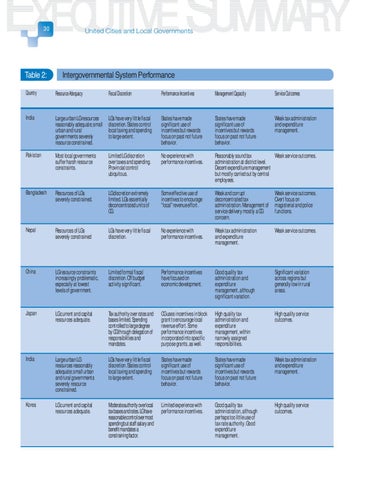
Performance A variety of criteria might be used to assess the performance of any particular intergovernmental system. The approach in this
Table 1:
The assessment indicates, in general, the considerable challenges faced by local
Estimated Sub-national Government Shares of Total Public Expenditure and Revenue
Country
Share of Total Public Expenditure (%)
Share of Total Public Revenue (%)
Sub-National
Upper Tier
Lower Tier
India
66
33
33
33
Pakistan
33
28
5
7
6.5
0.5
Bangladesh
15
5
10
2
1
1
Nepal
10
n.a.
8
4
n.a.
4
China
70
20
50
40
15
25
Japan
60
20
40
40
20
20
Korea
45
15
30
25
10
15
Indonesia
35
7
28
8
5.5
2.5
Philippines
25
11
14
10
2.5
7.5
Vietnam
45
30
15
35
25
10
Thailand
10
5
5
2
1
1
Australia
36
30
6
20
17
3
9
8
New Zealand
9
Source: GOLD II, Asia Pacific chapter.
n.a.
Sub-National
Upper Tier
Lower Tier
30
3
n.a.
8
0w2010 01 RESUM EJECUTIVO 03 DEFcarta ang
26/10/10
19:49
Página 30
EXECUTIVE SUMMARY 30
Table 2:
United Cities and Local Governments
Intergovernmental System Performance
Country
Resource Adequacy
Fiscal Discretion
Performance Incentives
Management Capacity
Service Outcomes
India
Large urban LG resources reasonably adequate; small urban and rural governments severely resource constrained.
LGs have very little fiscal discretion. States control local taxing and spending to large extent.
States have made significant use of incentives but rewards focus on past not future behavior.
States have made significant use of incentives but rewards focus on past not future behavior.
Weak tax administration and expenditure management.
Pakistan
Most local governments suffer harsh resource constraints.
Limited LG discretion over taxes and spending. Provincial control ubiquitous.
No experience with performance incentives.
Reasonably sound tax Weak service outcomes. administration at district level. Decent expenditure management but mostly carried out by central employees.
Bangladesh
Resources of LGs severely constrained.
LG discretion extremely limited. LGs essentially deconcentrated units of CG.
Some effective use of incentives to encourage “local” revenue effort.
Weak and corrupt deconcentrated tax administration. Management of service delivery mostly a CG concern.
Weak service outcomes. Overt focus on magisterial and police functions.
Nepal
Resources of LGs severely constrained
LGs have very little fiscal discretion.
No experience with performance incentives.
Weak tax administration and expenditure management.
Weak service outcomes.
China
LG resource constraints increasingly problematic, especially at lowest levels of government.
Limited formal fiscal discretion. Off budget activity significant.
Performance incentives have focused on economic development.
Good quality tax administration and expenditure management, although significant variation.
Significant variation across regions but generally low in rural areas.
Japan
LG current and capital resources adequate.
Tax authority over rates and bases limited. Spending controlled to large degree by CG through delegation of responsibilities and mandates.
CG uses incentives in block grant to encourage local revenue effort. Some performance incentives incorporated into specific purpose grants, as well.
High quality tax administration and expenditure management, within narrowly assigned responsibilities.
High quality service outcomes.
India
Large urban LG resources reasonably adequate; small urban and rural governments severely resource constrained.
LGs have very little fiscal discretion. States control local taxing and spending to large extent.
States have made significant use of incentives but rewards focus on past not future behavior.
States have made significant use of incentives but rewards focus on past not future behavior.
Weak tax administration and expenditure management.
Korea
LG current and capital resources adequate.
Moderate authority over local tax bases and rates. LG have reasonable control over most spending but staff salary and benefit mandates a constraining factor.
Limited experience with performance incentives.
Good quality tax administration, although perhaps too little use of tax rate authority. Good expenditure management.
High quality service outcomes.
0w2010 01 RESUM EJECUTIVO 03 DEFcarta ang
26/10/10
19:49
Página 31
Second Global Report on Decentralization and Local Democracy. GOLD 2010 EXECUTIVE SUMMARY
Table 2:
Intergovernmental System Performance
Country
Resource Adequacy
Fiscal Discretion
Performance Incentives
Management Capacity
Service Outcomes
Indonesia
Current resources adequate for most LGs; some relatively small number of LGs have insufficient funds.
LGs set tax rates under centrally imposed ceilings; LGs have (almost) complete discretion over spending.
Minor and ad-hoc experience with performance incentives. Formal encouragement of local revenue effort through block transfers discontinued
LGs administer taxes and spend resources inefficiently. Significant accumulation of cash reserves.
Weak service outcomes.
Philippines
Inadequate resources for significant number of LGs, particularly municipalities.
LGs set some tax rates but can make changes only every 3 years. CG heavily influences LG spending; Unfunded mandates a particular concern.
Explicit use of incentives limited to employment of transfer intercept in cases of non-repayment of loans.
LGs administer taxes ineffectively and manage spending poorly. Significant cash buildups.
Weak service outcomes.
Vietnam
LG resource adequacy questionable, especially for development and maintenance of infrastructure.
LGs have very limited tax authority. Moderate discretion over management of service delivery.
No experience with performance incentives.
Tax administration completely centralized so local capacity not an issue. Spending reasonably well managed—low wage bills.
Significant improvements needed. Little horizontal accountability in most provinces.
Thailand
LGs have sufficient resources, given unclear responsibilities.
Taxing discretion limited to minor charges/fees; spending heavily influenced by CG.
No experience with performance incentives.
Local efforts to improve tax and expenditure administration underway—tax system computerization and contracting out services.
Generally weak outcomes but improving responsiveness.
India
Large urban LG resources reasonably adequate; small urban and rural governments severely resource constrained.
LGs have very little fiscal discretion. States control local taxing and spending to large extent.
States have made significant use of incentives but rewards focus on past not future behavior.
States have made significant use of incentives but rewards focus on past not future behavior.
Weak tax administration and expenditure management.
Australia
LGs seem to have sufficient resources for their responsibilities
Discretion generally high, but some State interference in tax rates and bases
Little experience with performance incentives in fiscal transfer arrangements
LG has high level capacity to manage revenue collection and budget implementation
Outcomes generally of good standard
New Zealand LGs seem to have sufficient resources for their responsibilities
Discretion generally high
Little experience with performance incentives in fiscal transfer arrangements
LG has high level capacity to manage revenue collection and budget implementation
Outcomes generally of good standard
31
0w2010 01 RESUM EJECUTIVO 03 DEFcarta ang
26/10/10
19:49
Página 32
EXECUTIVE SUMMARY 32
United Cities and Local Governments
governments across the various dimensions of performance. The table below summarizes the findings.
Conclusions This study demonstrates the significant variation in fiscal decentralization frameworks and outcomes that exists across and within the Asia Pacific Region. This diversity makes it nearly impossible to make general recommendations about fiscal decentralization in the Region. These difficulties, notwithstanding this chapter, points to three broad conclusions that may be important for policymakers to consider as they develop decentralization reform agendas. These are to: •
stay the course,
•
build local capacity, and
•
strengthen horizontal accountability
Fiscal decentralization is most appropriately viewed as set of procedures designed to support a structure of government aimed at enabling greater community involvement and better service delivery outcomes. Some theoretical objectives of decentralization may best be seen as ideals that can rarely be fully met and that can only be achieved to any significant degree over many years. In many countries in the region, there is a desire to improve on the outcomes that have been attained by decentralization programs thus far. Policymakers must resist the temptation to roll back public sector decentralization reforms that have already been implemented. Countries need to take a long-term view and stay the course with regard to the execution of fiscal decentralization. The significant local level capacity concerns in many countries across the Asia Pacific have been a focus in this chapter. Lack of capacity should not be seen, however, as a reason to limit the kind and degree of fiscal
decentralization in a country. Instead, capacity constraints should be used in a strategic manner to design and implement reforms. That is, decentralization efforts should be organized and executed in a gradual manner, cognizant of the management capabilities at the local level. Perhaps more importantly, decentralization programs themselves should also be viewed as potential mechanisms for building needed capacity. A final conclusion concerns accountability. The review of local government finances in this chapter has shown that where countries have paid attention to accountability in the design and execution of their decentralization programs, they have mostly stressed (vertical) accountability to higher level governments. Horizontal accountability is somewhat weak throughout the Asia Pacific region. It is difficult for decentralization programs to deliver quality local public services in the absence of strong horizontal accountability to the people. Part of the problem may be technical in that the link between service delivery and tax payment is not strong; and this certainly constrains accountability. The larger issue lies outside the realm of the strictly fiscal however, and relates more to the political environment in which local governments operate. The stimulation of robust citizen demand for quality services, the efficient use of funds and the development of accountability mechanisms through which demand can be channeled are perhaps the greatest challenges facing decentralization policymakers today.
0w2010 01 RESUM EJECUTIVO 03 DEFcarta ang
26/10/10
19:49
Página 33
Second Global Report on Decentralization and Local Democracy. GOLD 2010 EXECUTIVE SUMMARY
UCLG ASPAC Policy Recommendations for Fiscal Decentralisation After discussion at the Workshop on Local Government Finances held at Batam, Indonesia, on 25-26 June, the members of the UCLG-ASPAC Region agree that the basis of its policy on Fiscal Decentralization is as follows: •
That local governments be given greater autonomy by having its powers widened to decide all tax bases and tax rates, and the level of fees for service, within its mandate.
•
That there be a review of the current allocation of revenue sources and service delivery responsibilities to each sphere of government and that they be reassigned so as to: a. Reduce vertical fiscal imbalance; b. Better match expenditure responsibilities with own-source revenues; c. Ensure all spheres of government share in natural resource revenues; and d. Reduce the impact of economic cycles on any one sphere of government.
•
That local governments be provided with an increased and fixed share of national public sector revenue through grants and transfers, but with a reduced number of grants and a larger proportion being provided as untied funding.
•
That grant distribution to local governments be managed by an institution that is independent of government, has membership acceptable to grant recipients and operates in a transparent manner to provide funds directly to the bank accounts of the recipients.
•
That there be a more widespread application of horizontal fiscal equalization principles within the distribution of grant funding for local government.
•
That all local governments have access to loan funds, under conditions and limits that are acceptable to both the national and local governments.
•
That where one does not already exist, there be a Local Government Finance Corporation or equivalent established to ensure local government has access to loans at lower than commercial rates of interest.
•
That all unfunded mandates of local government be removed by increased funding or reallocation of responsibilities, and that future unfunded mandates be made illegal.
33
0w2010 01 RESUM EJECUTIVO 03 DEFcarta ang
26/10/10
19:49
Página 34
EXECUTIVE SUMMARY 34
United Cities and Local Governments
•
That ‘finance follows function’ in any future reallocation of responsibilities between spheres of government.
•
That consultative mechanisms be established to ensure that all spheres of government work together to coordinate development, infrastructure planning, renewal, and budgeting, and that local government has an increased role in determining national service delivery objectives.
•
That other spheres of government review and amend their policies and procedures to remove unnecessary restrictions on local government fiscal autonomy.
•
That where not already done, standard accounting and financial management practices be introduced for local government; that there be clear procedural instructions for practitioners implementing these standards and that both elected officials and local government staff be trained in their application.
•
That national constitutions be amended where necessary to give local government appropriate status, that all sectoral legislation be examined to ensure its consistency with local government legal requirements and that local government revenue management be firmly based in the law.
•
That Local Government Associations be recognized by other spheres of government as the appropriate bodies to represent local government in intergovernmental discussions on policy and fiscal arrangements.
For its part, local government will work with other spheres of government to achieve these objectives, will re-examine its own policies, by-laws, regulations, procedures and practices to see that they best meet the overall objectives of government in providing services to the people in an efficient manner. Local government will also take steps to improve the transparency of its operations, involve the people more in its planning, budgeting and other activities, and will introduce programs to encourage the payment of local taxes and charges.
0w2010 01 RESUM EJECUTIVO 03 DEFcarta ang
26/10/10
19:49
Página 35
35
Eurasia Executive Summary
The major challenge of local governments in the eight countries under review (Armenia, Belarus, Georgia, Kazakhstan, Kyrgyzstan, Moldova, Russia, and Ukraine) over the past twenty years has been adjusting to the narrowing role and size of government, and the resulting reduction in local resources, while attempting to maintain the high quality of social services provided at the local level during the Soviet period. Concurrently, local governments across the region have been coping with a dramatic increase in migration, both domestic and international. This has resulted in a redistribution of service needs in relation to these positive and negative net-migrations, which no longer match
Table 3:
the existing infrastructure. However, the social infrastructure (schools, hospitals, etc.) in localities that have lost population has been preserved in order to reduce social tensions, as budget-supported institutions have become almost their only area of employment. Local governments in the countries of Eurasia vary from a system of decentralized state bodies for local administration in Kazakhstan and a centralized hierarchical system of public authorities in Belarus to a two-tier system of local self-government in Russia and Moldova. In between, there are states where local self-governments exist autonomously (Armenia, Georgia) or alongside state bodies for local
Legal Status of Local Governments
Countries
Regional level
Intermediate (raion) level
Settlement level
Armenia
D
Belarus
LG/LSG
LG/LSG
Georgia
D
LSG +
Kazakhstan
LG
LG
LG (without budget rights)
Kyrgyzstan
D
LG/LSG
LSG
LSG (include Autonomous Republics)
LSG
LSG LG/LSG
Autonomous Republics (LSG)
Moldova Russia
Subjects of Federation
LSG
LSG
Ukraine
LG/LSG
LG/LSG
LSG
D – deconcentrated units of central government LG – local state government bodies LSG – local self-governments bodies LG/LSG – local executive bodies included into hierarchical “vertical power structure” and local representative bodies (councils) with a status of a local self-government
Natalia Golovanova Center of Fiscal Policy (Moscow), Russia Galina Kurlyandskaya Center of Fiscal Policy (Moscow), Russia
0w2010 01 RESUM EJECUTIVO 03 DEFcarta ang
26/10/10
19:49
Pรกgina 36
EXECUTIVE SUMMARY 36
United Cities and Local Governments
administration (in Ukraine at oblast and raion level, in Kyrgyzstan at raion level). All countries under review (apart from Kazakhstan that officially has no local governments) have adopted laws on local self-government.
heads by the central government in Kyrgyzstan; the reorganization of local governments in Georgia; as well as limitations to expenditure autonomy of local governments in Russia.
During the last years, positive trends have been seen in some countries in the field of decentralization. In Armenia, the list of local taxes and duties was enlarged in 2010. In Ukraine, the concept of Local Government Reform was recently approved, and a new framework for local self-government legislation is currently being developed. In 2010, Belarus adopted a law on Local Government and Self-government.
The recent financial crisis has revealed weaknesses within the local finance system of some of the Eurasian countries, while in other countries local budgets seem to be doing better than central/regional ones due to their reliance on the most stable revenues sources, e.g. in Moldova, transfers to local governments were proportionally cut by 20 percent, while in Kazakhstan grants are set for a three-year periods and remain stable. In Russia, settlement tax revenues grew 22 percent in 2009 in comparison with 2008, however large industrial cities faced shortcomings in own revenues due to reductions in revenue from Personal Income Tax
However, in other countries, centralization tendencies are being observed: a reduced level of tax autonomy in Russia, Kyrgyzstan, and Georgia; a nomination of local self-government
Figure 5: Local Government Expenditure and Revenue as a Part of General Government Budgets in Certain Eurasian Countries
70% 60% 50% 40% 30% 20% 10% 0
revenue expenditure
0w2010 01 RESUM EJECUTIVO 03 DEFcarta ang
26/10/10
19:49
PĂĄgina 37
Second Global Report on Decentralization and Local Democracy. GOLD 2010 EXECUTIVE SUMMARY
as a result of the growth of unemployment. [See figure 5]
Main issues and policy challenges for local government finance In spite of the fact that local self-government in the Eurasian countries shared a common environment and starting conditions in the early 1990s, each of the eight countries under review responded to challenges in its own way and built its own model of local self-governance and intergovernmental fiscal relations in the years that followed. Thus, today they differ in the number of local government tiers, the ways in which powers are granted to the executive and representative authorities, the assignment of revenue sources and expenditure responsibilities, as well as in their systems of intergovernmental transfers. Common features of however be drawn out:
local
finance
can
In all the countries under review, expenditure responsibilities are assigned to different levels of government by legislation, but this assignment is not always clear. Sometimes the same tasks are assigned to different levels (e.g. Moldova), also some responsibilities are still assigned according to the property delineation (e.g., in Belarus). Sometimes de facto assignment differs from that outlined in the legislation, and can even result in local governments financing responsibilities that are not within their authority (e.g. Georgia).
central government laws define the number of local staff (e.g. Kazakhstan, Belarus, Kyrgyzstan, Moldova) or impose limits on certain expenditures of local governments (e.g. Russia). In Russia, according to the President’s decree, regional governments must evaluate the performance of municipal raions and city governments. Personal income tax is the main source of local government revenue. Property and land taxes make up only a small part of local budgets except for Armenia where property taxes are the only taxes assigned to local budgets. All countries under review have restricted lists of local taxes that limit local governments’ autonomy to propose new taxes. Some countries (Belarus, Kazakhstan, Kyrgyzstan) set the rates of shared taxes in the budget law. In some countries tiers exist that do not have own taxes (e.g. raions in Russia). In many situations, central (federal) governments mandate tax benefits that reduce amount due to local budget (e.g. Georgia, Russia). Delegation of tax powers is not common. Local governments can only collect local taxes in Moldova, Armenia, and Kyrgyzstan. The experience of Armenia has shown that tax collection by the local level increases tax efforts and as a consequence tax compliance. The inverse was also found to be true, where the centralization of tax collection (for example that of sales tax in Kyrgyzstan) has reduced the amount of revenue collected.
Unfunded mandates have been significantly cut. In many Eurasian countries, unfunded mandates are forbidden by the legislation, but legislative decisions of higher level governments still can result in additional financial burdens to the local level and a reduction in their expenditure autonomy.
Significant improvement in the design of equalization grants has been made. Most countries under review have legally adopted formula-driven methodologies for allocating equalization grants from the central/regional budget, but local experts note that negative transfers in Belarus, Kazakhstan, Moldova, and Ukraine create disincentives for local tax base development.
Central and regional government controls on local governments. In some countries, the
Lack of transparent allocation rules for earmarked grants in most countries. At best,
37
0w2010 01 RESUM EJECUTIVO 03 DEFcarta ang
26/10/10
19:49
Página 38
EXECUTIVE SUMMARY 38
United Cities and Local Governments
capital grants are allocated on a competitive basis, but clear provisions concerning capital grant allocation procedures are absent in budget legislation. At worst, their distribution is a result of lobbying on the part of individual municipalities. All countries in question exercise strict control over public expenditures funded by earmarked transfers. Borrowing powers are limited. For some countries, limitations are set as a percentage of annual local revenue, for others, as a share of local expenditure. In most countries (e.g. Russia, Kazakhstan, etc.), local governments’ capital expenditures are co-financed by higher level of governments.
Conclusions The main conclusions for the countries of Eurasia include the following: Clarification of the administrative-territorial division and the status of local governments. Local executive bodies should be accountable to local representative bodies and thus to the citizens. Local government bodies should not be subject to higher levels of government. Clear assignment of expenditure responsibilities. In some countries under observation, expenditure responsibilities need to be clarified, as responsibilities have been assigned to different levels of government with several cases of overlapping powers. In addition, clarification is necessary between state and local government powers operating at the local level. Elimination of unfunded mandates. Responsibilities should be delegated with adequate earmarked transfers and any reallocation of expenditures should be followed by reassignment of revenue. Expenditure autonomy of local governments should be increased. Local government should be free to establish the number of local staff and
the amount of money allocated to different local issues. Higher levels of government should not have the power to cancel the decisions of local government, and conflicts between central and local normative acts should be addressed in the courts. Revenue autonomy of local governments should be increased. For local self-governments to become more autonomous, it is necessary to enlarge the list of local taxes (specifically, in Russia, Kyrgyzstan, Georgia) or to assign, for long periods, those shared taxes whose sharing rates are currently established in budget laws (Kazakhstan, Kyrgyzstan, Belarus). Local real estate tax should be introduced instead of separate taxes on land and property. Personal income tax is a good source for local revenue if combined with flat rates and payments according to the residence principle (rather than in the workplace). Small business taxes are another good instrument if local governments could establish the tax base and the tax rates. Local tax administration and collection should be transferred to the local level. The experience of Armenia and Kyrgyzstan shows that delegation of the tax collection to the local level increases tax compliance and resulting revenues. Elimination of the negative incentives from the transfers’ allocation formula and increasing transparency in the allocation of earmarked grants. Incentives for local tax base development should be included in negative transfers. Transparent methodologies for earmarked transfers should be established. Access to capital markets should be provided for local governments. Limited borrowing rights hamper the ability of local authorities to fund capital expenditures. A more flexible legal framework needs to be developed to facilitate access for a responsible indebtedness for local governments.
0w2010 01 RESUM EJECUTIVO 03 DEFcarta ang
26/10/10
19:49
Pรกgina 39
Second Global Report on Decentralization and Local Democracy. GOLD 2010 EXECUTIVE SUMMARY
Development of the inter-municipal cooperation for better services provided. Inter-municipal cooperation is an effective instrument to reduce the costs associated with the provision of municipal services taking advantage of the available economies of scale, while at the same time allowing individual local selfgovernments to retain control over functions. The following country specific suggestions are also provided: Of all the countries under review, Kazakhstan is the only country that officially has no local self-governments. The introduction of local self-government would be the main challenge in this country; however this issue has not been on the national agenda. Belarus is an example of a country where local self-government formally exists, but its powers are very limited. The republic would do well to further develop its local authorities. Given political realities, one can assume that Belarus would benefit from the experience of other Eurasian countries where bodies of local power, albeit subordinate to the central government, nevertheless, have legally assigned responsibilities and own revenue sources. Armenia needs clear legislation on financing delegated responsibilities. Municipalities also need additional support in accessing financial markets; while they are allowed access by law, in practice this has yet to become effectively implemented. Moldova needs to make intergovernmental fiscal relations between raions and settlements in their territory more transparent and formula-driven. Settlements should receive more expenditure
and revenue autonomy to allow them to provide effective services. In Ukraine, the reform agenda has been determined. The first challenge will be the implementation of this reform, aimed at giving a greater role to local self-governments. Among the reforms on this agenda are: increasing local government autonomy from central government, clear assignment of expenditure responsibilities, introduction, at the local level, of real estate tax (assessed to the current market value), and improvement of the transfer allocation formula. In Russia, there is a need to assign own taxes to raion governments and introduce the real estate tax. There is also a strong need for better local tax administration and collection. Tax exemptions from local taxes established in the federal legislation should be eliminated. It is difficult to predict the local self-government development in Kyrgyzstan, but with the current political instability, the central government can hardly be interested in strengthening the local government level. The internal problems of Georgia are also not a good environment for building strong local governments. Despite the fact that local governments in Eurasia still do not have the same powers as their counterparts in Europe or North America, they have, since the early 90's, made significant progress on the road towards decentralization. We hope that the latest centralization trends in most Eurasian countries are temporary and that this progress can continue in the future.
39
0w2010 01 RESUM EJECUTIVO 03 DEFcarta ang
26/10/10
19:49
Página 40
EXECUTIVE SUMMARY 40
United Cities and Local Governments
UCLG Euro-Asia Regional Policy Recommendation These recommendations were developed by the participants in the Eurasia GOLDII workshop, held in Moscow, February 2010. •
•
Administrative-territorial division and the status of local government should be clarified: local executive bodies should be accountable to the local representative bodies and thus to the citizens; Clear assignment of expenditure responsibilities should be established;
•
Unfunded mandates should be eliminated not only on paper but in the everyday practice, delegated functions must be supported with adequate financial resources;
•
Local governments should have autonomy over local budgets: expenditure autonomy should be supported by revenue autonomy with sufficient revenue sources;
•
Local government responsibilities at the lowest level (that closest to citizens) should be increased and matched with adequate funds;
•
Transfer allocations should be transparent and should not contain negative incentives;
•
The administration and collection of local taxes should be transferred to the local level;
•
Inter-municipal cooperation should be developed: local governments should work together for better services provision;
•
Inter-municipal short-term loans can be recommended as a good system of mutual assistance;
•
Evaluation of the quality of local services and sufficiency of funding should be provided by external non-partisan entity;
•
Access to capital markets should be provided for local governments.
0w2010 01 RESUM EJECUTIVO 03 DEFcarta ang
26/10/10
19:49
Página 41
41
Europe Executive Summary
For several decades, the continent has seen a continuing, though sometimes uneven, trend towards greater democratic decentralization to the local and regional levels, as evidenced by the European Charter for Local Self-Government of 1985, which came into effect in 1989, having been ratified by all the European Union (EU), and almost all Council of Europe, member states. There is a rich array of intergovernmental fiscal settings in Europe, where countries are structured as unitary states, federations (Austria, Belgium, Germany and Switzerland) and quasi-federations (Italy and Spain), where the regional authorities enjoy comprehensive legislative, financial, and executive autonomy. The United Kingdom has a particularly interesting arrangement that could be described as asymmetric decentralization by combining a quasi-federal setting for Scotland, Wales and Northern Ireland with a unitary structure in England. Although rooted in history, European intergovernmental fiscal relations are far from immutable. European local governments have been hit hard by the global crisis that erupted in 2009 and the subsequent recession. Several EU countries have announced fiscal consolidation plans to restore long-term fiscal sustainability, which will affect local and regional governments through increased pressure for tax hikes and expenditure restraint, reduction in local revenue, and central transfers. Reform is ongoing in many countries, where local jurisdictional boundaries are being redrawn, as in Greece, Iceland, Latvia, Luxemburg and the role of intermediate or regional level of governments is being revisited, including in
France, Lithuania, Norway, Poland, and Sweden. Local governments will also have to deal with the emergence of new claims on local budgets, including in the areas of social protection in times of crisis and in a context of rapidly ageing populations. Demands associated with the need to integrate immigrants into the social fabric of the recipient countries also take a toll on local governments.
Luiz de Mello Economic Department, OECD4
Main issues and policy challenges for local government finance •
There is considerable variation in the assignment of expenditure functions to local governments in Europe
Cross-country variations in the relative size of local governments reflect differences in the assignment of expenditure functions across the various levels of government. Local government expenditure is comparatively high in relation to GDP and general government outlays in the Nordic countries [See figure 6]. In general, the expenditure functions of local authorities follow a “general competence” principle (enshrined in the European Charter of Local Self-Government), according to which local governments tend to focus on expenditures that are local in nature, so that the benefits of provision can be internalized by residents. In most countries, local governments are responsible for primary education, and in some new European Union Member States, such as Estonia, Latvia, Lithuania, Slovak Republic, and Slovenia, education alone accounts for at least one-third of local government budgets. Other
4. The opinions and analyses presented in this chapter are the author’s own and do not necessarily reflect that of the OECD or the organisation’s Member countries.
0w2010 01 RESUM EJECUTIVO 03 DEFcarta ang
26/10/10
19:49
Página 42
EXECUTIVE SUMMARY 42
United Cities and Local Governments
Figure 6: Local Government Expenditure and Revenue as part of the General Government Budgets in Europe
70% 60% 50% 40% 30% 20% 10% 0
revenue expenditure
responsibilities that are in general under the purview of local governments include the supply of urban amenities and planning, waste collection and treatment, distribution of drinking water and treatment of waste water, payment of social benefits, and the provision of social services, including child care and income support for the elderly and the disabled. Because the services delivered by local governments tend to be intensive in labor, payroll accounts for the lion’s share of local government outlays in most countries.
governments to make the most of economies of scale to reduce delivery costs. This problem is being addressed in some cases through the amalgamation of small jurisdictions (as in Belgium, Finland, Netherlands and Norway), the joint provision of services by neighboring local governments (as in Finland, France, Italy, Luxembourg and Poland), often in the form of inter-municipal consortia, and in some extreme cases a recentralization of financing and provision (as in the case of health care in Norway).
•
Local budgets are also affected by cost shifting between different levels of government and the creation of unfunded mandates by higher levels of administration. A case in point is when services are delivered locally, and norms and
Local governments are grappling with the need to contain the costs of service delivery
Since local jurisdictions are relatively small in many countries, it is difficult for local
0w2010 01 RESUM EJECUTIVO 03 DEFcarta ang
26/10/10
19:49
Página 43
Second Global Report on Decentralization and Local Democracy. GOLD 2010 EXECUTIVE SUMMARY
standards are set by different levels of government. A best practice in this area is to ban the creation of unfunded mandates across the different levels of administration, as in Denmark, for example. •
A rapidly ageing population is shifting, and will continue to do so, the demand for goods and services provided by local governments
The share in population of individuals aged 65 years or more is close to 16 percent on average in the European countries under examination in this chapter, which is among the highest in the world. The United Nations projects the old-age dependency ratio to nearly double during 2010-50. As a result, demand for health and old-age care will likely rise and delivery costs will put increasing pressure on local budgets. Demographic trends are particularly testing in southern Europe, where birth rates are well below replacement ratios and population growth rates (excluding immigration) are already negative. Immigration and the integration of long-term residents are creating claims on local budgets, especially in countries where the local authorities play a leading role in the provision (and financing) of housing, employment and related social assistance services, which are in high demand among immigrants. The proportion of foreign-born individuals in the population of Greece and Spain, for example, is already close to 10 percent. •
As in the case of local government expenditure functions, there are important differences in the assignment of revenue to local governments in Europe
Local government revenue, including local taxes, non-tax instruments (such as user charges and fees for services), intergovernmental grants and transfers, account for close to 10 percent of GDP on average in the countries
under examination. Local government revenue is much higher on average as a share of general government receipts in some unitary states, such as the Nordic countries (except for Norway), than in the federal countries, such as Germany. The relative shares of local government revenue are particularly low in some Southern European countries, including Cyprus, Greece, and Malta. A case can be made for relying on local taxes, rather than on revenue mobilized elsewhere, to finance the provision of local services. Such reliance tightens the link between the benefits and costs of local services, which is likely to make local officials more accountable to their taxpayers. Local governments are best equipped to tax immobile bases, because their revenue yield tends to be fairly insensitive to cyclical fluctuations in economic activity. As a result, property tax revenue accounts for a large share of local government receipts in several European countries, especially Belgium, France and Iceland. An important consideration is the extent of autonomy that local governments should have in tax matters. It can be argued that autonomy is beneficial, because it may enhance tax competition among the local governments, which may help to constrain increases in public spending and taxation. •
It is often difficult to draw a precise line between the various types of revenue accruing to local governments, especially in so far as own, shared or transferred revenue are concerned
This is the case of the personal and corporate income taxes, for example, whose revenue is often shared among different layers of administration, rather than being assigned exclusively to local governments. Another consideration is that formula-based revenue-sharing arrangements have the disadvantage of linking local government
43
0w2010 01 RESUM EJECUTIVO 03 DEFcarta ang
26/10/10
19:49
Página 44
EXECUTIVE SUMMARY 44
United Cities and Local Governments
receipts to central government revenue. This is the case of VAT revenue sharing in Germany and Spain, for example, which makes local budgets sensitive to cyclical fluctuations in central or middle-tier government revenue. If local governments have limited financial room for smoothing transitory budgetary slippages associated with the business cycle, due to a ban on borrowing, for example, revenue sharing may also make local finances pro-cyclical. •
In some countries, local budgets are financed predominantly by transfers and grants from higher levels of administration
This is the case of most Western European countries and a few Eastern European countries, such as Romania and Bulgaria. The United Kingdom stands out among the more populous European countries on the basis of its local governments’ reliance on grants and transfers from the centre. Schemes are in place in many countries to equalize revenue capacity among the local governments (Austria, Denmark, Germany, Sweden, Switzerland). The main consideration is that grants and transfers drive a wedge between the costs and benefits of local provision, which creates disincentives for cost-effective service delivery. To some extent, these disincentives can be mitigated through conditionality. Earmarking is particularly common in the case of grants to finance investment programs. •
The level of local government indebtedness in relation to GDP does not elicit concern about the longer-term sustainability of local public finances in Europe
Low debt positions are due to a large extent, to restrictions on local government borrowing. In most cases, local governments are only allowed to borrow to finance investment (golden rule). Guarantee of local government liabilities by higher-level jurisdictions is often banned.
Restrictions are in place in most countries on the type of collateral allowed in local government debt issuance. In some countries, administrative controls on local government financial management are being replaced by prudential regulations, often based on debt service and loan repayment capacity, as well as on the level of indebtedness in relation to local revenue, as in Bulgaria, Czech Republic, Greece and United Kingdom. Guidelines and recommendations on local government indebtedness are also available from the Council of Europe. Local government indebtedness remains comparatively low in Europe, despite the sharp deterioration in budget positions across the continent as a result of the global crisis and the ensuing recession. This deterioration will call for remedial measures in the form of fiscal retrenchment over the medium-to-longer term, which will also impinge on local governments. The magnitude and timeframe of fiscal consolidation will vary from country to country, depending primarily on the initial level of debt, the size of the stimulus packages put in place in response to the global crisis, and the speed of recovery in economic activity in the coming months.
Conclusions Intergovernmental provisions on service delivery need to recognize the benefits of local self-government. It is important to rely on regulations and norms set by higher levels of government to ensure that minimum standards are met throughout the national territory. But policymakers should make sure that top-down regulations do not curtail their ability to tailor service delivery to local preferences and needs, which may vary across regions, especially in territorially diverse countries. A related issue is that of cost shifting across levels of government, which often arise when top-down regulations impose a financial burden on local budgets.
0w2010 01 RESUM EJECUTIVO 03 DEFcarta ang
26/10/10
19:49
Página 45
45
Second Global Report on Decentralization and Local Democracy. GOLD 2010 EXECUTIVE SUMMARY
When unfunded, such intergovernmental cost shifting should be banned. Demand for local services, including the provision of selected old age-related care, and community and social services, is rising in Europe. This trend is particularly challenging in countries facing difficulties arising from a rapidly ageing population and the need to absorb and integrate immigrants. Therefore, coordination needs to be boosted among the different levels of government to devise workable, cost-effective solutions to these problems that would take into account local government expertise in service delivery and their ability to extract information of residents’ preferences and needs. At the EU level, efforts to expand the internal market need to take local choice into account. The provision of public services has come under increasing scrutiny from the European authorities as they seek to expand the European internal market.5 Tensions have therefore often arisen with sub-national governments in matters that they perceive as within the remit of their self-government prerogatives. A European Charter on Local and Regional Services of General Interest was proposed in 2009 to deal with this matter. Against this background, effort should be stepped up to reconcile initiatives towards building an internal market with the need to preserve local preferences and choice. With regard to own revenue sources, there is a lot of diversity among European local governments on the mix of tax instruments available to local governments. Immobile taxes, such as those on property, are the ideal sources of revenue for local governments. In addition, the experience of several countries suggests that, while the personal income tax works quite well as a local tax or when its revenue is shared
between different levels of government, the corporate income tax is best managed by the central government. There may be scope for raising local revenue through user charges and fees for services, but concern that co-payments may hinder access by selected social groups to local services has often discouraged local governments from levying charges and fees for services. While recognizing the constraints imposed by specific country environments, local authorities should continue to evaluate the costs and benefits of user charges in their efforts to raise revenue. There is scope for improving the design of fiscal rules for local governments. Rules that restrict local government access to credit markets may encourage local governments to rely only on bank lending as a source of finance or to look for ingenious mechanisms for bypassing restrictions on debt issuance. In this case, consideration could be given to the option of replacing such restrictions by more comprehensive prudential regulations based on debt repayment capacity that do not distort policymakers’ choice over financial instruments. Borrowing constraints or balanced budget provisions make it difficult for local governments to smooth the budgetary impact of fluctuations in the business cycle. This is especially the case of local authorities that rely of cyclical revenue, through own collections or sharing arrangements with higher levels of government. In this case, balanced budget provisions could be redefined on a cyclically adjusted basis, so long as local governments have access to budget financing from non-government sources in bad times and instruments to save cyclical revenue windfalls in good times.
5. Public services, including those that affect individual citizens’ quality of life, sustainable economic development or social/regional cohesion, are known in EU jargon as Services of General Interest (SGIs) or Services of General Economic Interest (SGEIs).
0w2010 01 RESUM EJECUTIVO 03 DEFcarta ang
26/10/10
19:49
Página 46
EXECUTIVE SUMMARY 46
United Cities and Local Governments
European Regional Policy Recommendations Based on recommendations presented by the representatives of CEMR members in the workshop of the City of Sceaux (Paris, March 2010): Europe’s local and regional governments will wish to respond to the major fiscal challenges and pressures which now confront them. In particular, they will need to consider how to engage effectively with central governments, with a view to maintaining the maximum scope for local and regional self-government for the coming decades. Some key points are likely to be: •
Local and sub-national governments should not take a disproportionate share of the fiscal reductions over the coming years, whether via reduced local revenue or through cuts in inter-governmental transfers;
•
There should be recognition that local governments have generally less fiscal flexibility than national governments, and for the most part have not incurred high levels of indebtedness;
•
Central governments should also recognize that local authorities generally have major social welfare obligations, which cannot be escaped while unemployment and other poverty indicators are high, that are pro-cyclical in impact, and over which they have little direct control;
•
Central and sub-national governments should together recognize the need for good quality future-oriented capital investment, mainly financed by new debt, e.g. on greening the future economy and urban infrastructure;
•
In most countries, the local government tax base should be broadened to give more fiscal room for maneuver and protection from excessive income losses from any one source;
•
Local governments should have more freedom to raise fees and charges;
•
Grants from central governments should be fewer (i.e. of a more general character), only ear-marked in exceptional cases, and provided without imposing undue administrative and regulatory burdens;
•
The EU needs to make its internal market and public procurement rules less centralized and intrusive, with more scope for local choice on local services, and with less detailed prescription. The cohesion policies must to be preserved.
At the same time, local and regional governments will need to think very carefully about how to do the best for their citizens within the reduced resources available. This means that they may have a common interest in looking at new ways of delivering public services
0w2010 01 RESUM EJECUTIVO 03 DEFcarta ang
26/10/10
19:49
Página 47
Second Global Report on Decentralization and Local Democracy. GOLD 2010 EXECUTIVE SUMMARY
cost-effectively, and at new ways of reducing administrative costs. The range of options must depend on local choices, whether by increased inter-communal cooperation, by some outsourcing or PPPs, by sharing some services between different levels of government, and so on. There will need to be an even greater emphasis on being responsive to the citizens and users of services. The important point will be for local and regional governments to be proactive in all of these issues, and not cede the initiative to central governments. The role of national associations of local and regional governments is of particular importance, since they can give advice and training to their members, directly or through daughter companies, as well as negotiate with central governments. Amongst the points for discussion with central governments, local authorities will often wish to emphasize that: •
Where territorial reforms are being considered in order to enhance efficiency and cost-effectiveness, priority should be given to supporting inter-municipal forms of co-operation, rather then centrally imposed amalgamations which often do not respect local needs and identities.
•
It is essential that there are effective and fair arrangements, involving all levels of government, for co-ordination and negotiation on financial and fiscal issues, in particular on the rules for and amounts of financial transfers, grants and redistributed resources (in particular equalization processes), but also covering the policy frameworks for all major services/competences.
It will probably be wise or even necessary to try to reach some form of “settlement” or compromise with central governments, based on protecting key principles of self-government (see Article 9 of the European Charter, above). We should also not ignore the European Union, which is playing an increasingly important role in relation to economic policy, cohesion funds as well as the rules for public services. Here too, there is a need for effective and fair co-ordination arrangements, involving the European Commission and the representative associations of local and regional government. The purpose would be to evaluate the financial, administrative, and regulatory impact of EU laws and policies on sub-national governments and seek improvements in the framework.
47
0w2010 01 RESUM EJECUTIVO 03 DEFcarta ang
26/10/10
19:49
Pรกgina 48
0w2010 01 RESUM EJECUTIVO 03 DEFcarta ang
26/10/10
19:49
Página 49
49
Latin America Executive Summary
The general trend has been an increasing level of fiscal decentralization in the Latin American region over the last two decades represented by a growing participation of sub-national expenditures as percent of national expenditures (from an of average 13 percent in 1985 to 19 percent in 2005), or as sub-national revenues and expenditures as percent of GDP (from 5.5 percent in 2000 to 6.6 percent in 2007) [See figure 7]. However, there are
significant variations in these trends across countries in the region. Measuring fiscal decentralization in terms of the actual autonomy to make expenditure and tax revenue decisions, there has also been progress, but that progress is less well defined. Overall, increased decentralization can be detected in the devolution of new responsibilities including the environment and the fight against poverty and in the increase in
Figure 7: Local Government Expenditure and Revenue as a Part of General Government Budgets in Latin America 40% 30% 20% 10% 0
revenue expenditure
Jorge MartínezVázquez Georgia State University, U.S.A.
0w2010 01 RESUM EJECUTIVO 03 DEFcarta ang
26/10/10
19:49
Pรกgina 50
EXECUTIVE SUMMARY 50
United Cities and Local Governments
decentralized expenditures in education, health, etc. Less progress can be detected in the devolution of autonomous revenue sources. Fiscal decentralization continues to be a dynamic process in Latin America. Recent times have seen a variety of innovations in the region that have attracted interest from all corners of the world, for example ranking local performance systems in Brazil and Colombia, per client based transfers for health and education in Chile, or fighting poverty with direct transfers to families administered by municipalities in Brazil. A good number of countries are embarked upon or considering significant reforms that will further deepen and strengthen municipal autonomy, such as Bolivia, Uruguay, and Costa Rica. But on the other hand, there are countries in the region where some trends have been toward some forms of re-centralization, such as Argentina, Colombia, Dominican Republic, Peru, and Venezuela.
Main issues and challenges for local government finance The local government shares in total public expenditures and in GDP in Latin America differ significantly by country but these shares are generally lower than those observed in other regions of the world. There are enormous variations in the assignment of responsibilities to municipalities representing a mosaic of approaches, but with a preponderance of concurrent responsibilities with the center. Municipal governments in many Latin American countries play a large role in public investment in infrastructure at the sub-national level often as equal partners with upper level governments. Practically all countries of Latin America assign certain taxes to local governments and the most commonly assigned tax is the property tax. The level of tax autonomy
granted to local governments also varies but, on average, municipalities raise a higher percentage of their budgets from own revenues than is the case in some other regions of the world. Nevertheless, in practically all countries in the region there are large vertical imbalances that need to be closed with transfers. The most common form of transfer is general revenue sharing, defined on the basis of central government general revenues or specific tax sources and distributed according to a formula index containing population and other variables, or, less often, on a derivation (i.e. origin) basis. Some countries allow unconditional use of shared revenues but more often the use of funds is conditional. Beyond the use of conditionality for revenue sharing funds, traditional conditional or specific transfers are less extensively used in Latin America than in other regions of the world. The practice of explicitly addressing horizontal fiscal disparities among local governments through explicit equalization transfers is still not common either. Most countries in the region allow local governments to borrow subject to prudent rules and limitations. The discussion about the special issues, constraints and opportunities for the development of local finance in Latin America is focused around several major themes: (a) Organizational Structure; (b) Intergovernmental Fiscal System Design; and (c) Short Term and Long Term Structural Challenges.
Issues in organizational structure Fragmentation and sub-optimal scale Many countries in the region have numerous local governments that are too small to take advantage of economies of scales in the delivery of public services. Often this problem is aggravated by the incentives provided for further fragmentation by transfer formulas
0w2010 01 RESUM EJECUTIVO 03 DEFcarta ang
26/10/10
19:49
Pรกgina 51
Second Global Report on Decentralization and Local Democracy. GOLD 2010 EXECUTIVE SUMMARY
that ensure fixed amounts of funds to each municipality, regardless of size.
The trade-off between economies of scale and representation The issue of the optimal scale of local governments presents an inherent tradeoff between the (potential) better political connection in terms of representation and accountability of smaller jurisdictions with the (potential) greater fiscal viability of larger jurisdictions. Thus, the issue of jurisdiction size is not only or primarily a technical issue, but also one that involves political considerations.
Local administrative capacity Closely associated with the problem of small size is the lack of administrative capacity of local governments in many countries in the region, particularly in small and rural local governments. The increased decentralization process in the regions in general has not brought increased collaboration and technical support by central government agencies to municipalities.
Issues in intergovernmental fiscal system design Lack of clarity in the assignment of expenditure responsibilities to local governments One of the weakest points of many decentralization programs in Latin America has been the scant attention given to a clear assignment of expenditure responsibilities of subnational governments; typically the focus has been almost exclusively on putting in place some form of financing scheme. The lack of clarity in the competencies of the different tiers often has been aggravated by: the insistence on uniform (as opposed to asymmetric) assignments, the practice of unfunded mandates, and the lack of
transparent methodologies to translate the assignment of functional responsibilities into the measurement of expenditure needs.
Insufficient revenue autonomy The level of tax revenue autonomy of local governments differs quite significantly across Latin American countries, relatively high in Brazil and Chile, but relatively low in El Salvador, Mexico and Peru where there is significantly less autonomy. But, in general, as in some other regions of the world (Africa, Asia, and many European countries), local revenue autonomy in Latin America remains below what is desirable. However, making a case for greater local tax autonomy is hurt by the perception that many local governments in the region do not make effective use of the tax autonomy that is currently granted to them in the law, for example, property taxes.
Unbundling revenue sharing Revenue sharing is the most common mechanism for arranging fiscal transfers to subnational governments in the region. The main problem with general revenue sharing is that generally there is confusion over what exactly the distribution formulas are trying to achieve; pursuing many objectives with essentially one instrument tends to be the source of that confusion. There is also confusion on whether the use of revenue sharing funds should be conditional or unconditional.
The need to rationalize the transfer system With the exception of a few countries, the current system of transfers to local governments in Latin America lacks clear structure. Most countries still have to introduce unconditional equalization grants that incorporate some formula-based measures of expenditure needs and fiscal capacity. Even though many countries have some form of
51
0w2010 01 RESUM EJECUTIVO 03 DEFcarta ang
26/10/10
19:49
Página 52
EXECUTIVE SUMMARY 52
United Cities and Local Governments
conditional grants, these lack clear objectives and predictability, especially in the area of capital grants. When conditional grants are used, complexity of the system is often a problem.
Increasing fiscally responsible local borrowing One consequence of Brazil and Argentina’s experiences with uncontrolled sub-national borrowing and hyperinflation during the 1980s and 1990s is that the policy of some countries in the region towards local government borrowing has become excessively conservative and restrictive. Thus a pending challenge for several countries is how to set up institutions that effectively regulate and monitor local borrowing without becoming overly restrictive. A second challenge for practically all countries is how to make more credit available to local governments for responsible borrowing. In practice, with the exception of a couple of countries, the level of borrowing by local governments in Latin America is far too low to meet the present large need for public infrastructure across the sub-continent.
Long term: Structural challenges Beyond the short-term issue of regaining fiscal balance, many local governments face similar long-term structural challenges. The chapter highlights three of these challenges: (i) strengthening tax capacity and its effective use by local governments. (ii) increasing the efficiency of public expenditures and the quality of public services; and (iii) finding avenues to finance the large capital infrastructure deficit for municipal services in the region, requiring a combination of capital transfers from central governments and better access to local credit.
Conclusions On organizational structure •
Countries with problems and small municipalities legislation and practical creation of associations into mancomunidades.
•
Most central governments in the region, and provincial or state governments in the case of federal systems, should devote more resources to developing administrative capacity, especially in the case of small and rural local governments.
Short term: Addressing the impact of the global crisis In 2009, local governments in the Latin American region have seen a deterioration of their fiscal position as a consequence of the ongoing global financial crisis. Like in many other regions of the world, local governments in Latin America have been further constrained by their dependence on central government transfers and their lack of access to credit markets. However, beyond the impact of the crisis, some have taken advantage of this crisis to take a harder look at their systems of intergovernmental fiscal relations and how municipal finances can be strengthened in the long run.
of fragmentation should introduce support for the of municipalities
On intergovernmental fiscal system design •
Most systems of intergovernmental fiscal relations in the region would benefit from an explicit clarification of the competencies assigned to local governments, identifying exclusive responsibilities of local governments where possible, and in the case of concurrent responsibilities, identifying the attributes of the particular competence (regulation, financing, and implementation) assigned to local governments.
0w2010 01 RESUM EJECUTIVO 03 DEFcarta ang
26/10/10
19:49
Página 53
Second Global Report on Decentralization and Local Democracy. GOLD 2010 EXECUTIVE SUMMARY
•
Where significant differences in administrative capacity at the local level persist, it may be desirable to introduce temporarily asymmetric competencies, with two or at most three different packages of expenditure responsibilities that can be devolved to local governments.
•
Region-wide transparent approaches should be adopted to translate the assignment of functional responsibilities into expenditure needs.
•
be desirable to un-bundle part of the revenue sharing system into separate transfers, including: (i) an equalization transfer with unconditional use of funds and (ii) a system of block conditional grants for current and capital purposes. •
Greater local revenue autonomy is a challenge not yet being adequately addressed. There is a need to find a better balance between the decentralization of expenditure responsibilities and the authority to collect local taxes from the residents directly benefiting from local services.
An explicit unconditional equalization grant is needed to address the important and increasing problem of regional fiscal disparities in many countries in the region—based on differences in tax capacity or economic base and differences in expenditure needs due to geography or the structure of population.
•
Explicit conditional grants are necessary to ensure national standards and objectives in the provision of important services that have been decentralized, such as education and health.
– Countries that have not assigned property tax to local governments should do so.
•
In those countries where local borrowing is not allowed, new legislation should introduce the possibility of responsible local borrowing. In those countries that already allow municipal borrowing, it would be desirable to review the current status of regulations, streamlining them when necessary so that they are not overly restrictive.
•
Facilitate a significant increase in credit availability to local governments for responsible borrowing, especially for smaller municipalities, including the creation of official financial intermediaries or municipal banks, operating with strict banking criteria.
•
Policies to encourage the development of private markets for local credit are equally, or even more, desirable.
– Other taxes that should be assigned to local governments are, for example, vehicle taxes, business licenses, and betterment levies on real estate for financing basic infrastructure improvements. – Some degree of discretion in setting tax rates should be granted to all local governments, within legislated maximum and minimum rates. – Consider the introduction of new taxes assigned to the local level including wider use of betterment levies and local business taxation, such as the ICA (taxes on the industrial and commercial activities) in Colombia or Chile’s municipal licenses. •
In those countries where revenue sharing is a major source of local finance, it would
53
0w2010 01 RESUM EJECUTIVO 03 DEFcarta ang
26/10/10
19:49
Página 54
EXECUTIVE SUMMARY 54
United Cities and Local Governments
Latin America Regional Policy Recommendations Prepared by the technical team of the Federación Latinoamericana de Ciudades, Municipios y Asociaciones (FLACMA), March 2010
Signs of recentralization in Latin America In various countries a backward trend has been observed with regard to decisions taken on the handover of responsibilities to local governments, affecting both local autonomy and financing.
National transfers to local governments must be stable and regular Financial transfers to local government are a mechanism to effectively integrate municipal participation into the national budget and constitute a right for citizens of territories. Universal services such as education and health are nationally designed and financed to ensure equality between territories and, when managed by local governments, merit regular and stable national transfers.
Strengthen collection and take into account the fiscal effort of local governments with regard to local poverty levels It is often argued that local governments are “fiscally lazy” and invest little in tax collection. These observations do not consider the low yield of economic activity and level of poverty in the majority of Latin American municipalities. As a result, levels of collection in poor areas are often confused with the efforts made to achieve them. To complement these fiscal efforts, systems of income compensation should be favored, such as unconditional transfers from central to local governments that permit a redistribution of resources in favor of more vulnerable, lower income territories.
Increase the participation of local governments in public spending and their autonomy in the management of resources It is a recurrent theme in Latin America to measure the level of decentralization of diverse countries with indicators such as local expenditure as a part of general government spending or local expenditure as a part of GDP. Such fiscal observations must be balanced against real levels of local government autonomy in deciding how financial resources will be used, be they collected directly by the local government or transferred from the central level. In addition, access to information on municipal finance must be improved as well as the methodologies for collecting and recording this information.
Promote association and cooperation between municipalities to strengthen municipal capacities In Latin America and the Caribbean there are more than 16 million local governments. Analyzing, by country, the total number of Latin American municipalities this is not
0w2010 01 RESUM EJECUTIVO 03 DEFcarta ang
26/10/10
19:49
Página 55
Second Global Report on Decentralization and Local Democracy. GOLD 2010 EXECUTIVE SUMMARY
necessarily excessive to respond to the needs of citizens. However, there are significant differences in both the sizes and characteristics for these entities, depending on the country and type of territory as well as the municipal human and financial resources. The most effective manner to balance municipal capacity – without reorganizing the territorial and institutional structure in each country – is through municipal associative movements, that is to say, to encourage inter-municipal cooperation. (“Mancomunidades”) allow local governments to mutually support each other, manage services jointly, and undertake local development programs and projects.
Increase the sources of own revenues for local government In Latin America the main sources of municipal income –apart from fees and tariffs for municipal services– are property taxes, business and commercial licenses, vehicle taxes, development charges and transfer systems for equalization purpose to strengthen incomes for less developed municipalities. Property tax is the most common, and is in use across all of Latin America, with some exceptions such as Costa Rica, Dominican Republic, and El Salvador. It is necessary to improve and increase the sources of own revenue for local governments.
Prioritize strengthening and improved functioning of local governments It is very important for the success of the decentralization process that local governments are effectively strengthened, helping them to better exercise their powers and responsibilities and provide good levels of services.
Improve coordination between ministries and national institutions responsible for sectoral policy and local government; the transfer of responsibilities must be accompanied by corresponding resources One of the most common conflicts in public policy is that of aligning the generally sectoral visions of national ministries, with the territorial optic of local governments. Municipalities are often assigned partial responsibilities, from national ministries, without the necessary resources to successfully implement them.
Recognize and strengthen the role of local government associations Local government associations are an important supporting structure for municipal management. The national associations allow for the design and discussion of national policies and regulations on decentralization and local responsibilities, with central government and parliament; the departmental, regional or intermediary municipal associations play a similar role with intermediary governments, and also provide technical support to member governments.
55
0w2010 01 RESUM EJECUTIVO 03 DEFcarta ang
26/10/10
19:49
Pรกgina 56
0w2010 01 RESUM EJECUTIVO 03 DEFcarta ang
26/10/10
19:49
Página 57
57
Middle East West Asia Executive Summary This study presents an overview and comparison of local government finance in seven countries of the Middle East and Western Asia (MEWA): Iran, Jordan, Lebanon, Palestinian National Authority, Syrian Arab Republic, Turkey, and Yemen. There have been important efforts recently to reform local government finance in the MEWA region. Examples of this are new laws that were adopted in Turkey since 2002 as part of its European Union membership process; a reform project in Jordan to transfer the responsibility of property tax collection and management from the Ministry of Finance to municipalities, the advances accomplished in the modernization of municipal administration in Syria in the framework of the current Five Year Plan (20062011); and the 1997 law on local authorities in Palestine. In Lebanon, in October 2009 the National Government, at its highest level, committed to further support decentralization and local government reinforcement during an international seminar organized by the UCLG in Tripoli (Lebanon). Local democracy is also in progress. Local elections took place in 2010 in Lebanon, allowing democratic renewal of local leaders. In Jordan a new municipalities' law was issued in 2007 that allows for full election of municipal councils and mayors, and dedicates a 20 percent quota for women. In Iraq and Yemen, provincial councils and governors have been elected for the first time in January 2009 and in May 2008 respectively. On the other hand, local elections have not, for the moment, been renewed in Saudi Arabia. While local elections in Iran were
scheduled for 2011, they may be delayed until the presidential elections in 2013.
Main issues and challenges for local government finance Some of the main challenges facing local government finance are: •
Prevalence of deconcentrated government structure
•
Significant spatial expenditures
•
Ad-hoc intergovernmental borrowing practices
•
Internal and external conflicts
•
Weak local participation
disparity
capacity
in
transfers
and
public
and
community
Local government systems in most of the MEWA region, with the exception of Turkey and Palestine, can be characterized as a form of deconcentration rather than one of devolved local self-government. In general, the public administration system is highly centralized, equipped with an elaborate system of deconcentrated field offices of line agencies and a good number of lower tier governments such as governorates, districts, and a variety of municipalities. Decisions for the most part, especially service delivery decisions, are made by the central government and the role of subnational authorities is largely confined to carrying these out. In all countries, the deconcentrated units of the central government provide a big chunk of public services, including health and education, under strict guidance of
Mehmet Tosun University of Nevada, Reno, U.S.A.
0w2010 01 RESUM EJECUTIVO 03 DEFcarta ang
26/10/10
19:49
PĂĄgina 58
EXECUTIVE SUMMARY 58
United Cities and Local Governments
the central government. Whereas, decentralized units (generally municipalities) perform limited number of functions such as street paving and maintenance, construction of local roads, street lighting, garbage collection, library and park services, and issuing permits for construction. A related issue is disparity in public expenditures across regions within MEWA countries. While some expenditure functions are delegated to local governments, provinces, and municipalities, particularly in poorer regions, have difficulty meeting their expenditure responsibilities due to lack of proper revenue assignment and/or inadequate intergovernmental transfers and borrowing. This is an important issue as such disparities may lead to deterioration in welfare in those regions. MEWA countries have largely ad hoc intergovernmental transfer systems where most countries in the region do not use transfer formulas. There is also often significant difference between de-jure and de-facto practices. Lebanon is an example where 75 percent of the Autonomous Municipal Fund (AMF) is invested in large scale development projects by the central government through the Council of Development and Reconstruction (CDR), and other development institutions, and hence not transferred to municipalities. The majority of local governments in Lebanon do not have sufficient resources to meet their needs. This has led in some cases to unsustainable borrowing. Local borrowing practices are also largely ad hoc. An important problem is lack of transparency in local borrowing which could lead to serious indebtedness and financial crisis. Faced in many cases by an imbalance between responsibilities and revenues, along with unpredictable or reduced transfers, the environment is ripe for unsustainable debt. Local administrations in Jordan and Turkey have engaged in significant borrowing to meet their rising investment needs. In Jordan, there has been a substantial growth in capital expenditures as the share of these rose
from 41 percent of total expenditures in 2003 to about 58 percent in 2008, reaching a share as high as 65 percent in 2007. Along with this increase, Jordan municipalities have run fiscal deficits recently with an average deficit of 0.33 percent of GDP. In Turkey, total outstanding debt, excluding deferred payments, of Turkish local administrations was 2.8 percent of GDP in 2008. An important issue is that municipalities are not required to have balanced budgets and thereby rely on central government to finance their debt in the case of insufficient resources. The cases of Turkey and Jordan show that these countries are suffering from fiscal deficits and indebtedness at the local level which is at least partially driven by ad hoc local borrowing practices and soft budget constraints. Conflicts have particular relevance to the Middle East and Western Asia region as it’s one of the most conflict-ridden regions in the world. Studies show evidence of strong negative spillovers from conflicts and point to external conflicts as a significant obstacle to a decentralized government structure in the region. The special circumstance of Palestine is featured in the chapter to show the unique form of government structure in Palestine in the face of a persistent conflict environment. Local government officials across the region generally express their need for more data and information. However, they tend to employ insufficiently trained staff and therefore do not have the capacity to work at a policy level and use local financial data. They simply do not have enough resources. Better informed and trained decision makers at the local government level would be an important element in implementing a decentralization strategy. In Lebanon for example, local tax collection is hampered by a slow tax evaluation process, non-computerized accounting practice, and a lack of tax collectors. Similar problems are found, at least to some extent, across the countries surveyed. There are also good practices in the region, particularly regarding training of local officials and
0w2010 01 RESUM EJECUTIVO 03 DEFcarta ang
26/10/10
19:49
Página 59
Second Global Report on Decentralization and Local Democracy. GOLD 2010 EXECUTIVE SUMMARY
community participation as depicted in the cases from Jordan, Syria, and Turkey. Turkey and Palestine seem to have the greatest degree of decentralization from the perspectives of expenditure and revenue assignments, and Jordan, Lebanon, Turkey and Palestine use some form of allocation rules and formulae for transfers. Among the countries analyzed, Palestine gives the greatest fiscal autonomy to its local governments. While this highlights Palestine as an interesting case to consider for other countries in the region, one should approach the decentralization efforts cautiously as the observed decentralization seems to spring from special political and security circumstances of that country, which include both external and internal conflicts, weak central authority and discontinuity in its geographical border.
Conclusions For a variety of reasons (e.g., tradition, history, culture), responsibilities assigned to local governments have not been as extensive as those in many other parts of the world. In their efforts to reform the local government sector, governments should recognize that decentralization requires sharing of fiscal roles and responsibilities between central and local governments accompanied by a robust capacity to deliver services both centrally and locally. The challenge is to determine how to sort out the responsibilities and financing among different types of local governments. The region-wide policy recommendations discussed in the chapter include: •
Application of asymmetric decentralization reforms
•
Gradual transformation from deconcentration to devolution while establishing accountability mechanisms
•
Providing fiscal space to local governments
•
Multilevel government coordinating body for fiscal decentralization reforms
•
Private sector participation and public-private partnerships
•
Transparent rule-based transfer systems that reduce spatial disparities
•
Investment in capacity building
•
Budget constraints for local governments
•
Multilateral cooperation to sustain decentralization even in conflicts environment
Specific criteria can be set to classify local governments into different categories that have asymmetric taxing, spending responsibilities, and borrowing privileges. This would give impetus to decentralization reform process by which regional governments (governorates) and local governments might be empowered with increased autonomy in expenditure and revenue decisions that remain in line with their capacity to meet these new responsibilities and build toward greater ones. However, there is also a need for systematically reviewing legal and regulatory standards for “sorting out” rules and responsibilities among different types and levels of governments. In addition, existing and future revenue commitments on the part of central governments must be honored both in quantity and timeframe to allow local governments to plan for and deliver their mandated services. In the long run, the governments in the region need to devolve expenditure responsibilities further to local governments while making them fully accountable before their respective constituencies for policy results, in terms of their effectiveness and efficiency in delivering quality public services. To this end, they should consider strengthening local government accountability mechanisms by systemic collection, analysis, and dissemination of information about local fiscal performance and compliance with financial and policy goals. Such information is essential both to informed community participation through political process and to the monitoring of municipal performance by the central government.
59
0w2010 01 RESUM EJECUTIVO 03 DEFcarta ang
26/10/10
19:49
PĂĄgina 60
EXECUTIVE SUMMARY 60
United Cities and Local Governments
In reforming local government systems, the most challenging task for the governments in the region would be restructuring the overall revenue system in a manner that provides local governments “fiscal space� to strengthen own revenue and expenditure arrangements. The governments should first make sure that adequate steps are taken to establish accountability mechanisms, then boost revenue autonomy by giving local governments adequate decision-making powers on tax rates and the determination of some tax bases in order to improve budgetary predictability. They should gradually lift central government controls on local fees and taxes after making sure that local revenue generation is maintained. The governments in the region should consider establishing a multilevel government coordinating body that would operate across the different tiers of government to launch fiscal decentralization reforms. This coordinating body would be a mechanism for the central government to improve the design and gauge the direction, pace, and extent of decentralization, as well as to disseminate information, provide training and directly engage municipal governments in the decentralization process. This body would be instrumental in developing institutions for intergovernmental cooperation and dialogue. It will be especially central to increasing local public expenditure efficiency in areas of concurrent expenditure responsibilities, and creating strong incentives (financial and legal) to promote cooperative arrangements among local governments for service delivery. In public service delivery, the governments could explore the participation of the private sector in both financing and delivery of public services to improve the overall efficiency of local government expenditures. Inter-municipal cooperation and collaboration with the private sector might be means towards overcoming inefficiencies associated with small size municipalities. However, the choice of management model must remain a local one to ensure the public appropriation and approval of the chosen methods.
Governments should study their transfer systems so as to make them more effective instruments for the implementation of policies of national interest at the local level, and in the reduction of spatial fiscal disparities. This would include an examination of both conditional and unconditional transfer systems. They should establish transparent rule-based transfer systems with explicit formulas for equalization. They should explore ideas for a combination of unconditional and matching grants that would to encourage municipal governments to exploit their revenue bases and improve the efficiency of tax collection. Another important element in the implementation of a decentralization strategy is capacity building through investment in both staff capacity and information technology. The region needs more capacity building initiatives supported by domestic and international funds and agencies. Central governments in the region should also credibly commit to the strengthening of local government management capacity both in terms of long-term budget planning and the sustainability of debt. This will mean on the one hand enforcing hard budget constraints for local governments, and on the other, ensuring that local governments receive the funds they are assigned under law and that these income sources are sufficient to allow them to provide their mandated services. This process will be important in particularly for local government borrowing as for many local governments in MEWA unsustainable debt has become one of the only options for continuing to provide service. Finally, a critical issue in the MEWA region is the role of conflicts in centralization. It seems external conflicts set a major obstacle to the decentralization process and are often a key impetus for recentralization movements. Regional conflict prevention should be seen as a regional or international public good of which the collective provision would ease the burden on central and local governments of individual countries.
0w2010 01 RESUM EJECUTIVO 03 DEFcarta ang
26/10/10
19:49
Página 61
61
North America Executive Summary
Canada and the U.S. are constitutional democracies with a federal structure of government. Both countries are geographically large (over 9 million km2) but the population of the U.S. (304 million) is much larger than the population of Canada (33 million). Canada has one federal government, ten provincial, and three territorial governments, and almost 4,000 local governments. The U.S. government structure is composed of one federal government, fifty states, and 89,476 local governments. Although Canada is a highly decentralized country in terms of federal and provincial powers, it is much more centralized with respect to provincial and local powers. Local governments are often referred to as “creatures of the provinces” because they have no original powers in the constitution and enjoy only those powers that are delegated to them by the provinces. Each province has separate legislation governing municipalities in the province and, as a result, there are differences across the country. In general, municipalities are responsible for delivering police and fire protection, roads and transit, water and sewers, solid waste, recreation and culture, and planning. Property and related taxes account for more than half of municipal revenues. Other municipal revenues include other taxes (such as taxes on hotels, restaurant meals, and liquor), provincial and federal transfers, and user fees. Municipalities are not permitted to levy income or sales taxes. The heavily reliance on property taxes has meant that Canadian municipalities have not experienced significant revenue losses as a result of the recent economic crisis.
In the U.S., the assignment of service responsibilities at the state versus the local level can vary widely across states based on constitutional and statutory provisions. The federal government generally plays a much smaller overall role in direct service delivery than do state and local governments, but the federal government often has important influence over service delivery through federal grants, loans, and cost sharing that come with various restrictions, as well as federal laws and regulations. State and local governments have nearly exclusive responsibility for a number of services, including fire, education, libraries, solid-waste management, sewerage, water supply, and transit. Water, electricity, gas supply, and sewerage are exclusive state and local responsibilities, although the federal government plays some regulatory and fiscal roles in all of these fields. U.S. local governments generally raise revenue from property taxes, sales taxes, income taxes, user fees and charges, and federal and state transfers. The recent economic crisis had a very uneven effect on local governments. Property tax revenues rose during fiscal year 2009. On the other hand, combined state and local personal income and sales tax revenues fell.
Main issues and challenges for local government finance Nine issues in local government finance in North America are discussed in this chapter: •
The contribution of property taxes to local finance (Canada and the U.S.): The property tax is the largest local revenue
William F. Fox, University of Tennessee, U.S.A. Enid Slack, University of Toronto, Canada
0w2010 01 RESUM EJECUTIVO 03 DEFcarta ang
26/10/10
19:49
Pรกgina 62
EXECUTIVE SUMMARY 62
United Cities and Local Governments
Figure 8: Local Government Expenditure and Revenue as part of the General Government Budgets in North America
40% 30% 20% 10% 0
revenue expenditure
source in both Canada and the U.S. Changes in the economy (for example the shift from a goods-based economy to a service-based economy to a knowledgebased economy) combined with conscious efforts to reduce property taxes through tax incentives, and tax and expenditure limits have resulted in a reduction in property taxes in the U.S. and, to a lesser extent, in Canada. Narrowing the property tax base means that tax rates have to be higher to collect the same amount of revenue. Higher tax rates increase the excess burden of the property tax, make the tax even more unpopular, and can result in greater tax arrears if there is reduced compliance. Narrowing the tax
base by targeting relief to particular taxpayers can result in an inequitable tax system, for example, by shifting the burden from existing to new businesses or by shifting the burden from those with rapidly growing market values to those with stagnant market values. โ ข
Sales tax base erosion (U.S.): Sales tax base erosion only affects local governments in the U.S. because Canadian municipalities are not permitted to levy sales taxes. Three factors explain the base erosion. First, state governments have chosen to narrow the base by granting a seemingly ongoing set of exemptions. Second, although differences
0w2010 01 RESUM EJECUTIVO 03 DEFcarta ang
26/10/10
19:49
Página 63
Second Global Report on Decentralization and Local Democracy. GOLD 2010 EXECUTIVE SUMMARY
exist across states, sales taxes are broadly imposed on goods, but relatively narrowly on services. Service consumption growth has outstripped goods consumption growth in recent decades, causing the relative taxable base to fall. Third, the tax is generally collected by vendors, but a Constitutional provision against states taxing interstate commerce means that states can only require vendors, to collect the tax when they have physical presence in the state. As a result, rapid growth of Internet-based transactions has cost states a significant share of sales tax receipts (effectively the base is narrowed). States also lose tax base because of physical cross border shopping and mail order sales. •
Inadequate revenue tools to meet expenditure requirements (Canada): Municipalities in Canada complain that they do not have adequate revenue tools to meet their expenditure requirements. This problem is more significant in Canada than the U.S. because Canadian municipalities have access to a narrower range of revenue tools. These concerns originate from a series of events that have had an important impact on the municipal fiscal environment. First, the “offloading” of services by the federal and provincial governments has meant increased responsibilities for municipalities throughout the country. Second, to compete in the new global environment, cities have to attract business and skilled labor. They not only have to provide sophisticated transportation and communications infrastructure but they also have to deliver services that enhance the quality of life in their communities. Third, municipalities that are facing rapid growth are also, in many cases, experiencing the higher costs associated with urban sprawl. Fourth, at the same time that municipalities are facing and will
continue to face increased pressures on the expenditure side of their budget, there has been no parallel diversification of their revenue sources in Canada. Although municipalities have not run deficits on operating accounts because they are not permitted to by law, there is evidence that the infrastructure deficit is rising as a result of insufficient revenues at the local level. •
Tax competition alters the tax base available to local governments: U.S. and Canadian local governments have considerable flexibility to choose tax rates and some control over the choice of tax bases. But, identical or similar tax bases are common and the intermediate governments often impose very similar or identical practice in terms of bases, such as for the property tax. Strong institutional linkages exist between tax bases at the intermediate or national level and at the local level, but there is scant evidence that these relationships are given serious consideration when policy decisions are made. The relationships are also competitive with local governments vying among themselves for tax base but also competing with higher level governments for the ability to tax different bases. Existing empirical evidence tends to confirm that state and local governments raise their tax rates to offset the decline in tax bases that occurs when national governments raise their rates, though the evidence is not conclusive at this point.
•
The federal limitations on sub-national taxation provide substantial constraints on local revenue raising: The U.S. Constitution imposes two basic constraints on state and local government fiscal actions. First, state and local governments are prohibited from discriminating against interstate commerce. Canadian provinces are precluded from
63
0w2010 01 RESUM EJECUTIVO 03 DEFcarta ang
26/10/10
19:49
Página 64
EXECUTIVE SUMMARY 64
United Cities and Local Governments
imposing indirect taxes, which is a stronger tool preventing them from distorting interprovincial trade. Second, state and local governments are prohibited from taxing international trade. In addition, the U.S. Constitution supersedes the state constitutions when conflicts arise between them. Limitations arising from state and local governments’ inability to distort interstate commerce are imposed both by federal court constraints and by congressional legislation. The revenue raising ability of local and state governments is significantly constrained by these limitations. •
•
Intergovernmental transfers provide a significant share of local financing: Both Canadian and U.S. municipalities depend on transfers from provincial/state governments and, to a lesser extent, from the federal government. In Canada in 2007, for example, transfers accounted for over 40 percent of local government revenues; in the U.S., transfers accounted for almost 34 percent of local government revenues. In most cases, these transfers are for specific purposes (for example, to pave roads or subsidize recreation programs) but, in some cases, they are general purpose grants (for example, they can be used for any expenditures or to reduce taxes). Canadian school boards depend much more on transfers than do municipalities. Over the last 20 years, overall transfers to municipalities in Canada in constant dollars per capita have fallen at the annual average rate of 0.1 percent. Transfers to local governments in the U.S., on the other hand, rose 2.3 percent annually in constant dollar per capita terms between 1992 and 2006. Federal mandates often require municipalities to generate funds to meet service standards: Higher level governments alter local behavior through
both carrot and stick approaches. The carrot approach often involves providing grants that include conditions that require local governments to spend the money in a particular way or alter the local price of delivering services that the higher government would like provided. The stick approach often means requiring local governments to deliver specific services, to use specific approaches to deliver the services, or to meet certain input or output standards as the services are produced. Of course, municipalities in both Canada and the U.S. may be more concerned with finding sufficient funds to meet the service standards associated with all of these functions than they are with the distinction between mandated or non-mandated services. Higher standards have led to higher costs but not necessarily to higher provincial funding. Municipalities often find such requirements and changes in those standards difficult to meet both in terms of qualified staff and capital demands. •
Municipalities are responsible for much of the countries’ infrastructure: Most public infrastructure is the responsibility of municipal governments. The argument has been made that infrastructure is in a state of disrepair because the municipal financing of infrastructure is in a state of disrepair. Some of the reasons include: politicians prefer to support short-term projects because of reelection rather than long-term capital projects; accounting practices fail to include replacement costs for depreciating assets resulting in a fiscal shock when it is time to replace the asset; and inadequate user fees and local taxes promote over-consumption of local services and an increased demand for infrastructure.
•
Local government services should be financed with user fees wherever possible: Collecting user fees is generally the preferred mechanism for financing local
0w2010 01 RESUM EJECUTIVO 03 DEFcarta ang
26/10/10
19:49
Página 65
Second Global Report on Decentralization and Local Democracy. GOLD 2010 EXECUTIVE SUMMARY
government services wherever possible. But, services can only be priced when nonpayers can be excluded from consuming the service and should only be used in cases where a marginal cost is associated with each additional user. These factors suggest that user fees apply best in cases where the local government services have some characteristics of goods and services provided through the private sector. Water, sewerage, electricity, solid waste disposal, higher education and urban mass transit are among the services that can be substantially or totally financed with user fees. U.S. local governments generate 25.7 percent of their own source revenues with user fees and charges and 35.0 percent when local public utilities are included. Canadian local governments raise a similar 25.6 percent from user fees.
•
Reduce the over-taxation of business. There is no economic justification for the high taxation of businesses either through the property tax or the sales tax. Local governments should reduce the property tax burden on non-residential properties to be more closely related to the benefits received from local services. Of course, a reduction in property taxes on nonresidential properties will necessarily mean an increase in taxes on residential taxpayers. To minimize the impact on residential taxpayers, a phased implementation is suggested along the lines of what is currently being done in cities such as Vancouver and Toronto. Although some states in the U.S. have exempted certain business input purchases from the sales tax and some provinces have harmonized their sales tax with the federal GST in Canada, many states (and some provinces) still need to eliminate the sales tax on intermediate transactions.
•
The erosion of property and sales tax bases must be reduced or eliminated. Property and sales tax base erosion have resulted from a number of factors including political decisions (either at the state or local level) and underlying economic trends that lower the taxable bases relative to economic growth. The result is either declining revenues relative to the economy or higher tax rates to maintain revenues. Higher rates and narrow bases increase the distortions arising from the taxes and declining revenues could result in under production of local public services. The best approach is to keep the bases broad to the maximum extent possible.
•
Local public services should be priced properly wherever possible. Local public services should be priced wherever
Conclusions Five suggestions are made in this chapter: •
Canadian cities need to be provided a richer mix of tax options. Revenues from a broader mix of taxes would give Canadian cities more flexibility to respond to local conditions such as changes in the economy, evolving demographics, and expenditure needs. Other taxes are more effective than property taxes at linking the costs and benefits of services when people commute to work from one jurisdiction to another. In principle, an income tax ‘piggybacked’ on the federal or provincial tax with locally set rates has clear advantages in terms of local autonomy, accountability, and revenue elasticity, but there are obviously some problems in imposing such taxes at the local level. Selective sales taxes, used by some municipalities in Canada, could also be extended to all municipalities.
65
0w2010 01 RESUM EJECUTIVO 03 DEFcarta ang
26/10/10
19:49
PĂĄgina 66
EXECUTIVE SUMMARY 66
United Cities and Local Governments
feasible since the prices provide an effective means of financing service production, providing service delivery to those who most value the services, and helping determine how much service to produce. North American local governments rely on pricing for many services, but should continue to seek cases where tax financing can be replaced with user fee financing. Cities should also expand pricing in new and innovative ways, such as with congestion pricing. •
Cities need the revenue authority to finance delivery of their responsibilities. Cities need to be empowered with adequate and appropriate revenue sources to meet their expenditure responsibilities. Only in this way can they be responsible for their own actions. To get to this point, cities (at least in Canada) likely need more fiscal power than they
now have. Federal and provincial/state governments also have an important role to play in cities because they are involved in policy areas that have a direct impact on cities. In Canada, for example, the federal government is responsible f o r i m m i g ra t i o n s e t t l e m e n t , u r b a n Aboriginals, and payments in lieu of taxes on government properties. If the federal and provincial/state governments provide adequate funding in the areas under their own jurisdiction, local governments would be relieved of responsibilities that are not rightly theirs and local revenues would be released for truly local functions. Regardless of the tax sources made available to local governments, federal, and provincial/state, transfers will continue to provide an important source of revenue to local governments in Canada and the U.S.
0w2010 01 RESUM EJECUTIVO 03 DEFcarta ang
26/10/10
19:49
Página 67
67
Financing Metropolitan Cities Executive Summary
Is there a “best” way to finance public services in a metropolitan area with a population of five million or more? The common pattern is for many different governments and enterprises to provide services within a single metropolitan area. This ultimately involves a balancing act in determining who governs, who manages and who pays. At almost every turn, there is a political dispute about the “right” balance of power among these governments. This paper is about the theory and practice of financing government services in metropolitan areas and about reform options. The scope of this review is both governance and finance. These two topics cannot be separated because the arrangements for financing public services in metropolitan areas is largely driven by the service delivery responsibilities assigned to the various governments and enterprises. Industrial countries must satisfy the residents’ demands for higher quality services, the investors’ demands for providing what is needed to become an internationally competitive city, the demands from higher level governments to realize mandates, and the overall demand to remove bottlenecks impeding a higher quality of life. In middle or low income countries, the staggering level of unmet needs and expectations for how these needs will grow, while facing in-migration together with limited experience and resources, make it clear that the problem will not be resolved quickly or easily. The resource base available to meet these
needs is obviously very different between rich and poor countries, as are the metropolitan finance problems.
The Problem The underlying problem between metropolitan governance and finance is the unrealistic goal of marrying these two very different spatial units. The functional economic region has boundaries that are informal and always changing, as one expects of a labor market. The “champion” of the region, as a governing entity, is a planner or social reformer who sees the great efficiency and equity gains that would come with regional service delivery. The other spatial unit, the local government, has fixed boundaries. The champions of the local government are elected officials and voters, both of whom want to maintain control over services provided in the local area. It seems unlikely that these two units will come together easily in support of a general purposeful region wide government. The issue is further complicated by overlapping special districts or public companies whose service boundaries may or may not be coterminous with either the metropolitan area (labor market area) or the general purpose local governments.
Governance Countries and metropolitan areas have reacted differently in deciding on a governance arrangement for service delivery. Some have created very fragmented structures with a
Roy Bahl Georgia State University, U.S.A.
0w2010 01 RESUM EJECUTIVO 03 DEFcarta ang
26/10/10
19:49
PĂĄgina 68
EXECUTIVE SUMMARY 68
United Cities and Local Governments
strong decentralization of responsibility and power, while others have created a more regional approach. Almost all have tried to strike some balance between capturing the efficiencies of area-wide government and maintaining local control. If there is a general conclusion that can be drawn about the choices actually made, it would seem that the sentiments for local control have largely held off the formation of metropolitan governments. Metropolitan areas in some countries emphasize fragmentation with public servicing decisions made by many different jurisdictions. Examples include New York City, Vancouver, and Copenhagen. Among the upper and lower middle income countries, Mexico City and Manila also fit this model. Home rule is emphasized with this approach but coordination and technical efficiency is sacrificed. Another approach to metropolitan governance is functional specialization, where the metropolitan area is serviced by general purpose local governments, and by public or semipublic companies with responsibility for specific functions. Stockholm, Paris, and Madrid emphasize this approach as do Bogota and many of the eastern European cities. This arrangement for delivering services can arguably produce better technical efficiency and coordination for a single service, but it moves decisions a step away from the local population and raises new problems with respect to crossfunction coordination. Another general approach is the creation of metropolitan government. Under this model, general services are provided by an elected, area-wide metropolitan government. While there are a number of area-wide governments in large urban areas, few of them have a wide range of powers. More often, they have a limited range of functional responsibilities, and govern alongside lower tiers of government. London, Tokyo, and Manila have created metropolitan supra governments with area wide
functions. Toronto and Cape Town are closer to being general purpose metropolitan governments. There has been little movement toward metropolitan governance in the U.S., however, or in the historically decentralized European countries. Most countries adopt government structures that mix these models. In fact, it is not unusual to see a metropolitan government, lower tier local government, and public companies all having responsibility for delivering services in the same metropolitan area. The question becomes emphasis.
Financing The general practice in developed countries is to give more taxing powers to subnational governments in comparison to developing countries. The same pattern appears to hold for local governments in metropolitan areas. In addition, special revenue raising powers sometimes are given to metropolitan local governments, especially in the developed countries. Unfortunately, comparative data on metropolitan finance is not available, so this study is forced to rely on a comparative case study approach.
Developed Countries Higher income countries appear to have given more attention to the issues of structuring governance in large metropolitan areas and finding ways of financing these structures. Examples of the “special� financial arrangements that have been put in place include (a) granting metropolitan governments both city and state level status (Tokyo, Berlin), (b) providing for special taxing powers (New York City) and (c) instituting special intergovernmental transfer arrangements (London, Rome). There is great variation in the finance instruments used. The Tokyo metropolitan area
0w2010 01 RESUM EJECUTIVO 03 DEFcarta ang
26/10/10
19:49
Página 69
Second Global Report on Decentralization and Local Democracy. GOLD 2010 EXECUTIVE SUMMARY
government finances about 70 percent of all metropolitan government revenues from local taxes. Toronto has a more traditional financing structure for a local government, and relies on the property tax and user charges to cover about 60 percent of its budget. Metropolitan cities in some developed countries finance local public services with non property taxes. Metropolitan local governments in the Nordic countries and Spain rely primarily on individual income taxes, and New York City makes heavy use from a combination of retail sales tax, personal and corporate income taxes, and business taxes. Stockholm’s local governments cover about 80 percent of their expenditures from local sources, primarily from an earned income tax. In Paris, the principal local tax is a business tax. Metropolitan local governments in some developed countries do not have significant taxing powers. The Greater London Authority receives most of its revenues from central government grants. The Stuttgart Regional Authority has no taxing authority. The Greater Vancouver Regional District is financed primarily by user fees and intergovernmental transfers.
Developing Countries In practice, large urban governments in most developing countries do not rely greatly on local taxation. Despite the arguments that local governments in metropolitan areas could feasibly handle a greater range of taxes, most are limited to property taxes and user charges as the main sources of revenue. There are, however, some exceptions to this general pattern. Additionally, there are good reasons why local government taxation is less used by developing countries. First, in most cases, expenditure regimes are centralized, so there is less demand for own source revenues. Second, local tax administrations are often thought to be less
efficient than central tax administrations, and this justifies a heavier use of intergovernmental transfers to finance subnational government services. Finally, the revenue sources available to subnational governments are often restricted by country tradition or in some cases by the constitution.
Conclusions Is there a next step in improving and rationalizing the financing of large cities in metropolitan areas? Three policy directions seem to stay in the public discussion and would seem worth consideration.
Governance It may be time to move away from the academic advice that general purpose local government is the answer to the public financing problems in metropolitan areas. Home rule is too firmly entrenched to be dismissed, at least in the foreseeable future. Such a shift in emphasis would take public policy toward emphasizing a two-tier metropolitan structure overlaid by a capital infrastructure district(s) for services that lend themselves to pricing and a regional coordination and planning district. Attention could then shift to designing a system of taxing and charging that would best fit two-tier governance. How would this differ from the present system? First, the regional districts would be elected and viewed as much as financing districts as service delivery areas. To make this happen however, enabling legislation by higher level governments would be required. Second, the taxation instruments used by the lower tier governments would be designed to fit the basic efficiency rules of taxation, e.g., no tax exporting. Third, higher level governments would ensure a better match between expenditure assignment and revenue assignment. This would require important changes– more clarity and fewer mandates– on the expenditure side and on the
69
0w2010 01 RESUM EJECUTIVO 03 DEFcarta ang
26/10/10
19:49
Pรกgina 70
EXECUTIVE SUMMARY 70
United Cities and Local Governments
revenue side assigning tax bases that are more responsive to economic growth to the metropolitan local governments. Finally, the provincial and national intergovernmental system should be redesigned to give more autonomy to metropolitan area local governments and at the same time limit the flow of grants to them in order to encourage local revenue mobilization.
recommend relative to a national or provincial program of grants. Some other taxes that are appropriate for a metropolitan taxing district are the property tax, or at least the commercialindustrial portion of it, and taxes on motor vehicle licenses. User charges would continue to play a major role in financing the regional district, but grants from higher level governments would not.
Metropolitan Finance
For single purpose special districts, revenue mobilization could continue to be centered on user charges, as is the case now. Special benefit taxes, raised within the metropolitan area, could be dedicated to the special district. There is still much more room here for public financing. Finally, general taxation to support a service is a possibility (and one that has been tried in several places), but should only be done if authorized by a voter referendum.
The biggest problem with finding a financing model for metropolitan areas is lower tier local governments. Those wedded to fiscal decentralization within metropolitan areas will argue for heavy assignment of expenditure responsibility to these local governments. If these local governments move toward budgetary independence, significant tax assignment is implied. The property tax and user charges alone will not likely carry the expenditure load. But broad-based taxes in jurisdictionally fragmented metropolitan areas are likely to be characterized by a significant amount of exporting of burdens to other jurisdictions. The recourse is to use a residence-based earnings tax with some sort of compensating mechanism as is the case in Denmark, Sweden, and Spain, or to rely heavily on intergovernmental transfers to finance local services. There is room for metropolitan (area-wide) governments to contribute more to the financing of services in the metropolitan area. A residence-based income tax, with an appropriate commuter charge, would be an attractive alternative. This might be justified first, on grounds that area-wide services provide benefits to non-users, hence less than full financing from user charges would be efficient. Second, this tax could support an intra-metropolitan equalization fund. This would remove the disincentive to lower tier tax effort, as has been observed in some Nordic countries. Intra-metropolitan revenue sharing has much to
In developing countries, metropolitan cities need to ratchet up the level of own source revenues but have less administrative capacity or legal authority to do so, and unfortunately, the will to increase local taxes is often not in place. If some of these constraints are removed, significant revenues might be raised in the largest metropolitan cities. Such a policy would reduce the pressure on intergovernmental transfers and give higher level governments more funds for public programs in poorer areas. The most viable options for increasing the rate of revenue mobilization might be increases in the rate and collection efficiency on user charges, improvements in the administration of the property tax, and taxes on wage income, either levied directly or as a piggyback on the national government income tax.
Intergovernmental transfers Central and state (provincial) governments might adopt an explicit strategy of using equalization grants to discriminate against large cities in order to induce them to make a greater level of tax effort. This is already done in some
0w2010 01 RESUM EJECUTIVO 03 DEFcarta ang
26/10/10
19:49
Pรกgina 71
Second Global Report on Decentralization and Local Democracy. GOLD 2010 EXECUTIVE SUMMARY
industrialized countries. Recent surveys show that metropolitan local governments raise about 70 percent of revenues from their own sources although there is significant variation in the degree of self-sufficiency. In developing countries, the metropolitan local governments tend to be heavily dependent on transfers from higher level governments. A
strategy of replacing most transfer revenue with increased local taxing power would not be met with great enthusiasm by local politicians, because of the political pain associated with imposing taxes. But, it has been argued in many countries that a significant amount of untapped taxable capacity resides in the cities. This model would provide an incentive to invent ways to tap it.
71
0w2010 01 RESUM EJECUTIVO 03 DEFcarta ang
26/10/10
19:49
Pรกgina 72
0w2010 01 RESUM EJECUTIVO 04 DEFcarta ang
26/10/10
19:45
Página 73
73
CONCLUSION Executive Summary
Overview Local governments around the world have become key public sector actors during the past two decades, and decentralization now ranks among the most common and consequential global reforms (See First GOLD Report on Decentralization and Local Democracy). This trend could ultimately be as influential as other major institutional transformations of the past century, such as decolonization in Africa and Asia or the transition from planned to market economies in the former Soviet Union, China, and elsewhere. Indeed, local governments have in many respects truly come of age. Their role is reinforced in global policy circles, including through major multilateral proclamations, such as the European Charter of Local Self-Government (1985) and the UN Habitat Guidelines on Decentralization and Reinforcement of Local Governments (2007). In many regions of the world decentralization has enhanced the functions and autonomy of local entities. Local governments play increasingly more critical roles in delivering basic infrastructure services, such as roads, transportation and water, and social services, such as education and health. These developments have contributed in minor and major ways to the progressive deepening of local democracy, the alleviation of internal regional tensions in conflict prone areas, the promotion of broader and deeper citizen participation in public affairs, and the overall strengthening and efficiency of the public sector.
Decentralization has also generated a dramatic upsurge in expectations. Citizens look more to local governments for those public services that improve daily living conditions. Central governments depend on local governments to support priority development and poverty reduction goals. Private firms increasingly rely on local governments to deliver infrastructure and other services that support production and stimulate job creation. One of the most critical factors underlying the ability of local governments to meet the growing expectations placed on them is the quality of the architecture and operation of the intergovernmental fiscal system. This Second GOLD Report focuses on local government finance worldwide. Local government finance is important not only because the role and impact of local governments have dramatically increased, but also because this progress has recently been confronted by daunting challenges. The global economic and financial crisis that emerged in 2008 —the most significant crisis since the Great Depression— has imposed major financial constraints on local governments. Equally important, central authorities in some countries have responded to the crisis by taking recentralization measures to deal with their own fiscal problems and increasing control over local governments. It is early to say whether these actions represent a durable change in the decentralization trend, but they clearly pose immediate challenges to the viability and effectiveness of local governments. Resource constraints during a period of greater
Jorge MartínezVázquez Georgia State University, U.S.A. Paul Smoke New York University, U.S.A.
0w2010 01 RESUM EJECUTIVO 04 DEFcarta ang
26/10/10
19:45
Pรกgina 74
CONCLUSIONS 74
United Cities and Local Governments
responsibility and need pose obvious threats, but so does the damaging curtailment of local government autonomy, which is a necessary condition for the full realization of the promise of decentralization. Beyond the impact of the global financial crisis, local governments are confronted with other significant structural challenges. As substantial urbanization continues unabated in some parts of the world, public service demands are growing faster than many local governments can keep up. New needs are also arising as a result of an emerging understanding of the onerous implications of global environmental challenges, as well as from major demographic changes, such as the increasing number of the elderly in some countries and the explosion of youth as a share of the population in others. These challenges, however, also present opportunities to strengthen and boldly reinvent the role of local governments, which are in a unique position of strength to deal with pressing local problems, the solutions to which have important national consequences. The preceding regional chapters document strengths and weaknesses of local government fiscal frameworks in different parts of the world and examine the capacity of local governments to mobilize resources and manage expenditures. The chapters also assess intergovernmental relations and developments in governance, such as broader and deeper citizen participation in local planning and budgeting. This chapter summarizes key challenges and issues discussed in the preceding regional chapters, and points to possible broad-based policy solutions that could alleviate problems and weaknesses experienced to date and help to improve overall local government performance. The next section outlines basic contextual factors that affect fiscal decentralization worldwide. This is followed by a summary of recent influential trends, experiences, and
policy issues. Building on the review of fiscal decentralization parameters outlined in the introduction and discussed in the regional chapters, local government finance issues and challenges are considered. Finally, recommendations and concluding thoughts on the way forward in local finance reform and the next steps for UCLG are presented.
The Context of Reform: Diversity, Politics and Change The potential for local governments to serve as full partners in managing public functions and to contribute to local governance and improved service delivery remains a promising, but only partially fulfilled process in many countries. To some extent this should be expected, as decentralization occurs under different circumstances, is subject to powerful political forces, and requires some minimum capacity to be effective. Even in the most conducive environments, decentralization is a highly dynamic process that demands ongoing adaptation to evolving economic, social and political conditions.
Understanding Diversity As highlighted in the introductory chapter, countries have been subject to different historical influences, so they are building from diverse institutional and governance traditions. This includes their experiences with and inclinations towards decentralization, as well as their ability to absorb decentralization reforms. The role of local governments in public finance varies considerably across regions (Figure 9 & Table 4), and there are also large differences within regions. An important implication of these various differences is that desired local finance reforms vary considerably across regions and countries. Clearly, the reforms needed to strengthen local finances differ between countries that have a long tradition with decentralization and those with a shorter history of relevant experience.
0w2010 01 RESUM EJECUTIVO 04 DEFcarta ang
26/10/10
19:45
Pรกgina 75
Second Global Report on Decentralization and Local Democracy. GOLD 2010 EXECUTIVE SUMMARY
Figure 9:
The Comparative Fiscal Role of Local Government: Expenditure and Revenue as a Percentage of General Government Expenditure and Revenue
Europe
North America
Eurasia
East Asia
South Asia MEWA Africa
40 20 10 5
South East Asia Latin America
expenditure revenue Note: while local expenditures as a proportion of public expenditure may be elevated in East Asia, Eurasia, and South Asia this does not necessarily correlate with the existing level of decentralization.
Local government finance is prospering in much of Europe, North America, and parts of East Asia and the Pacific (Korea, Japan, Australia, New Zealand). It remains at an early stage in some regions, such as the Middle East & Western Asia, where most local governments are deconcentrated units of the central government with limited autonomy. Likewise South Asia, with a recent tradition of democracy, local governments face controls by higher level governments. In Latin America and Eurasia, local finances are generally improving, but still face challenges associated with past centralized traditions. China and most of Southeast Asia have made progress, but intergovernmental fiscal relations are unevenly developed and still experience significant challenges. African local governments are rarely well empowered, but there are hopeful advances, especially in some Anglophone countries, such as South Africa or Tanzania.
One of the critical inferences emerging from the diversity of local government systems is that there is a need for diverse approaches to deal with fiscal challenges, even those that are relatively common. There is no magic formula to ensure that local government systems will function effectively. The road to success requires consistent and appropriately sequenced application of basic local public finance principles outlined in the introductory chapter. These are few, and they leave adequate flexibility for each country to structure its intergovernmental finance system to its history and national goals.
Responding to political reality Decentralization is an intensely political process since it involves the central government assigning powers and granting autonomy to local governments. While political forces can often open the door to decentralization, as
75
0w2010 01 RESUM EJECUTIVO 04 DEFcarta ang
26/10/10
19:45
PĂĄgina 76
CONCLUSIONS 76
United Cities and Local Governments
Table 4:
The Comparative Role of Local Government Local revenues as percentage of total revenues
Local expenditures as percentage of total expenditures
3.2
7.9
(3.6)
(6.8)
1.5
16.0
(0.9)
(0.9)
20.0
40.0
(0.3)
(0.3)
5.3
15.5
(0.8)
(0.6)
N.A.
26.5
Africa
Asia South Asia
East Asia
South –East Asia
Eurasia
(15.1) Europe (2008)
Latin America
Middle East & Western Asia
13.0
23.9
(0.7)
(0.5)
4.0
11.1
(4.5)
(7.3)
N.A.
4.6 (1.7)
North America
17.8
26.8
(0.6)
Notes: Coefficient of variation in parenthesis. The means include : Africa: Benin, Burkina Faso, Egypt, Ethiopia, Gabon, Ghana, Kenya, Malawi, Mali, Morocco, Mozambique, Niger, Nigeria, Senegal, South Africa, Tanzania, Togo, Tunisia, Uganda, Zambia, Zimbabwe. South Asia: Bangladesh, India, Pakistan; East Asia: China, Japan, Korea; South -East Asia: Indonesia, Philippines, Vietnam, Thailand. Eurasia: Armenia, Belarus, Georgia, Kazakhstan, Kyrgyzstan, Moldova, Russia, Ukraine. Europe: Austria, Belgium, Bulgaria, Cyprus, Czech Rep., Denmark, Estonia, Finland, France, Germany, Greece, Hungary, Iceland, Ireland, Italy, Latvia, Lithuania, Luxembourg, Malta, Netherlands, Norway, Poland, Portugal, Romania, Slovak Rep., Slovenia, Spain, Sweden, Switzerland, United Kingdom, Iceland, Norway, Switzerland ; Latin America: Argentina, Bolivia, Brazil, Chile, Colombia, Ecuador, El Salvador, Honduras, Jamaica, Mexico, Panama, Paraguay, Peru. Middle East and Western Asia: Bahrain, Iran, Jordan, Lebanon, Palestine, Syrian Arab Republic, Turkey, United Arab Emirates, Palestine, Yemen. North America: Canada, U.S.A.
0w2010 01 RESUM EJECUTIVO 04 DEFcarta ang
26/10/10
19:45
Pรกgina 77
Second Global Report on Decentralization and Local Democracy. GOLD 2010 EXECUTIVE SUMMARY
discussed throughout this report, they can also pose challenges. These include reluctance of central politicians to devolve powers to local governments for fear of losing control, the opposition of central bureaucrats whose institutional and personal goals conflict with decentralization, or resistance to legally mandated decentralization reforms during implementation from elites and pre-existing deconcentrated agencies. At the local level, local politicians can undermine decentralization if they are not sufficiently accountable to their constituents. These political realities must be understood and responded to if decentralization is to be effective and prosper.
Developing capacity Effective local governments require administrative capacity. Local government capacity can be an important constraint, particularly in developing countries. At times, perhaps somewhat paradoxically, decentralization underperforms because of weak central institutions, either due to political instability or a lack of control of basic functions of government, such as unified tax administration or treasury and budget implementation controls. If decentralization is to meet its promise, the various types of capacity constraints must be recognized and efforts to develop appropriate capacities need to be developed.
Adapting to change Conditions and motivations for decentralization change, sometimes rapidly and dramatically. These changes can be relatively routine, such as the adoption of new legislation or the turnover of a government power after an election. They can also be momentous, such as a major political shift or a sudden economic and financial crisis. Local government policies and systems need to respond effectively to these changes, and adapt as necessary to shifting circumstances. At the same time, the 2008 global financial crisis showed that adapting to
shifting circumstances can also damage local governments. Local governments and their advocates must be vigilant and be prepared to defend their interests when they come under threat.
Broad Policy Trends and Issues Before reviewing major findings on local government finance, it is important to contextualize those finding by noting some broader trends and common decentralization issues the report shows can affect local fiscal performance. Some of these are experienced globally, while others are particularly relevant in certain regions or some subset of countries across regions.
Global crisis The financial and economic crisis noted above is affecting local governments globally. Emerging countries of Asia and some in Latin America have been less impacted by the crisis, but others have suffered drastic effects. In March 2010, for example, the Greek government reduced by decree the number of local governments from 1,034 to 355 in order to save an estimated 1.2 billion euros annually. The pains of fiscal adjustment due to the crisis are being strongly felt by local governments in all the continents. In a number of countries in Africa, Eurasia, and Latin America, central governments have cut transfers or introduced recentralization measures. In some regions, the effects of the crisis simply compound the effects of existing challenges. In Africa, for example, trade liberalization and fiscal transition, and in less developed countries more generally, poverty and informality have long presented challenges for public finance in general and local governments in particular. Even in the most advanced countries, stabilization policies to reduce public indebtedness, such as those being adopted in
77
0w2010 01 RESUM EJECUTIVO 04 DEFcarta ang
26/10/10
19:45
Pรกgina 78
CONCLUSIONS 78
United Cities and Local Governments
Europe and North America, are deeply impacting local finances. Local governments in many of those countries fear that a disproportionate share of the costs of further fiscal consolidation will fall on them in the form of cuts in intergovernmental transfers, restrictions on local credit, and other austerity measures. The financial and economic crisis is not the only global crisis with relevance for local governments. Financing climate change mitigation policies and the investments required for the associated risk management would considerably increase the resource needs of local governments worldwide. The financial implications for local governments of the response to environmental challenges are only beginning to be understood.
Partial or interrupted decentralization Reform
implementation of intergovernmental transfer systems can compromise incentives and capacities for service delivery, local revenue generation, and borrowing. Among the most pervasive and damaging instances of incomplete decentralization is the assignment of too few revenues to finance assigned functions. At a global scale, very few countries escape dealing with major gaps between local expenditure and local revenues. This can result from a flaw in system design, but revenue inadequacy tends to occur for political or capacity reasons even in countries where constitutional or legal provisions prohibit unfunded local government mandates. The problem tends to be more significant in some regions. African countries, for example, generally have much less decentralization of revenues than of expenditures, leading to particularly severe revenue-expenditure gaps.
Demographic shifts The global crisis provides one example of how decentralization can be stalled or reversed, but this is a more general problem taking different forms as evidenced in the regional chapters. Fiscal decentralization frameworks involve complex systems with many interrelated components, and some are easier to implement or politically more feasible than others. Thus, some local finance systems are only partially designed (relative to best practice principles) and some are only partially implemented even if they are mandated in the legal framework design.
Many European countries are confronted with the challenge of coping with the effects on public finances of a rapidly ageing population and the need to integrate immigrants into the labor market and society at large. The ageing population challenge is also relevant in several countries in Asia, such as China and Japan, and in Eurasia, such as Russia and Ukraine. In some developing countries, the growth of youth as a share of population poses different types of service challenges that also have serious financial implications.
If only certain elements of the system are implemented or partially implemented, however, problems can arise because of the interdependencies involved. Deficiencies with one component often undermine the ability of the overall system to function effectively. For example, lack of clarity with functional assignment can lead to uncertainty regarding the financial needs of local governments. Similarly, problems with the design and
Rapidly increasing urbanization, particularly in many of the developing countries of Africa, Asia, and Latin America, continues to create demand for public services and infrastructure that requires a huge volume of resources. The needs are even larger if investments for climate change adaptation are included. To get an idea of the magnitude of the sums involved, given available maintenance and development costs of urban investments, it would seem
0w2010 01 RESUM EJECUTIVO 04 DEFcarta ang
26/10/10
19:45
Pรกgina 79
Second Global Report on Decentralization and Local Democracy. GOLD 2010 EXECUTIVE SUMMARY
reasonable to expect a need for about 200 billion USD per year over the next 25 five years for the developing countries alone (UCLG Support Paper on Local Finance, 2007); this represents only one-third of the total estimated need for public infrastructure by the World Bank.
Jurisdictional fragmentation Fragmentation is a major issue for many countries in most regions of the world. In many countries the appropriate structure and size of local governments is an ongoing debate. Small local governments cannot independently take advantage of economies of scale in the delivery of some services, resulting in higher costs. Smaller local governments, however, generally provide a stronger political connection to citizens and may be better able to respond to local demands. Getting the right balance, e.g. by maintaining smaller local governments but providing mechanisms for cooperative arrangements among them and links to higher levels for large scale services, is a critical challenge in many counties. Thailand has more than 7,500 bottom tier local governments with an average population of less than 10 000, and there are concerns that these are too small for service delivery. In some cases, such as Uganda or Dominican Republic, new local governments are being constantly created, diluting the capacity of local governments that were only recently empowered. In a number of countries perverse incentives, such as offering equal lump sum transfers to all local governments regardless of size, create incentives for further jurisdictional fragmentation. On the other hand, in countries such as France (with 36,600 local governments), citizens strongly identify with smaller local governments (communes). These are said to bring greater representation and accountability, thus potentially balancing the additional costs
represented by the inability to realize economies of scale, particularly if the latter can be realized by creating cooperative arrangements among the smaller units. When local governments in South Africa were substantially consolidated in 2002, some analysts expressed concern that the new larger, more fiscally viable local governments had damaged political connectivity to citizens in some areas.
Deconcentration and devolution Devolution of spending and taxing powers to autonomous local governments is generally held up as the standard for decentralization, but even some countries with elected local councils maintain deconcentrated administration. In Kenya, for example, district administrations exist in the same territory as elected county councils. There is little clarity with respect to their distinct functions, sometimes resulting in service redundancy or gaps (although this situation should be corrected by forthcoming constitutional reforms). In other cases, empowered local governments have not been created. In the MEWA region, for example, deconcentrated local administration prevails except in Turkey and Palestine. Similar situations can be found in countries in other regions, such as Egypt, Pakistan, Bangladesh, Thailand, and Kazakhstan. The use of local governments as deconcentrated units of the central administration leaves unexploited efficiency gains in the delivery of public services that are achievable with devolved systems by better matching the needs and preferences of local residents and making local officials more accountable to citizens.
Intermediate governments in federal and hierarchical systems While a federal country is often associated with high fiscal decentralization, many federal constitutions do not recognize directly the right
79
0w2010 01 RESUM EJECUTIVO 04 DEFcarta ang
26/10/10
19:45
Pรกgina 80
CONCLUSIONS 80
United Cities and Local Governments
of local entities to self government. Instead, they empower states or other intermediate governments to establish fiscal relationships with local governments. This approach has led to considerable fiscal powers for local governments in Brazil, Canada, South Africa, and the United States. In other cases, such as Argentina, Australia, India, Mexico, Nigeria, Pakistan, and Russia, local governments enjoy (often considerably) less fiscal autonomy even than those in some unitary countries with more centralized traditions. Depriving large populous countries like India or Pakistan (in the latter local authorities were suspended in 2009 by agreement between federal and provincial authorities) of accountable local governments diminishes their chances for attaining the potential benefits of decentralization. Limited authority for local governments is also present in unitary systems with strong hierarchical links between intermediate and local tiers of governments, such as China or Vietnam.
The role of international development agencies International development agencies often create challenges for the very developing countries in Africa, Asia, and Latin America that they are supposed to be assisting through support for decentralization and local government reforms. There are various issues in this regard, but two are particularly important. First, these agencies have often pushed particular types of reforms, sometimes based on particular objectives of the agencies or simply what has worked in other countries. As a result, in some cases, the reforms being promoted have been inappropriate for recipient countries or have proven unsustainable as they were not desired by them. Second, the donors have commonly created parallel mechanisms to implement programs that support the financing and delivery of local
services because of concerns about low local administrative capacity, corruption, and other institutional weaknesses in the host country. These mechanisms can be based at higher levels or at local levels, but in either case they bypass the regular decision-making and resource management procedures of local governments. They can improve service delivery and may be appropriate in some form at early stages of decentralization when local governments are weak, but they ultimately undermine the legitimacy and effectiveness of local governments unless there are plans to institutionalize the procedures and capacity into regular government operations.
Local Government Finance: Main Issues and Challenges As outlined in the introduction of the report, several key aspects of fiscal systems need to be in place and meet certain basic principles for local governments to perform effectively. These include expenditure assignments and management; local own source (autonomous) revenues; properly structured intergovernmental transfers; and, where appropriate, access to borrowing and other alternatives to mobilize resources for development expenditures. This section outlines key issues and challenges identified in the regional approaches with respect to each of these issues. The emphasis in this section is on identifying problems and challenges that require attention, but it is important to emphasize that there have been very significant improvements in local finance over the past decades in many developed and also developing countries. These improvements range from increased efficiency in public expenditures to greater revenue mobilization, and to innovations in public management, such as the more general adoption of the type of participatory budgeting that began in Latin America.
0w2010 01 RESUM EJECUTIVO 04 DEFcarta ang
26/10/10
19:45
PĂĄgina 81
Second Global Report on Decentralization and Local Democracy. GOLD 2010 EXECUTIVE SUMMARY
Expenditure assignment and management A clear assignment of responsibilities and explicit methodologies to translate expenditure responsibilities into financial needs are fundamental for local finance. Deficiencies on this front weaken local governments and undermine the rest of the local fiscal framework. Problems commonly take several forms: Clarity in expenditure assignment: Insufficient clarity occurs in many regions, particularly in developing countries in Africa, Asia, Eurasia, and Latin America. This results from poorly drafted laws and conflicts between decentralization laws and sectoral laws regarding specific services. Sectoral responsibilities may continue to be implemented by line ministries without coordination or in competition with local governments, duplicating efforts by keeping deconcentrated offices and staff at predecentralization levels; this is a common occurrence in African and Latin American countries. The ambiguity of expenditure assignments can be more severe where there are more levels of government, as in China, and in federations where intermediate levels have inadequately defined control over local governments under their jurisdiction, such as in the case of India. Related to this there is a hard debate in many regions, from Australia to Argentina, on whether local governments should obtain separate legal status from their intermediate level governments, provinces, or states. Suitability of and compliance with expenditure assignment: In some cases central authorities still play an unwarranted role in the delivery of local basic services, sometimes contrary to decentralization law. This can result in levels and types of services different than those desired by local people. In other cases, services with benefit spillovers (affecting people of juris-
dictions beyond direct beneficiaries) or a heavy focus on redistribution lack coordination of tasks with higher levels of government; this can result in insufficient or uneven provision of services. This happens, for example, in China, Malawi, and Mozambique, which assign responsibility for social security and public pensions to local governments. Funding expenditure mandates: Lack of clarity in functional assignment creates room for cost shifting among levels of government, often through unfunded local expenditure mandates that can be can be extremely burdensome. These can involve requiring local governments to deliver specific services, use particular delivery approaches, or meet certain input or output standards in service delivery. This is a common occurrence among developing and developed countries. Sometimes such mandates may involve services that local governments are not required to provide under local government legislation. Budget approval and control by higher level authorities: The central or regional authorities assist with and closely oversee —and ultimately may even approve— the budgets voted on by local elected councils in many countries, particularly in Africa, Asia, Eurasia, Latin America, and MEWA regions. This practice of ex-ante control weakens the budgetary autonomy of local authorities. Incentives for local expenditure efficiency: Particularly in developing countries, local government spending quality is often low in terms of the outcomes produced relative to the costs incurred. This is partly attributable to resource constraints and the often-excessive administrative shares of the local government budget. But other factors noted above (lack of clarity in functional assignments, unfunded mandates, etc.) and below (conditional transfers and low revenue autonomy) also undermine local accountability and incentives to use resources efficiently.
81
0w2010 01 RESUM EJECUTIVO 04 DEFcarta ang
26/10/10
19:45
Página 82
CONCLUSIONS 82
United Cities and Local Governments
Local revenue generation/autonomy Local revenue generation and autonomy are critical for local governments to be able to meet their expenditure responsibilities in an accountable and efficient way. Yet there are very few countries in the world that so far have provided local governments with the means and autonomy needed to raise adequate revenues. This problem is manifested in various ways related to the design and use of local revenue systems. Vertical fiscal imbalances: The transfer of expenditure responsibilities to local governments has often not been accompanied by devolution of corresponding revenue sources (including intergovernmental transfers, which are discussed below). As noted above, local government revenues in many regions play a minor role in national public budgets. This has resulted in increasing financial pressures on the local government expenditure, and even where resources are more adequate, greater local government dependence on central transfers. Revenue autonomy: Autonomy is highly constrained in most of Africa, Asia, and MEWA; the situation is better in Eurasia and Latin America, but not uniformly. Local governments have limited or no authority to introduce new taxes, and to decide on some or all tax rates, fees, and user charges. Even countries with established decentralization, such as Australia, provide limited local revenue autonomy. Some explicit attempts to enhance tax autonomy and reduce transfer dependence, such as recent “Trinity Reforms” in Japan, have only partially succeeded. Revenue autonomy is stronger, but not always without challenges, in advanced economies, such as Western Europe and North America. Property taxation challenges: The property tax is the most commonly recommended and globally used local government tax, but its significant revenue potential often remains
unrealized; on average developing countries raise 0.5 percent of GDP from property tax compared to two percent in developed countries. This is partly because the tax is unpopular— even in some developed countries where it plays a significant role (U.S., Canada, U.K.), citizen opposition has been strong. In addition, it is difficult and expensive to administer, all the more so in many developing countries without well defined property registers, with sizable informal areas, and with weaker local capacity for value assessments, enforcement, and collection. Diversification of the local tax base: Local tax bases are often narrow, especially given the problems with heavy reliance on the property tax. A number of counties in Europe and North America use local personal income taxes. A local piggy-back, flat rate personal income tax is collected with the national income tax in Nordic countries and some transition economies of Central and Eastern Europe. In Latin America, several countries, such as Brazil, Chile, and Colombia use various types of local business taxation. Local sales taxes are used in a few countries, notably in Canada, with the presence of a national VAT, and in the United States, where there is no VAT. Poor diversification of the local tax base is often aggravated by the lack of flexibility to adapt to evolving circumstances (for example, growth in the service sector). Inelasticity (lack of revenue response to changes in the economic base) of many local taxes over time is problematic as progressively increasing demand for services and costs outstrip revenue growth. In a number of African countries (Tanzania, Uganda, and Zambia) some viable local taxes have been recently eliminated and partially replaced with transfers, and many countries, prominently Korea, suffer from a proliferation of “nuisance taxes” that yield low revenues relative to collection costs. Fees and user charges: Local governments need to establish fees for services, ideally on a
0w2010 01 RESUM EJECUTIVO 04 DEFcarta ang
26/10/10
19:45
PĂĄgina 83
Second Global Report on Decentralization and Local Democracy. GOLD 2010 EXECUTIVE SUMMARY
cost-recovery basis where this is feasible. In Canada and the U.S., local governments generate one-quarter of their own revenues with fees and charges, which is all the more significant given their broad high levels of local own tax revenue. The situation is very different in many developing countries. In some African countries, such as Algeria, Benin, Egypt and Tunisia, local governments have no authority to set local fees and charges. Politics of local revenues: Political barriers to local revenue generation can be seen in both the reluctance of local government to raise taxes (for instance, in some EU countries) as well as in the limitations imposed on local revenue generation legislated by higher levels of government or citizen referendums (in many states in the U.S.). To some extent these phenomena result from poor taxpayer education and general expectations by citizens for more and better quality services with the same or lower taxes. Local and central roles in revenue collection: International practice varies as countries seek to maximize revenues while minimizing administration and compliance costs (which favor a role for higher levels in administration and enforcement) and maximizing local accountability and local information advantages (which favor local governments’ direct involvement in administration and enforcement). Although centralized mechanisms are in principal desirable for certain taxes, central agencies do not in some regions, including MEWA and West Africa, transfer the resources they collect to local governments in a timely manner. The lack of incentives for central tax authorities to collect local revenues can also be a problem. The experience of a variety of countries (Costa Rica, Jordan, and in Eurasia) shows significant increases in revenue collections when tax administration responsibilities are transferred from central to local authorities.
Intergovernmental transfers A properly structured system of intergovernmental transfers is a critical component of a local finance system. The use of transfers, however, faces a number of challenges that are dealt with in different ways and to varying degrees across regions and countries. Appropriate and stable revenue sharing: Most countries share some central taxes with local governments, an arrangement that is simple and has high revenue potential. This can be a partial solution to vertical imbalances, but shared revenues suffer from various constraints. Revenue sharing on a derivation basis can be seen as a stimulus for local economic activity, but it can also reinforce horizontal disparities and leads to higher volatility of local revenues. Particularly in developing countries, the amounts shared may be uncertain or lack transparency, making long term planning difficult for local governments. This is the case in some West African countries, where some central governments withhold for their own purposes or delay resources to which local governments are entitled. Perhaps most importantly, substantial revenue sharing can create perverse incentives for local revenue generation, undermining both local autonomy and the accountability of local governments to their constituents. Horizontal fiscal imbalances: Despite often significant differences across local governments in expenditure needs and ability to finance them, many regions lack effective equalization grants. In Africa, just a few countries (Morocco and South Africa) have introduced them, and in MEWA there are none. The situation is a little better in Latin America, where a few countries (e.g. Brazil and Chile) use explicit equalization schemes, although more countries in the region employ only limited redistribution elements in revenue sharing schemes. Some Asian countries use equalization transfers (e.g. Australia, Indonesia, Japan), while others
83
0w2010 01 RESUM EJECUTIVO 04 DEFcarta ang
26/10/10
19:45
Pรกgina 84
CONCLUSIONS 84
United Cities and Local Governments
virtually ignore fiscal disparities (e.g. China, India, Philippines, New Zealand). Equalization grants are common in Eurasia, Europe, and North America (except at the federal level in the United States), but with varying effectiveness. Some Eurasian countries have not used transparent methodologies for equalization transfers, although the situation is improving. Equalization transfer design: Where equalization schemes exist, they often present problems; for example, (1) only differences in fiscal capacity or expenditure needs, instead of both, are considered; (2) actual revenues, instead of fiscal capacity, may be measured, creating disincentives for local revenue mobilization; (3) the pool of funds may not be stable or well defined, or the use of funds may be subject to rigid conditions that in effect make the equalization grants, which are normally general purpose grants without use restrictions, into conditional transfers. In federal countries, such as Australia, there are issues regarding how second tier governments (the states) interpret federal policies regarding equalization. Conditional transfer design: Conditional grants from upper level governments are a key element of local fiscal frameworks. Such grants promote national standards and goals in the provision of important services that have been decentralized, for example, some aspects of education and health; address inter-jurisdictional externalities with respect to, for example, environmental concerns; or support local government infrastructure investments. Conditional or earmarked grants exist in many countries, especially for capital infrastructure purposes. However, in certain regions, such as Eurasia, conditional grants are not well developed. In other countries, such as Egypt, Nigeria, Tanzania, and Uganda, conditional transfers excessively dominate total transfers. Several problems are often associated with this type of grant, including their number and complexity, which impose high compliance costs on
local governments; lack of transparency, stability or timeliness; and sometimes political manipulation. In addition, excessive reliance on conditional grants can overly constrain local government autonomy and move their focus from local to national priorities, reducing their own comparative advantage. Performance based grants. A relatively recent innovation in the field of transfers has been the introduction of performance based transfers in some African and Asian countries with support from international organizations. Performance bases grants condition the transfer of funds to meeting certain standards and objectives, generally leaving local governments to decide how best use the funds. This type of transfer combines the flexibility of unconditional grants with an unconventional form of conditionality. On the downside, these transfers may privilege jurisdictions with greater administrative capacity, and they may suffer from the problems associated with voucher programs. Thus far they have been used more to promote compliance with financial and administrative management procedures than to improve service delivery outcomes. It is too early to definitively judge the effectiveness of performance based transfers but they are a promising mechanism and further trials are certainly desirable.
Local Government Borrowing and Access to Financial Markets Perhaps the most neglected aspect of local government finance in many regions of the world is borrowing. In the context of the rapid urbanization discussed earlier, especially developing countries in Africa and Asia, the need for infrastructure investment is paramount. In this context, borrowing, with the intergenerational equity that it entails, is potentially an important means to finance longer term investments. At the same time, there are multiple challenges that need to be considered.
0w2010 01 RESUM EJECUTIVO 04 DEFcarta ang
26/10/10
19:45
PĂĄgina 85
Second Global Report on Decentralization and Local Democracy. GOLD 2010 EXECUTIVE SUMMARY
Local government borrowing and fiscal responsibility frameworks. These frameworks are often weakly developed and poorly implemented. Some frameworks are highly restrictive, effectively precluding local government borrowing (from Denmark, to Chile, to Kenya or Tunisia), while others are too lax, potentially allowing for risky behavior. This was the case in the 1990s in Brazil and Argentina. Access to credit. In many cases, especially in poor developing countries, local governments often have poor and unreliable access to credit. Financial markets are not well developed, and many local governments do not have credit histories, or do not meet technical standards required by lenders. The situation is brighter in the short and medium term in emerging economies where financial markets tend to be more developed with the introduction of systems for disclosure, credit ratings, pricing benchmarks, and so forth. Special institutions. Special credit institutions that have been set up to lend to local governments (as is the case in more than 60 countries, often with support from international organizations in developing countries) have rarely performed well. The often disappointing results have been associated with the politicization of lending decisions and problematic design issues. Many of the intermediary institutions are not sufficiently independent from the government, and they are not allowed or have not attempted to link with domestic credit markets. In this regard, local governments are not supported in learning how to become familiar with and develop capacity to comply with market expectations regarding financial capacities, disclosures, provisioning, and so on. Central government practices. A number of central government practices, such as weak appraisal mechanisms for loans from government affiliated credit institutions, local
government bailouts and automatic intercepts, have disrupted the normal development of local credit markets. There has been a pervasive problem with approval by government associated lending mechanisms of inadequately vetted loans for non-viable projects. The practice of bailouts when local governments cannot or will not repay their loans undermines their fiscal discipline and distorts the credit market. Although reliance on automatic intercepts from transfers are generally associated with better repayment to special credit institutions and can help to develop access to credit, maintaining them for long periods, without encouraging local government graduation to more market oriented sources, can create poor incentives for local governments to properly consider and lenders to properly appraise local government projects. Links to the broader intergovernmental fiscal system. Other aspects of local government finance covered above are sometimes not conducive to borrowing. Borrowing can be curtailed if local governments have insufficient access to discretionary sources of revenue to make loan payments or if intergovernmental transfers undermine incentives for even relatively wealthy local governments to borrow, for self-financing development projects. Lack of appropriate financial management practices also undermines the ability of local governments to properly prepare development projects, qualify for credit, and manage their debt portfolios.
Recommendations The findings of GOLD II clearly indicate that local governments around the world —from the most industrialized to the least developed countries— suffer from problems and challenges in their local government finance systems, and in some respects the situation has stagnated or worsened in recent years. In Africa local governments represent well under 10 percent of public expenditures and less of
85
0w2010 01 RESUM EJECUTIVO 04 DEFcarta ang
26/10/10
19:45
Página 86
CONCLUSIONS 86
United Cities and Local Governments
pubic revenue. MEWA countries also have limited resources and even more limited autonomy. In many countries in Latin America, Asia, Eurasia, and even in Europe, local governments lack legitimacy because they cannot meet important responsibilities with available resources. Although some needed actions will be difficult to quickly implement, there is much that can be done.
Expenditure assignment and management A clear assignment of expenditure responsibilities should be at the top of national reform agendas for local government finance. There are some important political economy issues, including lack of political will, that often make this step difficult. Several basic measures need to be followed for this foundational reform that will in some cases require a revision of the legal framework and harmonization of decentralization and sector laws. Identifying the exclusive responsibilities of local governments is needed to increase the clarity required for accountability. In cases where there is legal clarity and the assignments have not been implemented, action is needed to enforce the provisions of the legal framework. In cases where it is deemed necessary to have concurrent responsibilities for particular services, it is important to identify which level has specific responsibilities for various aspects — i. e. regulation, financing, and implementation. Higher level controls on local expenditures must be appropriately limited. In the EU, for example, the Commission should not excessively control or interfere with local service delivery. In multi-tier systems the role played by intermediate tiers (states and provinces) in controlling local expenditures must be appropriate and restrained. There should be limited infringement on local autonomy, and
with specifically local services, intermediate levels should not be interfering. In developing environments where there are significant differences in administrative capacity across local governments, asymmetric assignment of responsibilities may be justified, at least temporarily. Over time local governments can graduate —if they have appropriate incentives and support— to more complete levels of responsibility as their capacity is developed. For a clear assignment of expenditure responsibilities to become useful for other aspects of the local fiscal framework, they must be translated into expenditure needs/financing requirements through application of an appropriate standardized methodology. A systematic evaluation of the cost of transferred responsibilities should precede the transfers of task and resources. Beyond expenditure assignments, a number of additional reforms may be needed. Fund all mandates. Several policy reforms are needed, including: making explicit that the level of government that has the power to regulate a function also has the obligation to pay for it; increasing coordination and dialogue among levels regarding functional assignment; and requiring ex-ante review of all government legislation regarding local governments to detect any unfunded mandates. Ensure that human resources follow functions. Funding/staffing of deconcentrated offices of line ministries should be downscaled or eliminated. This will reflect the functions transferred to local governments and ensure that they have the staff to execute them, while at the same time reducing the existence of staff at other levels who might interfere with local government functions. Reduce and progressively eliminate ex ante control of local government budgets. In some
0w2010 01 RESUM EJECUTIVO 04 DEFcarta ang
26/10/10
19:45
Página 87
Second Global Report on Decentralization and Local Democracy. GOLD 2010 EXECUTIVE SUMMARY
developing environments this may not be possible to do quickly, but as the local finance system matures it is important to shift from an emphasis on ex ante control to an emphasis on ex post control, such as audits, and more on accountability to the citizens. Implement expenditure decentralization strategically. It may be appropriate to use the type of asymmetry noted above, and both performance incentives and capacity building may be needed. Capacity building and technical assistance should support local governments to establish a foundation in the first stages of decentralization and then help them adapt to performance incentives in later stages.
New local taxes should be introduced in a way that assures central authorities and the business community will not impede local economic activity or entrepreneurship; nuisance taxes should particularly be avoided. A short list of other taxes that are a good fit for local governments includes vehicle taxes, business license taxes, and betterment levies on real estate for financing infrastructure. All can yield significant revenues. Business taxes can take different forms, but typically use sales turnover as a proxy for the tax base; care must be taken not to convert them into sales taxes that conflict with other consumption taxes, particularly national VAT.
Local revenue generation and autonomy Local revenue generation is the most serious challenge raised in a majority of countries globally. The main reforms required are: Increase reliance on own revenues with meaningful discretion. This strengthens the link between benefits and costs of local services, making local officials more accountable to taxpayers and more fiscally responsible. Appropriate revenue sources must be available and capacity must be built to ensure collection costs do not outweigh revenues. Reform and modernize property tax administration. Clearly the poor revenue performance of the property tax has a heavy administrative component. But there are political limits to using this source, so the nature and extent of reforms must be decided on a case by case basis. Diversify the local tax base. This is needed in many countries to increase local government revenue mobilization and autonomy. However, it is important to recognize that there is a limited list of appropriate local taxes with significant revenue potential.
Going further in the direction of increasing local tax autonomy would be the introduction of a local piggy-back personal income tax with a flat rate collected at the same time as the national income tax is collected. A potentially valuable but relatively unexploited source in most regions is environmental or “green” taxation related to waste management, water and air polluting activities, and the production of energy. Green taxes would provide a so-called “double dividend” since they promote both revenue generation and a cleaner environment. Most taxation is based on production and related sales and income, but there are also opportunities to develop sources of revenue based on the increasingly important knowledge economy. There is a need to adapt the fiscal system to include some taxation on activities from the informal sector, particularly in developing countries. Increase freedom to raise fees and user charges. There are economic, technical, and political challenges and limitations associated with such
87
0w2010 01 RESUM EJECUTIVO 04 DEFcarta ang
26/10/10
19:45
Pรกgina 88
CONCLUSIONS 88
United Cities and Local Governments
revenues, but they could be more extensively used in most countries. Better and more explicit pricing for public services may help to improve efficiency if political obstacles to charges can be overcome. The principle of cost recovery on public services should be promoted where feasible, but in a way that does not undermine access to basic services by the poor. Carefully organize local tax collection responsibilities. The challenges of getting the right arrangements between central and local governments, as noted above, are considerable. With local collection, robust systems and incentives are needed for the potential benefits to be realized. When centralized administration of local taxes is appropriate, it is important to establish the right incentives for central tax administrations. Extensive dialogue and cooperation between different levels of tax administration is always desirable and should be institutionalized. This needs to involve information sharing on collections with local governments and to allow participation in some aspects of management.
Assure predicable, regular, and transparent transfer mechanisms. A legal framework should establish a minimum level of public resources that the State must transfer every year to local authorities and offer sufficient assurance that they will be allocated in a clear and fair manner. Secure an appropriate balance among the various types of transfers. There is no hard and fast rule about derivation based versus formula allocated tax sharing, although the former may worsen fiscal disparities, reinforcing the need for equalization (see below). Similarly, there is no normatively ideal balance between unconditional and conditional transfers; a significant share of unconditional funds reinforces local government autonomy and accountability and it is the better option to support local autonomy and locally driven development when local governments have acquired minimum capacities.
Intergovernmental transfers
Expand and improve the use of equalization transfers. Countries that do not use them should consider doing so to offset the differential abilities of local governments to meet basic service needs. Countries that do use them should take stock of their approach and move towards a system that uses an explicit and stable rule to determine the pool of funds; takes expenditure needs and revenue capacity (as opposed to actual expenditures or revenues) into account when allocating funds; and allows unconditional use of transferred funds. In countries where elements of equalization are imbedded in revenue sharing, as is common in Latin America, it would be desirable, following the rule of using a single instrument for each objective, to unbundle those schemes and separately introduce an explicit equalization transfer with the properties listed above.
Given the challenges and weaknesses outlined above, multiple steps could be taken to improve the structure and operation of intergovernmental transfer systems.
Review and improve mechanisms used for allocating resources under conditional grants. Beyond the basic guidelines on equalization grants noted above, best practice for conditional
Engage local government officials more fully in mobilizing local resources, linking them to service delivery, and using them more transparently. Local officials must assume their responsibility to mobilize the local resources required to improve local service provision. The tax morale of local residents and their willingness to contribute to the local funds can be improved through campaigns of fiscal awareness that inform citizens about how resources are used and how decisions are made. Local officials should also ensure the transparent management of funds and encourage citizen participation in order to increase their confidence on the budget process.
0w2010 01 RESUM EJECUTIVO 04 DEFcarta ang
26/10/10
19:45
PĂĄgina 89
Second Global Report on Decentralization and Local Democracy. GOLD 2010 EXECUTIVE SUMMARY
grant systems calls for simplification, moving toward using fewer separate block grants with clear sectoral objectives and providing local governments with sufficient flexibility for deciding on the best use of the funds while meeting the broader sectoral objectives defined by the upper level authorities. Consolidating grants where large numbers of poorly coordinated programs exist. In some countries in Europe and Asia, for example, there are too many grants that are not clearly distinguished and the resources could be more productively used in a more consolidated system.
Local government borrowing and investment finance In many countries, there are considerable opportunities for increasing the use of borrowing and other investment finance mechanisms as well as expanding and improving sources of funding for this purpose. Promote local government borrowing. Borrowing is one of the necessary pillars of local finance. Responsible local borrowing, guided by prudent rules and regulations (a fiscal responsibility framework) should be allowed where feasible, in parallel to the strengthening of local capacities. Develop and strengthen legal and regulatory frameworks for local government borrowing. Rules regarding debt level and debt service ratios need not be overly restrictive, but central authorities need to enforce hard budget constraints and avoid bailouts. Central monitoring of local borrowing is critical, especially where private market discipline is not operational. Such monitoring should cover not only to regular debt but also “floating debt� or budgetary arrears with official institutions and private suppliers, and local government guarantees for municipal enterprises. Monitoring should be complemented
with a credible system of penalties for lack of compliance. Expand and improve options and support mechanisms for local government borrowing, including support where appropriate to intermediate financial institutions or municipal development funds. Beyond the regulation and monitoring, an even more important challenge for most developing countries is to facilitate a significant increase in credit availability to local governments for responsible borrowing, especially for smaller municipalities. The solution may be the creation of official financial intermediaries or municipal lending institutions, such as Municipal Development Banks or Funds. International experience, however, suggests that they must focus on lending operations rather than get involved in other matters (such as technical assistance to local governments), should be operated following strict banking criteria (including project appraisal), and should increase the share of private capital in their pool of resources over time. Policies to encourage the development of private markets for local credit are equally important. The exact mix of these activities will depend on the context of a particular country following the general rule to use the market to the extent feasible and to use public or mixed lending mechanisms in a way that prepares local governments for eventual commercial borrowing. Reform other aspects of the local finance system as necessary to enhance the prospects for local government borrowing. Local governments must have access to and effectively use existing (and as needed additional) local taxes, user charges, and central government grants earmarked to local infrastructure. In addition, it is necessary to have good financial management practices in place. Consider other investment financing mechanisms where feasible. Tax increment financing, betterment levies (valorization), and public
89
0w2010 01 RESUM EJECUTIVO 04 DEFcarta ang
26/10/10
19:45
Página 90
CONCLUSIONS 90
United Cities and Local Governments
private partnerships can also provide necessary investment finance for local governments. These mechanisms, however, also require certain capacities and conditions and should not be seen as an easy alternative to borrowing. Determine an appropriate role in infrastructure finance for International Financial Institutions. These institutions have long played an important role in developing and some transition countries, and in many cases they will continue to do so for the foreseeable future. Such resources have traditionally flowed to central governments with on-lending to local governments. Such on-lending should comply with the basic principles outlined above, and there should be an increasing role for direct sub-sovereign lending, especially to larger cities in countries where this is feasible.
Framing institutional reform The finance system reforms outlined above will need to be reinforced by other measures of a more institutional nature, most of which were discussed earlier in this chapter to set the stage for the discussion of fiscal decentralization. Some of those key institutional issues that impact local finances include the following: Assess and respond as necessary to local government jurisdictional fragmentation. Fragmentation is neither inherently desirable nor undesirable, but as discussed above it can create problems. There are two types of issues. The first is ensuring that any creation of new jurisdictions is done according to clear criteria to prevent the proliferation of non-viable entities. In some cases there are perverse incentives (e.g. in the transfer system) to create new jurisdictions. These should be avoided. The second is coping with existing fragmentation that is deemed to be problematic. Where politically feasible, consolidation of
small, non-viable units may be considered, but this can undermine political connection and local accountability. An alternative policy is to enable the creation of municipal partnerships to deliver public services requiring a minimum scale. Such associations and agreements can also help to address benefit spillovers across local government or the exporting of the costs of local services to neighboring jurisdictions by, for example, through agreements that provide for sharing service provision costs in accordance with benefits. Other solutions include voluntary jurisdictional consolidation, the creation of special districts to take advantage of economies of scale in selected services, or jointly contracting with private firms. Identify the right roles for and interactions between deconcentrated and devolved government entities. In cases where both deconcentrated and devolved entities coexist side by side, it should be made clear what functions each is responsible for, and they should respectively be provided with appropriate staff, funding, and capacity to meet their obligations. In countries where there has been heavy reliance on deconcentration alone, consideration could be given to introducing democratically elected local governments with devolved autonomy to prioritize their budgets in accordance with the expressed needs of local residents. It is important to note that there can be room for both deconcentrated and devolved levels in some cases, but the system must be set up to tap the advantages of each and prevent one type —usually deconcentrated administration— from undermining the other. Assess the appropriate role for and operations of external development assistance agencies in developing countries. As discussed earlier, there are two broad types of problems —the heavy handedness of external agents in promoting certain types of decentralization reforms, and their tendency to create parallel institutions and mechanisms for implementing
0w2010 01 RESUM EJECUTIVO 04 DEFcarta ang
26/10/10
19:45
PĂĄgina 91
Second Global Report on Decentralization and Local Democracy. GOLD 2010 EXECUTIVE SUMMARY
their programs that at least partially bypass normal decision making and resource allocation procedures of local governments. The latter measure is generally intended to compensate for real and perceived problems, such as weak local government capacity, corruption, and ineffective and bureaucratic central government agencies. Parallel mechanisms can help to deliver services and may be appropriate in some form at early stages of decentralization when local governments are very weak, but ultimately they undermine the legitimacy and effectiveness of local governments. Neither of these donor approaches is consistent with current thinking on aid effectiveness, as reflected in the Paris Declaration (2005), Accra Agenda for Action (2008) and the upcoming 4th highlevel symposium on aid effectiveness agenda in Seoul (2011), which highlights the harmonization of development assistance with national policy and stresses the importance of using national systems to deliver services, thereby reinforcing both national and subnational governments’ capacity development and their accountability to citizens. Ensuring that external development partners follow national policies is ideally the role of the national government. In countries with weak capacity and significant need for assistance, however, this may be difficult. Under such circumstances, the development partners themselves need to take steps to ensure that they align with national priorities. Ideally parallel institutions should not be used. If it is necessary to use them for reasons noted above, they must be framed as temporary arrangements with a clear plan for phasing them out in favor of greater reliance on local mechanisms as they become institutionalized. When local mechanisms are sufficiently credible, external agencies should foresee budget support that empowers local decision making.
International agencies need to ensure that budget support programs contribute to the strengthening of local governments and the development of their autonomy. Likewise, sector-wide approaches are often a centralizing force in practice, but they can be instrumental in strengthening and implementing the specific local powers and responsibilities as defined in the legal frameworks for decentralization. Create a regular and systematic dialogue between local governments and the central government on intergovernmental and local financial policy. Although this has not been previously discussed in an extensive way, this report clearly leads to the conclusion that local governments in many countries are not sufficiently consulted on policy national policies of great consequence for them. Local governments could be consulted annually during the national budget process on all questions that directly or indirectly affect their financing. This would require a mechanism created to bring together the national actors (legislature and executive) and local governments. For such an approach to be effective, it would be important to ensure access to appropriate information on public finances, both in general and specifically regarding local government matters.
The Way Forward Local governments have become more important and more autonomous in many countries around the world and higher expectations have been placed on them. Because this has happened in a challenging global environment of substantial urbanization, demographic shifts (aging population), climate change, and increasing risk, more attention needs to be given to developing the basic fiscal architecture that serves as a foundation for good local government performance. As highlighted throughout the report, there has been good progress on many fronts in many countries, but there are still major deficiencies
91
0w2010 01 RESUM EJECUTIVO 04 DEFcarta ang
26/10/10
19:45
PĂĄgina 92
CONCLUSIONS 92
United Cities and Local Governments
and challenges in most cases, both in terms of the elements of the fiscal system that need to be in place and the capacity of local governments to function effectively. Unless these are confronted head on, there are great dangers of social and economic decline in the more advanced economies and a failure to meet key increasingly urgent needs in developing countries, including poverty reduction targets and the Millennium Development Goals. Although diversity is great across countries, there are some shared challenges common to many places. Clarity of functional assignment in law and practice is a challenge in many developing countries, and unfunded mandates are a more general problem. In many countries there is a pressing need to reassess the structure of local taxes, and the degree of autonomy that local governments have in defining and using them. In many cases it will be desirable to move beyond traditional local revenue bases, and to search for a more appropriate distribution of resources between national and local governments, as well as among subnational governments in the context of the emergence of new tiers and new units at particular levels. Growing investment needs mandate expanded local government access to capital, increasingly through market-oriented and non-traditional mechanisms. There is also a need for developing more innovative approaches to raising resources and delivering services, including through new and expanded forms of partnership with different actors (private sector and civil society). As countries around the world strive to improve their local government systems, they will have to keep in mind some daunting short-term and longer term challenges. The most immediate challenge is the global financial and economic crisis that started near the end of 2008, which has resulted in revenue shortfalls for many local governments and even attempts to recentralize in some cases. Countries also face
longer term challenges that cut across all levels of government, some of which can have particularly important implications for local governments because of the increasing role this government level plays in the provision of social services, environmental control, and so on. Some of these challenges are common (global warming, energy crisis, etc.) but others differ by region of the world. Rapidly increasing urbanization, for example, particularly in many of the developing countries of Africa, Asia, and Latin America, is creating complex demands on public services and infrastructure, yet local governments in many countries in these regions do not have the necessary authority and autonomy to meet these demands, and they too frequently cannot even cover their operating costs much less the substantial investments needed. Although many suggestions to improve local government finance systems have been made in the regional chapters and in this concluding chapter, in closing this volume it is important to reiterate again a few fundamental points regarding the approach to reform. First, each country is unique and the basic principles for reform need to be tailored to the economic, political, fiscal, and social realities of individual countries. In Europe, for example, substantial capacity exists, but there is a need for system reforms and increased access to investment finance. At the other end of the spectrum, less developed countries in several regions need to build basic institutions gradually if reforms are to take root and be sustained, although more capacity may exist in larger cities for more immediate assumption of functions and resources. Second, consultation and collaboration among levels of government and other actors will be critical as efforts to strengthen local finance systems advance —each actor has an important role, but no actor alone can do what needs to be done. In particular, central
0w2010 01 RESUM EJECUTIVO 04 DEFcarta ang
26/10/10
19:45
Pรกgina 93
Second Global Report on Decentralization and Local Democracy. GOLD 2010 EXECUTIVE SUMMARY
governments need to treat local governments as partners, with full consultation in all issues of shared responsibilities. Local governments also need to continue the efforts they are already pursuing in many countries to reach out to citizens, to develop partnerships with non-governmental organizations and private firms, and to seek innovative means to deal with the challenges they face. Third, while political factors are critical and there is no point in pursuing reforms that are politically infeasible, it is also important to make decisions about reform based on good information and evidence, the lack of which created considerable challenges for the preparation of this report. Better information and analysis and broader and more transparent dissemination of such inputs can create and nurture a better environment for pursuing the right reforms over time. In addition, the success of initial modest reforms can create political momentum for the adoption of more advanced reforms with greater impact over time.
Finally, there is considerable value added from regional and global cooperation, sharing experiences, and learning by doing in pursuing local finance reform. The role of UCLG, its regional member organizations, and their individual country members, provides a strong foundation for collaborative learning at various levels, and these actors need to continue to strengthen those links going forward. Global and regional events, online access to information, country specific, regional and global networking activities, diagnostics to help countries and local governments to plan concrete productive action, and forums and mechanisms for sharing experiences and expertise would all be productive ways to support better local government finance. Some opportunities in these areas already exist, but much remains to be done to consolidate, improve, and enhance knowledge about them, access to them, and an understanding of how to effectively use them.
93
0w2010 01 RESUM EJECUTIVO 04 DEFcarta ang
26/10/10
19:45
Pรกgina 94
0w2010 01 RESUM EJECUTIVO 00 DEFcarta ang
26/10/10
19:48
PĂĄgina 100
Local Government Finance: The Challenges of the 21st Century The 2nd Global Report of United Cities and Local Governments (UCLG) on Decentralization and Local Democracy analyzes the architecture of fiscal decentralization in one hundred and ten countries as well as in metropolitan areas. In the majority of these countries, local authorities are taking on more and more responsibilities in terms of public investment and in the provision of essential services for both economic development and the well being of populations. However with accelerating urbanization and the changing world context (climate change, increasing risk of natural disaster, migration, aging populations in certain countries), existing funding does not allow local governments to respond to the urbanization of poverty , nor to the growing need for investment. The economic and financial crisis which began in 2008 only worsened this divide. Beyond a simple state of affairs the Report proposes recommendations to strengthen local government finance.
United Cities and Local Governments Cite´s et Gouvernements Locaux Unis Ciudades y Gobiernos Locales Unidos
Generalitat de Catalunya