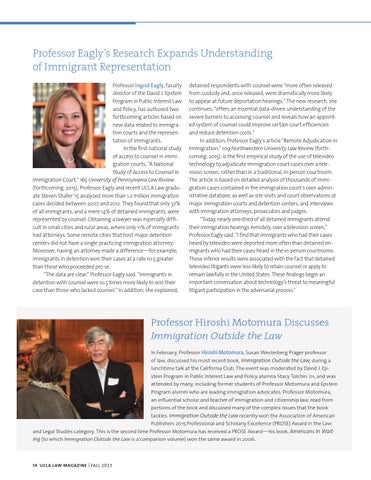
Professor Eagly’s Research Expands Understanding of Immigrant Representation Professor Ingrid Eagly, faculty director of the David J. Epstein Program in Public Interest Law and Policy, has authored two forthcoming articles based on new data related to immigration courts and the representation of immigrants. In the first national study of access to counsel in immigration courts, “A National Study of Access to Counsel in Immigration Court,” 165 University of Pennsylvania Law Review (forthcoming, 2015), Professor Eagly and recent UCLA Law graduate Steven Shafer ’15 analyzed more than 1.2 million immigration cases decided between 2007 and 2012. They found that only 37% of all immigrants, and a mere 14% of detained immigrants, were represented by counsel. Obtaining a lawyer was especially difficult in small cities and rural areas, where only 11% of immigrants had attorneys. Some remote cities that host major detention centers did not have a single practicing immigration attorney. Moreover, having an attorney made a difference—for example, immigrants in detention won their cases at a rate 10.5 greater than those who proceeded pro se. “The data are clear,” Professor Eagly said. “Immigrants in detention with counsel were 10.5 times more likely to win their case than those who lacked counsel.” In addition, she explained,
detained respondents with counsel were “more often released from custody and, once released, were dramatically more likely to appear at future deportation hearings.” The new research, she continues, “offers an essential data-driven understanding of the severe barriers to accessing counsel and reveals how an appointed system of counsel could improve certain court efficiencies and reduce detention costs.” In addition, Professor Eagly’s article “Remote Adjudication in Immigration,” 109 Northwestern University Law Review (forthcoming, 2015), is the first empirical study of the use of televideo technology to adjudicate immigration court cases over a television screen, rather than in a traditional, in-person courtroom. The article is based on detailed analysis of thousands of immigration cases contained in the immigration court’s own administrative database, as well as site visits and court observations at major immigration courts and detention centers, and interviews with immigration attorneys, prosecutors and judges. “Today, nearly one-third of all detained immigrants attend their immigration hearings remotely, over a television screen,” Professor Eagly said. “I find that immigrants who had their cases heard by televideo were deported more often than detained immigrants who had their cases heard in the in-person courtrooms. These inferior results were associated with the fact that detained televideo litigants were less likely to retain counsel or apply to remain lawfully in the United States. These findings begin an important conversation about technology’s threat to meaningful litigant participation in the adversarial process.”
Professor Hiroshi Motomura Discusses Immigration Outside the Law In February, Professor Hiroshi Motomura, Susan Westerberg Prager professor
of law, discussed his most recent book, Immigration Outside the Law, during a lunchtime talk at the California Club. The event was moderated by David J. Ep-
stein Program in Public Interest Law and Policy alumna Stacy Tolchin ’01, and was
attended by many, including former students of Professor Motomura and Epstein Program alumni who are leading immigration advocates. Professor Motomura,
an influential scholar and teacher of immigration and citizenship law, read from portions of the book and discussed many of the complex issues that the book
tackles. Immigration Outside the Law recently won the Association of American Publishers 2015 Professional and Scholarly Excellence (PROSE) Award in the Law
and Legal Studies category. This is the second time Professor Motomura has received a PROSE Award—his book, Americans In Wait-
ing (to which Immigration Outside the Law is a companion volume) won the same award in 2006.
14 UCLA LAW MAGAZINE | FALL 2015