advancing
Thriving to 10 and Beyond
The School of Education looks to its brilliant future after achieving Top 10 within a decade

Fall 2022

The School of Education looks to its brilliant future after achieving Top 10 within a decade

Partnerships (CFEP) and its Borderless Leadership Conference, held at Centro Fox in Mexico, which brought together young scholars from the United States and Mexico to discuss critical binational issues and solutions. This transborder engagement, which focused on migration, connected universities and education schools across both countries to share research and discuss critical local challenges. You can read more on Page 15.
Also in this issue, the School engaged in a larger effort to increase dialogue about Asian American studies across the curriculum, during the alarming surge of Covid-19-related xenophobia and violence against the Asian and Pacific Islander communities.
Welcome to the sixth issue of UCI School of Education’s annual Advancing magazine.
This 2022-23 academic year is monumental for our School of Education community and family for many reasons. Along with celebrating our rise this year to No. 10 graduate schools of education and No. 4 among public graduate schools of education, according to U.S. News & World Report, we are also celebrating an important anniversary: 10 years as a school.
Our achievement of Top 10 within 10 years is a testament to the incredible dedication and prestige of our faculty, staff, students and alumni. Their collective scholarship, collaboration and passion are among the many traits that have built the foundation and blueprint for success and meteoric rise as a school. In this issue, you will learn more about the exceptional work and accomplishments of this community, and where the School is headed in the near future.
In looking at the next five years, a committee of the School’s key stakeholders and I engaged in a strategic plan refresh last spring to further advance and leverage the School’s strengths, partnerships and impact in Southern California and the state.
Starting on Page 2, you will see both my vision for the School and our strategic plan, as we endeavor to empower the next generation of scholars, educators and leaders, while producing and co-constructing responsive and innovative cuttingedge research and program design in education.

On Page 10, we highlight the first four years of achievement of the Orange County Educational Advancement Network (OCEAN), which is exemplified by the students and alumni who are making strides as leaders in advancing the education sciences. From their integral work in creating the national RESHAPE Network to earning highly competitive National Science Foundation (NSF) scholarships, these students and alumni demonstrate OCEAN’s positive impact on training and professional development, and showcase the meaningful, long-term results of its partnerships.
Next, we feature our Center for Educational
Our CFEP and Teacher Academy hosted its first Teaching for Justice Conference focused on these issues, bringing together K-12 educators in Orange County to establish, strengthen and expand Asian American classroom instruction. More about this work is on Page 20.
Within our undergraduate and graduate programs, students are also impacting the education and education sciences landscape, including these individuals featured in the magazine – starting on Page 26. Read about Jessica Cai, an undergraduate in our trailblazing B.A. in Education Sciences program, who is a researcher, a SAGE Scholar and has a special interest in education technology. Or, Shannon Klug, who is shining in our Bilingual Authorization Program as a candidate in our Multiple Subject Credential in the M.A. in Teaching program. And, Valery Vigil, a Ph.D. in Education candidate who was awarded an NSF graduate research fellowship and recent winner of an Association of Doctoral Students in Education award.
The School has come a long way from its humble beginnings, which you can read about in a historical timeline on Page 7, when we had an inaugural class of three students as an Office of Teacher Education more than 50 years ago. We have grown exponentially since then and our far-reaching impact on education now spans across the nation through the research and work of our renowned faculty and award-winning student population.
This magazine is just one of the many ways we are honoring and uplifting the School of Education’s past, present and future in our 10th anniversary year. I hope you join us for our many celebratory activities this year as we work to ensure a brilliant and equitable future for the next generation.
Sincerely,
Frances
Contreras Dean and ProfessorUCI
School of EducationConversation with the Dean Q&A with Dean Frances Contreras about her vision and building on the School’s successes
Looking to the Next 5 Years Highlighting the School’s 10 strategic priorities to contribute to the Brilliant Future of the university
Historical Impact of the School Timeline of the School’s 10+ years of empowering scholars, educators and leaders
Leaving a Lasting Imprint Four years in, the Orange County Educational Advancement Network is making waves
Borderless Leaders Center for Educational Partnerships builds U.S.-Mexico university collaborations
24 Environmental Education Initiative Relaunch 26 Spotlights: Students in Our Degree Programs 34 Foster and Insecure Youth Conference 35 CFEP-hosted Summer Programs 50 By the Numbers: School Facts
Research 30 Local Northgate Market Par tnership 32 William T. Grant Foundation Grants
Faculty 36 Spotlight: Jacquelynne Sue Eccles 38 National Academy Professors 39 New Faculty Alumni 40 Spotlight: Lisa Moe, MAT ’16 42 Class Notes
Teaching for Justice Teacher Academy joins educators to confront anti-Asian hate through classroom instruction
Advancing Fall 2022 Volume 6, No. 1
Produced by the University of California, Irvine School of Education
Dean Frances Contreras
Sr. Associate Dean Young-Suk Kim
Associate Dean of Faculty Development and Diversity Elizabeth Peña
Giving 48 Spotlight: Stacey Nicholas 52 Special Thanks to Our Supporters
Assistant Vice Chancellor, Educational Partnerships
Stephanie Reyes-Tuccio
Assistant Dean Tammy Ho
Executive Director of Development Duane Rohrbacher
Director of Communications & Marketing Advancing Editor Stacey Wang Rizzo
UCI School of Education 3200 Education Irvine, CA 92697-5500 949-824-8073 education-communications@uci.edu education.uci.edu
Advancing magazine sits down with Frances Contreras, dean and professor at the UCI School of Education, to discuss her vision and five-year plan, what sets the School apart, building on the School’s Top 10 momentum and more.
Dr. Frances Contreras, whose appointment as the UCI School of Education dean began on January 1, 2022, is the first Chicana/Latina dean to head a school of education in the University of California system and the third dean in the School’s history. A first-generation college student, Contreras is widely acclaimed for her research on academic diversity and access from preschool to the Ph.D. and her leadership in equity and diversity. Prior to her tenure as dean, she was most recently associate vice chancellor for equity, diversity and inclusion at UC San Diego. She earned her bachelor’s degree at UC Berkeley, a master’s degree from Harvard University and a Ph.D. in education from Stanford University.

Advancing: What is your overall vision for the UCI School of Education under your leadership?
Dean Contreras: I plan to engage a community of scholars and stakeholders in an era of tremendous societal change to further the School’s reach and impact through our programs, courses and pedagogy, and research projects, while also translating our key findings to inform and improve education at all levels. The School of Education is already one of the best schools in the nation. To me, the role of a dean is to facilitate the conditions for excellence and to improve the infrastructure for all of us to thrive. This includes supporting progress, strategic growth, equity at all levels, and expanding our efforts in areas that the faculty and our stakeholders deem to be priorities.
Now that you’ve had time to get to know the School and its community, what would you say are the qualities that set the School of Education apart?
The School of Education is comprised of a dynamic, innovative and impressive group of scholars committed to equity. Our faculty interests span prekindergarten through postsecondary education pathways, motivation, policy, and learning in multiple contexts. This team of scholars cares deeply about education transformation. What sets the School of Education apart from many of the institutions I have been engaged in is the tenacity to not only produce cutting-edge research, but to ensure that the work we are collectively engaged in is timely, relevant and answering the challenges facing education today.
What excites you the most about your tenure as dean of the School of Education?
The possibilities that lie ahead to propel the School as a resource for the Orange County region, state and nation on critical issues across the P-20+ (prekindergarten to higher education and beyond) education continuum. We are collectively working to impact not only the field of education, but also the policy and practice landscape to improve equity and access in education for all children and students.
What are the biggest opportunities for the UCI School of Education in the next few years?
We remain poised to grow the faculty, which presents a tremendous opportunity to strategically
grow in areas that complement our faculty research efforts and programs. It is also critical that we examine how we serve our students and key stakeholders, as well as support staff and their pathways to professional advancement and growth.
Another key opportunity relates to supporting K-12 teachers. We have and will continue to witness unparalleled turnover from an overly taxed group of professionals. How we support, engage and respond to the needs of teachers in California is a critical investment for our School of Education.
Finally, the higher education landscape is changing. We are witnessing the prevalence of online courses, hybrid work and management, and overall national declines in enrollment. If we are to remain among the top schools of education, our academic programs must continue to examine how we serve our students, so that we can continue to lead by example.
Speaking of the changing higher education landscape, you worked with a committee to create a five-year strategic plan to build on the School’s successes. Could you share about the plan and what it means for the School as it looks toward the future?
A 15-member strategic planning committee comprised of all stakeholders (faculty, staff, students, alumni and key donors) engaged in a strategic plan “refresh” in Spring and Summer 2022. This process resulted in 10 strategic priorities that build upon our core strengths, which the School will continue to invest in as we build upon a solid foundation of engaging in impactful research, authentic partnerships and leaders in educational innovation.
What is the greatest challenges facing education today and how is the School planning to address these issues under the new plan?
There are several areas of the strategic plan, as noted in the 10 key priorities, that the School will prioritize moving forward. These elements of the plan reflect the strong research areas within the faculty – including early learning, language, bilingualism and multilingualism, out of school learning, motivation, digital learning and leading in a data science revolution.
Areas we see education systems struggling with relates to high teacher turnover. Our efforts to strengthen and build upon the Teacher Academy’s work will enable the School of Education and the
Center for Educational Partnerships (CFEP) to further expand professional development opportunities for current and future teachers. We want the School of Education to be an academic and professional home where these individuals can come back to, engage with, and utilize as a source of ongoing support and innovation, as they navigate their careers as teachers and leaders.
We also see the challenge for many universities in sustaining their partnerships with the local community. Here, our Orange County Educational Advancement Network (OCEAN) serves as a model for how a school of education can engage in co-designing program interventions and research as true partners in the inquiry process.
Finally, CFEP remains a key component of the School of Education, as it works to provide programs and opportunities for first-generation and low-income students through long-standing programs such as GEAR UP, TRIO and Upward Bound; but also its emerging programs and efforts, such as the SSTI program geared toward onboarding future community college transfers to UCI.
The School of Education reached Top 10 graduate schools of education within 10 years of becoming a school. How do you hope to continue that momentum?
This is an incredible group of faculty, staff, students and alumni that deeply care about education equity, access and moving the needle on education transformation. To this end, as the School of Education celebrates its 10-year anniversary, it is critical to reflect on the impressive rise to this national standing, while also staying true to our collective mission to leave a lasting imprint on education rooted in equity and justice. That the work we engage through our initiatives, labs and centers moves policy, practice and mindsets to go beyond accepting what is or what was; that we work to push for content, pedagogy, technological access, empowered educators, and services for all youth and learners of all ages. Looking to the future, it will also be important to step forward to lead in areas that are evolving rapidly, such as environmental education, and serving as a hub for educational innovation, culturally and linguistically responsive approaches to pedagogy, data science, and artificial intelligence in education across P-20+ systems.
The UCI School of Education improves access to high-quality educational opportunities for all individuals in our university, community and beyond. We are dedicated to producing responsive and innovative cutting-edge research, program design and a next generation of educators that will contribute to a transformational shift in education. We are committed to ensuring that all students are empowered and prepared to lead successful and productive lives and careers in a democratic society.


The UCI School of Education’s strategic efforts for 2022-27 focuses on engaging in research that is impactful, advances the field, and facilitates partnership and innovation across the P-20+ education continuum with a focus on both systemic and out-of-school learning contexts.
The UCI School of Education has identified 10 strategic priorities and initiatives to focus on for the next five years to leverage our collective strengths and fulfill our vision of serving as a catalyst for innovation, inspiration and transformation. These strategic priorities are consistent with all four pillars of UCI’s Strategic Plan and align with our collective efforts to contribute to the Brilliant Future of the university and the School of Education.
The UCI School of Education’s OCEAN represents our commitment to conducting relevant, innovative research in partnership with Orange County and Southern California. OCEAN has established more than 50 research-practice partnerships with local schools, districts and community organizations, and has secured over $14.6 million in grants. OCEAN is also prioritized in the UCI Strategic Plan’s Pillar 3: Great Partners by “making regional connections to serve the people.” OCEAN has an impressive track record for developing a strong foundation for research-practice partnerships that are impactful, relevant, innovative and in service to the broader region.
For more than 25 years, CFEP has engaged with schools and the community to establish lasting and impactful partnerships; and supported schools and districts as well as first-generation and low-income students to attain higher education. They have led the charge for the university, fulfilling several pillars of the UCI Strategic Plan by serving as great
partners to the region, elevating the student experience and working to forge new paths towards a brilliant future. CFEP epitomizes authentic community engagement and its work in Southern California expands educational initiatives to increase student pathways to and through higher education.
The UCI School of Education is a leader in digital learning, literacy access and is poised to further lead in this data science revolution. Our faculty are engaged in key P-20+ projects that inform the development of systems for data science use and innovative practice, pedagogy and ultimately expand access and equity in an increasingly technology-driven society. We are also establishing a master’s degree in education sciences, with the first concentration in digital literacy and data analytics, that provides students with relevant content and preparation for the industry, and the skills to develop solutions-oriented approaches to learning and computing.
The UCI School of Education is poised to further its role as a data leader for the state, creating a model for how schools of education may inform practice in real time through data-informed processes. Our role as a data leader and hub for connecting systems and creating seamless data sharing practices builds on our strengths and our centers that engage in research and practice partnerships across P-20+ systems of education.
The UCI School of Education is committed to serving as an academic and professional home to future and current teachers, and providing professional learning opportunities to engage them throughout their lifespan as K-12 system teachers and leaders. Our multi-faceted approach to cultivating teachers through our CalTeach, Master of Arts in Teaching and bilingual certificate programs is leaving a lasting imprint on the county and the Southern California region. The School is continuing to support teachers in the region and state by further institutionalizing the Teacher Academy as a critical component of teacher professional development, support and engagement.
The UCI School of Education faculty and students are committed to research related to STEM learning and pedagogy and are engaged in efforts to accelerate STEM equity in multiple education contexts. The School is working to ensure that all children and students have equitable access to opportunities in STEM. The School is building this area by advancing environmental science education through the Stacey Nicholas Endowed Chair in Environmental Education, while also leading conversations on environmental education through the collaborative Environmental and Climate Change Literacy Projects initiative.
The UCI School of Education recognizes that early learning impacts every child on their pathway through education systems, which is why we place high importance on informing early learning policy, practices and child development. Our School is committed to serving the whole child by developing holistic strategies and frameworks for connecting families early to educational resources, culturally responsive information and learning opportunities. Our faculty continue to establish synergistic research projects that inform practice and policy to maximize early learning opportunities. They are leaders nationally and have informed large-scale policy solutions to invest in parents, families and the future of our state and nation.
The UCI School of Education is committed to the study of bilingualism and multilingualism which has far-reaching benefits for our diverse
communities and our society. We are further committed to cultivating the next generation of bilingual, bicultural teachers through our bilingual certificate program. Through our teacher programs and research, we are advancing the science and knowledge on bilingualism and multilingualism that is informing California and the nation.
The UCI School of Education has a strong record of researchers committed to understanding the fundamental human developmental changes that impact culturally diverse children’s learning and wellbeing. Several School of Education centers and faculty are guided by holistic and culturally integrated frameworks that reflect the dynamic, multiple influences and bidirectional relations between persons and environment impacting lifelong learning and wellbeing. Our scholars are also collaborating with researchers globally to conduct research and develop intervention programs. We are committed to further strength ening our efforts that are enabling the School to remain a leader in this core area of research.
The UCI School of Education has a strong record of scholars that focuses on learning that happens outside of the classroom. Several faculty research projects are happening in partnership with key programs such as TRIO Scholars, Upward Bound, GEAR UP, the Center for After School and Summer Excellence (CASE) and the UCI Writing Project. This is a core value of the School and is also present through many of CFEP’s efforts, OCEAN’s partnerships and research projects, as well as several of our research centers where our scholars are co-designing programmatic approaches to learning and engagement.
The UCI School of Education faculty are engaged in research projects with community colleges and four-year universities that seek to inform institutional approaches to optimally serve first-generation students to thrive in college. We are expanding our faculty to inform student-centered approaches at UCI and the broader field of higher education. Also, through student-centered research, culturally responsive pedagogy and innovative approaches, we strive to enrich, graduate and inspire firstgeneration, civic-minded and diverse scholars who are committed to transforming education systems and society.
The School of Education’s rich history is rooted as far back as the university’s early years and its impact extends across a far-reaching community of scholars, educators and leaders.
Since its inception in 1965, the University of California, Irvine has been intertwined with the vitality of public education in Orange County by offering access to educational resources and enhancing the achievements of its diverse student population.

In 1967, the university established the UCI Office of Teacher Education, with an inaugural class of three students, to focus on professional preparation and high-quality training for teachers and administrators. Since then, UCI has awarded teaching credentials to thousands of aspiring educators.
Starting in 1973, the university offered a California Commission on Teacher Credentialing (CCTC)approved Internship Credential Program. Interns were employed as teachers of record by local school districts while working under a UCI field supervisor and a school district supervisor. The intern program thrived for 40 years.
The UCI Writing Project, the oldest of the California Subject Matter Projects, was established in 1978, to train teachers in a summer institute and in school-based professional development programs. It began hosting a summer youth program for prekindergarten through 12th grade in 1984
The Office grew to become the UCI Department of Education in 1991, signifying the first step for UCI in developing an emphasis on research and graduate studies in education.
Within three years, the Department initiated its first graduate degree program in 1994: a Doctorate in Education in Educational Administration, which was offered in cooperation with the University of California, Los Angeles Graduate School of Education & Information Sciences. The UCI/UCLA Joint Ed.D. program admitted students for the next 10 years.
In 2001, the Master of Arts in Teaching program was established and admitted its first students that summer. After 13 years, the program was redesigned during a two-year process in which program leadership drew on research on teaching, learning and effective practices in teacher preparation to derive goals and restructure the curriculum. This resulted in the development of a model program and the discontinuation of the non-degree stand-alone credential pathway. The graduate program continues to draw on research-based and equity-centered practices to prepare highly reflective, critical educators and teacher leaders.
A California State University/UCI Joint Ed.D. in Educational Administration and Leadership was introduced in 2003. A collaboration among CSU Fullerton; CSU Long Beach; CSU Los Angeles; California State Polytechnic University, Pomona; and UCI, the program admitted doctoral-level students until 2006 and graduated its last class in 2012
The education sciences minor was created in 2003, eventually becoming the second largest minor on campus.
2006 marked a significant year of growth as the Department reenvisioned its mission to encompass education across the entire lifespan, from early childhood to adulthood, and to foster learning and development in and out of school. It was the first school of education to combine education and human development across the prekindergarten to higher education continuum. Beginning that year, the Department also started its concerted effort to bolster the recruitment of nationally and
internationally recognized faculty from various disciplines.
In 2007, the Department introduced a Ph.D. in Education, which was designed to give students core knowledge of requisite educational theory and research while allowing them to focus on one of three areas of specialization: learning, cognition and development; educational policy and social context; and language, literacy and technology.


Since then, the doctoral program has produced graduates who are trained in studying the entire lifespan of human development and the myriad factors that contribute to education outcomes.
The School began a partnership in 2008 with the UCI School of Physical Sciences and UCI School of Biological Sciences to offer CalTeach – a highly diverse, community- and justice-centered program that prepares science and mathematics majors to earn their teaching credentials in four years as undergraduates. Since then, the program has served mostly minoritized students and has had an exceptionally high retention rate.
In response to a rising academic profile and administrative complexity, the Department became the UCI School of Education on July 18, 2012, by the Regents of the University of California with Deborah Lowe Vandell appointed as the founding dean. This was thanks largely to the recruitment of dedicated faculty whose strengths were in disciplinary perspectives such as psychology, economics, sociology, linguistics and neurosciences. Together, they shared a vision of creating an interdisciplinary, collaborative school of education unlike any other in the country.
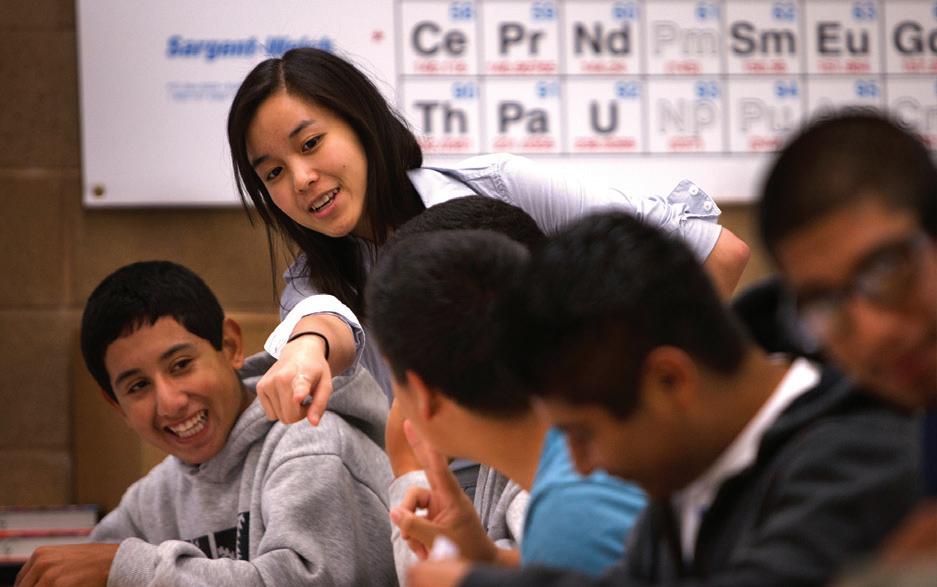
After seeing the benefits of the doctoral program’s holistic framework and the widely successful undergraduate minor in education sciences, the School initiated a Bachelor of Arts in Education Sciences in 2014. It was the first bachelor’s degree of its kind in the nation, centering on five core concepts: learning, human development, schools as organizations, social structure and stratification, and policymaking. The B.A. is also the first undergraduate major in the University of California system that focused on education as an academic discipline.
Richard Arum was appointed the second dean of the School of Education and began his tenure on June 30, 2016. Under his leadership, the School deepened its involvement with the community, diversified its ranks and expanded its research portfolio focused on the advancement of education sciences.
In 2018, the Center for Educational Partnerships (CFEP) was integrated into the School of Education. CFEP’s programs, partnerships and initiatives target the diverse and unique needs of four separate but interconnected groups: K-12 students, K-12 teachers, community college students looking to transfer and UCI undergraduates. CFEP celebrated its 25th anniversary in 2021, and has impacted millions of racially diverse and underserved students, families and educators in communities across Southern California.


The School of Education, in partnership with local K-12 schools and with the support of private donors, established the Orange County Educational Advancement Network (OCEAN) in 2018. As a network of research-practice collaborations

between K-12 schools, non-profit organizations and the School, OCEAN continues to engage in actionable scholarship to positively impact the diverse communities of Orange County and Southern California.
In the fall of 2018, the School of Education’s Teacher Academy was established to provide a professional community for educators to develop and enhance their practice, and to inspire and lead others in transforming instruction through professional development as well as teacher and administrator leadership opportunities. Supported by the SchoolsFirst Federal Credit Union, the Teacher Academy has hosted thousands of teachers and administrators across dozens of workshops and conferences.
In 2018, the School of Education partnered with the Department of Spanish and Portuguese to develop a minor in Spanish/English Bilingual Education to meet the important and growing need in K-12 schools.
Frances Contreras was appointed the third dean of the School of Education and began her tenure on Jan. 1, 2022. She was the first Chicana/Latina dean to head a school of education in the UC system.
In spring 2022, 10 years after becoming a school, the School of Education was ranked the No.10 graduate school of education and No. 4 among public schools of education by U.S. News and World Report
Today, the School is home to more than 1,000 students in its undergraduate and graduate programs and is a proud alma mater to a network of more than 10,000 alumni.
Entering its 5th year, OCEAN is making waves with graduate students and local schools.
By Christine ByrdThe Orange County Educational Advancement Network (OCEAN) was designed to create waves, but the speed and momentum of its impact has surprised even its founders.
Since its creation in fall 2018, OCEAN has grown from six local school partnerships to 20, and has attracted $8 million in funding from organizations such as the National Science Foundation, Chan Zuckerberg Initiative, Bill and Melinda Gates Foundation and the U.S. Department of Education.
“OCEAN’s growth has been amazing,” says June Ahn, professor of education and program director. “It’s a signal how much goodwill, energy and trust we’re building in the community. OCEAN’s success
also taps into the broader conversation about how universities can evolve to make a bigger contribution to society, beyond just producing knowledge.”
By matching graduate student and faculty researchers with local K-12 schools and non profit organizations, OCEAN enables educators to leverage the university’s expertise, while also training a new generation of education scholars on an increasingly popular model: research-practice partnerships.
“For UCI doctoral students, research-practice partnerships are becoming a big feature of their graduate training,” says Ahn. “They are learning how to do research that is much less ivory tower, and much more community-applied.”

OCEAN’s first cohort of Ph.D. student researchers have graduated and many have moved on to academic positions – at the University of Memphis, Utah State University, University of Nevada, Las Vegas and UCLA – where they continue to expand this model of collaborative research into new communities. The program has become a magnet attracting incoming graduate students to UCI, and even helping several of them earn prestigious fellowships and research grants.
A key feature of the OCEAN process is that UCI researchers and local educators are co-creating and designing solutions together – a model that differs from typical research methods.
“The traditional mode of university research is excellent at identifying issues and developing insights, but it’s really difficult to translate those findings into tangible programs, technologies or curriculum that make an impact,” explains Ahn. “We’re closing the loop by directly involving our partners from the get-go, which accelerates that translation process.”
Graduate student Socorro Cambero won a prestigious National Science Foundation Graduate Research Fellowship in STEM Education and Learning to support her ongoing research project with CalTeach, facilitated through OCEAN.
After earning a bachelor’s degree in education and gender and sexuality studies with a minor in queer theory at UCI, Cambero decided to pursue a Ph.D. in education, inspired, in part, by her sister who is a Latina math teacher.

“I would listen to her grapple with tensions but also the moments of joy she experienced in the classroom all while cognizant of the multiple layers of her experience as a woman, a woman of color, and a woman of color in STEM,” Cambero says.
Cambero embedded herself into CalTeach, which prepares undergraduates majoring in STEM fields to become middle and high school teachers. There, she works with Doron Zinger, director of the School of Education’s CalTeach; Naehee Kwun, CalTeach Teacher Network Facilitator; and Kris
Houston, CalTeach Academic Coordinator. Cambero facilitates critical reading groups, co-organizes an affinity space for women of color affiliated with the CalTeach program, and supports CalTeach students’ independent research projects. These activities encourage students to explore their own identities, which will inevitably inform the teachers they will become.
“My research is an ethnography of a STEM teacher preparation program that aims to prepare justice-oriented change agents to serve in high-needs schools and explores how and what spaces facilitate students’ process in becoming equity-minded teachers,” Cambero explains. She is following several cohorts of future teachers and plans to document their social justice identity development throughout their two years in the teacher preparation program and their first to two years in the classroom. Ultimately, Cambero’s work aims not only to support current students in CalTeach, but to inform future programming with the findings of her NSF-supported research.
Third-year graduate student Verenisse Ponce Soria was drawn to UCI in part by the opportunity to work with OCEAN. She joined a project funded by the Spencer Foundation on which Ahn and UCI Professor Richard Arum were co-principal investigators, focused on connecting a network of disparate services necessary to support foster youth and students with housing insecurity. They involved stakeholders across the county: social services, health services, the housing authority, the Orange County Department of Education and school districts.

“If a child’s family is evicted from their apartment, many different agencies need to be invoked to find housing, food and help with trauma,” explains Ahn. “And from the school perspective, all they see is that a child may not be coming to school for a couple weeks, and they’re falling behind, but the school doesn’t know why.”
Ponce Soria helped plan and coordinate a countywide fair in April 2022 that brought together practitioners from services across the county to learn from each other, exchange ideas and forge
relationships to better serve students in need. Now, stakeholders are looking at ways to host future events that will maintain the momentum and foster connections after the grant concludes.
Meanwhile, Ponce Soria has presented research at two national conferences explaining how this network was developed in partnership with the community. She shared her work directly with school leaders at the Carnegie Foundation Summit on Improvement in Education, and then with fellow researchers at the American Education Research Association conference.
“I always encourage students to join OCEAN,” says Ponce Soria. “The reason we go into education is that we believe there’s an impact to be made on the future. Anyone doing education research wants it to be practical and useful.”
While Ponce Soria hasn’t decided exactly what her future path will be, she knows she wants to continue engaging with the community.
“There’s a call from organizations, universities and think tanks looking to hire people who have experience in community-engaged work, so this is really preparing doctoral students for those types of jobs.”
“The reason we go into education is that we believe there’s an impact to be made on the future. Anyone doing education research wants it to be practical and useful.”
– Verenisse Ponce Soria
Ashlee Belgrave is a fourth-year Ph.D. student who was also drawn to UCI’s School of Education due to the community-based work of her advisor, Assistant Professor Andres Bustamante, and opportunities through OCEAN. Over time, her experiences with OCEAN have altered the direction of her research agenda – and helped expand the network outside of Orange County.
Belgrave got involved with the UCI’s Gaining Early Awareness and Readiness for Undergraduate Programs (GEAR UP), which provides a range of programming and support to underserved students and families in Compton. Belgrave wears dual hats of program coordinator as well as researcher, following cohorts of roughly 1,000 students year
by year, as they progress through high school and into college.
“Evaluation research tends to be removed from the people on the ground who need it, and it can be extractive – where researchers just take what they need and don’t give back to communities,” Belgrave says. “But because of the great relationship GEAR UP has with the schools, my research is something they can use when writing federal grant evaluations, applying for new grants or considering new programs.”
“I want people to know how special OCEAN is,” says Belgrave. “For me as a grad student, having this network, this collaborative space to do research in service to communities while also furthering academic careers, is so important.”
 Beyond OC: Ashlee Belgrave
“For me as a grad student, having this network, this collaborative space to do research in service to communities while also furthering academic careers, is so important.”
–Ashlee Belgrave
Chris Wegemer, Ph.D. ’21, was among the first UCI students to participate in OCEAN. During his three years with the program, he collaborated with the Samueli Academy, a public charter school in Santa Ana, serving as a resource for school administrators who wanted to make data-driven decisions.
A former classroom teacher and union organizer, Wegemer found OCEAN to be an ideal vehicle for his growth as a scholar.

“I gravitate toward community-based initiatives like OCEAN, which position scholars as mutual partners with educational practitioners,” Wegemer says. “We acknowledge that school leaders and teachers are experts, the holders of knowledge, and we’re co-creating together.”
As interest in this type of partnership grew among students across the country, Wegemer and a group of UCI grad students collaborated with students from other top universities to launch the Rising Educational Scholars Helping Advance Partnerships & Equity (RESHAPE) Network, a resource for earlycareer scholars engaging in research-practice
partnerships. The network now boasts more than 100 members from 20 universities internationally.
Today, Wegemer is a postdoctoral scholar at UCLA, where he is working on a collaborative research project with Ahn, two UCLA researchers, and the Los Angeles Unified School District, funded by the William T. Grant Foundation. He plans to pursue research-practice partnerships in the future.
“UCI has been at the forefront of this movement and is unique to the extent that it provides resources and funding to allow graduate students to take on these partnerships,” says Wegemer. “So many grad students previously taught or worked in schools and now want to connect with people to foster positive change in society. OCEAN is an opportunity for us to do just that – in an inclusive process that collaborates with communities to inform progress.”
If these first four years of OCEAN have been a startup phase, Ahn’s focus for the next phase is sustainability – solidifying the curricular model and ensuring the program’s continuity even as individual people come and go.
“Our biggest need is maintaining the relation ships we’ve built with the community, which takes time and effort,” says Ahn.
While Ahn celebrates OCEAN’s significant growth and extramural funding, he points out that not all the program’s impacts are tangible.
“There are impacts and benefits that don’t get encapsulated in the millions of dollars of fundraising, such as human development,” Ahn says. “We’re helping each other, and folks are learning, developing and jumping off from their experiences –not just our graduate students but our community partners as well. Working together develops everyone’s capacity.
“You can’t quantify the trust and relationships OCEAN has built,” Ahn continues. “But as universities need to become more and more relevant, trustful relationships are going to be a core resource. We have experience building that, and I’m really proud of that impact.”
UCI spearheads cross-border collaborations to prepare the next generation of leaders.
 By Christine Byrd
Our greatest global challenges –pandemics, climate change, poverty, refugees – span the world, regardless of national borders.
In an effort to prepare a new generation of leaders to tackle transnational issues by collaborating across borders, the UCI School of Education launched its first Borderless Leadership Conference through its Center for Educational Partnerships this summer, taking dozens of California students to Mexico to forge research connections and international relationships.
“Whether we are responding to an enduring pandemic, climate change disasters, or the eternal movement of people around the globe, we have learned the border does not stop a virus, a tornado, or human migrations, but the concept of the border
has limited our thinking and our collaboration,” says Stephanie Reyes-Tuccio, UCI assistant vice chancellor for educational partnerships, in opening remarks at the conference.
Undergraduate and graduate students from disciplines ranging from public health to social ecology participated in the conference, coming from UCI, UC San Diego, Long Beach City College and DREAM Fellows from other UC campuses who were funded through UC Collaborative to Promote Immigrant and Student Equity (UC PromISE) – a multicampus research initiative with the goal of informing policies and practices to advance equity and inclusion for undocumented and immigrantorigin students.
“One of the reasons global problems such as immigration are so difficult to resolve is not just because disciplines tend to stay in their own sandbox, but that too many people think immigration is the exclusive domain of social science. In fact, immigration impacts multiple sectors of society –including public health, business, labor and education,” says Reyes-Tuccio. “We found that students really appreciated the interdisciplinary presentations and the opportunity to think about immigration issues from a variety of different lenses.”
Former Mexican President Vicente Fox gave the keynote address, and hosted the conference at his presidential library and museum, Centro Fox, in Guanajuato, Mexico, June 20-22, 2022. Students heard from Juan Hernandez, Secretary of Migration and Foreign Affairs for the State of Guanajuato, attended research presentations by graduate students and faculty, and watched a screening of Llévate Mis Amores (2014), followed by a Q&A with the film’s producer, Indira Cato. UC graduate
students presented first-person accounts of attending college in California while undocumented, as well as research about student advocacy efforts on behalf of their undocumented peers. Interactive activities with students from multiple Mexican universities and sight-seeing opportunities encouraged students to share stories and build relationships.

“This initiative led by our Center for Educational Partnerships advances critical discussions and efforts that affect our young global leaders in education and beyond. It is through these important collaborations and connections that the UCI School of Education faculty, students and alumni can be integral in the conversations and solutions that will transform the educational landscape to become more equitable and accessible for all,” says Frances Contreras, UCI School of Education dean and professor.
For Valery Vigil, a third-year Ph.D. student in education, the conference opened her eyes to how
border conflicts may be affecting the families she works with in her research on bilingual education programs. The daughter of Mexican immigrants, Vigil grew up in California’s Central Valley.
“I wasn’t directly facing these immigration issues as a child. But it’s important for me now, when working with parents, that I make an effort to be aware of what’s happening at the border and the ways it can influence how parents are showing up for their kids,” Vigil says. “Families’ immigration stories affect them a lot, and hearing other students’ stories helped bring that to my attention even more.”
Students from both sides of the border had opportunities to learn about possible career pathways in academia, and to mentor and receive mentorship.

“I had a really great time connecting with students and faculty from other institutions in California and Mexico, sharing my experience and my journey,” says Andres Bustamante, assistant professor of education at UCI. “I think all of that has significant implications for students’ education and career trajectories.”
One of the reasons global problems such as immigration are so difficult to resolve is not just because disciplines tend to stay in their own sandbox, but that too many people think immigration is the exclusive domain of social science. In fact, immigration impacts multiple sectors of society – including public health, business, labor and education.
Stephanie Reyes-Tuccio, assistant vice chancellor for educational partnershipsBuilding on connections he made at the conference, Bustamante hired a UCI public health student as a research assistant, and a student from Mexico as a project coordinator.
“Our community college students had the opportunity to see themselves as future university and UCI students, our UCI undergrads got to see themselves as future Ph.D. students, and our grad students caught a glimpse of their potential as future faculty. All of our students were encouraged to see themselves as future global leaders,” says Reyes-Tuccio. “Our students are open to the possibility, indeed (are) planning to play a role in addressing issues at a global level. And they know it starts with building relationships.”
Graduate student Maritza Morales-Gracia, starting her fifth year in education at UCI, made connections on both sides of the border that she plans to leverage as she finishes her degree and begins looking for post-doctoral research opportunities and academic positions.
“I’ve tried my best to stay up to date on the politics and history of Mexico and the border, but there’s a lot of nuance that I learned about from other students, especially while we were enjoying
meals together and getting to know each other,” says Morales-Gracia.
“The highlight of the conference for me was the networks and community, realizing there are so many people willing to work with you, it’s just a matter of reaching out and maintaining those relationships,” she adds. “I just let myself be inspired by the amazing work all these people are doing.”
For many students, this trip to Mexico was their first, despite having family members there.
“Mexico is our neighboring country, literally two hours away, and over a quarter of our students have personal or family ties to Mexico. Yet we offer exceedingly few academic opportunities for students to be connected to Mexico,” Reyes-Tuccio points out.
Hosting the conference on the other side of the border also allowed California students to leverage their bilingual skills in an academic environment.
“Spanish fluency is cultural capital that many of our students have,” says Reyes-Tuccio. “And they don’t often get the opportunity to use that prized gift, and have it acknowledged in an academic setting. This was also a rare and critical opportunity

for our Latinx students to see their history, their families, their heritage and their culture being connected to their identities as scholars and university students. We speak a great deal about valuing the cultural capital and linguistic assets of Latinx students at a Hispanic Serving Institution. This experience made that aspiration a reality.”
Reyes-Tuccio began planning the conference after visiting Centro Fox last fall and discussing with the former president his interest in developing leaders with the skills and relationships to work on binational issues. Migration, a hot-button topic on both sides of the border, emerged as the logical choice to focus on for the inaugural conference.
Once School of Education Dean Contreras committed to funding 10 education students to participate in the conference, others followed suit – business, social sciences, social ecology and public health. UC San Diego Extension had a pre-existing collaboration with Centro Fox and joined the effort, as did Long Beach City College, led by UCI alum Mike Munoz ’02. UC PromISE also provided funding for UC DACA students – those brought to the U.S. as children without documents –to travel abroad for educational purposes and then return to the U.S. legally.
Most see the success of the 2022 conference as a launching point for continued work.
“It no longer makes any sense to think about addressing the challenges that we face in this global society without thinking about teams of experts who come from different disciplines and are willing to work interdisciplinarily, because that’s what’s required for the future,” says School of Education Professor Gustavo Carlo. “This conference provides a proven platform for developing those future leaders – those who will have a more expansive perspective on how to best address the challenges and needs of the future.”
“At UCI, we have fantastic leadership and great scholars doing policy work and basic research in the School of Education,” Carlo adds. “Those are critical because Latinos are now the largest ethnic minority in the country, and we’re continuing to grow faster than any other racial minority group.”
–Gustavo Carlo,
Contreras and Reyes-Tuccio are already planning to make the Borderless Leadership Conference an annual event, and to sponsor one focused on binational education issues, targeted for 2024.
“We know there is great potential for an international education-themed gathering to produce helpful research and genuine dialogue that will inform our own school systems, leaders and policies with a deeper understanding of the educational context that many of our immigrant students experience,” says Reyes-Tuccio.
She says that a better understanding of the skill sets students bring with them from Mexico, and learning how to effectively communicate with newly immigrated parents would help students as they transition into U.S. schools.
“I believe we can make the future better by providing our students these special cross-cultural and international opportunities. It’s our job to help them understand the global dimensions of the cascading challenges the world is facing today,” says Reyes-Tuccio. “The university is preparing individuals that will be ready to help lead us forward. The positive impacts will be seen on both sides of the border.”
It no longer makes any sense to think about addressing the challenges that we face in this global society without thinking about teams of experts who come from different disciplines and are willing to work interdisciplinarily, because that’s what’s required for the future.
UCI professor
Amid the dramatic rise in anti-Asian hate, educators share resources and build community.
By Christine ByrdGrowing up in the San Gabriel Valley’s thriving Chinese American community, Stacy Yung knew her great-grandfathers were buried in the nearby Chinese Cemetery of Los Angeles without their wives or daughters, but no one ever discussed the history that shaped her family’s experience.
Not until Yung took an Asian American studies course as a UCI undergraduate did she begin to understand the immigration laws that for decades limited Chinese immigration and prevented Chinese women and families from coming to the U.S., and the many challenges her family faced when they settled in Southern California.
“It was life changing, seeing my lived experience and my life centered in the class,” she remembers. After finishing her bachelor’s degree in social
science that specialized in secondary education in 2007, and her master’s in teaching in 2009, Yung became a middle school history teacher, determined to incorporate experiences and voices that reflected the diversity of her classroom.

“I was going to teach history the way I wished I had learned it, a history that is inclusive of all students’ cultural knowledge, histories and lived experiences,” Yung says.
Now, that vision has turned into a movement: Yung left the classroom to pursue her passion of providing culturally relevant resources and support to teachers, and is part of a team of UCI faculty, staff and alumni intent on empowering educators who want to incorporate Asian American histories and experiences for their K-12 classrooms.
After COVID-19 was first identified in Wuhan, China, and began circling the globe, hate crimes against Asian Americans skyrocketed, stoked by public figures who dubbed it the “China virus,” and fueled by centuries of structural racism.
In 2020, the OC Human Relations Commission reported an 1,800% increase in anti-Asian hate incidents. California – home to more than 5.8 million Asian Americans – saw hate crimes against Asian Americans continue to rise, increasing 177.5% from 2020 to 2021, according to the California Department of Justice.
Some teachers saw the violence as a predictable result of the lack of education and empathy about the Asian American experience.
“When you don’t know anything about someone’s story, it leaves room for stereotypes and bias,” says Jeff Kim, a teacher in Anaheim Union High School District, adding that he never had a teacher who looked like him going to school in California, and was never taught Asian American studies during K-12.
Through a series of town halls and community forums in 2020 and 2021, Yung and fellow teacher and UCI alumna Virginia Nguyen connected with UCI faculty and staff coalesced around a shared vision: supporting K-12 teachers who want to integrate Asian American studies into their curriculum.
On April 29-30, 2022, the committee presented Teaching for Justice: A Spotlight on Teaching Asian American Studies Across the Curriculum, which drew 250 educators from as far away as Hawaii and New York.
“We are centering teachers’ voices because we know that the classroom is the place where we can support learning for justice,” says Nicole Gilbertson, director of the UCI Teacher Academy and the UCI History Project, kicking off the conference’s first day, which was held virtually. “We honor the knowledge that our committee brings to this work, and also seek to learn from one another.”
Conference organizers assembled a powerhouse lineup of speakers representing a variety of Asian American backgrounds and experiences including educators, researchers, artists, filmmakers,
archivists, business owners, community organizers, and even a keynote by television personality and author Lisa Ling.

“When there’s no reference to a community’s inclusion throughout history, throughout pop culture, it becomes so easy to overlook an entire community and to even dehumanize it,” says Ling. “And that’s what we’re seeing today.
“It’s our kids who need to be empowered,” Ling continued, reflecting on her two children, ages 9 and 6. “If my generation had the opportunity to immerse ourselves or even to know about this rich Asian American history, I don’t think we would be where we are today with violence and vitriol and racism and discrimination just so pervasive in our culture.”
When there’s no reference to a community’s inclusion throughout history, throughout pop culture, it becomes so easy to overlook an entire community and to even dehumanize it. Lisa Ling
Conference organizers, from left, Mary Nguyen, undergraduate; Thuy Vo Dang, curator, Southeast Asian Archive; Stephanie Reyes-Tuccio, assistant vice chancellor for educational partnerships, Center for Educational Partnerships; Fuko Kiyama, graduate student; Tuyen Tran, assistant director, California History-Social Science Project; Wenli Jen, founding president, School of Education Alumni Chapter; Naehee Kwun, UCI Teacher Network Facilitator; Jeff Kim, teacher, Anaheim Union High School District; Nicole Gilbertson, director, UCI Teacher Academy and UCI History Project; Stacy Yung and Virginia Nguyen, co-founders of Educate to Empower. (Not pictured: Judy Wu, professor of history and Asian American studies)
Educators at the Teaching for Justice conference were eager to incorporate diverse voices into the curriculum – regardless of their own ethnic background, or even the subject they teach.
“As a math teacher, you don’t typically see anyone in my field incorporating any of these things in their lessons,” says Naehee Kwun, Teacher Network Facilitator for UCI’s CalTeach Science & Math program. “It takes more effort and it takes collaboration. I realized that student identities have to connect to what they’re learning and it’s our responsibility as teachers to do this.”
One first-year teacher who attended the conference wrote, “At my current site, 55% of the student population is Asian, yet the staff is majority White. With the lack of representation in the staff and the high percentage of Asian American students, I find it vital for students to see themselves in the curriculum they are learning. Though I am a science teacher, I want to challenge
my current curriculum and showcase more voices from minority groups.”
For conference organizers, this is exactly the outcome they hoped for.
“I have so much respect for teachers,” says Thuy Vo Dang, curator of the Southeast Asian Archive. “These are the folks who understand how powerful knowledge is, and have that sense of learning from others’ histories and experiences can only enrich your own life and worldview. They harness that and are hopefully going to bring that into the classroom to their students – not to try to flatten out differences, but to coexist and thrive together.”
While the first day of the conference was online, day two brought educators from across Orange County to gather in-person at the UCI Student Center and enjoy a sense of catharsis – both from being face-to-face and from finding a sense of community support after such a difficult two years.
“What really stuck with me was how healing the conference was, to me, and to many people,” says

Fuko Kiyama, a School of Education Ph.D. student who coordinated the conference volunteers.
“There were a lot of tears because it felt like such a safe and loving atmosphere.”
Throughout the event, participants were asked to pause for a moment and dedicate their learning to someone – an ancestor, a parent who sacrificed to immigrate, or even their childhood selves, who needed to feel seen.
“I wish I had this when I was a student growing up in Southern California,” says Yung in the conference’s opening session.
Soon, all public K-12 students in California will take an ethnic studies class. With the passage of Assembly Bill 101, which Gov. Gavin Newsom signed into law in October 2021, high schools will be required to offer a semester-long course in ethnic studies beginning in 2025-26. Already, educators are working on curriculum and professional development programs to prepare educators to teach these new classes.
“For 20 years, I’ve been a believer in ethnic studies, but just in the past two years we’ve seen real movement around getting ethnic studies into the K-12 curriculum,” says Vo Dang. “It’s not new, but a lot of the current teachers left college before Asian American, African American and Chicano/ Latino studies became part of the higher education landscape, and so they don’t really know how to talk about these concepts.”
Vo Dang and UCI colleagues believe that incorporating local voices and perspectives will be critical to the success of ethnic studies programs.
“It’s essential for teachers to not only teach social movements of specific ethnic groups in California, but also to create classroom communities where students can see themselves as active change agents in their local communities,” says Gilbertson.
As a large producer of Asian American educators in the region, UCI plays a special role in equipping teachers with the tools and resources to incorporate culturally relevant materials in their classrooms, and Asian American stories in particular.
Gilbertson is working with Vo Dang, the co-author of A People’s Guide to Orange County (UC Press,
2022) and the organization that Yung and Nguyen established, Educate to Empower, to provide resources for effective ethnic studies curricula in local classrooms. Yung and Nguyen have offered workshops through the UCI Teacher Academy since 2021 that focus on topics such as the anti-racist classroom, stopping AAPI hate, and creating affinity spaces for local educators of color.
“Because it’s UCI, because it’s a research university, and because of the people we have on the team, this was a real opportunity to create a community of educators made up of alumni of teachers,” says Gilbertson. “There was this emotional aspect of coming together and sharing stories at the conference that forged a sense of community, and that’s something UCI can continue to facilitate.”
Ninety percent of survey participants said they acquired new knowledge and skills during the conference. Organizers assembled robust curriculum resources based on the sessions to provide attendees, and they are actively working on ways to continue supporting the burgeoning community of local educators who want to weave Asian American studies into their classrooms.
“Well beyond just bringing resources, we built community from this conference,” says Vo Dang. “This is UCI’s responsibility regionally – not just to our own students and faculty, but to our larger community.”
It’s essential for teachers to not only teach social movements of specific ethnic groups in California, but also to create classroom communities where students can see themselves as active change agents in their local communities.
–Nicole Gilbertson, UCI Teacher Academy director
The UCI School of Education leads an effort in environmental science education and pedagogy with the relaunch of a UC-CSU environmental and climate change literacy partnership and its first endowed chair.

As the world confronts rapid climate change, the UCI School of Education is working toward curtailing the crisis in the classroom and in the community.
In its commitment to advancing environmental science education, pedagogy and access, the School relaunched the statewide higher education initiative known as Environmental and Climate Change Literacy Projects (ECCLPs) and established a new endowed chair in environmental education, the Stacey Nicholas Endowed Chair in Environmental Education. Both were made possible by a transformational $3 million gift from School of Education supporter and UCI Foundation Trustee Stacey Nicholas.
ECCLPs serves as a University of California and California State University partnership focused on advancing prekindergarten to 12th grade environmental and climate change literacy, justice and action. The new chairholder will work with the
School and ECCLPs to ensure environmental and climate education is incorporated into teacher professional development, the education sciences and interdisciplinary majors. They will also provide expertise to move environmental and climate research, teaching and service goals forward.
“While we have begun to make progress nationally and globally to address this existential problem, the pace of change is too slow and our children unfortunately will inherit, confront and have to struggle with these challenges. At a minimum, we have to prepare the next generation of citizens to understand the multifaceted and complex environmental issues they will be facing,” says Richard Arum, UCI professor of education and sociology and ECCLPs executive committee member, who established the School’s efforts to relaunch the initiative during his time as School of Education dean.
The ECCLPs initiative, which was relaunched by a School-hosted event on Sept. 15, 2022, aims to graduate all California high school students to be literate and informed decision-makers about climate change and environmental justice issues and solutions with the hope that they will be the drivers to combat, mitigate and adapt to the effects of the climate crisis.
“[ECCLPs] is the first program in the nation to connect public universities to climate change education in primary and secondary schools. Its systemic and concerted approach will ensure understanding and awareness among the next generation of students of one of the most fundamental challenges facing them and the entire world,” shares UCI Chancellor Howard Gillman. “We are proud that UCI will serve as the hub of this effort, putting our amazing School of Education and our university at the center of climate change education and action.”
The ECCLPS initiative serves as an educational ecosystem for local prekindergarten through 12th-grade teachers, higher education institutions and community partners. It provides a connection for educators to the UC-CSU systems, relevant cutting-edge research and community partners to help inform prekindergarten to 12th-grade learning experiences.
“Moving out of a siloed approach to working in community with one another is essential to advance our collective capacity to address the urgent and large-scale crisis,” says Kelley Lê, UCI Science Project director and ECCLPs executive director.


ECCLPs provides support for California teachers to learn about climate change and nuanced ways to effectively teach about the politically controversial topic. The initiative’s comprehensive efforts also center on exciting the next generation of youth about science and nature; collaborating with local researchers to elevate teaching and learning to align with 21st century instruction; and outreach and engagement of regional community partners to create student-focused, culturally relevant and responsive solutions.
“For this work to be successful, we have to cut through the divisive politics confronting our nation. We have to work to bring together diverse stakeholders – including not just educators, but business leaders, workers and citizens – to promote increased understanding of the complex environmental challenges we are facing and how to promote innovative solutions that can garner collective community support,” Arum says.
“While the pandemic generated significant societal challenges that we are still working to overcome, a silver lining is that it made clear that society can change how we organize ourselves in fundamental ways.”
Jessica Cai skated and danced competitively in middle and high school. As in, seriously competitive. She trained year-round, won regional titles, and reached the pinnacle of her sports.
In 2014, she made it to the United States Figure Skating Championships. In 2017-2018, she won silver and gold, respectively, at the National Solo Dance Finals.
Competing at the highest levels at that age came with challenges; chief among them was keeping up with her education. As Cai spent more time
pursuing her athletic dreams, she had to sacrifice traditional schooling and the typical social life of a high school student. While her school provided her with a flexible, hybrid model for remote learning, Cai knew she wasn’t getting the same benefits and insights that her peers received each day in the classroom.
“That’s where my interest in online learning began,” she says. “I realized I was giving up a higher-quality education in order to pursue these things I was interested in outside of class. So, I became very interested in educational research and education technology – even if I didn’t know those terms yet – because I knew I wanted to help in that realm and improve remote education.”
Now a fifth-year senior at UCI studying education sciences, Cai is already doing just that. Last year, the SAGE Scholar earned a spot as a research assistant and instructional designer for online courses in the School of Education’s Science of Learning (SOL) Lab. The SOL Lab is a collaborative research group that explores the development of human thinking and learning. Lab researchers –under the direction of Lindsey Richland, professor and associate dean of graduate programs –investigate children’s cognitive development, reasoning skills, and learning in dynamic, complex, everyday settings.
“Jessica’s exceptional work ethic and indefatigable eagerness to explore, coupled with her heightened capacity to operate at high levels, made her uniquely qualified to immediately join the SOL Lab,” Richland says.
In her first project with the lab, Cai played an integral role in the planning, filming and editing of a project designing and videotaping Common Core math curriculum instruction. The results are helping to serve Title I elementary students in various Orange County school districts.

These students from the School of Education’s three degree programs are forging their academic paths to make a difference in their field.
By
Jessica Cai loads up on research opportunities and ed tech projects as an undergraduate SAGE Scholar.Photos by Ryan Miller/Capture
“That was such a great opportunity to dive deeper into ed tech,” Cai says. “I got to work with some really cool gadgets and cameras, even use Final Cut Pro for the first time and do a little bit of coding. It’s all about finding the best ways to support children’s learning development and get to higher order thinking.”
Cai received extensive training in the lab on instructional design and educational media production from her peer mentor, Joseph Wong. She also brought plenty of her own experience, which enabled her to both grasp the highly conceptual learning pedagogies being employed in the project, and also managing and troubleshooting the actual filming.
“It is not so often we see an undergraduate student operate at such high levels managing several critical roles at the same time,” Richland says.
This year, Cai is supporting research led by Rachel Baker, assistant professor of education, focused on learning how people learn – and how educators can make learning easier. Cai is also taking advantage of other academic avenues UCI offers. In addition to her double-major in education sciences and English, Cai has a double-minor in Chinese studies and business. And a recent internship with McGraw Hill, the educational publisher and ed tech industry giant, helped Cai realize her passion for instructional design could take her down nontraditional paths, if she so chooses.
“Whenever someone at school suggests something they think I might be interested in, I apparently just say ‘yes,’ ” Cai says with a laugh.
What’s next? Cai hopes to enter a doctoral program after she graduates; she has her eyes on UCI’s School of Education Ph.D. program and a concentration in Teaching, Learning and Educational Improvement.

And, yes, you can still find her at the skating rink quite often. Cai may not compete for medals anymore, but her time on the ice offers a respite from the classroom — and a reminder of her pledge to make remote learning easier for those following in her skate-grooved path.
“I never knew what I wanted to be growing up,” says Shannon Klug. “But I knew how I wanted my job to feel. I wanted to work in a field where heart matters and where every day is dynamic, flexible and exciting.”
Her career search has taken her back to her origin story. This fall, Klug, a native English speaker, will do her student teaching in Spanish – in the same Gates Elementary kindergarten classroom in Lake Forest where she was once a student. Making the experience even more memorable: She’ll be teaching alongside her own beloved kindergarten teacher.
“I am more excited about this journey beginning than anything else in my life,” Klug says. “My love for Spanish was born in that kinder classroom that I’ll now be teaching in, and that means so much to me. My teacher there, Sra. Maria Regueiro, was amazing. I have the best memories of her. And I feel so lucky to be paired with her because she is still so passionate about what she does.”
MAT student Shannon Klug champions bilingual education in the same kindergarten classroom where her own journey began.
Klug is a student in the School of Education’s Master of Arts in Teaching (MAT) + Multiple Subject Credential program, which graduates students with the skills and licensure needed to teach all grade levels and content areas within the elementary school curriculum. Students who complete the program graduate with both a master’s degree and a teaching credential. She’s complementing her studies by concurrently enrolling in the School’s Bilingual Authorization Program (BAP).
“My experience so far has been everything I was hoping for,” she says. “There are not many programs out there that support bilingual and equitable education the way UCI does.”
Susan Guilfoyle, her bilingual coordinator in the School of Education, says Klug enhances the program, too.
“Shannon is the very first graduate of a local dual-language immersion K-12 program to enter our MAT+BAP program at UCI,” Guilfoyle says. “I’m thrilled to have her perspective in our program, and I know she’ll make an outstanding bilingual teacher. I hope we see many more students like Shannon, too, who have a personal experience attending these types of schools.”
Klug’s inspiration for entering UCI’s Bilingual Authorization Program was born out of her own positive experience, starting at Gates Elementary, in Saddleback Valley Unified’s award-winning K-12 Dual Language Immersion program. Now, Klug has the chance to help students and families benefit from the same path that helped bring her dreams into focus.
“I want to be an advocate for bilingual education, and for the community and global perspective it provides,” she says. “I hope to encourage families that it’s possible to come into the program as a native English speaker and become fluent within a couple of years. And to show them that embracing a culture outside of my own has been beneficial in so many ways.”
Klug was a Spanish major as an undergrad at California Polytechnic State University, San Luis Obispo. She has always enjoyed the sciences, too, and wants to give her students the space and support they need to feel safe and confident about pursuing any subject that piques their curiosity. “For instance, science was never my strongest subject as a student and I didn’t enjoy the way we learned it,” Klug recalls. “But once I connected
with it, I loved learning new things in my science classes.
“With today’s new standards, I’m so glad that science is now more of a discovery process where students get to take charge of their learning. There’s less emphasis on memorization and performance, and more on practice and exploration. I’m so excited to connect science to my students’ worlds and help them become more confident.”
Ultimately, Klug wants to nurture a classroom environment where equality is valued and both teacher and student ideas are challenged in positive, respectful ways. That goal is part of Klug’s developing teaching philosophy, one she’s refining at UCI – founded upon her desire to engage with, enlighten and understand her students.
“I hope to make a difference in as many lives as I can,” Klug says. “We don’t always know what a student’s home life and support system is like, so sometimes being their teacher has an even greater impact than many people can imagine.”
Doctoral student Valery Vigil aims to increase Latinx interest in STEM fields through her Graduate Research Fellowship from the National Science Foundation.

Most doctoral students don’t receive a Graduate Research Fellowship from the National Science Foundation (NSF) in year one of their Ph.D. studies. But most doctoral students also didn’t start working on their proposals when they were still undergraduates.
Valery Vigil is not like most students.
She did, indeed, begin working on her NSF application during her senior year at UC Santa Barbara. Then she developed her proposal statements during her time in UCI’s Competitive Edge Research Program, a pre-entry summer research program that supports entering doctoral students from diverse backgrounds. By the time she actually began her Ph.D. program, she only needed a month to incorporate feedback from mentors and faculty before submitting her application.
Today, Vigil, just 23, is a third-year doctoral student in UCI’s School of Education, where she specializes in Teaching, Learning and Educational Improvement. And, yes, she is an NSF Graduate Research Fellow, working on a wide range of research in support of her proposal on “Innovations in Artificial Intelligence: Promoting Latinx Children’s Science Learning and Engagement with a Bilingual Conversational Agent.”
“As a first-generation college student who has battled imposter syndrome and self-doubt in my academic journey, receiving this fellowship and research opportunity was extremely validating,” Vigil says.
She hopes the fellowship helps her grow as a researcher, writer and communicator – all skills that will help her become a professor at a research institution. In line with her NSF research, Vigil wants to encourage Latinx and other underrepresented students to pursue higher education and careers in STEM. And she hopes to connect her research to her teaching – incorporating her findings on cognitive psychology and digital learning into AI-assisted science learning environments.
“I want to build on the values instilled in me by my immigrant parents,” Vigil says. “My goal in life is to pave the way for tens, hundreds or thousands more low-income minoritized children to find and seize the academic opportunities that have meant so much to me.”
For those who knew her as a child, Vigil’s academic achievements come as little surprise.
She grew up in California’s Central Valley in the agricultural community of Ducor. Vigil’s elementa ry school was so small that multiple grade levels would often be grouped together. But her high school science classes opened up new worlds to explore. She enrolled in an Environmental Science Academy program to take advantage of additional STEM learning opportunities – even though it meant 12-hour days away from home, accounting for the two buses she had to take and her other extracurricular activities each afternoon.
Vigil’s enthusiasm for learning carried her through her psychology studies at UCSB, where she served as an undergraduate research assistant and contributed to the publication of a STEM children’s book.
Collectively, it’s all served as a launching pad for her time in the School of Education. In addition to her NSF Fellowship, Vigil has also co-authored papers in some of the leading publications on educational psychology and human-computer interaction, including Child Development and Journal of Applied Developmental Psychology
“Valery’s deep understanding of the cultural and linguistic assets of the Latino community, combined with her knowledge of digital learning, child development and co-design processes, has allowed her to make extraordinary contributions to our Converse to Learn project,” says Mark Warschauer, professor of education. “I’m confident that she will become a true leader in research and development of AI-based learning media that can advance educational and social equity.”
But it’s not just savvy scholarship that Vigil has brought to the School. She’s also striven to create community and camaraderie among her peers, embracing every mentorship and service opportunity she can. Among other roles, she has served as coordinator of the School’s Digital Learning Lab, member of the DECADE CommunityBuilding Committee, and student representative on the Ph.D. Admissions Committee. For her efforts, she received the 2021-2022 Service Award from the Association of Doctoral Students in Education.
As one of her fellow SOE graduate students noted: “Valery has gone above and beyond for others as an early scholar in the program. She values community and it shows.”
UCI researchers help create educational moments at the grocery store.
By Christine ByrdAtrip to the grocery store with an abuela can be a rich source of educational moments for a child – learning how to use the five senses to choose a ripe avocado or converting kilos to pounds.

As a developmental psychologist, UCI Assistant Professor Andres Bustamante cherishes these rich conversations that pass knowledge between generations. Soon, families visiting a popular supermarket in Santa Ana, Northgate Market, will be greeted by signs and interactive exhibits that spark conversations about science and math and could measurably impact school readiness.
For the last two years, with $2.57 million in funding from the National Science Foundation, Bustamante
and colleagues June Ahn, UCI professor of education, and Kathy Hirsh-Pasek, professor of psychology at Temple University, have been working closely with the Santa Ana Early Learning Initiative (SAELI) to design public spaces that encourage playful learning.
“We’re trying to bring enrichment opportunities akin to what you’d find at a museum, zoo or amusement park into communities that don’t have access to as many of those places, due to cost, travel or language barriers,” Bustamante says. “So we’re designing these opportunities in everyday spaces where children and families naturally tend to spend time like parks, bus stops and grocery stores.”
Bustamante worked with SAELI to host 20 design sessions with families – including seven held virtually – and invited families to tell stories and share how they imagine their community. From these sessions emerged a wealth of anecdotes: an uncle who accidentally bought twice as much ham as he needed (a kilo is just over 2 pounds), or a grandmother’s wisdom about popping the stem off an avocado to see if it’s ready to eat.
“Families have all of this cultural knowledge to pass down – we call them ‘funds of knowledge’ –and their conversations combine those funds of knowledge with the scientific practice of using the five senses to observe, compare and contrast,” says Bustamante. “We’re building on families’ strengths and encouraging them to engage kids in talking about why they are picking these fruits and vegetables.”
Through ongoing collaboration with the families, Bustamante and his colleagues used these stories to create signs and activities that are culturally responsive and foster conversations about math and science within the grocery store and other everyday spaces. Northgate Market, a mainstay of Southern California’s Latino community, emerged as an ideal partner.
“Northgate Market is thrilled to join UCI on such an innovative initiative to teach children about math and science. We know the importance of a good education to achieve their dreams, especially for children in underserved communities. We are happy to be part of it and can’t wait to see the results,” says Oscar Gonzalez, Northgate Market co-president and UCI Foundation trustee.
The first signs will be installed at Northgate Market on Bristol and McFadden in Santa Ana this fall, and then Bustamante and UCI graduate students will begin evaluating their impact. Researchers will observe conversations between children and adults near the signs and exhibits, and count how many math and science words they use. They will also have parents record their own shopping trip with their children to gather qualitative data about their in-store discussions.
Ashlee Belgrave, a Ph.D. student in education, recently published an article in the Journal of Applied Developmental Psychology about the participatory design process used to develop the supermarket signs. Another Ph.D. student, Vanessa Bermudez, is publishing a paper focused on capturing the cultural values of community partners through projects like this one.
Education graduate and undergraduate students have played crucial roles throughout every step of this project, according to Bustamante. Students with bilingual Spanish and English skills were instrumental in the design sessions for communicating with families, and then creating designs, stories and signage in Spanish.
“It’s so beautiful to watch the design sessions, because the families look at our undergrad and graduate students, and feel like they see their own children in them,” says Bustamante. “It’s also really valuable that our undergraduate and graduate students are able to come into the project and leverage their cultural strengths and language assets in a meaningful way.”
The signage at Northgate Markets is just one of several installations designed to foster educational moments in public spaces throughout Santa Ana, funded by Bustamante’s NSF grant. Neighborhood bus stops will be upgraded to feature the bingotype card game Loteria and murals with an “I spy”style list of items for children to find in the artwork.
The first public project expected to be completed will be a giant abacus at a bus stop on Main Street in Santa Ana, near Madison Park. Many families shared memories of using an abacus to learn math growing up, so they helped design the feature at this bus stop. The city incorporated the design into its planned upgrades to the street corridor, and is funding the construction of the play-themed bus stop.
“We’re really excited for this proof of concept. The city can integrate the design and have an educational impact with similar cost to what they had budgeted for the bus stop anyway,” says Bustamante. “It’s like a dream come true for this whole movement.”
That movement is global. Santa Ana is part of a network of cities from Pittsburgh to Johannesburg to have these Playful Learning Landscapes in public spaces. Bustamante and colleagues connect with leaders around the world to share best practices and lessons learned from the process, through a group coordinated by The Brookings Institute.
“I appreciate the amazing community around this work,” says Bustamante. “Students, colleagues, community partners and parents all contribute in special ways, and without each and every one of us we would not be able to do this work.”
More than $1.4 million in new grant funding helps UCI School of Education professors study solutions for dismantling inequity and racism in schools – and for creating better learning environments for minoritized students.
By Phillip JordanThe past few years have yielded longsuppressed and much-needed conversations about racial equity and racial justice in America. There’s an aware ness in the education community that schools need to be involved in addressing those issues, too, says June Ahn, a professor of learning sciences and research-practice partnerships (RPP) at the UC Irvine School of Education.
“But what’s not clear to most school systems and educational leaders is how they do that,” Ahn says.
To help supply some of those answers, Ahn secured a three-year, $600,000 grant (2021-2024) from the William T. Grant Foundation. The funding will support Ahn’s ongoing Anti-Racist Educations Partners for Action (AREPA) research project, a partnership between UCI’s Orange County Educational Advancement Network (OCEAN) – of which Ahn is the founding director – and UCLA’s School of Education and Information Studies.
Collectively, their goal is to conduct research that leads to practical, actionable anti-racism solutions
that educators can use to make positive changes in local schools. Ahn and his co-PI at UCLA, Kimberly Gomez, are using their Grant Foundation funding to develop and test two new research-practice partnerships.
Ahn’s team at UCI is working with a local teachers’ union in Orange County to provide tailored research that can inform the union’s anti-racism training for its members. Gomez’s UCLA team, meanwhile, is working with an L.A. County school on identifying the root of racism and exclusivism on its campus, and creating research-backed strategies for addressing those issues.
“What we’re not trying to do is just study the schools,” Ahn explains. “We received this funding specifically because they want us to answer the questions of how research can be useful to realworld partners. That’s our goal.”
For instance, in working with the local teachers’ union, Ahn’s team can provide research that identifies effective anti-racism messaging, anticipates potential backlash, and collects data

to help the union’s efforts moving forward.
“We want to really move the needle here,” Ahn says. “How can we scale up racial-awareness initiatives across school systems and teachers’ unions? How can we work with these groups to provide research that helps them shift resources, execute plans and create teacher-based or school-based change at scale?”
Ahn’s AREPA collaborative also plans to create a guide for how other research universities can similarly partner with schools in their communities.
“All of this is really about centering racial equity and trying to understand how each of us experiences race and racism,” Ahn says. “Then, together with our partners, we can co-design a research-informed system for solutions. It’s heavy, grounded work. But it’s invigorating to collaborate and see what brings people together and what makes our schools better places for all students to learn in.”

In 2017, Adriana Villavicencio was deputy director of the Research Alliance for New York City Schools at NYU. There, she co-led a William T. Grant Foundation-funded pilot project that evaluated the effectiveness of NYC’s Internationals Academies (IAs) for immigrant and refugee schoolchildren. IAs are specialized schools that deliver linguistically and culturally responsive teaching, along with tailored support to meet the socioemotional needs of multilingual students. IAs strive to meet a huge need. English learners, on average, graduate at much lower rates than their non-English-learning peers — nearly 20 percent less, in fact.

Villavicencio’s work revealed that IAs were more successful than traditional schools in raising attendance, graduation and college-entrance rates for English learners. The limitation, however, is that it’s not always easy for other school districts to replicate the IA model since it’s based on creating entirely new schools.
Since that study, Villavicencio returned to her native California as an assistant professor at UCI’s School of Education. Her research remains focused on educational policies and school practices that deepen or disrupt inequities for minoritized students and their families. And now she’ll have a chance to build on her previous IA research. This year, Villavicencio won a three-year $598,000 grant from
the William T. Grant Foundation to study IA-created Learning Academies – new learning communities for English learners that are modeled after the successful IA network of schools but are nestled within existing schools.
“This study will help us understand if these Learning Academies achieve the same results,” Villavicencio explains. “If they are, I want to understand how and why they’re successful. What resources or infrastructure do you need to have in place?”
The aim of her research is not theoretical.
“The goal is to help replicate the outcomes of these schools in more communities across the country,” Villavicencio says. “This is research that’s driven by the needs of our partners and the communities they serve. We want to make real-world change that doesn’t just sit on a shelf somewhere. We want to disseminate what we find to superintendents, school boards and elected officials all over the country.”
The IA study is one strand of Villavicencio’s multi-pronged research approach to advancing equity and racial justice in schools. She also recently received a two-year, $250,000 grant from the Spencer Foundation to examine how racial justice programs in Southern California high schools can meaningfully nurture anti-racist cultures on their campuses.
“In all of this, I’m not just interested in documenting problems, but also in seeking promising areas of hope,” Villavicencio says. “I want to use my work to spotlight how more schools, districts and systems can do justice for young people who are historically the most underserved.”
In a committed effort to better support foster and housing insecure youth, and to strengthen the collective network of practitioners serving these individuals, OCEAN and several county partners hosted the Orange County Resource & Connection Fair: For Practitioners Serving Housing Insecure & Foster Youth. The Spring 2022 conference was co-designed with community partners, who identified the need to improve knowledge of social services and programs available to support youth and families, and strengthen relationships between professionals for greater coordination and responsiveness to youth needs. Along with OCEAN, the event was hosted by the O.C. Department of Education, O.C. Social Service Agency and Orangewood Foundation. It was made possible by the generosity of Marji and Roger Davisson, and a grant from the Spencer Foundation to launch a research-practice partnership that is focused on improving services for foster and housing insecure youth.

An undergraduate endowment scholarship that recognizes junior and senior level students for their leadership, dedication and desire to teach children with disabilities.

This scholarship has granted me the gift of financial security as I enter my final quarter at UCI and beyond. I can now shed the burden of financial worries and dedicate my focus entirely towards my studies and my long-term career goals. I am beyond passionate about my line of work and feel my strengths, expertise, and abilities are best utilized in the classroom.
Zoë Liuag, scholarship recipientEach year, CFEP facilitates numerous summer programs to empower students in leadership and academia, from residential experiences to engaging workshops. Here’s a photo highlight of three programs that ran this year: the California Alliance for Minority Participation (CAMP-UCI) Summer Research Scholars, the Council of African American Parents (CAAP) Legacy Summer Program and the Summer Scholars Transfer Institute (SSTI).
From June 22-Aug.10, CAMP-UCI invited 18 students to learn to conduct and present scientific research as well as prepare a scientific paper on the experience.


With the objective to significantly increase STEM degree recipients, CAMP is especially focused on augmenting undergraduate STEM education through experiential learning, community building and resources for underrepresented groups in STEM. Serving students since 1991, the program is part of the Louis Stokes Alliance for Minority Participation initiative. The Summer Research Scholars is one of the many programs that CAMP-UCI holds throughout the year.

From July 28-31, the program hosted 25 students to experience college – including distinguished speaker visits, campus tours, and specialized projects and presentations.
The Council of African American Parents (CAAP) Legacy Summer Program is a residential program for high school males that pledges to ensure every scholar is a competitive applicant for top national colleges and universities. The program emphasizes college preparation, academic excellence and leadership, while highlighting cultural awareness, community responsibility and the need to strive for overall excellence.
Other CFEP summer programs this year included
n Gaining Early Awareness and Readiness for Undergraduate Programs (GEAR UP) Summer Program;
n California State Summer School for Mathematics and Science;
From June 23-July 2 and July 22-31, SSTI welcomed 73 participants to reside at UCI and complete a college-level course in earth science, English, ethnic studies or speech.
The SSTI is a collaborative partnership between UCI, Santa Ana College, Rio Hondo College, Fullerton College, and Compton College with the goal of providing community college students with a unique summer residential experience. Now in its 28th year, SSTI is a transfer preparation program aimed to increase community college transfer rates to four-year institutions.
n California Reading & Literature Project;
n CAMP-UCI Summer Science Academy;
n College on College Summer Residential Program; and
n Upward Bound Summer Program.
Distinguished Professor of Education Jacquelynne Sue Eccles has contributed a career’s worth of seminal achievements to the field of educational psychology.
 By Phillip Jordan
But don’t let the modesty fool you. Eccles is one of the leading developmental scientists of her generation, and she’s made monumental contributions to the study of student motivation and after-school programming. Her research is no secret, either. According to Research.com, she’s the second-most-cited motivational scientist in the world, and she’s ranked No. 13 nationally and No. 25 worldwide among all psychological scientists.
So, yes, Eccles’ career timing may be impeccable, but so, too, is her intellectual curiosity, investigative research and work ethic. To wit, those three “right place, right time” moments include:
• Developing a seminal theory on the motivations behind students’ academic and career choices — the Expectancy-Value Theory that’s often referred to simply by Eccles’ name.
• Conducting research on students’ psychological, social and physical development that led to major reforms of the junior high school model of education in the 1980s and 1990s.
As Jacquelynne Sue Eccles would have you believe, her legendary career in educational psychology is largely the byproduct of fortuitous timing.
“I just so happened to be in the right place at the right time to take part in three really transformative moments in educational research,” says the UCI School of Education’s Distinguished Professor of education.
• Chairing a 2003 National Research Council committee that authored a game-changing report outlining the most effective after-school programs to meet the developmental needs of adolescent students.
“Essentially, I’ve spent my career studying why people do what they do,” Eccles says. “What they choose to study, what they want to pursue. And then thinking about how we as educators can help meet their developmental needs so they can make the best choices possible for them.”
Eccles cites her background as an early scholar of gender and ethnicity in STEM as the gateway
to much of her research — including, principally, her Expectancy-Value Theory. Eccles and her colleagues developed the theory as a comprehensive “model that can help researchers evaluate the social and psychological influences on how children (and adults) make achievementrelated choices. Along with her longtime collaborator Allan Wigfield — her first postdoctoral research assistant back in 1978 at the University of Michigan — Eccles studied the role families, media and identity play in student choices.
“When we began that research,” Eccles says, “we were initially interested in what motivated girls to choose careers outside certain STEM fields. Then, it got much broader about what students choose to engage in, from careers to college majors and a wide range of pursuits.”
Eccles’ Expectancy-Value Theory remains in widespread use today. In fact, Eccles spent part of her summer this year in Germany, receiving an honorary degree from the University of Tübingen. There, the university’s Hector Research Institute of Education Sciences and Psychology grounds its work in Eccles’ theory.
Now, Eccles and Wigfield are writing a book that tells the story of how they developed and refined their groundbreaking theory.
“I’m coming to the end of my career, so I’m interested in weaving it all together,” Eccles says. “The idea is to leave a legacy book that can illustrate and share what we’ve found through our years of work together.”
Eccles is thankful that her career will conclude back in her native California at UCI’s School of Education, where she has taught since 2015. It was here that she began her research as a student in the UC system, advancing far beyond the dreams of her parents — especially her father, who she says was a “dirt-poor farmer” in Oklahoma before joining the U.S. Air Force and taking his family around the world with him.
Those travels sparked a curiosity in Eccles about how different people in different situations make decisions for themselves. Her ensuing education as a first-generation college student led to her own opportunities to traverse the globe, including as a Peace Corps volunteer teaching math and science
in Ghana and as one of the first non-Chinese professors to teach in that country once it reopened to the world in the mid-1980s.
Along the way, Eccles’ influence in her field has been profound. Among her many achievements: She has secured more than $20 million in research awards; accepted four honorary degrees; mentored nearly 100 Ph.D. and post-doctoral students; chaired National Science Foundation and MacArthur Foundation committees; received four lifetime achievement awards; and been honored with the Kurt Lewin Memorial Award from the Society for the Psychological Study of Social Issues for “outstanding contributions to the development and integration of psychological research and social action.”
Essentially, I’ve spent my career studying why people do what they do, what they choose to study, what they want to pursue. And then thinking about how we as educators can help meet their developmental needs so they can make the best choices possible for them.
Above it all, though, Eccles might be proudest of the fact that she did all of this as a divorced single mom, raising two beloved children.
“I love my job and I love my children,” she says. “I couldn’t imagine doing anything else. I was able to travel, to work with amazing colleagues all over the world. And nothing beats working with students in the classroom. It’s been endlessly fascinating and I’m thankful for all of it.”
Several of our professors are members of the prestigious National Academy of Education, National Academy of Sciences and the American Academy of Arts and Sciences.


Dr. Duncan spent the first 25 years of his career at the University of Michigan working on, and ultimately directing, the Panel Study of Income Dynamics (PSID) data collection project, which was named in 2001 by the National Science Foundation to be one of the 50 most significant NSF-funded projects in the organization’s history. His research highlights the influence of economic deprivation and policy-induced income increases on children’s developmental trajectories. He is part of a team conducting a randomassignment trial assessing the impacts of income supplements on the cognitive development of infants born to low-income mothers in four diverse U.S. communities.
Over the past 50 years, Dr. Eccles has conducted research on a wide variety of topics including gender-role socialization, teacher expectancies, classroom influences on student motivation, and social development in the family and school context. One of the leading developmental scientists of her generation, she has made seminal contributions to the study of achievementrelated decisions and human development. Most notably, her expectancy-value theory of motivation and her concept of stage-environment fit have served as perhaps the most dominant models of achievement during the school years, contributing to extensive research and reform efforts to improve the nature of secondary school transitions.

Dr Kroll is the author of more than a hundred studies that have appeared in publications including the Journalof ExperimentalPsychology, Cognition, Proceedingsofthe NationalAcademyofSciences and Brain&Language Her research uses the tools of cognitive neuroscience to ask how bilingual speakers juggle two languages and how learning and using more than one language comes to change the mind and the brain. She was a founding editor of the journal Bilingualism: Language and Cognition and among the founding organizers of Women in Cognitive Science.


An author of 190 articles and five books, Dr. Vandell’s research focuses on the effects of developmental contexts (early childhood education & care, K-12 schools, afterschool programs, families) on social, behavioral, and academic functioning. Her work as one of the principal investigators with the NICHD Study of Early Child Care and Youth Development is viewed by many social scientists as one of the most comprehensive studies of the short-term and long-term effects of early education programs, schooling, and families on children’s development. Vandell is also Founding Dean Emerita of Education at the University of California, Irvine.
Dr. Warschauer is one of the most widely-cited scholars in the world on digital learning, addressing topics such as computer-assisted language learning, digital literacy, the digital divide, one-to-one laptop classrooms and artificial intelligence in education. His current focuses are on the use of conversational agents to support children’s STEM and language learning and on the teaching and learning of computer science for linguistically diverse students. He has served as founding editor of Language Learning & Technology journal and inaugural editor of AERA Open A former Fulbright Scholar and US Title VII Bilingual Education Fellow, he is a Fellow of the American Education Research Association.

Dr. Michael Hebert is an associate professor in the UCI School of Education and the director of the UCI Writing Project. His primary research interests include the impacts of writing on reading, writing assessment and the development of writing interventions. Dr. Hebert has more than 45 publications, including two influential Carnegie Corporation reports: Writing to Read and Informing Writing. He is also the co-editor of the third edition of Best Practices in Writing Instruction. He has received more than $9 million in grant funding, including a new 2022 Pandemic Recovery grant from the Institute of Education Sciences to test a professional development intervention to enhance reading achievement for rural students in Nebraska. He also received one of the first Early Career and Mentoring Program awards from the National Center for Special Education Research in 2013. He currently serves on the editorial board for the Journal of Educational Psychology. Dr. Hebert was previously a classroom teacher and reading specialist in schools in New Hampshire, Massachusetts, California and the Navajo Nation.
Dr. Symone Gyles will join the UCI School of Education in Fall 2023 as an assistant professor. She is currently a postdoctoral scholar at the Goodlad Institute for Educational Renewal at the University of Washington, Bothell. She earned her Ph.D. in Urban Schooling from UCLA. Informed by her experiences as a Black marine scientist and middle school science teacher, Dr. Gyles’ research agenda examines the redesign of the K-12 science curriculum to contextualize learning in the local community, and position student and family community and cultural wealth as valid sources of knowledge in science classrooms. Her work seeks to redefine ideas of who holds scientific knowledge, what is considered scientific knowledge, and who is seen as a science expert. She has published on researcher-teacher collaborations to promote science agency among students and educators, and has upcoming publications examining the restructuring of power through community-based science practices, and the use of communitybased framing to support the teacher production of Next Generation Science Standards-aligned phenomenological framing.

Lisa Moe ’16 is one of the most joyful and uplifting educators you’ll ever come across.
The fifth-grade teacher at Philistine Rondo School of Discovery in Eastvale, Calif., will do just about anything to get her students excited about science, technology, engineering and math.
But there is one thing she will not abide in her classroom.
Labels, be gone.
“Many students enter my classroom with some sort of label they’ve been given before,” says Moe, an alumna of UCI’s Master of Arts in Teaching + Credential Program. “Some carry the

tag of a learning disability or they’ve been told they’re not ‘math-brained’ or ‘science-brained.’ Others may have been labeled as ‘gifted’ and carry the burden of greater expectations.”
As much as it’s her responsibility to teach a student how to code, Moe believes it’s equally her mission to help students free themselves from the societal labels and boxes that have been placed upon them.
“There is no such thing as having a ‘math brain’ or a ‘science brain,’ ” she says. “I teach my students that we are all innovators and leaders of our own knowledge. When we remove all those labels and
limitations, we can grow our curiosity and creativity. When we can nurture empathy, compassion and respect in our students, they can use STEM to make a positive difference in the world.
“Honestly, young students need to know that mistakes and failures are not the end all,” Moe adds. “Our learning environments should be safe places that encourage a growth mindset. The more we encourage students to take pride and ownership in their learning, the more we can help them connect the dots to their future in STEM fields.”
Earlier this year, Moe had the chance to share her “Yes, You Can” philosophy with a national audience when CBS featured her as a “superstar teacher” on its show “Mission Unstoppable.” The appearance also enabled Moe to showcase some of the creative ways she makes STEM learning accessible and engaging for her students.
“Mission Unstoppable” is hosted by actor Miranda Cosgrove, who co-executive produces the show with Academy Award-winning actor and advocate Geena Davis. CBS calls the series a way to highlight “fascinating female innovators on the cutting edge of science” and inspire young women to think about how they can impact the world through STEM careers.
That sounded like music to Moe’s ears. So, too, was the chance to share the screen with three of her students, as they worked collaboratively on a robotics project for the episode.
“I will never forget my students’ faces when the show crew used the film clapperboard before the cameras started rolling,” Moe recalls. “Not only was there such excitement on their faces, but it made me emotional knowing that this experience came from our shared curiosity and desire to learn, together, about robotics, coding and computer science.”
Moe believes that connecting with her students, understanding their backgrounds, and laughing together are key to creating an environment conducive to trust and learning. Given those priorities, perhaps it’s not surprising that Moe’s background includes both in anthropology and an internship on “Conan,” Conan O’Brien’s late-night TBS show.
Moe knows “Conan” is a surprising entry for an educator’s résumé. But she notes that her time working in the show’s digital department didn’t just fuel her passion for technology. “I got to see firsthand how Conan engages an audience,” Moe says. “And I take that experience into the classroom where I get to be ‘Conan’ every single day with my students, by creating a space for fun, engaging and sometimes comical learning!”
Clearly, her methods are working. The UCI Anteaters in Education Alumni Chapter named Moe a nominee for the 2022 Outstanding Teacher of the Year Award.
“It truly brought tears to my eyes to be nominated and considered for such an honor,” she says. “I’m beyond grateful for the School of Education’s continued support in my journey.
“The MAT program is no cakewalk,” she adds with a laugh. “But when you commit to it, you are going to get a phenomenal education. I mean it when I say that UCI’s School of Education is the G.O.A.T. (greatest of all time) of preparing future teachers and educators. I stepped into my first classroom with such confidence and I’ve been prepared for every challenge that has come my way.”
Our learning environments should be safe places that encourage a growth mindset. The more we encourage students to take pride and ownership in their learning, the more we can help them connect the dots to their future in STEM fields.
Verónica AhumadaNewhart, Ph.D. ’18 Verónica AhumadaNewhart received the Founder’s Award at this year’s Latino Excellence and Achievement Awards Dinner (LEAD). She is an assistant professor of health informatics and humanrobot interaction in the UC Davis School of Medicine, Department of Pediatrics, and the director of the Technology and Social Connectedness Lab at UC Davis Health. Ahumada-Newhart is the principal investigator of a National Science Foundation grant, “RobotMediated Learning: Exploring School-Deployed Collaborative Robots”; and co-PI of a UC Multi campus Research Projects and Initiatives project, “Robot-facilitated Health Equity in Post-Pandemic California and Beyond.” Recently, AhumadaNewhart was featured in the American Association for the Advancement of Science (AAAS) Science magazine, received the EDGE in Tech Athena Award from UC’s Center for Information Technology in the Interest of Society (CITRIS) and the Banatao Institute, was quoted as an international expert in the Future Investment Initiative Institute’s Impact Report: Robotics Revolution, and is a partner with LA Plaza de Cultura y Artes in Los Angeles.
Judith Au, MAT & Credential ’11
Judith Au is a fifth-grade teacher at Monroe Elementary Language Academy, Garden Grove Unified School District’s first dual immersion school, teaching there since its opening in 2016. Her focus as an educator has been to foster a love of language, cultures, technology and learning for her students. Au earned her M.S. in literacy and reading education, and reading specialist credential from CSU Fullerton in 2015. Au was recognized in 2017 by the city of Garden Grove for her contributions as a Pioneer Teacher. She has also served as a mentor teacher to over 10 UCI student teachers and is proud to support new educators.
Karly Cassese, MAT & Credential ’19
Karly Cassese is in her fourth year as a middle school science and leadership teacher at Irvine Unified School District. One of her focuses is to foster a sense of community and promote social justice in the classroom. Cassese was recognized as an IUSD Teacher of Promise for the 2021-22 school year for her willingness to go above and beyond and for her enthusiasm for teaching. She also co-authored “Adapting Existing Curriculum for Equitable Learning Experiences” for the National Science Teaching Association Science Scope Journal. Cassese has also supported UCI Science Academy research, directed by UCI Associate Professor Hosun Kang, regarding equity and social justice in the science classroom.


Tracy Dawson, MAT & Credential ’10
Tracy Dawson was recognized as a 2023 Orange County Teacher of the Year. She has taught for 12 years and is currently a science and AVID teacher at Arnold O. Beckman High School in Irvine. She stands out as an impactful educator to her colleagues and her students for her ability to create a challenging yet safe learning environment. Dawson is a driving force in the success of Beckman’s Career Technical Education program. She is a leader of the Applied Medical Pathway and established Beckman’s chapter of the California Health Occupations Students of America. This leadership program helps aspiring healthcare workers prepare for a career in the industry. One of Dawson’s proudest achievements is starting the Human Body Systems course in 2011, which now serves as the gateway into the Applied Medical Pathway program and has become one of the most popular at Beckman.
Gregory Dharman, MAT & Credential ’21
Gregory Dharman is a math and engineering teacher
at South Lake Middle School in Irvine Unified School District – where he also is an assistant football coach, robotics coach and serves on multiple committees for teachers. A current focus for Dharman is to provide extra support to students who are struggling with mental health issues or learning disabilities to help them reach their fullest potential and feel more comfortable in school. One of his greatest professional achievements was his nomination for the Outstanding Alumni Teacher Award by the UCI School of Education this past spring.
Erika Espinoza, MAT & Credential ’13
Erika Espinoza began her 10th year as a fifth-grade dual language Spanish immersion teacher at El Marino Language School in Culver City. Espinoza has worked with various committees in her school district and taken on leadership roles within the teacher union, Culver City Federation of Teachers, as a school site representative and publications committee chair. In partnership with campus parents, Espinoza formed the Comité de la Herencia Cultural to bring Latino cultural awareness to campus. This summer, she completed her M.Ed. and administrative credential from UCLA and is an ELD school site chair and administrative designee at El Marino.
Yannan Gao, Ph.D. ’22
Yannan Gao began her postdoctoral fellowship this fall at the New York University, Shanghai, where she will continue her research with a team of talented psychologists. In her new position, she will work with Xuan Li, Ph.D., to research gender role socialization, how it manifests in Chinese families and its influence on the socioemotional development of children – including their future career choices. As a researcher, she is helping to solve social problems by documenting the phenomenon and digging into its roots.
Olivia Georgieff, MAT & Credential ’22

Olivia Georgieff is a second-year third-grade teacher at Martin Elementary in the Santa Ana Unified School District. Her major focuses include providing an equitable classroom experience for each of her students and a safe environment to discuss social justice topics. Georgieff recently shared her expertise by presenting her capstone research project on applying anti-racist teaching
strategies to prepare preservice teachers at the California Teacher Education and Improvement Network Supervisors of Teacher Education Network Team (STENT) Summer Conference.
Jill Hardy, Credential ’94 Jill Hardy is a mathematics and social sciences teacher at Marina High School in Huntington Beach. Hardy teaches algebra and pre-calculus, and is working with the Huntington Beach Union High School District and Golden West College to create dual enrollment courses in economics and U.S. government. Hardy is slated to be the district’s first teacher to have dual enrollment classes as part of their teaching schedule. Most recently, she worked with a UCI MAT student and enjoyed the exchange of ideas throughout the year. In addition to teaching, Hardy is actively involved in politics and is running for her fifth term as a Huntington Beach City Council member. She served as mayor of Huntington Beach in 2005 and 2015, served as a member of the Electoral College in 2000, and attended the Democratic National Convention in 2008 as a delegate for Barack Obama.

Su Jiang, M.A. & Ph.D. ’22
Su Jiang is a postdoctoral research associate working with Jeffery Liew, Ph.D., at Texas A&M University. Her research at TAMU focuses on the social-emotional development of children from diverse ethnic and racial backgrounds. One of her greatest professional achievements was having her paper published in the top research journal Developmental Psychology, focusing on how adolescents’ math and science motivation at the beginning of high school related to their achievement and choices throughout high school and their choice of college major seven years later. Her paper also explored whether these indicators differentiate across the groups based on gender or college generation.

Dimitri Kaviani, B.S. ’18, MAT & Credential ’21
Dimitri Kaviani is in his second year of teaching physics at his alma mater, Woodbridge High School. Kaviani graduated from UCI with a Bachelor of Science in chemical engineering with a minor in materials science engineering in 2018. He worked as a plumbing design engineer at LPA Studios for two years before realizing his passion for teaching. He returned to UCI and completed the MAT and Credential program in 2021. While studying as an undergraduate, Kaviani completed an internship with UCI Applied Innovation. One of Kaviani’s greatest achievements was being chosen by the Knowles Teacher Initiative as a member of its 2021 Cohort of Teaching Fellows, which includes 31 promising, early-career high school mathematics and science teachers.
Kamasi Kendrick, B.A. ’21, MAT & Credential ’22
Kamasi Kendrick began his first year as a middle school math teacher at Katherine Johnson STEM Academy in Los Angeles. His focuses as an educator are to ensure his students receive a quality mathematics education and develop relevant, 21st-century skills for success in their careers and higher education. As a teacher, he is motivated by his students and everything he does in the classroom is for them.

Amy Marcoullier, MAT & Credential ’05
Amy Marcoullier recently began her first year as the principal at Palm Crest Elementary, where she previously served three years as the assistant principal. Before working at Palm Crest, Marcoullier was the assistant principal at La Cañada High School. Her experience includes nine years of teaching across multiple content areas such as English language arts, science, history and Spanish. She has worked in charter schools and unified school districts, and has served as an intervention teacher and instructional leader. She is also a lecturer at the University of Southern California, where she earned her Ed.D. Her professional achievements include being selected as a teacher leader to attend the Bill & Melinda Gates Foundation Elevating and Celebrating Effective Teaching Conference and being recognized as the 2020-21 Administrator of the Year for La Cañada Unified School District.

Christopher Martinez, B.A. ’22
Christopher Martinez serves as a project manager and lab coordinator at the UCI School of Education. He is responsible for managing the operations of research projects and processes for the Design and Partnership Lab (daplab). Under the direction of UCI Professor June Ahn, Ph.D., and Assistant Professor of Teaching Fernando Rodriguez, Ph.D., Martinez is also developing and implementing the Career Pathways for Research in Learning and Education, Analytics and Data Science (CP-LEADS) Fellows Program, which aims to increase pathways into doctoral programs for undergraduate students. Martinez was also a UCI Chancellor’s Award of Distinction recipient and a Phi Betta Kappa Society inductee and member.
Lani Matsumura, B.A. ’18

Lani Matsumura teaches sixth-grade humanities and seventh-grade leadership at Santa Clara Unified School District’s Dolores Huerta Middle School, where she founded the Associated Student Body Program. This past spring, she presented at the California Teachers Association Good Teaching North, Good Teaching South and the New Educator Weekend conferences. She received the LifeChanger of the Year Award from the National Life Group in 2021 and was nominated for the UCI School of Education’s Outstanding Alumni
Teacher Award in 2022. Matsumura founded Laurelwood Elementary’s Music Club, for which she directed and produced its winter performance and Black History Motown Musical in the 2021-22 school year. Last year, she served as a founding teacher and social-emotional learning facilitator at Agnew Elementary School. Matsumura earned an M.A. in education and multiple subject credential from Stanford University in 2019 and M.Ed. in instructional design from Western Governors University in 2022.
Annmarie Ngo, B.S. & Credential ’21 Annmarie Ngo is a second-year science teacher at Portola High School in Irvine. One of Ngo’s focuses is to create a more culturally responsive, anti-racist curriculum. Ngo is currently in an affinity space called WOKE WOCE with other female early-career teachers of color. She has also become an Institute for Teachers of Color Committed to Racial Justice Fellow for the school year. Ngo has been selected to present at multiple professional development events – including the UTeach STEM Educators Conference at the University of Texas at Austin, the Emancipating Education Conference and multiple UCI CalTeach events.
To submit alumni updates for future publications, please email education-communications@uci.edu

Kayla Nunes, B.A. ’22
Kayla Nunes works as a program coordinator at the UCI Center for Educational Partnerships (CFEP), a role that she began while still a student. Her role focuses on California State Summer School for Mathematics and Science (COSMOS), a four-week summer STEM program for high school students hosted at various UC campuses. Nunes was on the team that revived the COSMOS program for its first run since the pandemic began. Just before her graduation, she won first place at the UCI Working Memory and Plasticity Lab Research Symposium for the research that she worked on with UCI Professor Stephanie Reich, Ph.D.


Alondra Perez, MAT & Credential ’22
Alondra Perez is a first-year third-grade dual immersion teacher at Ralph A. Gates Elementary School in Saddleback Unified School District. She was recently awarded the California Association for Bilingual Education Teachership. While she was a UCI undergraduate, Perez worked under UCI Professor Mark Warschauer, Ph.D., to research the importance of computer science and how it can support multilingual learners. She also served as a peer counselor for the Chicano Latino Youth Leadership Project and president of the Bilingual Teacher Student Association. A ballet folklórico dancer since age 4, Perez hopes to bring the cultural dance to her school as an enrichment opportunity for her students.
Kayla Puente, M.A. ’21, Ph.D. ’22
Kayla Puente is an assistant professor of psychology at Lewis & Clark College in Portland. Her research focuses on how family and cultural strengths support the positive socioemotional and academic development of Latinx children and adolescents. Her work focuses on these strength-based processes within STEM motivation and achievement. During graduate studies, Puente received the Eugene Cota-Robles Fellowship and the Provost Ph.D. Fellowship. She was also honored with the American Educational Research Association Minority Dissertation Fellowship and received the Division of Teaching Excellence and Innovation Summer Fellowship in Summer 2021.
Natalia Vu, Credential ’05 Natalia Vu teaches first-grade dual immersion at Monroe Language Academy in Fountain Valley, where she has taught since the founding of its Spanish dual immersion program in 2016. She also shares her expertise in dual language immersion education through her work as an independent consultant for school districts implementing these programs. She has taught a course in the bilingual education program at CSU Fullerton and has presented at California Association of Bilingual Education conferences. Additionally, Vu has served as a mentor teacher for UCI, CSU Long Beach and CSUF students, and for Induction Programs through the Orange County Department of Education.
Cathery Yeh, M.A. ’13, Ph.D. ’16
Cathery Yeh is an assistant professor of STEM education at the University of Texas at Austin, College of Education. She was recently awarded a National Science Foundation grant for developing and researching K-12 teacher leaders enacting anti-bias mathematics education. Yeh was also involved in community efforts to add ethnic studies courses to districts’ curricula and was a driving force in the establishment of the ethnic studies major and the Asian studies minor at Chapman University. Her awards and accolades include the Association of Mathematics Teacher Educators Early Career Award, Chapman’s Scudder Award for Faculty Excellence and UCI School of Education’s Outstanding Alumni Teacher Award.
Facilitator/Trainer,


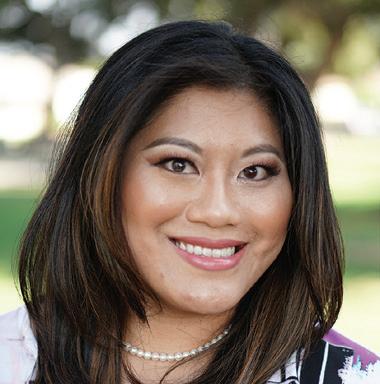

Chief
Research
Social


Owner

Engineering Leadership Council and Diversity Advisory Board member and Claire Trevor Society Leadership Committee member, among others. She provides guidance, leadership and support for student and program success, research efforts, interdisciplinary collaborations and partnership outreach.

“I’ve always been interested in education, and it is so inspiring to be part of a university,” Nicholas says. “Equitable access to a quality education can be transformative, for both the individual and for our society as a whole.”
Most recently, Nicholas pledged $3 million to the UCI School of Education to advance the School’s environmental science education and education access efforts. The gift created a new endowment fund for the Stacey Nicholas Endowed Chair in Environmental Education to support the chairholder’s teaching, research and service activities.
Achampion of STEAM (science, technology, engineering, arts and mathematics) education, Stacey
Nicholas has a personal mission: to help build a more equitable and just world with access to quality education and opportunities for youth to reach their full potential. And although she considers her role small in this effort, her service and support have provided an extensive impact in progressing education access and inclusion for underrepresented students from historically excluded populations.
At UCI, Nicholas has served as a UCI Foundation Trustee since 2015, The Henry Samueli School of
It also provided seed funding to relaunch the Environmental and Climate Change Literacy Projects (ECCLPs), a unique network of University of California and California State University campuses dedicated to educating all students statewide about environmental and climate literacy by high school graduation.
“Everything starts with education. The next generation of kids coming up through our public school system is our greatest hope for creating positive change into the future. Students educated in the ECCLPs program will grow up being very aware of the environment, and will learn how to be good stewards of the planet for future generations,” Nicholas says.
Nicholas’ generous gift positions the School of Education as a leader in climate and environmental education. It also empowers students, teachers and community partners to be informed decision
and change makers in bending the curve of the climate crisis.
As an engineer acutely aware of the need for access and inclusion in education, particularly in STEM, Nicholas has focused much of her efforts on supporting students from historically underrepresented communities.
“Science and engineering can be very challenging. It’s critical to expose our young people to STEM at an early age, and provide a lot of support and encouragement. It’s also important for students to have role models and mentors who will make them feel that they belong in these fields, and that they can do this,” she says.
So when she learned from Richard Arum, UCI professor of education and sociology and former School of Education dean, about ECCLPs’ mission to provide all California students starting as early as prekindergarten with environmental and climate education, the initiative struck a chord.
“ECCLPs is not just a project UCI is doing; it involves other universities. It’s inclusive and casts a very wide net. This is something that I don’t think has ever been done on this scale,” Nicholas says.
A staunch UCI supporter Nicholas’ longstanding UCI connection extends into the university’s School of Education, The Henry Samueli School of Engineering and Claire Trevor School of the Arts, along with many other areas. Her support of UCI was due in part, interestingly enough, to her alma mater, UCLA.
Shortly after Nicholas moved with her family to Orange County, one of her former UCLA professors took the job of dean of the UCI School of Engineering. He reached out and asked if she was interested in getting involved at UCI.
Having left the workforce to raise her children, Nicholas enthusiastically agreed to the opportunity to support future engineers and students. It would allow her to stay connected to engineering while staying close to home.
“It was just a great fit. It felt right. I was excited about it and was able to still spend time being a mom to my three young kids, but yet be involved in this amazing school,” Nicholas says.
Her children are all grown now, but she still maintains a busy schedule – dedicating two days each week to provide support and serve organizations and universities she’s associated with.
Among these roles, Nicholas is trustee emeritus at her children’s independent school, a trustee of the Rhode Island School of Design, a member of the Brown University Arts Advisory Council, and is active in the International Mountain Bike Association.
She is also on the advisory board of Breakthrough San Juan Capistrano (SJC), a role she has held since 2006. Breakthrough SJC provides academic support and guidance to local students from backgrounds that are underrepresented in higher education. Several years ago, she helped create a three-way partnership between Breakthrough SJC, UCI School of Education’s Orange County Educational Advancement Network (OCEAN) and nearby Marco Forster Middle School.
Though Nicholas’ service spans from the East to West Coast, her involvement at UCI is a distinct point of pride. During her years of support, she has witnessed the university’s evolution into a leading institution in research, education and public service. She hopes the recognition the university receives for its tremendous achievements continues to spread throughout Orange County.
She says: “There are amazing things happening at UCI, and I’ve seen the university lead the way in so many areas. I am particularly excited about UCI’s leadership role on the ECCLPs program. Its impact will be far-reaching. Our community should be so proud.”
NicholasECCLPs is not just a project UCI is doing; it involves other universities. It’s inclusive and casts a very wide net. This is something that I don’t think has ever been done on this scale.”
Stacey
Because of generous donors like Jim and Claudia Looney, who have made UCI a beneficiary in their estate, we will train more aspiring K-12 teachers to lead innovations in classroom teaching and learning.
“Creating the Aunt Mabel Looney Endowed Fund for Teacher Education is our way of ensuring that our family’s legacy lives on through the work of future teachers.” – Jim and Claudia Looney


If you already have UCI listed as a beneficiary in your estate or would like to consider making a philanthropic impact by including the UCI School of Education in your estate, please contact Duane Rohrbacher, Executive Director of Development, at duane.rohrbacher@uci.edu.
www.plannedgiving.uci.edu
 Jim and Claudia Looney
Aunt Mabel Looney
Jim and Claudia Looney
Aunt Mabel Looney
Our accomplishments are possible with support from generous alumni, community friends, corporations, foundations, and government agencies. We are deeply grateful to the following donors for their investment in the Brilliant Future Campaign for the School of Education. Together we have the power to lead innovations in teaching and learning from preschool through K-12 and higher education.
Bank of America Foundation
Bank of the West Bear Coast Coffee
Bill and Melinda Gates Foundation* Brady Education Foundation* California Community Colleges Chief Instructional Officers
CARS
CEO Leadership Alliance – Orange County Chan Zuckerberg Initiative, LLC
Charles Stewart Mott Foundation* ChevronTexaco Corporation
Children and Screens: Institute of Digital Media & Child Development*
City National Bank College Futures Foundation Community Partners
Crevier Family Foundation
Edison International ENO Brands, Inc.
Google High School Inc. Academies Foundation
Human Options, Inc. Intel Corporation
Jason Tong D.M.D., P.C.
Johnson & Johnson Foundation
John Randolph & Dora Haynes Foundation*
The Kay Family Foundation
Kioxia America, Inc. The Learning Agency

Lumina Foundation Mellon Foundation* Nihon Kohden
Northrop Grumman Foundation
Orange County Community Foundation Rice University
RMP Foundation
SchoolsFirst Federal Credit Union Smith Richardson Foundation, Inc.* SubjectToClimate
Swedlund Properties
The Spencer Foundation
Teacher Created Materials Publishing Tilly’s Life Center
United Way Capital Region
United Way of Greater Los Angeles
Western Digital Corporation
William T. Grant Foundation
American Educational Research Association

California Department of Justice
California Department of Public Health
California State Polytechnic University, Pomona Society for Research in Child Development State of California
Stephanie Martinez Stacey Nicholas
Ch. Eloy Oakley ’96, ’99 and Bernadette Mendez
Wendy Robello ’04
Cheryll and Richard Ruszat
Eric and Wendy Schmidt
Stephanie ’76, ’88 and Allan Schneider
Eva Thomas
Irene Thomas and Linwood Howard
Kevin ’10 and Stephanie Tsao
Individual Donors of $1,000 and up
Anonymous
Christine Baron Mary Bianco
Carolyn Brothers ’78, ’80
Kelvin Chuang ’09, ’10
Donnie Crevier
Keith Curry ’11
Brian Dang ’07, ’13, ’14
Roger and Marjorie Davisson
Dorothy and Greg Duncan
Arnold ’90 and Esther Gutierrez
Arif ’94 and Azmina Haji
Rufie and Michael Harr
Douglas and Sandra Jackson
Kim Jalbert
Wenli Jen ’03, ’04
Elim and Helena Kay
Ethan Kay and Nina Nguyen
Shasham and Martha Kothari
Sonny and Martha Kothari
Richard Kwong ’04, ’11
Claudia and James Looney
Florence Martinez
Andrew Tulumello
Victoria Vasques ’81
Myuriel ’86, ’11, ’12 and John ’96 Von Aspen
Nhu Weinberg ’05
Christopher ’68 and Sherryl Wilson ’68
Bold = Alumni
Italics = UCI Foundation Trustees
* = Ongoing Grant Funding
University of California, Irvine 3200 Education Irvine, CA 92697-5500
education.uci.edu