f e a t u r e
conjugates A few minutes of conversation with Rabuka reveals that underneath his easy-going exterior lies an insightful scientist and a driven entrepreneur. Rabuka graduated from high school in 1990 and enrolled in the University of Saskatchewan in Saskatoon, where he earned his B.S. with double honors in chemistry and biochemistry in 1996. Next he obtained his M.S. in chemistry in 1999 at the University of Alberta in Edmonton, where he studied carbohydrate chemistry with Ole Hindsgaul, now at the Carlsberg Laboratory in Copenhagen, Denmark. It was through Hindsgaul that Rabuka found an opportunity to work at the Burnham Institute in La Jolla, a biomedical research institute just north of the UCSD campus. “Burnham was good exposure,” he says. “I worked there for about a year and, in 2000, became the sixth employee at a biotech startup, Optimer Pharmaceuticals. “Optimer was developing new antibiotics, including one which is used against Clostridium difficile infections that cause persistent diarrhea. It was a good time for me to get my start in biotech. In a small biotech startup, I learned that every experiment counts. “I loved working at Optimer, but I decided to go back to school for a lot of reasons. Without a Ph.D, opportunities are closed to you. I had no aspirations to be a professor—I knew I was going back into biotech. That understanding helped me focus. “I applied to Berkeley in part because I was drawn to Carolyn Bertozzi’s work on glycobiology. I ended up writing my thesis on chemical tools for studying glycoproteins, but along the way, in 2006, I found some interesting technology to spin out.” Understanding the significance of Rabuka’s work on ADCs at Redwood Biosciences requires a short review of the long history of antibody-based therapies: Antibody-based therapies are not new. For decades, antivenom treatments for deadly snake and insect bites have been based on polyclonal antibodies. To produce these antibodies, venom is injected in small quantities into horses or other animals, and their blood is filtered to collect the antibodies that neutralize the toxins. There are two problems with these antivenoms. First, polyclonal antibodies are not identical copies of each other—they vary in their chemical composition and potency. Second, they are animal antibodies and can cause severe allergic reactions when injected into humans.
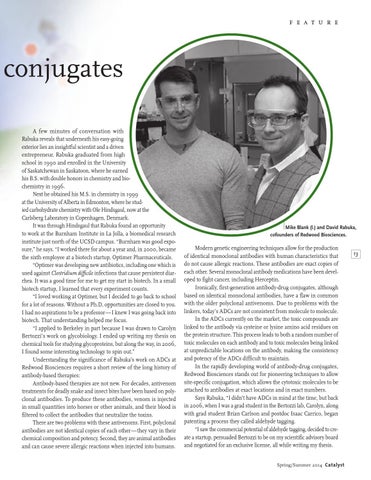
Mike Blank (l.) and David Rabuka, cofounders of Redwood Biosciences.
Modern genetic engineering techniques allow for the production of identical monoclonal antibodies with human characteristics that do not cause allergic reactions. These antibodies are exact copies of each other. Several monoclonal antibody medications have been developed to fight cancer, including Herceptin. Ironically, first-generation antibody-drug conjugates, although based on identical monoclonal antibodies, have a flaw in common with the older polyclonal antivenoms. Due to problems with the linkers, today’s ADCs are not consistent from molecule to molecule. In the ADCs currently on the market, the toxic compounds are linked to the antibody via cysteine or lysine amino acid residues on the protein structure. This process leads to both a random number of toxic molecules on each antibody and to toxic molecules being linked at unpredictable locations on the antibody, making the consistency and potency of the ADCs difficult to maintain. In the rapidly developing world of antibody-drug conjugates, Redwood Biosciences stands out for pioneering techniques to allow site-specific conjugation, which allows the cytotoxic molecules to be attached to antibodies at exact locations and in exact numbers. Says Rabuka, “I didn’t have ADCs in mind at the time, but back in 2006, when I was a grad student in the Bertozzi lab, Carolyn, along with grad student Brian Carlson and postdoc Isaac Carrico, began patenting a process they called aldehyde tagging. “I saw the commercial potential of aldehyde tagging, decided to create a startup, persuaded Bertozzi to be on my scientific advisory board and negotiated for an exclusive license, all while writing my thesis. Spring/Summer 2014 Catalyst
13