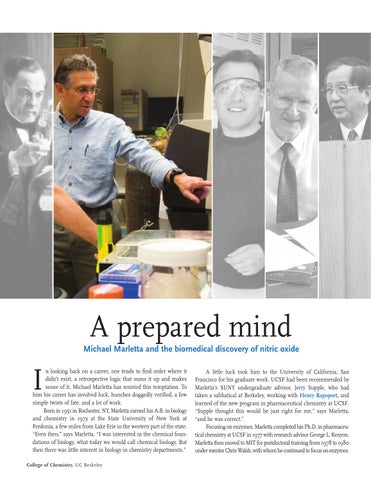
A prepared mind Michael Marletta and the biomedical discovery of nitric oxide
I
n looking back on a career, one tends to find order where it didn’t exist, a retrospective logic that sums it up and makes sense of it. Michael Marletta has resisted this temptation. To him his career has involved luck, hunches doggedly verified, a few simple twists of fate, and a lot of work. Born in 1951 in Rochester, NY, Marletta earned his A.B. in biology and chemistry in 1973 at the State University of New York at Fredonia, a few miles from Lake Erie in the western part of the state. “Even then,” says Marletta, “I was interested in the chemical foundations of biology, what today we would call chemical biology. But then there was little interest in biology in chemistry departments.” College of Chemistry, UC Berkeley
A little luck took him to the University of California, San Francisco for his graduate work. UCSF had been recommended by Marletta’s SUNY undergraduate advisor, Jerry Supple, who had taken a sabbatical at Berkeley, working with Henry Rapoport, and learned of the new program in pharmaceutical chemistry at UCSF. “Supple thought this would be just right for me,” says Marletta, “and he was correct.” Focusing on enzymes, Marletta completed his Ph.D. in pharmaceutical chemistry at UCSF in 1977 with research advisor George L. Kenyon. Marletta then moved to MIT for postdoctoral training from 1978 to 1980 under mentor Chris Walsh, with whom he continued to focus on enzymes.