n e w
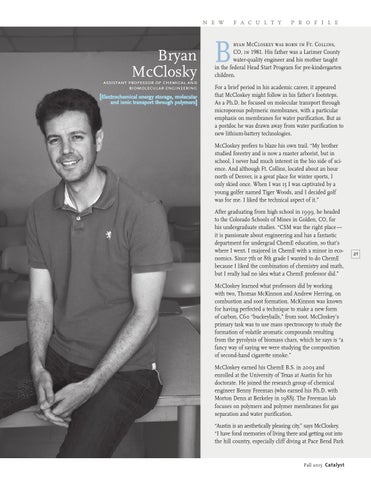
Bryan McClosky
assistant professor of chemical and biomolecular engineering
[Electrochemical energy storage, molecular and ionic transport through polymers]
f a c u l t y
p r o f i l e
B
ryan McCloskey was born in Ft. Collins, CO, in 1981. His father was a Larimer County water-quality engineer and his mother taught in the federal Head Start Program for pre-kindergarten children. For a brief period in his academic career, it appeared that McCloskey might follow in his father’s footsteps. As a Ph.D. he focused on molecular transport through microporous polymeric membranes, with a particular emphasis on membranes for water purification. But as a postdoc he was drawn away from water purification to new lithium-battery technologies. McCloskey prefers to blaze his own trail. “My brother studied forestry and is now a master arborist, but in school, I never had much interest in the bio side of science. And although Ft. Collins, located about an hour north of Denver, is a great place for winter sports, I only skied once. When I was 15 I was captivated by a young golfer named Tiger Woods, and I decided golf was for me. I liked the technical aspect of it.”
After graduating from high school in 1999, he headed to the Colorado Schools of Mines in Golden, CO, for his undergraduate studies. “CSM was the right place— it is passionate about engineering and has a fantastic department for undergrad ChemE education, so that’s where I went. I majored in ChemE with a minor in economics. Since 7th or 8th grade I wanted to do ChemE because I liked the combination of chemistry and math, but I really had no idea what a ChemE professor did.” McCloskey learned what professors did by working with two, Thomas McKinnon and Andrew Herring, on combustion and soot formation. McKinnon was known for having perfected a technique to make a new form of carbon, C60 “buckeyballs,” from soot. McCloskey’s primary task was to use mass spectroscopy to study the formation of volatile aromatic compounds resulting from the pyrolysis of biomass chars, which he says is “a fancy way of saying we were studying the composition of second-hand cigarette smoke.” McCloskey earned his ChemE B.S. in 2003 and enrolled at the University of Texas at Austin for his doctorate. He joined the research group of chemical engineer Benny Freeman (who earned his Ph.D. with Morton Denn at Berkeley in 1988). The Freeman lab focuses on polymers and polymer membranes for gas separation and water purification. “Austin is an aesthetically pleasing city,” says McCloskey. “I have fond memories of living there and getting out into the hill country, especially cliff diving at Pace Bend Park
Fall 2015 Catalyst
21