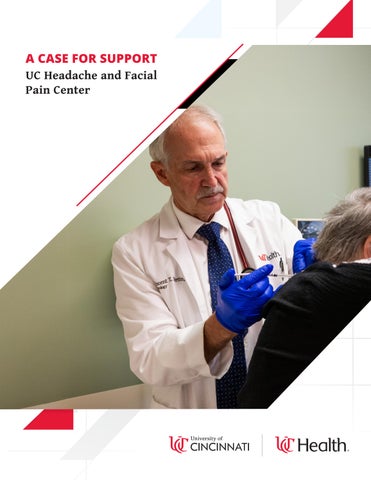
A CASE FOR SUPPORT UC Headache and Facial Pain Center
“For patients who suffer from chronic or debilitating headache pain, our center has the nation’s foremost experts to help diagnose underlying causes, from primary headache disorders such as migraine, cluster headaches and tension headaches to more complicated cases involving Chiari malformations, spinal fluid leaks or high spinal fluid pressures called intracranial hypertension. We offer evidence-based treatments and care intended to help our patients improve quality of life.” VINCENT MARTIN, MD Director, Headache and Facial Pain Center
Dear Friend, As a nationally recognized provider, the Headache and Facial Pain Center at the UC Gardner Neuroscience Institute is making breakthroughs in research and treatment for patients with chronic pain. By partnering with experts in neurosurgery, ENT and integrative medicine, our patients receive the highest quality care right here in the Tristate, at UC Health. We pride ourselves in our strengths: • The UC Headache and Facial Pain Center is one of the largest physician-led headache groups in the country, incorporating dozens of clinical specialties. • Our team is enhancing patient care for migraine sufferers by equipping primary care physicians with training and tools to diagnose and treat migraines effectively. This initiative helps reduce wait time for patients and ensures faster, more effective treatment. • We’re at the forefront of research, studying how high- and low-pressure weather systems impact migraines, aiming to personalize treatments based on a patient’s location and weather conditions. • Groundbreaking treatment at UC Health is revolutionizing migraine relief by targeting spinal fluid leaks. We have advanced imaging techniques to diagnose and treat the site of a spinal fluid leak or a connection between the space containing spinal fluid and a vein called a CSF venous fistula. • We also have great expertise in the diagnosis and treatment of disorders of high spinal fluid pressures called intracranial hypertension. Thank you for your consideration and interest in partnering with our center to elevate migraine care and advance our research. Together, we can redefine the way headaches and facial pain are diagnosed and treated to provide the best pain management options for every patient. Vincent Martin, MD Professor of Clinical, Director of UC Headache and Facial Pain Center President, National Headache Foundation
RESEARCH Growing and retaining top talent At the UC Gardner Neuroscience Institute, our faculty leaders bring an evidence-based focus to everything we do. To attract rising-star researchers and expand our quests for discovery, we must evolve our resources to maintain the fast pace required for continual health care innovation.
Endowed chairs for clinical leadership and research faculty Historically, endowed chairs were a want-to-have luxury; today they are a need-to-have tool in order for UC to be competitive with other nationally ranked academic medical centers. Chairs are essential to our ability to recruit and retain top talent among a competitive field of other neuroscience institutes. Establishing new chairs builds permanency and sustainability in our areas of excellence: Clinical leadership to advance the subspecialty care in headache and facial pain, including a Director of Headache and Facial Pain Center position. Neuroscience research chairs expand clinical trials and basic neuroscience research, to enable the discovery of new medications and treatments, and protect time for physicianscientists to balance patient care with research and teaching. An endowed research chair allows us to recruit new thought leaders or retain vital faculty and ensures continuity of important research efforts at the university. Paired with our advanced facilities and research operations, endowed chairs will attract nationally and globally recognized faculty to the UC Gardner Neuroscience Institute. This accelerates the research and development of new treatments, all to directly benefit more patients.
UC HEADACHE AND FACIAL PAIN CENTER 5
Expanding research for improved outcomes
MRI research technology MRI scans are now a key component of clinical research trials at the neuroscience institute—including in Parkinson’s disease, stroke, epilepsy, memory and mood disorders. Neuroimaging research allows a physician or researcher to evaluate a patient’s baseline or see how they respond to new medications or therapies. To support our robust research efforts, the institute is in need of a dedicated research scanner. An MRI focused entirely on research, with staff trained in neuroinformatics and the latest imaging techniques, will broaden our discovery efforts across all specialty areas. The outpatient facility (that opened in 2019) was built to accommodate an additional MRI with researcher staffing space. For example, the Cincinnati Cohort Biomarker Program, led by Alberto Espay, MD, involves a comprehensive collection of health data. It requires many MRI scans per year for its more than 800 study participants. With the evolution of personalized medicine our team now takes multiple images throughout a patient’s care journey to evaluate in real time how they are responding to medicine or therapies.
Research endowment fund Neuroscience is the most prolific research area throughout the academic health center and the entire university. Creating a substantial research endowment will encourage further cross-disciplinary projects across departments and centers and can spark “high-risk/highreward” ideas that are less likely to find support through conventional grant funding. Pilot grants are the mustard seeds of research. Their results lead to much larger grants from the National Institutes of Health and other external foundations. For example, $925,000 in pilot grant funding from 2014 to 2020 resulted in $16,236,369 in monies from the government and external foundations—a 17 to 1 return on investment.
A research endowment fund is critical to progress and will allow investigators to pursue more novel, long-term and untested research projects, giving them the security to take the risks that will yield breakthrough discoveries right here in Cincinnati.
UC HEADACHE AND FACIAL PAIN CENTER 7
Understanding the links between weather and migraine headaches There is growing evidence that shows migraines can be triggered by changes in the weather. Vincent Martin, MD, and Brinder Vij, MD, professors of neurology at the UC Headache and Facial Pain Center, have published several key studies that examine the effect of weather conditions, like temperature and barometric pressure, on migraines. In 2018, in the first study of its kind, Martin and his team found that for some patients, low and falling barometric pressure led to headaches whereas for other patients, high and rising barometric pressure resulted in headaches. The study had 218 migraine patients keep a headache diary and researchers compared the data with current weather conditions including barometric pressure, temperature, humidity and wind speed. Recently, in 2024, UC researchers updated their findings in a larger study of migraine patients to determine if medication could ward off headaches triggered by changes in temperature. Data taken from 71,030 daily diary records from 660 migraine patients and regional weather data determined a 6% chance of getting a headache for every 10 degrees Fahrenheit increase daily. This association was completely eliminated when a medication (CGRP Monoclonal antibody) was administered to patients. For migraine sufferers, these headaches can derail daily life. More precise treatment options from these findings could improve the trajectory of their wellbeing. By supporting studies like these, we can continue to gain a better understanding of how weather affects our bodies and how migraine management can help patients everywhere.
Migraine onset and pubertal development in females The prevalence of migraines is quite common in adolescent females, ranging from 15 to 24%. To advance our understanding of the relationship between pubertal development milestones and migraines, a team of UC researchers conducted a well-designed cross-sectional study of 761 females ages 6-18. Research examined whether the timing of puberty onset affects migraine headaches in teenage females, tracking when they reached puberty milestones like breast development (thelarche), pubic hair growth (pubarche) and first menstruation (menarche). The study’s key finding showed that females who started puberty earlier were more likely to experience migraines in their later teenage years. About 29% of the females had migraines, and those who developed breasts or had a first period at a younger age had higher migraine rates. The study also looked at those with higher rates of emotional and behavioral factors—like anxiety and depression, or hyperactivity—and found that females who experienced these symptoms were more likely to have migraines, independent of puberty timing. The researchers believe early exposure to hormones like estrogen during puberty may trigger migraines in susceptible females. This study helps doctors understand why migraines become much more common in females after puberty and highlights the complex relationship between hormonal changes, mental health, and headaches during adolescence.
UC HEADACHE AND FACIAL PAIN CENTER 9
CLINICAL CARE Grow our patient data infrastructure, strengthen services for our centers of excellence, creating a national destination for care
The power of big data: Improving patient outcomes To offer truly world-class care for our patients, we need to rely on not just the expertise of one doctor, but leverage the expertise of every single doctor in our institute and beyond. We must continue to scale our approaches to personalized treatment for our patients, understanding that care is unique to each individual. With the vast amount of health data now available, a physician has millions of data points at their fingertips. The flow of new information never stops as biomedical knowledge from new research doubles every 73 days. However, the time lag from putting new knowledge into practice currently takes more than a decade. The UC Gardner Neuroscience Institute is building an integrated network of research, clinical data and quality improvement processes that will rapidly deliver new learnings to the bedside, vastly improving patient care and quality and longevity of life. This network will connect all of our centers of excellence, and eventually connect us to peer neuroscience institutes like the top-ranked Weill Institute at UC San Francisco. These connectors multiply the expertise of our institute, identifying new approaches and treatments that will improve patient outcomes not only in our region, but worldwide.
Adopting a big data approach to care Before
After
• Average 17 years from evidence to practice.
• Less than 3 years to apply new evidence to patient care.
• Lacks patient input and learned experience.
• Patient-driven research and resources.
• Disparities in practice, decision-making. • Measures process with outcomes.
• Aligned use of best practices, efficient and accessible evidence. • Measures real-time patient outcomes, to continuously modify care.
Leveraging big data This approach to care will measure real-world outcomes from our patients and make immediate and continuous improvements to the system as a result. Our leaders have already demonstrated how an integrated, data-driven approach can optimize patient outcomes for brain and mental health care. For example, UC’s epilepsy team has focused on controlling seizures and reducing patient barriers to medication. By partnering with patients to identify common issues, 30% of epilepsy patients were found to have at least one barrier to medication—including access or cost, forgetting to take the medication, or not taking it due to side effects. With patients contributing data in between visits, through wearable apps, surveys and/or seizure diaries, it drives both quality improvement and research. The care teams can view all of this in a digital dashboard to look for patterns and make immediate adjustments to a patient’s treatment plan.
“Getting to the truth of a patient’s problem and how best to cure it, requires data scientists, analysts and biostatisticians—people and tools that aren’t normally part of the healthcare model. And I think this is where philanthropy and the generosity of our community and patients can make a big impact.” JOSEPH CHENG, MD Associate Director for UC Gardner Neuroscience Institute Frank H. Mayfield Endowed Chair & Professor of Neurosurgery
Enhanced clinical services Expanding talented, highly trained staff is crucial to provide the most comprehensive care to our patients and their caregivers. In addition to our physician leaders, these key roles include: • Nurse navigators who provide an essential core of clinical expertise for our center. • Social workers who provide critical care and guidance to community and other resources for our patients, particularly those managing complex conditions. • A psychologist on staff who will provide necessary care to headache patients who are experiencing depression and need help with stress management, relaxation techniques, etc. As our patient outcomes continue to excel, new technology and comprehensive services in support of the whole person will evolve across the institute. Our current priorities include: • Patient-centered mobile app that allows patients to track symptoms, triggers and treatments enhancing self-management and patient care. • Enhanced tools for electronic medical records (EMRs), that can suggest treatments to primary care providers for patients seen with a headache diagnosis. • Integrative medicine programs and clinics offered by the Osher Center for Integrative Health at UC, providing complementary therapies like classes for nutrition, exercise and mindfulness.
UC HEADACHE AND FACIAL PAIN CENTER 13
EDUCATION Empowering providers and patients with education, resources around migraines
Primary care physician education outreach This initiative addresses critical gaps in migraine treatment by equipping primary care physicians (PCPs) with the knowledge to diagnose and manage migraines effectively. This effort reduces delays in care by enabling PCPs to provide timely treatment, minimizing the need for specialist referrals that often come with long wait times. By improving diagnosis and first-line treatment at the primary care level, more patients receive the care they need sooner, preventing migraines from being undiagnosed or undertreated.
Patient education programming We offer two specialized classes to help patients better manage and cope with migraines: Centering and Empowered Relief. • Centering includes a moderator and groups of patients who discuss different topics such as migraine triggers, stress management and migraine diets, allowing patients to learn from each other. • Empowered Relief teaches psychological techniques to manage chronic pain disorders. These sessions provide patients with practical tools for symptom management, stress reduction and lifestyle adjustments. Additional funding would enhance these programs by supporting patient resources, expert-led demonstrations, provider training and the development of digital tools to extend the impact of these classes and help patients manage migraines.
UC HEADACHE AND FACIAL PAIN CENTER 15
Education and training programs The UC Gardner Neuroscience Institute is a magnet of talent, attracting out-of-state high school graduates and potential graduate students to Ohio with the promise of a world-class education, mentors in research and industry, and access to leading laboratory and clinical facilities. We plan expansion and support of the following areas: • Simulation lab space and training support Several of the top programs in the country use simulation-based training: realistic clinical environments that blend learning with virtual and hands-on experiences through a model of team-based patient care. At UC, leadership from across the academic health center and UC Health have articulated a high-level vision and operational model for a simulation center that will teach not only basic procedures but also complex neurological care skills. • Student recruitment and programming The UC College of Medicine is committed to building a physician workforce that accurately reflects the community we treat. Our mission is to recruit and retain the most talented students, residents and faculty to our academic medical center and support them in pursuing neuroscience specialties. • Continuing medical education Training programs will provide continuing medical education in our areas of excellence. New programming will offer primary care physicians opportunities to enhance learning in often requested specialties like depression and anxiety.
UC HEADACHE AND FACIAL PAIN CENTER 17
MEASURES OF SUCCESS Philanthropic support will speed our time to impact in the areas of research, patient care and training the next generation. We will track and measure our success in these areas through improved scores and metrics in:
Research Our research portfolio will grow and be measured by: the number of publications in top level journals, faculty presentations at conferences, and scores/rankings from the National Institutes of Health and Blue Ridge Rankings. Additionally, we will track membership growth in premier research networks such as StrokeNET, Mood Disorders and the Alzheimer’s Disease Research Centers (ADRCs).
Clinical Investments into personalized medicine and clinical advancements will be measured by: improving patient outcomes (relevant to a patient’s quality of life including symptoms, functionality, and physical, mental and social health), impacting key hospital metrics like decreasing mortality and re-admissions rates, and improving patient safety and satisfaction. These will additionally support our reputation rankings in mass media outlets like U.S. News and World Report.
Education Being a destination for complex neurological care also means being a destination for the best and brightest talent—from students pursuing our residency and specialty fellowship programs to new clinicians and researchers. As demand increases for limited spots (for example, hundreds of fellowship applicants for 10 openings), so will competitiveness and the strength of applicants, along with the quality of care and research across the institute. Professional physician networks like Doximity and professional organizations like Association of American Medical Colleges will help us measure this.
THANK YOU We’re grateful for your thoughtful consideration of a leadership gift to the UC Headache and Facial Pain Center in support of our 10-year Vision for Neuroscience.
CONTACT Jeannie Kellett Director of Development University of Cincinnati Foundation 513-575-8008 Jeannie.Kellett@foundation.uc.edu
To learn more about how philanthropy can make a meaningful impact, scan the QR code or visit foundation.uc.edu/ucgni/headache
UC HEADACHE AND FACIAL PAIN CENTER 19
This is how breakthroughs happen.
Kim Francis Associate Vice President Academic Colleges and Campaign Strategy Kim.Francis@foundation.uc.edu Office: 513-558-3438 Mobile: 317-362-1995 University of Cincinnati Foundation | PO Box 19970 | Cincinnati, OH 45219-0970
foundation.uc.edu