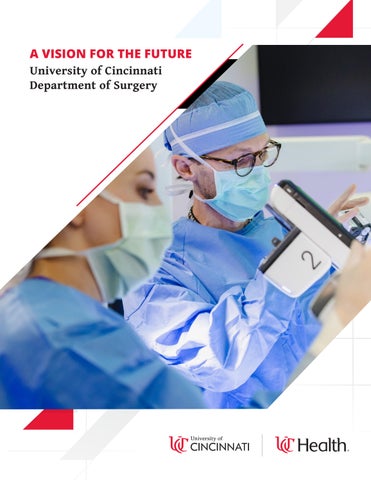
A VISION FOR THE FUTURE University of Cincinnati Department of Surgery
This is how breakthroughs happen.
A MESSAGE FROM THE CHAIR The University of Cincinnati Department of Surgery traces its roots to the 18th century, but it was in 1922 when we made the shift to a structure that set the foundation for our commitment to patient care, education and research. As we look ahead to the future of academic medicine, our vision is to build a Department of Surgery that leads through discovery, excellence and purpose—transforming surgical care today while training the surgeons and innovators who will define tomorrow. DAVID A. GERBER, MD Christian R. Holmes Memorial Chair University of Cincinnati Department of Surgery
THE NEXT BREAKTHROUGH BEGINS WITH YOU For over 100 years, the University of Cincinnati Department of Surgery has trained generations of surgeon-leaders while championing advancements in surgical research and education. Building on our rich history while focusing on the future, we offer innovative educational and clinical research opportunities that draw premier surgeon-scientists to our department. Our commitment to the advancement of knowledge in the surgical sciences creates an environment where training and research flourish. Our vision can only be achieved through investments in our breakthrough research, talented residents, fellows, students and our distinguished faculty.
Our priorities: • Support integrated translational research that accelerates the translation of discoveries from the lab to patients. • Provide bridge and pilot funding, which increase our research productivity and support the pursuit of novel ideas. • Create a Center for Regenerative Medicine to further the study of repairing, replacing or regenerating human cells, tissues and organs. • Invest in our leaders to develop the specialized skills that prepare them to lead during the ongoing healthcare evolution. • Recruit and retain faculty by investing in research, resources and laboratories that support their work. • Ensure student success through innovative education and research opportunities. • Support our residents to engage in the continuum of surgical research that occurs across the department. With your partnership, we can create breakthroughs and lead the way in research and education, all to improve patient outcomes. The next breakthrough begins with you.
A VISION FOR THE FUTURE 3
“Our lab has the goal of improving care for patients after injury or critical illness. We investigate the severity of an injury, the detrimental effects one injury can have on the rest of the body and then assess the outcomes of commonly utilized treatments, including blood transfusion and supplemental oxygen, to optimize the recovery of the injured or critically ill patient.” MICHAEL GOODMAN, MD Dario Rodriquez Jr. Endowed Chair in Trauma Surgery Vice chair for research and associate director of the General Surgery Residency Training Program
EXPANDING RESEARCH FOR IMPROVED OUTCOMES Surgical research is an essential component to advancing patient care in the complex and rapidly changing world. Our research initiatives focus on finding more effective and less invasive approaches to disease management while implementing evidence-based practices that minimize risk and provide a better patient experience.
Funding priorities:
Translational research The department’s discovery-to-recovery research focus drives collaboration among clinicians, scientists and community partners with the aim of accelerating the translation of discoveries from concept to patients and their communities. It is a dynamic area that includes drug trials, device manufacturing, and hardware and software development. In essence it bridges research-to-practice gaps and improves population health. Examples include our work with new immunosuppressive drugs for transplant patients, cancer vaccines that are used in combination with surgery to cure previously incurable diseases like pancreatic cancer, and navigation and robotic technology to detect lung cancer earlier in the disease state. Bridge funding and pilot awards are crucial ways philanthropy can accelerate translational research: • Bridge funding maintains staffing and lab productivity between grant funding cycles. This type of funding is vital to retain talent and resources when scientists are between grants. The return on investment is exceptionally high for this type of funding. Every dollar invested in bridge funding can yield up to $10 in subsequent grant support. • Pilot funding allows researchers to generate the preliminary data needed to secure major extramural grants. Private philanthropy is vital to jump-start these novel research projects. Dedicated pilot funding allows investigators the latitude and security to pursue the next breakthrough discovery. These funds are crucial for new faculty to gain initial seed funding, or for an established investigator who wants to explore a new research question. A VISION FOR THE FUTURE 5
“I think my goal, my future dream, is to make this a translational regenerative center, meaning we could have a facility to produce these biomaterials on our own and serve patients. Nothing like this has been done in cardiac surgery on that spectrum. I think we are positioned in the best way ever to do this because we have internal expertise, we have companies and collaborators that can help and we are building all this out of cooperation with other academic centers and industry.” CRISTIANO SPADACCIO, MD, PhD Associate professor, Division of Cardiothoracic Surgery
EXPANDING RESEARCH FOR IMPROVED OUTCOMES Center for Regenerative Medicine Regenerative medicine encompasses the repair, replacement and regeneration of cells, tissues and organs to restore lost function due to age, disease or damage. This multidisciplinary domain leverages techniques including stem cell therapy and tissue engineering to fix the root causes of diseases rather than just treating symptoms. Philanthropic support will help us establish a collaborative center that partners with departments across the university, including internal medicine, biomedical engineering and chemistry. This support enables a public health focus and ensures progress toward making Cincinnati the healthiest city in the country.
Center for Surgical Innovation (CSI) CSI is a collaboration between the UC departments of surgery, biomedical engineering, and emergency medicine, along with Cincinnati Children’s to develop, assess and enhance recent technologies in biomedical and surgical care. The 3,700-square-foot research and training facility includes a teaching laboratory and operating room and is equipped with the latest surgical technology, offering opportunities for continuing medical education and/or device development.
Simulation center and robotics training Within the Center for Surgical Innovation, a simulation center offers a variety of resources and programs to help students, residents or trainees develop the competence and confidence they will need in their chosen surgical field. A variety of technology-rich resources are available to enhance procedural and clinical skills. One example of this is a robust computer software system, which supports evaluation of the learner’s progress. Students can even create 3D models that allow a physician to map out everything that needs to be done in a case prior to being in the operating room, using innovation to improve training and readiness. As technology expands, many specialties are launching robotics training. Residents in all disciplines have the opportunity to take a week-long training with simulation robots.
A VISION FOR THE FUTURE 7
“This is a true example of a bench to bedside to bench approach. One thing the field is starting to appreciate is that the cancer cells can hijack or co-opt the functions of the healthy cells to do their bidding. And due to generous philanthropic investments in our research—combined with collaborations with surgeon-scientists like Syed Ahmad, MD—we are now beginning to untangle functionally how the cancer cells are doing this.” ANDREW WATERS, PhD Assistant professor, Department of Surgery Dr. Waters and his research team from the University of Cincinnati Cancer Center show how pancreatic cancer cells resist treatment. His work points to potential new combination therapies to make treatments more effective.
BUILDING EXCELLENCE IN CARE, TRAINING AND SPECIALIZED STAFFING The University of Cincinnati Medical Center is a pioneering institution in ex vivo organ transplant perfusion. This technology keeps donor organs viable outside the body by circulating nutrient-rich solutions, saving more lives with more transplants.
Funding priorities: • Pioneering technology: Our transplant team was the first to use portable hypothermic machine perfusion for a liver transplant, replacing traditional static ice storage. • Expanded options: Ex vivo perfusion allows for the evaluation and, in some cases, repair of donor organs that might otherwise be unused. • Active preservation: Unlike static cold storage, this method involves continuous circulation of perfusion solutions. • Improved outcomes: Machine perfusion provides real-time monitoring of organ quality, aiding in better patient outcomes. This innovation significantly improves the quality and quantity of organs available for patients, offering shorter wait times for liver (15 days) and kidney (198 days) patients. The Department of Surgery’s strength lies in our people, experts with a passion to advance surgical knowledge and improve outcomes for patients. This is the foundation of our continued success and a model for what academic surgery can be today. Our faculty leaders bring an evidence-based focus to everything they do. To attract rising star researchers and drive clinical innovation, we must invest in our teams to maintain the fast pace required for continued healthcare evolution.
A VISION FOR THE FUTURE 9
“The Cincinnati Graft initiative represents a new approach to vascular reconstruction—transforming synthetic grafts into living, biologically active conduits. By leveraging regenerative medicine and cell-based therapies, our goal is to improve graft longevity and outcomes for patients with complex vascular disease. Working with collaborators across the country and internationally, we are building the expertise and infrastructure needed to make this groundbreaking treatment available to patients throughout the region.” LUKE P. BREWSTER, MD, PhD Professor, Division of Vascular Surgery
ENDOWED CHAIRS FOR CLINICAL LEADERSHIP AND RESEARCH FACULTY Endowed chairs for clinical leadership and research faculty. Endowed chairs are essential to our ability to recruit and retain top talent among a competitive field of academic surgery leaders. Establishing new chairs builds permanency and sustainability in our areas of excellence.
Funding priorities:
Endowed clinical chairs or endowed lectureships Opportunities to support endowed positions exist across all nine divisions of the department: cardiothoracic, colon and rectal, general, oral/maxillofacial, pediatric, plastic/ reconstructive/hand/burn, surgical oncology, transplantation and vascular surgery.
Research chairs expand strength in established and new areas of study An endowed research chair allows us to recruit new leadership or retain vital faculty. This ensures continuity of important research efforts (e.g., cancer, injury, inflammation and transplant) as well as areas of new research such as drug or device development. These use funds advance surgical innovation and collaboration and protect time for physician scientists to balance patient care with research and teaching. This accelerates UC’s research and scientific inquiry, all to directly benefit more patients.
A VISION FOR THE FUTURE 11
“While traditional conferences sharpen our clinical skills, this symposium addresses something equally important—the whole surgeon. By centering conversations around mentorship, personal development, financial literacy and career navigation, it gives trainees and early-career attendings the tools they need not just to succeed in a surgical career,
but to lead one.” VIKROM DHAR, MD former UC surgery resident ‘21
EDUCATION Our residents train across a wide range of clinical settings, both in the Cincinnati area and around the globe. These include rotations in a Level I Trauma Center, the Veterans Affairs hospital, Cincinnati Children’s and community-based hospitals. They also can participate in a global surgery rotation at Mzuzu Central Hospital in Malawi, Africa. As part of an academic medicine institution, our trainees are further immersed in opportunities for research and leadership development.
Funding priorities:
Global education and care The University of Cincinnati Global Surgery Program offers an eight-week elective general surgery rotation at Mzuzu Central Hospital in Malawi, Africa. Through a sustained partnership with Mzuzu, UC trainees gain an unparalleled educational experience while helping provide and strengthen much-needed surgical care in a community with limited healthcare access. The program supports continuity of care by staffing a surgeon onsite 24 hours a day. Additional support would guarantee medical care in this community as well as support travel for our program participants.
Leadership development program The Department of Surgery hosts a unique leadership development retreat focusing on the transition from trainee to independent surgical specialist. Launched more than 15 years ago, this program hosts 30 to 40 participants, with sessions exploring real-life experience.
A VISION FOR THE FUTURE 13
THANK YOU Thank you for your consideration of a gift to support the UC College of Medicine and Department of Surgery in a meaningful way. We appreciate your interest in supporting our department as we advance in surgical research, patient care and education.
CONTACT David A. Gerber, MD Christian R. Holmes Memorial Chair of Surgery UC Department of Surgery David.Gerber@uc.edu 513-558-5333 Lynn Smith Director of Development, Clinical Programs University of Cincinnati Foundation Lynn.Smith@foundation.uc.edu 513-307-0975 Kaylee Balzano Associate Director of Development, College of Medicine University of Cincinnati Foundation Kaylee.Balzano@foundation.uc.edu 513-913-6000
A VISION FOR THE FUTURE 15
This is how breakthroughs happen.
University of Cincinnati Foundation | PO Box 19970 | Cincinnati, OH 45219-0970
foundation.uc.edu