MONDAY, MARCH 18, 2013 |
stuDEnt VoICE. CoMMunIty REACH.
10
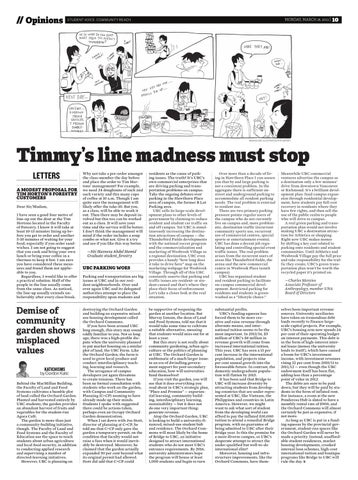
InDIAnA JoEL ILLustRAtIon/tHE ubyssEy
Timmy’s line madness must stop LETTERS A MODEST PROPOSAL FOR TIM HORTON’S FORESTRY CUSTOMERS Dear Sir/Madam, I have seen a good four metre of line-up out the door at the Tim Hortons located in the Faculty of Forestry. I know it will take at least 10-15 minutes lining up before you get to order and another 5-10 minutes of waiting for your food, especially if you order sandwiches. I am not going to suggest that you cook and bring your own lunch or bring your coffee in a thermos to keep it hot. I am sure you have considered these measures and found them not applicable to you. Regardless, I would like to offer a practical solution. Half of the people in the line usually come from the same class. As noticed, the line-up usually extends unbelievably after every class break.
Demise of community garden shows misplaced values KATICHISMS
by gordon katic Behind the MacMillan Building, the Faculty of Land and Food Systems cultivates a humble plot of land called the Orchard Garden. Planted and harvested entirely by UBC students, the garden provides an abundant harvest of fruits and vegetables for the student-run Agora Café. The garden is more than just a community-building initiative, though. The Faculty of Land and Food Systems and the Faculty of Education use the space to teach students about urban agriculture and local food security, in addition to conducting applied research and supervising a number of directed-learning initiatives. However, UBC is planning on
Parking and transportation are big issues at UBC and in our resident neighbourhoods. Over and over again UBC and its delegated authorities attempt to place the responsibility upon students and
residents as the cause of parking issues. The truth? It’s UBC’s own commercial enterprises that are driving parking and transportation problems on campus. Take the ongoing debates over parking in the Hawthorn Place area of campus, the former B Lot Parking area. UBC sells its large-scale development plans to other levels of government by claiming to reduce resident and student car traffic on and off campus. Yet UBC is simultaneously increasing the destination attractions of campus — the Thunderbird Fields developments with the national soccer program and the commercialization and marketing of Wesbrook Village as a regional destination. UBC even provides a handy “how long does it take to drive here” map on the marketing webpage for Wesbrook Village. Through all of this UBC constantly asserts that parking and traffic issues are resident- or student-caused and that’s where they place their focus of enforcement. Let’s take a closer look at the real situation.
Over more than a decade of living in Hawthorn Place I can assure you that by and large parking is not a consistent problem. In the aggregate there is sufficient onstreet and underground parking to accommodate all resident parking needs. The real problem is external to resident use. There are two primary parking pressure points: regular users of the campus who do not currently live on campus and, more problematic, destination traffic (recurrent community sports use, recurrent use of commercial centres, special sports or entertainment events). UBC has done a decent job regulating and controlling special event traffic issues. The real problem arises from the recurrent users of areas like Thunderbird fields, the arena and the new commercial centre in Wesbrook Place (south campus). UBC has organized student and resident parking to facilitate on-campus commercial development. Restricted parking for residents and students is greenwashed as a “lifestyle choice.”
Meanwhile UBC commercial ventures advertise the campus as a destination only a few minutes’ drive from downtown Vancouver or Richmond. It’s a brilliant development plan: fund campus expansion through residential development, have students pay full cost recovery in residents where they have few rights, and then sell the use of the public realm to people who will drive to campus. A real green parking and transportation plan would not involve making UBC a destination attraction for Athletics or shopping. Right now UBC makes money by shifting a key cost related to parking onto residents and student communities. Until Athletics and Wesbrook Village pay the full price and take responsibility for the traffic they create, UBC’s green transportation plan won’t be worth the recycled paper it’s printed on.
destroying the Orchard Garden and building an expensive mixeduse housing development called the Orchard Commons. If you have been around UBC long enough, this story may sound oddly familiar to you. Not so long ago, there was a high-profile dispute when the university planned to put market housing on a similar plot of land, the UBC Farm. Like the Orchard Garden, the farm is used to grow local produce and conduct interdisciplinary teaching, learning and research. The arrogance of campus developers yet again threatens to create tensions. There has been no formal consultation with students who work on the garden, with Campus and Community Planning (C+CP) seeming to have already made up their minds. Students I spoke with suggested there could be actions taken, perhaps even an Occupy Orchard Garden demonstration. When I sat down with Joe Stott, director of planning at C+CP, he told me that C+CP only gave the garden a temporary permit, on the condition that faculty would not raise a fuss when it would inevitably be destroyed. Moreover, he claimed that the garden actually expanded 50 per cent beyond what its original permit had allowed. Stott did add that C+CP could
be supportive of reopening the garden at another location. But Murray Ismam, the dean of Land and Food Systems, told me that it would take some time to cultivate a suitable alternative, meaning that students would miss out for at least a year. But this story is not really about community gardening, urban agriculture or the politics of planning at UBC. The Orchard Garden is emblematic of a much larger issue: in an era of dwindling government support for post-secondary education, how will universities fund themselves? If you visit the garden, you will see that it does everything you read about in UBC’s strategic plan, "Place and Promise" — experiential learning, community building, interdisciplinary learning, sustainability — but it does not do one very important thing: generate revenue. Atop the Orchard Garden, UBC is looking to build a university-financed, mixed-use student hub and residence. The Orchard Commons will most likely be the home of Bridge to UBC, an initiative designed to attract international students who do not meet UBC’s entrance requirements. By 2016, university administrators hope the program will house at least 1,000 students and begin to turn
substantial profits. UBC’s funding squeeze has forced them to be more creative and raise revenue through alternate means, and international tuition seems to be the most important. In 2013/14, $5 million of UBC’s $8 million in revenue growth will come from increased international tuition. This year, UBC has seen a 15 per cent increase in the international population, and projects nine per cent annual growth into the foreseeable future. In contrast, the domestic undergraduate population will flatten by 2015. It has been said that Bridge to UBC will increase diversity by attracting students from developing countries that are under-represented at UBC, like Vietnam, the Philippines and countries in Latin America. However, we might want to ask what sort of student from the developing world can afford to pay the inflated $30,000 tuition to attend a remedial Bridge program, with no guarantee of being admitted to UBC after their Bridge year. Is this the promise for a more diverse campus, or UBC’s desperate attempt to attract the under-qualified but well-to-do international elite? Moreover, housing and infrastructure improvements, like the Orchard Commons, have them-
selves been important revenue sources. University auxiliaries have taken on tremendous debt loads recently to finance largescale capital projects. For example, UBC’s housing arm now spends 24 per cent of their operating budget on interest payments. This debt is in the form of high-interest internal loans (money the university lends to itself), which have caused a boom for UBC’s investment income, with investment revenues rising 32 per cent from 2010/11 to 2011/12 — even though the UBC endowment itself has been flat, adding less than a percentage point of value in 2012. The debts are sure to be paid down, but they will be paid by students in the form of inflated rent. For instance, a room at the new Ponderosa Hub is slated to have a monthly rental rate of $900, and the Orchard Commons will almost certainly be just as expensive, if not more. As long as UBC is put in a funding squeeze by the provincial government, student-run spaces like the Orchard Garden will never be made a priority. Instead, unaffordable student residences, market housing developments, crooked internal loan schemes, high-cost international tuition and boutique programs like Bridge to UBC will rule the day. U
Why not take a pre-order amongst the class-member the day before and place the order to Tim Hortons’ management? For example, we need 24 doughnuts of such and such variety and this many cups of coffee at 10 a.m. Though I am quite sure the management will likely offer the take-10. But you, as a class, will be able to work it out. Then there may be deposit involved but this too can be worked out as a class. It will save your time and the service will be better. I don’t think the management will mind if the order includes a soup combo or what not. Give it a try and see if you like this way better. Siti Hazneza Abdul Hamid Graduate student, forestry
</em>
UBC PARKING WOES
Charles Menzies Associate Professor of Anthropology, member UNA Board of Directors