Law School Report
Left to right, Shawn C. Graham ’06, Amy Deen Westbrook, Associate Professor, and Philip Halpern, Professor.
Continued from Page 20
Jacobs School of Management. In its first incarnation, 20 law and management students spent spring semester 2006 in New York City, studying with some of the top minds in the business. The program sprang from an invitation from the Neil D. Levin Graduate Institute of International Relations and Commerce, a new graduate institution operating as part of the State University of New York system. The UB program is the first for-credit SUNY graduate program offered with the assistance of the institute, which was established in memory of the director of the Port Authority of New York and New Jersey, killed in the Sept. 11, 2001, terrorist attacks. “We are unique because we have both a law school and a management school,” said UB Law Professor Amy Deen Westbrook, who worked with a group of faculty and administrators in Buffalo to organize the program. “We were able to see what an opportunity this would be. And we were able to put it into place quickly because we work well with the management school, and at the Law School there is already a welldeveloped finance transactions concentration. We had faculty members and students interested in transactional work, so
22
we were in a good position to go forward. “We also got an incredible response from alumni and friends of the school who were practitioners in New York City and who wanted to participate in the program by lecturing and giving presentations – people who work with the New York Mercantile Exchange, the New York Stock Exchange. A lot of people wanted to do something to help with the program.”
T
he 12-week program was designed to introduce students to the challenges of managing financial transactions and banking flows across borders, business cultures and multiple regulatory systems, and it had three main parts. First was a classroom component, in which a different professor each week taught one main subject area. These professors included both UB faculty and faculty from such institutions as St. John’s University, Texas A&M University, New York University and the Sasin Graduate School of Business in Thailand. Second was a series of learning opportunities with practitioners and public officials who are working in international finance. Finally, students were assigned in five-member teams to work on semes-
U B
L A W
F O R U M
ter-long projects with top New York City law and financial services firms, culminating in an end-of-semester presentation by each team. “It was important to us that it not be like a semester at sea,” Westbrook said. “It had to be things that were not basic and reflected the kind of work that somebody in an international finance practice in New York would be doing. The other trick was that it would not be a professor talking at them for four hours every morning. As soon as possible, we invited people who did it for a living to tell about it.” Besides Amy Westbrook, UB Law faculty who taught pieces of the program were David A. Westbrook, John H. Schlegel, Thomas E. Headrick and Philip Halpern. Halpern spent the semester in New York to provide continuity for the students and overall administration of the program, and expects to do so again when the program is next offered in spring 2007. Also serving on the planning committee for the program was Professor Thomas F. Disare. The team projects took place in conjunction with some of the top law firms and financial institutions in this area of practice. They included: •An effort to find private companies in China that are ripe for IPO and investment banking services, with CLSA, a banking operation based in Hong Kong. •An analysis of the leveraged buyout of Toys R Us by a private equity consortium, with the law firm Fried, Frank, Harris, Shriver & Jacobson. •A study of the issue of “unbundling” of client commissions by broker/dealers, with financial services firm UBS. •An analysis of Pepsico’s business model and its decision to spin off its restaurant chains, and discussion of its strategy moving forward, with Credit Suisse. •An investigation of trade financing opportunities in Ukraine, with M&T Bank Corp. “The team projects were to be something that their young associates would do, to help the students acquire a skill set they would not have otherwise, something that was of use to them,” Westbrook said. “Some of them were hard. At the end of the semester, they gave their information to their sponsors and made a big presentation. “The impact on the students was
transactions concentration have been very interested in how theory really works out in practice. Although we are very much academically inclined toward theory, we realize one of our primary goals is to help our students get jobs. To some degree we were training students and developing in them some expectations that, when it came time to go out and find employment, these expectations were in some cases hard to realize.” The exposure to firms and individuals that the New York students enjoyed, he said, begins to address that gap. Said UB Law Dean Nils Olsen: “This is an opportunity to expose the students to institutions and people that are found only in New York. We have a developed and innovative concentration in financial transactions, and we have always had a close collaboration with the management school. The goal is for our students to become familiar with each other’s culture so they can work collaboratively in the future. The students, the faculty and the alumni have all been thrilled about this.”
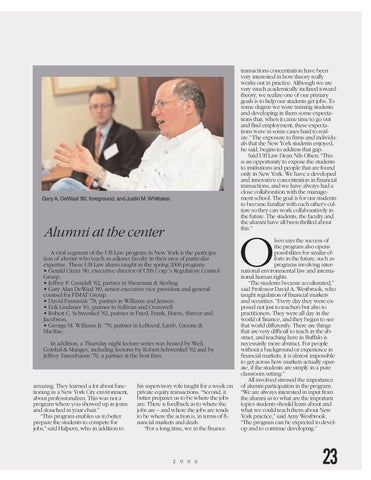
Gary A. DeWaal ’80, foreground, and Justin M. Whittaker.
Alumni at the center A vital segment of the UB Law program in New York is the participation of alumni who teach as adjunct faculty in their area of particular expertise. These UB Law alums taught in the spring 2006 program: • Gerald Citera ’80, executive director of UBS Corp.’s Regulatory Control Group. • Jeffrey P. Crandall ’82, partner in Shearman & Sterling. • Gary Alan DeWaal ’80, senior executive vice president and general counsel for FIMAT Group. • David Franasiak ’78, partner in Williams and Jensen. • Erik Lindauer ’81, partner in Sullivan and Cromwell. • Robert C. Schwenkel ’82, partner in Fried, Frank, Harris, Shriver and Jacobson. • George M. Williams Jr. ’78, partner in LeBoeuf, Lamb, Greene & MacRae. In addition, a Thursday night lecture series was hosted by Weil, Gotshal & Manges, including lectures by Robert Schwenkel ’82 and by Jeffrey Tanenbaum ’76, a partner at the host firm.
amazing. They learned a lot about functioning in a New York City environment, about professionalism. This was not a program where you showed up in jeans and slouched in your chair.” “This program enables us to better prepare the students to compete for jobs,” said Halpern, who in addition to
his supervisory role taught for a week on private equity transactions. “Second, it better prepares us to be where the jobs are. There is feedback as to where the jobs are – and where the jobs are tends to be where the action is, in terms of financial markets and deals. “For a long time, we in the finance
2 0 0 6
O
lsen says the success of the program also opens possibilities for similar efforts in the future, such as programs involving international environmental law and international human rights. “The students became acculturated,” said Professor David A. Westbrook, who taught regulation of financial markets and securities. “Every day they were exposed not just to teachers but also to practitioners. They were all day in the world of finance, and they began to see that world differently. There are things that are very difficult to teach in the abstract, and teaching here in Buffalo is necessarily more abstract. For people without a background or experience in financial markets, it is almost impossible to get across how markets actually operate, if the students are simply in a pure classroom setting.” All involved stressed the importance of alumni participation in the program. “We are always interested in input from the alumni as to what are the important topics students should learn about and what we could teach them about New York practice,” said Amy Westbrook. “The program can be expected to develop and to continue developing.”
23