S U N Y
B U F F A L O
L A W
F O R U M
•
F A L L
2 0 1 4
Black’s wordsmith Adjunct Gary Muldoon ’76 makes his mark in the definitive law dictionary
T
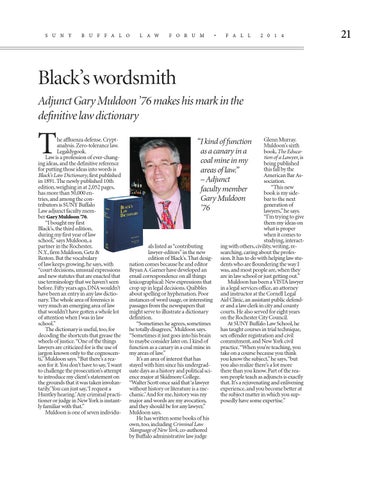
he affluenza defense. Cryptanalysis. Zero-tolerance law. Legaldygook. Law is a profession of ever-changing ideas, and the definitive reference for putting those ideas into words is Black’s Law Dictionary, first published in 1891. The newly published 10th edition, weighing in at 2,052 pages, has more than 50,000 entries, and among the contributors is SUNY Buffalo Law adjunct faculty member Gary Muldoon ’76. “I bought my first Black’s, the third edition, during my first year of law school,” says Muldoon, a partner in the Rochester, N.Y., firm Muldoon, Getz & Reston. But the vocabulary of law keeps growing, he says, with “court decisions, unusual expressions and new statutes that are enacted that use terminology that we haven’t seen before. Fifty years ago, DNA wouldn’t have been an entry in any law dictionary. The whole area of forensics is very much an emerging area of law that wouldn’t have gotten a whole lot of attention when I was in law school.” The dictionary is useful, too, for decoding the shortcuts that grease the wheels of justice. “One of the things lawyers are criticized for is the use of jargon known only to the cognoscenti,” Muldoon says. “But there’s a reason for it. You don’t have to say, ‘I want to challenge the prosecution’s attempt to introduce my client’s statement on the grounds that it was taken involuntarily.’ You can just say, ‘I request a Huntley hearing.’ Any criminal practitioner or judge in New York is instantly familiar with that.” Muldoon is one of seven individu-
Glenn Murray. Muldoon’s sixth book, The Education of a Lawyer, is being published this fall by the American Bar Association. “This new book is my sidebar to the next generation of lawyers,” he says. “I’m trying to give them my ideas on what is proper when it comes to studying, interacting with others, civility, writing, researching, caring about the profession. It has to do with helping law students who are floundering the way I was, and most people are, when they are in law school or just getting out.” Muldoon has been a VISTA lawyer in a legal services office, an attorney and instructor at the Cornell Legal Aid Clinic, an assistant public defender and a law clerk in city and county courts. He also served for eight years on the Rochester City Council. At SUNY Buffalo Law School, he has taught courses in trial technique, sex offender registration and civil commitment, and New York civil practice. “When you’re teaching, you take on a course because you think you know the subject,” he says, “but you also realize there’s a lot more there than you know. Part of the reason people teach as adjuncts is exactly that. It’s a rejuvenating and enlivening experience, and you become better at the subject matter in which you supposedly have some expertise.”
“I kind of function as a canary in a coal mine in my areas of law.” – Adjunct faculty member Gary Muldoon ’76
als listed as “contributing lawyer-editors” in the new edition of Black’s. That designation comes because he and editor Bryan A. Garner have developed an email correspondence on all things lexicographical: New expressions that crop up in legal decisions. Quibbles about spelling or hyphenation. Poor instances of word usage, or interesting passages from the newspapers that might serve to illustrate a dictionary definition. “Sometimes he agrees, sometimes he totally disagrees,” Muldoon says. “Sometimes it just goes into his brain to maybe consider later on. I kind of function as a canary in a coal mine in my areas of law.” It’s an area of interest that has stayed with him since his undergraduate days as a history and political science major at Skidmore College. “Walter Scott once said that ‘a lawyer without history or literature is a mechanic.’ And for me, history was my major and words are my avocation, and they should be for any lawyer,” Muldoon says. He has written some books of his own, too, including Criminal Law Slanguage of New York, co-authored by Buffalo administrative law judge
21