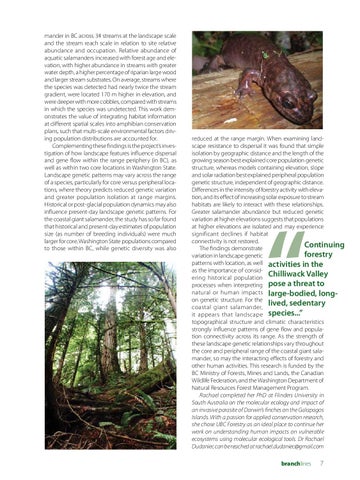
mander in BC across 34 streams at the landscape scale and the stream reach scale in relation to site relative abundance and occupation. Relative abundance of aquatic salamanders increased with forest age and elevation, with higher abundance in streams with greater water depth, a higher percentage of riparian large wood and larger stream substrates. On average, streams where the species was detected had nearly twice the stream gradient, were located 170 m higher in elevation, and were deeper with more cobbles, compared with streams in which the species was undetected. This work demonstrates the value of integrating habitat information at different spatial scales into amphibian conservation plans, such that multi-scale environmental factors driving population distributions are accounted for. Complementing these findings is the project’s investigation of how landscape features influence dispersal and gene flow within the range periphery (in BC), as well as within two core locations in Washington State. Landscape genetic patterns may vary across the range of a species, particularly for core versus peripheral locations, where theory predicts reduced genetic variation and greater population isolation at range margins. Historical or post-glacial population dynamics may also influence present-day landscape genetic patterns. For the coastal giant salamander, the study has so far found that historical and present-day estimates of population size (as number of breeding individuals) were much larger for core, Washington State populations compared to those within BC, while genetic diversity was also
reduced at the range margin. When examining landscape resistance to dispersal it was found that simple isolation by geographic distance and the length of the growing season best explained core population genetic structure, whereas models containing elevation, slope and solar radiation best explained peripheral population genetic structure, independent of geographic distance. Differences in the intensity of forestry activity with elevation, and its effect of increasing solar exposure to stream habitats are likely to interact with these relationships. Greater salamander abundance but reduced genetic variation at higher elevations suggests that populations at higher elevations are isolated and may experience significant declines if habitat connectivity is not restored. Continuing The findings demonstrate forestry variation in landscape genetic patterns with location, as well activities in the as the importance of considChilliwack Valley ering historical population processes when interpreting pose a threat to natural or human impacts large-bodied, longon genetic structure. For the lived, sedentary coastal giant salamander, it appears that landscape species...� topographical structure and climatic characteristics strongly influence patterns of gene flow and population connectivity across its range. As the strength of these landscape genetic relationships vary throughout the core and peripheral range of the coastal giant salamander, so may the interacting effects of forestry and other human activities. This research is funded by the BC Ministry of Forests, Mines and Lands, the Canadian Wildlife Federation, and the Washington Department of Natural Resources Forest Management Program. Rachael completed her PhD at Flinders University in South Australia on the molecular ecology and impact of an invasive parasite of Darwin’s finches on the Galapagos Islands. With a passion for applied conservation research, she chose UBC Forestry as an ideal place to continue her work on understanding human impacts on vulnerable ecosystems using molecular ecological tools. Dr Rachael Dudaniec can be reached at rachael.dudaniec@gmail.com branchlines
7