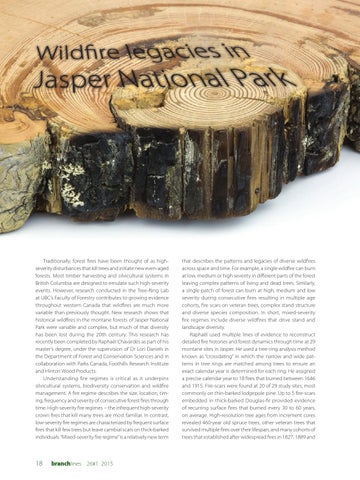
Traditionally, forest fires have been thought of as highseverity disturbances that kill trees and initiate new even-aged forests. Most timber harvesting and silvicultural systems in British Columbia are designed to emulate such high-severity events. However, research conducted in the Tree-Ring Lab at UBC’s Faculty of Forestry contributes to growing evidence throughout western Canada that wildfires are much more variable than previously thought. New research shows that historical wildfires in the montane forests of Jasper National Park were variable and complex, but much of that diversity has been lost during the 20th century. This research has recently been completed by Raphaël Chavardès as part of his master’s degree, under the supervision of Dr Lori Daniels in the Department of Forest and Conservation Sciences and in collaboration with Parks Canada, Foothills Research Institute and Hinton Wood Products. Understanding fire regimes is critical as it underpins silvicultural systems, biodiversity conservation and wildfire management. A fire regime describes the size, location, timing, frequency and severity of consecutive forest fires through time. High-severity fire regimes − the infrequent high-severity crown fires that kill many trees are most familiar. In contrast, low-severity fire regimes are characterized by frequent surface fires that kill few trees but leave cambial scars on thick-barked individuals. “Mixed-severity fire regime” is a relatively new term
18
branchlines 26#1 2015
that describes the patterns and legacies of diverse wildfires across space and time. For example, a single wildfire can burn at low, medium or high severity in different parts of the forest leaving complex patterns of living and dead trees. Similarly, a single patch of forest can burn at high, medium and low severity during consecutive fires resulting in multiple age cohorts, fire scars on veteran trees, complex stand structure and diverse species composition. In short, mixed-severity fire regimes include diverse wildfires that drive stand and landscape diversity. Raphaël used multiple lines of evidence to reconstruct detailed fire histories and forest dynamics through time at 29 montane sites in Jasper. He used a tree-ring analysis method known as “crossdating” in which the narrow and wide patterns in tree rings are matched among trees to ensure an exact calendar year is determined for each ring. He assigned a precise calendar year to 18 fires that burned between 1646 and 1915. Fire-scars were found at 20 of 29 study sites, most commonly on thin-barked lodgepole pine. Up to 5 fire-scars embedded in thick-barked Douglas-fir provided evidence of recurring surface fires that burned every 30 to 60 years, on average. High-resolution tree ages from increment cores revealed 460-year old spruce trees, other veteran trees that survived multiple fires over their lifespan, and many cohorts of trees that established after widespread fires in 1827, 1889 and