SPRING
16
IMPRESSIONS 2
Dean’s Message
16
The Importance of Student Awards
20
SSPP Spotlight: James Chen
26
Craniofacial Research— How Human Faces Form
32
Alumni Class Notes and Events
3
News
18
SSPP Student and Mentor Comments
22
4th-Year Travel Clinics Alumni Pay Forward
30
Dental Hygiene Students on Rotation to Vietnam
39
CDE Calendar
Advancing Oral Health Through Outstanding Education, Research and Community Service
16 SPRING
Dean’s Message
Dear Colleagues, Welcome to the spring 2016 issue of UBC Faculty of Dentistry’s Impressions.
In this edition of Impressions, we look at how Prof. Virginia Diewert’s research investigating the development of the human face has contributed to understanding mechanisms responsible for craniofacial birth defects. Dr. Diewert’s work clearly demonstrates the link between basic science and advances in patient care. She has been an outstanding mentor for dental students, both undergraduate and graduate, and the research of one of her current mentees, Kiavash Hossini, is also noted in this issue.
2
U B C D E N T I S T RY I M P R E S S I O N S
International oral health experiences are important for our students to learn the differences and commonalities between oral health care delivery in Canada and other countries. Several recent graduates look back on their international experience and reflect on the impact it has had on their dental careers. There is also an article on dental hygiene students’ recent international experience in Vietnam. Our students remain highly committed to serving the oral health needs of diverse populations of patients in multiple settings worldwide. In the past year, our students have also gained considerable recognition, receiving multiple awards, some representing “firsts” for UBC or Canada. We are blessed to have outstanding students, whose extraordinary accomplishments in research are being recognized by scientists in their fields. Many of our students are very talented researchers, and it will be particularly impressive to see them become the next generation of dental school faculty members. A priority for our Faculty development
activity is the creation of student awards that provide funding and recognition. The importance of student awards is highlighted in an article in which student recipients reflect on, and demonstrate, the value of receiving these awards. The faculty, staff and students of UBC Dentistry remain committed to our strategic themes: enhance the student experience, amplify research productivity and increase community involvement. Having just celebrated, in 2014–2015, our first 50 years of providing dental education and training, we know that our next 50 years is based on an outstanding foundation. Please enjoy this issue of Impressions. All the best,
Charles Shuler, DMD, PhD Dean and Professor, Faculty of Dentistry
PHOTO BY MARTIN DEE
The 2015–2016 academic year is the University of British Columbia’s 100th, and UBC Dentistry is excited to help the university celebrate this century of growth and development. We will be linking our 10-year anniversary of the Nobel Biocare Oral Health Centre, as well as our student bursaries fundraising, with the university’s centennial events. And, while the accomplishments that have occurred at UBC in the past 100 years are celebrated, we will continue to highlight the recent accomplishments of our Faculty in research, teaching and service.
SPRING
16
Blue Light Shines Brightly as an Oral Cancer Surgery Tool Findings in a retrospective case-control observational study, published recently in the Journal of the American Medical Association Otolaryngology—Head & Neck Surgery,† suggest that using fluorescence visualization (FV) during oral cancer surgery drastically improves the accuracy of removing cancerous tissue and preserving healthy tissue. Dr. Catherine Poh, lead author of the study, is a Vancouver Coastal Health Research Institute scientist and an oral pathologist and associate professor in the UBC Faculty of Dentistry. The study showed that use of FV during surgery to remove lesions significantly reduced the recurrence rates of cancerous tissue in the affected oral region at three years. For patients with cancerous lesions, recurrence rates dropped from 40 percent to 6.5 percent; among patients with pre-invasive lesions, recurrence dropped from 39 percent to 9 percent. The FV technique uses a regular white light that is filtered so that only blue light shines through. Under the blue light, normal tissue
appears bright green and cancerous tissue appears dark. Without FV, surgical removal of cancerous lesions in the mouth requires cutting an extra 10 millimetres around the lesion (or tumour) in the hopes of removing hard-to-see cancerous cells that may be spreading. “Not using FV technology means sometimes under-cutting the affected area, or overcutting in a direction we don’t even need to,” explains Poh. However, per this study, one in three patients will still experience local recurrence of the cancer.
Catherine Poh, Principal Investigator, Discusses COOLS Trial Dr. Catherine Poh is the principal investigator of the Terry Fox Research Institute Translational Research Project: Canadian Optically-guided approach for Oral Lesions Surgical (COOLS) trial. Poh discusses the project, which uses a blue light to distinguish between normal tissue and cancerous tissue, and how it can help surgeons provide better treatment to oral cancer patients.
According to Poh, Vancouver Coastal Health–affiliated head and neck surgeons in BC have already changed their practice and are using FV during oral cancer surgeries. She hopes that with more research, such as that happening through a national trial (see sidebar), all surgeons will consider FVguided surgeries as standard practice. †Poh CF, Anderson DW, Durham JS, Chen J, Berean KW, MacAulay CE, Rosin MP. (2016). Fluorescence visualization–guided surgery for early-stage oral cancer. Journal of the American Medical Association Otolaryngology—Head & Neck Surgery. doi:10.1001/ jamaoto.2015.3211.
View her discussion about the COOLS trial on YouTube at http://bit.ly/1WLG1RK
U B C D E N T I S T RY I M P R E S S I O N S
3
1 6 SPRING
Old and new Fellows joined together onstage at the American College of Dentists Annual Meeting and Convocation in Washington, DC, in November 2015. From left to right: Drs. Lance Rucker, Greg Chang, John Hung, Angelique Leung, David Baird, Cathy McGregor, Ingrid Emanuels, Marcia Boyd, Tim Gould, Myrna Halpenny, Farah Remtulla, Kevin Lauwers, David Lim and Bruce Ward.
The American College of Dentists (ACD) inducted several UBC Dentistry affiliates as new Fellows this past year: David Baird DMD 1980; Greg Chang DMD 1986, clinical instructor; Ingrid Emanuels DMD 1980, clinical associate professor; John Hung, clinical assistant professor; and Farah Remtulla DMD 2009, clinical instructor. The convocation was held November 5, 2015, at the ACD Annual Meeting and Convocation in Washington, DC. The American College of Dentists is the oldest national [US] honorary organization for dentists. Its members have exemplified excellence through outstanding leadership and exceptional contributions to dentistry and society.
DMD Student Takes First Place in National Research Award Competition
Muizz Wahid
Muizz Wahid, second-year dental student, placed first in the Junior Category in the Canadian Association for Dental Research (CADR) and the Network for Canadian Oral Health Research (NCOHR) Student Research Award competition for 2014–2015. His research, titled “Dosimetry Analysis of Panoramic-Imaging Devices in DifferentSized Phantoms,” was undertaken as an undergraduate summer student of Dr. Nancy Ford, who is director of the Centre for High-Throughput Phenogenomics and assistant professor in the Department of Oral Biological & Medical Sciences. The project spanned seven weeks, from June to August 2015. Wahid measured the X-ray dose in adult-, adolescent- and pediatric-sized head phantoms using the Planmeca panoramic imaging system and the panoramic option on the Carestream 9300 cone beam computed tomography machine, both in UBC’s Nobel Biocare Oral Health Centre. He demonstrated a significant reduction in dose for the pediatric and adolescent patients imaged using child/adolescent acquisition protocols instead of protocols designed for adults. The top placement includes a travel award for Wahid to present his research at the American Association of Dental Research (AADR)/ Canadian Association of Dental Research (CADR) meeting in Los Angeles, California, in March 2016.
4
U B C D E N T I S T RY I M P R E S S I O N S
The CADR/NCOHR student research competition required a five-page manuscript and an abstract for assessment. A panel of 13 dental researchers from across Canada judged the entries using the criteria applied by the American Association for Dental Research (AADR) Edward H. Hatton Awards Committee. Those undertaking a Bachelor of Science degree or a degree in dentistry who have not completed a Master of Science or a doctorate-level degree may compete in the Junior Category. Previous UBC Dentistry students who have won an award in CADR/NCOHR student research competitions in either junior, senior basic science or senior clinical categories since 2007 are: Hai-Sle Moon, MSc candidate (Don Brunette supervisor) in 2015; Sara HosseiniFarahabadi, PhD 2014 (Joy Richmond supervisor) in 2013; Leila Mohazab, DMD 2014 (Hannu Larjava supervisor) in 2011; Darlene Tam, BDSc 2008, MSc 2014 (Catherine Poh supervisor) in 2010; Angela Wong, MSc/Dip Pros 2013 (Chris Wyatt supervisor) in 2010; Heather Szabo-Rogers, PhD 2007 (Joy Richman supervisor) in 2008; Maryam Sharifzadeh-Amin, MSc 2002, PhD 2007 (Rosamund Harrison supervisor) in 2007; and Mario Brondani PhD 2008, MPH 2012 (Michael MacEntee supervisor) in 2007.
PHOTO COURTESY OF GREG CHANG
Faculty and Alumni Granted Fellowship in the ACD
SPRING
Dr. Eli Whitney
16
US Looks to UBC Faculty Member for New Postdoctoral Oral Medicine Competencies
Recognizing the need for an updated competency document for oral medicine residency programs, Dr. Nathaniel Treister, then chair of the American Academy of Oral Medicine (AAOM) Program Directors Committee, recruited Dr. Eli Whitney, program director of UBC Dentistry’s Oral Medicine– Oral Pathology residency program, as lead author. The competency document outlines what is expected of residents upon graduation. Treister, assistant professor of oral medicine at Harvard School of Dental Medicine and associate surgeon in the Division of Oral Medicine and Dentistry at Brigham and Women’s Hospital, is also a co-author on the project. The other authors are Drs. Eric Stoopler, University of Pennsylvania School of Dental Medicine, Michael Brennan, Carolinas Medical Center, and Scott DeRossi, Georgia Regents University, all recruited for their expertise in oral medicine. Whitney’s team reviewed the “Curriculum Guidelines for Postdoctoral Oral Diagnosis/ Oral Medicine” that were published in the Journal of Dental Education in 1992. That original document was published at the beginning of the move toward competencybased training in North American dental education. It was both descriptive and prescriptive, but did not incorporate measureable outcomes, and its focus in areas strayed from educational outcomes into areas such as operational and facility needs. They also reviewed an internal AAOM competency document from 2009. It was
a lengthy, detailed document that included many lower-level and subjective learning objectives. In addition, it focused on specific conditions and treatment details; however, with scientific advancement, these had become outdated in some content areas. Whitney notes that, among other documents reviewed by the project authors, one of the key reference documents guiding the team was a paper co-authored by UBC Dentistry professor emerita Dr. Marcia Boyd and colleagues, which was published in the European Journal of Dental Education in 2002. After many teleconferences and shared early drafts, and using a consensus approach, the team developed a more contemporary, high-level competency document to describe the knowledge, skills and behaviours expected of postdoctoral oral medicine graduates. Once the document had reached an advanced state, it was circulated to stakeholders in the field of oral medicine for feedback. “We decided to submit the final document, titled, ‘Competencies for the New Postdoctoral Oral Medicine Graduate in the United States,’† to the well-respected journal Oral Surgery Oral Medicine Oral Pathology Oral Radiology, because of its widespread readership, not only in the oral medicine community; it would also provide exposure to practitioners in the other dental diagnostic sciences disciplines,” explains Whitney. This journal is the official publication of the American Academy of Oral Medicine and the Canadian Academy of Oral and Maxillofacial
Pathology and Oral Medicine (CAOMPOM). Treister remarks that this competency document will be very helpful to the oral medicine residency programs in the United States. “Publication was the culmination of many years of collaboration between the authors, all of whom are oral medicine experts and thought leaders from across North America,” he says. The document supports the requirements outlined in the United States Commission on Dental Accreditation (CODA) “Accreditation Standards for Advanced General Dentistry Education Programs in Oral Medicine.” It provides a common set of expectations for US oral medicine programs, while still providing sufficient latitude for developing, delivering, administering and evaluating programs based on particulars of staffing, resources and expertise. While this competency document was composed with an American audience in mind, its content is fully compatible with the content and resident expectations of Canadian oral medicine–oral pathology residency programs. In fact, Whitney points out, “It helps Canadian programs ensure that their graduates are prepared to write the American Board of Oral Medicine examinations.” †Whitney EM, Stoopler E, Brennan MT, DeRossi SS, Treister NS. (2015). Competencies for the new postdoctoral Oral Medicine graduate in the United States. Oral Surgery Oral Medicine Oral Pathology Oral Radiology, 120(3): 324–328. doi.org/10.1016/j. oooo.2015.04.007.
U B C D E N T I S T RY I M P R E S S I O N S
5
1 6 SPRING
UBC Dentistry Grad Student Wins Dental Materials Award—A First for a Canadian University
Bernardo U. Peres, a graduate student in Craniofacial Science, won third place in the prestigious George Paffenbarger Award from the Academy of Dental Materials (ADM). The award is given to the top three scientific studies presented to a judging committee during the ADM annual meeting. The 2015 meeting took place October 7 to 10 in Maui, Hawaii. Dr. Peres competed with graduate students at all levels from around the world. This is the first time a student from a Canadian university has won this award. His study, titled “Nanocrystal Cellulose (NCC) as Reinforcing Agent for Electrospun Nanofibers,”† was conducted at UBC in the Faculty of Dentistry’s Carvalho Lab in collaboration with the Department of Materials Engineering, Faculty of Applied Science. The study found that NCC is a promising, sustainable candidate for reinforcing composite structures. Peres is in his second year of a three-year Master of Science degree and is supervised by Dr. Ricardo M. Carvalho, professor, Department of Oral Biological & Medical Sciences. Internationally, the Academy of Dental Materials is one of the most influential institutions in the field of dental materials. The Academy publishes Dental Materials, which ranks among the top five impact factor journals in dentistry. The annual Paffenbarger Award was created in 1987 to recognize the best paper in the field of dental materials. †Peres BU, Vidotti HA, Manso AP, Ko F, Carvalho RM. (2015). Nanocrystal cellulose (NCC) as reinforcing agent for electrospun nanofibers. Dental Materials, 31(1): e65–e66. doi:10.1016/j.dental.2015.08.143.
Dr. Bernardo Peres
Read more about this award at http://bit.ly/1nlVLyv
New Appointments: Full-Time Faculty Georgios Giannelis, DDS, MSc/ Dip Perio, FRCD(C), DABP
Karen Campbell, DDS, MSc, FRCDC
Karen Campbell has been appointed to the endowed professorship position, Professorship in Dentistry, which is jointly held between UBC and BC Children’s Hospital (BCCH) and funded by donors to support pediatric dentistry at both institutions. Dr. Campbell is director of both the Department of Dentistry at BCCH and the graduate program in Pediatric Dentistry at UBC Dentistry. Conferral of this professorship recognizes Campbell’s important role in the oral health care of children and the education of pediatric dentists for the province.
6
U B C D E N T I S T RY I M P R E S S I O N S
Georgios Giannelis has been appointed director of the graduate program in Periodontics. For more information, see the news item “New Director of Graduate Periodontics” on page 7.
Zul Kanji, BSc, Dip DH, MSc, EdD (candidate)
Zul Kanji has been appointed director of the Dental Hygiene Degree Program (DHDP). For more information, see the news item “New Director of Dental Hygiene Program” on page 8.
Chris Wyatt, BSc, DMD, MSc, Dip Pros, FRCD(C)
Chris Wyatt has been appointed Seniors Foundation Professor in Geriatric and Outreach Dentistry. Dr. Wyatt is head of the Division of Prosthodontics and Dental Geriatrics in the Department of Oral Health Sciences at UBC Dentistry. This endowed professorship recognizes the importance and depth of his role in the promotion of oral health for senior citizens in the UBC Geriatric Dentistry Program.
SPRING
Retirements: Full-Time Faculty
Donald M. Brunette, BSc, MSc, PhD, Professor
Prof. Donald Brunette is an iconic figure in dental implant research and a leader in dental research and education. Trained as a medical biophysicist and recruited from the University of Toronto, Brunette started his UBC career as an associate professor in 1979. He became a full professor in 1985. His work has directly impacted both the dental profession and the field of dentistry as a branch of the health sciences. He has conducted outstanding research over a broad spectrum of topics in biomaterials, dental implants, cell biology, periodontology and oral malodor. His studies on using surface topography to impede epithelial downgrowth and enhance bone production around implants have influenced commercial manufacturers in the design of their implants. The concept of altering surface topography of an implant to improve integration is now well recognized and applied by almost all dental implant manufacturers. Brunette received millions of dollars of government and industry funds to advance dental research and train clinical researchers who are now at leading academic positions in Canada and around the world. He has published over 100 refereed journal articles and 16 chapters in books and reviews. His book, Critical Thinking: Understanding and Evaluating Dental Research, now in its second edition, was awarded Best Book in the Allied Health Sciences by the American Medical Writers Association, and has been translated into Japanese. He is a co-editor of the book Titanium in Medicine, which continues to be the definitive text on the topic of titanium implant surface interaction with the biological environment. He served in several top academic and research positions: eight years as associate dean of
Research/Grad Studies at UBC Dentistry; 12 years as the Faculty’s head of the Department of Oral Biology; eight years on the Canadian Association of Dental Research (CADR) executive; 16 years as member, chair and scientific officer of grant evaluation committees with the Canadian Institutes of Health Research (CIHR) and its former iteration, the Medical Research Council of Canada, as well as the National Science Foundation in the United States.
16
New Director of Graduate Periodontics
Brunette retired at the end of 2015. The UBC Faculty of Dentistry will certainly miss his presence.
Donald Brunette Symposium: Optimizing the Design of Dental Implants To honour Prof. Don Brunette’s retirement, a reception will be held on Thursday, April 14, 2016, and a full-day symposium on Friday, April 15. These events will celebrate Brunette’s career and recognize his many contributions to science and the outstanding mentorship he has provided to many students and faculty members. The symposium will present the current state of the art and science of implantology and related fields, as well as new and exciting developments in the biology that underlies diagnosis and treatment of peri-implant diseases. Sixteen speakers from around the world–all leading researchers in immunology, oral biology and implantology–will analyze and review the critical data that optimizes implant success and informs the profession’s thinking on implant failure. The ideas of Brunette and his colleagues in this field will be considered in depth, with a focus on Brunette’s research on implant surface topography and how this central element of implant design and engineering impacts the behaviour of cells, living tissues, and ultimately, clinical outcomes. Additionally, the symposium will highlight how this research established UBC as an important centre for implant research. The symposium is designed for the general practitioner, hygienist and dental researcher. The information and approaches considered will be useful for practitioners who place and manage the long-term health of dental implants. The course will also be very useful for dentists who address problems associated with failing implants. For more information, including speakers, topics and registration, visit www.dentistry.ubc.ca/brunettesymposium
Dr. Georgios Giannelis
Georgios (George) Giannelis, DDS, MSc/Dip Perio, FRCD(C), DABP, has joined the Department of Oral Biological & Medical Sciences as an assistant professor and director of the graduate Periodontics program. Dr. Giannelis obtained his Doctor of Dental Surgery degree with distinction and awards from the Aristotle University of Thessaloniki (Greece) in 2007. Supported by scholarships from three independent foundations, Giannelis continued his education at UBC Dentistry, where he completed a combined Diploma in Periodontics and Master of Science degree in 2011. He was awarded the Kathleen McAnulty Memorial Prize in Graduate Periodontics for outstanding overall performance, the Nobel Biocare Achievement Prize for outstanding theoretical performance and excellence in implant surgery, and his involvement in research on wound healing led to the George S. Beagrie Scholarship. In recognition of his contribution to the education of UBC dental and hygiene students, he was given the Graduate Student Teaching Award. From 2011 to 2014, he was a part-time clinical assistant professor at the College of Dentistry in the University of Manitoba’s Faculty of Health Sciences and worked in private practice as a periodontist in the Southwest Specialty Group in Winnipeg. Giannelis is a Fellow of the Royal College of Dentists of Canada. In July 2015, he became a Diplomate of the American Board of Periodontology. Prior to returning to Vancouver, he served in the Greek military as a periodontist.
U B C D E N T I S T RY I M P R E S S I O N S
7
1 6 SPRING
UBC Dentistry Names New Director of Dental Hygiene Program The Faculty of Dentistry has appointed Zul Kanji, BSc, Dip DH, MSc, EdD (candidate), as its new director of the Dental Hygiene Degree Program (DHDP). Kanji’s affiliation with the program began with teaching in 2009, and in 2011 he was appointed a full-time faculty member. Since then he has been the DHDP clinic coordinator, coordinator for Year 1 and Year 2, and acting director of the program from 2012 to 2013. “Zul has considerable experience with our dental hygiene program and will be a major asset to the Faculty,” said Dr. Charles Shuler, dean of UBC Dentistry. Kanji completed a Master of Science (Dental
The Dental Hygiene Degree Program: Looking Ahead Zul Kanji sees interprofessional education (IPE), internationalization and accessibility to higher education as central elements to his strategic vision for the Dental Hygiene Degree Program (DHDP). Some of his priorities include strengthening collaboration with other programs in the Faculty and other disciplines on campus, developing new international partnerships, and renewing the entry-to-practice and degree-completion options of the program. “We have a solid foundation on which to build,” he says, “and a committed team in this Faculty, who are eager to work collaboratively on these projects.” Over the past few years, curriculum common to both dental hygiene and dentistry has been integrated to allow for shared learning experiences in local anaesthesia and anatomy of the head and neck.
8
U B C D E N T I S T RY I M P R E S S I O N S
Science) degree from UBC in 2010. Stemming from his graduate research, which focused on outcomes of dental hygiene baccalaureate education, he received a research excellence award and a visionary award, both from the Canadian Dental Hygienists Association (CDHA). Currently, Kanji is undertaking a doctoral program at Simon Fraser University in Educational Leadership in Post-Secondary Contexts. His research focus is student retention in higher education. Now in his third year, he is the recipient of three SFU Faculty of Education Graduate Fellowships for scholastic and research achievements.
Zul Kanji
director and is an editorial board member of the Canadian Journal of Dental Hygiene. His appointment as director of the dental hygiene program is paralleled by a tenure-track position in the Educational Leadership Stream toward the rank of Professor of Teaching. This is fitting for Kanji given his previous positions, doctoral education and teaching achievements. He has received five UBC Faculty of Dentistry and two national teaching awards, including the 2013 W.W. Wood Award for Excellence in Dental Education from the Association of Canadian Faculties of Dentistry and the 2014 CDHA Excellence in Teaching Award.
Kanji also sits on the board of the College of Dental Hygienists of British Columbia as a
Continuing in this spirit, this year the two undergraduate programs will come together to learn about addiction medicine, gender diversity, social responsibility and Aboriginal health. Through identifying additional areas of common learning in the Faculty, as well as partaking in IPE initiatives stemming from the cross-campus health disciplines body, UBC Health, such as the integrated ethics curriculum being implemented across all UBC health and human services programs, the DHDP aims to graduate collaborative health care practitioners. Involvement in more international learning opportunities will also be a priority for the DHDP. For example, over this past winter break, two fourth-year dental hygiene students participated in education, health promotion and research initiatives in Vietnam’s National Hospital of Odonto-Stomatology in Ho Chi Minh City. (For details about this initiative, see page 30 in this issue of Impressions.) Kanji says: “Our students’ involvement with oral cancer
screenings, presentations to hospital staff and university students, and visits to orphanages allowed them to learn about health practices and disparities in ways that simply cannot be taught locally.” Finally, curriculum renewal is always an ongoing process. This past fall, the DHDP received funding from UBC’s Teaching and Learning Enhancement Fund to renew several online courses in the entry-to-practice and degree-completion options. Additionally, the program has approved adoption of the 2015 CDHA Canadian Competencies for Baccalaureate Dental Hygiene Programs for implementation in the 2016—2017 academic year. All these opportunities, Kanji asserts, are made possible only through the vision, dedication and collaboration of many members in this faculty. “I look forward to forming new partnerships and to fostering further collaborative efforts.”
SPRING
16
UBC Graduate Prosthodontics Student Wins ACP Award Graduate prosthodontics student Dr. Nesrine Mostafa’s poster garnered a second-place win from the American College of Prosthodontists (ACP). The competition was held in Orlando, Florida, during the College’s 45th Annual Session, October 22 to 24, 2015.
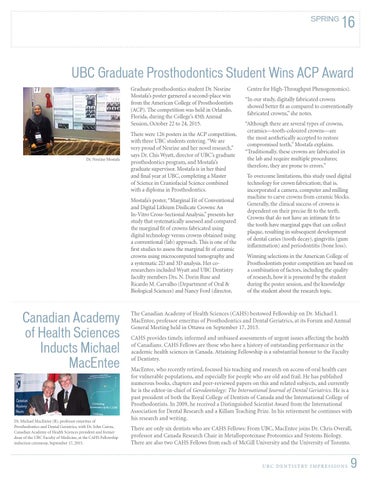
Dr. Nesrine Mostafa
There were 126 posters in the ACP competition, with three UBC students entering. “We are very proud of Nesrine and her novel research,” says Dr. Chis Wyatt, director of UBC’s graduate prosthodontics program, and Mostafa’s graduate supervisor. Mostafa is in her third and final year at UBC, completing a Master of Science in Craniofacial Science combined with a diploma in Prosthodontics. Mostafa’s poster, “Marginal Fit of Conventional and Digital Lithium Disilicate Crowns: An In-Vitro Cross-Sectional Analysis,” presents her study that systematically assessed and compared the marginal fit of crowns fabricated using digital technology versus crowns obtained using a conventional (lab) approach. This is one of the first studies to assess the marginal fit of ceramic crowns using microcomputed tomography and a systematic 2D and 3D analysis. Her coresearchers included Wyatt and UBC Dentistry faculty members Drs. N. Dorin Ruse and Ricardo M. Carvalho (Department of Oral & Biological Sciences) and Nancy Ford (director,
Canadian Academy of Health Sciences Inducts Michael MacEntee
Dr. Michael MacEntee (R), professor emeritus of Prosthodontics and Dental Geriatrics, with Dr. John Cairns, Canadian Academy of Health Sciences president and former dean of the UBC Faculty of Medicine, at the CAHS Fellowship induction ceremony, September 17, 2015.
Centre for High-Throughput Phenogenomics). “In our study, digitally fabricated crowns showed better fit as compared to conventionally fabricated crowns,” she notes. “Although there are several types of crowns, ceramics—tooth-coloured crowns—are the most aesthetically accepted to restore compromised teeth,” Mostafa explains. “Traditionally, these crowns are fabricated in the lab and require multiple procedures; therefore, they are prone to errors.” To overcome limitations, this study used digital technology for crown fabrication; that is, incorporated a camera, computer and milling machine to carve crowns from ceramic blocks. Generally, the clinical success of crowns is dependent on their precise fit to the teeth. Crowns that do not have an intimate fit to the tooth have marginal gaps that can collect plaque, resulting in subsequent development of dental caries (tooth decay), gingivitis (gum inflammation) and periodontitis (bone loss). Winning selections in the American College of Prosthodontists poster competition are based on a combination of factors, including the quality of research, how it is presented by the student during the poster session, and the knowledge of the student about the research topic.
The Canadian Academy of Health Sciences (CAHS) bestowed Fellowship on Dr. Michael I. MacEntee, professor emeritus of Prosthodontics and Dental Geriatrics, at its Forum and Annual General Meeting held in Ottawa on September 17, 2015. CAHS provides timely, informed and unbiased assessments of urgent issues affecting the health of Canadians. CAHS Fellows are those who have a history of outstanding performance in the academic health sciences in Canada. Attaining Fellowship is a substantial honour to the Faculty of Dentistry. MacEntee, who recently retired, focused his teaching and research on access of oral health care for vulnerable populations, and especially for people who are old and frail. He has published numerous books, chapters and peer-reviewed papers on this and related subjects, and currently he is the editor-in-chief of Gerodontology: The International Journal of Dental Geriatrics. He is a past president of both the Royal College of Dentists of Canada and the International College of Prosthodontists. In 2009, he received a Distinguished Scientist Award from the International Association for Dental Research and a Killam Teaching Prize. In his retirement he continues with his research and writing. There are only six dentists who are CAHS Fellows: From UBC, MacEntee joins Dr. Chris Overall, professor and Canada Research Chair in Metalloproteinase Proteomics and Systems Biology. There are also two CAHS Fellows from each of McGill University and the University of Toronto.
U B C D E N T I S T RY I M P R E S S I O N S
9
1 6 SPRING Significant Honour From a French University to UBC Dentistry Professor
N. Dorin Ruse (L), UBC Dentistry professor, and Frédéric Dardel, president of Paris Descartes University. The insignia Doctor Honoris Causa of Paris Descartes University.
Paris Descartes University bestowed N. Dorin Ruse, UBC Dentistry professor and chair, Biomaterials, with the insignia Doctor Honoris Causa. The title is one of the most prestigious distinctions awarded by French higher educational institutions to honour foreign nationals for their work in a particular field such as science, literature or art. In a ceremony in the French capital on September 17, 2015, Frédéric Dardel, president of Paris Descartes University, presented the rank of honorary doctorate to Ruse and four other professors from universities in the US (Buffalo and Los Angeles) and Germany (Hamburg). Ruse’s research focuses on the application of fracture mechanics and fatigue methodology in the study of dental materials and adhesive interfaces. His publication record includes 50 peer-reviewed papers, 70 oral/poster presentations and two book chapters.
He was president of the Academy of Dental Materials from 2004 to 2006, and from 1997 to 2006 was secretary and chair of the ISO (International Organization for Standardization), Technical Committee 106/SC 1 Filling and Restorative Materials. He is a member of the editorial board of Dental Materials and serves as an editorial consultant or reviewer for over a dozen journals. Ruse has received several awards over the years: Killam Teaching Award, University of British Columbia (1997); Award of Merit, Canadian Dental Association (2000); Distinguished Service Award, British Columbia Dental Association (2004); Graduate Studies Award, University of British Columbia (2013); and most recently, the Couronne de la Personnalité, Faculté de chirurgie dentaire, Paris Descartes Université (2014).
Read the news announcement about N. Dorin Ruse receiving the Couronne de la Personnalité in 2014 at http://bit.ly/1079kY5
International College Inducts Faculty, Alumni and Others The International College of Dentists (ICD) Canadian Section inducted many UBC faculty, alumni and other BC dentists as new Fellows. The convocation was held in St. John’s, Newfoundland, on August 28, 2015. UBC Dentistry faculty members (alumni indicated by graduation year) inducted as Fellows are: Drs. Andrea Esteves (MSc 1994), clinical associate professor and associate dean, Clinical Affairs; Todd Jones (DMD 1990), clinical instructor; Graham Lee (DMD 1978), clinical instructor; Joyce Ling (DMD 1984), clinical assistant professor; Cathy McGregor (DMD 1980), clinical assistant professor; Mark Norris (DMD 1979), clinical instructor; Edward Putnins (PhD 1995), professor and associate dean, Research, Graduate & Postgraduate Studies; Jim Richardson (DMD 1984), clinical associate professor; Charles Shuler, professor and dean, UBC Dentistry; and Gary R. Wong, clinical instructor.
10
U B C D E N T I S T RY I M P R E S S I O N S
Non-faculty alumni inducted as Fellows include: Drs. David Baird (DMD 1980), Raymond Fong (DMD 1989), John Lee (DMD 1981), Angelique Leung (DMD 1988), Marcy Schwartzman (DMD 1984) and Michael Shimzu (DMD 1989). Prince George dentist Dr. Anne Muirhead and Victoria dentist Dr. Donald Bays were also inducted as Fellows. The International College of Dentists is the oldest and largest international honour society for dentists in the world. Its 12,000 members (Fellows) are dedicated to recognizing outstanding professional achievement and meritorious service and to the continued progress of the profession of dentistry for the benefit of all humankind.
New ICD Fellows from British Columbia surround a few long-time Fellows* during the convocation ceremony held in St. John’s, Newfoundland. First row (bottom) from left to right: Drs. Joyce Ling, Marcy Schwartzman, Angelique Leung, Anne Muirhead, David Ciriani,* John Lee, Serge Vanry* and Donald Bays. Second row from left to right: Drs. Andrea Esteves, Cathy McGregor and Jim Richardson. Third row from left to right: Drs. Todd Jones, Edward Putnins, Martin Braverman,* David Baird, Charles Shuler, Bob Baker* (registrar, ICD Canadian Section) and Peter Kearney.* Fourth row (top) from left to right: Drs. Gary R. Wong, Michael Shimizu, Raymond Fong, Mark Norris, David Sweet* and Graham Lee.
SPRING
16
UBC Celebrates 100 Years of Learning, Research and Community Engagement UBC launched its centennial year in September 2015, exactly 100 years after welcoming its first class of 379 students. For information about the centennial celebrations, including stories about the history of the university, photo and video galleries, plus listings of all the special events planned into 2016, visit UBC100.ca. Be sure to explore how UBC (including the Faculty of Dentistry over the past five decades) evolved from 1915 to 2015, one discovery at a time, to become one of Canada’s leading research universities. See the online story, “100 Years of Discovery,” at http://bit.ly/1nlU4RE
Highlights: Research Day 2016 This year’s Research Day, held on January 26, revisited the important topic of oral cancer with a focus on early detection, risk factors and treatment approaches. Important advancements have been made in these areas since oral cancer was featured in Research Day 2009. Now in its ninth year, Research Day highlighted the work of local researchers from the UBC Faculty of Dentistry and the BC Cancer Agency. Their discoveries have led to new techniques for preventing, detecting, triaging and treating oral cancer with the aim to improve long-term outcomes for patients with oral cancer or precancer. The Faculty of Dentistry was honoured to have the keynote address delivered by Dr. Miriam Rosin, director of the BC Oral Cancer Prevention Program and senior scientist at the BC Cancer Agency. As principal investigator on the Oral Cancer Prediction Longitudinal Study, which has been following patients with oral cancer or precancer since 1999, Dr. Rosin’s work focuses on the development of new strategies for oral cancer prevention and control.
Chan, assistant professor Dr. Caroline Nguyen, associate professor Dr. Catherine Poh and PhD candidate Leigha Rock. Guest presenters were Daniel St. Andrews, an oral cancer survivor, who spoke about his personal oral cancer survivorship journey, and Brenda Currie, UBC alumna, who spoke about the successful oral cancer fundraising initiative, Taste for Life, An Evening to Conquer Oral Cancer. The event took place in the Great Hall of the Alma Mater Society Student Nest and was well attended by faculty, students and staff. UBC Dentistry is grateful to Scotiabank and Sinclair Dental for sponsoring Research Day 2016.
Other scientific presenters included Dr. Ajit Auluck, a postdoctoral research fellow at Simon Fraser University and a UBC alumnus, as well as, from UBC Dentistry, clinical assistant professor Dr. Bertrand
U B C D E N T I S T RY I M P R E S S I O N S
11
1 6 SPRING $4M in Funding to Canadian Sleep Network—UBC Dentistry Researcher Plays a Key Role
Dr. Fernanda Almeida
The Canadian Sleep and Circadian Network (CSCN) has been awarded close to $4 million to mobilize the health care community toward an integrated approach to improving outcomes and treatment of patients with obstructive sleep apnea (OSA). A grant just under $2 million from the Canadian Institutes of Health Research (CIHR) was equally matched by funds from the faculties of dentistry and medicine at the University of British Columbia, other Canadian universities and various industry sources. Dr. Fernanda Almeida, UBC Dentistry associate professor, dental sleep medicine expert and a co-investigator with CSCN, says the network’s research plan will involve multidisciplinary teams from 19 universities* and include investigators in sleep medicine, respiratory medicine, dentistry, cardiology, genetics, nephrology, neurology, pediatric medicine, kinesiology, behavioural sciences, epidemiology, neuropsychology, brain imaging, chronobiology (circadian rhythms), public health, health services and health economics. Obstructive sleep apnea (OSA) affects over one million Canadians. OSA leads to significant cardiovascular and metabolic health problems, and patients with untreated OSA are at higher risk of stroke and Alzheimer’s disease. Eighty to 90 percent of patients with moderate to severe OSA have not been clinically diagnosed
12
U B C D E N T I S T RY I M P R E S S I O N S
due to poor access to therapy and lack of resources for diagnosis. “The network will provide a comprehensive integrated ‘basic science to clinical practice model’ to understand the mechanisms relating to adverse health consequences for OSA patients,” Almeida says. Four research project areas have already been outlined to respond to several pressing OSA challenges: the difficulty in identifying vulnerable OSA patients; the rise of OSA in obese children and youth most at risk of OSA; the increased rate of OSA in the aging population, especially those with mild cognitive impairment; and the issue of poor access and adherence to OSA treatment. Almeida is particularly excited by the creation of databases for CSCN projects. One of these will be the first adult multi-site OSA database in the world to incorporate polysomnographic sleep patterns, biological samples (genetic, serum) and cognitive measures. “By having these data, we hope to determine whether inflammatory and genetic markers predict the occurrence of negative cardiovascular, metabolic and cognitive outcomes and to evaluate how shift work schedules interact with inflammatory biomarkers in OSA patients,” she says. Another data-collecting and sharing project earmarked because of the CIHR matched funding includes creating the Canadian Obese OSA Children and Youth Database. For this population, Almeida’s contribution will focus on understanding craniofacial structures. This, she notes, is important for identifying possible adjunct therapies for children and youth. These databases will facilitate interaction and collaborative projects between clinical and research groups. Almeida is no stranger to large database-sharing scopes: she is steering committee chair of the Oral Appliance Network of Global Effectiveness, a multinational study involving worldwide data collection to evaluate the long-term effectiveness of oral appliance therapy in patients with OSA. Almeida also has several studies underway investigating adherence to different OSA therapies. The aging population also holds special interest for Almeida. Despite the decline in edentulism (tooth loss), it is estimated that
24 percent of individuals aged 55 to 65 years will need one or two dentures in 2020. She notes that previous studies found an aggravation of OSA while not wearing dentures during sleep, a common recommendation by dentists. Therefore, a group study of elderly people will certainly include the evaluation of dentures and its use. Complementing the research, the CSCN will consult with OSA patients to focus research on patients’ priorities, reinforce participative research, facilitate knowledge translation and ensure strong links with community-based groups. The network will also deploy a national plan of knowledge exchange between patient groups, researchers, the health care community and industry, to provide affordable home-based diagnostic technologies, clinical practice guidelines and lay information to patients on research outcomes and therapies. Over the course of the five-year CIHR grant, anticipated outcomes include: identification of OSA patients at greater risk of adverse cardiovascular, metabolic and cognitive effects; earlier OSA diagnosis in vulnerable populations; development of personalized OSA treatments; and improvement strategies for patient adherence to OSA treatment. The CIHR grant also provides for the CSCN to develop a national training and career development program in sleep and circadian research for a broad range of health care providers. Collaborations among CSCN investigators includes stakeholder engagement from professional and scientific groups, provincial government agencies, private companies, CIHR institutes and patient advocacy groups. For more information about the Canadian Sleep and Circadian Network, visit www.cs-cn.ca
*University of Alberta, University of British Columbia, Brock University, University of Calgary, Concordia University, Dalhousie University, University of Guelph, Université Laval, McGill University, Université de Montréal, University of Ottawa/Université d’Ottawa, Université du Québec à Montréal, Queen’s University, University of Saskatchewan, Université de Sherbrooke, Simon Fraser University, University of Toronto, University of Waterloo and Western Ontario University.
SPRING
16
Spotlight on Human Dental Pulp: The Overall Lab Increases by 17 the Number of Proteins Known to Exist in Teeth Per the Human Proteome Project A team of UBC Dentistry researchers led by Prof. Chris Overall, including Drs. Ulrich Eckhard, Simon Abbey (MSc student), Ian Matthew (oral surgeon), Giada Marino and Grace Tharmarajah, recently published a study† focused on human dental pulp. Dental pulp is the “nerve centre” lying within the mineralized outer covering of the tooth. The study, the most comprehensive snapshot of any dental tissue so far, was featured in an editorial†† of the Human Proteome Project special issue, published in the prestigious Journal of Proteome Research for the 14th Human Proteome Organization World Congress in 2015. Using contemporary mass spectrometry technology in their lab, these researchers identified more than 4,300 proteins, representing nearly 22 percent of predicted human proteins, including 17 proteins that were predicted from genes but had never been observed before. Furthermore, the study revealed that specialized enzymes called proteases, which cut proteins, are highly important for maintaining tissue function. Over 9,000 cut protein ends (termini) were identified in pulp, revealing pervasive protease action in healthy human tissue. For many years, studies focused on the role of proteases as non-selective protein degraders. However, over the last 15 years, Overall and his laboratory have pioneered the idea that proteases can act as sharp and highly specific scissors that precisely cut or process proteins, rather than just degrading them. Such finely tuned processing can generate new protein
products with altered protein termini that have different protein functions and localization in cells and tissues. For example, protein activity can be turned on or off by proteases, which can switch whole signalling cascades on or off. Thus, proteases and their actions affect many biological processes in health and disease, such as gum disease (periodontitis) and dental pain.
drivers of caries and potential drug candidates to promote tooth dentine repair after caries has been arrested or the tooth restored. Also, human gum tissue will be used to study periodontitis, a serious gum infection that damages soft tissue and destroys bone supporting the tooth, frequently leading to tooth loss.
The Overall Lab actively participates in the Chromosome-Centric Human Proteome Project (C-HPP) a global initiative designed by the Human Proteome Organization (HUPO) to map every single protein in the human body (also called “human proteome”), a quest that began as soon as the Human Genome Project was completed in 2003. Research teams around the world are trying to describe the structure and function of the human proteome and its changes in disease.
With this research, the Overall Lab is at the forefront of research aimed at improving the lives of millions of Canadians and decreasing the financial burden of dental caries and periodontitis on Canada’s health system.
As a first step, researchers in the Overall Lab used healthy human tissues such as platelets, erythrocytes and then dental pulp to capture human protein termini to build a solid understanding of proteolytic processing in human health.
†Eckhard U, Marino G, Abbey SR, Tharmarajah G, Matthew I, Overall CM. (2015). The human dental pulp proteome and N-terminome: Levering the unexplored potential of semitryptic peptides enriched by TAILS to identify missing proteins in the Human Proteome Project in underexplored tissues. Journal of Proteome Research, 14: 3568–3582. doi: 10.1021/acs. jproteome.5b00579. ††Young-Ki P, Hancock WS (Eds). (2015). Recent advances in the Chromosome-Centric Human Proteome Project: Missing proteins in the spot light [special issue]. Journal of Proteome Research, 14: 3409−3414. doi: 10.1021/acs.jproteome.5b00785.
In the next stage, researchers in the lab will analyze diseased samples to identify disruptions in proteolytic processing and signalling, with a goal of casting light on new drug targets. Dental pulps from healthy teeth will be compared with pulps from teeth with various degrees of tooth decay, to identify key For more information on the Overall Lab, visit www.clip.ubc.ca. And for further reading sources, go to http://bit.ly/2022Yph
U B C D E N T I S T RY I M P R E S S I O N S
13
1 6 SPRING
Having a new oral health centre at UBC Dentistry was a dream come true for students, faculty, alumni, the profession and patients. This year marks 10 years since the Nobel Biocare Oral Health Centre (NBOHC) opened in the newly constructed David Strangway Building. Spanning 3,623 square meters (39,000 square feet), the oral health centre occupies mainly the second floor of the building located at University Boulevard and Wesbrook Mall. For over a decade the NBOHC has received unprecedented backing throughout its planning, construction, outfitting and operations stages. Hailed for its state-of-the-
PHOTO BY MARTIN DEE | PHOTO BY SHELLEY N. (FLICKR)
The NBOHC: A Decade of a Dream Come True
Online Stories Worth Clicking
art technology and innovative architectural design, the oral health centre today remains a sophisticated and efficient space for learning, community service and research.
Dr. Adriana Manso
The steel framing of the David Strangway Building is seen during construction in May 2005.
Check out some facts and features about the Nobel Biocare Oral Health Centre and view photos of the facility from its first 10 years in operation at www.dentistry.ubc.ca/ohc10
UBC Prof SaysTeeth Whitening Can Cause Permanent Damage Hoping for a whiter, brighter smile in 2016? With whitening toothpastes, floss, gum, strips and gels available over-the-counter, there is more pressure than ever to have a pearly white smile. Dr. Adriana Manso, clinical assistant professor in UBC’s Faculty of Dentistry, explains how whitening and bleaching products work and why we have to be careful if we are considering using them. Read the story on UBC News at http://bit.ly/1PswJ7F
Help Keep the NBOHC Dream Alive—Adopt an Op
Watch the story on CBC News Vancouver at 6 (January 7, 2016) at http://bit.ly/1Os12LW
To ensure the continuing success of the Nobel Biocare Oral Health Centre as a dynamic and interactive learning environment for students and an exceptional clinical facility for patient care, the Adopt an Op Challenge is underway. Support the next generation of oral health care professionals by taking the Challenge. Here’s how it works: Members of class year, study club and/or regional association collectively contribute $25,000 to name an operatory in the Nobel Biocare Oral Health Centre. The average gift per person is $1,500. Individuals or corporations may name an operatory with a gift of $25,000. At present, there are 128 open operatories in the NBOHC and 44 are named. Of the 16 enclosed operatories, 11 are named. Interested in taking the Adopt an Op Challenge? For more information, contact Manuela Boscenco in the UBC Dentistry Development Office, at 604-822-6808 or manuela@dentistry.ubc.ca
Stay Connected to UBC Dentistry
Visit www.dentistry.ubc.ca/news Follow news on Twitter @ubcdentistry (http://twitter.com/ubcdentistry) Read or download past issues of Impressions at www.dentistry.ubc.ca/impressions
14
U B C D E N T I S T RY I M P R E S S I O N S
Dr. Andrea Esteves
Hidden Treasures: Andrea’s Story Dr. Andrea Esteves, UBC Dentistry’s associate dean of Clinical Affairs, recently completed UBC’s coaching program through Continuing Studies. “I couldn’t think of a better way to develop as a director, teacher and mentor,” she says of the program. View her story “Hidden Treasures,” about being a certified coach, at http://stories.cstudies.ubc.ca/andrea
SPRING
16
Celebrate a Special Occasion WITH DONATIONS TO UBC DENTISTRY
Are you planning a special occasion to honour a colleague or loved one? Consider the ultimate celebration gift of a donation that acknowledges an outstanding professional and/ or family member and also supports UBC Dentistry. Here are some ideas: · For pledged gifts of $25,000 to $50,000, you could name an operatory in the Nobel Biocare Oral Health Centre to honour a graduating student, mark a personal milestone such as a birthday or retirement, dedicate the memory of a mentor or loved one, or
fete your own achievement or corporate brand. Or, you could come together with your family members or colleagues (class, study club or practice) to name an operatory, with each group member’s name inscribed on the dedication plaque. · For pledged gifts of $3,000 to $30,000, you could establish a student award or bursary, or provide opportunities for students to participate in unique community outreach dental initiatives.
· For pledged gifts of $10,000 and under, you could ensure that individual graduate students receive the funding they need for their outstanding academic work in any graduate discipline. · Or, whatever amount of pledged gift, you can choose to benefit other areas of UBC Dentistry, supporting any program, department or project that holds particular meaning for you.
For more information about special occasion giving, contact the UBC Dentistry Development Team at 604-822-6808 or manuela@dentistry.ubc.ca
U B C D E N T I S T RY I M P R E S S I O N S
15
1 6 SPRING
The Importance of Student Awards
Five students at UBC Dentistry reflect on the importance of student awards, and an alumnus weighs in on the impact of recognition. Continue reading to see how determination, passion and hard work motivate the next generation of oral health professionals.
BY STEPHANIE CHOU
Iris Lin, BDSc 2017
Katja McBee, DMD 2016
Alison Ashworth, BDSc 2018
· Impact of Ten Dental Hygiene Award (2015)
· Dr. Clay Hallman Memorial Scholarship for Proficiency in Removable Prosthetics (2015)
· Impact of Ten Dental Hygiene Award (2015)
· Western Canada Dental Society Dr. Cal Waddell Memorial Scholarship (2015)
For Alison Ashworth, student awards help create a balance between the past and future: that is, recognizing past accomplishments is a formula for future success. She reflects, “It is important that student awards continue to be offered, to inspire students to rise above and beyond to reach their highest potential. This is when students will produce their finest work and make a progressive difference in the field of dentistry.”
· Impact of Ten Dental Hygiene Award (2014)
Transformation happens outside the comfort zone for Iris Lin, who has received two Impact of Ten Dental Hygiene Awards. In her dedication to growing as a lifelong learner and dental professional, Lin sees student awards as markers of progress. The recognition is incentive to distinguish herself through hard work. Recently, Lin had the opportunity to meet with a donor who supports the Impact of Ten Dental Hygiene Awards. She says, “It was a reminder of the gratitude I have. Knowing that there are people willing to support my education motivates me to apply myself wholeheartedly and to work to be someone they will be proud to have supported.” Another benefit to awards, notes Lin, is the monetary value that helps ease financial stress for students. “Knowing that others are willing to invest in your education is an encouragement for you to invest in your own.”
16
U B C D E N T I S T RY I M P R E S S I O N S
· Chrysalis Dental Centre – Vancouver Prize in Dentistry (2014) · College of Dental Surgeons of BC Scholarship for Dentistry (2014) · Bisco Dental Products (Canada) Inc. Scholarship (2013)
Katja McBee believes that student awards are a celebration of the oral health care profession. McBee says, “I’m in a class full of amazing people, and to be recognized is truly an honour.” She feels that fostering a community where accomplishments are recognized cultivates a work ethic that ultimately encourages excellence and benefits the profession. McBee reflects, “I work hard to provide the best care I am capable of, and it is gratifying to be rewarded for my efforts.” Participating in volunteer clinics and providing care to underserved populations has been a particularly meaningful experience for Katja. She hopes to gain as much knowledge and experience as possible in dental school, and values learning from instructors who have a myriad of clinical experience.
Ashworth is driven to combine her passion for learning with a desire to have a positive impact in the Faculty of Dentistry and the patient community. Having received the Impact of Ten Dental Hygiene Award, she feels motivated to continue challenging herself in the years to come. She says, “Looking ahead, I am fascinated at how much there is to learn. Although it can be overwhelming at times, being recognized for my commitment and dedication as a student is encouraging.” She is looking forward to participating in community practice and seeing first-hand the positive impact she can have on a patient’s health.
SPRING
16
Kevin Urness, DMD 2016
Dr. Rana Tarzemany, PhD/Dip Perio candidate
Dr. Mark Casafrancisco, DMD 2005
· International College of Dentists Award (2015)
· Dr. S. Wah Leung Scholarship (2015)
· British Columbia Society of Paediatric Dentists Prize (2004)
· A-Dec Community Service Award (2014)
· Joseph Tonzetich Fellowship (2014)
· Western Canada Dental Society Dr. Cal Waddell Memorial Scholarship (2004)
“Dental school is more than lectures, exams and studying,” says Kevin Urness. “Student awards are a chance to recognize how far we’ve come.” Recognition is rewarding and especially welcome in a schedule with obligations that include school, volunteer clinics, family and participation in the Dental Undergraduates Society (DUS). “Many dental students are extremely busy, and at times there is a sense of doubt at the effects of our efforts.” Awards, he says, offer feelings of appreciation as well as welcome financial relief for students who are juggling various commitments. One of Urness’s passions is being a member of the DUS. He believes that the student experience extends beyond the classroom, and involvement in social events and charity initiatives helps prepare students for the non-clinical aspect of their future careers. He is inspired by the prospect of a career that is limitless in its scope of knowledge and skills. “Knowing that you were recognized pushes you to continue working hard at dental school, and motivates you to be able to give back to students in the future.”
· Joseph Tonzetich Fellowship (2013) · Joseph Tonzetich Fellowship (2012)
Determination and passion guide Dr.Tarzemany. She has won many awards for her research, including the prestigious Volpe Prize, sponsored by Colgate and the University of Ohio Dental School, for the best clinical research in periodontology by dentistry students in Canada, Mexico and the United States. “When your work is recognized by others, you recognize yourself too. Each award increases appreciation of work and adds to your motivation,” Tarzemany says. “Awards raise the quality of work and research alongside expectation.” Her body of work speaks to the research that others have dedicated years or even lifetimes to. Participating in this larger conversation is like adding pieces to a puzzle. Along with the gratification of having her efforts recognized comes a responsibility, in international competitions, to represent the university and department. “The level of competition corresponds with a level of prestige,” she says. And, the recognition solidifies the importance of Tarzemany’s research.
Dr. Mark Casafrancisco, a recipient of student awards when he was a dental student, now supports awards and bursaries along with other co-owners of Monarch Pediatric Dental Centre. “Student awards are a rewarding form of feedback for performance. They recognize those who are striving and can also help those who are having a hard time financially.” Awards also help students to explore their potential, Casafrancisco says. He had an interest in pediatric dentistry as a student and followed that interest into his career. The synergy he shares with the other dentists and staff at Monarch Pediatric Dental Centre is evident in their high level of commitment to children’s health and in the relationship Monarch has with UBC Dentistry. As an alumnus, Mark reflects, “It helps to be able to provide recognition to students. It helps those who excel to move forward in higher education, and it’s a positive form of feedback that they deserve.” Student awards recognize a culmination of personal effort, skill and expertise.
U B C D E N T I S T RY I M P R E S S I O N S
17
1 6 SPRING
The Summer Student Practitioner Program Experience— STUDENT AND MENTOR COMMENTS
The SSPP Student Practitioner The Summer Student Practitioner Program is open to students who have completed their third year and have been successfully promoted to fourth year per the Academic Progress Committee. Since the SSPP is not part of the UBC curriculum, participating students must be duly registered and licensed by the College of Dental Surgeons of BC as a summer student practitioner. This registration allows them to practise dentistry in British Columbia mentored by the principal in a private practice. They must also possess valid malpractice insurance through the Canadian Dental Services Plan Inc. Typical procedures practised in the program include: • • • • • • •
Recall examinations Scaling; oral hygiene instruction/prevention Single canal endodontic procedures Conservative operative procedures Removable partial dentures Complete upper and lower dentures Additional simple restorative procedures deemed appropriate by the dentist and the student
The Summer Student Practitioner Program is supported by Pacific Dental Conference Trust, CDSPI and UBC Dentistry.
18
U B C D E N T I S T RY I M P R E S S I O N S
Student feedback On supervision and role modelling of mentors “It was good to see different styles of dentistry, as well as seeing what we’ve learned being reinforced.” — Don Beeson, DMD 2016 candidate “My mentor was an amazing supervisor and role model. I was extremely grateful for his guidance and input. He checked every procedure that I did and was happy to help me if I ended up overwhelmed or unsure in a step.” — Fiona Roth, DMD 2016 candidate
On clinical and other procedures “Felt very good about the amount and types of clinical procedures I was able to do. I was worried patients wouldn’t want a student working on them, but many were more than happy to have me do so.” — Don Beeson, DMD 2016 candidate “I love that my mentors started me off slowly, giving me several hours to do one-surface fillings at the start. This helped me get more comfortable in the new clinic, learn where things were and reduce my stress. When I was ready for more challenging and fastpaced work, my mentors were accommodating and gave me as much work as I thought I could handle.” — Amanda Campbell, DMD 2016 candidate
“I left [the dental office] every day with my head almost spinning with how much I had learned that day. It was a great chance to see that there are multiple ways to obtain the same result. You have to find which technique you can master best in order to provide the best care for the patient. There are tons of new materials, tools, equipment and techniques. Even if I didn’t do or use them, I got to learn about them and see some of them in action. It was a huge realization to me that school provides a solid foundation for you to understand all that’s out in the real world, but it’s up to you to explore it all and choose what works best for you.” — Kevin Urness, DMD 2016 candidate
On the best part of SSPP “Learning what they [the dentist mentor] did after dental school, how they do procedures, what types of continuing education they would choose, and how they would redo things if they were starting fresh again. This was very valuable.” — Don Beeson, DMD 2016 candidate “The best part of SSPP was seeing what a practice is like in the real world. It was so nice to be outside of an academic setting and practise dentistry—I became more excited about going into the profession.” — Jaclyn Brash, DMD 2016 candidate “The best part was just getting comfortable doing some basic work and becoming less afraid to cut a tooth. It was great to see dentistry in a new context. I probably did more
SPRING
16
The Summer Student Practitioner Program (SSPP) matches dentists with students between third and fourth year for two to six weeks during summer. This gives the student an opportunity to be part of the day-to-day operation and management of a dental practice. Valuable experience indeed before they start their final year of dental school. Participating dentists enjoy both working with future colleagues and testing the “fit” of a potential associate. Last summer, 41 students were paired with 63 dentist mentors in 33 locations. At the end of the summer, comments and feedback were gathered from both groups. Read on to find out what some of them wrote about their experience.
in two or three days at the clinic than in all of third year at UBC.” — Fiona Roth, DMD 2016 candidate “You see the challenges that arise in a private clinic, and I got a great view into the business side of the practice. My mentor was great at showing me the importance of knowing how to do every procedure in the clinic —from turning on the lights and computers, to ordering supplies, to cleaning teeth and sterilizing, to the intricate procedures—as you are the one ultimately responsible for them and for teaching the other members [of the practice team] how you expect them to be done. I saw the beautiful opportunity that dentistry provides, where you can create the office atmosphere you want, and it was positive, joyful and community oriented. From birthday lunches to jokes in the morning, we have the ability to create a workplace that we want to go to every day! I left SSPP feeling confident in my career choice.” — Kevin Urness, DMD 2016 candidate
Other comments “I feel like I got in twice the dentistry I did in third year—at least that much.” — Don Beeson, DMD 2016 candidate “I really wish it could be guaranteed that every student get a spot in SSPP. It was more useful to my education than I expected.” — Fiona Roth, DMD 2016 candidate “I’ve learned a ton and made a lifelong mentor who I will never hesitate to bounce ideas off.
Keep the program going! In hindsight, it’s one of the highlights of UBC Dentistry. If I had to go back in time and choose between all dental schools, the SSPP program would be one of the main advantages of attending UBC.” — Kevin Urness, DMD 2016 candidate
Mentor feedback On the student mentees “The best. Eager to learn, listened and tried unfamiliar techniques in a strange environment with instruments that he was not used to.” — Dr. Gerry Dyck, Williams Lake, BC
On the best part of SSPP for you and your office “It makes ‘the old dog’ feel like a pup again. I feed on their enthusiasm.” — Dr. Gerry Dyck, Williams Lake, BC “It reminds my staff that there is always room to provide compassionate mentoring to all colleagues.” — Dr. Chris Bryant, Sooke, BC “Fresh ideas and enthusiasm.” — Dr. Dave Burwash, Cranbrook, BC “Interesting to hear what is being taught at UBC and have someone excited about the profession.” — Dr. David Maycher, Vancouver, BC
On adjusting schedules and roles to accommodate a student “I put in a new chair based upon need/ experience from previous years.” — Dr. Chris Bryant, Sooke, BC
Other comments “A very worthwhile program.” — Dr. Dave Burwash, Cranbrook, BC “A fantastic program; we have loved all our students. Real-world experience is so beneficial. Every dentist should be doing this!” — Dr. Gerry Dyck, Williams Lake, BC
Bring Another to Practice Dentist mentors are needed for the Summer Student Practitioner Program. The success of the program has an ironic twist: each time an SSPP mentor recruits their summer student practitioner as an associate, a potential mentor for the subsequent summer is lost. And generally, there are more dental students interested in the SSPP than available mentors. So the program always needs to recruit new SSPP mentors. Bringing a student into your practice during summer is a simple process; a few clicks is all it takes to get started. For more information about the Summer Student Practitioner Program and to facilitate student matches, visit www.dentistry.ubc.ca/sspp
U B C D E N T I S T RY I M P R E S S I O N S
19
1 6 SPRING
The SSPP Experience Spotlight: JAMES CHEN BY JAMES CHEN
I have a friend from Williams Lake who always tells me how beautiful and fun the city is. I often found myself drooling over imagined beautiful hikes that take your breath away and gorgeous lakes to dive in under the summer sun. So, I set out on my search for a summer practitioner program placement in Williams Lake to experience what it’s like to live there and practise in a rural community. After talking to Dr. Sweet (director of Students at UBC Dentistry) and a few students from the DMD upper year, I thought Dr. Gerry Dyck’s practice seemed almost a perfect fit. There was a catch, however: the dental office only treats pediatric patients, hence its name “KidsOnly.” I had heard the screams from the other side of the UBC clinic where fourth-year students do their pediatric rotation, which made me nervous about treating children. But, after much debate with myself, I decided to take on the challenge.
James Chen and Dr. Gerry Dyck
20
U B C D E N T I S T RY I M P R E S S I O N S
I arrived at the clinic in Williams Lake with my then-pregnant wife on a Thursday evening in July. The clinic was once a church and has a basement that is fully equipped with a kitchen and a bedroom; this was to
be our home for the next three weeks. The next morning, after an early hour-anda-half drive to Quesnel Hospital, I got to do amazing full-mouth dentistry on kids who are under general anaesthetic. Yes, I was thrown in the deep end. The doctor on call at the time even taught me how to do intubations for the kids. I also did many stainless steel crowns, pulpotomies, extractions and multiple fillings, with one-onone instruction from Dr. Dyck, and two dental assistants helping me. I was beyond spoiled. I spent the next three weeks working in the KidsOnly clinic, which was just as wonderful. Dr. Adrienne Robb, a recent grad from UBC Dentistry, is the associate dentist. She is an excellent teacher, who not only taught me how to approach different procedures, but also how to interact with patients and their parents. Dr. Dyck, who is semi-retired now and lives in Penticton, drove up and stayed at a hotel for the whole second week, with the sole purpose of teaching me. The staff of the clinic treated me like a member of their family the second I arrived. I felt like I belonged there before I could even remember everyone’s name.
SPRING
My clinical skills, though, weren’t as wonderful to begin with. Getting used to different equipment and to the much-shorter time slot for each patient than I was used to at the UBC clinic was quite a challenge for me. But the clinic eased me into patient care with simpler cases to start. During the first half of my time there, my restoration work was not very good. One day, Dr. Dyck carved a few dentoform teeth and asked me to fill them with amalgam if I had time. I spent a few hours that night in the clinic practising amalgam fillings over
and over again. In my mind, I kept thinking, “KidsOnly clinic must be regretting hiring me for the summer.” For some reason, after that night, all my amalgam fillings and other clinical skills improved dramatically. I remember very clearly that, when I asked Dr. Dyck to check my work on one of the fillings, a huge, satisfied smile appeared on his face. The truth is, the clinic doesn’t earn any money from hiring me. But for them, seeing us dental students grow and gain experience is what really matters. The clinic never regretted hiring me. To the contrary, they
HUNDRED
HUNDRED FOR HUNDRED HUNDRED FOR HUNDRED
01001001001001001001001001001001001001 HUNDRED FOR HUNDRED HUNDRED FOR HUNDRED
01001001001001001001001001001001001001 HUNDRED FOR HUNDRED HUNDRED FOR HUNDRED
01001001001001001001001001001001001001 HUNDRED FOR HUNDRED HUNDRED FOR HUNDRED
01001001001001001001001001001001001001 HUNDRED FOR HUNDRED HUNDRED FOR HUNDRED
16
even offered me an opportunity to work with them after I graduate. My experiences up in Williams Lake were absolutely amazing. I now feel very confident treating kids of all ages. And, truly, the hikes were easily accessible and had gorgeous views. I am not sure where my dentistry career will take me in the future, but I am sure I will take this experience with me wherever I end up and will pay it forward.
Hundred for Hundred! To celebrate 100 years since the University of British Columbia welcomed its first class of students, we invite you to participate in our “Hundred for Hundred” challenge to support the next generation of dental professionals. Help us reach our goal of raising $100,000 to establish centennial bursaries for the Dental Hygiene and DMD students of today and tomorrow. To participate, donate $100—a dollar for each year of the university’s centennial—and challenge your colleagues, classmates and friends to do the same. Every dollar given will help provide more students with opportunities to learn, conduct research and participate in community outreach. Imagine the possibilities for the next century of DMD and Dental Hygiene students . . . and make your $100 for the next 100 count!
Donations to centennial bursaries may be made online at www.dentistry.ubc.ca/100for100, or through regular mail using the reply card found in the centre of this issue of Impressions magazine. Tax receipts are issued for all donations. UBC Charitable Business Number 10816 1779 RR0001.
U B C D E N T I S T RY I M P R E S S I O N S
21
1 6 SPRING
FOURTH-YEAR DMD TRAVEL CLINICS—ALUMNI PAY THEIR EXPERIENCES FORWARD BY HEATHER CONN
University of British Columbia
Imagine hundreds of smiling children from remote parts of Latin America and elsewhere, their faces agleam, showing off their newly fixed teeth. Perhaps previously crying from pain or fear, they now tug on the scrubs of UBC Dentistry student volunteers, like those in fourth year of the Doctor of Dental Medicine (DMD) program, who gave them free care at a temporary clinic. “Muchas gracias,” the little ones say quietly. Some of the kids’ parents or relatives, who received free treatment themselves, respond by enveloping the students or supervising dentists with silent, heartfelt hugs. Belize
Jamaica
Guatemala Colombia
“It’s important to use your skills, education and blessings to give back to underserved populations. It makes a difference.” – Courtney Butler DMD 2013
22
U B C D E N T I S T RY I M P R E S S I O N S
SPRING
Since 2011, such images and memories have become motivational touchstones for fourthyear DMD students who participate in a 10-day travel elective. For the past four years, two UBC Dentistry students each year have joined students and dentists from the University of Southern California in a volunteer dental program run by Ayuda Inc.; this non-profit organization provides free dental care to underserved communities. The Sinclair Travel Fellowship Program, established by Vancouverbased Sinclair Dental, funds the UBC students’ transportation and expenses. A
C
B
You’re questioning what it means to be happy, seeing how people can be so appreciative and giving when they have nothing. In North America, people have superficial complaints; I call these ‘First-world problems.’” Milligan says she learned to do dental procedures faster, thanks to immediate feedback from the overseeing dentists in the triage atmosphere of the travel clinic. Now a dentist in Toronto, she is on the board of the Ontario Dental Association; at age 30, she believes she’s the youngest board member ever. D
16
Now a dentist in North Vancouver, Butler says that she still uses many clinical tips and distraction techniques applied when treating children, which she gleaned from the Guatemala clinic where she worked alongside a pediatric dentist. Since she spoke little Spanish, Butler learned to communicate through a smile, using gestures and drawing pictures; such approaches have proven handy when dealing with immigrant patients in Canada. Butler emphasizes that it is important to bring the same sense of selfless authenticity applied F
E
In Cartagena, Colombia: Patients (A, B); Dr. Melissa Milligan with patients (C). In Patzicia, Guatemala: Dr. Melissa Milligan, a USC Ayuda team member and Dr. Courtney Butler (D); USC Ayuda team members with Drs. Melissa Milligan and Courtney Butler (E); Dr. Courtney Butler (F).
While these travel clinics reveal that dentistry is a valuable skill transferable to almost anywhere in the world, UBC student participants also learn that helping those less fortunate can bring satisfaction back home— on the job and in their own communities. With greater awareness of those in need both locally and globally, these students, now dentists themselves, feel motivated to do more volunteering and encourage other students and colleagues to do the same. “These clinics are truly an amazing experience,” says Melissa Milligan (DMD 2012), a UBC Dentistry student who volunteered in April 2012 to be part of an Ayuda team in Cartagena, Colombia. In 35-degree-Celsius heat with 100-percent humidity, she helped treat 845 patients in a low-income barrio. “They change you fundamentally: how you view other people and what you’ve taken for granted.
She says she often draws on the greater confidence and resilience gained from her travel clinics when giving a presentation to older, more long-term dentists. She recognizes that, for many dentists, such rewarding volunteer work in a foreign culture is a rare experience. “Many dentists have been practising for 30 to 40 years, but I haven’t met many who have done these kinds of trips.” Inspired by her participation in Colombia as a student, she decided to volunteer the following year, in April 2013, in the same UBC travel clinic program. But this time, she was an overseeing dentist and went to Patzicia, Guatemala. While there, she helped fourthyear UBC students Courtney Butler and Kaitlin Enns (both DMD 2013) and the rest of their group provide almost 1,000 treatments on more than 300 patients at a clinic set up in an elementary school.
at free clinics to one’s daily work in private practice and ongoing volunteering, whether in Canada or abroad. “You need to keep sincere compassion at the core of your approach,” she says. “It’s important to use your skills, education and blessings to give back to underserved populations. It makes a difference.” During a travel clinic, student volunteers do not have the luxury of booking follow-up visits for their patients, so they learn that they have only one chance to make their actions count, says Enns. Therefore, they have to ensure that they are making truly sound decisions that will provide long-lasting comfort for a patient. Even now, at her current dental practice in Calgary, she can’t be sure that a patient will return, so she applies the same approach. “It’s a really good way to look at a problem: every interaction with a patient is crucial.”
U B C D E N T I S T RY I M P R E S S I O N S
23
1 6 SPRING
Enns says that one memorable case of patient rapport and reassurance in Guatemala inspired her to apply the same soothing manner in her own practice. She watched an oral surgeon, speaking through a translator and using body language, talk to a woman about 50 years old, who had a growth on her lip the size of a baseball. The surgeon knew the team couldn’t do a biopsy or other treatment at their temporary clinic, so he gently encouraged her to get it checked at a hospital. He was able to convey a sense of urgency without scaring her. “The patient seemed
G
H
had a resounding effect on audience member Michael Carabash, a dental lawyer who had been looking for a way to do more to give back. This year, inspired by the senior Milligan’s presentation, he helped organize 1000 Smiles, a volunteer dentistry mission to Jamaica, with the help of Great Shape! Inc. Next summer, the father-and-daughter Milligan team plan to participate in one of the free clinics in Jamaica. “The volunteer clinics create substantial changes in people,” says Bill Brymer, a UBC Dentistry clinical assistant professor who advises, helps I
In Patzicia, Guatemala: Drs. Bill Brymer, Courtney Butler, Kaitlin Enns and Peter Brymer, Bill’s brother (G); Dr. Melissa Milligan and her father Dr. Tim Milligan (H); Dr. Bill Brymer and patient (I).
more relaxed and now had a plan,” Enns says. “This was a good learning experience for me.”
Cambodia
In true pay-it-forward fashion, Milligan invited her dentist dad, Tim, to accompany her on the volunteer clinic in Guatemala. She had no idea what immediate and lasting impact this action would have. “He had never been exposed to poverty like that,” she says. “I remember a father coming up to him to thank him for fixing his children’s teeth. My dad started crying. When the man hugged him, it was the most genuine hug I’ve ever seen.” The following year, when Milligan’s dad accepted an award of distinction at the University of Toronto for his dental outreach work abroad, he called his experience in Guatemala “the highlight of his life,” says his daughter. His words Fiji
24
U B C D E N T I S T RY I M P R E S S I O N S
organize and participates in the fourth-year elective abroad. “Dentists and students who volunteer at UBC seem happier, less self-centred and better able to cope with the stresses of [their] practice. For them, life seems less about ‘my new Beamer’ and other temporal pleasures and more about helping others.” Jamie Marshall (DMD 2015), who participated in a fourth-year dental clinic in Fiji this past April, says this experience has prompted him to contemplate every day how he contributes to the greater good of society. He splits his paid dentistry time between a regular dentistry practice and Kelowna’s Gospel Mission, where he sees patients of all ages, including the working poor and those with addiction and mental health issues. After facing language barriers with patients in Fiji, he says he is now more sensitive to current patients’ non-verbal cues. Of his clinical time in Fiji, he adds: “I got
SPRING
this universal sense that wherever you go, people are people. They all have basic health needs and they all deserve the same level of care.” During a 2011 Ayuda travel clinic in Belize, UBC students Daniel Nosyk and Arash Maskan (both DMD 2011) learned how quick thinking, initiative and a willingness to adapt and improvise can make a difference in patient care. With dozens of children waiting in searing sun and little room left indoors to provide service, they grabbed water and instruments and used park benches in the shade as their “dental chairs” J
K
situation you’re given, instead of losing your patience,” he says. While in Belize, Nosyk saw patients with no shoes who literally had only the shirt on their back; he left his running shoes there for one of them. Such experiences have helped him respond with empathy and understanding, rather than judgment, to current patients who are homeless or addicts. “You never really want to assume anything about the person and where they came from or where they are now.”
L
16
has more time, she hopes to provide free dentistry in a Masai community in Africa. She has applied to be a volunteer clinical dentist with Operation Smile, a global charity that serves children with cleft palates and lips who need surgery. She would also like to provide free dentistry for the Union Gospel Mission in Vancouver’s Downtown Eastside. “It should be a priority for people who have the education and skills to broaden their horizons culturally and socially and enrich the lives of others,” Butler says.
N
O
M P
In Fiji: Dr. Jamie Marshall (J). In Belize: Dr. Arash Maskan (K); Drs. Daniel Nosyk and Arash Maskan (L). In Edmonton, Alberta: Homeless Connect (M). In Toronto, Ontario: Dr. Arash Maskan (N); Yonge Street Mission’s Evergreen Centre for Street Youth (O, P).
to treat patients. They didn’t let the crude outdoor conditions—a mechanic doing a brake job on a car only a few metres away—deter them. “If we didn’t do that, the patients weren’t going to be seen,” Maskan says. Now a dentist in Mississauga, Ontario, Maskan says that he brings this same “Don’t worry— improvise” approach to his daily practice when equipment problems or other dilemmas arise. “I’m definitely a lot more flexible,” he says with a laugh. He feels much more comfortable seeing child patients now, he adds, because he mostly treated youngsters in Belize. In his current dental practice in Edmonton, Nosyk says that he often thinks of the impromptu park bench treatments in Belize, especially when a current patient can’t lean back in a dental chair and he must find an alternate solution. “You work with the
Like all the UBC Dentistry graduates interviewed for this feature, Nosyk has made volunteer work a core passion, maintaining a desire to give back to his community. He attributes the Belize trip for inspiring his two current volunteer gigs. On weekends, Nosyk serves as a dentistry supervisor at a health clinic for underserved youth run by University of Alberta students in Edmonton. And twice a year, he provides free dentistry to Homeless Connect, an initiative that helps the city’s at-risk and homeless residents. Recently, Nosyk contacted Brymer, saying he’d like to be a volunteer dentist for one of UBC’s future travel clinics. Butler and Marshall said that they, too, would love to share their skills this way. While Butler stays busy working with another dentist at Third Street Dental and helps care for two newborn nieces, she keeps a mental to-do list for volunteering. Once she
For almost three years after graduating from UBC, Maskan provided free dentistry once a month at the Yonge Street Mission’s Evergreen Centre for Street Youth in downtown Toronto. The father of a three-year-old son says he is not travelling abroad for now, but hopes to help a friend who has done relief work in Cambodia. At work, Maskan keeps photos of the Belize trip on his desktop and shares stories of the trip with patients and rotating dental assistants. Like Nosyk, Enns and others, he urges dental students, colleagues and clinic staff to volunteer in a foreign country. At the very least, start in your own community, Maskan advises, even if it’s not in your field of expertise. “Life experience is what makes us in the end,” he says. “The more life experience you have, the more you’ll be attuned to everything around you.”
U B C D E N T I S T RY I M P R E S S I O N S
25
1 6 SPRING
Craniofacial Research— How Human Faces Form and Develop BY MARK WITTEN
Dr. Virginia Diewert has been unravelling the enigma of how the human face is created ever since completing her orthodontics training at Northwestern University in Chicago in 1970. Diewert dove into pre-clinical studies in the lab at Northwestern, where she kindled her enthusiasm for measuring the formation and development of orofacial features such as the secondary palate (roof of the mouth).
PHOTO BY DON ERHARDT
As a researcher and educator, Diewert has a passion for piecing together the intricate puzzle of how the human face forms and pinpointing alterations in the process that contribute to medical conditions, such as cleft lip and cleft palate. Her curiosity and desire to share this expanding body of knowledge— with orthodontics students, researcher collaborators, future specialists training in her lab and dental patients—is as strong today as four decades earlier. “Embryonic craniofacial development is an amazing and very dynamic process. It’s often presented in lectures and textbooks in such a standard and static know-it-all way, as if there were no more questions to be answered. But when you dig deeper, there is still much more to learn and know, especially using newer tools, like micro-CT, to look at hard tissues in a way we couldn’t do before,” says Diewert, professor of orthodontics, who was head of UBC Dentistry’s Department of Oral Health Sciences from 1998 to 2012.
26
U B C D E N T I S T RY I M P R E S S I O N S
Diewert has been digging deeper since joining the faculty as an assistant professor in 1971. At that time, scientists knew very little about the early development of facial structures and the mechanisms of facial growth during the embryonic and early fetal periods. Diewert forged a career as a pioneer in the field of craniofacial development by mapping in precise detail the tremendous growth changes that take place in the formation of the primary palate (the shelf between the oral and nasal cavities), which gives rise to the nose, the upper lip and the premaxillary region (bones in front of the maxilla or upper jaw). She also surveyed and modelled in similar detail the growth changes in the formation and development of the secondary palate from seven to 10 weeks post-conception. The formation of the primary palate and secondary palate are part of the most dynamic and miraculous period of facial development, in which facial structures such as the eyes, ears, nose, lips, tongue, mouth and forehead
form, differentiate and come together to create a face that has a human profile. “After the primary palate is formed at six weeks, the face grows rapidly and by 10 weeks the face has a distinctly human appearance,” says Diewert, who received her dental degree from the University of Alberta. A focal point of Diewert’s research has been to identify and understand factors that contribute to cleft lip and cleft palate, congenital conditions that affect about one or two of every 1,000 babies born in Canada each year. Cleft lip and cleft palate are openings or splits in the upper lip, the roof of the mouth, or both, which result when developing facial structures in an unborn baby don’t close completely. Both cleft lip and cleft palate can be treated with corrective surgery, although some babies may experience speech, hearing or dental problems. Diewert and long-time collaborators Dr. Diana Juriloff, professor of medical genetics in the Faculty of Medicine at UBC, and Dr. Ken Wang,
SPRING
16
Dr. Virginia Diewert
U B C D E N T I S T RY I M P R E S S I O N S
27
1 6 SPRING
one of her former PhD students, were the first researchers to show how a multifactorial threshold model applied to cleft lip. Using quantitative methods of morphometric analysis they had developed, Diewert and Wang showed in strains of mice with different clefting frequencies and in human studies how a variety of risk factors and mechanisms contributed to cleft lip. “We showed how lip formation is a continuous variable, not an all-or-nothing process. Successful lip formation involves a sequence of local cellular events that are closely timed with spatial changes that must occur within a critical developmental period. Delays in some of these events during the threshold period leads to a higher frequency of cleft lip,” explains Diewert. She has also had productive, ongoing collaborations with former postdoctoral research trainees in her lab, such as Dr. Scott Lozanoff, head of anatomy and cell biology at the University of Hawaii. Diewert and Lozanoff developed 3D computer reconstructions of histological sections to display and measure changes in spatial relations of human facial structures during formation of the primary and secondary palate. “I like to measure things, and 3D shows you more realistically what’s happening in facial growth and development. It lets you see what’s happening internally. Scott and I are now working with face scans to make holographic models that will be the next frontier for anatomic display of morphogenetic changes during facial development,” says Diewert. Throughout her career Diewert has been eager to take advantage of new tools to better study the form and structure of craniofacial growth and development as it unfolds in both experimental animal models and humans. In
28
U B C D E N T I S T RY I M P R E S S I O N S
collaborations with Dr. Benedikt Hallgrimsson at the University of Calgary, she has used 3D imaging and 3D morphometrics to analyze how disruption or delay of critical events during face formation can lead to cleft lip and palate. “The application of these advanced 3D tools allows us to rigorously analyze size and shape variation associated with genotype,” explains Diewert. In a 2008 study of a mouse model for cleft lip, for example, Diewert and Hallgrimsson used 3D geometric morphometric techniques and 3D micro-CT imaging to analyze craniofacial shape variation during primary palate formation. Their analysis found that the maxillary prominence (which contributes to formation of the cheeks, lateral portion of the upper lip, canines, premolars and molars) is relatively smaller and appears to be developmentally delayed in a strain of mice that has a higher frequency of cleft lip than other mouse strains. The reduced midfacial growth caused by the genetic mutation pushes these mice closer on average to the threshold for cleft lip formation. The researchers also learned that face shape varies more in these mice than in other strains, which may explain why some, but not all, mice with the genetic mutation develop cleft lip. Diewert also collaborated with Dr. Joy Richman, a professor in the UBC Dentistry Department of Oral Health Sciences, and other co-researchers on studies published in the Journal of Anatomy in 2015. Richman, like Lozanoff, was a postdoctoral trainee in Diewert’s lab in the mid-1980s. These studies provide new information about formation of the human soft palate, which is important for speech and swallowing. The studies used 3D reconstructions of various stages of hard and soft palate development in humans to
help determine the timing and mechanism of soft palate closure. “In the soft palate, the mechanism of closure had been unclear. In earlier studies, it was possible to find support for both fusion and the alternative mechanism of merging. Our results provided new evidence to show that fusion is the main mechanism of closure and that the soft palate follows a developmentally more-rapid program of fusion than the hard palate,” explains Diewert. As a researcher, educator and practising orthodontist for over 40 years, Diewert sees herself as an avid student and teacher of craniofacial development and growth, both prenatal and postnatal. Inspired by her deep and detailed knowledge of normal and abnormal craniofacial development, many of Diewert’s students have gone on to become specialists in orthodontics, pediatric dentistry and surgery, and to pursue research careers. Since 2006 a new generation of UBC Dentistry students has had the opportunity to carry out innovative summer research projects in Diewert’s lab, using 3D modelling techniques to study different aspects of facial growth and development. Undergraduate students Sean Lim (DMD 2017) and Bryce Smiley (DMD 2016), for example, used reconstructions of micro-CT scans of human skulls for 3D analyses of the growth patterns of the mandibular (lower jaw) and naso-maxillary regions of the face during the early fetal, late fetal and postnatal periods. In a research poster presentation of their 3D study, carried out with Diewert in the summer of 2014, Lim and Smiley found that mandibular growth rates are greater than maxillary growth rates, resulting in more growth in the mandible than the maxilla both prenatally and postnatally. By late fetal development, the child’s jaw characteristics have already been established.
SPRING
16
Kiavash Hossini, currently a fourth-year dental student, undertook a research project in Virginia Diewert’s lab in the summer of 2015. Hossini won the undergraduate student award in the 2016 UBC Dentistry Research Day poster competition for his presentation of this work.
Kiavash Hossini (DMD 2017), who earned an architecture degree in London, England, before moving on to dental school, found that his 3D visualization and computer skills were well suited to analyzing jaw growth patterns for his research project in Diewert’s lab last summer. He used Dolphin 3D imaging software and algorithms to digitally landmark and measure the growth pattern of the human mandible at different stages during early fetal, late fetal and postnatal periods. “Architects see things from different angles. In our research, we investigated how different parts of the mandible grow in relation to other parts of the skull at different stages. Our initial results and analysis indicated that the rate of growth of the mandible in the middle section was faster than the rate at the back and front sections,” says the now fourth-year dental student. Hossini was excited to be directly involved in the process of making a new research A
B
observation with Diewert’s direction and guidance. “As we kept going, it got more interesting. Why is the middle section growing faster? We looked further into the causes and developed new hypotheses about what might be happening to drive growth in the middle section,” says Hossini. The summer experience enriched his understanding of orthodontics and boosted his confidence and enthusiasm for doing more research in the future. “My knowledge of facial development and orthodontics grew exponentially over the summer. The jaw is only one part of the body, and I realized that not everything is known about each part of the body. The experience was so positive I would definitely do it again next summer,” he says. The qualities that drew Hossini to Diewert’s summer research program have encouraged many students over the past four decades to carry on the quest for discovering and D
applying new knowledge about how the face forms. “Professor Diewert loves what she does. That’s the bottom line for her. She loves working with students, she loves orthodontics and she loves research. She always wants to know more,” says Hossini. Diewert enlightens students by teaching them what the textbooks and experts do and don’t know about normal and abnormal facial growth and development. “We’re discovering new things about jaw formation, for example, that we couldn’t see before. Nobody’s done this, so it gives students an opportunity to pursue original research, and after our results are published, the new information will be added to textbooks,” she says. “Students find it exciting when they realize we don’t understand everything about the craniofacial region. They recognize that there is still a lot to be learned about how our faces develop.”
E
C
3D reconstructions of CT scans and changes between early fetal and young child stages: A – Three views of a 12-week fetal skull showing measurements. B, C – Lateral and ventral maxillary composites showing growth patterns between early fetal and child stages. D, E – The body of the mandible (green) grew most rapidly during the prenatal period and continued this pattern in the young child stage.
U B C D E N T I S T RY I M P R E S S I O N S
29
1 6 SPRING
OFF THE CAMPUS
Dental Hygiene Students on Rotation to Vietnam Sonia Minhas presents an educational seminar to dental nurse students at a university in Ho Chi Minh City, Vietnam. As a student in the dental hygiene baccalaureate program at UBC, Sonia found that: “I was equipped with the knowledge and skills needed to ensure that this global oral health initiative had a meaningful outcome.”
Delwyn Lee, Sherry Priebe and Sonia Minhas at the UBC Dentistry & National Hospital of OdontoStomatology Oral Health Research Centre, where Sonia and Delwyn delivered a lecture, “Cleft Lip Palate, Infection Prevention and Control, and Client-Centred Communication,” to dental nurses.
Delwyn Lee and Sonia Minhas facilitate an interactive oral health presentation to a group of 50 10-year-old students in their classroom. Of the experience in Vietnam, Delwyn says, “This initiative gave me the opportunity to exercise all aspects of the dental hygiene scope of practice.”
For close to two weeks during the winter holiday break last December, Delwyn Lee and Sonia Minhas, both fourth-year students in the Dental Hygiene Degree Program, and faculty leader Sherry Priebe (MSc 2009, BDSc (DH) 2003), undertook a volunteer dental hygiene rotation to Ho Chi Minh City, Vietnam. This was the first opportunity, made possible by donors to the 2014 UBC Dentistry 50th Anniversary Fund, for global community service by dental hygiene students. Zul Kanji, director of the dental hygiene program, says, “Initiatives such as this strengthen students’ international service-learning experiences and foster global citizenship.”
30
U B C D E N T I S T RY I M P R E S S I O N S
Under the watchful gaze of Ho Chi Minh, with Sonia Minhas looking on, Delwyn Lee delivers his part of a lecture titled, “Oral Biofilm, Protocol of Tooth Brushing, Dentifrices and Flossing,” to dental nurse students at a university in Vietnam’s capital. “Although the health professionals we interacted with were highly educated, they were incredibly humble in their knowledge and gave us outstanding respect as we conducted educational sessions,” Delwyn says.
The students engaged enthusiastically in the ongoing collaborations between the University of British Columbia and several institutions in Ho Chi Minh City. They provided instruction and preventative care for oral cancer patients, presented seminars and demonstrations to students at a university, conducted oral cancer screenings, and provided oral hygiene care to children and staff at orphanages. Several cultural activities complemented their professional work, including a visit to a betel nut farming area. For Sherry, who practises dental hygiene in Kelowna, BC, it was a return visit to a country where, from 2002 to 2009, she had conducted
research in cultural risk habits regarding oral health and cancer. In 2010 she won the prestigious World Dental Hygienist Award in the research category. Her past work in the Southeast Asian country makes her not only an outstanding mentor for the students, but also a key professional in sustaining the oral health collaboration between UBC Dentistry and Vietnam’s National Hospital of OdontoStomatology, the Oncology Hospital and the University of Ho Chi Minh City. Here are some nuggets of insight from each of the volunteers’ post-trip reports: Sherry: It was a privilege to lead this outreach
SPRING
OFF THE CAMPUS
Sonia Minhas provides oral hygiene care to a child at Thien Phuoc, where many children suffer genetic deformities and other devastating health effects of Agent Orange. Agent Orange is a herbicide used from 1961 to 1971 during the Vietnam War and which remains persistent in the ecology.
View down a VELscope. Sherry Priebe, Sonia Minhas and Delwyn Lee, along with oncologists at the Oncology Hospital, used this hand-held fluorescence visualization device to conduct oral cancer evaluations of patients treated for oral cancer.
Delwyn Lee and Sonia Minhas observe a surgery in which half a tongue, with oral squamous cell carcinoma, is removed and replaced by a flap of neck tissue. Sherry Priebe delivers oral hygiene care at Thien Phuoc. Sherry’s past educational experiences in Vietnam sparked a compelling desire to continue making a difference in oral health in that country.
initiative. I am proud of Delwyn and Sonia as future colleagues; they inspired me in every aspect of this mission. As oral health professionals, we need to be aware of the challenges of people around the world and how we may assist them in improving their lives— especially so with increased global migration. Delwyn: A moment that stands out—one that I often revisit—is walking through the overcrowded and not-air-conditioned Oncology Hospital, and seeing beds occupied by two to three patients battling advancedstage cancer, many with tumours the size of a grapefruit. I realized then that although dental hygienists are not involved with treating such
serious conditions, they play a significant role in the early identification of these complex and often fatal oral conditions. Coming from North America, I thought I would be able to contribute the wealth of knowledge I have acquired from my undergraduate program to this developing nation. However, while this trip allowed us to make a difference, I actually gained more than I could ever give. Sonia: I was presented with invaluable learning opportunities: specifically, when providing dental hygiene care at the orphanages and during my observation visit at the Oncology Hospital. Delivering care to children living with disabilities who have been
affected by Agent Orange allowed me to learn new client management techniques. And, witnessing the high prevalence of oral cancer patients in the Oncology Hospital exposed me to oral cancer manifestations that I would likely never have seen in Canada. My experience in Vietnam has enriched my knowledge and appreciation for health disparities in developing countries and has enhanced my assessment skills. As a developing health care professional, I find this invaluable when working with clients in Canada who may confront oral health disparities similar to those in Vietnam.
U B C D E N T I S T RY I M P R E S S I O N S
31
PHOTOS COURTESY OF DELWYN LEE, SONIA MINHAS, SHERRY PRIEBE
Children in cots on the floor at Thien Phuoc, a non-governmental organization that cares for disabled children and disabled orphans, under the Catholic Committee of Ho Chi Minh City.
Delwyn Lee delivers oral hygiene care to a child at Thien Phuoc. Through exploring different practice settings in the rotation to Vietnam, Delwyn found that his appreciation for the profession deepened, reaffirming his choice to be an oral health professional. Delwyn says he left Vietnam even more passionate about advocating for preventative services to reduce the prevalence of oral diseases, improving access to health care services, and increasing awareness of the dental hygiene profession.
16
1 6 SPRING
CLASS NOTES AND EVENTS
Share your news with classmates, faculty and friends. Look for reunion announcements and events for all alumni. Submit alumni stories and keep in touch at www.dentistry.ubc.ca/alumni
1970s
1980s
DMD 1971 REUNION
Greg Chang DMD 1986
William (Bill) Sherry is planning the DMD Class of 1971 45-year reunion dinner at Dave Chan’s house on September 14, 2016. For information, email alumni@dentistry.ubc.ca
Susan Chow DMD 1972 Susan and UBC Dentistry got into the spirit of the Vancouver & District Dental Society 2015 Midwinter Clinic theme, “Peek into the Future of Dentistry,” with a special guest at the booth—Chewbacca.
DMD 1976 Reunion The DMD class of 1976 is tentatively planning a 40-year-reunion weekend getaway in September. For information, email alumni@dentistry.ubc.ca
FOLLOW ALUMNI ENGAGEMENT ON TWITTER Follow UBC Dentistry Alumni @ubcdentalumni www.twitter.com/ubcdentalumni
KEEP IN TOUCH www.dentistry.ubc.ca/alumni
32
U B C D E N T I S T RY I M P R E S S I O N S
Jim MacDonald DMD 1980 To celebrate their 35-year reunion, the Class of 1980 made a weekend of it, October 3 to 4, 2015, at Spirit Ridge Resort in Osoyoos, BC. Reunion leader Jim and classmates enjoyed some fine food and wine in a spectacular setting, and activities included a wine tour.
DMD 1981 REUNION Richard Wilczek is planning the DMD Class of 1981 35-year reunion dinner at Al Porto Ristorante following the Annual Alumni Reception at the 2016 Pacific Dental Conference. For information, email alumni@dentistry.ubc.ca
Greg was inducted into the American College of Dentistry (ACD) as a Fellow during its Annual Meeting and Convocation in Washington, DC, on November 5, 2015. See the news item on page 4 for more details, including other alumni inducted. Greg has also been in the spotlight with his SuperChefs Cookery for Kids. Recently, he and culinary students from Pacific Academy in Surrey, BC, were in New York City working with top experts in kids’ culinary education. These included Bill Yosses, former executive pastry chef of the White House, and Stephen Ritz, Green Bronx Machine founder and global award–winning teacher. The SuperChefs team performed at the NY Times Taste of the World—Kids Kitchen stage at the NY Times Travel Show in January 2016. Watch the YouTube video at http://bit.ly/20WzGoT
Zoltan Keresztes DMD 1982 Chris Barlow DMD 1989 Zoltan and Chris mentored student volunteers at the Abbotsford Food Bank on November 22, 2015. Pictured here from left to right: Mandeep Toor DMD 2016, Chris Barlow, Zoltan Keresztes, Lala Hennessey (Abbottsford Food Bank), Harry Clyde DMD 2017, Bonita Buddhee (Abbottsford Food Bank), Chris Louie (son of Caroline Cesar DMD 1989), Douglas Whitelaw DMD 2019, Frida Gustafsson DMD 2017, Karambir Banwait DMD 2019, Morris Huang DMD 2017, Stacy Stelting DMD 2016, Ebin Thaliath DMD 2016, Cecilia Loewen DMD 2018 and Dr. Bill Brymer (seated).
Closer to home, Greg and other UBC faculty were interviewed by the Canadian Dental Association Oasis Discussions about an interdisciplinary collaboration involving dietetic students, dental hygiene students and SuperChefs. Listen to the interview at http://bit.ly/1KGvjdz
SPRING
DMD and Dip DH 1986 Reunions Chris Wyatt and Greg Chang are planning the DMD Class of 1986 30-year reunion dinner at the Dirty Apron Cooking School in Vancouver on Friday, March 18, from 5:30 to 8:30 pm. Members of the Dip DH Class of 1986 are invited to the DMD Class of 1986 reunion dinner. For information, email alumni@dentistry.ubc.com
Norman Wong DMD 1988
DMD 1996 REUNION Leslie Wong DMD 1993 Leslie (pictured in the large grey coat at middle right) was the sole dentist among a group of executives that included local TV and film celebrities, lawyers, presidents and CEOs of banks and other firms, and heads of the Vancouver Whitecaps and Hawksworth Restaurant. During Sleep Out, an annual November fundraiser for Covenant House, Leslie and fellow sleepers raised over $672,000. Leslie says, “I am proud to donate my services to the youth of Covenant House on an ongoing basis, as there is a large need for dental treatment with these youth.”
Norman and his wife Carmen enjoy a visit with Dr. Charles Shuler, dean of UBC Dentistry, who visited Hong Kong for the Alumni UBC Hong Kong Centennial Gala in December. Andrea Esteves MSc1994
1990s DMD 1991 REUNION Harvey Thompson is planning the DMD Class of 1991 25-year reunion dinner at Market by Jean-Georges at Shangri-La Vancouver to follow the Annual Alumni Reception at the 2016 Pacific Dental Conference. For information, email alumni@dentistry.ubc.ca
Karen Gardner DMD 1992 Along with a busy schedule as the Faculty’s director of the Integrated Care Clinic, Karen continues her passion for bringing calmness into workplaces. She leads a twice-weekly meditation group in the Faculty boardroom. And now, word of her mindfulness techniques has spread across campus. Recently she was invited to guide a meditation at the Wellbeing at UBC Vancouver Leadership Workshop.
16
Andrea had many accomplishments this year: she was elected vice-president and treasurer of the Association of Canadian Faculties of Dentistry, was inducted as Fellow into the International College of Dentists Canadian Section, and completed UBC’s coaching program through Continuing Studies. View her story, “Hidden Treasures,” about being a certified coach at http://stories.cstudies.ubc.ca/andrea Diane Bird John Bjornson Peter Kiss Lonny Legault Stacie Ross DMD 1996 Peter, John, Lonny, Stacie and Diane (pictured from left to right) enjoyed their time together on the Big Island of Hawaii during the Adventure & Learn Hawaii 2016 CE course from February 1 to 5, 2016.
John Bjornson is planning the DMD Class of 1996 20-year reunion dinner at Cactus Club Cafe Coal Harbour following the Annual Alumni Reception at the 2016 Pacific Dental Conference. For information, email John at oralhygiene@live.ca
Andrew Tsang DMD 1997 Andrew, who practises dentistry in Ho Chi Minh City, Vietnam, paid a visit to his alma mater in November with Dr. Le Trung Chanh, director of the National Hospital of OdontoStomatology in Ho Chi Minh City. The visit was part of the UBC Dentistry Vietnam Centennial International Fellowship. In the photo, Andrew (on the right) and Le Trung take a break at Spanish Banks (located close to UBC).
Joel Fransen DMD 1998 Joel was part of the Better Outcomes!! team in the annual Ride to Conquer Cancer this past August. Joel rode in honour of Michele Williams DMD 1988, who passed away in January 2015. The team raised more funds than any other team this year; but, Joel says: “This pales in comparison to the over $140K raised posthumously in honour of Michele! Our team would love for Michele to go down in history as the single largest fundraiser in the history of the Ride to Conquer Cancer.”
U B C D E N T I S T RY I M P R E S S I O N S
33
1 6  SPRING 2000s
DMD and BDSc 2011 Reunions
DMD 2015 REUNION
The DMD and BDSc classes of 2011 are each planning a five-year reunion dinner to follow the Annual Alumni Reception at the 2016 Pacific Dental Conference. For information, email alumni@dentistry.ubc.ca
Vikhar Ahmed is planning the DMD Class of 2015 one-year reunion dinner at Rogue Kitchen & Wetbar following the Annual Alumni Reception at the 2016 Pacific Dental Conference. For information, email alumni@dentistry.ubc.ca
Melissa Deng DMD 2000
Almost Alumni
Melissa and 1998 PhD graduate Wai Keung Leung share the UBC Dentistry table at the Alumni UBC Hong Kong Centennial Gala in December 2015.
DMD 2001 REUNION Charity Siu is planning the DMD Class of 2001 15-year reunion dinner following the Annual Alumni Reception at the 2016 Pacific Dental Conference. For information, email alumni@dentistry.ubc.ca
DMD 2006 REUNION
Melissa Milligan DMD 2012 Melissa (pictured with her father Dr. Timothy Milligan) was recently elected to the board of directors of the Ontario Dental Association (ODA). A member of the West Toronto Dental Society, she has represented her component society at ODA general council since 2013 and has chaired its Oral Health Month Committee since 2012. Melissa is currently pursuing a master’s degree in orthodontics at the University of Toronto.
Nick Seddon is planning the DMD Class of 2006 10-year reunion dinner at Miku Restaurant following the Annual Alumni Reception at the 2016 Pacific Dental Conference. For information, email alumni@dentistry.ubc.ca
2010s
BDSc Class of 2016 The Dental Hygiene Degree Program Class of 2016 assemble for a group photo after their presentations on special care populations and community clinics.
In Memoriam Sayena Faraji Lachlan McLean DMD 2013 Lachlan and Sayena chose California for their August 2015 nuptials. Clement Lear
Kevin Ko DMD 2011 Esther Chen DMD 2014 Kevin and Esther were married in Taiwan in July of 2015.
PLANNING A REUNION? For ideas, contact Alumni Engagement at alumni@dentistry.ubc.ca
34
U B C D E N T I S T RY I M P R E S S I O N S
Jay Chan Sharon Shao DMD 2014 Jay and Sharon tied the knot this past summer in Vancouver surrounded by many of their classmates from 2011, 2012 and 2015. Jay and Sharon now make their home in Regina, Saskatchewan.
Dr. Clement Lear passed away on December 12, 2015, at the age of 86 after a short illness. After dental and orthodontic education in Dunedin, New Zealand, and Boston, Massachusetts, he served as professor and head of Orthodontics in the Faculty of Dentistry at UBC from 1967 until his emeritus appointment in 1990. Dr. Lear appreciated the importance of training general dentists in the basics of orthodontic care and wrote an essential teaching manual that is still extensively used with dental students and in continuing dental education courses. For over 30 years, he mentored the Continuing Dental Education (CDE) study club Advanced
SPRING
Orthodontics for the General Practitioner. In fall 2015, an enclosed operatory in the Graduate Specialty Clinic was named in Dr. Lear’s honour, supported by many individual members of the study club and CDE. In addition, Dr. Lear maintained a specialist orthodontic practice for 46 years, first in Vancouver and later in Burnaby, where he continued to practise until just one month before his passing. He is survived by his wife Elizabeth and mourned by friends, patients, dentists and fellow orthodontists, who collectively acknowledge his dedication to excellence in orthodontics and exemplary professionalism, as well as his gentle wit.
16
Recent Events
Prince George Alumni CE & Reception The Prince George contingent from the DMD Class of 2015 includes Vikhar Ahmed, Brad Asay, Carmen Hansford, Amanda Lacerda and Rosy McCrodan (see photos). They took the opportunity to visit with the dean, Dr. Charles Shuler, when he visited last September to speak at the Prince George Monster Weekend, a golf and CE event organized by Sinclair Dental. The Friday night social event included a pig roast hosted by fellow alumnus Lydia Naccarato DMD 1985.
Alumni Wine Reception at the TODS Meeting, Kelowna The Thompson Okanagan Dental Society (TODS) annual meeting is always a great excuse for UBC alumni to reconnect. This year the historic Laurel Packinghouse was the venue for the reception co-sponsored by UBC Dentistry, Scotiabank and Sinclair Dental. In the photo: Gurpal Buttar BSc 2003, Rene Buttar DMD 2005, MSc/Dip Endo 2015 and Jordan Noftle DMD 2006.
Richard V. Tucker Dr. Richard V. Tucker, whose pioneering work using gold in restorative dentistry created legions of devotees in the dental profession, died January 12, 2016. The Faculty of Dentistry—in particular, the Division of Continuing Dental Education—was lucky to work with Dr. Tucker over the years and will miss this great mentor. His legacy lives on at UBC in the annual offering of two cast gold restoration courses based on his techniques: one for general dentists, mentored by Dr. Margaret Webb, and one for third-year students, which is mentored by Tucker Study Club members. Months before his death, Dr. Tucker told the American Dental Association’s ADA News that he only wanted to be remembered for being one thing: “A good dentist.” Read more about Dr. Tucker on the ADA website at http://bit.ly/1P6XZwq
Alumni Receptions: Langley, Nanaimo and Victoria October’s alumni events in Langley, Nanaimo and Victoria had great turnouts in those cities. In the photos: (right photo) sisters Jeraldine Tan BDSc 2013 and Jillian Tan BDSc 2014 in Langley, and in Nanaimo (left photo), Margaret Jamieson DMD 2007, Chris Olynik DMD 2008, Bryan Wong DMD 2013, Ann Lu DMD 2014 and Danielle Coulson DMD 2014.
Spaghetti for Six Several once-a-month group dinners called Spaghetti for Six have taken place at the dental school since October 2015. These dinners are hosted by an alumnus who, over dinner, shares his or her insights and experiences with five dental or dental hygiene students, who in return, share what it is like to be a student these days. See the “Thank You” page for recent alumnus-hosts. Interested in being a host? Email alumni@dentistry.ubc.ca
SHARE Send an alumni story or update for “Class Notes” to alumni@dentistry.ubc.ca
U B C D E N T I S T RY I M P R E S S I O N S
35
1 6 SPRING Events for Students and Alumni
REUNIONS IN 2016 DMD 1971 45-Year Reunion DMD 1976 40-Year Reunion DMD 1981 35-Year Reunion DMD and Dip DH 1986 30-Year Reunions
Community Outreach Volunteer Recognition On November 19 at UBC’s Cecil Green Park House, the Faculty celebrated the dental professionals and students who volunteer their time in UBC Dentistry’s Community Outreach Program, providing oral health care at community sites in the Lower Mainland and across the province. A special recognition award was presented to Mr. Lex Vides (left above with Dr. Bill Brymer), dental clinic manager at the Vancouver Native Health Society (VNHS)—UBC Dentistry’s first community outreach site partner. This past year, UBC students volunteered at eight volunteer clinics at the VNHS in the Downtown Eastside.
YOUNG ALUMNI & STUDENT RECEPTION AT THE PACIFIC DENTAL CONFERENCE 2016
36
U B C D E N T I S T RY I M P R E S S I O N S
DMD 2001 15-Year Reunion DMD 2006 10-Year Reunion DMD and BDSc 2011 5-Year Reunions
All recent graduates and students in third and fourth years are invited. Young alumni, share your life-after-school perspective over sips and nibbles with other “alumni-inresidence.” Complimentary beverage and appetizers provided.
DMD 2015 1-Year Reunion
Rogue Kitchen & Wetbar 200 Burrard Street, Vancouver, BC
For great ideas about reunion dinners, themes, locations and class gifts, contact Rosemary Casson, manager, Alumni Engagement, at 604-822-6751 or alumni@dentistry.ubc.ca
RSVP to alumni@dentistry.ubc.ca
Friday, March 18th
5:30 – 7:30 pm Vancouver Convention & Exhibition Centre West Ballroom Foyer Draw at 7:00 pm for a “Night on the Town” prize! Stop by UBC Dentistry booth 1735 to pick up your prize passport and visit our alumni partners to enter.
Join us for a celtic celebration at our Annual Alumni Reception!
The dean, Dr. Charles Shuler, visited dentistry alumni in Hong Kong during the Alumni UBC Hong Kong Centennial Gala on December 10, 2015. Pictured in the photo are: Dr. Jin Li-Jian, associate dean, Faculty of Dentistry, Hong Kong University and member of the UBC Dentistry Board of Counsellors; Melissa Deng DMD 2000; Jane Merling, UBC Dentistry director of Development & Alumni Affairs; Dr. Charles Shuler, dean of UBC Dentistry; Mrs. Michelle Wong and Dr. Bill Wong, member of the UBC Dentistry Board of Counsellors; Dr. Thomas Ip, Star Dental Alliance; and Wai Keung Leung PhD 1998.
DMD 1996 20-Year Reunion
Thursday, March 17, 2016 · 6 pm
WE’RE LUCKY TO HAVE YOU!
Alumni UBC Hong Kong Centennial Gala
DMD 1991 25-Year Reunion
ANNUAL ALUMNI RECEPTION AT THE PACIFIC DENTAL CONFERENCE 2016
To find out about reunion leaders and to get updates for all reunion plans, visit www.dentistry.ubc.ca/reunion
PLANNING A REUNION?
VOLUNTEER COMMUNITY CLINICS — UPCOMING Abbotsford Food Bank (Abbotsford) January 23, April 16, October 1, November 19, 2016 Ray-Cam Co-operative Centre (Vancouver) July 16, 2016 Richmond Hospital (Richmond) January 16, October 22 (tentative), 2016
Friday, March 18, 2016 · 5:30 – 7:30 pm
Steveston Buddhist Temple (Richmond) October 22 (tentative), 2016
West Ballroom Foyer, Vancouver Convention and Exhibition Centre
Tl etinqox (Anaham) July 21 – 24, 2016
Join fellow alumni for Irish music, tasty food and green beer–you are now 2,900 strong! Commemorative anniversary class photos to be taken of: 1971, 1976, 1981, 1986, 1991, 1996, 2001, 2006, 2011 and 2015.
Vancouver Native Health Society (Vancouver) January 9, January 30, April 9, September 17, October 8, November 5, 2016
No RSVP is necessary, but if you would like to organize a class reunion to follow the reception, contact alumni@dentistry.ubc.ca
Volunteer supervising dentists and dental hygienists can get updates at www.dentistry.ubc.ca/cvcp
SPRING
More Events for Alumni
ALUMNI DINNER IN THE BIG APPLE Saturday, May 7, 2016 · Welcome drinks 7 pm · Dinner 7:30 pm
NORTH SHORE CE & ALUMNI RECEPTION
Patrizia’s of Manhattan, 462–466 2nd Avenue, New York, NY
Thursday, April 28, 2016 · 6 – 9 pm
Join the dean, Dr. Charles Shuler, and your fellow UBC Dentistry alumni who live on the east coast of the United States, for the second annual gathering in New York City.
Sinclair Dental, 900 Harbourside Drive, North Vancouver, BC See behind the scenes at Sinclair Dental’s newly renovated space and earn one complimentary CE credit; Dr. Charles Shuler, dean of UBC Dentistry, to host CE lecture on oral cancer.
CALGARY ALUMNI CE & RECEPTION Thursday, June 9, 2016 · 5:30 – 8:30 pm
KELOWNA ALUMNI CE & RECEPTION Friday, April 29, 2016 · Registration and welcome 2:30 pm · CE 3 – 6 pm · Reception 6 – 7:30 pm Scenic Road Cidery, 770 Packinghouse Road, Kelowna, BC Dr. Charles Shuler, dean of UBC Dentistry, to host three hours of complimentary CE in a unique orchard setting, followed by cider tastings and a reception for alumni and the dental community.
Aurum Ceramic Dental Laboratories 115–17 Avenue SW, Calgary, AB This evening is co-hosted by the Aurum Group and UBC Dentistry. Dr. Charles Shuler, dean of UBC Dentistry, will present a CE lecture titled, “Oral Cancer: Why Haven’t the Clinical Outcomes Improved?” This will be followed by a tour of the Aurum Ceramic Dental Laboratories and Core3d milling centre.
EDMONTON ALUMNI CE & RECEPTION
16
EVENT INVITATIONS Invitations to alumni events are sent out by mail or email. Be sure to receive all the invitations: update your contact details at www.dentistry. ubc.ca/alumni or email alumni@dentistry.ubc.ca
Stay in Touch The alumni office at UBC Dentistry can help you stay connected with your fellow graduates, plan and promote reunions, and keep you informed of upcoming educational opportunities. To learn more, contact Rosemary Casson, manager, Alumni Engagement, at 604-822-6751 or alumni@dentistry.ubc.ca Stay connected to more than 2,900 alumni. Share your news, thoughts or comments. Visit www.dentistry.ubc.ca/alumni
MENTORSHIP PROGRAM The UBC Faculty of Dentistry & BC Dental Association Dental Mentorship Program, sponsored by CDSPI, is recruiting dentists to be mentors. If you are interested in being paired up with a student, contact Brendan Farrell at bfarr79@dentistry.ubc.ca
Friday, June 10, 2016 · Time TBA
ALUMNI RECEPTION AT THE ONTARIO DENTAL CONFERENCE Friday, May 6, 2016 · 6 – 8:30 pm
Location TBA, Edmonton, AB Dr. Charles Shuler, dean of UBC Dentistry, to provide CE lecture.
Real Sports Bar and Grill, Toronto, ON For more information about all these events, visit www.dentistry.ubc.ca/alumni or email alumni@dentistry.ubc.ca
COMMUNITY PARTNERS
ALUMNI PARTNERS
U B C D E N T I S T RY I M P R E S S I O N S
37
1 6 SPRING DENTAL MENTORSHIP PROGRAM · Dr. Fatemeh Basij · Janis Boyd DMD 1987 · Mary Lou Campbell DMD 1985 · Gavin Chu DMD 1980 · Jeffry Davis DMD 1980 · Jadvinder Dhesi DMD 2004 · Dr. Inderjit Dulay · Dr. Trista Felty · Ray Fong DMD 1989 · Anita Gartner-Makihara DMD 1993 · Judith Gough DMD 1995 · Silke Gumplinger DMD 2003 · Dr. Kathy Horwood · Nazeem Kanani DMD 1996 · Andrew Kay DMD 1981 · Kim Kent DMD 1995 · Hank Klein DMD 1978 · Dr. Arshbir Kler · Hin Long Ko DMD 2005 · Alisa Lange DMD 1984 · Kevin Lauwers DMD 2005 · Dr. Paul Lee · Angelique Leung DMD 1988 · Shinyoung Lim DMD 2008 · Joyce Ling DMD 1984 · Dr. Frank Pan · Mehraban Poulad-Noshiravan DMD 2010 · Mike Racich DMD 1982 · William (Bill) Riddell DMD 1987 · Alexander Rosenczweig DMD 2002 · Dr. Andrew Shearon · Dr. Bob Sims · Brian Standerwick DMD 1988 · Garry Sutton DMD 1972 · Dr. Timothy Tam · Dr. Bruce Ward · Dave Waterman DMD 1979 DENTAL UNDERGRADUATE SOCIETY · Nick Aytoglu DMD 2017 · Sam Bote BDSc 2016 · Carlee Buek DMD 2016 · James Chen DMD 2016 · Kerri-Lyn Chong DMD 2018 · Tanner Dobson DMD 2018 · Kelsey Fairbairn DMD 2017 · Hailea Fulljames BDSc 2016 · Ashley Gill DMD 2016 · Frida Gustafsson DMD 2017 · Jiya Jung DMD 2016 · Shivalika Katyal BDSc 2019 · Natalie King BDSc 2017 · Viktoria Kirsten DMD 2018 · Jay Lam DMD 2016 · Matt Laul BDSc 2016 · Janson Lee DMD 2017 · Kelvin Leung DMD 2016 · Soroush Liaghat DMD 2016 · Raj Lidder BDSc 2016 · Sonia Minhas BDSc 2016 · Tasso Rinquinha DMD 2016 · Eric Rocca DMD 2018 · Kayley Sewak BDSc 2018 · Dustin Trudeau DMD 2019 · Kevin Urness DMD 2016 · Steven Zbarsky DMD 2017 SPAGHETTI FOR SIX · Ruby Bhullar DMD 2007 · Lauren Currie DMD 2014 · Asef Karim DMD 1999 Dip Ortho 2013 · Rachel Pang BDSc 2012 · Candice Woodman DMD 2007 UBC ALUMNI ASSOCIATION ADVISORY COUNCIL · Ed O’Brien DMD 1976 UBC DENTISTRY BOARD OF COUNSELLORS · Ms. Heather Bigger BDSc 2006 MSc 2009 · Richard Busse DMD 1986 · Dr. Kenneth Chow · Susan Chow DMD 1972 · Brenda Currie Dip DH 1976 BDSc 2004 MSc 2007 · Mr. Craig Dewar · Asef Karim DMD 1999 Dip Ortho 2013 · Mark Kwon DMD 1997 · Ms. Winnie Leong · Mrs. Sophia Leung CM · Dr. Jin Li-Jian · Mr. Hyo Maier · Ms. Brenda Morris · Nick Seddon DMD 2006 · Dr. Chuck Slonecker · Robert Staschuk DMD 1989 · Mr. Ron Suh · Dr. Tim Tam · David Tobias DMD 1984 · Ash Varma DMD 1983 · Dr. Bill Wong · Benjamin Yeung DMD 1983 · Ron Zokol DMD 1974 VOLUNTEER CLINIC—ABBOTSFORD FOOD BANK · Stephanie Allan DMD 2018 · Tony Bae DMD 2013 · Karambir Banwait DMD 2019 · Chris Barlow DMD 1989 · Dr. Bill Brymer · Jesse Chahal DMD 2018 · Harry Clyde DMD 2017 · Frida Gustafsson DMD 2017 · Brianne Henderson DMD 2019 · Bonita Lala Hennessey · Morris Huang DMD 2017 · Zoltan Keresztes DMD 1982 · Alice Kim DMD 2017 · Charles Kim DMD 2019 · Eric Kong DMD 2017 · Brian Lee DMD 2019 · Nathan Lee DMD 2017 · Zachary Lim DMD 2018 · Sean Lin DMD 2017 · Cecilia Loewen DMD 2018 · Dr. Steve Mottahed · Parisa Pezeshkfar DMD 2016 · Tasso Rinquinha DMD 2016 · Sonia Sahi DMD 2017 · Varun Saran DMD 2017 · Kia Shahtaheri DMD 2019 · Bryce Smiley DMD 2016 · Reeti Soni DMD 2017 · Stacy Stelting DMD 2016 · Jonathan Tan DMD 2017 · Ebin Thaliath DMD 2016 · Emily Thong DMD 2017 · Mandeep Toor DMD 2016 · Douglas Whitelaw DMD 2019 VOLUNTEER CLINIC—RAY-CAM CO-OPERATIVE CENTRE · Dr. Bill Brymer · Flora Chang BDSc 2016 · Kathy Chatten · Daphne Chen DMD 2019 · Connie Choi BDSc 2016 · Caroline Chu DMD 2019 · Joanne Dawson · Sukhpaul Gurm DMD 2016 · David Hemerling DMD 1993 · Ivy Hsieh BDSc 2016 · Elizabeth Johnson-Lee DMD 1992 · Sierra Lee DMD 2016 · Spencer Lin DMD 2017 · Ian Liu BDSc 2016 · Scott Matheson DMD 2016 · Sandy Nghiem DMD 2016 · Doug Nielsen DMD 1972 · Susan Nielsen · Katie Olson DMD 2018 · Jason Park DMD 2018 · Andrea Soo DMD 2016 · Jimmy Wang DMD 2017 · Cindy Xu BDSc 2016 VOLUNTEER CLINIC—RICHMOND HOSPITAL · Bob Blacker · Bryan Blondahl DMD 2017 · Samantha Bote BDSc 2016 · Belinda Boyd · Dr. Bill Brymer · Flora
Chang BDSc 2016 · Kathy Chatten · Matt Chin DMD 2016 · Andrew Dawn DMD 2018 · Joanne Dawson · Lisa Enns · Iris Feng BDSc 2017 · Ruh Fernando DMD 2016 · Hailea Fulljames BDSc 2016 · Sukhpaul Gurm DMD 2016 · David Hemerling DMD 1993 · Morris Huang DMD 2017 · Zoe Ignacio-Pacunayen BDSc 2016 · Navdeep Johal BDSc 2017 · Alice Kim DMD 2017 · Viktoria Kirsten DMD 2018 · Eric Kong DMD 2017 · Alan Lau DMD 1988 · Brian Lee DMD 2019 · Kelvin Leung DMD 2016 · Raj Lidder BDSc 2016 · Sean Lim DMD 2017 · Iris Lin BDSc 2017 · Spencer Lin DMD 2017 · Ian Liu BDSc 2016 · Scott Matheson DMD 2016 · Sonia Minhas BDSc 2016 · Sandy Nghiem DMD 2016 · Doug Nielsen DMD 1972 · Susan Nielsen · Katie Olson DMD 2018 · Alex Radu DMD 2018 · Jessica Ren BDSc 2016 · Varun Saran DMD 2017 · John Sharp DMD 2019 · Arezoo Sotoodeh DMD 2019 · Andrea Szeto DMD 2019 · Joe Tian BDSc 2016 · Mandeep Toor DMD 2016 · Akash Villing DMD 2013 · Jimmy Wang DMD 2017 · Si-Si Xu BDSc 2016 VOLUNTEER CLINIC—STEVESTON JAPANESE CANADIAN CULTURAL CENTRE · Nick Aytoglu DMD 2017 · Don Beeson DMD 2016 · Dr. Bill Brymer · Amanda Campbell DMD 2016 · Andrew Dawn DMD 2018 · Jaymi Embuscado BDSc 2016 · Ming Kui Ho DMD 2017 · Vanessa Hong BDSc 2016 · Jiya Jung DMD 2016 · Viktoria Kirsten DMD 2018 · Eric Kong DMD 2017 · Alan Lau DMD 1988 · Brian Lee DMD 2019 · Kerry Li DMD 2017 · Scott Matheson DMD 2016 · Doug Nielsen DMD 1972 · Susan Nielson · Dylan Olver DMD 2017 · Alex Radu DMD 2018 · Kelsie Sallis DMD 2019 · Andrea Soo DMD 2016 · Garry Sutton DMD 1972 · Joe Tian BDSc 2016 · Si-Si Xu BDSc 2016 VOLUNTEER CLINIC—VANCOUVER NATIVE HEALTH SOCIETY · Houman Abtin MSc/Dip Endo 2011 · Naureen Aftab DMD 2016 · Mike Allan DMD 2018 · Jennifer Ayola · Tony Bae DMD 2013 · Carlee Beuk DMD 2016 · Dr. Bill Brymer · Eugene Chien DMD 2017 · Min Cho DMD 2017 · Dr. Chris Clark · Harry Clyde DMD 2017 · Amarjot Dev DMD 2018 · Marcus Hackman DMD 2019 · Luke Hawkins DMD 2018 · Conrad Henseleit · Brian Hoo DMD 2016 · Kiavash Hossini DMD 2017 · Morris Huang DMD 2017 · Zoe Ignacio-Pacunayen BDSc 2016 · Roger Kiang DMD 2016 · Genevieve Lalonde DMD 2019 · Kevin Lauwers DMD 2005 · Leo Lee DMD 2018 · Nathan Lee DMD 2017 · Teresa Lee DMD 2018 · Raj Lidder BDSc 2016 · Cody Lin DMD 2016 · Spencer Lin DMD 2017 · Lucy Lu DMD 2019 · Shinam Mittal · Alex Moore DMD 2016 · Dr. Steve Mottahed · Karen Nguyen DMD 2016 · Kimberly Patterson DMD 2018 · Neda Rafati DMD 2010 · Victoria Rogoschewsky DMD 2016 · Fiona Roth DMD 2016 · Sheena Sachdeva DMD 2018 · Navraj Sandhu DMD 2018 · Farhan Shivji DMD 2017 · Andrea Soo DMD 2016 · George Spanos DMD 2016 · Emily Thong DMD 2017 · Joe Tian BDSc 2016 · Mandeep Toor DMD 2016 · Kevin Urness DMD 2016 · Lex Vides · Jimmy Wang DMD 2017 · Gordon Wong DMD 2017 · Michael Wong DMD 2019 · Candace Woodman DMD 2007 · Rachelle Young DMD 2017 VOLUNTEER COMMUNITY CLINIC PROGRAM—STUDENT LEADERS · Carlee Beuk DMD 2016 · Andrew Dawn DMD 2018 · Alice Kim DMD 2017 · Brian Lee DMD 2019 · Zachary Lim DMD 2018 · Cecilia Loewen DMD 2018 · Dylan Olver DMD 2017 · Jason Park DMD 2018 · Parisa Pezeshkfar DMD 2016 · Sheena Sachdeva DMD 2018 · Joe Tian BDSc 2016 Those listed with DMD or BDSc years from 2016 through 2019 following their names are candidates for graduation in the specified year. UBC Dentistry appreciates all who volunteered their time. We apologize if your name or organization was missed.
38
U B C D E N T I S T RY I M P R E S S I O N S
SPRING
This calendar is subject to change. For updates to course offerings, visit www.dentistry.ubc.ca/cde
CONTINUING DENTAL EDUCATION 2016 MARCH – MAY 2016 Certificate in Dental Practice Management– Building a Business Worth Smiling About March 4 – 6 (FRIDAY – SUNDAY) April 8 – 10 (FRIDAY – SUNDAY) May 13 – 15 (FRIDAY – SUNDAY) Mr. Steve Alisharan, Dr. Jim Armstrong, Dr. Anthony Boardman, Dr. Mahesh Nagarajan, Dr. Tim Silk, Dr. Daniel Skarlicki Course in partnership with the Sauder School of Business and the British Columbia Dental Association
APRIL 2016 16 (SATURDAY) How to Diagnose, Assess and Manage Patients with TMD Ms. Cathy Russell 23 (SATURDAY) Porcelain Veneers: A Step-by-Step Approach Dr. Nariman Amiri 23 (SATURDAY) Surgical Assisting and Sterile Set-up for Implants and Grafting Procedures Ms. Penny Anderson, Ms. Teena Dhensaw, Ms. Jody Field 30 – 7 (SATURDAY – SATURDAY) Clinical Skills Enrichment Course (CSEC) for Foreign-Trained Dentists Dr. Goli Khorsandian
MAY 2016 13 – 15 (FRIDAY – SUNDAY) Inhalation and Oral Sedation in Dentistry: Mastering Adult Minimal Sedation Dr. Scott Dickinson, Dr. Mark Donaldson, Dr. Jason Goodchild 28 – 29 (SATURDAY – SUNDAY) Make Them Smile Again–Update on Dentoalveolar Trauma: Two-Day Theoretical and Hands-On Course Dr. Christine Berthold
16
JUNE 2016 2 (THURSDAY) Current Concepts in the Management of Extraction Sockets (lecture) and Extraction Socket Management with Ridge Preservation/ Ridge Augmentation (hands-on workshop) Dr. Daniele Cardaropoli 6 – 10 (MONDAY – FRIDAY) Cast Gold Restoration Dr. Margaret A. Webb 10 (FRIDAY) Minimally Invasive Adhesive and Esthetic Dentistry: A Contemporary Approach Dedicated to Maximum Hard and Soft Tissue Preservation Dr. Abdi Sameni
AUGUST 2016 European River Cruise 2016 Pre-Cruise Program in Prague, Czech Republic 8 – 11 (MONDAY – THURSDAY) Oral Cancer: Why Haven’t the Clinical Outcomes Improved? Dr. Charles Shuler Oral Lesions: An Anatomic Approach to Differential Diagnosis Dr. Charles Shuler Medical Emergencies in Dentistry Dr. Daniel A. Haas The Romantic Danube Cruise 11 – 18 (THURSDAY – THURSDAY) Seven nights cruising the Danube River from Vilshofen, Germany, to Budapest, Hungary.
CDE PARTNERSHIP September 2015 – June 2016 The AAID (American Academy of Implant Dentistry) Vancouver Maxicourse is a structured program consisting of 30 days of education over 10 months. For more information, visit www.vancouvermaxicourse.com
STUDY CLUBS 2016 – 2017 September 2016 – July 2017 UBC–Radiant Advanced Orthodontics for the General Practitioner Dr. Paul Witt September 2016 – August 2017 Advanced Orthodontics for the General Practitioner Dr. Ben Pliska October 2016 – May 2017 Advanced Fixed Prosthodontics for the General Practitioner Dr. Chris Wyatt October 2016 – July 2017 Basic Orthodontics for the General Practitioner Dr. Paul Witt Fall 2016 Dental Biomaterials: From Scientific Evidence to Clinical Practice Dr. Ricardo Carvalho, Dr. Adriana Manso For dates, times and locations of study clubs, visit www.dentistry.ubc.ca/cde
FOR REGISTERED DENTAL HYGIENISTS AND CERTIFIED DENTAL ASSISTANTS MAY 2016 24 – 26 (TUESDAY – THURSDAY) 2016 Orthodontic Module Update for Certified Dental Assistants and Registered Dental Hygienists Dr. Paul Witt
MAY – JUNE 2016 Orthodontic Module for Certified Dental Assistants and Registered Dental Hygienists 24 – 26 (TUESDAY – THURSDAY) Lecture sessions 27 – 31 (SATURDAY – WEDNESDAY) Clinical session A 11 – 15 (SATURDAY – WEDNESDAY) Clinical session B
2016 SPRING THURSDAY EVENING LECTURE SERIES FOR DENTAL HYGIENISTS Spring dates, topics and speakers will be posted on www.dentistry.ubc.ca/cde
FOR FULL DETAILS OF CDE COURSES AND TO REGISTER VISIT DENTISTRY.UBC.CA/CDE U B C D E N T I S T RY I M P R E S S I O N S
39
MARK YOUR CALENDARS! DONALD BRUNETTE SYMPOSIUM Optimizing the Design of Dental Implants April 14 – 15, 2016 (Thursday – Friday) Welcome Reception and Cocktails April 14, 2016 (Thursday) · 4:30 pm Symposium April 15, 2016 (Friday) · Registration and continental breakfast 7 – 8 am · Opening remarks 8 – 8:30 am · Presentations 8:30 am – 12 pm · Lunch 12 – 1 pm · Presentations 1 – 5 pm · Dinner (full-course) 6 pm Location: Sage Bistro, UBC Point Grey Campus These events will honour Prof. Don Brunette’s retirement, celebrate his career and recognize his many contributions to science and the outstanding mentorship he has provided to students and faculty members. The symposium will present the current state of the art and science of implantology and related fields, as well as new and exciting developments in the biology that underlies diagnosis and treatment of peri-implant diseases. Sixteen speakers from around the world–all leading researchers in immunology, oral biology and implantology–will analyze and review the critical data that optimizes implant success and informs the profession’s thinking on implant failure. Dr. Yoshihiro Abiko, Dr. George Beagrie, Dr. Marcia Boyd, Dr. Babak Chehroudi, Dr. Laisheng (Lee) Chou,
IMPRESSIONS 204 – 2199 Wesbrook Mall Vancouver BC Canada V6T 1Z3
T 604 827 3335 E terrysw@dentistry.ubc.ca dentistry.ubc.ca
Update your address at www.dentistry.ubc.ca/alumni or email alumni@dentistry.ubc.ca
Dr. Connie Eaves, Dr. Tetsuya Goto, Dr. Timothy Gould, Dr. Douglas Hamilton, Dr. Christopher McCulloch, Dr. Christopher Overall, Dr. Emil Svoboda, Dr. Howard Tenenbaum, Dr. Douglas Waterfield, Dr. Marco Wieland, Dr. Ken Yaegaki For more information, including speakers’ topics and registration, visit www.dentistry.ubc.ca/brunettesymposium
CONTINUING DENTAL EDUCATION 2016 European River Cruise 2016 Pre-Cruise Program in Prague August 8 – 11 (Monday – Thursday) The Romantic Danube Cruise August 11 – 18 (Thursday – Thursday) For more details, visit www.dentistry.ubc.ca/cde
EVENTS FOR STUDENTS AND ALUMNI Young Alumni & Student Reception Pacific Dental Conference 2016 March 17, 2016 (Thursday)
MORE EVENTS FOR ALUMNI Annual Alumni Reception Pacific Dental Conference 2016 March 18, 2016 (Friday) North Shore CE & Alumni Reception April 28, 2016 (Thursday) Kelowna Alumni CE & Reception April 29, 2016 (Friday) Alumni Reception at the Ontario Dental Conference May 6, 2016 (Friday) Alumni Dinner in the Big Apple May 7, 2016 (Saturday) Calgary Alumni CE & Reception June 9, 2016 (Thursday) Edmonton Alumni CE & Reception June 10, 2016 (Friday) For more information about these events, visit www.dentistry.ubc.ca/alumni or email alumni@dentistry.ubc.ca
Publisher Charles Shuler Editor-in-chief Terry Wintonyk Writers James Chen, Stephanie Chou, Heather Conn, Terry Wintonyk, Mark Witten Contributors Manuela Boscenco, Rosemary Casson, Jane Merling
Stylistic/copy editor Vicki McCullough Photography Martin Dee, Don Erhardt, Bruce McCaughey, Terry Wintonyk Design Letterbox Design
Return undeliverable Canadian addresses to: UBC Dentistry (Impressions) 204 – 2199 Wesbrook Mall Vancouver BC Canada V6T 1Z3
This magazine is for informational purposes only and is not intended for treatment purposes. Impressions is published twice per year. This magazine has been printed on FSC® certified paper containing 55% recycled fibre of which 30% is post-consumer waste. Printed in Canada. © Impressions, UBC Faculty of Dentistry. All rights reserved.