Photo by Martin Vloet, U-M Photo Services
No Time to Finish that Research Project? Problem Solved.
R
esidency programs at many academic of practice need to understand what medical centers require their constitutes a valid research study and then trainees to carry out at least one determine how the findings might affect major research project, but few offer standards for patient care,” he says. “In scheduled time for residents to complete fact, during resident interviews, more and the work. That recently changed for more candidates are asking whether we residents at the U-M Kellogg Eye Center, provide time for research,” says Dr. Mian. where they now have a separate rotation “We have always expected our residedicated to research. dents to be involved in research endeavors It’s an opportunity and now we can provide offered by only a few We have always expected our dedicated time for them to other programs, says make greater contributions resident Irina V. to the field,” he adds. residents to be involved in Koreen, M.D., Ph.D. Dr. Koreen used her Second-year residents research rotation to study research endeavors and now patients diagnosed with at Kellogg now have almost two months to sebaceous carcinoma, a we can provide dedicated time rare but serious tumor of work on a project that they will later present the eyelid. She reviewed for them to make greater at the Department’s case histories and anaannual Research Day. lyzed tissue samples. Her contributions to the field, Dr. Koreen and her goal was to identify factors colleagues value this that might predict the — Shahzad I. Mian, M.D. protected research prognosis for patients time. “If you want to with this form of cancer. make a significant contribution and espe Such projects allow residents to work cially if you are interested in academic closely with senior faculty. Dr. Koreen had medicine, it’s extremely helpful to have a two advisors, both specialists in oculoseparate rotation for research,” she says. plastics: Victor M. Elner, M.D., Ph.D., and The growing interest in research is Christine C. Nelson, M.D. Dr. Koreen’s not limited to those looking at academic tissue analysis was guided by Dr. Elner, careers, observes Shahzad I. Mian, M.D., one of just a few ophthalmic pathologists director of the Department’s residency in the country. He is the Ravitz Foundation program, “Ophthalmologists in all areas Professor.
“
”
Sight-Saving Treatment
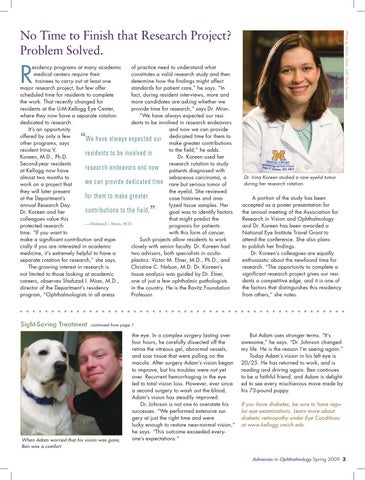
Dr. Irina Koreen studied a rare eyelid tumor during her research rotation. A portion of the study has been accepted as a poster presentation for the annual meeting of the Association for Research in Vision and Ophthalmology and Dr. Koreen has been awarded a National Eye Institute Travel Grant to attend the conference. She also plans to publish her findings. Dr. Koreen’s colleagues are equally enthusiastic about the newfound time for research. “The opportunity to complete a significant research project gives our residents a competitive edge, and it is one of the factors that distinguishes this residency from others,” she notes.
continued from page 1
When Adam worried that his vision was gone, Ben was a comfort.
the eye. In a complex surgery lasting over four hours, he carefully dissected off the retina the vitreous gel, abnormal vessels, and scar tissue that were pulling on the macula. After surgery Adam’s vision began to improve, but his troubles were not yet over. Recurrent hemorrhaging in the eye led to total vision loss. However, ever since a second surgery to wash out the blood, Adam’s vision has steadily improved. Dr. Johnson is not one to overstate his successes. “We performed extensive surgery at just the right time and were lucky enough to restore near-normal vision,” he says. “This outcome exceeded everyone’s expectations.”
But Adam uses stronger terms. “It’s awesome,” he says. “Dr. Johnson changed my life. He is the reason I’m seeing again.” Today Adam’s vision in his left eye is 20/25. He has returned to work, and is reading and driving again. Ben continues to be a faithful friend, and Adam is delighted to see every mischievous move made by his 73-pound puppy. If you have diabetes, be sure to have regular eye examinations. Learn more about diabetic retinopathy under Eye Conditions at www.kellogg.umich.edu.
Advances in Ophthalmology Spring 2009 3