Kellogg Ophthalmologists Have Written “The Book” on Eye Care
W
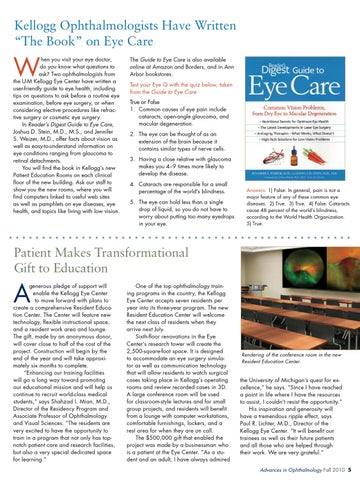
hen you visit your eye doctor, do you know what questions to ask? Two ophthalmologists from the U-M Kellogg Eye Center have written a user-friendly guide to eye health, including tips on questions to ask before a routine eye examination, before eye surgery, or when considering elective procedures like refractive surgery or cosmetic eye surgery. In Reader’s Digest Guide to Eye Care, Joshua D. Stein, M.D., M.S., and Jennifer S. Weizer, M.D., offer facts about vision as well as easy-to-understand information on eye conditions ranging from glaucoma to retinal detachments. You will find the book in Kellogg’s new Patient Education Rooms on each clinical floor of the new building. Ask our staff to show you the new rooms, where you will find computers linked to useful web sites as well as pamphlets on eye diseases, eye health, and topics like living with low vision.
The Guide to Eye Care is also available online at Amazon and Borders, and in Ann Arbor bookstores. Test your Eye Q with the quiz below, taken from the Guide to Eye Care True or False 1. Common causes of eye pain include cataracts, open-angle glaucoma, and macular degeneration. 2. The eye can be thought of as an extension of the brain because it contains similar types of nerve cells. 3. Having a close relative with glaucoma makes you 4–9 times more likely to develop the disease. 4. Cataracts are responsible for a small percentage of the world’s blindness. 5.
The eye can hold less than a single drop of liquid, so you do not have to worry about putting too many eyedrops in your eye.
Answers: 1) False: In general, pain is not a major feature of any of these common eye diseases. 2) True. 3) True. 4) False: Cataracts cause 48 percent of the world’s blindness, according to the World Health Organization. 5) True.
Patient Makes Transformational Gift to Education
A
generous pledge of support will enable the Kellogg Eye Center to move forward with plans to create a comprehensive Resident Education Center. The Center will feature new technology, flexible instructional space, and a resident work area and lounge. The gift, made by an anonymous donor, will cover close to half of the cost of the project. Construction will begin by the end of the year and will take approximately six months to complete. “Enhancing our training facilities will go a long way toward promoting our educational mission and will help us continue to recruit world-class medical students,” says Shahzad I. Mian, M.D., Director of the Residency Program and Associate Professor of Ophthalmology and Visual Sciences. “The residents are very excited to have the opportunity to train in a program that not only has topnotch patient care and research facilities, but also a very special dedicated space for learning.”
One of the top ophthalmology training programs in the country, the Kellogg Eye Center accepts seven residents per year into its three-year program. The new Resident Education Center will welcome the next class of residents when they arrive next July. Sixth-floor renovations in the Eye Center’s research tower will create the 2,500-square-foot space. It is designed to accommodate an eye surgery simulator as well as communication technology that will allow residents to watch surgical cases taking place in Kellogg’s operating rooms and review recorded cases in 3D. A large conference room will be used for classroom-style lectures and for small group projects, and residents will benefit from a lounge with computer workstations, comfortable furnishings, lockers, and a rest area for when they are on call. The $500,000 gift that enabled the project was made by a businessman who is a patient at the Eye Center. “As a student and an adult, I have always admired
Rendering of the conference room in the new Resident Education Center.
the University of Michigan’s quest for excellence,” he says. “Since I have reached a point in life where I have the resources to assist, I couldn’t resist the opportunity.” His inspiration and generosity will have a tremendous ripple effect, says Paul R. Lichter, M.D., Director of the Kellogg Eye Center. “It will benefit our trainees as well as their future patients and all those who are helped through their work. We are very grateful.” Advances in Ophthalmology Fall 2010 5