Payment model goals
Sources of savings
Physicians provide comprehensive primary care cognitive services
• Decreased referrals • Decreased testing • Decreased duplication of tests and treatments
Practice provides evening and weekend hours
• Decreased charges for facility fees at more expensive sites (ER vs. clinic, e.g.) • Fewer expensive tests and treatments ordered
Physicians agree to not order tests from the excessive testing list or treatments from the excessive treatment list
• • • •
Physicians prescribe generic medications whenever possible
• Lower medication costs per prescription • Increased use of OTC medications
Practice provides comprehensive procedural services
• Decreased duplication of E/M and facility fees • Decreased duplication of work ups prior to procedure
Practice has in-house urgent care capability
• Decreased charges for facility fees at more expensive sites (ER vs. clinic, e.g.) • Fewer expensive tests and treatments ordered • Decreased duplication of E/M and facility fees • Decreased duplication of work ups prior to procedure
Physicians care for continuity patients in the hospital
• Decreased transition of care errors • Decreased duplication of tests • Decreased admissions and re-admissions
of a long-term trusting relationship with their patients. But we also found a huge mismatch between these characteristics and the aspects of medical practice that are incentivized in the existing payment rules. I had the honor of being chosen to be in the first, and probably only, class of CMS Innovation Advisors in 2012. My project was to create a brand new way for family physicians to document, code, and bill for their work. I based my proposals on the results of these two research projects and later investigations. My full proposals are over 100 pages long. I’m happy to share them with anyone who is interested. There are a lot of details in this work, but the summary is that there are three major reforms: 1.
The number of issues addressed in a primary care clinic visit are additive. A patient with one simple problem will be seen quickly and the visit will generate a smaller allowable fee than existing rules. In contrast, a patient with six problems to be addressed will have all of those issues addressed, and that visit will generate a bill which is larger than the existing rules allow.
Fewer unnecessary tests Fewer tests of questionable benefit Fewer treatments of unproven benefit Physicians practice with more comfort with uncertainty
2.
Pay primary care providers for non-face-to-face care such as phone consultations and email-based clinical encounters.
3.
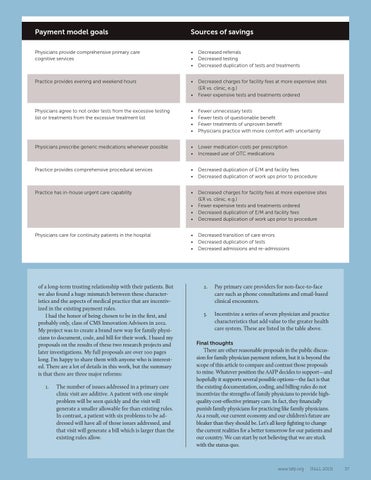
Incentivize a series of seven physician and practice characteristics that add value to the greater health care system. These are listed in the table above.
Final thoughts There are other reasonable proposals in the public discussion for family physician payment reform, but it is beyond the scope of this article to compare and contrast those proposals to mine. Whatever position the AAFP decides to support—and hopefully it supports several possible options—the fact is that the existing documentation, coding, and billing rules do not incentivize the strengths of family physicians to provide highquality cost-effective primary care. In fact, they financially punish family physicians for practicing like family physicians. As a result, our current economy and our children’s future are bleaker than they should be. Let’s all keep fighting to change the current realities for a better tomorrow for our patients and our country. We can start by not believing that we are stuck with the status quo.
www.tafp.org
[FALL 2013]
37