policy
brain drain
Licensure delay provides incentive for IMGs to leave Texas after residency training By Monica Kortsha
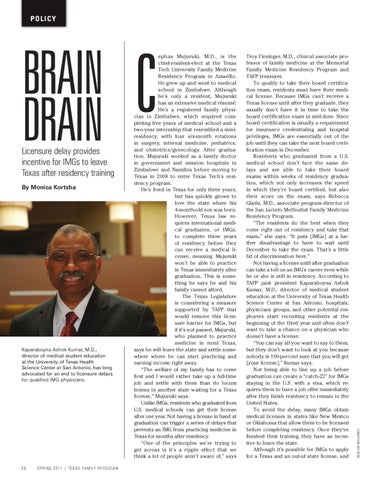
Kaparaboyna Ashok Kumar, M.D., director of medical student education at the University of Texas Health Science Center at San Antonio, has long advocated for an end to licensure delays for qualified IMG physicians.
s p r i n g 2 0 1 1 | T e x as Family Physician
Troy Fiesinger, M.D., clinical associate professor of family medicine at the Memorial Family Medicine Residency Program and TAFP treasurer. To qualify to take their board certification exam, residents must have their medical license. Because IMGs can’t receive a Texas license until after they graduate, they usually don’t have it in time to take the board certification exam in mid-June. Since board certification is usually a requirement for insurance credentialing and hospital privileges, IMGs are essentially out of the job until they can take the next board certification exam in December. Residents who graduated from a U.S. medical school don’t face the same delays and are able to take their board exams within weeks of residency graduation, which not only increases the speed in which they’re board certified, but also their score on the exam, says Rebecca Gladu, M.D., associate program director of the San Jacinto Methodist Family Medicine Residency Program. “The residents do the best when they come right out of residency and take that exam,” she says. “It puts [IMGs] at a further disadvantage to have to wait until December to take the exam. That’s a little bit of discrimination here.” Not having a license until after graduation can take a toll on an IMG’s career even while he or she is still in residency. According to TAFP past president Kaparaboyna Ashok Kumar, M.D., director of medical student education at the University of Texas Health Science Center at San Antonio, hospitals, physicians groups, and other potential employers start recruiting residents at the beginning of the third year and often don’t want to take a chance on a physician who doesn’t have a license. “You can say all you want to say to them, but they don’t want to look at you because nobody is 100-percent sure that you will get [your license],” Kumar says. Not being able to line up a job before graduation can create a “catch-22” for IMGs staying in the U.S. with a visa, which requires them to have a job offer immediately after they finish residency to remain in the United States. To avoid the delay, many IMGs obtain medical licenses in states like New Mexico or Oklahoma that allow them to be licensed before completing residency. Once they’ve finished their training, they have an incentive to leave the state. Although it’s possible for IMGs to apply for a Texas and an out-of state license, and
JONATHAN NELSON
2 6
C
ephas Mujuruki, M.D., is the chief-resident-elect at the Texas Tech University Family Medicine Residency Program in Amarillo. He grew up and went to medical school in Zimbabwe. Although he’s only a resident, Mujuruki has an extensive medical résumé: He’s a registered family physician in Zimbabwe, which required completing five years of medical school and a two-year internship that resembled a miniresidency, with four six-month rotations in surgery, internal medicine, pediatrics, and obstetrics/gynecology. After graduation, Mujuruki worked as a family doctor in government and mission hospitals in Zimbabwe and Namibia before moving to Texas in 2008 to enter Texas Tech’s residency program. He’s lived in Texas for only three years, but has quickly grown to love the state where his 4-month-old son was born. However, Texas law requires international medical graduates, or IMGs, to complete three years of residency before they can receive a medical license, meaning Mujuruki won’t be able to practice in Texas immediately after graduation. This is something he says he and his family cannot afford. The Texas Legislature is considering a measure supported by TAFP that would remove this licensure barrier for IMGs, but if it’s not passed, Mujuruki, who planned to practice medicine in rural Texas, says he will leave the state and settle somewhere where he can start practicing and earning income right away. “The welfare of my family has to come first and I would rather take up a full-time job and settle with them than do locum tenens in another state waiting for a Texas license,” Mujuruki says. Unlike IMGs, residents who graduated from U.S. medical schools can get their license after one year. Not having a license in hand at graduation can trigger a series of delays that prevents an IMG from practicing medicine in Texas for months after residency. “One of the principles we’re trying to get across is it’s a ripple effect that we think a lot of people aren’t aware of,” says