T H E S P I R I T O F A L L N AT I O N S
WEDNESDAY, MA MArch 5th, 2014 | www.tworowtimes.com | Serving the Dish with One Spoon tterritory erritory | Ontario & Upstate NY
PROMISE KEPT
FREE take one
Tyendinaga Mohawk, Shawn Brant fulfilled his promise to Prime Minister Steven Harper that he would engage in direct disruptive action if an inquiry into several hundred murdered and missing Native women was not ordered by the end of February. When Feb. 28th came and went, Brant, along with several other Tyendinaga Mohawks began handing out information pamphlets along the roadside. In response, the OPP closed several roads and highways around the Tyendinaga reserve, including Shannonville Road at Highway #2. Brant and his supporters are braving the cold in tents and teepees and will remain in place until Harper responds to his letter. OPP are utilizing drones for surveillance of the area. PHOTO BY KENNETH JACKSON PM42686517
2
TWO ROW TIMES
MARCH 5TH, 2014
OPP Closes Wyman’s Road in Tyendinaga tabase of missing and murdered women in Canada both Native and non-Native. While Native women account for just 2% of the entire Canadian population they account for almost a quarter of Pearce’s database. Last year a Special Parliamentary Committee was mandated to further examine the issue of murdered and missing Indigenous women and girls. Native organizations and the Tyendinaga demonstrators do not hold out for anything beyond a report. Brant asserts, “the Prime Minister doesn’t place any value on [Native] women or girls” and “the perpetrators…do so By Erica L. Jamieson and Clive Garlow TYENDINAGA – The OPP, the Canadian Military and the RCMP have surrounded Tyendinaga Mohawk Territory in response to a series of protests. On Friday, February 28th, Wyman Rd was closed by police when members of Tyendinaga lit a fire to request a response to Shawn Brant’s letter to the Prime Minister asking for a National Inquiry into the more than 825 missing and murdered Indigenous women across Canada. Demonstrator Dan Doreen stated, “it is a good start to the cam-
paign to bring an inquiry to murdered and missing [Indigenous] women.” At around 8:00pm the fire was extinguished and demonstrators wrapped it up without incident, according to police. Late Sunday, afternoon there was some concern when elements of the Hastings and Prince Edward Regiment (Reserves) were in the immediate affected area. The regiment travelled in armoured personnel carriers down York Road, which is the main artery that runs diagonally through Tyendinaga from Highway 2 and Shannonville Road to Highway 49. Some Mohawk dem-
onstrators chased them down and told them to leave the territory, which they did. Then Sunday night, Tyendinaga community members held a meeting to discuss further campaign action. Later that night, they started another fire and erected a teepee at the intersection of Hinchey Rd and Shannonville Rd and then further down Shannonville Rd to Highway 2. There was a high OPP presence at the intersection of Shannonville Rd and Hinchey Rd and anyone going to Tyendinaga, by way of Highway 401 or Airport Pkwy were affected. The demonstrations
comes after Shawn Brant, a Mohawk Warrior, wrote to Prime Minister Stephan Harper demanding a national public inquiry into the over 800 missing and murdered Indigenous women from across Canada. “Maryann Pearce…documented over 3000 deaths but she was only able to conclusively identify 824 of them as being of First Nations ancestry,” stated Brant. The Vancouver Sun writes, “The Native Women’s Association of Canada documented 582 cases. With three more years of cases in her database Pearce has documented 824 cases.” Pearce created a da-
HAD ENOUGH OF WINTER?
Then March into Pro-Fit Health Club and bask in the glory of the Pro-Fit Tanning Studio MINUTE PACKAGES INCLUDE: 100 MIN 200 MIN 300 MIN 500 MIN
905-765-1210
+25 +50 +75 +100
$40.00 $70.00 $90.00 $1100.00
UNLIMITED PACKAGES ALSO AVAILABLE. ASK FOR DETAILS!
believing that they can do it with impunity and [without] consequences. The police don’t adequately investigate the courts don’t adequately prosecute” Barricades have been a common tactic used by the Warriors, as such, people are no longer shocked. Brant had this to say, “I believe that people can become desensitized to this as a tactic, it’s hard to believe that you have to put up barricades and put your life on the line simply to call for justice to 824 dead First Nations women.” Left: Shawn Brant does an impromptu fireside interview with a Haida Gwai student. PHOTO BY CLIVE GARLOW
MIKE BEKENDAM 519
753.MOVE OFFICE (6683)
519 802.6683 MOBILE 519 753.8408 FAX
mike@themovingbox.ca
WWW.THEMOVINGBOX.CA 1440 COLBORNE ST. E. | BRANTFORD, ON | N3T 5L4 365 Argyle St. South Caledonia, ON CUSTOMER SERVICE
AUTO SERVICE DEPT.
905-765-8473
905-765-8700
Goods and service that meet everyday needs.
- Industry licenced technicians - Quality service
Thank you for supporting local business
62A Argyle St. N, Caledonia 905-765-3334 mikemc@shaw.ca LESSONS
SALES
SERVICE
TWO ROW TIMES
MARCH 5TH, 2014
Reclamation commemorated 8 years later By Jim Windle
KANONHSTATON - The early morning of February 28th, was bitterly cold, similar to Friday, February 28th, 2006, when the planned development site was taken over and eventually stopped by the people of Six Nations. Many of the same faces that were there that cold morning eight years ago were back again for the 8th anniversary march and potluck at the former Douglas Creek Estates, now rebranded as Kanonhstaton, a Mohawk word meaning “the protected place.” The day started, like every February 28th – since the “conflict in Caledonia” became news across all of Turtle Island and even into Europe – with a sunrise ceremony at Kanonhstaton, followed by a breakfast before the march from Sixth Line Road to Highway #6 and onto the reclamation site, and a potluck lunch. Now, eight years later, the site looks much different. The Six Nations’ and Caledonia town-folk’s barricades have been down for several years. All but one of the partially completed houses have been torn down, and life has re-
A reunion of sorts took place Feb. 28th at the main gate of what was once a battleground during the 2006-2007 Conflict in Caledonia when Six Nations reclaimed land earmarked for a housing development. From left are Kanonhstaton veterans, Carol Bomberry, Jan Longboat, Bebby Jamieson, Janie Jamieson, Mindi Maracle, Doreen Silversmith and Donna Powless. PHOTO BY JIM WINDLE turned to a form of peaceful co-existence, albeit a volatile one. There are a few telltale signs of those turbulent months of riot police and stare-downs across manned barricades block blocking Highway #6. A burned out tractor-trailer, set ablaze by Caledonia resident late one night still stands as a stark reminder of the standoff between neighbouring communities. A section of hydro tower, adorned with a Mohawk Unity Flag and a Hiawatha Flag, still sits in
two pieces at the edge of the entrance to the property, ready to be used again as an instant barricade should it be needed. There is also the noticeable emotional scars of those who faced-off against angry Haldimand citizens and an army of heavily armed OPP, in riot gear, 24/7 for weeks and months on end. Among those in attendance this year was Janie Jamieson, one of two Mohawk women who, along with Dawn Smith, became the face and the voice of
supporting our families at their request,” said one of the ladies, reading from a prepared statement. “Our aim is not political, but an inherent right of our people when they request our aid themselves. Our responsibilities are to help families. What we have to assist us is a good mind, and they are encouraged to have a good mind as well.” Government and CAS agencies have said the traditional form of family support through the clans is not working up to today’s standards, but the women disagree. “We should not be told we are uneducated, not qualified or do not understand,” the statement continues. “We have educated ourselves in their system and operate
under the instruction of the Great Law on our territory. We are working with Child Welfare, providing them with information. We have clearly advised the agency and this council of our protocol, and to date, there has been no correspondence or request from CAS (to meet).” A position paper has been drafted which the Clan Mothers have had input on and they requested that letter be released to the appropriate stakeholders. “We agree with the letter drafted by Paul Williams and Leroy Hill along with our suggestions and especially to include the letter from Aaron Detlor, which should be mailed out right away,” they concluded.
Clan Mothers give green light By Jim Windle SIX NATIONS – Clan Mothers addressed the Confederacy Chiefs Council on Saturday with concerns about Six Nations Social Services, CAS Brant, the Elected Band Council in matters of the care and Six Nations children and the Chiefs and Clan Mothers’ traditional role in the upbringing of Haudenosaunee children, internally. A reported agreement to remove CAS from Six Nations Territory was a decision made between Social Services, Brant CAS and the Elected Band Council, according to the Clan Mothers. But they have not made that same request at this time. “They should not be threatened when we are
the reclamation in its early days. ‘So why not just let the situation die and forget about it,’ some would say. But Jamieson believes
it is important not to forget what happened, and more importantly, why it happened. “A big part of our history is overlooked in the mainstream,” she said. “One of the biggest issues is the lack of awareness and education about the true, shared history we have. We are still here. This is our land, it was never sold, never surrendered and this should be a constant reminder.” Jamieson want’s to see an end to the colonial mentality of the federal, provincial and municipal governments. “I would like to see an acknowledgement from the mainstream education system to start educat educating, so our children can be taught to walk shoulder to shoulder with non-Natives and for our children to know their history,” she says.
3
“They will always criminalize us. It’s the only way to silence us. Now they are making the move to starve us out through that Bill C-10. That tactic has been around for thousands of years, but we always find ways and means to survive.” Ultimately, that’s why I come here (every anniversary) because who we are is tied to this land.” Jan Longboat was also at ground zero eight years ago and she too believes it is important that her people never forget. “It’s to celebrate that we are still here as a people and we are not going anywhere,” said Longboat. “We’re going to be here forever and it’s important that we protect our land, because it’s part of our culture for the coming faces of future generations.” ...CONTINUED ON PAGE 17
4
TWO ROW TIMES
MARCH 5TH, 2014
Original wampum not released Suspected killers arrested to museum exhibit By Jim Windle
By Jim Windle SIX NATIONS – Peter Jamieson of Cattaurragus was at the Onondaga Longhouse Saturday to ask on behalf of organizers of a “Treaty Exhibition” at the Indigenous Peoples Museum in Washington D.C., and New York, for the loan of two delicate and historically important Wampum Belts held in trust at Six Nations. Organizers are looking for many authentic items including the Two Row Wampum and the original Cananagua Treaty signed by George Washington. Jamieson was also asked if the organizing committee could use a photograph of the Two Row and another belt for the exhibitions promotional campaign and fliers. The exhibit is to open September 21st of 2014. After several hours of discussion it was decided not to release the original Wampum however should they want to use a replica of each, that would be fine. They also approved of the use of the photos of the belts. There was concern over the possible confiscation of the priceless relics at the border, and the wear and tear on the aged items themselves in transit. “This will be a great opportunity to tell our history and relationship with the original 13 castles (colonies),” said Jamieson. He was also requesting someone representing the Grand River Territory be assigned to participate in the exhibition by being on hand to explain the Wampums to exhibit visitors during the show. Once the exhibition closes at the Washington Museum, plans are being made to take some items from the exhibit on a tour to other communities and cities as well.
Over the past few years, Six Nations researchers headed up by historians Rick Hill, Keith Jamieson and lawyer Paul Williams, have found and have had returned to Six Nations several Wampum Belts and other relics taken or sold and put in museums around the world. According to a 1998 book by Elisabeth Tooker, entitled, A Note on the Return of Eleven Wampum Belts to the Six Nations Iroquois Confederacy on Grand River, Canada; “After wampum became more abundant, wampum made into either strings or belts became the customary gift on a number of different occasions. Among these were treaty conferences, where each important statement was accompanied by the gift of a wampum belt, a practice adopted by the colonists in their treaty negotiations with the Indians. Preparations for such conferences consequently included the manufacture of belts-many with designs of purple beads-for use by both colonists and Indians in the proceedings. The belts might be retained as mnemonic aids of what was said at the conference. Others were taken apart and the beads used in other belts. After the American Revolution, and with the decline of the fur trade and the quantity of wampum beads available, the use of wampum also declined, for with few furs to trade, wampum could no longer be “the magnet which drew the beaver out of the interior forests” (Weeden 1884: IS). Although still in evidence on some occasions-notably in strings used in the Condolence ceremo-
ny and in short strings attached to tally sticks used as invitations to certain meetings-much of the wampum that survived had more the character of heirlooms. In time, some of this wampum, including a number of wampum belts, was lost, disintegrated, or was sold. Among these heirlooms were the belts in the custody of the wampum keeper of the league, an Onondaga who held the seventh Onondaga name – title on the Roll Call of the Chiefs and who might recall, when required, the agreement to which each belt attested. After the American Revolution, when a number of Iroquois moved to the Six Nations reserve in Canada, these league belts-possibly forty in number-were divided, one moiety of the belts remaining in New York State and the other going to Canada, where a council of league chiefs was established that paralleled that in the United States.” Eleven belts were returned on May 8th, 1988 at the Onondaga longhouse on Six Nations reserve in Canada. Others have been found and returned since then and the search continues for even more. The great Mohawk poet, Pauline Johnson, whose Christian father was Chief George Henry Martin Johnson, used some Wampum Belts left under her father’s care as theatre props, which she later sold. One of these belts has recently been returned to the Haudenosaunee Confederacy Chiefs Council at Grand River.
99
HALIFAX - Loretta Saunders, a 26-year-old Inuk Student at Saint Mary’s University in Halifax, will not be soon forgotten. She was writing her University thesis on the Murdered and Missing Indigenous Women across Canada last week when she herself became another number to add to the more than 800 names already on the statistic sheet. Her body was found on the side of a New Brunswick highway after
Call 519-900-5535 Today
“Investigators have identified suspects in this homicide and they are not looking for anyone else,” Const. Pierre Bourdages told CBC News. “This homicide investigation is ongoing and charges are anticipated.” Cheryl Maloney, president of the Nova Scotia Native Women’s Association in Halifax, isn’t stopping with the arrest of the suspects in the Saunders case, and is helping organize the broader event set for this Wednesday, on Parliament Hill.
revue
The
Investigators process a section of woods in the median of the TransCanada Highway, west of Salisbury, NB. This is where Loretta Saunders' remains have been found. PHOTO FROM YOUTUBE
The Whole World’s Got The Blues
– New CD Release
Jace Martin The Bad Guys
March 7, 2014
9:15 p.m. Open Mic 10:15 p.m. Jace Martin 11:00 p.m. CRYSTAL SHAWANDA 12:15 p.m. The Bad Guys
Subscribe! $ Two Row Times delivered to your home for 6 months
disappearing Feb. 13. A vigil is being planned in the memory of Saunders and for a call for a national inquiry into hundreds of cold case files still unsolved and in many cases not even investigated. In this case, police did quickly locate and arrest two suspects. Blake Leggette, 25, and Victoria Henneberry, 28, are currently behind bars in Halifax, each is facing a charge of theft of a motor vehicle. They were Saunders’ roommates.
$20 COVER/Doors Open at 8:30 p.m.
TO RESERVE YOUR TICKETS email Millie Knapp, Executive Director, millie.andpva@gmail.com www.andpva.com
334 Queen St West Toronto, ON.
FOR OPEN MIC, email Rich Hunter, Development Manager rich.andpva@gmail.com Art Design by Paul McLeod
Hosted by
Cheri Maracle Co-hosted by
Michelle Thrush
TWO ROW TIMES
MARCH 5TH, 2014
5
St. Lawerence Island’s ownership questioned By Charles Kader AKWESASNE - Yet another one of the vaunted 1000 Islands on the St. Lawrence River has been offered for sale. According to published reports, Sheep Island is now available on the Canadian real estate market. The United States government has claimed some of the islands “on behalf of the Mohawk people”. Akwesasne residents assert that ownership of the islands has never been ceded. The Sheep Island property listing valued at $650,000 (U.S. dollars), was derided in the media as being located in a “smuggler’s alley” east of Cornwall, Ontario. Nevertheless, the principle of land ownership allowing such a sale is highly controversial in Haudenosaunee communities. As recently as June 2011, representatives of the United States government claimed that the U.S.
is holding title on several of the islands on behalf of Onkwehon:we. In a hearing before U.S. Magistrate George Lowe concerning land claims in New York State, James Cooney of the U.S. Department of Justice asserted the underlying title to Barnhart, Baxter and Long Sault Islands was held by the U.S. The sworn statement by Cooney seemed to be an irritation to New York State representatives at the proceeding. New York State Asst. Atty. Gen. David Roberts denied the validity of the federal position regarding the islands. The position provided by the U.S. in their argument is derived from a European view of sovereign discovery. The control of the 1000 Islands was held by Britain when New York State was formed. This resulted in New York losing a pre-emptive right to acquire the scattered island holdings that the
American colonies lost when the U.S. Constitution was adopted. The islands were transferred to the U.S. directly using language contained in the Treaty of Ghent, 1814. Longhouse researcher, Rarihokwats, points to earlier histories relevant to this matter. The presence of French traders, priests and soldiers on the St. Lawrence River
supports the U.S. position of sovereign discovery. Longhouse scholars point out that the French never claimed these islands as their own, leaving the original title undisturbed even though France was eventually overcome by Britain in North American wars. Akwesasne Men’s Council Wolf Clan representative, Rarahkwisere,
summarized the position of the Longhouse. “As Kanienkehaka people, we have free usage of the river. That is why Akwesasne was an important Iroquois castle (village). It was because it was at the intersection of three rivers. These islands are part of the river. We never gave them away, to anyone. Not ever to Denmark, France, Britain, or any of the American colonies.” Conditions along the St. Lawrence River have dominated Indian relations with the settlers since early trading days. With the near extinction of beavers to the industrial pollution of the twentieth century, Onkwehon:we populations have been left reeling in the aftermath. The Canadian government has recently dedicated over $90 million dollars to high tech surveillance of the St. Lawrence River in a bid to contain what they call “contraband tobac-
co” importation from Akwesasne. The integrated technologies of radar, sonar, thermal and unmanned sensors are intended to halt the river traffic described as a North American Ho Chi Minh Trail for smugglers. Canadian legislative efforts are currently focused at using terms of imprisonment for possession of untaxed tobacco products. According to some activists in Akwesasne and Kahnawake, the time has come for an assertion of Onhkwehonh:we land and water rights. In 1970, Stanley Island and Loon Island were reclaimed by what was described in some newspaper reports as the Warrior Society. Some current Akwesasne residents are upset at the leasing of Stanley Island guest cabins to non-natives in the aftermath of the reclamation. They also say a new campaign of reclamation effort is due.
the plane was confirmed as a Canadian military aircraft, involved in what was described as “a treetop exercise.” Another Canadian media report indicated that the plane made it back safely to the Trenton Canadian armed forces base after the emergency calls were received. Rarahkwisere stated that a lingering concern in Akwesasne is about the dark smoke that the plane was reportedly emitting. He said that research that he has conducted over the past 8-10 years shows a pattern of chemtrail emissions over the St. Lawrence River, but especially over Akwesasne. “Is somebody trying to gas our people from above, or is the soil being affected by this long-term pattern of unknown pollution, which is what chemtrails are,” said the retired Ironworker and community activist. He thought about the timing of the sighting. “Friday is sort of a dead news day, so maybe this
was an effort to bury this story intentionally, in plain sight. There was an omnibus march on Saturday in the city of Cornwall against Stephen Harper that involved Akwesasne activists, so maybe it had something to do with that protest. I’m going to be doing some digging on behalf of the people to see what else I can find out. If this is a military operational exercise, we need to know what actually took place,” stated the Wolf Clan representative. Military treetop exercises apparently are held to familiarize aircraft pilots with ground level flying conditions, which are not routinely encountered. The American Federal Aviation Administration (FAA) is unable to receive complaints concerning military aircraft, of any country. Canadian military overflights of their claimed southern border are not held out as pressing concerns of the U.S. Homeland Security Department, according to published reports.
Canadian military plane buzzes Cornwall Island By Charles Kader
AKWESASNE – A low-flying Canadian military aircraft was spotted on Feb. 28, 2014 by Akwesasne community members living on Cornwall Island (Kawehnoke). The plane reportedly flew so low that it was immediately feared that the aircraft had then crashed into the nearby St. Lawrence River. Emergency first responders flooded regional highways as reports spread of a rumored airplane crash. No crash actually took place, it was later determined. Questions, however, remain in Akwesasne on the incident. Rarahkwisere, the Wolf Clan representative of the Akwesasne Men’s Council, told the Two Row Times that he heard about the reported plane crash through word of mouth. “I didn’t see anything while it was taking place, but a lot of people here have been talking about this incident ever since,” said Rarahkwisere.
According to published reports, children on Cornwall Island were the ones who first saw the plane. At least one emergency call was then made from Cornwall Island. That was received by Franklin County (N.Y.) emergency services dispatch, which in turn coordinated with St. Lawrence County (N.Y.). A low-flying plane with dark smoke trailing it was described. At 1:15 p.m., law enforcement, fire and rescue agencies all responded to the International Seaway. These agencies included New York park police, Massena Village Police, the Massena Fire Department and the Massena Rescue Squad Inquiries were also received by the St. Regis Tribal Council and the New York State Police, according to media reports. A New York State Trooper spokesperson issued a statement approximately an hour after the emergency call went out that
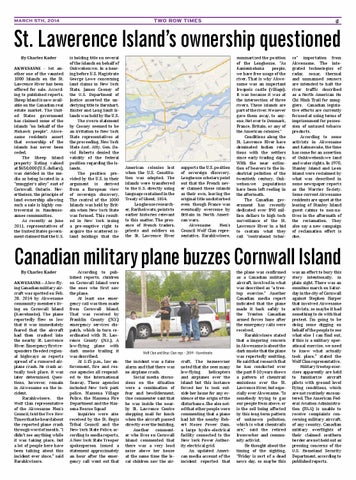
Wolf Clan and Bear Clan reps - 2009 - Kawehnoke the incident was a false alarm and that there was no airplane crash. Social media discussions on the situation were a combination of fear and bewilderment. One commenter said that he was inside the nearby St. Lawrence Centre shopping mall for lunch when the aircraft passed directly over the building. Another commenter who lives on Cornwall Island commented that there was a very loud noise above her house at the same time the local children saw the air-
craft. The homeowner noted that she sees many low-flying helicopters and airplanes over the island but this instance forced her to look outside her home for any evidence of the origin of the disturbance. She also noted that other people were commenting that a plane had hit the nearby Robert Moses Power Dam, a large hydro-electrical facility connected to the New York Power Authority electrical grid. An updated American media account of the incident reported that
6
TWO ROW TIMES
EDITORIAL
Get Informed Much information is flying around the community at the moment and as usual there is a fair share of misinformation. Misdirection, misinformation, inaccuracy and ignorance are all tools of parties who seek to divide the people and divert attention from the issues at hand. Case in point, the Harper Government presented Bill C-10 before the Christmas holiday season and managed to push through two readings of the Bill without any public consultation or awareness. The Government was able to accomplish this feat because the attention of the majority was focused on the coming festivities and the New Year. People need to understand why Bill C-10 is so harmful and why being ignorant of the Bill is dangerous. Families who have finally attained a level of comfort and security will once again be thrown into abject poverty. So whether you support smoking or not, the broader scope of the issue is the foundation of Onhkwehonh:we independence.
The implementation of Bill-C10 will directly affect hundreds upon hundreds of families on the territories. The Bill focuses on shutting down independent manufacturers and smoke shops. An overwhelming number of Onhkwehonh:we are employed in the “tobacco” trade and have been able to live a life above the poverty level as a result. Another benefit of the ‘trade’ is the relative freedom the Onhkwehonh:we have achieved by not having to depend on the Canadian welfare system. The government wishes to undermine the footing we have created for what reason? Are we to return the Indigenous communities to inflated suicide rates, unemployment, and despondence? The obvious answers to the above stated questions can be found in the self interests of the Government. When the Government can illegally legislate itself upon our territories and we do and say nothing we will have nothing left. An absence of response will be all the
reply the Government will need to continue raping and stealing from us. Hydro-fracking will flourish, the tar sands will expand, more women will be abducted, raped and murdered, alcoholism will soar, the list is extensive. The Harper Government will then point to the invalidity of our treaty rights because we did not stand and say or do something when we had the opportunity. The attack on our tobacco trade is a sword aimed at piercing the heart of the Onhkewhonh:we communities. Misdirecting the focus of the issues at hand will result in misery and suffering for many in this community. We have every right to live lives that are based on basic human comforts such as feeding our children, buying warm winter jackets for our children and ensuring our elderly are fed and clothed. Is it any coincidence that tobacco, our sacred plant, has also been the emancipator of our people? Let’s be united and let’s be informed.
BRING ALL CLASSIFIED ADS TO:
ICKYS VARIETY
741 SOUR SPRINGS ROAD Prices 50 starting at:
$12
Volume 1, Issue 30 657 Mohawk Road Six Nations of the Grand River Territory, Ontario, N0A 1H0 Make all cheques payable to: Garlow Media Printed at Ricter Web, Brantford ON
MARCH 5TH, 2014
Letter to the Editors Dear editors, In 1951 the Indian act was revised so that Aboriginals were now allowed to possess and drink alcohol for the first time, but only on their own reserves. The provinces gained an increased role in determining Indian status. However, ultimate control over the Aboriginal peoples still resided (and still resides) with the federal government. If the Federal government has the ultimate control over the Ogwehoweh and their land, how is it that the elected council and Six Nations Police can impose any Provincially based laws/Highway Traffic Act/Liquor License or otherwise on this territory? Who has the given right to tell another person what they can/ cannot do on their own territory? The Indian Act? You must understand that the Indian Act was only created to control and destroy the traditional ways of our peoples. The Indian Act is the only one of the few history making documents in Canada that surfaces such anger, resentment, and sadness. It almost destroyed our ceremonies, it restricted us from having certain rights, it divided our peoples, and it took our children away. It has succeeded in only one thing. It made those that follow it into one of them. A white person. Or are you an apple? Red outside and white inside. Now having said all that, on December 1213 at Yogi’s Social Club, I was charged under the Provincial law with ‘illegally selling liquor” by the Six Nations police. I was to appear in court on January 14th, but as luck
The opinions expressed in the letters or submitted opinion pieces are not necessarily that of the Two Row Times.
would have it I didn’t have to. I am innocent till proven guilty. I am also prepared to fight this issue. Why? Because who the hell gave the police the right to pass on provincial rulings on Federal land. Our land! I didn’t. Did you? I am disturbed by this whole ordeal and feel that I have been stereotyped by some people in this community. Charged with selling liquor, ‘whatever’! I’ve been told by the Six Nations police that there were also some complaints made by the Six Nations Chief and its councillors and a few close neighbors of Yogis barn that beer was being sold there. Why complain about Yogi’s social club when there’s a whole heck of lot more going on this territory to complain about other than Yogis social club (the Barn or whatever you want to call it). It has been said in our papers that Yogi’s barn serves to minors. That is so untrue and yet to be seen. But lets’ talk about what is true. Yearly Lacrosse rookie parties for the 19U parties (youngest is 15 and the son of a newly elected councillor), and some parents (some of whom are police officers) sit alongside their sons and have beers. Is that appropriate? Is it ok that we allow our youth to drink alcohol all because they made the team? (Yet they rush in to disturb a Grade 12 graduation party). Yogis Social Club is on personal property, yet the police came in there with their provincial law making papers and start handing out these yellow papers to appear in court. The white man’s government has always sent us their diseases. From residential schools, CAS, immu-
nizations, the Indian Act, to jails and taxes (soon to come our way if this council has their way) and the list goes on. If the people who sit in these councils want to follow the white man laws and bow to a queen then go live with the white man. This is a case where long-time members of a certain establishment gathered to socialize and entertain and have a few sociable drinks. The atmosphere of the building was welcoming and safety measures were always taken. It wasn’t a bar or a business. It was a place where members voluntarily contributed to local charities. The members replenished their own stock. It was not to serve as profit. It was built to help those in need. Taking all this into consideration, does it matter that alcohol was/ wasn’t served. What matters is this is Ogwehoweh territory. This is federal land. This is where assimilation, decolonization, decultration and decimating stops. We must not allow provincial rulings to supersede the federal laws of this land. In doing so it will only destroy the Ogwehoweh and our inherent rights to live with what they have left. The charges that were laid upon us is not about selling liquor. It’s about not following the elected council’s way of doing things. I am not a constituent of any elected council. I am above that. I do not vote because that it not what I believe in. I am Ogwehoweh. If there is to be any rulings given then let it fair and equal, without prejudice and above all proven. Rhonda Martin, Ohsweken
Publisher: Garlow Media Founder: Jonathan Garlow General Manager: Tom Keefer Senior Writer: Jim Windle Production: Dave LaForce Business Manager: Kelly MacNaughton Advertising Coordinator: Josh Bean Web Manager: Benjamin Doolittle Circulation Director: Lucho Granados Ceja Arts & Culture: Nahnda Garlow Writer: Jen Mt. Pleasant Advertising: Sterling Stead & Jeff Ross Editorial Team: Jonathan Garlow & Tom Keefer Main office: (519) 900-5535 Editorial: (519) 900-6241 Advertising: (519) 900-6373 For advertising information: ads@tworowtimes.com General inquiries: tworowtimes@gmail.com Website: www.tworowtimes.com
TWO ROW TIMES
MARCH 5TH, 2014
7
OPINION
C-10 part of a history of oppression By Edward Pickersgill
Bill C-10 is the latest in a long, long list of bullying attempts to make “first nations” give up identity, rights and even existence. Every precedent indicates C-10 will not be the last; there will be more. If there is such a thing as a miracle then one of the biggest miracles is that most of the nations have not been made extinct like the Beothuk. And as the nations stand up more and more frequently in resistance against the slice and dice and crush of the assimilators so we see the attempts to criminalize the growing community-based economies. One of the things about living a fairly long time is witnessing the repeating patterns of abuse
and oppression. The camouflage nets under which the strategies are waged do change but the goal remains the same: assimilation. Several decades ago I taught high school in Lachine and many of the students in my grade 8 and 9 classes were bussed in from what was then called Caughnawaga. I learned many good things from them starting from my very first day when I asked why so many of my kids were identifying as North Americans rather than as Canadians or whatever the other options were in the registration process. Thus, in the 1960s, I learned about the Mohawk people and was introduced among other things to a newspaper named Akwesasne Notes. Fired from teaching
in 1970 (insubordination had become my personal nation) I found myself in 1973 on Parliament Hill along with thousands of others facing RCMP riot squad and Canadian Army with fixed bayonets. That day was certainly a day of reckoning and a consciousness-challenge for many of us non-aboriginal activists who were there as supporters of the “Native Caravan”. From Grassy Narrows and Sandy Dog in the 1970s through Oka almost 20 years later and on then to Burnt Church and Caledonia and the Idle No More movement there is a powerful thread of resistance and community building. And, be it never forgotten, always a powerful and relentless borg-like response from the agents and agencies
of old empires and newer international corporations. Obviously there is much more to C-10 than a simple attack on tobacco sales. C-10 fits into a stream of oppression which is about the money – and about their willingness to do whatever it takes to control it all. For them there has only ever been One Row and the people are simply expect-
ed and required to toe the line, that thin red line of empire (old and new). Recently I’ve been happy to receive some education about the Two Row and be able to co-operate in building a distribution system here in Guelph and Wellington County for the Two Row Times. So, although the community work in which I’m engaged today involves much less
writing and opinionating than back in the 1970s I do want to salute and “of “offer props” to the activists gathered in and around the Two Row initiative and particularly on the very recent information meeting on the Harper government’s Bill C-10. The struggles continue! We must be as incorrigible as they are relentless.
Accounting of Anti-Bill C-10 WarChest
The Two Row Times wishes to keep a public accounting of all monies collected and all expenditures made to the Bill C-10 WarChest. The WarChest are monies donated by concerned peoples aimed at battling Bill C-10. Monies Donated
Anti C-10 Expenditures
$1,638.15 - Feb 22, Meeting $6,020.00 - Mar. 02, For Advertising $100.00 - Mar 02, Meeting $750.00 - Feb 22, Sale of TRT Books
$500.00 - Feb. 22, Hall rental Polytech with sound system $434.15 - Feb. 22, Refreshments for meeting $418.00 - Feb. 22, cost of TRT Books
Total: $8,508.18
Total: $1,352.15 BALANCE: $7,156.00
Any queries can be directed to Kelly MacNaughton, Business Manager of the Two Row Times at 519-900-5535
Niagara Peninsula Aboriginal Niagara Peninsula Aboriginal Area Management Board
Niagara Peninsula Aboriginal Niagara Peninsula Aboriginal Area Management Board
Area Management Board
Area Management Board
A diversified and active circle of off-reserve Aboriginal peoples from Brantford, Hamilton, St. Catharines and Fort Erie with a population of approximately 20,000 people, offers excellent opportunities for growth,Aboriginal as well as employment. A diversified and active circle of off-reserve peoples from Brantford, Hamilton, St.Catharines and Fort Erie
A diversified and active circle of off-reserve Aboriginal peoples from Brantford, Hamilton, St. Catharines and Fort Erie with a population of approximately 20,000 people, offers excellent A diversified and opportunities active circle offor off-reserve Aboriginal from Brantford, Hamilton, St.Catharines and Fort Erie growth, as well aspeoples employment.
The Niagara Peninsula Aboriginal Area Management Board is currently seeking:
The Niagara Peninsula Aboriginal Area Management Board is currently seeking:
with a population of approximately 20,000 people, offers excellent opportunities for growth, as well as employment.
with a population of approximately 20,000 people, offers excellent opportunities for growth, as well as employment.
CENTRAL FILE CLERK (EI eligible) Fulltime position (40 hours per week; Location: NPAAMB Head Office, 50 Generations Drive, 2nd Floor Ohsweken, Ontario N0A 1M0
CULTURAL AND RESOURCE DEVELOPMENT OFFICER (EI eligible) Fulltime position (40 hours per week; LOCATION: NPAAMB Head Office, 50 Generations Drive, 2nd Floor Ohsweken, Ontario N0A 1M0
Reporting to the NPAAMB Executive Director, the CENTRAL FILE CLERK will provide support to the NPAAMB administration through coordination of the central file area and assist with other activities per the agreement with the Project funder and as requested by the NPAAMB Executive Director.
Reporting to the NPAAMB Executive Director, the CULTURAL AND RESOURCE DEVELOPMENT OFFICER will provide support to the NPAAMB administration through coordination of a milestone Research project and assist with
This position requires an individual who has: ¥ Educational Requirement: High School graduate and/or a Post Secondary diploma or degree in Business or equivalency of, and/or a minimum, three years (3) proven work experience and three (3) years of clerical experience. ¥ Excellent communication and interpersonal skills, ¥ Proven self starter with strong planning, time management and analytical skills, ¥ Must have at least three (3) years of experience using computer/systems software programs. ELIGIBILITY: ¥
Candidates must meet eligibility criteria set out in Section 58 of the Employment Insurance Act
¥
This is an EI-Reach Back only funded position.
¥ ¥ ¥ ¥ ¥ ¥
°
They established a claim for Employment Insurance Benefits or their Employment Benefit period within the past three years.
°
They established a claim for Employment Insurance maternity or paternity benefits or were paid benefits within the past five years, and are re-entering the labour force after having left to care for newborn or newly adopted children.
other activities per the agreement with the Project funder and as requested by the NPAAMB Executive Director.
This position requires an individual who has: 1.
2. 3. 4. 5. 6.
Be E.I. Eligible …. you must meet the definition of an "insured participant" found in Section 58 of the Employment Insurance Act. When applying for assistance, you must be unemployed and legally authorized to work in Canada (Canadian citizen or permanent resident) and either: Excellent communication and interpersonal skills Proven self starter with strong planning, time management and analytical skills Work within an office setting and a Team player Possess a Post-Secondary Education/Diploma or equivalent Have reliable transportation to and from work
ELIGIBILITY:
Previous experience in Not for Profit setting, proven Project Research and implementation, Excellent communication and group facilitation skills, Proficient writing and computer skills are measured assets, Candidate must have access to, and reliable, transportation to fulfill the duties of the position, as required. The successful candidate, upon hiring, must be prepared to provide an up-to-date copy of their CPIC. Supply three (3) work-related references with your application package.
¥
Candidates must meet eligibility criteria set out in Section 58 of the Employment Insurance Act
¥
This is an EI-Reach Back only funded position.
¥ ¥ ¥ ¥ ¥ ¥
Mail, Courier or Drop off your Application package to: Niagara Peninsula Aboriginal Area Management Board nd 50 Generations Drive, Oneida Business Park, 2 Floor Box 9, Ohsweken, Ontario N0A 1M0 REFERENCE: ‘CENTRAL FILE CLERK’
°
They established a claim for Employment Insurance Benefits or their Employment Benefit period within the past three years.
°
They established a claim for Employment Insurance maternity or paternity benefits or were paid benefits within the past five years, and are re-entering the labour force after having left to care for newborn or newly adopted children.
Previous experience in Not for Profit setting, proven Project Research and implementation, Excellent communication and group facilitation skills, Proficient writing and computer skills are measured assets, Candidate must have access to, and reliable, transportation to fulfill the duties of the position, as required. The successful candidate, upon hiring, must be prepared to provide an up-to-date copy of their CPIC. Supply three (3) work-related references with your application package.
Mail, Courier or Drop off your Application package to: Niagara Peninsula Aboriginal Area Management Board nd 50 Generations Drive, Oneida Business Park, 2 Floor Box 9, Ohsweken, Ontario N0A 1M0 REFERENCE: ‘CULTURAL AND RESOURCE DEVELOPMENT OFFICER ’
The personal information submitted for employment is collected under the Freedom of Information and Protection of Privacy Act and will be used to determine eligibility for employment. We thank you for your application, but advise that only those selected for an
The personal information submitted for employment is collected under the Freedom of Information and Protection of Privacy Act and will be used to determine eligibility for employment. We thank you for your application, but advise that only those selected for an
interview will be contacted. An Equal Opportunity Employer.
interview will be contacted. An Equal Opportunity Employer.
Page 1
Page 1
8
TWO ROW TIMES
MARCH 5TH, 2014
FEATURE COLUMN: LET'S TALK NATIVE WITH JOHN KANE
Economy? We Don’t Need No Stinking Economy! I haven’t weighed in much on Canada’s Bill C-10 issues but in the overall scheme of things it is no different than any of the others on the long list of anti-Native laws, regulations and policies that Canada and the U.S. have attempted to impose on our people and lands for centuries and, of course, this includes their provinces and states, as well. It all boils down to an attempt to control, marginalize and criminalize our people. It is particularly ironic that participation in a trade industry that has been ours for thousands of years – actually introduced to their ancestors by our ancestors – has been under attack since the moment we began realizing any significant economic gain from it. But the attempt by the U.S. and Canada to deny this inherent right is not the only egregious act by two of the world’s biggest hypocrite nations. Kidnapper, hostage holder and pedophile of Pocahontas, John Rolfe’sfame took the first steps to bastardize our tobacco by commercializing the product for the European market. Philip Morris, Lorillard, R.J. Reynolds and others finished the job by turning tobacco into nicotine delivery systems praying on chemical addiction for market security. Governments and government officials raked in billions with taxes, fees, surcharges, settlements, political contributions,
tobacco lobby perks and campaign contributions. Lawyers did the same; and both tobacco and anti-tobacco lawyers got rich and famous. And while all this money was being spread, Big Tobacco continued cranking out cigarettes. These guys played every angle possible to keep up demand, supply and distribution. They even courted small, almost insignificant Native smoke shops and the low or no-tax environments we operate in. Anything for sales. But that all changed. Soon the unholy marriage between Big Tobacco and small Native smoke shops bore an offspring that would destroy the bliss – Native-manufactured brands and products. Soon the very companies that used our people to skirt state and provincial law were writing the federal legislation to snuff us out of the business. Now don’t get me wrong, even with Big Tobacco kind of in our corner the US and Canadian governments were hell bent on not letting us build an economy on this or anything else. A few Big Tobacco executives even got prosecuted for bending rules and breaking laws in dealing with the “illicit reservation tobacco trade.” But once these guys lined up with the top cops it didn’t matter where tobacco originally came from since Team USA and Team Canada were going to lie, cheat and steal to keep us out of the game. We were now terrorists or at the very least, funding them. What ensued were stings, seizures and setups of all kinds, including
creating sell-outs among Native businessmen and in tribal councils. But our shops continue to operate and Native brands and Native-produced generics continue to roll off our shelves. Criminalizing our businesses has not stopped them. It has just made it easier to call us criminals. And while the tobacco sideshow keeps everyone distracted, Canada and the U.S. eye what’s left of our lands and resources all the while calculating how they might separate us from both. Even as most territories wallow in poverty and the majority of Native people live ghetto lives in the cities where they have been removed; coal, gas, oil and tar are raped from our lands leaving destruction that would make George Washington and John Sullivan proud. While people freeze to death in their homes due to the very extreme weather caused by the world’s “fat takers,” diamonds, minerals, lumber, water and energy resources are stripped from our lands leaving wastelands behind as well as cancer, tainted fish and wildlife, polluted water and a stench in the air. And this while poison seeps out of our own Mother in radioactivity and other seen and unseen dangers. Almost no economic benefit ever makes it back to the people from all this exploitation and the little that does only seems to validate or encourage the practice. More jobs are created for cleanup of the inevitable disasters associated with raping the planet. But, of course, real cleanup is impossible. The
THE BEAR’S INN More than a place to stay...
Experience Iroquois Culture & Hospitality at this Gracious Country Inn 1979 4th Line Road, Ohsweken, Ontario N0A 1M0 P.O. Box 187, Six Nations of the Grand River Tel: (519) 445-4133 • E-Mail: innkeeper@thebearsinn.com www.thebearsinn.com
fact of the matter is that Americans and Canadians are neither the users of these energy resources nor are they beneficiaries of their revenue either – except those Americans and Canadians that pocket the money on the sales to China. The U.S. broke reexportcords last month export ing more than a billion gallons of crude and petroleum products in a single week ending on February 21. So all the hype about domestic supply and energy security is as big a lie as the whole “Tobacco and Terrorism” scam. China has invested billions of dollars into the tar sands oil extraction in Alberta and it’s not to build a better Canada. It is to pull billions and billions of dollars out of our Mother and do it at the greatest rate and scale possible. The majority of Americans and Canadians are ignorant about the issues at stake. Even in the liberal state
of New York a recent poll with more than 10,000 online participants had over 51 percent saying “Frack Away,” obviously believing the hype over the jobs and benefits to be had destroying the Earth. The same goes for the Keystone XL Pipeline. Far too many Canadians and Americans have bought into all the lies and propaganda associated with this international crime against humanity because they have been duped into believing they will somehow benefit from the dirtiest oil on the planet flowing from Canada to the Texas Gulf so it can be sold to China. This is not irony. This is criminal. While the U.S. and Canada legislate to prevent any economy from developing or meagerly continuing on Native lands, they rape the land they stole from us or are stealing from us. This is all being done while they lie to their own people and
destroy the ground beneath their feet. I am not a fan of what the white man did to our tobacco but I would rather be a criminal farmer of tobacco, than a lawful destroyer of the planet.
John Karhiio Kane, Mohawk, a national expert commentator on Native American issues, hosts two weekly radio programs — “Let’s Talk Native…with John Kane,” ESPN Sports Radio WWKBAM 1520 in Buffalo, N.Y., Sundays, 9-11 p.m. EST and “First Voices Indigenous Radio,” WBAI-FM 99.5 in New York City, Thursdays, 9-10 a.m. EST. John is a frequent guest on WGRZ-TV’s (NBC/ Buffalo) “2 Sides” and “The Capitol Pressroom with Susan Arbetter” in Albany. John’s “Native Pride” blog can be found at www.let www.letstalknativepride.blogspot. com. He also has a very active “Let’s Talk Native...with John Kane” group page on Facebook.
THIS IS OUR TIME! Come together to unite against Bill C-10. Let’s create a commission to regulate pricing and raise our prices to fair market value! Let’s create a war chest to defend our borders against aggression! Fly your Unity/Confederacy flag and show your support.
QUESTIONS/CONCERNS CALL BILL (519) 802-5562
TWO ROW TIMES
MARCH 5TH, 2014
9
FEATURE COLUMN: SCONEDOGS & SEED BEADS
That’s what you get By Nahnda Garlow Nothing beats Six Nations in the spring. When I was a kid it was always exciting the first time you got to play outside without your winter coat on. My little sister Laura and I would go racing back the bush, hair blowing in the wind trying to be the first one down to the crick. If I stop and think hard enough I can almost hear the birds singing and the trickle and flow of the water passing me by. I could sit for hours in the warm sunshine down by the crick. There was a big log that went across it. I would walk back and forth over that log, singing songs and imagining I was a circus star. Inevitably that fun would be interrupted. Usually it was because my little sister was trying to follow me
but got stuck in the mud. “HELP ME! I’m stuuuck….” she would cry. “Ha, ha that’s what you get” I’d tease her. Then I’d start walking away like I was just gonna leave her there all alone. That is when she’d start screaming because she thought she would be stuck there forever. “Heckinit, quit being a little Jih’dawihs. You’ll be fine” I would shout back at her, still walking away. “I’m gonna tell! MOOOOM!” she would scream. And I don’t mean shout. My little sister could cry bloody murder. Because we lived on top of a hill you could hear her screaming halfway down the concession. “Alright!” I shouted. “I was just kidding, holay!” I’d go walk myself into the slurpy mud and help to try and release her boots. She’d be crying there all red faced and
snotty because I teased her too long. As soon as I got close enough she’d leach onto me for dear life and I’d pick her right up out of her boots and lift her to safety setting her down on the grass. Sometimes I could rescue the boots, sometimes they’d sit there stuck in the mud until my dad got home. Of course we didn’t have the mind to go get her other shoes. We were too excited to play. Instead we’d just run around getting her socks all muddy tearing up the backyard because it was spring. After a while we’d get called inside for lunch; that meant tomato soup, grilled cheese and Fred Penner or the Flintstones. We’d race up to the house to be the first one in. Because every kid knows that whoever is first is best. “What did you do to your socks?” my mom
would shout. My little sister could turn on the tears in an instant. This came in handy that day as she told my mother the harrowing tale of being trapped in the mud and how I left her there to suf suffer. “Nahnda you march right outside this minute and get her boots: right now!” mom shouted at me. Laura looked at me and smiled, wiping away her tears. I glared at her. Still smiling she peeled off her muddy socks, flopped them down in front of me and sauntered inside to her soup with her nose in the air. “Come on! Go get those boots.” my mom would scold me. Defeated by my younger and wiser sister, I did a full on tantrum walk to the mud to yank out her boots. I suppose that’s what I get.
Circle of Courage Conference
JOIN US AT THE SURESPAN JOB FAIR! Hosted by Grand River Employment and Training
Featuring Dr. Martin Brokenleg
Thursday March 13th 11:00AM-6:00PM NOW HIRING!!!
Dr. Martin Brokenleg is the co-founder of the Circle of Courage. He holds a doctorate in psychology and is a graduate of the Episcopal Divinity School. He is an Emeritus Professor and was most recently Director of Native Ministries and Professor of Native American Theology and Ministries at the Vancouver School of Theology in Vancouver, British Columbia. Dr. Brokenleg has consulted and led training programs throughout North America, New Zealand, and South Africa. He is an enrolled member of the Rosebud Sioux Tribe practicing the culture of his Lakota people.
Apply in person – Immediate Interviews 16 Sunrise Court, Ohsweken, ON W H O
S H O U L D
AT T E ND ?
Eager, Enthusiastic and Flexible construction workers Willing to learn the many different aspects of constructing a Wind Farm GREAT opportunity with a chance for long term employment for the adventurous
Positions Available For All Skill Sets
Administration Offload Crew Rotor Build Crew QA/QC Crew Base Set Crew
Main Erection Crew Electrical Crew Mechanical Completion Crew Tool Crib
Custom Exhaust Fabrication Engine Swaps E.F.I. Conversions Safety Inspections Rims & Tires Performance Parts Welding Service Wiring & Interior + general repairs + Restorations 100% Tax Free Licenced Mechanic (905) 768-7278
For more information go to: www.reclaiming.com
Topics to be presented include: -The Circle of Courage -Culture and Helping -The Effect of Family Experience on Resiliency -Creating a Positive Youth Culture -Restoring Spiritual Balance Among Native People -The Spiritual Needs of Youth
Where: Six Nations Community Hall 1738 Fourth Line Ohsweken When: March 17 & 18, 2014 From: 9:00am-4:30pm Lunch Provided Conference fee of $125 Various Vendors available on site
Accommodations at Best Western Plus– 19 Holiday Drive Brantford ON. Discounted rate of $109.99/night. To make a reservation please call 519-753-8651 or 877-341-1234 Make reservations under Circle of Courage Conference or with code # 107429
Last day to register and make payment is March 17, 2014 For More Information Please Contact Ed Hannigan or Karen Bomberry at (519) 445-2222
Six Nations Mental Health 1745 Chiefswood Road P.O. Box 609 Ohsweken, ON N0A 1M0
Phone: 519-445-2143 Fax: 519-445-0504 Email: rfraser@sixnations.ca To Register please contact Robin Fraser
Limited Space Available
10
TWO ROW TIMES
MARCH 5TH, 2014
ARTS CULTURE ENTERTAINMENT Kaha:wi Dance Theatre, Artistic Director Santee Smith; Photo by Cylla Von Tiedemann
Derek Miller headlines free concert The Future is Aboriginal Podcasting for Tyendinaga Warriors By Jim Windle SIX NATIONS - Six Nations’ rocker Derek Miller is using his celebrity and his musician friends to raise awareness and funds to help the people of Tyendinaga who are on the front line of protests against the Harper Government’s lack of interest in calling for an inquiry into missing and murdered Native women. This Thursday, March 6th from 6 pm until 11 pm, the Juno Award winner is headlining a free concert at Yogi’s Social Club at 2298 Chiefswood Road, at Six Nations along with Chris Smart and the Real Deal, Matthew Jesus Miller, Ras Haile X, Henry Booka, Ghost Town Orchestra, and more. Admission to the event is free, however, it should be mentioned that it is a fundraiser and there will be opportunity to make financial contributions to those on the front lines in Tyendinaga. Other donations of blankets and canned food are also appreciated.
“The situation of missing and murdered women is a symptom of something that has been moving me for a long time,” said Miller. “Just seeing what is happening with Bill C-10, (criminalizing the Native tobacco trade), the state of our community, and the declarations of war being made against our people, is frustrating.” Miller is doing what he can do to support these efforts in the best way he can. Music, as he says in his song, is the medicine. “I organized this free show in unity with our sister community in Tyendinaga, and the Warriors who are taking up the fight against
the government to call and inquiry into the disturbing numbers of missing and murdered Indigenous women,” he says. “I found it imperative to initiate dialogue with the community at a grass roots level because I don’t think a lot of people really know what is at stake here. Only we as a Nation united can assert change.” Miller believes that in order to fight the government’s assimilation designs, Haudenosaunee people we have to let go of egos and religious backgrounds and just be Onkwehon:we to move forward. “We have to rally and look at real solutions to the matters at hand,” he says. “We need to support our Warriors now, which is what this concert is about. I just want to challenge people here. If you are for the people and for sovereignty as a nation, it’s time to step up, shut off our egos and come together, or roll over and be absorbed by Canada, and/or America.”
Celebrating Indigenous Women as the centre of life, work and community CMG Freelance invites self-employed workers into our membership
Join our Circle of Support! The Canadian Media Guild is building a movement of freelance communications, creative, IT, knowledge & media workers.
cmgfreelance.ca
By Wesli Day My Name is Wesli Day and I am a podcaster. I am from Serpent River First Nation and have been involved in media relations for the past 7 years. If you had asked about podcasting a year ago, I would have told you that I was an avid fan of the medium and that I really support it and enjoy the programming that is available. I wouldn’t have told you that I was going to start doing it myself! The path to this podcasting world really started when I began listening to the Joe Rogan Experience Podcast. Af After hearing a friend speak highly of it, I decided to tune in by downloading the podcast app on my smart phone and subscribing to his show for free. Upon hearing multiple episodes with guests ranging from sports stars to scientists, I quickly realized that this medium was a window into the lives and minds of people you wouldn’t think you could relate to but almost always did. The podcasts inspired and challenged my concepts of life and helped me better understand different lives that famous and innova-
tive people lead. This of course left me to question what our people’s lives could reveal and how we could learn from our nations leaders, our youth and our elders. I dug deep and found myself looking at our world. The world of rez life and band politics. The youth and the everyday person just trying to get by. Suddenly it hit me. I can podcast for our people! I can tell our story and I can tell the story of my generation through this incredible medium! In no time I found a website that would host the show. I found guests in friends and family and I made the effort to reach out through social media. With a hand held digital recorder and rough knowledge of audio editing software, I was immediately able to reach an audience online and in minutes. Now wait! What’s the show about? Who owns the content and why are your people telling you what to say? The beauty of this podcast is it is mine. I can say what I like to say and if you aren’t interested in it then you have the choice not to listen. What has been happening with podcasts now is that they are becoming the new way to get your words, thoughts and perspectives out to large audiences without the need of any corporation. No one telling you what to say or not say. My show, “The Rez Quest Podcast” aims to look at the things I find interesting and bring you into my world and my travels. My first episode entitled: “Hip Hop in the Big City,” examined what native hip hop was and
where it was going. These things seem interesting to me and sure enough I found a small audience online. In the hands of our people, this medium will enhance and challenge the conventional methods of delivering knowledge. You could do a show on just about anything and find an audience. From the elders with the teachings and language to the youth with their dreams and energy, we will be heard! If you would like to hear Wes Days podcast you can find it in iTunes by searching: “The Rez Quest Podcast.” In the podcast section. You may also find it online at the Homepage: http://bit.ly/1mTFJtX iTunes: http://bit.ly/1ib9VP6
You can also follow him on twitter @wesliday @rezquestpod
The Two Row Times does not necessarily endorse this podcast but wishes to acknowledge this fresh OG.
E.L.K. FARMS
PRODUCERS OF White Corn & Roasted, Pre-sifted White Corn Flour
$80/bushel (56 lbs)
TWO ROW TIMES
MARCH 5TH, 2014
11
FOOD & RESTAURANTS FROM THE CITY TO THE LAND: A COOK'S JOURNEY
Community over Competition By Joe Farrell This past Monday night I participated in the Six Nations Health Services Pancake Challenge. Thank you to the community members and event organizers for including me in the cook-off. I feel honoured to have participated and shared in the celebration of creative, delicious, and healthy food. Admittedly, being a guy who likes to hide in a kitchen I have some social anxiety. The typical anxiety I get from such a large group of people was put at ease by the smiles
from those welcoming me to cook for them for the first time. The support of amazing friends present at the event also helped. It was so wonderful to witness intergenerational family enthusiasm for the meal. What was particularly inspiring to me was the sight of so many youth and children getting excited about foods and preparations that were new to them. My goal was to take familiar and traditional ingredients - squash, deer, and white corn - and show what can be done using simple cooking techniques to produce
unfamiliar yet attainable healthy results. The intention I had going into the event was to put forward the positive energy and love of those who had provided me with the ingredients to be shared with the community. Cooking with a good mind and honoring a friend who had hunted the deer, the community member who provided the white corn, and the Edge of the Woods farm chickens who produced the eggs used was what I was trying to showcase in my dish. I am thankful to have shared a creative
BURGER BARN 3000 4th Line Rd SIX NATIONS 519-445-0088 DINE IN OR TAKOUT BURGER BARN EXPRESS 7135 Indian Line Rd SIX NATIONS 519-445-2518
cooking space with Chef Joleen General, Chef Rich Francis, and the Dietitians hosting the event. It was really fun to see each of our own different and unique takes on pancakes. I could feel the joy and love in the room over the celebration of a wonderful meal. These feeling will stay with me going forward and I am grateful.
White cake
Corn
Pan-
Yield: approx. 6 Cups total batter
Ingredients: • 5 Cups ground white corn flour toasted and sifted • 3 Whole eggs • 4 Cups Cold Water • 2 tsp baking powder (or 1 tsp/cup of flour for fluffier pancakes) • 1 tsp chopped herbs (rosemary, thyme, sage) • 1 tsp salt
Whisk whole eggs lightly Incorporate white corn flour, baking powder, finely chopped herbs and cold water. Mix thoroughly. Let sit for 10 - 15 min before cooking Cook with butter on both sides until golden brown and crispy For a sweet preparation omit the herbs and substitute whole milk for the water.
Butter for cooking pancakes
Village Cafe 1875 4th Line (519) 445-0555
12
TWO ROW TIMES
The Canadian Government introduced Bill C-10 in Parliament through Justice Minister Peter MacKay on November 5, 2013.
The Two Row Wampum belt is the symbolic record of the first agreement between Europeans and North American Indian Nations on Turtle Island. 2013 marked the 400th anniversary of this first covenant, which forms the basis for the covenant chain of all subsequent treaty relationships made by the Haudenosaunee and other Native Nations with settler governments on this continent.
The agreement outlines a mutual, three-part commitment to friendship, peace, and respect between peoples, and living in parallel forever (as long as the grass is green, as long as the rivers flow downhill and as long as the sun rises in the east and sets in the west). Throughout the years, the Haudenosaunee have honored this vision and have increasingly emphasized ecological stewardship as being a fundamental prerequisite for this continuing friendship.
"You say that you are our Father and I am your Son. We say 'We will not be like Father and Son, but like Brothers.' This wampum belt confirms our words. Neither of us will make compulsory laws or interfere in the internal affairs of the other. Neither of us will try to steer the other's vessel." - Haudenosaunee reply to the initial Dutch treaty proposal
MARCH 5TH, 2014
The Bill is seeking to amend the Criminal Code to include a section on the possession and trafficking of contraband tobacco. It will now be a crime to possess more than 10,000 cigarettes or 10kg of raw unstamped tobacco.
The RCMP considers contraband tobacco to include product to be sold on First Nations’ reserves that has been diverted to the wider market.
In other words, Bill C-10 is an attempt at criminalizing the Native Tobacco Trade.
This bill is in reality about Canada’s ongoing colonial project, for the last 30 years the Native tobacco trade has been quietly laying the economic foundation that has seen the resurgence of indigenous pride. The tobacco trade has provided a viable way out from the nightmare of poverty and oppression suffered by many Onkwehon:we people.
Under this new legislation a new 50-officer RCMP Anti-Contraband Tobacco Force will be created.
For a second conviction it's up to a minimum of 90 days. For a third conviction it's up to 180 days of minimum imprisonment, and then for a fourth or subsequent conviction it's up to two years less a day.
On indictmen the maximum penalty is up to five years imprisonment.
STOP BIL
UPHOLD THE TWO
nt m
TWO ROW TIMES
MARCH 5TH, 2014
13
WWW.KILLBILLC10.CA
Bill C-10 also provides mandatory minimum terms of imprisonment for individuals who have been convicted of this particular offence for the second or subsequent times.
All police forces are mandated to pursue these new specific tobacco offences, including the OPP, First Nations Police Services and Surete du Quebec.
The Harper Government has made repeated attempts to link contraband tobacco with organized crime, drugs and weapons even though a report by MacDonald Laurier Institute entitled “Border Integrity, Illicit Tobacco and Canada’s Security” states that there is little evidence to support claims of ties to bikers or mafia.
“There is no solution but lowering the tax. I don’t think vigorous law enforcement is possible...To really attack it would almost be a military solution, and the Mohawk would fight back. The Canadian public would not put up with the violence — it would be like another Oka standoff, which basically the Mohawks won. “Any heavy handed enforcement is likely to touch off sympathy blockades on a wide scale...in theory the law should be enforced, but in reality Canada doesn’t have the resources to control all the rail lines and road and power lines across the country — if the First Nations put their mind to it, they can cause a lot of damage in places where there are no police to keep an eye on it.” - Tom Flanagan, Stephen Harper's former mentor and campaign manager
It is because of the threat of economic self-determination that the Canadian state is attempting to crush the Native tobacco trade through its imposition of the draconian Bill C-10.
LL C-10
The Crown will be able to prosecute for proceeds of crime, e.g. confiscate homes and vehicles and property which they claim came from the “proceeds of crime”.
O ROW WAMPUM
The Canadian Government is advancing its efforts to combat what it calls trafficking and cross-border smuggling of contraband tobacco" by creating a new Criminal Code offence with mandatory penalties of imprisonment for whom they deem to be "repeat offenders".
The proposed amendments, Bill C-10, to the Criminal Code would create a new offence of trafficking in contraband tobacco". "Trafficking would involve any of the following actions by the Haudenasaunee: Sale, Offering for sale, Possession for the purpose of sale, Transportation, Distribution or Delivery of "contraband tobacco".
14
SPORTS
TWO ROW TIMES
MARCH 5TH, 2014
Demons perfect at 6-0 to top CLax By Jim Windle SIX NATIONS – Back-toback wins this past weekend vaulted the Ohsweken Demons into a four-point hold on first place ahead of the Niagara Lock Monsters in Canadian Lacrosse League (CLax) action. Friday night, the Demons went cage–to-cage with the Niagara Lock Monsters in a hard fought 12-8 win before a large crowd at the Iroquois Lacrosse Arena in Six Nations Territory. The two top seeded teams traded goals throughout the first quarter to a 4-4 tie, but as time was running out, with 18 seconds left in the quarter, Wayne VanEvery scored to go up 5-4. The Demons began to inch ahead in the second quarter with goals by Chris Attwood, his second and third of the game, and Joe Maracle, to end the half 8-5 in the Demons favour. Niagara had a solid third quarter, outscoring the Demons 3-1 to draw within one at 9-8, but there would be no more for the Monsters as Jake Henhawk closed the door of the Ohsweken goal and Wayne VanEvery netted two more along with singles by Joe Maracle and Torrey VanEvery for the 12-8 final. Sunday night, the Demons had trouble with the
The Ohsweken Demons are a perfect 6-0 after weekend wins at home against Niagara, and on the road in Durham. Chris Attwood and Wayne VanEvery were a two man wrecking crew to power the Demons offense. PHOTO BY DAVID LAFORCE
newly retooled Durham Turfdogs, but came out with a 13-10 win. The Demons came with a skeleton crew, missing several key players for a variety of reasons. There were only 13 runners on the bench when the game began and as a result, coach Randy Chrysler had a lot of line juggling to do. Chris Attwood sent a shot-pass to Wayne VanEvery at the edge of the crease who one-timed it to open the scoring. Newly inserted in the Demons lineup is Alex Kedoh Hill, who set up Travis Hill, who bounced in the second Ohsweken marker. Murray Porter capped off a three way passing play around the Durham crease to make it 3-0 at the end of the first quarter. Fifteen seconds into
the second quarter, Att Attwood scored, but Travis Bland scored to start a Durham rally, which reduced a four goal lead to 4-3 before the Demon got their legs back under them. Kedoh Hill was put on a line with Roger Vyse, also new to the Demons lineup, and the pairing worked well all night. Kedoh Hill set up Vyse for the 5-3 goal, but the Dogs earned two powerplay goals on the same penalty to draw even again, at 5-5. Lazor stopped the Durham charge with three saves in close succession to hold the line. The Demons 6th goal was almost a comedy show making even the Durham players laugh. Wayne VanEvery found himself with the ball in front of
the Turfdog goal with lots of time and only the goalie and one defender on that half of the floor. VanEvery faked and faked and faked again causing both Coswell and Hopcraft to dance around in the crease like puppets before VanEvery finally buried it to end the half with Ohsweken holding on with a 6-5 lead. Six seconds into the second half, the Dogs scored to tie it up at 6-6, and then move ahead 7-6 with a Hopcraft power shot from outside, past Lazor. That was a reality check for the Demons bench who seemed to be energized by the embarrassment of finding themselves behind the league’s bottom feeders. Using Kedoh Hill as a
decoy, Wayne VanEvery scored the Demons 7th goal on a 2-0 breakaway. Later on in the period, with the score 9-8 in favour of Ohsweken, Travis and Blu Hill performed a perfect hidden ball play that fooled everyone in the arena. During a player change at the Demons bench, Travis Hill pretended to dish the ball off to Blu Hill who appeared to carry the ball to the far side of the floor. Everyone fol-
lowed, including Coswell, leaving the entire side of the net empty and a clear shot for VanEvery who shocked the Durham fans and players alike with the 10-8 goal. This coming week, the Southwest Cyclops will be at the ILA Friday to face the Niagara Lock Monsters and on Saturday, the Demons take another kick at the Durham Turfdogs. Both games start at 8 pm.
TWO ROW TIMES
MARCH 5TH, 2014
15
3613 1st Line
Enjoy customer service and great prices at Nancy’s Variety and Gas Bar
BIG SAVINGS on name brands like Juicy Couture, Levis, Kushies, Kricket and more
The Ohsweken Demons vs Durham Turfdogs Saturday March 8th, 8PM @ the ILA Ohsweken Demons Canadian Lacrosse League 2014 Schedule The Canadian Lacrosse League (CLax) is pleased to announce their 2014 schedule. This season, each team will play eight games plus playoffs, which will consist of four home games and four road games.
*Illustration not exactly as shown.
DAY DATE HOME
VISITOR
Sat. Mar. 8 Ohsweken Sat. Mar. 15 Ohsweken
Durham Barrie
MSRP: $27,995
TIME
VENUE
8:00 PM Iroquois Lacrosse Arena 8:00 PM Iroquois Lacrosse Arena
16
Double Trouble in Lacrosse TWO ROW TIMES
MARCH 5TH, 2014
VS This Friday, March 7, 8 PM at the ILA KIDS! Come watch Monster University @ 6PM Free popcorn! Then join the Cyclops @ 8pm
2014 Southwest Cyclops & Ohsweken Demons CLax Schedule Day
Date
Home
Fri.
Mar. 7
SouthWest
Sat. Sat.
Mar. 8 Mar. 15
Ohsweken Ohsweken
Tickets are available at Ticketpro.ca or by calling 1 888 655 9090
Visitor
Time
Venue
Niagara
8:00 PM
Iroquois Lacrosse Arena
Durham Barrie
8:00 PM 8:00 PM
Iroquois Lacrosse Arena Iroquois Lacrosse Arena
For those who can't make the game you can catch it live as it happens on the Canadian Lacrosse League website: canadianlacrosse.com and you can watch it right through our site. If you haven't already followed us on Facebook you can like us here https://www.facebook.com/southwestcyclops and Twitter here @swcyclops.
NEXT GAME Ohsweken Demons vs. Durham Turfdogs
Saturday, March 8 at Iroquois Lacrosse Arena @ 8PM
TWO ROW TIMES
MARCH 5TH, 2014
Pro-Fit Corvairs pummel Pirates
17
Kanonstaton article from Page 3 Carol Bomberry was there that cold morning in 2006 as well. “It is good to remember that we did something really important here, and we won’t forget how important this is,” she said. Hazel Hill drove her late husband, Dick Hill’s familiar black GMC Yukon SUV to lead this year’s march. Dick Hill, who died only a few weeks ago, was a very important part of the reclamation of Kanonhstaton, as was Hazel. “I think the women, especially these women, demonstrated the strength of the Haudenosaunee,” she said. “That’s why Bill C-10, and whatever other bills
they try and impose upon our people, will never be accepted and continue to be rejected. The ethnic cleansing that they are attempting by all of these things will never succeed because the spirit lies in each and every one of us. It’s something that is generational and they can’t put it out. That spirit lives in all of us, and even when you pass on, that spirit remains and it lingers here with the rest of us. And I know that.” Doreen Silversmith took the message of the Haudenosaunee all the way to the United Nations while the conflict was happening, and she returns to Kanonhstaton every anni-
versary. “I think it’s great that we are still doing this every year. What has changed over the last few years is that young people are going back to their roots and learning more. There were a lot of people that didn’t know who they were or the issues. I think it was a big education for our people as well. There are still people out there totally ignorant about what’s going on. I’m glad we are still coming out, no matter how cold it is.” There was no interference from either police or Caledonia residents at any point throughout the day.
Caledonia Pro-Fit Corvairs' captain, Matt Quilty, swings around the Port Colborne net in Game #2 of the best of seven series played at the Haldimand Centre Arena in Caledonia. The Corvairs won in Port Colborne Sunday, 14-2 and have scored 28 goals in three playoff games. PHOTO BY JIM WINDLE
By Jim Windle CALEDONIA – The Caledonia Pro-Fit Corvairs made short work of the Port Colborne Pirates in the first round of the GOJHL Jr. B hockey playoffs. Monday night they completed the sweep of the Pirates at the Haldimand Arena, by a score 10-2 in game #4, to advance, out scoring the Pirates 38-9 along the way. Sunday afternoon, the final score in Game #3 was 14-2. To rub salt in the wounds of Sunday’s embarrassing loss a little more, Caledonia’s goalie, Colin Furlong, faced only two more shots than his teammates scored at the other end of the ice. Caledonia recorded 55 shots.
After pounding the Pirates 7-0 in Game #1 of the first round of the GOJHL Golden Horseshoe Conference, the Corvairs seemed to almost lose interest in their Port Colborne opponents in Game #2. Although the game was never really in jeopardy, the Pirates were game enough to take advantage of a few Caledonia mental errors to make the game look closer than it actually was. Caledonia outshot the Pirates 54-17, but goalie Colin Furlong and his defense seemed to be someplace else for most of the game, allowing 5 goals against. Caledonia’s penalty killers were only bat-
ting .500 allowing three goals on six short -handed situations. Meanwhile, the Corvairs’ powerplay sputtered with two goals in eight chances.
GIL LAY MEMORIAL ARENA – IRVING, NY
CASH PRIZES
1ST - $2000 2ND - $1000 3RD - $600
68 King George Rd. Brantford 519-304-8818
FOR MORE INFORMATION PLEASE CONTACT: CHUCK STEVENS @ (716) 548-4563 AMY WHITE @ (716) 713-1592 OR GAHGWIDE@YAHOO.COM
Sayer 11-15 MAIN ST. S. HAGERSVILLE, ONT. 905-768-3431
905-768-3536
8 teams max., 25 player roster Must be 19 years or older (by December 31, 2014)
Deadline to submit entry fee & roster : March 14, 2014 Entry fees can be made payable to: Kevin White Memorial Lacrosse Tournament PO Box 77 Lawtons, NY 14091
All You Can Eat Rib Wednesdays Kids Eat Free on Thursdays & Sundays
ENTRY FEE : $600 per team
ONE STOP PLUMBING Pumps • Vanities • Toilets & All Fittings Copper, Pex, ABS, CPVC, Poly
18
TWO ROW TIMES
MARCH 5TH, 2014
Confederacy Council report from March 1st By Jim Windle SIX NATIONS - The Haudenosaunee Development Institute delivered its March 1st report to the Confederacy Chiefs and Clan Mothers this past Saturday at the Onondaga Longhouse, at Six Nations of the Grand River Territory. There were several items to report, beginning with an update on the Samsung wind energy project. “Regarding the Grand Renewable Solar Project, I need to be clear to distinguish that there already has been project conclusion with Samsung on the wind project,” said HDI lawyer, Aaron Detlor. “We had told Samsung and, what they call the TTL Project, in 2009 that we are prepared to participate as 50% equity owners in the project. That would have brought in something in the range of $5-6 million a year. Instead, they went off and they made a deal with another company, which
they did not tell us about.” He reported that the about face denied the HDI a position to participate in the project. According to Detlor, they came after the fact and offered a small amount of money, something like $100,000 or $160,000 a year, which they considered fair and reasonable. “We asked them how much money they are making on this project” he said. “They said they can’t tell me that, it’s confidential.” Detlor said that he found out that the project would bring the company somewhere around $6$10 million a year. “They were told that if the project continues it would not be doing so with the permission of this council,” Detlor reported. “And unless they do get that permission, that solar project is not going to proceed. They heard our position and will report to us again next month.”
Next was his report from a Feb.14th meeting with the Ministry of Aboriginal Affairs regarding the Nanfan Treaty of 1701. For some time the HDI has been trying to get the Province to acknowledge that the Nanfan exists. “They could not give us information that we would have agreed with. They suggest that the Nanfan constitutes a surrender and was geographically much smaller in area. But we at least got the Province of Ontario to formally recognize the Nanfan exists,” said Detlor. “We believe the meeting was successful to the extent that we now have a place to talk to them about the Nanfan.” Regarding the City of Brantford, and the injunction which ordered somewhere around $350,000 be paid to the city, Detlor explained where that issue stands. “After reviewing the litigation the City had
brought trying to criminalize people, the Confederacy and individuals, we lost the injunction motion,” he said. “The City of Brantford was asking for $1.2 million. We had that amount knocked down to $360,000.” atThe City began to at tempt to collect on those costs and have taken legal action to force payment. “We have prepared a settlement offer and have taken the $360,000 down to a more reasonable number,” Detlor said. “So we want council to consider this offer. According to Confederacy Secretary, this offer is within the amount to continue Haudenosaunee Council operations and does not come out of any community money.” He then turned at attention to the Burtch lands, advising that Band Council have expressed a desire to put a treatment centre on that land once it is officially transferred, but there is a problem with that, as far as Detlor
is concerned. The Burtch land has already been placed in the Haudenosaunee Land Registry system, which the Confederacy Chiefs control, and lies outside of the Provincial and federal land registry. “The Ministry has denied any involvement (in a treatment centre) and have not participated in any discussions,” Detlor reported. “But they agreed to take it back to the relative ministries and will get back to us with respect to that.” The rehabilitation of the Burtch lands was also reported to the Chiefs Council. According to Detlor, it continues and is very close to the completion of rehabilitation. There is going to be a gated entrance placed just off of Burtch Road, and a culvert and driveway will be removed off of Cockshutt Road, “for the safety of the Haudenosaunee.” “They have shown support for a college course that we have ini-
tiated with Cambrian College in Sudbury, in partnership with the Confederacy and GREAT to have a college course where Haudenosaunee people are being trained as environmental monitors,” Detlor said. “Not just by the standards of the Province, but they are being trained in the environmental monitoring according to the Confederacy’s standards and principles.” To help towards a more open and transparent line of communication with the people of Six Nations, Nichol Childs has been hired to work with the Confederacy to update the website, and Hazel Hill is scheduled to begin her weekly Saturday morning updates on CKRZ. The HDI has also entered into an agreement with a small area logger to clear a section of land near the Highway #6 bypass. The Confederacy would get 25% of the proceeds from that logging.
and told the SNFA that it will be, ‘put to good use.’ Maracle was also thankful to the SNFA for growing white corn on fields on Six Nations. For that, “we are able to continue to do our ceremonies,” stated Maracle. White corn, which was grown by the SNFA on fields donated by community members, was plentiful last fall and interested community members were able to go to these fields and pick what they needed. This wouldn’t have been possible if it weren’t for the SNFA. Maracle also stated that white corn was braided and hung in the Mohawk Longhouse, “We can look at that corn and know that it came from your sweat.” Art Porter told the crowd that there is still a lot of white corn, which is still good and can still be picked in the fields for anyone who wishes to do so. Ruby Jacobs, who is Secretary of the Six Nations Farmers Asso-
ciation and President of the Six Nations Health Foundation, explained that as part of her job, ‘we want to make a healthy community for us all.’ Jacobs went on to explain a couple of upcoming projects that the Six Nations Health Foundation (SNHF) is in the process of either hosting or planning. Teachings of the Elders Gala is being put on by the SNHF and will provide an opportunity for the youth to learn from Elders in the community. The event will be held on March 22 at the Six Nations Community Hall. The Corn Project is another event, which is being supported by Six Nations Elected Council via Rama funds. There has been a huge concern in the past few years, especially when the community became scarce of lyed corn last year, that culture and traditions are being lost. In collaboration with the SNFA, the Woodland Cultural Center will be hosting sev-
eral workshops on how to make corn soup from scratch, how to make cornbread, and how to do corn husk art. The workshops will be filmed so that it will always be on record at the Cultural Center. Jacobs stated that these workshops will be held before the end of March so keep your eyes open for more details soon to come. SNFA member Jesse Porter explained to the small gathering that the SNFA is a young famers’ association here on Six Nations. There’s been, ‘learning curves,’ but it has brought people together in a lot of good ways, explained Porter. Porter stated it is important to do things in a way, in this community, ‘where we come up with solutions’, instead of focusing on the problem. Porter thanked all the people who came out to represent their community services on Six Nations and stated it took a community effort to,
‘get where we’re at today. We’re working up the Burtch to try and do something good for the community. It’s a good ef effort on our behalf.’ Porter proudly stated that the SNFA is farming the Burtch land without government help, ‘we’re still maintaining that on our own.’ Porter wants to let the community know that if you have land you want to donate to the SNFA, then please contact them. They want farmland that is isolated as possible to keep the crops from cross-pollinating. The mission statement of the SNFA, said Porter, is to use the best crop rotation practices for the land so that, ‘we don’t burn out the ground like they used to do 20, 30 years ago by non-native farmers.’ Porter also stressed that, ‘we need to maintain the land, keep it going and respect each other.’ The SNFA would also like to congratulate the winners of their post-
er contest for the Seed Growing Project, which was initiated in the spring of 2013. Winners are: Emily C General: 1st Place, Madison Martin; 2nd Place, Rilyn Sandy; 3rd Place, Seth LaForce. Oliver m Smith: 1st Place, Kyeriah Maracle; 2nd Place, Jewelle Hill; 3rd Place, Kendra Hill. Jamieson Elementary: 1st Place, Brier McDonald; 2nd Place, Phoenix Jade House; 3rd Place, Mitchell VanEvery. IL Thomas: 1st Place, Sydnie Thomas; 2nd Place, Hannah General; 3rd Place, Ethan Monture. Gaweniio: 1st Place: Odrenota; 2nd Place: Ieteieka:nereh; 3rd Place: Shakorena:awe. The Six Nations Farmers Association is always looking for ‘younger guys’ to get involved also, so if anyone is interested in learning more about what they do, please contact Ruby Jacobs at 905768-3601.
SNFA puts funds back into the community By Jen MtPleasant
OHSWEKEN - The Six Nations Farmers’ Association (SNFA) graciously handed out $12,000 worth of checks to various community services last Thursday including: Oliver M. Smith, J.C. Hill, I.L. Thomas, Jamieson Elementary, Gawennio, Six Nations Food Bank, Youth Lodge, Elderly Network, as well as the Seneca, Cayuga, Onondaga and Mohawk Longhouses. The SNFA farm Burtch Lands as well as donated lands on the Six Nations Territory and in turn, share the proceeds with organizations that provide services within the community. Chief Administrative Officer for the SNFA, Art Porter told the crowd that he is, ‘looking forward to a good year of farming.’ This year the SNFA are planting soy beans. Bryan Maracle, representing the Mohawk Longhouse, was very thankful for the donation
TWO ROW TIMES
MARCH 5TH, 2014
#NotYourTonto goes VIRAL during Oscars By Nahnda Garlow
A ‘Twitter Storm’, targeting the Academy Award nomination for Disney’s “The Lone Ranger” went viral on Sunday during the Oscars. The film was controversially nominated by the Academy for “Achievement in Make up & Hair Styling”. Critics of the film took to social media and put the Academy on blast, saying nominating “The Lone Ranger” for best make up was not only racist and inappropriate, but considered ‘Redface’ and highly offensive to the indigenous community. ‘Ranger’ received harsh criticism after casting non-native celebrity “Johnny Depp” to play the role of ‘Tonto’. Depp is seen throughout the film with full white face paint
and wearing a black crow on the top of his head. Make up used on Depp in this production was offensive to many indigenous people of the United States as it does not represent a true indigenous nation, yet makes the claim that ‘Tonto’ is an indigenous person with special powers. Disney in particular was under heavy target during the social media frenzy. In early 2013 Disney re-released the animated version of “Peter Pan” in a digitally remastered 60th anniversary edition on Blu Ray and DVD; just a few months prior to the premiere of “The Lone Ranger”. Peter Pan is well known for racist depictions of Native Americans including use of the word “squ*w” to describe the lone female character, Tiger Lily.
TITAC seeks Confederacy letter on C-10 By Jim Windle SIX NATIONS – Four representatives from the Turtle Island Trade and Commerce (TITAC) organization at Six Nations, requested a position paper from the Chiefs Council on taxation of Haudenosaunee people and their economy through Bill C-10 and other legislations. Businesswomen Audrey Squire-Hill, Barb Henry, Teri-Lynn Brant and Andrea Curley spoke on behalf of TITAC. “Onkwehon:we commerce is not about capitalism,” said Teri-Lynn Brant about the spirit behind TITAC. She also reminded the chiefs and clan mothers present that Six Nations Commerce is about self-identity and self-reliance of Haudenosaunee as a people. The group was asking that an official position letter be drafted by the Chiefs to underscore their understanding of Canadian tax laws and the Haudenosaunee people. Andrea Curley explained to the Chiefs that the petition they have begun at Six Nations against
C-10 already has nearly 3,000 signatures on it already. In it, those who sign on are stating that the Indian Act does not govern them, but rather the Two Row Wampum and the Great Law. The group has produced a YouTube video explaining the Haudenosaunee perspective on C-10 and other legislations seeking to extract tax money from treaty abiding Onkwehon:we people. Curley explained that in her door-to-door canvasing, she has found that some people are concerned saying that ‘my Chief has my back’, and so they would not sign it although they are open to it. Cayuga Chief Blake Bomberry asked the TITAC reps where the petition information would go, to which he was assured that the list would go to the Confederacy and stay on reserve. In conclusion, they reminded everyone that they conduct weekly information sessions for free at the G.R.E.A.T. theatre, every Thursday evening at 7 pm.
Arguably, some say releasing the animated classic before “The Lone Ranger” was a tactical move by Disney to remind audiences of how far they have come in representing indigenous people in film. However, it backfired, and “The Lone Ranger” was an epic flop, reportedly losing $190 million at the box office. In 1995 Disney also famously produced an animated version of the story of Pocahontas which was littered with gross
historical inaccuracies; including a romance between an adult Pocahontas and John Smith. The Pocahontas franchise includes two animated films both containing half truths. According to trendsmap.com use of the hashtag #NotYourTonto went viral in Toronto, Montreal, New York City, Washington, D.C., Minneapolis, Winnipeg, Edmonton, Vancouver and various other major areas in the United States and
Canada. One of the organizers for the social media campaign, Jacqueline Keeler, Navajo and Yankton Dakota of the Kinyaa’aanii/ Kiyaa'aanii The Towering House Clan spoke with the Two Row Times. “Nominating The Lone Ranger for an award for what is basically Redface in this day and age just demonstrates how native people are still marginalized and stereotyped.” said Keeler. “I think Johnny Depp is actually a very
well meaning person but he is just caught up in the thrall of romantic Native American stereotypes.” Keeler is part of a large and widespread social movement to eradicate native mascotry from the face of modern media. Using the hashtag #notyourmascot they have launched a few social media campaigns and plans are underway to protest the stadiums who will be hosting the Washington Redsk*ns in the upcoming season.
O Gwa deni:deo “Taking Care of Our Own” Call for Commission Members Six Nations is in the process of establishing our own child welfare program, “Taking Care of Our Own” under the direction, currently, of the Six Nations Child Welfare Designation Working Group. The Designation Working Group has now reached the point in the child welfare designation process at which it is necessary to establish the twelve member “Community Commission” that will assume responsibility for negotiation of the designation and for the implementation and on-going operation of the Program. The Taking Care of Our Own Community Commission shall sit, on behalf of the children/youth and their families resident on Six Nations of the Grand River Territory and on behalf of Six Nations’ and other native children/youth and their families resident in Brant County as the ultimate authority for Taking Care of Our Own. Anyone who meets the following criteria can apply to be an initial member of the Commission: • • •
18 years of age or older • Able to enter into contracts. Able to pass a Canadian Police Information Centre (CPIC) and Vulnerable Sector Searches. Have an interest in and a reasonable knowledge of the delivery of human services.
We are looking for community members who have abilities/experience in one or more of the following areas: • •
finance • personnel • child/youth services • domestic violence • health mental health • addictions • law enforcement • ability to represent Six Nations’ traditional social structure and cultural heritage.
Anyone interested in serving on the Commission is asked to submit a letter stating their interest and a current resume by March 28, 2014 to: Barbara General, Project Coordinator Six Nations Child Welfare Designation P.O. 5001 Ohsweken, Ontario N0A 1M0 Office #: 226-227-2168 or Email: barbgeneral@sixnations.ca
19
**You may also contact the coordinator to pick up a copy of the Community Commission’s initial terms of reference, as well as copies of the draft operating policies and procedures.
20
BUSINESS
TWO ROW TIMES
MARCH 5TH, 2014
You could be missing out on thousands by not filing income tax By Jim Windle BRANTFORD – Carm Eaton of Eaton Bookkeeping and Income Tax, located at 19 McMurray St. in Brant Brantford, Ont., has been doing tax returns for people of Six Nations, both on and off reserve, for several years because she knows where the money is for Onkwehon:we people and how to get it. “There are so many reasons why people from Six Nations should file,” says Eaton. “I get why some people choose not to, and that’s their decision, but there is money sitting there with your name on it, so why not go and get it?” But not just any accountant will do. Most non-Native tax return specialists don’t understand the unique benefits there are for Natives filing returns, or the deductions and payments the government has in place for Native people. “I’ve been preparing income tax for people living on Six Nations and Ohsweken for the past 15 years,” says Eaton. “Even though Natives are not taxed on their income earned on reserve, they really should be filing a tax return, because there are benefits out there with their name on them and they won’t get them if they don’t file.” According to Eaton, the cash available
through the Child Tax Benefit alone should be enough incentive to file, especially for young families or single parents. If you don’t file a tax return, you will not get a Child Tax Benefit for any of your children. As far as this benefit is concerned, you don’t even have to be the biological parent of the child under your care. To qualify you only have to prove yourself as a custodial person to that child. “It may be a grandparent, or an aunt or uncle who is legally and physically responsible for the child or children,” she explains. “They need to file too, because the Child Tax Benefit would be applicable to them. If they are not the biological parent, they especially deserve some help raising those kids.” Eaton is well aware that there are some who are just not comfortable revealing anything about them selves to the government, but advises, “There is money out there for you, why not file to get it?” She speaks on one sit situation she knows of from a few years ago where a woman had legal guardianship of two grandchildren. “By the time we backtracked it, and she got the back Child Tax Benefits owing to her, the cheque was for close to $9,000,” she recalls.
“Also, there is the GST/HST rebate,” says Eaton. “It is based on net family income which is why the government insists that you file a tax return, so they know what your income is.” Just because you live on reserve does not mean all your income is not taxable, because some of it may have been earned on reserve, and they won’t know that unless you file. “They also have a benefit now called the working income tax benefit, and even if you work on reserve and are still not subject to tax. If you are issued a T-4 slip it will show either Canada Pension or E.I. has been deducted from your pay, you may also be eligible for this benefit. That too is based directly on how much you have earned on reserve or off.” The WIB can pay anywhere up to approximately $1,600 on the bottom line of a tax refund, depending on the situation. “A single parent living on reserve receiving a T-4 slip, depending on how much your CPP or E.I. deductions were, could find themselves with a refund of up to $1,600,” says Eaton. “That’s a significant amount of money. But additional to that, for seniors who are getting either Old Age or CPP, they may also be eligible for the Guaranteed Income Supplement, which again
is calculated based on income as calculated on your tax return.” To get your fair share of this available money, one would have to file an income tax return. “Even if you have never filed before or have not in a long time, there is no penalty,” says Eaton. “If the government is not hastling you that usual-
ly means you don’t owe them any money, and in fact, they probably owe you and don’t want you to know it,” she says. Finally, Eaton says to anyone not filing, “When you go off reserve and spend money and pay the tax, why not get it back one way or another.” Even with Carm’s expertise and experience
J O B
specific to Natives and filing tax returns, she of offers special reduced rates for her services to anyone from Six Nations. For more information about your personal sit situation and what it could mean to you in benefits to start filing, call Carm Eaton at 519-512-0883 or email ceatonc188@rogers.com.
B O A R D
POSITION
EMPLOYER/LOCATION
SALARY
CLOSING DATE
Weekend Maintenance Person Website Redesign RFP Chief Executive Officer Cultural & Resource Development Officer Central File Clerk Three Fires Community Justice Program - Program Director Workshop Facilitator Finance Officer Beyond The Bell Supervisor Beyond the Bell Educator
Woodland Cultural Centre Grand River Employment & Training Aboriginal Centre of Excellence Niagara Peninsula Aboriginal Area Management Board
TBD TBD $65,000 TBD
Open until Filled March 6, 2014 March 7, 2014 March 7, 2014
Niagara Peninsula Aboriginal Area Management Board Niagara Regional Native Centre
TBD $45, 000
March 7, 2014 March 12, 2014
The Abor Group Contract Niagara Peninsula Aboriginal Area Management Board TBD YMCA Hamilton/Burlington/Brantford @ I L Thomas School TBD YMCA Hamilton/Burlington/Brantford @ I L Thomas School TBD
March 14, 2014 March 14, 2014 March 15, 2014 March 15, 2014
POSITION
EMPLOYER/LOCATION
CLOSING DATE
Activity Assistant Personal Support Worker Director of Health Services Case Manager Case Manager
Iroquois Lodge, Health Services Iroquois Lodge, Health Services Health Services Ontario Works LTC/HCC Health Services
Job descriptions are available at GREAT Weekdays... Monday through Friday from 8:30 - 4:30 pm 16 Sunrise Court, Ohsweken
TERM
SALARY
Contract Full-Time Full-Time Full-Time Full-Time
TBD TBD TBD TBD TBD
March 5, 2014 @ 4pm March 5, 2014 @ 4pm March 5, 2014 @ 4PM March 12, 2014@ 4pm March 12, 2014@4pm
Phone: 519.445.2222 • Fax: 519-445-4777 Toll Free: 1.888.218.8230 www.greatsn.com
TWO ROW TIMES
MARCH 5TH, 2014
21
S S E N I
S U B
Y R O T C E R I D
PLACE YOUR BUSINESS CARD HERE Icky says Sago, NO TAX!
741 Sour Springs Rd. (2nd Line) Tel: 519-445-9252
Open 8am - 10pm
sales@ h amiltonbuilders. c om w w w . h amiltonbuilders. c om 9 0 5 .6 3 9 .3 8 8 8
Coordinator - Clint Doolittle (519) 771-0025 sncfoodbank@gmail.com 1741 Fourth Line Rd P.O. Box 209 Ohsweken ON N0A 1M0
NIGHTHAWK PROTECTION SERVICES INC. Peace of Mind Protection Michael Play er
c. o. o. /D irector of Operations
mplay er@
npsi. ca
Email: redclubcardroom@gmail.com Phone/text: 289-680-8680
Address: Hollis Auto Sales 1258 Barton St. E Hamilton, Ontario
Telephone 905-548-9361
TWO TWO ROW TIMES
22
Thank You
Thank You
Coming Events
22 MARCH 5TH, 2014
Coming Events
Coming Events
Coming Events
ROGER PORTER February 26, 2014 The family of the late Roger Porter would like to extend our sincere gratitude for the kindness you have shown as we try to cope with the loss of our husband, father, grandfather and great grandfather. Thank you to Reverends Paul Hansen, Tom Morikawa and James Reilly for officiating a funeral service wherein our hearts were warmed by joyful music provided by Mary Hansen, Leonard Lickers, Rose Thomas, Wally Hoover, Jim Hoover, Terry Smith and Orie Jantzi. Our appreciation goes out to pallbearers Aaron Porter, Matthew Jamieson, Vic Porter, John Porter, Lyle Johnson and Curt Styres who carried Roger to his final resting place that was faithfully prepared by Curtis and Fred Hill. Our thanks to Donna Bomberry, Bev Beaver, Lisa Hill and Norma Lickers for their ongoing love and support and to Lana Henhawk and her family for their superb catering. We would like to acknowledge Dr. Jason Zacks and the staff of the Brantford General Hospital including ICU nurses Sam and Ashleigh for the care and comfort that they provided. To Bill Lofthouse and the entire staff at RHB Anderson, accept our appreciation for the skill and sincerity you extended to the family and the community. Many donations, flowers and cards were received by the family that are too numerous to list. We look forward to seeing you all soon to thank you in person for your kind gestures. It may be argued that other places are better to live than Six Nations. Your support proves once again that there is no better place on earth to spend your last days. Thank you
I would like to thank my sisters and brothers, nieces and nephews for helping us through this time of loss. I would also like to thank Landa Henhawk for catering the meal after the service, it was a great meal. I would also like to thank the Nurses and staff and Dr. Trevor for there compassionate care. I would like to thank the staff at RHB Anderson Funeral Home for their knowledge, help and support. I would like to thank the pallbearers for carrying Aunty Gladys to her final resting place. Carolyn LaForme and Sisters and Brothers Community Living
Winner of Community Living Six Nations Pendleton jacket is Trish Jamieson. Thank you to everyone who supported our funding ef efforts.
(All You Can Eat) Breakfast
SIX NATIONS HEALTH FOUNDATION ANNUAL GALA
At St. Lukes Church Smoothtown (1246 Onondaga Rd near 3rd Line) Sat. Mar. 15, 2014 Adults - $10.00 Child (6-12) - $5.00 Preschoolers Free 9:00am 12:00 Noon Take Out Available
Yard Sale
Indoor Yard Sale
Teachings of The Elders & Silent Auction
Social Service Gym, Ohsweken, ON March 22, 2014 from 9 am – 2 pm $20/Vendor’s Spot (no food/fund raising) Fund Raiser for Expeditions Guiding Spirits – The Duke of Edinburgh’s Award mhenhawk@dukeofed. org or (519) 445-0094 (messages) *Get a head start on that Spring Cleaning!
Six Nations Community Hall Saturday March 22, 2014 1:00 pm – 5 pm
Presentation & Dinner Admission: $25.00 Adults & Youth (14 yrs. plus) $10.00 Children 6 yrs. - 13 yrs. Further Information & Advance Admission Phone: Ruby Jacobs 905-768-3661 or Melba Thomas 905-765-6278 Proceeds to Six Nations Health Patients & White Pines Complex
BRING ALL CLASSIFIED ADS TO:
ICKYS VARIETY 741 SOUR SPRINGS ROAD
Prices starting at:
Supper
Corn Soup Supper at Ohsweken Baptist Church Friday March 7, 2014. 4:30 to 6:30 PM. Cost donations.
12
$
50
TIME TO EAT! CAN’T BE BEAT!
Village
Village Cafe
Hill’s Snack Bar
Pizza & Wings
1875 4th Line (519) 445-0555
3345 6th Line (905) 765-1331
(519) 445-0396
1766 4th Line Ohsweken ON
Breakfast, Lunch, Supper... We’ve got you covered. Great Food, Excellent Service Make The Difference
TWO TWO ROW ROW TIMES TIMES
WEDNESDAY, MARCH 5, 2014 MARCH 5TH, 2014
CLUES ACROSS 1. Plural of eyrir 6. Concord 12. Photographer 16. Atomic #18 17. Tobacco cylinder 18. Of I 19. 1/10 meter (abbr.) 20. In the year of Our Lord 21. Belittle 22. 1/2 of an em 23. Equally 24. Cornmeal mush (British) 26. Desires 28. Of sound mind 30. 1st moon man’s initials 31. Public broadcasting 32. Bodily cavity 34. Insecticide 35. County in China 37. Platforms 39. Frost 40. Crucifix 41. Bodily faculties 43. Seladang 44. Denotes three 45. Imbibe slowly 47. What’s left 48. Liberal degree 50. Competition 52. Confederate 54. 7th Hindu month 56. Senator Frankin 57. “Crying” singer’s initials 59. Taro root dish 60. Bahrain dinar 61. Sun god 62. 39th state 63. In a harmful way 66. Immunoglobulin (abbr.) 67. Differences 70. Moves slowly 71. Snarl, growl (var. sp.) CLUES DOWN 1. Aviator 2. Boutros’ group 3. Go over 4. Be among
23 23
ARIES - Mar 21/Apr 20 Don’t feel a need to take charge of others, Aries. People will respond to your cues even when such hints are subtle. Step back from the dictator’s podium.
TAURUS - Apr 21/May 21 Taurus, you should be able to accomplish your objectives this week, in spite of some early distractions. Things will right themselves before long. GEMINI - May 22/Jun 21 Gemini, concern about those closest to you might be foremost on your mind this week. Shift that focus to your own life and responsibilities for the time being.
5. Cloth scrap 6. Clerks 7. Vacuum tube 8. Actress Blanchett 9. Removes the lid 10. Atomic #45 11. Peremptorily 12. Dishonorable men 13. Spanish appetizers 14. Algerian gulf & port 15. Sets again 25. About Freemason 26. One point N of due W 27. Not happy 29. Accumulates on the surface 31. Peels an apple 33. Diamond weight unit 36. Possesses
Answers for March 5, 2014 Crossword Puzzle
38. Note 39. About heraldry 41. Hair filament 42. Title of respect 43. Hair product 46. Colas 47. Capital of Huila, Colombia 49. More diaphanous 51. Eliminate 53. Change to a vapor 54. Ancient temple sanctums 55. Pesters 58. Off-Broadway award 60. Light Russian pancake 64. Baseball official 65. Work unit 68. Jr.’s father 69. Atomic #77
SUDOKU
CANCER - Jun 22/Jul 22 Your professional life takes precedence this week, Cancer. Allow yourself ample time to tackle all the things on your plate at the office, and you will be glad you did. LEO - Jul 23/Aug 23 Use the power you have carefully, Leo. Sometimes it surprises even you just how great an impact you can make and the wide-sweeping consequences of some of your actions. VIRGO - Aug 24/Sept 22 Virgo, uncertainty about your priorities arises over the next few days. Take time to think things through, but don’t be idle for too long. Do your best to stay motivated.
LIBRA - Sept 23/Oct 23 Long-term career goals are on your mind, Libra. Make time to develop a plan that can make those goals a reality. Consult with colleagues for advice or guidance. SCORPIO - Oct 24/Nov 22 Scorpio, there is always room for compromise, even when compromise seems unlikely. Don’t be too quick to assume there is no room to work out an agreement.
SAGITTARIUS - Nov 23/Dec 21 Your focus is at an all-time high this week, Sagittarius. Now is a good time to establish clear objectives at the workplace or for important personal matters. CAPRICORN - Dec 22/Jan 20 Friends and family bring you a sense of wellbeing, Capricorn. Surround yourself with plenty of people in the days to come. Open your heart, and you will get much in return.
AQUARIUS - Jan 21/Feb 18 Aquarius, coworkers turn out to be a source of much-needed support when you receive some unexpected news. Thank them for their support and kind gestures.
PISCES - Feb 19/Mar 20 Pisces, expect others to seek your help in the coming days. Do your best to help, and those around you will greatly appreciate it.
3304 Sixth Line Rd. Ohsweken, Ontario N0A 1M0 Phone: (905) 765-7884 Fax: (905) 765-3154 construction@sitnbull.ca
3304 Sixth Line Rd. Ohsweken, Ontario N0A 1M0 Phone: (905) 765-7884 Fax: (905) 765-3154 RIMS & BATTERIES • UNBELIEVABLE PRICES
1 Alabastine Avenue, Caledonia, Ontario N3W 1K9 (905) 765-CARS (2277) www.cindoraautosales.ca
Cynthia Trimble
Email: cindor@shaw.ca
24
TWO ROW TIMES
MARCH 5TH, 2014
GR E
GRAND RIVER ENTERPRISES STANDS WITH THE PEOPLE AGAINST BILL C-10