You’re Having a
DOWN?!? L
et’s start with a “thumbnail”. In comics,
tion to create the “composition”. The terms “composition”
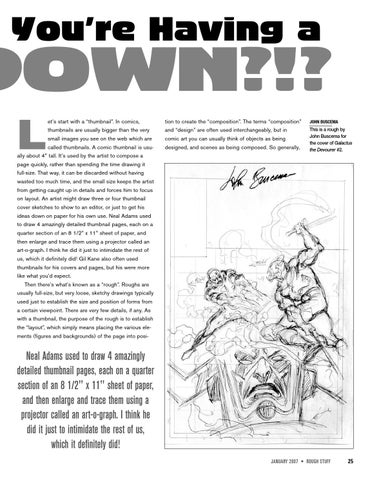
JOHN BUSCEMA
thumbnails are usually bigger than the very
and “design” are often used interchangeably, but in
This is a rough by John Buscema for the cover of Galactus the Devourer #2.
small images you see on the web which are
comic art you can usually think of objects as being
called thumbnails. A comic thumbnail is usu-
designed, and scenes as being composed. So generally,
ally about 4" tall. It’s used by the artist to compose a page quickly, rather than spending the time drawing it full-size. That way, it can be discarded without having wasted too much time, and the small size keeps the artist from getting caught up in details and forces him to focus on layout. An artist might draw three or four thumbnail cover sketches to show to an editor, or just to get his ideas down on paper for his own use. Neal Adams used to draw 4 amazingly detailed thumbnail pages, each on a quarter section of an 8 1/2" x 11" sheet of paper, and then enlarge and trace them using a projector called an art-o-graph. I think he did it just to intimidate the rest of us, which it definitely did! Gil Kane also often used thumbnails for his covers and pages, but his were more like what you’d expect. Then there’s what’s known as a “rough”. Roughs are usually full-size, but very loose, sketchy drawings typically used just to establish the size and position of forms from a certain viewpoint. There are very few details, if any. As with a thumbnail, the purpose of the rough is to establish the “layout”, which simply means placing the various elements (figures and backgrounds) of the page into posi-
Neal Adams used to draw 4 amazingly detailed thumbnail pages, each on a quarter section of an 8 1/2" x 11" sheet of paper, and then enlarge and trace them using a projector called an art-o-graph. I think he did it just to intimidate the rest of us, which it definitely did! JANUARY 2007 • ROUGH STUFF
25