JACK KIRBY COLLECTOR SIXTY-SEVEN
SPRING 2016
$10.95
1
82658 00047
9
Contents
THE
Up Close And Personal! OPENING SHOT . . . . . . . . . . . . . . . .4 (take a trip through yesterday, today, and TwoMorrows via Jack)
C
ISSUE #67, SPRING 2016
o
l
l
e
c
t
o
r
I MET JACK KIRBY . . . . . . . . . . . .25 (a fan recalls the big moment) INCIDENTAL ICONOGRAPHY . . . . .26 (from Mary Poppins to Agatha Harkness) INNERVIEW . . . . . . . . . . . . . . . . . .27 (a very patriotic 1989 interview with Jack) GALLERY . . . . . . . . . . . . . . . . . . . .41 (all the things Jack loved most) KIRBY KINETICS . . . . . . . . . . . . . .50 (Norris Burroughs on the streets of Jack’s neighborhood) INNERVIEW . . . . . . . . . . . . . . . . . .52 (Jack discusses race and comics, in a 1971 interview) JACK KIRBY, ART CRITIC . . . . . . .54 (Jack’s advice to a promising fan artist) TRIBUTE . . . . . . . . . . . . . . . . . . . .56 (the panel discussion from the big CSUN Kirby Exhibit) KIRBY OBSCURA . . . . . . . . . . . . .74 (some strange tales before Kirby) DOWN WITH THE KING! . . . . . . . .76 (another fan’s long friendship with the Kirbys) JACK F.A.Q.s . . . . . . . . . . . . . . . . .77 (Mark Evanier moderates the 2015 Comic-Con Tribute Panel, with Marv Wolfman, Rob Liefeld, David Spurlock, and Paul Levine) KIRBY CAMEOS . . . . . . . . . . . . . .81 (has Jack guest-starred in comics more than Stan Lee?) JACK KIRBY MUSEUM PAGE . . . .89 (visit & join www.kirbymuseum.org) COLLECTOR COMMENTS . . . . . . .90 PARTING SHOT . . . . . . . . . . . . . . .96 Page one inks: MIKE ROYER Page one color: TOM ZIUKO If you’re viewing a Digital Edition of this publication,
PLEASE READ THIS: This is copyrighted material, NOT intended for downloading anywhere except our website or Apps. If you downloaded it from another website or torrent, go ahead and read it, and if you decide to keep it, DO THE RIGHT THING and buy a legal download, or a printed copy. Otherwise, DELETE IT FROM YOUR DEVICE and DO NOT SHARE IT WITH FRIENDS OR POST IT ANYWHERE. If you enjoy our publications enough to download them, please pay for them so we can keep producing ones like this. Our digital editions should ONLY be downloaded within our Apps and at
www.twomorrows.com
Jack poses with the Yellow Kid award he received during his 1976 trip to Lucca, Italy. Photo by Shel Dorf. The Jack Kirby Collector, Vol. 23, No. 67, Spring 2016. Published as often as possible by and © TwoMorrows Publishing, 10407 Bedfordtown Drive, Raleigh, NC 27614, USA. 919-449-0344. John Morrow, Editor/Publisher. Single issues: $14 postpaid US ($18 elsewhere). Four-issue subscriptions: $45 US, $61 Canada, $66 elsewhere. Editorial package © TwoMorrows Publishing, a division of TwoMorrows Inc. All characters are trademarks of their respective companies. All artwork is © Jack Kirby Estate unless otherwise noted. All editorial matter is © the respective authors. First printing. PRINTED IN CHINA. ISSN 1932-6912
3
COPYRIGHTS: Beast Rider, Captain Victory, Deep Space Disco, Deities characters, Dream Machine, Evil Gene Machine, Galactic Head, Lisa Kirby drawings, Rootz, Soul Love, Superworld of Everything, The Gods, Tribes Trilogy, True Divorce Cases TM & © Jack Kirby Estate • Mary Poppins TM & ©Walt Disney Productions • Bewitched TM & ©Columbia Pictures • The Prisoner TM & ©ITV • 2001: A Space Odyssey TM & ©Warner Bros. • Bruce Lee TM & ©Bruce Lee Enterprises, LLC • Johnny Reb and Billy Yank TM & ©the respective owner • All photos © the respective photographers • Double-Header, Fighting American, Ginza Goniff, Madame Butterscotch, Rhode Island Red, Round Robin, Sawdoff, Speedboy, Stuntman, Uncle Samurai, Yuscha Liffso TM & © Joe Simon & Jack Kirby Estates • Ariel, Gemini, Mindok, Ookla, Thundarr TM & ©Ruby-Spears Productions • Angry Charlie, Batman, Ben Boxer, Big Barda, Captain Marvel/Shazam, Darkseid, Demon, Dingbats of Danger Street, Dr. Canus, Flippa Dippa, Forager, Forever People, Guardian, Jimmy Olsen, Justice Society, Kamandi, Kliklak, Lightray, Lois Lane, Mister Miracle, New Gods, Newsboy Legion, OMAC, Orion, Sandman, Superman, The Losers, Vykin, Wonder Woman TM & ©DC Comics • Agatha Harkness, Ardina, Beast, Black Panther, Bucky, Captain America, Civil War, Don Blake, Dr. Doom, Eternals, Fantastic Four, Galactus, General Argyle Fist, Hatch-22, Hercules, Hulk, Human Torch, Ikaris, Iron Man, Karnilla, Loki, Magneto, Medusa, Mr. Fantastic, Odin, Red Skull, Silver Surfer, Spider-Man, Strange Tales, Sub-Mariner, Thing, Thor, Warriors Three, X-Men TM & ©Marvel Characters, Inc.
Opening Shot
Jack Kirby: Yesterday,
To kick off the Jack Kirby Museum’s PopUp exhibit (November 11-19, 2015) in Jack’s old neighborhood on the Lower East Side of New York, I put together a video “scrapbook” of my recollections of the man, his work, and his influence on my life and career. I presented it during the Pop-Up’s opening weekend release party for TJKC #66, and the whole whirlwind weekend experience was a blast for me.
I
From the event itself, to walking around Jack’s childhood stomping grounds with Rand Hoppe and Tom Kraft (including finding the building Jack was born in), you could feel Kirby everywhere. And the feedback I received on my presentation was so positive, that rather than let all the hard work and research languish, for this “up close and personal” issue, I proudly present an expanded print version here. I hope you enjoy this trip down my personal Kirby memory lane.
was born in 1962, so my exposure to Kirby came later than many of you. But my one encounter with him, literally changed the course of my life.
By producing The Jack Kirby Collector for over 20 years, I’ve accumulated a wide array of photos and art. Here is Jack being mobbed at an early 1970s San Diego Comic-Con, mingling with fans, and talking with Golden Age great Don Rico.
4
...a grasshopper?!
Okay, a GIANT grasshopper, named Kliklak. In 1973, I was in my hometown of Montgomery, Alabama, trading comics with my best friend MATT. Somehow a copy of Kamandi #12 ended up in my stack. I didn’t know who the artist was, and I immediately hated the ugly square knees and fingers, and lack of super-heroes. But by the last page, while I wasn’t yet a Kamandi fan, I was impressed with this Kirby guy, who’d made me enjoy a comic I was sure I would hate. (Now, if he would only draw some super-heroes...)
One night in early 1974, my Aunt gave me a stack of comic books her boyfriend no longer wanted. On top was New Gods #6. The title sounded sacrilegious, and I was a little afraid to open it. But “The Glory Boat” BLEW... MY... MIND! I read it repeatedly, but still wasn’t satisfied. I had to have more! Issue #9 was also there, and I devoured it.
I cut out the Kirby figures and made my own story scenes. And I became obsessed with finding out what this “Fourth World” thing was. (My first page of original art was from New Gods #9, with one of my favorite Kirby poses on it.)
6
This Kirby Art is from The 1978 book Sorcerers, which taught me more about Jack. And around this time, I discovered Jack had done a series of war stories in The Losers.
I continued to pick-up oddball Kirby items when I ran across them, like A People tabloid that printed a flopped version of this great Kirby Cap piece. (I Guess they flopped it to keep from showing a swastika prominently in their mag.)
In 1978, the Montgomery Museum of Art was inexplicably included in a traveling exhibit of comic book and strip art, and I got to see my first Kirby original art page (“Forever People” from Kirby Unleashed). It left me so inspired, I went home and decided, if Jack wasn’t going to finish his Fourth World saga, I’d do it for him!
I got a cover and two pages into it before I gave up, gaining a new appreciation for what a hard worker Kirby was.
11
Jack didn’t let it get him down. He was still attending the San Diego Con, surrounded by devoted friends and fans. This mid-1970s photo shows Jack with Mark Evanier, and Marv Wolfman peering over his head.
He could Still Chalk Talk with the best of them, but it was becoming apparent there wasn’t a place for him in comics anymore. So he found work as an animation storyboard artist and concept designer on shows like Thundarr the Barbarian and other RubySpears projects.
He Also kept a toe in comics with Captain Victory, which launched the Direct Market for comics distribution.
Here’s close friend and Captain Victory inker Mike Thibodeaux in the early 1980s, with Jack and Roz in Jack’s studio.
And here’s Steve Robertson, who helped Mike with inking by filling in solid black areas and cleaning up pages.
14
In 1989, having interviewed Joe Simon on the imminent release of Marvel’s Fighting American hardcover compilation, I followed up by talking to Jack Kirby. Selected quotes from these interviews appeared in several Comics Scene articles on Fighting American and Captain America. While the full Simon interview later ran in Comic Book Marketplace, the complete Kirby transcript has never before seen print. Although this exchange is limited to Kirby’s patriotic heroes, he does reflect on his career in general. More importantly, it accurately reflects the indomitable spirit of Jack Kirby in the last years of his life.
Innerview
Jack Kirby Remembers Interviewed by Will Murry in 1989 • Thanks to Brian K. Morris for the meticulous transcription. WILL MURRAY: When I was a kid back in the 1960s reading Marvel Comics, I came across a coverless issue of Fighting American #3. I was fascinated by it. It was unlike the Marvel Comics, which I did enjoy and still do. There was an element of fun that was only in the earlier Marvel Comics. JACK KIRBY: The atmosphere at that time was very bleak for everybody, really, because it was right after the war and it was the early 1950s and we were just turning our attention to look for another enemy. MURRAY: This was the McCarthy era and America was kind of in a panic. And I wondered why in an atmosphere where everybody was looking for Reds under the beds, as it were, you decided to play the Commies as fun, inept villains. KIRBY: Because I didn’t believe they were that serious a challenge—although the Communists, they had one stage and that was the streets. And I was brought up as a city boy and I’d seen Communist parades, and I’d seen union strikes, and all sorts of parades, and that’s what it looked like to me. And I think the average American never took them seriously and they never got a foothold here, not in a serious way. MURRAY: This is true. History’s proven you right. In the past year or so, the Communists have proven pretty ineffective. KIRBY: Sure, Americans never deviate from their own history.
Fighting American villains, from the mid-1970s Valentine’s Day sketchbook Jack drew for wife Roz.
27
MURRAY: Take me back to 1953, ’54 when you and Joe Simon first sat down and came up with the Fighting American idea. How did the trend, the conversation go? Do you recall? KIRBY: Oh, the conversation was—well, the gist of it was, what was current? And that’s how we always worked. Captain America was a current product of its time and at that time, Hitler was in the news and the Nazis were in the news, Europe was being swallowed up, one country after another, and when were we getting into war? There was a state of hysteria. This was a similar frame except it never got that serious. But there was a state of hysteria about Communism and it
and you came back to in the ’70s —of course updated for the ’70s— and I just wanted you to talk about the differences between, say, the three Captain Americas: the ’40s, the ’60s, the ’70s. KIRBY: Well, I can only say that I did the best I could with the illustrations and I turned them in that way. And the illustrations always reflected my own techniques, my own drawing techniques, and my own feelings. But as for the Stan Lee dialogue, it’s something that you will have to interview him about.
wrote the entire plot in on the side and Stan Lee would put in his own dialogue. MURRAY: Well, let me rephrase the question in a much more simple way; if Stan Lee sees Captain America as Hamlet—and let’s just say for the sake of argument that he does—how do you see Captain America in a word or two? [mutual chuckling] You see what I’m saying? [Jack laughs] If he sees it as Hamlet, what do you see him as? KIRBY: Well, I see Captain America as you and me, okay? And I never saw him any differently. And I could never see Captain America as a ham actor. I saw Captain America as a real person. I saw him as a guy under stress. I saw him as a guy in exuberant moods, and I saw you and me through all kinds of situations. And I happen to love the average guy and if you’ve read any of my Captain Americas, you’ll find they’re all reflected in the strip. I can’t speak for Stan, I don’t know what he was trying to do. If you spoke to him, possibly, he could explain it.
MURRAY: Okay, well, I’m just asking for your opinion of it. KIRBY: Yeah, I had nothing to do with the blurbs. MURRAY: Yeah, I know that. But you read the comics after they were printed, I assume. You knew what was going on. KIRBY: Well, what I did was write the plot, see? I wrote the plot, I
MURRAY: Oh, you know, I’m not interested in his point of view on the thing because I think I know what it would be. I’m just interested in your point of view in how you see Captain—. KIRBY: Yeah, my point of view is you and me, all right? MURRAY: Yeah, okay. That’s it succinctly, okay. When you brought back Captain America with Lee in The Avengers, in the early ’60s, Bucky was killed off. Was that your decision? Were you happy with it? Did you think that was right for the era? KIRBY: Yes. Because it was a drastic thing to do to a teen that had been around for, what, fifteen years at that time, maybe close to—it was a terrible thing to do. It was a terrible thing to do when you had—it illustrated that some kind of circumstance like that could come about. And it’s something that definitely is emotional and I personally felt the emotion myself. MURRAY: Oh, I did too. Of course, I was eight years old. KIRBY: I thought the reader might. You know, I was hoping the reader might. MURRAY: I did and it was a very strong thing. KIRBY: Because I wanted to do it as a gesture of reality, you know. And that would give the strip itself a kind of a cloak of reality. MURRAY: Well, it certainly worked because it was a very powerful thing to do for that time and it worked very well. I remember suddenly that before you brought back Captain America—the real Captain America in the early ’60s—a few months before, you brought his costume back in a “Human Torch” strip where a villain played Captain America. I guess that was kind of a test to revive the character. This is what, ’63, ’64, as I recall. It was a “Human Torch” strip in Strange Tales. KIRBY: Yes, I’m trying to recall this.
Weighing in at nearly 20 lbs. and over 800 pages, the above image serves as the cover.
33
MURRAY: Yeah, it was basically that the Human Torch had a villain named the Acrobat and suddenly, Captain America came out of nowhere and he was a bad guy. And at the end, after fighting the Human Torch, you unmasked him as the Acrobat. It wasn’t the real Captain America, but at the end of the story, you have the Human Torch reading an old Captain America comic, saying, “Gee, I wonder
not getting into a lot of the other things. KIRBY: Yeah, why, I have no idea what they’re going to do with him. I have absolutely no idea. It’s their job and they’ll probably do it the way they see it. MURRAY: What did you think of the Captain America TV movies and the serial? Did you have a specific opinion on any of those? KIRBY: Well, I felt they were done like all serials, see? They were done trite and very quickly. And of course, that’s how they came off to me on TV. So you know, their time is limited so they get in their point quick, fast, and that’s how they emerge to the viewer. MURRAY: You weren’t consulted on that serial, were you? KIRBY: No, I wasn’t. MURRAY: How about the TV movies. Did you have an opinion on those? KIRBY: No. MURRAY: Did you ever see them? KIRBY: Oh, I’ve seen them all. MURRAY: You’ve seen them, but you didn’t care for the TV movies. KIRBY: Well, I took them as they made them. [mutual chuckling] MURRAY: I’ll take that as a “no comment.” [laughs] KIRBY: It’s a “no comment.” MURRAY: Yeah, okay, that’s fine. Back to Fighting American, this is a very unusual thing for Marvel to do, to print a character that they don’t own. Does that signify Marvel becoming a little more responsive to creator’s rights, or your rights, specifically? Or did you see this as a different thing? KIRBY: Well, I think that all new artists—in fact, at conventions, I always felt that the artists should be able to take care of themselves, and if the publisher is entitled to advise, the artist is entitled to advise. And so I think that should be the quest for all artists, to get a fair deal. So if they can do it, I wish them all the luck. MURRAY: For a guy who has been one of the giants of the field— and we can say that without any boastfulness at all—you’ve been kicked around a bit in the sense that— KIRBY: Oh, believe it! MURRAY:—you’ve been kicked around a bit, yet it never squashed your enthusiasm, at least as far as the work comes out, where another person, a lesser person, a less motivated person would have—I’m reminded of a story I heard at a convention a number of years ago. Maybe you know this story, maybe you don’t. The story goes like this: John Buscema was on a panel—he was talking about when he first went to work for Marvel, doing his super-heroes in the late ’60s. He said he was doing a Silver Surfer meets Thor story and he knocked himself out. He said he went to Norse mythology and he tried to do Asgard the way it might have really looked in the Norse version, and he tried to do Odin and Thor in a more naturalistic point of view, and he said he did his version. And he brought it in to Stan Lee, and Stan Lee just criticized the thing to death and said, “You should make Asgard look like Jack Kirby’s Coney Island,” and all these things. And Buscema went away from that, saying, “I will never put the work I put into that story in another story I do for Stan Lee ever again.” So basically, in one criticism session, John Buscema’s enthusiasm for his work was just totally destroyed, and he just put in his time since then. He does good work, but he lost that spark to go an extra mile. You never lost that spark. KIRBY: No, I never did.
A really nice mid-1970s Cap sketch.
they’re certainly not consulting me on it. MURRAY: Well, let me put it this way, when it comes out, are you going to go see it? KIRBY: Well, I’ll go see it and see the kind of job they did on it. And that’s the best I could do. MURRAY: Well, it doesn’t excite you, in other words. Or does it? I mean it is your character more than it is anybody else’s character, with the exception of Joe Simon. And I would think there would be some satisfaction in the idea of that character coming to the big screen, even if they’re not showing you— KIRBY: Oh, he’s been on the big screen before. And he’s been on TV before. MURRAY: This is true. KIRBY: It’s just a—don’t handle him in the wrong way, and my curiosity would be in what that particular way is.
MURRAY: I’m sure you received just exactly those kinds of comments from editors all— KIRBY: Stan Lee and I got into a lot of contentious situations, but somehow, they never seemed to phase me. And John might be a little
MURRAY: Yeah. Well, it’s my understanding they’re going a bit more towards your original conception than you might expect. They are doing the reviving him after being in ice for a while, but they’re 39
Gallery The things Jack loved most, with commentary by Shane Foley (based on graphic selections by John Morrow)
It’s well known now that King Kirby liked voluptuous WOMEN (what man doesn’t?)—and what better example of a Kirby woman than this 1967 pin-up of Medusa? Both strong and graceful, confronting and feminine. Someone has suggested that these FF Annual #5 pinups were not drawn specifically as pin-ups, but were actually Jack’s original concept drawings for the characters. I find this hard to believe since the figure drawing style of these pin-ups is that which Jack developed after FF #50. The Black Bolt in the pin-up is not the lithe version of FF #45 & 46 but more like the heavier version of the 5th Annual and FF #82. And Medusa herself, apart from this
WOMEN
apparent style mismatch, sported a headpiece as well as a different mask in her first appearance (FF #36) and, judging by the art corrections in FF #38, probably in her second as well.
41
FAMILY
Kirby of course was a very devout FAMILY man. Editor John says: “These are all drawings of daughter Lisa. Lisa loved horses and still does, hence these drawings done by her father for her. When I was visiting her house this summer, I saw the big image (in B&W, inked by Mike Royer, which I had colored for this issue by Tom Ziuko), done when she was 14 (circa 1974), and the one in the oval frame, with its beautifully delicate pencil-work, from when she was about 7.� The top right image is an undated, quicker sketch of young Lisa by her proud father.
42
An ongoing examination of Kirby’s art and compositional skills
(below) Jack Kirby was born August 28, 1917 at the Kurtzberg family tenement apartment at 147 Essex Street. Below is a photo by Tom Kraft of what the building looks like today. Can’t you picture young Jack climbing the fire escapes?
The King & His City ack Kirby’s life force was attuned to the rhythms of New York City. Growing up on the Lower East Side’s Essex Street, the King began to inject the flavor and wild exuberance of that neighborhood, as well as the teeming bustle of the greater metropolis, into his earliest stories. One of his most vibrant early series, Star Spangled Comics’ “Newsboy Legion” was set in Suicide Slum, a fictional version of Kirby’s crowded birthplace. The Legion was a motley crew of multi-cultural youths. Their protector, the heroic Guardian, was a costumed hero whose alter ego was police officer Jim Harper. With the city as its backdrop, the series action exploded throughout the streets, alleys, and rooftops of Suicide Slum. In particular, Kirby seemed to exult in dizzying aerial acrobatic conflicts that spanned the gulfs and canyons of Manhattan. Clearly, such action had been inspired by the artist’s vividly remembered inner city experiences. In a Comics Journal #134 interview conducted by Gary Groth, Kirby described some of the more unusual gang fights that he had engaged in as a boy. “A climb-out fight is where you climb a building. You climb fire escapes. You climb to the top of the building. You fight on the roof, and you fight all the way down again.” Here on the cover of the May 1942 issue of Star Spangled Comics #8, we see just such a scene, as members of the Newsboy Legion create a human bridge between buildings with their connected bodies. The skewed angle of the structures and the lithe dynamic leaping form of the Guardian create a tangible sense of vertigo for the viewer. Twenty odd years later, The Fantastic Four was one of the first comics to be set in New York City, as opposed to a generic town such as Superman’s Metropolis. In FF #4, readers would be astounded to see Johnny Storm, on the run from his teammates, taking refuge in lower Manhattan’s Bowery, a neighborhood not too far from Kirby’s birthplace. Johnny is surely walking down desolate streets that the King was more than familiar with. [For more on this amazing story, see TJKC #60’s entry, “Dynamic Chemistry.”] In a large Chapter panel from the FF’s sixth issue, Kirby gives us incontrovertible evidence that the Four’s Baxter Building headquarters was located in Manhattan, before it had been mysteriously levitated above the island. The perspective slant of the structure again gives a strong sense of vertigo, as our angle of vision plunges us earthward. The genius stroke of placing the formation of jets below gives us scale, as well as various directional indication guides. My eye scans directly from the red A in “Trapped” and across the street
J
50
Innerview
May 1971 Kirby Interview
by Lee Falk and Steve DeJarnatt, and edited from a raw transcript by Concrete creator Paul Chadwick in 2014
(above) Jack’s original 1960s concept drawing for the Black Panther. (below) This interview is unpublished, except for a ditto’d transcript that was apparently shared only with a college class at Occidental College. Below is the first page of the original transcript.
[PAUL CHADWICK: This unpublished interview, conducted at the 1971 San Diego Comic Convention, was done as part of a paper for the class “Confrontations of Politics and Art” by two young students at Occidental College in Los Angeles. One, Steve DeJarnatt, went on to write and direct films, including the cult film Miracle Mile, which I storyboarded. During a recent visit, he dug out the interview and paper. The transcript was very raw, including every repetition, trailing-off sentence fragment, “ahs,” and even a PA system announcement, so I have edited it for clarity. It’s amusing to see the college students try to bait Kirby into trashing Steranko and Stan Lee, which Jack refrains from doing (though his tone on Lee is chilly). Jack’s pretty hedged and conflict-averse in his comments generally. But it’s an interesting time capsule, with Kirby’s ramblings on Captain America, drugs, racism, and God. He repeats himself, contradicts himself, and sometimes becomes lost in words. But keep in mind the poor guy was grabbed at a noisy convention and asked difficult, overly broad questions with no time to reflect. When Jack lapses into the style of speech of his Lower East Side youth, it’s charming.]
own [opinions]. I [don’t] have any special crusade to inject into the comics so I can convert others. I feel I have no right to do that. Nobody’s ever done that to me, and I’m not going to do that to anybody else. Q: Do you think politics has any place in comics? KIRBY: Certainly, it has a place… it needs a special division by itself—just like romance comics, or adventure comics. Comics should come out of all aspects of life, all aspects of society. But as far as politics, I feel comics should do it in a definitive way. In other words, do it rationally, research a subject, then give an opinion on it. In other words, if I were to comment on My Lai, say, I would get all the facts before I put it in the comics. Then I’d make a rational version of it. I wouldn’t just give you a raw emotional feeling on something that demands just the opposite. That would be wrong. [My Lai was an incident during the Vietnam War in March 1968, where US soldiers brutally killed civilians.] Q: You spoke earlier on the merits of putting your personal feelings in the comics… politics are a very personal thing… KIRBY: No, those are my… for instance, [earlier] I spoke about ghosts. That’s a common subject. Everybody has a [set of beliefs] on that. As I said [then], that’s my particular version of it and I’m not asking anyone to believe it. Q: But politically, how would you describe yourself— liberal, conservative, Democratic, Republican? KIRBY: Politically, I can’t categorize myself. I don’t believe in labels. What I might say today may be liberal, and tomorrow it might be conservative—because someone has found aspects of the issue I haven’t seen. So I never give definitive answers on politics. I feel I’m not qualified, [nor do I have] easy access to all the information. Whatever I give you on politics would come from my own experiences in the past. The past might be good enough. That’s what I mean to say. I’m conditioned by a certain type of life, and I can only give you the [results] of my conditioning. I’m not asking anyone to accept or reject them. I can just throw them out and say this is what I’ve done, and that’s me, exactly! To answer on an issue, it might reflect what I thought in the past, or what kind of guy I am.
QUESTION: Can we talk to you? KIRBY: Yeah, what, two minutes, three? Q: Could you comment on your political beliefs and how they might influence your work? KIRBY: Like I say, I never inject politics into the comics. I never inject my personal beliefs. Comics, to me, are purely entertainment. I feel I’ve no right to impose what I believe on readers. And so I don’t. I merely entertain. I do my versions of classics, I do my version of originals, I do my version of whatever I develop. Outside serious issues? I certainly have my own. I form my
Q: What about drugs? KIRBY: The only thing I can say is I’m not going to knock it, because I haven’t tried it. But do mindexpanding drugs produce mind-expanding people? So far I haven’t seen that kind of product. I haven’t seen people who have anything particularly relevant to contribute, after using [drugs]. Q: How about racism? In your comics, do you integrate? KIRBY: [misunderstanding the word as “discriminate”] No, I don’t integrate! I’ve never been a racist! I’ve never seen color as such. I come from a place where there were no minorities—just people you know. I’ve always seen people as people. Yes, I’ve used all the cliché words pertaining to 52
TRIBUTE
CSUN Kirby Panel With opening commentary by Charles Hatfield
For a closer look at the CSUN exhibition itself, be sure to check out last issue’s feature. For a video of this panel, go to: https://www.youtube.com/ watch?v=vixR0CNrz1o (right) The companion catalog to the exhibition features scholarly essays about Jack’s work by Glen David Gold, Diana Schutz, Howard Chaykin, Carla Speed McNeil, and others. It was published by and is available through IDW.
(above) One of Jack’s collages which was on display at CSUN. (right) The promotional postcard for the exhibit. This Silver Surfer #18 image was also used for a giant mural in the gallery.
The exhibition Comic Book Apocalypse: The Graphic World of Jack Kirby ran from August 24 through October 10, 2015 at the California State University, Northridge Art Galleries in Los Angeles. This show, the largest solo Kirby exhibition yet mounted in the United States, incorporated 107 originals and filled the Main Gallery space, which consists of three rooms, about 3000 square feet, and 300 linear wall feet. Comic Book Apocalypse has the distinction of being the best-attended art exhibition in the history of CSU Northridge, drawing some 6200 visitors in its seven weeks. The opening reception, on Saturday, August 29, drew more than 600 people; the gallery talk on the following Monday morning, featuring Mark Evanier, was filled to capacity at about 150; and the show’s last big public event, a panel discussion and catalog signing on Saturday, September 26, drew more than 300. On its final afternoon, Saturday, October 10—a period of just four hours—the show drew an additional 350-plus. The Gallery led a record number of tours through the exhibition (more than forty, totaling about 1350 people). I cannot count the number of times I found myself in the Gallery, serving as de facto docent or hearing stories full of love and admiration from fans, friends, and colleagues of Jack Kirby—and from people who had never looked at his work before! I’m not surprised by any of this. Or, rather, I’m surprised and proud that I was able to do my part, but not at all surprised by the sheer enthusiasm for Kirby’s art and the big numbers racked up at the Gallery. I think the Gallery team may have been surprised, and that many of my CSUN colleagues were surprised, but to me the idea that people should want to come see a hundred-plus Kirby originals is a no-brainer. For me, curating this show fulfilled a lifelong dream, that of acknowledging publicly, somehow, my fascination with, and never-repayable imaginative debt to, the art of Kirby. Ten-year-old me and fifty-year-old, professorial me were arm-in-arm on this one, and delirious with joy to be doing it. Comic Book Apocalypse was an idea whose time had already past come. During my preparation for the show, I talked or exchanged emails with several other scholars who also wanted to do Kirby shows at their institutions. I got lucky. On the heels of my book, Hand of Fire: The Comic Art of Jack Kirby (2011), I got the opportunity to be the first person to curate a Kirby show at a university. This all came about because CSUN Galleries Director Jim Sweeters—a savvy, interested, and generous man—invited me to do it. What happened was that Jim and I met during the Gallery’s big Robert Williams exhibition about six years ago. On the night Williams—of Zap Comix and Juxtapoz fame—did the Hans Burkhardt Lecture (named for the abstract expressionist painter and former CSUN teacher) and a signing in the Gallery, I was somehow introduced to Jim. That event got me into the Gallery after too many years away—I should have come long before—and that’s how we began to strike up a conversation about doing a comic art show. For the record, that was on March 10, 2010. And then, five days later, incredibly, I ran into Jim again at Pasadena City College, where esteemed artist (and Kirbyphile) Gary Panter was doing a weeklong residency, facilitated by my colleague, PCC Gallery Director Brian Tucker. Serendipity! From then on Jim and I were talking seriously about a comics exhibition. I waffled for a while about what theme to do—Los Angeles cartooonists? Alternative comics? Fantasy comics?—but when Hand of Fire bowed at the end of 2011 to good reviews, I allowed myself, finally, to see the obvious: What I really want to do is a full-on Kirby show. Jim said yes, and that’s when our roughly three years of concerted work really began. It turned out that we had bit off a lot. For a first-time Main Gallery show devoted to original comic art—and a first-time curatorial effort by yours truly, an English prof—we aimed high. How high, 56
Sitting next to Steve is artist, curator, writer, critic, experimental musician—you name it, Doug Harvey, who can be found online at dougharvey.la. [applause] Doug was, for more than a dozen years, the lead art critic at L.A. Weekly, and it was his writing about Jack Kirby’s Fourth World that really brought him onto my radar perhaps 15 years ago, and we’re pleased to have him among our catalog contributors. Sitting next to Doug is my colleague and good friend, Ben Saunders from the University of Oregon. [applause] Ben is the founder of the Comics and Cartoon Studies program at the University of Oregon, which is this country’s first undergraduate liberal arts degree program in comics studies—a first, and a program like no other. He’s also a renaissance literature scholar, a pop music scholar, a scholar of comic books and of the superhero narrative, and the co-editor of our catalog, without whom I could do nothing. So, thank you to Ben. [applause] To my immediate left, Adam McGovern, a prolific writer of cultural criticism and of comic books. You may have seen him at hilowbrow.com or other online critical venues. Among his comic book creations is a deliriously Kirby-esque collaboration with Paolo Leandri on the recent comic book published by Image called Nightworld, which is really funky and head-turning and great, so you should check that out. [applause] To my right, from Indiana University-Bloomington is the art historian and artist, Andrei Molotiu, who is the founder of the newly formed center at IU for the study of comics and sequential art. His publications include Fragonard’s Allegories of Love, which is the companion to his Getty exhibition he curated here in L.A. some years ago, and also the mindboggling anthology called Abstract Comics. Andrei is the foremost authority and proponent of the abstract comic genre, or movement, and an incredible maker of sequential art in his own right. [applause] And finally, on the far right of the table, from Stanford University, professor of film and media studies, Scott Bukatman: a fellow comics teacher, and, like so many here on the panel, another catalog contributor. Scott is the author of The Poetics of Slumberland, Terminal Identity, Matters of Gravity, the BFI Film Classics book on Blade Runner, and, forthcoming from the University of California Press, an amazing book called Hellboy’s World. Scott Bukatman. [applause] So let the record show Steve, Doug, Ben, Adam, myself, Andrei and Scott. More panelists than you can shake a stick at. So I want to start out with a brief question for every panelist, and I’ll ask you (though I’m springing this on you all unexpectedly) to answer this as succinctly as you can: [tell us] about your first Kirby comics or Kirby art memory, or an early formative one that sticks in your brain. Whether it was delightful or confounding, whether you loved it or were troubled by it. If there’s just something like that early in your experience that you can relate to us. Steve?
JIM SWEETERS: I’m the gallery director here at the CSUN Galleries. Thank you for coming to our panel discussion on Jack Kirby—Comic Book Apocalypse: The Graphic World of Jack Kirby. Charles Hatfield, professor of English here on campus, will lead the discussion and curated the exhibition. [applause] He teaches popular culture, graphic novel classes, and comics classes and, as I said, is in the English Department. So, I’m going to let him introduce the panelist—and thank you, panelists, for coming. Thank you all for coming, and we will see you later in the Gallery. [applause] CHARLES HATFIELD: So, we’re flying by the seat of our pants this afternoon. That seems appropriate somehow, given the energy and sense of release or escape that you so often see in the work of the great Jack Kirby. We’re grateful to be able to mount an exhibition of Jack’s work here at Cal State Northridge, and indeed to mount the largest exhibition of Kirby that this country has yet seen. It seems unlikely that Cal State Northridge should be the place, but why not? [laughter] And the answer as to how that came about has to do with the generosity of Jim Sweeters, our gallery director, who five years ago—just after meeting me—said, “Hey, how about a comics show?” I don’t think Jim knew what he was in for, necessarily. But since that time, we’ve worked together to bring the Comic Book Apocalypse show into our Gallery space. We have a jam-packed panel of Kirby experts— Kirby thinkers: artists and scholars and creators of all stripes. And we’re just going to toss back and forth a few broad and, we hope, generative questions this afternoon. Many of the panelists are contributors to the catalog. I hope to introduce them quickly, succinctly. So I’ll just start over here on my far left with L.A.-based artist Steve Roden. [applause] Steve is a painter. He’s a maker of spaces, of installations. He’s a sound artist. He has an exhibition ongoing now at the Pasadena Museum of California Art. He can be found online at inbetweennoise.com. He’s also an avid collector of comics art.
STEVE RODEN: Thanks. The first comic book I ever had as a child was from a babysitter named George Levitt, who was completely insane. When my parents left the house and left me alone with him, all kinds of crazy stuff happened. One of the things he gave me that first babysitting night was Jimmy Olsen... I think it was #145. It still has, for me, everything that I’m interested in in Kirby’s work. It begins with three crazy monsters in the first three pages, and on the fourth page is a monster called “Angry Charlie”, who looked like he was made of bubble gum. The images, for an 8-year-old, were so 58
Photos by John Morrow
dynamic, I had no idea what to do with them. I didn’t read comics as a kid. I just tried to copy the pictures, but I did it terribly… That’s how I became an artist. [laughter]
everyone’s like that.” Kirby was showing me—that’s the kind of future I liked Kirby showing me. A little afield of your question, but that was what made an impact on me.
DOUG HARVEY: Yeah, Jimmy Olsen. Me too. I probably had seen Kirby’s work before. I read… I definitely read Silver Surfer and Fantastic Four, but the first thing that hit me consciously was when Kirby took over Jimmy Olsen. It blew my mind because it was so strange. The clone of Don Rickles [laughter], hippies living in trees, and flying cars, and so on and so on. It was like suddenly someone was doing something with comics that was a whole world beyond what was already going on. It just seemed to open up… and then close down. [laughter]
HATFIELD: I can’t remember when I wasn’t reading Kirby. I used to say that Kamandi, The Last Boy on Earth #32, which was a double-sized issue, was the first one I bought with my own money, my allowance money— which I didn’t really earn, but my parents, bless them, gave me. Although I now realize I had a lot of Kirby memories prior to that and I don’t know how that’s possible. For example, there’s a page in the exhibition from The Demon #14 which I can remember reading in front of the television at my grandmother’s house. I
BEN SAUNDERS: I grew up in the U.K., so there was no access to American comics, or it was irregular and haphazard. But there was our British Marvel [magazines] and they were reprinting the ’60s stuff. So, I couldn’t tell you which particular story it was, but it would’ve been the Fantastic Four. The British comics were cheaper and produced in black-&-white, so my early memories of Kirby—and I think this is important in terms of my own connection to him— were that I was seeing the work at a larger size than the American comics, and always without color. There was something about the handling of the ink that made it very easy to fall into the page. So that would be it. I was very young. I’m thinking back to memories of Doctor Doom stealing the Silver Surfer’s powers—those kinds of stories. That’s probably my first Kirby encounter that I can remember. ADAM McGOVERN: I think I was conscious of Kirby before I was acquainted with him. By which I mean, his style is so pervasive that it was instantly recognizable, and definitive of comics style. I remember, only now—I have a memory for the first time in like 46 years of envisioning a comic that I wanted to do that I know was patterned on the compositions of Kirby. You know, some hero kicking in the faces of some strangely arranged colonnade of Nazis, this kind of weirdly set up action. And I think… I’m not sure. I must have become aware of who he was—which guy was doing this stuff— with the Fourth World. And the things that stand out to me are, really, kind of like a civic education. I’m a writer, so I approach Kirby from a textual direction and it was kind of like my civic education. Like when Izaya talks about, “Where is Izaya, the servant of those he leads?” You know, all of [these] Nixon-era yearnings for a truer democracy. Or, like when Richard, I think it is, in “The Glory Boat” says, “I’m a conscientious objector, I’m opposed to all killing and violence,” and Lightray says, “I know a place where 59
(previous page) The poster “Galactic Head” is available with your membership to the Jack Kirby Museum: www.kirbymuseum.org. (below) Page 5 pencils from Jimmy Olsen #145 (1972). This mag’s editor thinks Angry Charlie is Jack’s best monster design ever, and worthy of his own book (by Mike Mignola, maybe?).
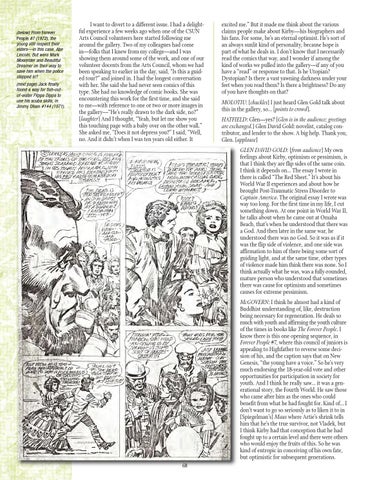
(below) From Forever People #7 (1972), the young still respect their elders—in this case, Abe Lincoln. But were Mark Moonrider and Beautiful Dreamer on their way to save him when the police stepped in? (next page) Jack finally found a way for fish-outof-water Flippa Dippa to use his scuba skills, in Jimmy Olsen #144 (1971).
I want to divert to a different issue. I had a delightful experience a few weeks ago when one of the CSUN Arts Council volunteers here started following me around the gallery. Two of my colleagues had come in—folks that I knew from my college—and I was showing them around some of the work, and one of our volunteer docents from the Arts Council, whom we had been speaking to earlier in the day, said, “Is this a guided tour?” and joined in. I had the longest conversation with her. She said she had never seen comics of this type. She had no knowledge of comic books. She was encountering this work for the first time, and she said to me—with reference to one or two or more images in the gallery—“He’s really drawn to the dark side, no?” [laughter] And I thought, “Yeah, but let me show you this touching page with a baby over on the other wall.” She asked me, “Does it not depress you?” I said, “Well, no. And it didn’t when I was ten years old either. It
excited me.” But it made me think about the various claims people make about Kirby—his biographers and his fans. For some, he’s an eternal optimist. He’s sort of an always sunlit kind of personality, because hope is part of what he deals in. I don’t know that I necessarily read the comics that way, and I wonder if among the kind of works we pulled into the gallery—if any of you have a “read” or response to that. Is he Utopian? Dystopian? Is there a vast yawning darkness under your feet when you read them? Is there a brightness? Do any of you have thoughts on that? MOLOTIU: [chuckles] I just heard Glen Gold talk about this in the gallery, so… [points to crowd]. HATFIELD: Glen—yes? [Glen is in the audience; greetings are exchanged.] Glen David Gold: novelist, catalog contributor, and lender to the show. A big help. Thank you, Glen. [applause] GLEN DAVID GOLD: [from audience] My own feelings about Kirby, optimism or pessimism, is that I think they are flip sides of the same coin. I think it depends on… The essay I wrote in there is called “The Red Sheet.” It’s about his World War II experiences and about how he brought Post-Traumatic Stress Disorder to Captain America. The original essay I wrote was way too long. For the first time in my life, I cut something down. At one point in World War II, he talks about when he came out at Omaha Beach, that’s when he understood that there was a God. And then later in the same war, he understood there was no God. So it was as if it was the flip side of violence, and one side was affirmation to him of there being some sort of guiding light, and at the same time, other types of violence made him think there was none. So I think actually what he was, was a fully-rounded, mature person who understood that sometimes there was cause for optimism and sometimes causes for extreme pessimism. McGOVERN: I think he almost had a kind of Buddhist understanding of, like, destruction being necessary for regeneration. He deals so much with youth and affirming the youth culture of the times in books like The Forever People. I know there is this one opening sequence, in Forever People #7, where this council of juniors is appealing to Highfather to reverse some decision of his, and the caption says that on New Genesis, “the young have a voice.” So he’s very much endorsing the 18-year-old vote and other opportunities for participation in society for youth. And I think he really saw… it was a generational story, the Fourth World. He saw those who came after him as the ones who could benefit from what he had fought for. Kind of… I don’t want to go so seriously as to liken it to in [Spiegelman’s] Maus where Artie’s shrink tells him that he’s the true survivor, not Vladek, but I think Kirby had that conception that he had fought up to a certain level and there were others who would enjoy the fruits of this. So he was kind of entropic in conceiving of his own fate, but optimistic for subsequent generations.
68
Mark Evanier
Jack F.A.Q.s A column of Frequently Asked Questions about Kirby
The war is over, and now it’s just beginning! Following the court settlement, Marvel is now giving Kirby proper credit, as they did heavily on the January 19, 2016 TV special Captain America: 75 Heroic Years—a lead-in to this Spring’s pivotal Marvel film Captain America: Civil War.
be chased by a caterpillar.” [laughter] But with Jack, it was hard to sometimes second-guess where that brain of his was going. Maybe he would have gone, “Of course Ant-Man is a great movie.” I don’t know that for a fact. One of the other things that has changed is that a lawsuit was settled. You may have heard about this. And we’re not going to talk much about it at all, really. I’m going to say two things about it. One was that I’m real happy, Jack and Roz would have been happy, the Kirby family is happy, everybody around the Kirby family is very happy. Now, you can make an argument that it’s too little, too late, Jack and Roz should have been here to see it. Okay, fine. Given. Given the reality of what was possible, I am very happy. Now, the second thing is a personal matter. I met Jack in July of 1969, almost exactly this time of July, in fact. And he told me at that time, as he told anyone who visited him then, what he felt he had contributed to the Marvel Universe, what he did, how he felt he was being under-credited and not treated very well. And through subsequent visits, as I got to know him better, I learned more and more about that. And I began to realize that— and, of course, I started meeting people like Don Heck, and Steve Ditko, and Joe Sinnott, and Dick Ayers, and Stan Lee, and Sol Brodsky, other people who were around through all that, and I began to realize that Jack’s version of the events was essentially correct. One could occasionally quibble with a mistake of memory. Jack would occasionally say “Captain Marvel” when he meant “Captain America,” or he’d sometimes confuse Dick Ayers with Joe Sinnott when he was talking about something— the kind of mistakes everybody makes. And he had some different terminology sometimes for words like “creator” or “writing.” But I found that Jack was very honest, a very honest man. I never, in my entire association with him, felt he was intentionally lying to me, or to anyone. I never heard Jack lie. I heard him get things wrong— which comic Iron Man was in or something like that— but I never felt that he lied. And over the years, my feeling that he was under-credited, that he was being financially wronged, grew and grew, and I got madder and madder, and I got to a point in my life where I could not go see Marvel movies. It just annoyed me
2015 Kirby Tribute Panel Held at 10:00 a.m. on Sunday, July 12, 2015 at Comic-Con International: San Diego. Featuring Rob Liefeld, Marv Wolfman, J. David Spurlock, and Paul S. Levine, and moderated by Mark Evanier. Transcribed by Steven Tice, edited by John Morrow, and copyedited by Mark Evanier. You can view a video of this panel at https://www.youtube.com/watch?v=ewpZ2sAn7F8 MARK EVANIER: Since we last met, the major change in the— You know, Jack was a man who was rarely ever surprised by anything relating to comics. He was surprised a bit by the business ethics, but the content didn’t surprise him. Somebody asked me last year, “Would Jack have been surprised that there was this huge multi-milliondollar movie of the Avengers?” No. Would Jack have been surprised that there was this huge multi-milliondollar movie of Thor? No. The other day somebody asked me, “Would Jack have been surprised to see a multimillion-dollar movie of Ant-Man?” Maybe. [laughter] I don’t know for sure. I think—AntMan was the character that Jack cared about the least of anything he had ever worked on, and he got very angry one time—well, not very angry, maybe, on a scale of one to ten, about a five — when somebody remarked, “Obviously, because Jack was short, the character he must have identified with most was Ant-Man.” [laughter] And Jack said, “That’s stupid.” And he thought Ant-Man was a stupid comic, because nobody fantasizes about being an ant. [laughter] They fantasize about smashing down walls and being able to fly… Nobody suddenly says, “I really want to
77
human beings you will have ever met. Two Roz oz little kids come there, the first thing is, R insists upon making sandwiches, so we would have eaten before we go down to see Jack, so we ate. W Wee hadd a nice time. W Wee’d go down. Again, imagine the person who is drawing Galactus at the time—we saw pages with Galactus months before they came out—speaking to little kids, and treating us like adults. It was amazing. So I had been a fan, and I got to work with Jack on covers. I got to work with—the only one I suggested was one Captain America cover. Y You ou don’t tell Jack what to do, but it was the big anniversary of 1776 to 1976, and I said, “W Wee have to do a special cover.” And he just did the most amazing stuff. And I think he enjoyed working with me because he knew me, and that was a little bit of a difffference. So I only worked with him a few times before everything was moved over to other editors and stuff like that. EVANIER: Now, I remember you telling me how much you loved the first Eternals comic when it came in, didn’t you? WOLFMAN: Well, the New Gods. That was at DC. EVANIER: Yeah, but I’m talking about Marvel. WOLFMAN: Well, the Eternals, I, Jack— first of all, I’m a mythology nut, and Jack created so much about that because of his “T Tales of Asgard” stuff, which was the most amazing comic that I had ever seen, and I loved the mythology he created. And I was a huge fan of the New Gods artwork and all of tha t, which,THIS by thePREVIEW, way, he had in his IF YOU ENJOYED CLICKhouse THE about LINK eight TO ORDER THIS years befor e it ever ISSUE INapPRINT FORMAT! peared,OR becDIGITAL ause they w ere all on the walls of his house. There were all those characters, and he would tell us what the stories were about, and we just kept waiting and waiting and waiting to see when they would come out. The Eternals was yet another take—we were talking about revisiting concepts, but taking it in a brand new direction yet again. It was the most amazing stuff. Unfortunately—I was a huge fan of his stuff. Stan was an even larger fan. He really was. He loved Jack’s work, but not all of the editors did, not all of the other people, because his writing wasn’t the same flavor as the rest of the Marvel stuff, and I think there were a lot of people who may not have appreciated the workKIRBY he was dCOLLECTOR oing, as well. B#67 ut you look at it and UP-CLOSE & PERSONAL! Kirby interviews you weren’t aware go, “Nobody has this imagina tion. Nfrom obody drasaw wshim tointhis scale. The of, photos and recollections fans who person, giant characters, anpersonal d theanecdotes n the lifrom ttle Jack’s onesfellow , anpros, d thLEE e eand ndKIRBY less backgrounds, cameos in comics, MARK EVANIER and other regular columand the most amazing stuff am cover I hitting anything nists, and more!ever Don’t.”letBut the photo fool you; this issue is that you of rare Kirby pencil art, from Roz Kirby’s private wanted me to? chockfull sketchbook, and Jack’s most personal comics stories!
WOLFMAN: Yeah, the, um… u it was Stan. And he comes back in, and it was still very quiet, still fairly secret that Jack was coming back to Marvel, which was the most amazing thing in the world. I was a huge Jack Kirby fan from the point—I didn’t even know who the artist was, but there were—I read everything, and back in Adventure Comics was the “Green Arrow” strip which was one of the more boring strips ever done, and suddenly there were a whole bunch of Green Arrow stories with giant arrows coming from outer space and all of this stuff, and I went, “Hey, this is really good stuffff.” Years later, I discovered it was Jack Kirby. Or I’m reading a comic, so I bought Challengers of the Unknown. And, again, no credits, and it’s by Jack and Wally Wally. And, wow! Where did this come from? This is was like no other comic. So I’’ve ve been b a fan of his forever, and we went to his house off and on when we were 13, 14, and 15. He was an endless fount of information. The kindest
(100-page FULL-COLOR EVANIER: Yes, yes. [laughter] I remember edmag) tha$10.95 t discussion when the (Digital Edition) $4.95 first Eternals camehttp://twomorrows.com/index.php?main_page=product_info&cPath=98_57&products_id=1215 in. First, you were so amazed at—Marv and I one time were talking about the decision at DC to cancel the New Gods and Forever P People eople, and he said… [pauses]
WOLFMAN: Please tell me, I don’t know what I said. 86