IN THE US
$995
Black Bolt TM & ©2003 Marvel Characters, Inc.
JACK KIRBY COLLECTOR THIRTY-NINE
FAN FAVORITES! COPYRIGHTS: Angry Charlie, Batman, Ben Boxer, Big Barda, Darkseid, Dr. Fate, Green Lantern, Guardian, Joker, Justice League of America, Kalibak, Kamandi, Lightray, Losers, Manhunter, New Gods, Newsboy Legion, OMAC, Orion, Super Powers, Superman, True Divorce, Wonder Woman TM & ©2003 DC Comics • 2001 characters, Ardina, Blastaar, Bucky, Captain America, Dr. Doom, Fantastic Four (Mr. Fantastic, Human Torch, Thing, Invisible Girl), Frightful Four (Medusa, Wizard, Sandman, Trapster), Galactus, Gargoyle, hercules, Hulk, Ikaris, Inhumans (Black Bolt, Crystal, Lockjaw, Gorgon, Medusa, Karnak, Triton, Maximus), Iron Man, Leader, Loki, Machine Man, Nick Fury, Rawhide Kid, Rick Jones, Sentinels, Sgt. Fury, Shalla Bal, Silver Surfer, SubMariner, Thor, Two-Gun Kid, Tyrannus, Watcher, Wyatt Wingfoot, X-Men (Angel, Cyclops, Beast, Iceman, Marvel Girl) TM & ©2003 Marvel Characters, Inc. • Captain Victory, Silver Star, Galaxy Green TM & ©2003 Jack Kirby Estate • Foxhole, Fighting American, Bullseye, Stuntman TM & ©2003 Simon & Kirby • Airboy TM & ©2003 Todd McFarlane Productions, Inc. • The Fly, The Shield TM & ©2003 Archie Publications, Inc. • Conan, Red Sonja TM & ©2003 Robert E. Howard, Inc. • Tarzan TM & ©2003 Edgar Rice Burroughs, Inc. • Addams Family TM & ©2003 Estate of Charles Addams and Filmways TV Productions, Inc. • Batman TV show TM & ©2003 20th Century Fox, Inc.
THE NEW RETROSPECTIVE . . . . . . . . . . . . . . . . .68 (the real Silver Surfer—Jack’s, that is) COLLECTOR COMMENTS . . . . . . . . . . .78 (some very artful letters on #37-38) #39, FALL 2003
C o n t e n t s
C
o
l
l
e
c
t
o
r
OPENING SHOT . . . . . . . . . . . . . . . . . . .2 (where the editor lists his favorite things)
KIRBY OBSCURA . . . . . . . . . . . . . . . . .21 (Barry Forshaw has more rare Kirby stuff)
UNDER THE COVERS . . . . . . . . . . . . . . .3 (Jerry Boyd asks nearly everyone what their fave Kirby cover is)
GALLERY (GUEST EDITED!) . . . . . . . . .22 (congrats Chris Beneke!)
INNER VIEW . . . . . . . . . . . . . . . . . . . . . .7 (Jack’s on Entertainment Tonight!) JACK F.A.Q.s . . . . . . . . . . . . . . . . . . . . .8 (who’s the better artist, Kirby or Buscema?) RETROSPECTIVE . . . . . . . . . . . . . . . . .14 (Ang Lee is green with envy)
KIRBY AS A GENRE . . . . . . . . . . . . . . .42 (it’s not Kirby, but it’s close) RETROSPECTIVE . . . . . . . . . . . . . . . . .44 (they’re creepy and they’re kooky...) TRIBUTE . . . . . . . . . . . . . . . . . . . . . . . .55 (better late than never, it’s the 2002 Kirby Tribute Panel)
PARTING SHOT . . . . . . . . . . . . . . . . . . .80 (we’ve got a Thing for you) Front cover inks: MIKE ALLRED Front cover colors: LAURA ALLRED Back cover inks: P. CRAIG RUSSELL Back cover colors: TOM ZIUKO Photocopies of Jack’s uninked pencils from published comics are reproduced here courtesy of the Kirby Estate, which has our thanks for their continued support. (below) Jack’s cover pencils from Marvel Super-Heroes #54 (Nov. 1975). Hulk TM & ©2003 Marvel Characters, Inc.
The Jack Kirby Collector, Vol. 10, No. 39, Fall 2003. Published quarterly by & ©2003 TwoMorrows Publishing, 1812 Park Drive, Raleigh, NC 27605, USA. 919-833-8092. John Morrow, Editor. Pamela Morrow, Asst. Editor. Eric Nolen-Weathington, Production Assistant. Single issues: $13 postpaid ($15 Canada, $16 elsewhere). Four-issue subscriptions: $36.00 US, $60.00 Canada, $64.00 elsewhere. All characters are trademarks of their respective companies. All artwork is ©2003 Jack Kirby unless otherwise noted. All editorial matter is ©2003 the respective authors. First printing. PRINTED IN CANADA.
1
Opening Shot
by John Morrow, editor of TJKC
amilies are remarkable things. They’re the only people you can go to and get generally universal acceptance. And even though Jack passed away almost ten years ago, the family of friends and relatives united by the name “Kirby” is as strong as ever—a testament to how remarkable a figure Jack was. 2004 marks the tenth anniversary of this magazine, which launched TwoMorrows Publishing. Last July, my wife Pam, daughter Lily, and I took our annual sojourn to beautiful San Diego, California for the tenth time (first in 1991,
F
tribute, with more material being added all the time, so check it out. Things are also afoot from other FOOJs (that’s 1994-2004 “Friends Of Ol’ Jack”) that’ll impact the King’s presence on the Web. Look for an exciting announcement in September 2004— not so coincidentally, exactly ten years to the day of the release of TJKC #1. Another new addition to the Kirby “family” came on August 13, as Kirby biographer Ray Wyman Jr. and his wife Mary welcomed their second child Thomas Francis to the world. We’re sure he’ll be properly taught the value of square fingers, toes, and
1
A Few Of My Favorite Things! (top) My daughter Lily picking out her Halloween pumpkin! (center) The Kirby “family” at the 2002 San Diego Con. Left to right: Grandson Jeremy Kirby, Ray Wyman Jr., granddaughter Tracy Kirby, former Kirby assistant Steve Sherman, family friend Mike Thibodeaux, and Jeremy’s wife Crystal (holding baby Hannah as a one-year-old). (above) Recent shot of Jeremy, Crystal, and Hannah Kirby, and (right) Jeremy’s new website; check it out! Characters TM & ©2003 Marvel Characters, Inc.
then nine in a row starting in 1995) to attend Comicon. It was Lily’s second year (she was just shy of two years old at the time), but she probably had the most fun of any of us. Friends we’ve made over the last decade flocked to our booth, ooohing and aaahing over our little girl and giving her gifts, while we all caught up on what’s been going on in each others’ lives since the last San Diego con. But perhaps our ultimate experience this year had little to do with comics, when Lily got to spend an afternoon playing with Jeremy and Crystal Kirby’s daughter Hannah. There was something so right about seeing my daughter walk off hand-in-hand with Jack and Roz’s great-granddaughter. Besides being absolutely adorable, Hannah’s awfully advanced for a two-year-old, and she proceeded to amaze my wife by teaching Lily all kinds of new things that day. It made us both wonder if she inherited a little bit of Jack’s non-stop mind. Hannah’s dad has a new website devoted to his grandfather— www.jackkingkirby.com—and Jeremy’s put together a wonderful
squiggly knees. Lastly, if you have listing corrections or updated additions that you wish to send to The Jack Kirby Checklist, please send them to Richard Kolkman’s new post office box or e-mail address below. Your ongoing help and support results in the definitive listing of the work of The King of Comics, and this list is always being updated and expanded to become ever more accurate. Richard Kolkman Seriocomics Box 501905 Indianapolis, IN 46250 protista1@aol.com On a more personal note, I’d like to dedicate this issue to the memory of the little Morrow who didn’t make it. You’re the reason it was so late, and though we never got to know you, you continue to impact our lives daily. We’ll see you again one day. ★
Must-Have Kirby Items From TwoMorrows!
2
Captain Victory TM & ©2003 Jack Kirby Estate.
Characters TM & ©2003 Marvel Characters, Inc.
Batman TM & ©2003 DC Comics. Captain America TM & ©2003 Marvel Characters, Inc.
• In February, we’re re-releasing THE COLLECTED JACK KIRBY COLLECTOR, VOL. ONE, which reprints TJKC #1-9 plus 30 pieces of Kirby art never shown anywhere else! $29 US postpaid • Now shipping is the debut issue of our new magazine BACK ISSUE!, which features an even dozen pages of Kirby’s pencil art in the inaugural “Rough Stuff” section, plus a FULL-COLOR presentation of Jack’s hand-colored guides for the covers of JIMMY OLSEN #133 and FOREVER PEOPLE #1. $8 US postpaid • Initial mail-only sales of the CAPTAIN VICTORY: GRAPHITE EDITION haven’t done the trick, so we’re offering it through stores in March (all proceeds go toward scanning the Kirby Archives!). To avoid a sell out, order yours before March! $8 US postpaid See the ads elsewhere in this issue for ordering details!
Under The Covers Our front cover this issue is inked by Mike Allred, returning for a reader-requested second outing at a TJKC cover (his first being on issue #28’s wraparound beauty). This Black Bolt piece (at left) first appeared in Fantastic Four Annual #5 (1967), inked by Frank Giacoia, and we originally ran the pencils in TJKC #23 (see page 54 of this issue). Mike’s wife Laura Allred added her artful touch by coloring Mike’s inks to make a truly striking cover image. Our back cover this issue is a Hulk fan commission inked by P. Craig Russell, one of the true “fine” artists in comics. Craig took time out to do an interview with TwoMorrows’ Eric Nolen-Weathington, which we’ll feature next issue! (Kudos to Tom Ziuko for the splendid coloring on the back cover of this issue!)
(right, top to bottom) 2001 Treasury Edition, Jimmy Olsen #139, Kamandi #12, Fantastic Four #1 recreation, and Foxhole #1.
Covering It All!
Written and compiled by Jerry Boyd (with help from John Morrow and John Fleskes) erily, ’tis true that ye cannot judge a book by its cover. However, you can judge a comic magazine cover on its own merits and a cover by our beloved king usually stated a mouthful. Whether Jack was capturing the essence of his own regularly drawn books, or a dramatic moment in time for stories done by others, there was always something about a Kirby cover that demanded your undivided attention. The cover pieces the king produced in his long, stellar career number in the thousands. Nevertheless, the memories they evoke remain so tangible that one can probably pinpoint the place/places—whether it be big city newsstand, comics office, home-delivered subscription issue, or that familiar spinner rack in your local drug store/convenience market—where one first lay eyes on the Fly cautiously approaching the malevolent Spider Spry (Adventures of the Fly #1), or an outmatched Captain America almost cowering before the Enchantress and Power Man (Avengers #22), or the Forever People in the evil grip of Desaad (Forever People #4), to name a few examples. For this “fan favorites” issue, we’ve gathered an eclectic selection of writers, editors, artists, and fans and posed to them one question: “What is your favorite Jack Kirby cover and why?” For some, this was a “no-brainer” and others (understandably) needed days/weeks/months to narrow it down to a single precious choice (or two). Special thanks go out to all who happily took on this admittedly daunting task and... away we go!
V
MARIE SEVERIN
STAN LEE
cartoonist/colorist without peer I kinda liked the (Kirby) splashes more than the covers! Jack had a way of capturing the same excitement on the opening page or outdoing his covers outright. It’s hard to pick one because they were all so good and had such impact... and they all bumped into each other in quality. I would say that the wraparound cover for 2001 (the treasury-sized edition) was a particularly exciting cover to me and also unusual for Jack. I believe he colored that one himself. The scope of it was fantastic and I wish he could’ve done more wraparound pieces. I also wish Kirby had tried sculpture. Can you imagine it if he had done murals? We’d... have more pieces like 2001!
writer/art director/editor supreme I’m sorry but it’s impossible for me to say which is my favorite Kirby cover. However, if there absolutely must be a choice, then it’s the cover for Fantastic Four #1. Not because it’s Jack’s best artwork, but because it was the cover of the mag that started the Marvel Age of Comics—and once seen, it’s almost impossible to forget. Excelsior!!
DANIEL CLOWES artist/writer of Eightball, Doofus, & Ghost World I like the Don Rickles and Goody Rickels cover on Jimmy Olsen #139. It was a favorite of mine because it was such a crazy idea!! I actually had that one on my wall for five years! I should go read that book again. I haven’t read it since 1972. Aside from being one of modern-day comics’ brightest talents, the talented Mr. Clowes also co-wrote the screenplay for Terry Zwigoff’s excellent movie adaptation of Dan’s comic, Ghost World. If you haven’t seen it, you’re missing out on a real treat! Dan did this drawing of Enid, the movie’s main character, especially for TJKC! Thanks, Dan! ©
JOHN MORROW editor/publisher It’s Kamandi #12, with the giant grasshopper leaping toward the reader. This was my first Kirby book, and it really threw me for a loop. I remember looking at it, instantly hating the square knees and fingers that Jack drew, and then by the time I finished reading the issue, I was a total Kirby fan for life.
Kirby and Ayers recreated the famous cover to FF #1 in the early ’90s (shown below).
MARK EVANIER columnist/creator Picking one or even ten Kirby covers is like going into a Baskin-Robbins that has 31,000 flavors. Never mind which one you prefer, how do you even begin to pick? But if you were holding a few loved ones hostage and demanding a selection, I suppose I’d opt for Foxhole #1—a haunting image that was among the very few times that Jack ever drew a cover scene as much from memory as imagination. Jack told endless tales of his days in World War II, often to the impatience of fans who only wanted to hear about Asgard and Apokolips. In his anecdotes, as in his drawing, he did not glamorize the killing, but did, in life-affirming manner, glamorize the heroism, memorialize the emotion, weighing them against one another. Most of his war-theme covers captured that ambiguity but the first Foxhole did it as eloquently as any, and without any tricks of forced perspective or exaggerated anatomy. And if you made me pick some others, I’d probably go eenie-meenieminie-mo and name—hmm, let’s see... FF #29, Tales of Suspense #80 or maybe Captain America #107. But ask me again in an hour and I’ll pick completely different ones.
3
Tales of Suspense #71
Journey Into Mystery Annual #1
Tales To Astonish #34
Airboy Comics Vol. 4, #4
JERRY BOYD
DICK AYERS
TwoMorrows contributor Time has witnessed many a warrior who has fought through his anguish as fallen comrades lie nearby. In addition, many warriors have survived in battle and claimed the victory because of the inspirational charge of an ally. The Kirby/Ayers team, two WWII veterans, captured all of this in the cover of Suspense #71 with modern warriors in mechanized armor in a battle televised before an entire world. “Happy” Hogan was prone, unconscious, a seeming martyr to the Golden Avenger’s (and the free world’s) struggle against Communism. Set against a bleak, rugged terrain, the vengeful Iron Man is positioned between his fallen friend and the bloodthirsty Titanium Man. Jack’s design was in contrast to many of the Marvel covers at the time which depicted the heroes either at bay, beaten (see TOS #70 before this one by Heck), or about to attack. This kingly masterwork set up the fight’s denouement victory!! This intimate, tension-filled, and dramatic cover, just above a stupendous Lee/Heck/Wood effort, was a Kirby tour de force and it caught all the glory of Iron Man’s greatest triumph. (It is too tough to pick one—Evanier was right!) During the Renaissance, my second pick would’ve fit in as a statue sculpted by Michelangelo, a painting by Titian, or a drawing by DaVinci. It screams classic art, and it’s the cover of Journey into Mystery Annual #1—with the warrior gods Thor and Hercules in a locked fighting pose that defies denouncements.
artist/inker extraordinaire My favorite monster cover is “Monster at My Window!” (Tales to Astonish #34). That was a beaut. And my favorite story was “(I Created) Sporr, the Thing That Could Not Die!!” (Tales of Suspense #11). Monster stories were my favorites of all the stuff that Kirby penciled that I inked. I enjoyed those the most.
New Gods #1
Sgt. Fury takes a time-out from stomping “Sieg-Heilers” in this convention portrait by Dick Ayers (shown below).
JIM VADEBONCOEUR, JR. comics historian/publisher of ImageS magazine Kirby’s post-WWII artwork for Hillman was some of his most raw and powerful as typified by the May 1947 cover for Airboy Comics vol. 4, #4. The story the image communicates is immediate and obvious and requires only a single glance to comprehend. Compare this to the text-heavy Charles Biro covers for such contemporary titles as Crime Does Not Pay. With Black Magic and other titles at Crestwood/Prize, Kirby reached one of his several artistic peaks. His ability is exemplified by the cover for issue #18 (vol. 2, #12, Nov. 1952) with its incredible sense of place and its visually easy-to-read scenario.
NEAL ADAMS artist/writer/publisher When I was a younger kid, Kirby’s stuff put me off in many ways! His art was totally focused on action and the villains were so ugly!! It was the Challengers of the Unknown with Wally Wood’s inking that made Kirby palatable to me. I really became a fan of the Challengers because the interior Kirby/Wood material was fantastic— a new style of comic art to my eyes. So I’d pick a Challengers cover but I believe someone else other than Wood inked them... like George Klein? Also, I don’t know if this is generally known but when I was going to go professional 4
Black Magic #18 (Vol. 2, #12)
I did a sample art page of the Challengers... from still-strong impressions of their earlier stuff. So, the first coming of Jack’s importance in the field to me came from Wood’s magical filter. Later on, I fell in love with their Sky Masters, as well. From a historical point of view, I’ll go for Fantastic Four #1. I don’t know whether it was Jack convincing Stan or Stan convincing Jack they ought to concentrate on comics (and walk away from comic strips) but their joint point of view in creating the Marvel era was momentous. FF #1 was a monster comic—it wasn’t even a super-hero book yet! The huge monster clawing up out of the street played on their earlier successes in the monster books. Hell, the Thing’s a monster, too! Jack, in his “ugliness period,” teamed up with Stan and really started something. There’s no charm there on that cover and like a lot of Kirby work, it’s hardly ever exciting because it’s beautiful—it’s the dynamic!! The cover... marked a second beginning for Marvel. I don’t have any strong favorites from the DC period because I inked as many as I could because I wanted to save them from others! I believe someone told me then that Al Plastino would ink them. I didn’t like the idea of Plastino over Kirby so I stepped in and tried to save as many as I could! Because Neal is such a great guy and because this is the Kirby Collector, he sent along this bust of comicdom’s greatest super-patriot, Captain America (shown above)!
INNER VIEW
Entertainment Tonight (The following is a transcript of a two-minute interview segment with Jack Kirby which aired on October 28, 1982, during the first season of the television program Entertainment Tonight. The interviewer/narrator was Katherine Mann, and this piece was conducted in Jack’s Thousand Oaks, CA home. Thanks to Steven Thompson for supplying the video, and to Glen Musial for capturing the images you see here from the VHS tape.)
All images ©2003 Entertainment Tonight.
(this page, top right) The word balloon Jack added to the drawing he did of Katherine has the supercharacter saying “Never fear, Katherine! I’m fast when I’m flying!”
During the afternoon we spent with him, Jack couldn’t resist including me in one of his action-packed plots. That’s me, being thrown from a helicopter by two vicious villains. But in the nick of time, I’m saved by a flying passer-by.
KATHERINE MANN: How many characters have you created? JACK KIRBY: It would probably come to an Army Division. By his own admission, Jack Kirby’s super-hero creations are so numerous, even he can’t keep track. After some 40 years at the drawing board, and an estimated 40,000 pages of action with such characters as Captain America, Fantastic Four, and the Avengers, Kirby is the undisputed King of comic book super-heroes.
MANN: Oh, you’re endowing me nicely there, Jack! Thanks a lot! (laughter) This is the Katherine Mann you’ve never seen before, and probably never will again! KIRBY: This is my normal masculine instincts coming out. (laughter)
MANN: What do your characters represent? KIRBY: Well, the characters represent a sort of transcendent feeling we all have inside us; that we could do better. We want to do better. We have the time to do better. We can be the people we lionize. To anyone passing by his Southern California home, Jack looks like anything but a musclebound super-hero. But according to him, it’s what’s inside the mind that counts. KIRBY: If you look at my characters, you’ll find me. No matter what kind of character you create or assume, a little of yourself must remain there.
As he sits each day at his board along with his characters, Jack Kirby is far from lonely. KIRBY: I haven’t got the trappings of a circus, but there in my mind is a very active, and bright, and colorful place, that’s as good as any circus that I’ve ever seen. I live with that, and I enjoy it immensely. ★
7
Mark evanier
Jack F.A.Q.s
A column answering Frequently Asked Questions about Kirby by Mark Evanier Let’s jump right in with this question from Tim Woolf... I keep seeing on the Internet, people who say things like, “I can’t stand the way Kirby drew. John Buscema was so much better an artist.” How do you deal with such people?
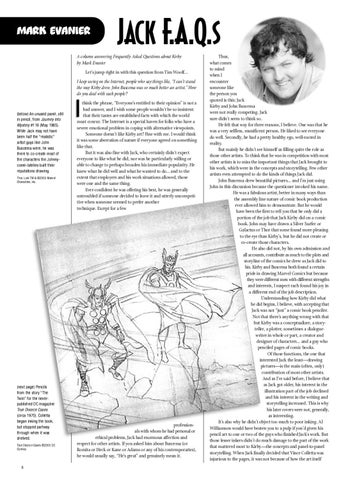
(below) An unused panel, still in pencil, from Journey Into Mystery #116 (May 1965). While Jack may not have been half the “realistic” artist guys like John Buscema were, he was there to co-create most of the characters the Johnnycome-latelies built their reputations drawing. Thor, Loki TM & ©2003 Marvel Characters, Inc.
(next page) Pencils from the story “The Twin” for the neverpublished DC magazine True Divorce Cases (circa 1970). Colletta began inking the book, but stopped partway through when it was shelved. True Divorce Cases ©2003 DC Comics.
8
think the phrase, “Everyone’s entitled to their opinion” is not a bad answer, and I wish some people wouldn’t be so insistent that their tastes are established facts with which the world must concur. The Internet is a special haven for folks who have a severe emotional problem in coping with alternative viewpoints. Someone doesn’t like Kirby art? Fine with me. I would think it was some aberration of nature if everyone agreed on something like that. But it was also fine with Jack, who certainly didn’t expect everyone to like what he did, nor was he particularly willing or able to change to perhaps broaden his immediate popularity. He knew what he did well and what he wanted to do... and to the extent that employers and his work situations allowed, those were one and the same thing. Ever-confident he was offering his best, he was generally untroubled if someone decided to leave it and utterly uncompetitive when someone seemed to prefer another technique. Except for a few
I
professionals with whom he had personal or ethical problems, Jack had enormous affection and respect for other artists. If you asked him about Buscema (or Romita or Heck or Kane or Adams or any of his contemporaries), he would usually say, “He’s great” and genuinely mean it.
Thus, what comes to mind when I encounter someone like the person you quoted is this: Jack Kirby and John Buscema were not really competing. Jack sure didn’t seem to think so. He felt that way for three reasons, I believe. One was that he was a very selfless, munificent person. He liked to see everyone do well. Secondly, he had a pretty healthy ego, well-rooted in reality. But mainly he didn’t see himself as filling quite the role as those other artists. To think that he was in competition with most other artists is to miss the important things that Jack brought to his work, which were in the concepts and storytelling. Few other artists even attempted to do the kinds of things Jack did. John Buscema drew beautiful pictures... and I’m just using John in this discussion because the questioner invoked his name. He was a fabulous artist, better in many ways than the assembly line nature of comic book production ever allowed him to demonstrate. But he would have been the first to tell you that he only did a portion of the job that Jack Kirby did on a comic book. John may have drawn a Silver Surfer or Galactus or Thor that some found more pleasing to the eye than Kirby’s, but he did not create or co-create those characters. He also did not, by his own admission and all accounts, contribute as much to the plots and storyline of the comics he drew as Jack did to his. Kirby and Buscema both found a certain pride in drawing Marvel Comics but because they were different men with different strengths and interests, I suspect each found his joy in a different end of the job description. Understanding how Kirby did what he did begins, I believe, with accepting that Jack was not “just” a comic book penciler. Not that there’s anything wrong with that but Kirby was a conceptualizer, a storyteller, a plotter, sometimes a dialoguewriter in whole or part, a creator and designer of characters... and a guy who penciled pages of comic books. Of those functions, the one that interested Jack the least—drawing pictures—is the main (often, only) contribution of most other artists. And as I’ve said before, I believe that as Jack got older, his interest in the illustration part of the job declined and his interest in the writing and storytelling increased. This is why his later covers were not, generally, as interesting. It’s also why he didn’t object too much to poor inking. Al Williamson would have beaten you to a pulp if you’d given his pencil art to one or two of the guys who finished Jack’s work. But those lesser inkers didn’t do much damage to the part of the work that mattered most to Kirby—the concepts and panel-to-panel storytelling. When Jack finally decided that Vince Colletta was injurious to the pages, it was not because of how the art itself
He was power and pathos personified in green. Retrospective
He was the Silver Age heir to the Golden Age anti-heroes who epitomized destructive force propelled by uncontrollable rage. He was Jack and Stan’s first solo-star, and likewise, their first flop. Characteristically, he smashed his way back from obscurity, raging and rampaging into the hearts and minds of millions along the way. Four decades later, he shows no signs of stopping. Move over “Man of Steel”:
The Strangest Man Of All Time! hat do you do for an encore after launching “The World’s Greatest Comic Magazine?” When faced with that question back in 1962, Jack Kirby and Stan Lee responded by creating a solo-star who, if anything, pushed the envelope even further than The Fantastic Four. They gave him the power and pathos of the Thing, and the shape-shifting ability of Dr. Jekyll and Mr. Hyde. They took the visage of Boris Karloff ’s Frankenstein, and the sympathy-evoking persona of Quasimodo; the pathetic, hunted-beast with limited intellect. To this, they the added angst-ridden characterization that was serving them so well in The Fantastic Four, along with some Golden Age antihero attitude (as personified by the 1940s SubMariner). Finally, they took the name of a wisely forgotten Journey Into Mystery monster (right) , and from this wildly diverse synthesis, came their new creation. The fact that the Incredible Hulk bore a clear resemblance to many of Marvel’s pre-super-hero monsters, may indicate that the writers (along with Martin Goodman) were hedging their bets on a full-fledged 1960s superhero revival. However, it was more likely a conscious effort by Lee and Kirby to Kirby’s enigmatic emerald enormity, effusively examined and expounded on by Mark Alexander put as much stylistic distance as they could between their new star, and the cheerful, pro-social super-heroes their Distinguished Competitors were churning out, as epitomized by Superman. Indeed, Marvel’s Green Goliath had more in common with kryptonite than he did with the “Man of Steel.” The very image of Superman, a smiling, utopian figure, standing on a mountain top—with his bright red cape floating in the summer breeze— was totally antithetical to Kirby’s tortured behemoth-in-rags, who savagely pounded his prison walls in The Incredible Hulk #3 (left). Moreover, the idea that acquiring super-powers could bring misery (instead of fame and glory) and drive a wedge between man and his society, was light-years away from concepts like Krypto, the caped Super-dog. Suddenly, even to the preteen eye, National Comics would seem simplistic and clichéd. Jack Kirby’s creativity seemed a force as unstoppable as The Hulk himself.
W
14
The Strange Case of Dr. Banner and Mr. Hulk Q: In the past, you’ve mentioned writers like Robert Louis Stevenson and Jack London as favorites. Stevenson’s Dr. Jekyll and Mr. Hyde obviously influenced The Hulk. KIRBY: Sure. Those writers were good writers. They were professionals and men who knew the craft—and of course they could write about a thing like the Hulk as well as I or anybody could, and maybe see some insights that I couldn’t. —from TJKC #23 Another aspect of Kirby’s beleaguered behemoth that set him apart from the rest of comicdom, was Banner and the Hulk’s unique relationship with their alter-egos. It was a personality divided against itself. Banner, a bespectacled, introverted version of Reed Richards, lived in constant fear of the Hulk’s uncontrollable rage, while the monster within despised Banner’s frailty and weakness. In the Hulk’s clouded mind, he viewed Banner as a different person altogether: an enemy whom he wished to destroy, but was never able to find. Obviously, Lee and Kirby (like Robert Louis Stevenson before them) were capitalizing on the idea that everyone has a darker entity raging within. In The Incredible Hulk #1, Banner stated: “I despise men who think with their fists,” while the Hulk, who was anti-intellectualism personified, reveled in his bestial power. The harder Banner tried to repress his capacity for rage, the more the beast within would lash out. The ultimate irony was that Banner, a scientist who developed weapons of mass destruction for the military, was—if anything—even more dangerous to humanity than the Hulk. Moreover, Banner’s intellect, which enabled him to create a monstrous weapon without considering the moral consequences, would prove his ultimate undoing. In an entirely fitting twist of fate, Banner’s life would be irrevocably altered by his own insidious invention (the gamma-bomb) and a chance encounter with a mysterious orphan.
Rick Jones (The TeenEnigma, Part I) The supporting characters Kirby and Lee introduced in the Hulk’s debutissue were (typically) potent enough to keep the book’s storyline rolling for decades: There was General Thaddeus E. “Thunderbolt” Ross, a blustering, ill-tempered, old firebrand who was the 1960s military-industrial-complex personified. Ross loathed Banner: “The trouble with you is you’re a milksop!” He chided: “You’ve got no guts!” Ironically, Banner was about to unleash a weapon more powerful than anything even Thunderbolt Ross could imagine, and within the frail frame of Bruce Banner lay a rage that would make the geriatric general seem feeble by comparison. Betty Ross, the General’s daughter, was as demure as her father was domineering. Betty was attracted to the mild-mannered scientist, despite (or possibly because of ) the dark, terrible secret she sensed he was hiding. This “loved by the daughter, loathed by the father” Freudian syndrome would (naturally) become the matrix for some classic Marvel-style conflict. Oddly, Betty Ross had the same name as the leading female protagonist in the original 1940s Captain America series (the Simon/Kirby Betty Ross was a blonde special-agent for the U.S. government). To further compound this “coincidence,” the Hulk’s teen-sidekick, Rick Jones, was a dead-ringer for Cap’s adolescent ally, Bucky Barnes. The fact that a third Simon/Kirby CA alumnus, “The Ringmaster of Death,” was resurrected in Hulk #3, advances the possibility that this self-plagiarism was premeditated. The writers were presumptively reanimating characters they knew would work—just as they’d done with
the Human Torch in 1961. Rick Jones, the enigmatic orphan, was by far the most intriguing supporting character in The Incredible Hulk, if for no other reason than his ubiquity. He alone would break the bonds of the series to play a larger role in the ever-expanding Marvel Universe; a role that would prove to be both contrasting and complex. Stan Lee has stated in numerous interviews that he abhorred the idea of the “teen-sidekick” who proliferated in the early days of comics. In view of this, it’s odd that Marvel’s first solo-star was immediately given an adolescent associate. Perhaps it was Kirby’s input, or perhaps the writers felt the kids who read the magazine would relate to Jones more than they would a mutated freak. In any event, after Banner saved Jones from the gamma-bomb, he had Rick’s loyalty, sympathy and confidence. Throughout the original series, Rick Jones was along for the ride, trying in vain to keep the Banner/ Hulk equation under control, and guarding Dr. Banner’s terrifying secret. The Hulk’s view of the indebted, ever-present youth vacillated from contempt, to annoyance, and (finally) to a grudging acceptance of the situation. This uneasy alliance between monster and mascot would change drastically with the return of Captain America (Avengers #4, March, 1964). In the last issue of The Incredible Hulk (Jan. 1963) Rick formed the “Teen Brigade,” a group of young ham-radio buffs, who used their telecommunications talents to aid the army, the police, and (mainly) the Marvel super-heroes. Ironically, Marvel’s only Silver Age “kid gang”—the type which Jack Kirby was noted for—seems to have been a Lee/Ditko concept.
The Kirby ISsues (Hulk #1-5 & FF #12) “Fan out men! We’ve got to find that—that Hulk!! (And thus a name is given to Bruce Banner’s other self, a name which is destined to become—immortal!) —Incredible Hulk #1. In “The Coming of the Hulk” (Hulk #1, May 1962) Banner rescues Rick Jones from a secret bombsite, and takes the full brunt of the “mysterious gamma rays” which cause him to become a hideously mutated beast with every sunset (a concept that was probably borrowed from Dracula). The story is set in New Mexico, making the Hulk the only early 1960s Lee-Kirby hero who wasn’t indigenous to New York. The acquisition of super-powers transmuted through radiation was a reoccurring motif in the 1960s Marvel comics (see the FF, Spider-Man, and Daredevil). Kirby recalls
(above) A (re-)cast of characters? Some of the 1940s Simon/Kirby Captain America luminaries may have been recycled for the 1962 Hulk series. You be the judge! (left) A prototype for the Leader? The Gargoyle: the diminutive, evil genius (from Hulk #1) whose large, misshapen skull was expanded via radiation. Color him green and it’s clear that Kirby almost nailed the perfect adversary for the Hulk right off the bat. (below) The Teen Enigma: Like many teenagers of his generation, Rick Jones was somewhat confused as to where his loyalties lay. Hulk, The Leader, Gargoyle, Rick Jones, Betty Ross, Ringmaster TM & ©2003 Marvel Characters, Inc.
15
Obscura
Barry Forshaw
Want inexpensive reprints of this issue’s selections? As stated in Barry’s column, Double Life of Private Strong #1 was reprinted in its entirety in Blue Ribbon Comics Vol.2, #5 (Feb. 1984), featuring a new Kirby cover inked by Rich Buckler (pencils shown below). Pvt. Strong/Shield © 2003 Archie Publications. House of Secrets TM & ©2003 DC Comics.
A regular column focusing on Kirby’s least known work, by Barry Forshaw
hile Jack Kirby’s career repeatedly threw up examples of The Master creating a brilliantly winning concept which other hands later took over (and utilized to far less interesting effect), there are, in fact, some cases where wonderful ideas were essentially stillborn; nobody took up baton after Kirby. A classic case here is the pitifully small run (just two issues) for The Double Life of Private Strong, a Captain America/ Fighting American knock-off that Simon & Kirby turned out for Archie comics in the Fifties. The first issue of this title (which some reports claimed was torpedoed for its protagonist The Shield’s Superman-like associations) contains some of Kirby’s best work in the period, and is certainly the equal of its companion title, Adventures of The Fly (a title which did survive, executed with far less imagination by lesser talents). But Private Strong was a gem: take the splash panel of the first tale, as Lancelot Strong strips off his army fatigues to reveal the red white and blue of his Shield outfit, a series of tableaux around him demonstrate powers (hurling bolts of lightning generated by his own body, defying weapons at point blank range, adapting to temperatures at which nothing could live, etc.). In fact, this page is actually better than the actual cover, striking though that is. While the central figure has features that are clearly inked by George Tuska, the battling spaceman and soldiers in the distance are clearly Kirby, as is the most distinctive feature of the cover, a series of frames of film which in just 19 panels manages to tell a complete Shield mini-adventure. Irresistible back then—still so today. The first tale, detailing the creation of this assemblyline super-hero was, admittedly, off-the-shelf stuff for Simon & Kirby, but no less entertaining for that. In fact, the gargoyle-faced Communists in the first two panels could be straight out of the sardonically satirical Fighting American strips, and suggest that a similar sense of fun will be found in these pages. More than The Fly, the actual design of the panels here is notably sophisticated, and there are some striking touches, such as the highly futuristic mobile lab that a persecuted scientist escapes in with his son (who
W
will, of course, later become The Shield. But with the second tale, “Spawn of the X-World,” we are in for a treat. This is a hint-oflater-things reading experience for Kirby fans. This marvelous splash panel displays—in fact, it features—a classic destructive monster of the kind that Kirby would make his speciality when he moved over to Marvel with Stan Lee; and the opening panel (The Shield leaps towards a gigantic green monster throwing destructive rays from its eyes) is the kind of thing calculated to warm every Kirby fan’s heart. In fact, the piece makes it quite clear who was the prime creative force in those Lee and Kirby monster tales: every element of the later work is here, notably a panel which became a cliché in the monster fests, Kirby visualizes a character’s vision of the monster laying waste to a city, when in actual fact it never gets the chance to do so. The second tale is a filling-in of more of The Shield’s origins, but the last piece, “The Menace of the Micro Men,” is a typically delirious Simon/Kirby piece of the period, crammed full of wacky pseudoscientific concepts and headlong plotting (the splash panel is an eye-catcher: The Shield crashes in through a window, as a mad scientist supervises his green micromen feeding the heroine into a very typically Kirby piece of super-scientific equipment). The use of forced perspective throughout this tale is also very characteristic of the King—interestingly, it’s one of his artistic fingerprints that the legion of artists inspired by him didn’t often pick up on. Kirby fans should have no trouble tracking this issue down, and there is also an affordable alternative: in the Eighties, the entire comic was re-issued by Archie as Blue Ribbon Comics #5, with a new Kirby cover (striking, but showing the element of the slapdash that had crept into Kirby’s at about this time). No true Kirby fan should be without House of Secrets #11, published by DC in 1958. And I make no apologies for recommending this one, even though Kirby’s contribution is confined to a striking cover showing a giant trying to save a city from destruction (needless to say, the cover is full of classic Kirby design elements, the buildings, the giant’s futuristic costume), but if you’re hesitating to purchase a title in which there is no Kirby interior art, you should be aware that the cover is not the only reason for buying this. The first tale, “The Guardian of the Past” contains some of the finest work that Nick Cardy ever did for DC (in fact, his pre-super-hero stories for DC’s mystery and SF titles were actually more refined than his later work), and the story that Kirby’s cover illustrates, “The Man Who Couldn’t Stop Growing” is something of a find, illustrated as it is by the underrated Lou Cameron, an artist who at times matched The Master in terms of his imagination and panache, even if his grasp of anatomy was a touch wayward (but then... think later Kirby!). Take the fifth panel on page 4, in which the eponymous giant straddles a dwarfed world, his footsteps leaving massive imprints in a continent, his shadow stretching across oceans... this is quite as impressive as anything in Jack Kirby, and more than justifies whatever the Kirby collector may have to shell out for this rather rare issue. ★ 21
Gallery
And the winner is...
hris Beneke of Brooklyn, NY! We put all the entries we received from last issue’s “Guest Editor” contest in a really big box and drew his out. So congratulations, Chris; you got to pick this issue’s Kirby Art Gallery! (We’ll keep all the other entries for choosing future Galleries.) Now, let’s let Chris take it away!
C
Page 22: Kamandi #22, page 18 Kamandi #21 was probably the first Kirby comic I bought from the newsstand. I turned 11 that summer, but this page from the following issue was a shocker, if not a heartbreaker. Page 23: Kamandi #26, page 9 A glimpse of the mutant Canadian wilderness that is beautifully portrayed in the (missing) two-page spread that follows.
Pages 25-27: OMAC #2, page 5 OMAC #3, page 17 OMAC #5, page 19 I am quite a fan of D. Bruce Berry’s inks, perhaps for nostalgic reasons. Royer does seem to have been more faithful to the spirit of Kirby’s pencils, but there’s often a fragility or delicacy to Berry’s inks, even an echo of the Hergé/ European clear-line style, that works for me, especially with (Jerry Serpe’s) colors. 22
Kamandi TM & ©2003 DC Comics
Page 24: OMAC #1, page 16 Probably my favorite Kirby series: Jampacked with too many ideas, dropped subplots, social satire, self-conscious selfparody, funny villains, and a piss-take ending. OMAC would make a great, possibly frustrating (if it was faithful to Kirby’s plotting) video game.
Adam M c Govern Know of some Kirby-inspired work that should be covered here? Send to:
As A Genre
Adam McGovern PO Box 257 Mt. Tabor, NJ 07878
A regular feature examining Kirby-inspired work, by Adam McGovern
JACK OUTSIDE THE BOX f course comics are a legitimate artform; no one’s denying that. But there’s also... well, websites about comics. And painters inspired by comics. And works of literature that remind us of comics. And so much more. Come, let me expand your horizons. We’ll start with some comics.
O (right and below) Tom Scioli’s striking art from Seneschal. Look for an upcoming interview with Tom in TJKC! (next page, bottom) Dogrion of the New Dogs lovingly pokes fun at Kirby’s Fourth World, with an art homage that’s a sight to see.
Seneschal TM & ©2003 Tom Scioli. Fighting Yank TM & ©2003 AC Comics. You Shall Know Our Velocity ©2003 Dave Eggers. Painting ©2003 Michael V. Bennett. Unstable Moledules TM & ©2003 Marvel Characters, Inc. Dogrion of the New Dogs ©2003 Gabriel Morissette.
Magnum Opus Readers who’ve been wondering at the whereabouts of Tom Scioli’s sleeper epic The Myth of 8-Opus will find their wait worth it in a new graphic novel that gives an economysize reintroduction to Scioli’s psychedelic scifi odyssey. With its blockbuster spectacle and movie-serial pacing, The Doomed Battalion delivers the definitive space-opera page-turner, which is why it’s good there’s a hundred of ’em to turn and let you soak in Scioli’s sensibility. By the time you read this the book will have been out for a few months (at $13.95 from A-Okay Comics, 5645 Hobart St., Pittsburgh, PA 15217; www.geocities.com/sciolit); another highpoint for Scioli-watchers may be a hacker collector’s item by now, so we’re proud to present some of its images: a roiling cyber-Arthurian battle-royal titled “The Seneschal,” posted this past spring as part of Dark Horse Comics’ unfortunately-named “Strip Search” competition for emerging and indie talents (www.darkhorse.com/ community/ stripsearch/index.html). More than just a Kirby clone
(though one of the best, and justly proud of it) Scioli brings wild compositional imagination to a field that too often favors generic technical overkill. Scioli’s style is the kind of throwback that actually moves the medium forward.
Fightin’ Pictures The newest incarnation of Kirby crossed our desk with a mailing from Mark Glidden, who drew the second story in AC Comics’ Fighting Yank #5 (right). Though this was Glidden’s first professional assignment, it’s more like his first several, with echoes of Steranko, Starlin, and at least two Kirby periods (’50s-monster and ’60s-spandex). What ends up getting evoked is the ferment of Marvel’s post-Kirby era of the early ’70s, with a pantheon of new talents vying to sustain his dynamism while nurturing their own unique offshoots. The intricacy, scope and ambition of Glidden’s visuals make him someone to watch, while the two issues preceding his debut marked the fond farewell of Eric Coile (a.k.a. “Hack Koilby”) to the title. Coile’s scorchedearth policy toward comics clichés saw him laying waste to both the jungle-hero and space-cadet 42
Retrospective
The Royal Attilans! A look at Jack Kirby’s enigmatic Inhumans by Mark Alexander (aided and abetted by Phyllis Chappell)
It had all the makings of a Shakespearian tragedy: a reclusive royal family who hid themselves from a xenophobic world. Young star-crossed lovers whose warring families kept them apart. A lunatic/genius brother with mad political ambitions. Conspiracies, coup d’etats, subterfuge, pathos, and romantic melodrama. Overtones of madness, undertones of incest, and royal intrigue brewing just below the surface. Move over Macbeth—make way for the incomparable Inhumans!
Xenophobia (Those Who Would Destroy Them) n comic-books, alienation really mattered. The key to Marvel’s success right from the beginning, was the alienated hero; and if the concept had become formulated by the time of the Inhuman’s debut, it still worked. Since their inception, the Royal Family has suffered the slings and arrows of a “human” race that fears and distrusts them. Like intergalactic gypsies, their fate has been to wander aimlessly; a persecuted minority, in search of refuge. [Note: Displacement is still a key theme in the Inhumans saga: at the time of this writing, Dr. Doom has recently offered the nomadic Attilans sanctuary in Latveria.] The concept of super-powered beings as social pariahs—unimaginable in the sunny, positivistic Superman comics of the ’50s and early ’60s—was a theme that proliferated in Marvel comics from the beginning. It started with the arrogant and anti-social Prince Namor in 1939, followed by The Human Torch, who was
I
44
originally dubbed a menace when he wreaked havoc on New York, burning out of control. Both were significant precursors to the next generation of comic book anti-heroes. Kirby and Lee picked up the gauntlet in the early 1960s: First with The Thing, who originally instilled terror in the general public, and later—more significantly— with The Hulk, who was the first totally alienated comic book character—never gaining the trust or acceptance of any segment of society. The idea that a “hero” could also be perceived as a menace was, at this point, a minor theme in the Marvel Universe. Then, two closely-timed events occurred—in the X-Men—that would have a catalytic effect on the entire comic book culture. In X-Men #5, Magneto’s sycophantic underling “The Toad” demonstrated his super-human abilities in public, triggering a riot from which the X-Men had to rescue him. Hank McCoy—the group’s intellectual—was soon questioning the
wisdom of protecting a populace that apparently hated them. Soon after, in issue #14, Kirby—through his layouts and margin notes—introduced The Sentinels. Enter: Xenophobia. The Sentinels were an army of murderous robots created to purge mutants from the face of the earth. Their creator, Bolivar Trask—an alarmist intent on spreading fear and unease among the public—rallied his followers against homo superiors, with rabble-rousing Hitlerian propaganda. Dark, ominous themes began to germinate in the Kirby-plotted X-Men: Disenfranchised super-beings as persona non grata, hated by society. An all-powerful fascist police force, dedicated to exterminating a minority group. Ill-boding themes with dark edges of
intolerance, ostracism and genocide, which—unavoidably— harkened back to Nazi Germany of the 1940s. Hindsight illumines what a significant turning point this was for the comic-book genre: It brought an air of darkness and paranoia to the previously sunny world of early 1960s comics, and future creators would extrapolate these harrowing themes— quite prominently—in the Inhumans saga. For better or worse, the medium was changed fundamentally and forever—and Jack Kirby was just getting warmed up.
Rooting Out The Royal Family (Batman Meets The Addams Family?) “I created the Inhumans because the competition was coming up in the field—so I thought we would try a new concept: The family concept. So, when someone came up with one super-hero, we would slap them with five. As simple as that.” —Jack Kirby, 1969, first printed in The Nostalgia Journal, 1976 As the story goes, sometime in mid-1965, Stan Lee, having prior knowledge of a forthcoming Batman TV series—and anticipating the inevitable glut of super-hero comics it would trigger— asked Jack Kirby to come up with some new characters to stave off the competition. [Note: There was one hitch: due to Marvel’s dismal distribution deal, Lee couldn’t launch a new book without canceling an existing title.] The end result was “The Inhumans”— an ancient race of bizarre characters from a hidden city; no two of whom were remotely alike. These characters (according to Kirby), had been developed with no input from Lee. When asked if The Royal Family was Kirby’s response to the mid-’60s “Batcraze” (and if there was a Batman/Black Bolt nexus), Mark Evanier replied: “As far as I know, no.” However, with all due respect to the man whose contributions to this article were invaluable, a synchronicity of events in the comics industry circa 1965 (along with Kirby’s abovementioned statement) seems to substantiate a Batman tie-in. The creator of the 1966 Batman series—Bill Dozier—claims he pitched the idea for the show to ABC in March, 1965 (ABC television network had already secured rights to the character). Two months later—when Kirby was creating the Inhumans story arc—news of the forthcoming Batman series (which premiered 1/12/66) would’ve been common knowledge in the comics trade.
Batman TM show TM & ©2003 “Batmania” was coming, and the 20th Century Fox, Inc. industry would have a ton of product ready to exploit it. The rush was on. It was hardly coincidence that just as the Inhumans saga began (FF #44, cover date Nov. 1965), an industry-wide floodgate of new heroes opened up. Archie Comics’ Mighty Crusaders also premiered cover-dated Nov. 1965, as did Harvey Comics’ Pirana. Dell Comics got the jump on them all, with the premiere of their new super-hero Nukla, cover dated Oct. 1965. Archie came back with Mighty Comics, and (later) Super Heroes vs. Super-Villians, featuring a whole horde of heroes. [Note: Even Archie Andrews contracted “bat fever,” transforming into a super-hero send-up called “Pureheart the Powerful.”] Harvey Comics soon developed Jigsaw, Bee-Man, and Spyman (whom they bought from a young ad-artist named Jim Steranko). Gold Key added The Owl and Tiger Girl; Charlton began a new super-hero push, Tower Comics expanded its line, and someone named Milton Fass published a poorly-revised Captain Marvel. Holy escalation! In regard to the claim that Black Bolt was designed to look “Batman-esque,” it seems unlikely that Jack Kirby (comicdom’s inveterate originator) would consciously purloin such a well known rival creation. And yet—on the cover of FF #46—Black Bolt’s “gliding membranes” certainly resemble bat-wings! It’s also been reported that The Addams Family (the hit TV series that ran from 9/64 until 4/66) was Kirby’s primary inspiration for the Royal Family! [Note: Accordingly, The Munsters may have heen a secondary thematic-progenitor.] The Addams (like the Attilans) were a bizarre family unit with supernatural abilities. The only “normal” looking Inhuman—Crystal—emulated the blacksheep of the Munster family, Marilyn; i.e., a beautiful young girl with an ordinary name, who dressed normally compared to her bizarre brethren. (Remember, Crystal was depicted in a simple white dress for over a year before Kirby gave her a costume.) This creepy, kooky (mysterious and spooky) scenario, sounds just bizarre enough to be true. Considering Kirby’s infinitely convoluted thought process, it’s easy to imagine that “Gomez” and “Morticia”—after going through Kirby’s head— could have surfaced on paper as Black Bolt and Medusa!
(above) Holy Batspoitation! Black Bolt (and possibly the Black Panther) might have been Marvel’s answer to the mid-’60s Batman craze that was sparked by the campy hit TV series starring Adam West. Black Bolt’s “gliding membranes,” certainly seem to resemble batwings. (left) The Kirby-created Sentinels, with their fascistic implications, brought harrowing themes of xenophobia and genocide to the hitherto sunny world of comics. The ripples they created in the X-Men would spill over into the Inhumans saga as well. Inhumans, Sentinels TM & ©2003 Marvel Characters, Inc.
Medusa Revisited (A Minority Opinion) “Who is she Reed? Where did she come from? She’s the most menacing female I’ve ever seen!” —Sue Storm (FF #36,1965) The licentious lady of the living locks— who exploded out of FF #36—was proof positive Jack Kirby could create genuinely potent femmes fatale. She was also the precursor of an entire race of geneticallyengineered super-humans. The general (perhaps apocryphal) opinion is that Kirby didn’t have his “Inhuman race” conceptualized at the time of Medusa’s debut. Or did he? Consider this: In the first 36 issues of The World’s Greatest Comic Magazine, 18 new antagonists were introduced. All were given a detailed origin, and/or a plausible explanation for their unique powers. All but one. The malicious madam with the mentally-manipulated mane
Match-ups, anyone? Gomez = Black Bolt Morticia = Medusa Lurch = Gorgon Thing = Karnak (both were good with their hands) Uncle Fester = Triton (no hair on either) Wednesday = Crystal Pugsley = Lockjaw Addams Family TM & ©2003 Estate of Charles Addams and Filmways TV Productions, Inc.
45
Tribute
2002 Kirby Tribute Panel Held August 4, 2002 at Comicon International: San Diego, featuring (shown at right, top to bottom): Dick Ayers, Todd McFarlane, Mike Royer, Paul Levitz, John Romita, and Herb Trimpe. Moderated by Mark Evanier, transcribed by Steven Tice.
(below) Catch! A 1977 Kirby convention drawing of ol’ Greenskin! Hulk TM & ©2003 Marvel Characters, Inc.
MARK EVANIER: We’re going to get started. We’ve got lots to say about this man and we’re going to try to say it. I am purportedly Mark Evanier. Merely as a means of getting cheap applause, this is my twelfth panel of the convention, [laughter and applause] and in many ways the most important. We started doing Jack Kirby tribute panels right after Jack passed away, because it didn’t feel like a Comicon International without Jack Kirby in some way, shape or form. We found if we didn’t have this panel, we were talking about him on every other panel and people were talking about him everywhere. There’s been a certain presence—you were all probably stunned by how large this
convention is. This convention has officially run out of badge holders. [laughter] They do not have badge holders anymore. They are recycling them, and as you leave, they ask you to please turn your badge holder back in so you can give it to someone else who’s in a line that wraps around the city to get in here. I think the first one, we had five hundred people and we thought that was the size of it. There was only one person who envisioned what this convention was going to become, and it was Jack Kirby. Jack always knew what was going to happen—his ability to see the future and perceive it. He didn’t always have the ability to capitalize on those visions, and did not make big money off of them, but he sure knew what was going to happen, and it was amazing all the time. We’ve got a bunch of people here who have interesting things to say about Jack, and we’ll ask them for their remembrances of Jack. A little later, we’re going to break out some time to talk about a man named John Buscema, who was on this panel last year at this convention. [applause] Let me start now and introduce these people, and I’m gonna talk a little more about each of them than you might ordinarily expect, because I’ve got a few things I think should be said here. On the far end is a gentlemen who, you probably know him—the phrase “Jack Kirby’s inker” comes to mind. I happen to think this man should have done less inking of other people and more stories of his own, because I’ve never thought the work looked—I’m phrasing this badly, forgive me, it’s my twelfth panel of this convention. [laughs] I’m going to come in tomorrow and just do panels for myself here at the convention. [laughter] But I just always loved when this man penciled and inked everything on his own. A terrific artist, and a gentleman who Jack really respected his work and loved what he did with his pencils. Mr. Dick Ayers, everyone. [applause] Jack admired artists who brought something new to the table. If you went to Jack with samples of your artwork that looked exactly like his, or purported to look as close to his as you could manage to do them, he would be polite, but he wouldn’t be that impressed, because doing work that looked like Kirby was not work in the Kirby tradition. Work in the Kirby tradition meant making something new. And he very much respected and admired this gentleman’s work, and also respected and admired his courage and ability to take over command of one’s own career. Jack was jealous of him, because for too much of his career, he was not the master of his own destiny, he didn’t own his own properties, he didn’t really control what happened to him, and he very much—he lived long enough to see the Image Comics 55
organization begin to flourish and to show Marvel “we don’t need you to do it,” and I think Jack very much respected and loved the work of Mr. Todd McFarlane, ladies and gentlemen. [applause] I’ve known Mike Royer for 33 years, I believe... MIKE ROYER: I’m only 23. [laughter] EVANIER: Oh, well, I knew Mike in his prenatal period [laughter], and when I first went to work for Gold Key Comics, they used to say Mike Royer was the most reliable artist in the history of mankind. They were right, and you all saw over the years the very, very fine work he did on those pages, inking Jack’s work, lettering it, for hundreds of wonderful pages. What you may never have perceived is that Mike had the impossible task, he not only had to ink Jack Kirby and letter Jack, but he had to do it as 56
fast as Jack Kirby did. [laughter] There are few human beings in our business who could have physically done it, period, let alone done it so well. He was very diligent at it all, and we owe him a great debt of gratitude. Mr. Mike Royer, ladies and gentlemen. [applause] If you have followed me writing about comics for thirty years, you know that I generally look at the people who run comic book companies and editors as, for the most part incompetent, and in many cases, unethical. I believe this is true, I believe many of the people who have made fortunes in this industry have done so in spite of their abilities, not because of their abilities. I don’t have a very high opinion of publishers or editors or presidents of companies, and I think I am right most of the time. There are exceptions to this. There are one or two people who have been in those capacities for whom I have enormous respect and admiration, and I’m going to take a minute here and tell you two very
fast stories, because I think they should be said, they should be out in the public arena. About two weeks before he passed away, I spent an evening with Jerry Siegel at his place in Marina Del Rey, and we spent an evening talking about—I got a feeling Jerry kind of knew the end was near, because he was in that philosophical bent and such, and at one point he turned to me. He had this lovely little— they did a stamp of Superman in Canada. Joe Shuster was of Canadian origin, and they’d done a stamp of Superman in Canada, and in this miserable, bad picture frame that you buy at the drug store, next to a little, badly framed letter that had come from President Clinton, congratulating Jerry Siegel on his most recent birthday or some anniversary. And Jerry was so happy. And he turned to me and he said, “You know, Paul [Levitz] has been so good to us.” Now, I remember meeting Jerry Siegel in 1968, when if you said “DC Comics” to him, he turned red in the face and started sputtering. You had to not ask him questions about this because it upset him so much. And to be able to—nobody could have undone all the damage that was done to Siegel and Shuster over the years, and to be able to do as much as they could, I just wanted to call Paul in tears and thank him for all he did for Jerry and Joe over the years. But it isn’t just Jerry and Joe. There’s an awful lot of people over the years in the comic business who’ve been wronged or have been mistreated. Some of them more than others, some of them maybe their own fault, whatever. But to see a certain amount of decency in this business, to go out and quietly, not for show, to put things right, I think is just a wonderful thing. It’s probably good business, but it’s also a wonderful thing. And I’m going to come and ask Paul to tell a little bit about the fact that Jack Kirby got from DC a royalty deal, some sort of profit participation, on the New Gods, that they were not legally obligated to do. And I think, and we have to be honest, it was good business for DC to do that, they showed up Marvel and they showed up other publishers. They told the industry that as new management that took over DC that time, “This is a new company. Look how we’re treating Jack Kirby. We’re giving him more money for the Steppenwolf doll than Marvel ever gave him for every piece of merchandise with the Hulk and the Fantastic Four and the Silver Surfer and all those.” And that’s probably good one-upsmanship business-wise, but it was also a very decent thing to do, and I want him to talk about what happened. Ladies and gentlemen, Mr. Paul Levitz. [applause] This week he’s president and publisher, next week he’ll be publisher but not president, the week after he’ll be president, publisher, and... you never know what’s up with Paul. I asked this next gentlemen to be here again this year—he was here last year—because I thought he was the best possible person to talk about Mr. Buscema, but he also was an artist who Jack admired greatly. He’s referred to always as “the guy who saved Spider-Man.” We had an interesting discussion on the Gene Colan mailing list (and Gene’s very sorry he’s not here this year) about the fact that when Steve Ditko left Spider-Man—forgive me for getting off subject for a second—it wasn’t just that John Romita was the best choice. He was the only choice. If you look at the list of people who worked for Marvel at that time, the talent pool was about eight
Retrospective (throughout this article) Kirby’s uninked pencil pages and panels from the Silver Surfer Graphic Novel. (next page, top right) Besides his fill-in on Silver Surfer #18, Jack’s one other shot at a soloSurfer story was this back-up that ran in FF Annual #5 (Nov. 1967). Silver Surfer, Galactus, Ardina TM & ©2003 Marvel Characters, Inc.
Only Truth Is Constant...
A Closer Look at the Silver Surfer Graphic Novel by Rex Ferrell
Introduction wasn’t always a Silver Surfer fan. My first encounter with the character was in a mid-’70s issue of the Fantastic Four, and a pretty lackluster one at that. After years of “indoctrination” by well-meaning, albeit slightly misguided parents, I remembered being terrified by the appearance of “the devil” (Mephisto) on the last page; but other than this, nothing, and I do mean nothing, impressed me about the comic—certainly not some goofball on a flying surfboard. My opinion elevated slightly when a friend loaned me a covertattered copy of Origins of Marvel Comics. I thoroughly enjoyed the witty comments by Stan Lee and thought the stories weren’t bad. However, one tale in particular really stood out, the story I
I
reread constantly: “When Strikes the Silver Surfer.” The story was mindless, nothing more than an excuse for the Thing to duke it out with the Surfer, but to a 12-year-old, it was mind-blowing! I was very impressed with the art of Jack Kirby, who I was slowly becoming a fan of via the powerful conclusion of the “Madbomb” storyline (would Cap really shoot this Taurey guy?). Kirby’s rendition of the Surfer and the explosive nature of the battle sequences were like nothing I had ever seen in comics up to that point; not 68
in Captain America nor even in The Avengers, which was the number one crowd pleaser on the playground (sorry, Mr. Pérez!). This “goofball on the surfboard” wasn’t so bad after all! I eagerly sought out every story that featured the “Sky Rider of the Spaceways” but unfortunately, in those days, they could only be found in Lee’s self-aggrandizing Origins series, wherein only the best ones were chosen and spoon-fed to naïve souls such as myself. Surely, I thought, the Silver Surfer was one of the greatest characters ever created! Okay, he was no Batman, but hey, we can’t have everything! Adolescence, encroaching adulthood and an increasingly critical and discerning eye would change everything. Over the years, in-between art school and world literature, I would still read the adventures of the former Norrin Radd, and since many of his appearances in other magazines had mixed results, I concluded that only Stan Lee really knew how to write Surfer stories. (After purchasing The Essential Silver Surfer a few years back, I even revised that assessment!) What the heck was wrong? What was missing? Why didn’t I feel that same feeling of wonderment I had encountered in the reprints of the Fantastic Four? Where was the Norrin Radd who blew my mind away in the Silver Surfer graphic novel? What was missing? Two words: Jack Kirby! A few articles in The Jack Kirby Collector made me come to the realization that over the years, I had been reading the adventures of two different characters who shared the same name! The first version, who I shall refer to as “The Classic Version,” was from the far-off planet Zenn La, transformed by Galactus and served for a time as his herald; he defied his master, was imprisoned on Earth for about ten years (I’m using Franklin Richards’ age as a reference point) and recently was set free to pursue some cosmic adventures with Alicia Masters (?!). The other Surfer, whom I shall refer to as the “Kirby Version,” was a creation of Galactus; nearly as old as the Planet Devourer himself and whose name would cause shivers in all those who heard it, for he was literally a herald of destruction. He came to Earth, was shown the meaning of compassion by the aforementioned Ms. Masters and was then persuaded to turn against Galactus in defense of those who had previously been inconsequential to him. For his defiance, he was imprisoned on Earth to live among those same human beings.
KIRBY COLLECTOR #39 FAN FAVORITES! Covering Kirby’s work on HULK, INHUMANS, and SILVER SURFER, TOP PROS pick favorite Kirby covers, Kirby ENTERTAINMENT TONIGHT interview, MARK EVANIER, 2002 Kirby Tribute Panel (DICK AYERS, TODD McFARLANE, PAUL LEVITZ, HERB TRIMPE), pencil art gallery, and more! Kirby covers inked by MIKE ALLRED and P. CRAIG RUSSELL! (84-page tabloid magazine) $9.95 (Digital edition) $3.95 http://twomorrows.com/index.php?main_page=product_info&cPath=98_57&products_id=464
Hulk TM & ©2003 Marvel Characters, Inc.
IF YOU ENJOYED THIS PREVIEW, CLICK THE LINK TO ORDER THIS ISSUE IN PRINT OR DIGITAL FORMAT!