JACK KIRBY COLLECTOR THIRTY-EIGHT
IN THE US
$995
Jack Kirby
(right) Burne Hogarth’s classic Dynamic Figure Drawing was a revelation to me as a budding teenage artist, but deep down I always wondered what a “how-to” book by Kirby would be like. Jack never produced such a book, and if he had, it’s a safe bet nobody would’ve bought it for the words anyway. So here’s my take on what the cover might’ve looked like.
DYNAMIC FIGURE DRAWING
Hulk, Thing TM & ©2003 Marvel Characters, Inc. Big Barda TM & ©2003 DC Comics.
C O P Y R I G H T S : Atlas, Big Barda, Boy Commandos, Challengers of the Unknown, Darkseid, Demon, Dingbats of Danger Street, Dr. Fate, Forager, Forever People, Green Lantern, Jimmy Olsen, Kamandi, Lightray, Losers, Mr. Miracle, Negative Man, New Gods, Newsboy Legion, OMAC, Orion, Promethea, Pyra, Spectre, Superman, Toxl the World Killer, Wonder Woman, Young Romance TM & ©2003 DC Comics • Black Bolt, Black Panther, Bucky, Capt. America, Crystal, Dr. Doom, Dr. Strange, Dragon Man, Enchantress, Fantastic Four, Galactus, Gorgon, Hercules, Hulk, Human Torch, Infant Terrible, Inhumans, Invisible Girl, Iron Man, Karnak, Liberty Legion, Magneto, Makarri, Medusa, Melter, Modok, Mr. Fantastic, Nick Fury, Rawhide Kid, Red Skull, Sgt. Fury, Silver Surfer, Spider-Man, Sub-Mariner, Super Skrull, Thing, Thor, Triton, Two-Gun Kid, Warlock TM & ©2003 Marvel Characters, Inc. • Enchantra, Silver Star, The Family, Capt. Glory, Capt. Victory, Satan's Six, Inky, Galaxy Green TM & ©2003 Jack Kirby Estate • Boys' Ranch, Police Trap TM & ©2003 Simon & Kirby • Thundarr TM & ©2003 Ruby-Spears Productions, Inc. • The Fly TM & ©2003 Archie Publications, Inc.
Spotlighting the artist of THE FOURTH WORLD TRILOGY and THE MARVEL UNIVERSE 84 pages of text & drawings A new approach to drawing the moving figure in deep space and foreshortening
Contents OPENING SHOT . . . . . . . . . . . . . . . . . . .2 (be guest editor, and preserve the archives)
NEW COLUMN! KIRBY OBSCURA . . . .44 (Barry Forshaw on more obscure Kirby)
COLLECTOR COMMENTS . . . . . . . . . . .78 (letters on #35 which escaped us)
UNDER THE COVERS . . . . . . . . . . . . . . .5 (a quick look this time)
INNERVIEW . . . . . . . . . . . . . . . . . . . . .45 (spend an afternoon as Jack tells stories)
PARTING SHOT . . . . . . . . . . . . . . . . . . .80 (don’t peek, now; we’d rather you wonder!)
THINKIN’ ’BOUT INKIN’ . . . . . . . . . . . . .6 (Joe Sinnott tells all)
TECHNIQUE SECTION: SQUIGGLES . . . . . . . . . . . . . . . . . . . . . .62 KIRBIFYING YOUR ART . . . . . . . . . . . . .64 KIRBYTECH . . . . . . . . . . . . . . . . . . . . . .65 KRACKLE . . . . . . . . . . . . . . . . . . . . . . .66 SWIPES . . . . . . . . . . . . . . . . . . . . . . . . .68 BURSTS . . . . . . . . . . . . . . . . . . . . . . . .70 EVOLUTION OF THE TORCH & THING . . .72 BUTTONS OF DOOM . . . . . . . . . . . . . . .75
Front cover inks: DON HECK Front cover colors: JACK KIRBY Back cover inks/colors: JACK KIRBY
JACK F.A.Q.s . . . . . . . . . . . . . . . . . . . .22 (Mark Evanier on Kirby misconceptions) KIRBY AS A GENRE . . . . . . . . . . . . . . .30 (Adam McGovern goes far afield) GALLERY (GREATEST HITS) . . . . . . . . .32
Photocopies of Jack’s uninked pencils from published comics are reproduced here courtesy of the Kirby Estate, which has our thanks for their continued support.
The Jack Kirby Collector, Vol. 10, No. 38, Spring 2003. Published quarterly by & ©2003 TwoMorrows Publishing, 1812 Park Drive, Raleigh, NC 27605, USA. 919-833-8092. John Morrow, Editor. Pamela Morrow, Asst. Editor. Eric Nolen-Weathington, Production Assistant. Single issues: $13 postpaid ($15 Canada, $16 elsewhere). Four-issue subscriptions: $36.00 US, $60.00 Canada, $64.00 elsewhere. All characters are trademarks of their respective companies. All artwork is ©2003 Jack Kirby unless otherwise noted. All editorial matter is ©2003 the respective authors. First printing. PRINTED IN CANADA.
1
Opening Shot (right) Captain Victory: Graphite Edition is now on sale, only by mail from TwoMorrows. $8 postpaid US ($10 Canada, $11 Surface, $15 Airmail, but foreign orders get a FREE Kirby Checklist).
by John Morrow, editor of TJKC
’m very grateful for the opportunities I get by producing this magazine: To be exposed to so much Kirby art, as well as to so many of his gracious fans. If you enjoy this magazine (and I hope you do), you should thank your lucky stars that Jack and Roz thought enough of the King’s work to photocopy his pencils before sending them off to be inked. But one of the toughest parts of TJKC since its inception has been getting access to those very pages.
I
JPEG files and backing them up to CDs/DVDs. Since 1998, we’ve scanned about 1000 of the pages from the batch the Kirbys loaned us (with all the work being done by our paid employees, on company time whenever there’s a free moment). With 3000-4000 to go, it’s a task that’ll require huge amounts of man-hours, hard disk space, and wear-&-tear on our 12" x 17" scanner, and the clock is ticking as the pages keep fading over time (and I don’t think we have the 15-20 years left that it’d take at our current rate of scanning!). We need to be able to pay someone to devote their time to scanning this enormous batch of xeroxes. So, I had this idea. Readers have been clamoring for us to print complete
Thank Your Lucky Stars! (next page) Current list of what’s in the Kirby Pencil Xerox Archives. Note: the page numbering is based on story page (which is the number Jack put on his actual pencils), not necessarily the printed page number (which, as in the case of 1970s Marvel comics, was different due to their including the ad pages in their numbering). Also, unless noted otherwise, these are pencil pages only. There are lots of animation pages in the files, too numerous to list here. In the case of unpublished work (ie. Dingbats #2 and #3) I included a listing of the inked pages we have also.
(below) Cover to the fourth volume of Pure Imagination’s Complete Jack Kirby series, reprinting some of Jack’s earliest work. ©2003 Pure Imagination
Captain Victory TM & ©2003 Jack Kirby Estate.
2
I depleted my personal supply of Kirby art with TJKC #1. Once word of mouth started, though, Kirby fans all over began sending in convention sketches, fanzine repros, and various other interesting art tidbits; but this magazine probably wouldn’t have lasted more than a half-dozen issues if not for the intervention of David “Hambone” Hamilton. Ol’ Hammie has made a near-career out of trading pencil photocopies with dozens of top comics artists and their biggest fans. He not only clued me in to the fact that Kirby pencil copies existed (albeit in pretty poor quality, due to their being second-or-more-generation duplicates), he told me there was a sort of “pencil art underground” of fans who traded this type of stuff. Hambone had hundreds of pages, and generously sent me copies of them, which really got the ball rolling on TJKC. During one of our first phone conversations, Roz Kirby suggested I contact Greg Theakston about supplying art for the ’zine, which I promptly did. Greg had possession of around 3000 of Jack’s original xeroxes, and when I contacted him, he said to let him know what I needed, and he’d send it. This sounded great, but there wasn’t any kind of list of what actual pages Greg had, so I was shooting in the dark about what to ask for. What Greg did send, however, was of amazing quality; much better than the second- or more generation copies I had access to. So I was left with a dilemma: get good copies from Greg each issue (but never know if I’d get what I’d requested), or proceed with Hambone’s lesser-quality copies, where I’d at least have my pick of art to decide what to build an issue around. I ended up using a combination of both, along with whatever fans sent in. Around TJKC #19 (right after Roz’s death), the Kirbys made things a lot easier for us. With the help of Mike Thibodeaux, they dug out the remaining 2000 or so photocopies they still had in storage, and loaned them to me for use in this magazine. It was mostly 1970s Marvel work, with much less DC and 1960s stuff included, but it sure made it a lot easier to put this mag together, having a lot to pick from, and all of good quality. I’m happy to report that things have just gotten easier still. Greg is in the process of sending the original xeroxes to us (he’s sent around 2500 since the first of this year), so for the first time in years, nearly all the xeroxes are in one place. (While I’m on the subject of Greg, let me mention his outstanding Complete Kirby series. This project deserves every Kirby fan’s support, and I wholeheartedly recommend it. If you’re not familiar with Greg’s series reprinting Jack’s earliest work, you can order in the US by sending $25 to: Pure Imagination, 516 State St., Brooklyn, NY 11215. The first four volumes are currently available). All this leads to our new, wonderful dilemma: How to preserve and archive 4000-5000 “thermal fax” copies of Jack’s pencils before they fade away to nothing. My goal is to create a permanent digital archive by scanning them as high-resolution
stories in pencil for years, but copyright issues keep that from happening. However, Jack’s original Captain Victory graphic novel exists nearly complete in pencil form (it was drawn a few years before it was used in Pacific Comics’ Captain Victory #1-3, so it’s Prime Kirby pencils), and he owned the character. So as I write this, we’re releasing the 52-page Captain Victory: Graphite Edition, a pencils-only reprinting of the original graphic novel. It’s being produced with the approval of the Kirby family, and proceeds will offset the cost of scanning and archiving the pencil xeroxes. It’ll only be available by mail to maximize proceeds (we have to give retailers huge discounts, which would keep such a niche product from serving its purpose—to generate income to support the archiving of the xeroxes). So order a copy (or two) now from TwoMorrows; you’ll be doing your part to make sure this incredible material is around for future generations to enjoy, appreciate, and learn from. It’s $8 postpaid in the US. (Sorry, if you’re outside the US, you must add $2 for Canada, or elsewhere $3 Surface or $7 Airmail—but we’ll include a FREE COPY of the Kirby Checklist for the extra cost). Once the 4000+ pages are digitally archived for future use, the Kirbys are planning to donate sets of the disks to both Duke University’s and the University of Michigan’s special library collections, so the general public will have access to this wealth of material for scholarly research. Then the Kirbys will decide what happens to the original photocopies (we’ll be returning them since they’re only on-loan to us). Now, for the best part. Since we’ve got access to the bulk of the xeroxes for the first time, I’ve compiled a master list of what’s here (see next 3 pages). This probably isn’t everything that exists, however. From time to time, Jack and Roz gave away sets of the pencil copies when they sold the original art to a given issue, so those may be in private collectors’ hands. And all those collectors who swapped pages as part of the “pencil underground” may have some that aren’t listed here. So show your appreciation for the King’s work, and help us make this digital archive as complete as possible. If you’ve got any Kirby pencil pages or photocopies, please compare your collection to this list, and send us copies or scans of anything not listed here. I plan to post an updated list on our website (www.twomorrows.com) at the end of this year so we’ll all know what exists. And brace yourself; with all this new art in-house, TJKC is about to get even better! I’ve got big plans for upcoming issues, that I’m sure will make you—and me—even more thankful that these xeroxes exist. ★
BOOK 2001 Treasury Edition 2001: A Space Odyssey #1 2001: A Space Odyssey #2 2001: A Space Odyssey #3 2001: A Space Odyssey #4 2001: A Space Odyssey #6 2001: A Space Odyssey #8 2001: A Space Odyssey #9 2001: A Space Odyssey #10 Action Comics #638 Amazing Heroes #47 Atlas #1 (First Issue Special #1) Avengers #148 Avengers #151 Avengers #152 Avengers #153 Avengers #154 Avengers #156 Avengers #157 Avengers #158 Battle for a 3-D World #1 Black Panther #3 Black Panther #4 Black Panther #5 Black Panther #6 Black Panther #7 Black Panther #8 Black Panther #9 Black Panther #10 Black Panther #11 Black Panther #12 Blue Ribbon Comics #5 Captain America #103 Captain America #193 Captain America #194 Captain America #195 Captain America #196 Captain America #197 Captain America #198 Captain America #199 Captain America #200 Captain America #201 Captain America #202 Captain America #203 Captain America #204 Captain America #205 Captain America #206 Captain America #207 Captain America #208 Captain America #209 Captain America #211 Captain America #212 Captain America #213 Captain America #214 Captain America Annual #3 Captain America Annual #4 CA's Bicentennial Battles Treasury Captain Victory #1 Captain Victory #2 Captain Victory #3 Captain Victory #4 Captain Victory #7 Captain Victory #8 Captain Victory #9 Captain Victory #11 Captain Victory #12 Captain Victory #13 Captain Victory Special #1 Champions #6 DC Comics Presents #84 Defenders #42 Defenders #44 Defenders #45 Demon #1 Demon #2 Demon #3 Demon #5 Demon #6 Demon #7 Demon #8 Demon #9 Demon #10 Demon #11 Demon #12
ORIGINAL XEROX PAGES WE HAVE ifc, 1-70 c, 1, 2, 4-17 c, 1, 4-8, 10-17 1, 4-6, 8-10, 12-17 c, 1, 4-8, 13-17 c, 1-4, 6-17 1-17 c, 1-17 c, 1, 3-17 cover cover 1, 4-20, 2 concept pages, 1 unused page cover cover cover cover cover cover cover cover inside cover, 2-page spread c, 1-17 c, 1-17 c, 1-17 c, 1-17 3-14 c, 1, 4-17 c, 1-14, 16, 17 c, 1-17 c, 1-3, 5-17 c, 1-17 cover 9-13 c, 1-18 c, 1, 4-18, unused page 1, 4-17 c, 1 c, 1-17 c, 1-17, unused page c, 1-17 c, 1-6, 8-17 c, 1-12, 14-17 c, 1-17 c, 1-17 c, 1-17, unused page c, 1-17 c, 1-17 c, 1-17 c, 1-17 c, 1-17 1, 4-17 1-17 c, 1-17 c, 1, 4-17 c, 1-35 c, 1, 4-24, 26, 28-30, 32-34 c, bc, 1-77, 80, 81, unused page 1-6, 9-13, 15-18, 20-23 2-25 1-7, 14, 15, 18-25, 27 4-10, 12-14 7, 14 2-6 6, 7, 12, 13, 28, 29 6 4, 5, 10 5-8, 12-14 31 cover 11, 17 cover cover cover 1, 4-25, unused page, 2 unused half pages c, 1, 4, 5, 7-23, unused page c, 1-13, 15-22 1-23 c, 1, 4-23 1, 4-23 c, 1, 4-17, 23 1, 5-23 c, 1, 4-14, 16-20, unused page c, 1, 4-20 1, 4-11, 13-20
Demon #13 Demon #14 Demon #15 Demon #16 Destroyer Duck #1 Destroyer Duck #2 Destroyer Duck #3 Destroyer Duck #4 Destroyer Duck #5 Devil Dinosaur misc. Devil Dinosaur #2 Devil Dinosaur #3 Devil Dinosaur #4 Devil Dinosaur #5 Devil Dinosaur #6 Devil Dinosaur #7 Devil Dinosaur #8 Devil Dinosaur #9 Dingbats #1 (First Issue Special #6) Dingbats of Danger Street #2 Dingbats of Danger Street #3 Eternals #2 Eternals #3 Eternals #4 Eternals #5 Eternals #6 Eternals #7 Eternals #8 Eternals #9 Eternals #10 Eternals #11 Eternals #12 Eternals #14 Eternals #15 Eternals #16 Eternals #17 Eternals #18 Eternals #19 Eternals Annual #1 Fantastic Four #44 Fantastic Four #49 Fantastic Four #75 Fantastic Four #76 Fantastic Four #78 Fantastic Four #80 Fantastic Four #89 Fantastic Four #90 Fantastic Four #91 Fantastic Four #95 Fantastic Four #97 Fantastic Four #108 Fantastic Four #164 Fantastic Four #172 Fantastic Four #173 Fantastic Four #174 Fantastic Four #175 Fantastic Four #176 Fantastic Four #177 Fantastic Four #181 Fantastic Four #181 Fantastic Four #190 Fantastic Four Annual #5 Fantastic Four Annual #11 Forever People #1 Forever People #6 Forever People #7 Forever People #8 Forever People #9 Forever People #10 Forever People #11 Ghost Rider #22 Ghost Rider #23 Giant-Size Conan #5 Hulk Annual #5 In The Days Of The Mob #2 Invaders #4 Invaders #5 Invaders #8 Invaders #9 Invaders #12 Invaders #14 Invaders #15 Invaders #16 Invaders #32 Iron Man #90
c, 1, 4-20 cover c, 1-20 c, 1-20 1-20 c, 1-20, 2 unused pages c, 4-7, 10-12, 14-16 1, 4-11, 14, 15-20 c, 1-5, unused page Proposal 1, 2 c, 1, 4-17 c, 1, 4-6, 8-17 c, 1-3, 5-17 c, 1, 4-17 c, 1, 4-17 c, 1-17, unused page c (1/2), 1-7, 9-10, 13-17 c, 1-4, 7-12, 14-17 c, 1, 4-14, 18-20 (pencils), 1-20 (inks) 20 (pencils), 1-11, 13-20 (inks) 1, 4-20 (pencils), 1-20 (inks) c, 1-17, unused cover c, 1-17 c, 1-17 c (2 ways), 1-17 unused cover c, 1-17 c, 1-17 c, 1, 4-6, 8-17 c, 1-17 1-17 c, 1-17 c, 1-17 c, 1-17 c, 1-17 c, 1-17 1, 4-17 c, 1-17 c, 1-33 19, 20 1-11, 19 2, 3, 6, 8 2-5 1-3 unused page 2-6, 10-20 10-12, 14-17, 19, 20 1, 2, 5, 6, 10-20 6, 15 6-7 unused pages cover cover cover cover cover cover cover cover cover cover 4, 5, 8, 11-17, 20, Black Bolt, Crystal, Gorgon, Karnak cover cover 1-11, 13-17, 20-22, back-up 1-4 c, 1, 4-12, 15-23 1-23, 25, 26 1-25 c, 2-4, 6-10, 21 c, 1, 4-21 cover cover cover cover c, 1-3, 11 (pencil), 1-14, 19, 29-46 (all ink) cover cover cover cover cover cover cover cover cover cover 3
Iron Man #92 Iron Man #95 Journey Into Mystery #101 Journey Into Mystery #119 Jungle Action #18 Justice Inc. #2 Justice Inc. #3 Justice Inc. #4 Ka-Zar #12 Kamandi #1 Kamandi #2 Kamandi #3 Kamandi #4 Kamandi #5 Kamandi #6 Kamandi #7 Kamandi #8 Kamandi #9 Kamandi #10 Kamandi #11 Kamandi #12 Kamandi #13 Kamandi #14 Kamandi #15 Kamandi #16 Kamandi #17 Kamandi #18 Kamandi #19 Kamandi #20 Kamandi #21 Kamandi #22 Kamandi #23 Kamandi #24 Kamandi #25 Kamandi #26 Kamandi #27 Kamandi #28 Kamandi #29 Kamandi #30 Kamandi #31 Kamandi #32 Kamandi #33 Kamandi #35 Kamandi #37 Kamandi #38 Kamandi #39 Kamandi #40 Kamandi misc. Kobra #1 Kung-Fu Fighter #3 Machine Man #2 Machine Man #3 Machine Man #4 Machine Man #5 Machine Man #6 Machine Man #7 Machine Man #8 Machine Man #9 Manhunter #1 (First Issue Special #5) Marvel Chillers #7 Marvel Double Feature #13 Marvel Double Feature #18 Marvel Premiere #29 Marvel Premiere #31 Marvel Premiere #35 Marvel Premiere #40 Marvel Spotlight #29 Marvel Super-Heroes #54 Marvel Treasury Edition #7 Marvel Treasury Edition #11 Marvel Triple Action #24 Marvel Two-In-One #12 Marvel Two-In-One #19 Marvel Two-In-One #20 Marvel Two-In-One #25 Marvel Two-In-One #27 Marvel Two-In-One Annual #1 Marvel's Greatest Comics #77 Mister Miracle #5 Mister Miracle #6 Mister Miracle #7 Mister Miracle #8 Mister Miracle #9 Mister Miracle #10 Mister Miracle #11 4
cover cover 1-13 Tales of Asgard 4 cover c, 1-18 c, 1-18 1-10, 12-18 cover 1, 4-23 4-22 1, 4 c, 17-22 1, 4-9, 11-23 c, 1, 6, 7, 9-11, 13-23 1, 2 (partial), 4-20 c, 1, 4-20 c, 4-20 c, 1, 4, 6-15, 18-20 1, 4-15, 17-20 c, 1-20 c, 1-20 c, 1, 4-10, 12-20 c, 1, 4-20 c, 1, 4-20 12-20 1, 20 c, 1, 4-20 c, 1, 4-20 c, 1-8, 10-14, 16-20 c, 1-4, 6-20 c, 1, 4-15, 17, 19, 20 c, 1, 4-9, 11, 13-16, 18-20 c, 1, 4-20 c, 1, 4-10, 13-20 1, 5-9, 11, 12, 14, 15, 17, 20 c, 1, 4-20 c, 4-20 c, 1, 4-17 c, 1, 4-18 2, 24, 25 c, 1-18 1, 4-18 1-18 8, 10-13 1-18 1, 4-18 2 unused covers unused 1-6, 8, 9, 16-18 c, 1-17 c, 1, 4-17 c, 1-17 c, 1, 4-17 c, 1-17 c, 2-17 c, 1-17 c, 1-17 1, 4-11, 13-18 cover cover cover cover cover cover cover cover cover cover, back cover cover, back cover cover cover cover cover cover cover cover cover c, 1-26 c, 1-26 c, 1, 4-26 c, 1, 4-8, 11, 12, 14-26 c, 4-15, 17-20, 23-26 unused cover, 1-22 1, 4-22
Mister Miracle #12 Mister Miracle #13 Mister Miracle #14 Mister Miracle #15 Mister Miracle #16 Mister Miracle #17 Mister Miracle #18 New Gods #6 New Gods #8 New Gods #9 New Gods #10 New Gods #12 (Hunger Dogs GN) New Gods Reprint #2 New Gods Reprint #4 New Gods Reprint #5 New Gods Reprint #6 (new story) Nova #5 Nova #7 OMAC #1 OMAC #2 OMAC #3 OMAC #4 OMAC #5 OMAC #6 OMAC #7 Our Fighting Forces #151 Our Fighting Forces #152 Our Fighting Forces #153 Our Fighting Forces #154 Our Fighting Forces #155 Our Fighting Forces #156 Our Fighting Forces #157 Our Fighting Forces #158 Our Fighting Forces #159 Our Fighting Forces #160 Our Fighting Forces #161 Prisoner #1 Sandman #1 Sandman #2 Sandman #3 Sandman #4 Sandman #5 Sandman #6 Sandman #7 Satan's Six #1 Secret Origins #19 Silver Star misc. Silver Star #1 Silver Star #2 Silver Star #3 Silver Star #4 Silver Star #5 Silver Star #6 Silver Surfer Graphic Novel Skull the Slayer #8 Soul Love #1 Spidey Super-Stories #19 Spidey Super-Stories #20 Spirit World #2 (FTODM #6) Spirit World #2 (WMT #2) Spirit World #2 (WMT #3) Strange Tales #141 Street Code (Argosy Vol. 3, #2) Super Powers V.1 #5 Superman #400 Superman's Pal Jimmy Olsen #139 Superman's Pal Jimmy Olsen #143 Superman's Pal Jimmy Olsen #144 Superman's Pal Jimmy Olsen #145 Superman's Pal Jimmy Olsen #146 Superman's Pal Jimmy Olsen #147 Superman's Pal Jimmy Olsen #148 Thor #144 Thor #147 Thor #152 Thor #157 Thor #166 Thor #177 Thor #250 Thor #251 Thor #252 Thor #253 Thor #255 Thor Annual #5 Thunder Foot #1
1-8, unused page 1-23 c, 1, 4-8, 10-23 1, 4-20 c, 1, 4-10, 13, 16-20 1-20 9, 20 c, 1, 3-25 (page 25 with and without text) 1-16, 18-23, back-up 1-3 1, 4-26 c, 1, 4-15, 17-22 1-3, 6-25 pencils, 1-25 inks (unaltered 1st version) cover, back cover, unused cover cover, back cover back cover 1-15, 37-44, unused cover cover cover 1, 4-20 c, 1, 4-20 c, 1, 4-20 1, 4-20 c, 1, 4-20 c, 1, 4-20 c, 1, 4-18 1, 4-20 c, 1, 4-9, 11, 14-17, 19--20 1, 4-18, 20 c, 1, 4-13, 15-20 cover 1, 4-18 c, 1, 4-18 c, 1, 4-18 c, 1, 4-18 1, 4-16 1 1-17 1, 4-20 cover cover c, 1-18 c, 8-11 1-18 1-8, 10-12, 14-18 (all inked, no pencils) c, 10 pages cover Concepts 1, 2 8, 12-15 c, 1, 4-20 4-20 c, 1-15 c, 1-7, 10, 11, 14-20 c, 1, 2, 5-20 1-4, 6-71, 74-97, 100 cover c, Doll 1-5, Go-Go 1-10, Nurse 1-7, Teacher 1-10 cover cover Bloodhound 1 (layout) Toxl 1, 4-12 Burners 1-5, 7-10 6 1-10 c, 2, 3, 6-10, 12, 16-20, 22-23 pin-up 19 c, 1, 6-22, back-up 1-2 c, 1-22, back-up 1-2 1, 4-24, back-up 1-2 c, 1-22, back-up 2 1, 4-24 1-22 1-16, unused cover 14-15, Inhumans 1-5 2 9, 10 1-15 2 cover cover cover cover cover cover cover
True Divorce Cases #1 Weird Wonder Tales #18 Weird Wonder Tales #19 Weird Wonder Tales #20 What If? #9 What If? #10 Who’s Who #2 Who’s Who #3 Who's Who #16 Who’s Who #20
Twin 1-7, Maid 1-13, Other Woman 1-10, Cheater 1 cover cover cover cover cover (unused) Beautiful Dreamer, Big Barda Black Racer New Gods Sandy
The following are issues that we have poor-quality second- or third-generation xeroxes of, so THESE ORIGINALS DO EXIST. If you have decent copies of any of these (or any others not on the main list above), please LOAN THEM TO US so we can scan them for the archives (or send the best quality copies possible, since they’ll be one generation worse): 2001: A Space Odyssey #3 2001: A Space Odyssey #7 Atlas #1 (First Issue Special #1) Captain America #101 Captain America #102 Captain America #103 Captain America #104 Captain America #210 Demon #1 Demon #2 Demon #3 Devil Dinosaur #8 Eternals #11 Fantastic Four #75 Fantastic Four #76 Fantastic Four #86 Fantastic Four #89 Fantastic Four #91 Forever People #6 Forever People #7 Forever People #8 Forever People #9 Forever People #10 Forever People #11 In The Days Of The Mob #2 Journey Into Mystery #112 Journey Into Mystery #117 Kamandi #1 Kamandi #2 Kamandi #30 Machine Man #6 Mister Miracle #8 Mister Miracle #9 Mister Miracle #18 New Gods #7 New Gods #8 New Gods #11 OMAC #1 Our Fighting Forces #151 Our Fighting Forces #152 Silver Surfer Graphic Novel Spirit World #2 (WMT #1) Strange Tales #141 Super Powers V.1 #4 Super Powers V.1 #5
11 3, 14 cover, unused cover 1, 3-11 1-10 1, 4-8, 14-20 1, 4, 5, 8, 19, 20 c, 12-13, 16-17 c, 26 published page 6 (says 5 on it) 14 11 cover 4 20 17, 18, 20 7 4 12, 18, 19 13 c, 24 unused cover 11 22 1, 17, 30, covers (3 ways) TOA 1-5 14, 16 (2) unused covers 1 18 unused cover 9, 10 16, 21, 22 15 10, 14, 22, unused page, others? 17 cover cover unused page 12-13 5 Horoscope 1, others? 2-5, 7, 8 cover 15
Under The Covers
Super Powers V.2 #3 Superman's Pal Jimmy Olsen #139 Superman's Pal Jimmy Olsen #141 Superman's Pal Jimmy Olsen #142 Superman's Pal Jimmy Olsen #143 Superman's Pal Jimmy Olsen #145 Superman's Pal Jimmy Olsen #147 Superman's Pal Jimmy Olsen #148 Thor #147 Thor #152 Thor #154 Thor #155 Thor #156 Thor #157 Thor #162 Thor #164 Thor #166 Thor #177 Thor #258
cover 1-22 cover back-up 1-2 4, 5 cover unused cover back-up 1-2 2-11 1, 3-11, 13-16 2, 3, 9, 11, 12, 14-18 5 1-5 1-8 16, 18-20 16-20 16-20 1 cover
It’s extremely likely complete sets of copies of pencils exist for the following issues, but we don’t have access to them. If you have copies of ANY of these, please loan them to us or send copies, so we can verify their existence and scan them for the archives. DC Comics Presents #84 Demon #4 Forever People #5 New Gods #5
New Gods #7 Our Fighting Forces #155 Our Fighting Forces #162 Spirit World #2 (WMT #1) “Horoscope”
Become Guest Editor of TJKC! Here’s your chance to guide the future direction of TJKC! Next issue is our long-awaited “Fan Favorites” theme, and one lucky reader gets to be guest editor of our Art Gallery section! Just look over the Kirby Archives list starting on the previous pages, and tell us the 20 pieces of pencil art you’d most like to see. We’ll randomly select one reader’s list, and run their choices!
The Rules: 1) For copyright and variety reasons, pick no more than one page from any given issue, or we’ll disqualify your entry. (And try to mix-up companies and time periods as much as possible, so other readers will enjoy it too!) 2) If the winner chooses a page that’s been reproduced in a previous issue of TJKC at a decent size, we’ll pick an appropriate substitute (after all, we want to see as many of these pages in print as possible). 3) Submit your entry by mail, fax, or e-mail NO LATER THAN JULY 4 to: TwoMorrows Publishing • 1812 Park Drive • Raleigh, NC 27605 FAX 919-833-8023 • e-mail: twomorrow@aol.com Be sure to include your name and mailing address on your entry. Include any captions or comments you’d like considered for print (including why you chose the ones you did). The best part is this contest has no losers! All entries will be used to determine what goes in future issues, so enter today!
he front cover of this issue is another of those mid-1960s concept pieces Jack did (this one from 1966). It looks to have been inked by Don Heck, and then watercolored by Jack. Who this enchanting lady was meant to be is anyone’s guess, but the “E” on her belt makes me want to simply call her “Enchantra,” so I guess that’s as good a name as any to use when referring to her in the future. Our back cover certainly looks to be of the Challengers of the Unknown. The Challengers of the Unknown comic was cancelled in 1970 after its last three issues (#75-77) featured Kirby reprints (right at the time Jack was launching the Fourth World at DC). Jack was asked to do a new Challs cover for Super DC Giant #S-25 in 1971 (featuring more Kirby Challengers reprints), and the Challengers comic was briefly revived in 1973 for three more all-Kirby reprint issues (#78-80). Based on this, and the 1973 date of this color painting by Jack, I’m inclined to believe that DC might’ve been considering bringing the strip back with Jack at the helm, doing all-new stories (Challs is about the only old Kirby strip or genre DC didn’t give Jack a shot at reviving in the 1970s). I’m guessing Jack may have done this painting as a “warm-up” to get a feel for the characters again, but sales on the reprint revival didn’t live up to expectations, and plans were shelved. ★
T
5
Thinkin’ ’bout inkin’
No Ordinary Joe:
Interviewed by Jim Amash
(next page, top) Recent photo of Joe Sinnott.
Fantastic Four TM & ©2003 Marvel Characters, Inc.
(Editor’s Note: Thanks to Joe Sinnott, Jim Amash, and TJKC readers for their patience in allowing me to delay this interview until this issue, where we can give it the full space it deserves. I’m confident this is the most thorough discussion of inking Joe’s ever had in print.)
THE JACK KIRBY COLLECTOR: You really have a three-phase career in inking Jack Kirby. By that, I mean you did a little bit of inking over his pencils in the early 1960s, before Jack’s style evolved into his more famous one. Then, of course, you were his inker on Fantastic Four during its best period, and did a short stint on Captain America in Tales Of Suspense, all during that “famous” period. Finally, you inked some covers and that Silver Surfer graphic novel in the 1970s, after Jack’s work had reached its peak. JOE SINNOTT: That’s all very true. Early on, I put a lot of my own style into the work, much more so than I did later on. I got slicker later on, and followed Jack’s pencil lines more, not adding or changing as much as I had previously. TJKC: When you first started inking Jack, did Stan say much to you? JOE: The first thing I inked over Jack was a western (“The Man From Fargo” in an issue of Kid Colt, Outlaw). A few times in the past, I’ve stated that “Pildorr” was the first story of Jack’s I inked, because that’s the first one that really stands out in my memory. I thought Pildorr was a prototype for the Thing. It was right at that point where Stan and Jack created the Fantastic Four. Before all this, I had always penciled and inked my own work, so inking another artist was a change. Stan didn’t give me any direction; he just wanted me to ink Jack. He was in a bind, needed an inker, and I was one of the guys he asked to ink Kirby. Evidently, Stan liked what I did right off the bat. The only comment he ever made, early on, was “I like what you’re doing. Keep it up. Whatever you do, don’t leave us!” I don’t remember if that was before Fantastic Four #5 or not. Of course, I wasn’t going to leave Stan, but I had outside work to do, too. I started the sixth issue of Fantastic Four, but dropped it after I inked a couple of panels because I wanted to do a sixty-five page story of the life of the Pope for Treasure Chest. Anyway, that was the only comment he ever made about my inks on Kirby. I never talked to Kirby during that time either; not by phone or by mail. The only time I met Jack was in 1975, at a convention in New York. We spent two days together there. I got the pages in the mail from Marvel, did them and sent them back in. I rarely ever went to the offices. In looking back at some of my pages over the years, I only saw a couple of times where the pages didn’t look quite like I
6
Mr. Sinnott Speaks had inked them. I’m thinking specifically about the cover of Fantastic Four #98 [previous page]. Jack had placed a shadow on the Thing’s left arm, and I followed it. I can see they took the shadow out, because I’d have never inked those rocks the way that they appear. The shadow also covered part of the left leg, the left side of the Thing’s chest and a little bit on the underside of the Thing’s right triceps. I have the original art to that cover and can see all the white paint over those areas and the corrections on top. The original drawing was better and those changes detracted from the drawing. I don’t know why they did that. Sometimes, they used to make other changes. For example, on this cover, if they had felt the Torch would have looked better flying in from the other side, they’d stat the pose and reposition it. They didn’t do that here, but when they did do it, I felt it usually wasn’t as good as what we had done. TJKC: We’ve already covered the early stuff for a future issue of Alter Ego [#26, shipping from TwoMorrows in July], but because that was the more famous period where you really evolved, we’ll focus our attention there.
Thing. I’d have added shadows behind Crystal and Johnny, too. That’s all it’d have needed. In those days, when we were getting the rates we were paid, we put as much into it as we had the time for. I had to get the work done in a certain amount of time in order to make a living. I had to do a minimum of three pages a day over Jack’s work. That was basically the reason I didn’t do more than I did. Look at Reed and Sue’s faces. It’s Kirby, but it also has my influence over it. The noses and hair are slightly different.
JOE: Sure. I do want to say that I was very impressed by FF #5. Doctor Doom was such a great character and that’s a very good story, too. My inking got better as I went along, too. TJKC: I agree. Of course, Jack’s figure work was different here, in comparison to what he did by the time you returned. JOE: I agree. The figures were thinner in the earlier days. You’re probably wondering about what I did in this early period. I always felt the backgrounds were very important and always gave them complete attention. Backgrounds are an integral part of the total composition. Jack’s backgrounds at this time were not as intricate as they became later on. Look at page six in Fantastic Four #88 [right]. You see the backgrounds? They’re simple, but effective. I added detail to the tree trunks, the grass and the dirt. Look just below Reed’s feet and you’ll see my trademark texture. It’s also behind Sue on the bottom right corner. It’s all incidental, but it adds an extra feeling to the page as a whole. You need to convince the reader that they are in that environment. This is a simple page, but very effective. Not much is happening action-wise, but the techniques carry the day. TJKC: True, but I notice that while you indicate some light sources in their clothes and in the tree trunks, you didn’t place any shadows beneath the characters. JOE: That’s true. You know, it’s funny, but I was just thinking about that. If I had inked this page now, or even a little later than I had, I’d have cast those shadows. I’d had a shadow from Reed’s feet, going back in the space. I’d have cast a shadow behind Reed, onto the 7
over other patches of grass. It may not mean much, but it adds depth of space to the area. TJKC: It seems to me that you would keep Jack’s basic patterns, but modified them in order to fit your style. JOE: That’s probably true. A lot of the things I did over Jack were done unconsciously. I tried to ink it with a nice thick-&-thin line, add form, and keep a nice three-dimensional effect. I certainly didn’t think about it too much. I prettied up the faces and such, rendered the textures as I thought they needed to look, and added a spot of black here and there as needed to help the page read better. I did what I could in the time that I had. TJKC: Getting back to the shadows, I know you’re aware that Jack’s light sources had little in common with nature. JOE: (laughs) When I draw something, I make my light sources as consistent as I can. Of course, Jack was thinking more about design than he was light source, so he felt free to alter the rules. Who’s to say that there’s not another light source to the left that you don’t see in the picture? Jack spotted blacks according to design, not light source. Burne Hogarth taught me as a kid to squint my eyes at my work to see if the page is balanced. If you have blacks on the bottom right corner of the page, make sure you have black on the left somewhere to balance it out and make it easier to read. I always tried to balance my black areas out to enhance the composition of the page. That also makes it “reader friendly.” Another example of something I’d do differently today (or even a few years after I had originally done it) is on the splash page of Fantastic Four #91. [left] I would have added a black shadow behind the caption at the top right, under the title. It would have balanced the page a little better. TJKC: Some inkers start with the backgrounds first. Do you?
(right) Lyle Tucker sent in this clipping from the fanzine Ragnarok #2, from around 1973 or 1974. The photo (possibly by Tom Fagan) is from the 1972 New York Comic Art Convention. So for all of us who thought Kirby and Sinnott first met at the 1975 Marvel Convention, looks like they actually met a few years earlier, if only briefly. (Check out the expression on the face of that kid in the middle— probably the same expression this mag’s editor had the one time he met Jack.) Fantastic Four, Gorgon TM & ©2003 Marvel Characters, Inc.
8
I always made the characters a little better looking than Jack did. All these faces are a little prettier than what Jack had penciled. That was one of the things I brought to his work. If I was getting better pay and had more time, I’d have improved it a little more. Now, Jack’s work was great just as it was, but an inker’s job is to correct and add things as needed. TJKC: Exactly. Even the patterning of the grass at their feet was changed. That’s your patterning, not Jack’s. You made it a little more naturalistic. JOE: There again, I’m a stickler for detail and textures are very important. As you know, I love doing outdoor scenes; they’re so much fun to play with. On this page, you’ll notice that I had the grass cross in front of the logs. I even crossed the grass
JOE: No. Sometimes, in the morning when I start, in order to get my pen working, I might do a couple of straight lines in the background first; but then, I’d go to the figures and do the backgrounds later. I’d only do backgrounds first when I needed to warm up; same thing if I started with a brush that day. TJKC: Most inkers (and I’m not one of them) start out inking a page with a pen first. That’s not how you work, is it? JOE: When I inked Kirby, the Winsor-Newton Series Seven #3 brushes were very good. Once in a great while, I’d use a #2. I’d take the brush and do the bold, heavy stuff first. I’d do the hair and other details with a pen, too, but the brush is usually what I started inking a page with. TJKC: You started your long run of the FF with #44. Your style is very evident on this story. Let’s look at the splash page. [next page, top]
14
conscious of that. You know that they are going to make the “F” on the car blue, but still you should make it more definable in ink. My lines are a little weak here. The pages should always hold up in black-&-white. It’s not enough to have two “colors,” meaning black-&-white. You need to have midtones, which is why I’d feather out of black areas, turn slashes into feathering, and vary my line weights so much. Using thin lines and thick lines for wrinkles creates a gray area. Using thin groups of lines in Reed’s hair, then spotting a few black places makes a great contrast to the lower half, where Reed’s hair is white. In that area, you don’t spot black, unless the scene is dramatically lit and even then, you don’t need much of it. You’re like me in the sense that you never take a page and think, “I’m going to ink this exactly like it was penciled.” You know everyone’s work can be improved, no matter if it’s Kirby or John Buscema, if the inker knows what he’s doing. I always felt that I had to improve the work. TJKC: In Jack’s case, did you feel like you were “improving” or “enhancing?” JOE: I think I did both. Sometimes, I tried to enhance it and maybe I improved it instead. I hate to use the word “improved,” because Jack’s work was so great. I could have inked them exactly as Jack had penciled them, and everything would have still looked good; but then I wouldn’t have been doing my job—so I made changes. Jack had a habit of not putting both eyes on the same plane when he drew faces. That was something I’d always fix. Every artist has these kinds of quirks. TJKC: Mike Royer made the same comment about the eyes.
JOE: It sure is. It’s more realistic than Jack’s faces. Look at his ear: Jack never drew ears like that. The face is basically Jack’s proportioning, but things like the muscle lines on Johnny’s neck and the hair treatments are mine. Notice how I cut down on the dots on the Thing’s face in that panel. I didn’t use any on the head. TJKC: The Thing’s an interesting character because graphically, there’s so much happening in his body, with all the rocks and blacks and textures. JOE: True. That’s why organization of blacks and textures were so important here. Jack always spotted blacks on the Things’ body and while I may have refined them from time to time, I always made sure
they defined the readability of that character. I’m looking at panel one and while it’s okay, it’s a little light looking. I should have spotted more blacks and maybe thickened up a few holding lines, especially on the front part of the Fantasti-car and around the area where Ben is working; but I was pressed for time. My holding lines are thinner than what I normally did. I would have added some blacks to the underside of the cycle in Ben’s hands, and to the inside of the cockpits in the Fantasti-car. I know this is Monday morning quarterbacking, but these are the things I notice now. Hopefully, it’ll help give further insight to our readers. Of course, color will solve a lot of these problems. When you’re working, you’re
JOE: I’m sure Jack was aware of it, but it’s just the way he drew. He was drawing a mile a minute and these things just happen. I did pretty up the women, but I didn’t labor over it. I felt I could help the work. I certainly didn’t erase what Jack did and put my own work over it. I just inked what he penciled and my style came out, particularly in the faces. Look at page nineteen of FF #89 [left, shown in pencil and ink]. In the third panel, you’ll notice that I changed Sue and Crystal’s faces, if you compare them to the original pencils. There’s not much of a difference, but it’s there. I also added some white in the black areas of the Thing’s rocks. Same goes for panel one. Sue’s face is more organic and I gave more definition to the shape of the face. I kept the basic patterns in Reed’s hair, but gave it that midrange we were discussing earlier. By the way, I also added the “4” on Sue’s chest in panel three and altered the one on Johnny’s chest in panel four for consistency’s sake. I see the Mole Man’s in that panel. I always loved inking the Mole Man. I loved inking capes and flowing robes, which was a reason I liked Dr. Doom so much. Those two villains were among Jack’s best. Characters like Galactus, no matter how great they were, had all those buttons and mechanical things 15
Mark evanier
Jack F.A.Q.s
A column answering Frequently Asked Questions about Kirby by Mark Evanier ll those monologue jokes were wrong: Al Gore never actually claimed to have invented the Internet; but if he had invented it, he’d deserve a large round of thanks from comic book fans. Our fandom and the World Wide Web were practically made for one another. I mean, we’re all over it. I can’t do a Google search on a non-comic topic without one of the first hits leading me to some site about comics... often, mine. Mine, in case you’ve never been there, is www.POVonline.com There—and all throughout cyberspace—you’ll find pieces about Jack Kirby, The Man and The Legend. Alas, I often find myself in the realm of Jack Kirby, The Myth. A rather startling number of untrue or semi-true “facts” have been promulgated about Kirby, and I thought this might be a dandy place to debunk the ones that warrant debunking, and to clarify the ones with some kernel of truth to them. I did a search of my hard disk archives... thousands upon thousands of messages I’ve downloaded since I obtained my first modem (this was back in the days of
A (below) Who is that masked man in this 1960s promotional photo, sold as part of a set of Bullpen photos for the Merry Marvel Marching Society fan club? Red Skull TM & ©2003 Marvel Characters, Inc.
2400 baud) and began connecting to computer bulletin boards. Many times, I responded to these urban and urbane legends but many times, I didn’t bother, or didn’t see them until it was way too late. Here’s a sampling: (next page) Jack may not have drawn the first Iron Man story, but he did design his initial armor, and did a pretty fair job of rendering his more modern attire on these pencils from the cover of Iron Man #92 (Oct. 1976). Iron Man, Melter TM & ©2003 Marvel Characters, Inc.
22
“Jack Kirby sued Marvel Comics.” False. Though Jack occasionally threatened to sue Marvel— often in response to someone there threatening him—at no time did he ever file a suit or come particularly close to it. The one time he was seriously considering it, he met with a few lawyers and decided that neither his health nor wallet could withstand a lawsuit that might have taken ten years and cost a fortune. “When Martin Goodman (owner of Marvel Comics) sold the company to Perfect Film and Chemical Corporation, Kirby and some of the other artists soaked Goodman for big bucks to sign releases on the characters they’d worked on so he could complete the sale.” False. This story was circulated during Jack’s infamous battle with Marvel Comics over the return of his original artwork. A Marvel editor was quoted in some sources as spreading it, and claiming Stan Lee had told him that. Stan told me he absolutely
never said or heard of such a thing, and the editor in question recently claimed to me he’d either been misquoted or misinformed—I’m not sure which. Whatever, he no longer believes it, and there is no evidence in Kirby’s files of any such soaking and apparently none in Marvel’s, either. “Jack conceived The New Gods while he was doing Thor at Marvel. He wanted to build to a big epic in the Thor comic and do ‘Ragnarok’ and kill off Thor, Odin, Loki and all the rest. Then he would have launched New Gods in its place. Stan Lee vetoed the idea.” Mostly false. Jack did come up with the concept for New Gods while at Marvel but he never had any intention of doing it there. At the time, he had become convinced that Marvel was reneging on various promises to him of financial participation in characters he’d co-created. He therefore was not about to give them another idea unless there was a significant change in the way they did business. That did not happen so, as you can see, his last few years at Marvel were not as rich with new characters. Ideas were forever coming to him but he was saving them to offer DC or any other potential publisher that might emerge. “Jack Kirby designed Spider-Man’s costume.” False. Steve Ditko designed the distinctive costume we all know and love. Jack did claim to have presented the idea to Stan Lee of doing a hero named Spiderman (no hyphen) who walked on walls and had other spider-themed powers— a claim which Stan vociferously denies. But for all the things Jack did well, he was not great at being interviewed. He occasionally got carried away or confused. There was one interview where, without realizing what he was saying, he said he’d created Superman. Needless to say, he never really believed that but somehow, that’s what came out of his mouth. This kind of thing most often occurred when the topic veered near an instance where Jack felt he’d been undercredited and undercompensated, and Spider-Man was such a case. In at least one such conversation, he misspoke and claimed he’d designed the costume for the final version of Spider-Man. I’m guessing the gaffe had something to do with the fact that he did pencil the cover of Amazing Fantasy #15 with the first appearance of that costume. There were a number of cases where Jack designed a character on a cover, and then Don Heck or Dick Ayers or someone else drew the interior story, following his design. In this case, however, the cover was drawn after Stan had rejected one drawn wholly by Ditko. Jack knew that. And he also knew what it was like to have someone else claim credit for your ideas. So he very much regretted the error. “Jack Kirby was art director of Marvel in the Sixties.” False. Jack was apparently listed as such in an article in either Writer’s Digest or some similar magazine in the Sixties. A few reporters, penning stories about the phenomenon that was
Gallery
Kirby's Greatest Hits! F
eel the pain! This issue, we pull no punches with an art gallery of pencils featuring some of Kirby’s most memorable zaps, hits, and explosions! Some are from hits (like Kamandi), some from misses (my affectionate favorite Dingbats of Danger Street), but all are packed with the power and velocity that are synonymous with Jack Kirby. Here’s the guide:
Page 32: Cover pencils to Marvel Double Feature #18 (Oct. 1976). That has to sting! Page 33: Page 5 to Atlas #1 (published in First Issue Special #1, April 1975), showing pure brute strength Kirby-style. Page 34: Page 18 from the never-published Dingbats of Danger Street #3 (1974). You can feel Jack flashing back to his days of fighting in gangs on the streets of New York (as seen in his autobiographical story “Street Code”). Page 35: Action-packed page 5 pencils from Our Fighting Forces #151 (Oct. 1974). This was Jack’s first Losers story, and no doubt this page is reminiscent of many of the WWII situations he found himself in. Page 36: The Bug dukes it out with lots of typical Kirby weaponry on page 17 from New Gods #10 (Aug. 1972). Page 37: Demon #2, page 7 (Oct. 1972). Check out the motion and momentum taking place on this page! Page 38: Page 10 from the story “Toxl The World Killer,” meant for Spirit World #2, and finally published in Weird Mystery Tales #2 (Oct. 1972). That last panel is so simple, yet so powerful. Page 39: Jack has a little fun at the Man of Steel’s expense in Superman’s Pal Jimmy Olsen #147, page 10 (March 1972). Pages 40-41: Two-page spread from Captain America Annual #3 (1976), featuring a bug-ugly alien getting his comeuppance. Page 42: Now that’s a punch! OMAC #6, page 5 (July 1975). Page 43: Kamandi #1, page 8 (Oct. 1972); more muted action due to poor little Kamandi being outclassed, but still one of the most memorable pages in the issue. Did you notice there were several page fives here? I guess the story flow in Jack’s mind, at least at DC in the 1970s, tended to call for a big BANG around page 5. Let’s hear it for mindless violence the Kirby way!
32
Obscura
Barry Forshaw
Want inexpensive reprints of this issue’s selections? As the name implies, DC’s Young Romance #1 Millennium Edition was released in 2000, so should be easily found in back issue bins. It’s a much less expensive alternative to purchasing the original 1947 edition. ©2003 DC Comics
Adventures of the Fly #2’s cover features a pretty blatant swipe from Captain America #7, if copying yourself can be considered swiping. To date, “Marco’s Eyes” was reprinted in the 1979 Archie’s Super-Hero Special #1, and “The Master of Junk-RiLa” was reprinted in Blue Ribbon Comics, Vol. 2, #1 (Nov. 1983). Fly ©1959 Archie Publications Captain America TM & ©2003 Marvel Characters, Inc.
44
A new regular column focusing on Kirby’s least known work, by Barry Forshaw
here is much argument about which book inaugurated the Silver Age of Comics. Was it the revamped Schwartz/Kanigher/Infantino Flash? The “J’onn J’onzz” back-up features? There are even those who make claims for the first solo outing for Superman’s girl friend, Lois Lane. Similarly, which was the first real horror title? Avon’s Eerie? Or the longer-running Richard Hughes/ACG winner, Adventures into the Unknown? But there is absolutely no argument about which was the first comic to create the much-condescended-to romance genre. And Jack Kirby, most famous for his massively thewed super-heroes, is one of the unlikely midwives. Having said that, such a distinction is something of a poisoned chalice. While Simon & Kirby’s Young Romance for Prize spawned a million imitations, it also gave rise to a genre which (page for page) produced more terrible art and writing than just about any other branch of comics you might name. Not so, needless to say, where Simon & Kirby were concerned. It is, in fact, a shame that only the basic concept of banal love and romance scenarios was lifted by the many imitators, as there are levels of sophistication and invention found in some of the stories and art in the first issue of Young Romance that was quickly to vanish from the genre (the aforementioned Richard Hughes came up with the odd off-the-wall tale in ACG’s shot at the genre, Confessions of the Lovelorn, but most issues of that mag were as worthless as anything in the genre). Of course, the only real reason to pick up DC’s handsome reprints (in their Millennium Edition series) of this groundbreaking book is for Kirby’s appearances. Fans who only know his work post-Fantastic Four may need to apply themselves, but the effort is worthwhile. A pedestrian Kirby cover (adorned with the come-on tagline ‘Designed for more adult readers of comics’, promising carnal pleasures that never materialize) heads up a brace of very different stories. “I Was A PickUp” has some solid art by Kirby looking very much like his contemporaneous work for Black Magic. The usual sense of design is always paramount, and the burst of action on page 8 shows the dynamism that informed his Captain America work of a few years earlier. The story, though, is nothing to write home about; neither is that of the second tale, an uninteresting piece illustrated by Bill Draut. The next piece, “Misguided Heart,” has a conventional romance narrative (the heroine has to choose between a man who is perfect for her and one who, though handsome, is obviously unsuited... yawn), but is enlivened by Kirby’s imaginative work. Another Bill Draut tale, “The Plight of the Suspicious Bride” (awful titles are par for the course in romance comics), has the rather macabre device of being seen from inside
T
the skull of the protagonist, but the final piece, “Young Hearts Sing a Summer Love Song,” delivers some fine Kirby art, with the elegance that he lost interest in as the Marvel age beckoned. Now don’t for a second think that Young Romance represents Kirby at his best: at most, this is of academic interest (unless you’re someone who is turned on by the very notion of romance), but for anyone interested in the artist (and if you’re reading this, that’s you), it’s certainly worth dipping into. Much more interesting Kirby fare may be found in the second issue of The Fly (Archie, 1959), although (like all Simon & Kirby productions of the period) it’s a bit of a pick-and-mix affair, with several artists pitching in; but as these craftsmen are of the order of Kirby and Al Williamson, who cares? The cover actually has more of Joe Simon’s input than most of the team’s collaborations: The Fly swings towards a malevolent leprechaun, who is riding a building-smashing robot. This tale, “Tim O’Casey’s Wrecking Crew,” revives the sinister leprechaun figure from Black Magic’s “Nasty Little Man,” and is satisfyingly whimsical (although why a leprechaun should use such a high-tech menace as a robot crew is never explained), but the tale is a mélange of different artists’ work: the splash panel is a lively Kirby piece, but the story itself is drawn by Paul Reinman in his usual pleasant (if unexceptional) style. The second piece, “One of Our Skyscrapers Is Missing,” is a smooth Al Williamson job, but (after a nice two-page strip promoting the concurrent The Double Life of Private Strong) the King triumphantly blazes in with “Marco’s Eyes,” set off with one of his beloved two-page spreads. The Fly dodges machine gun fusillades as he shrugs off the rays from the massive, distended eyes of a villainous hypnotist on a hoarding; in the meantime, hypnotized crowds struggle toward the poster, proffering jewels and money (Kirby’s double-page spreads are always value for money). For the rest of the issue, Kirby erases the contributions of his fellow artists with some dynamic, brilliantly designed storytelling, including another splendidly over-the top villain, The Junk Man. The only problem with reading these few Fly issues (as with his equally brief stint on Private Strong/The Shield and Race for the Moon) is how little of this wonderful stuff there is. Kirby’s gadabout career trajectory often meant that artistic gems were presented to us all too briefly before being consigned to lesser talents. If you’re a real Kirby enthusiast, you owe it to yourself to seek out his late Fifties work—it’s often more individual than his later Marvel work, and that’s saying something! ★
Inner View
An Afternoon With Jack (and a lifetime of memories) Written and transcribed by Jerry Boyd
(above) The flyer that announced Jack’s appearance, and (right) Jack with fan Jordan Neri, Jr. (center) Patriotic house ad by Carl Burgos and Kirby, from Marvel Mystery #19 (May 1941). (below) Kirby art from the 1978 San Diego Con program book. Human Torch, Capt. America TM & ©2003 Marvel Characters, Inc. Capt. Glory, San Diego art TM & ©2003 Jack Kirby Estate.
The flyers announcing the impending comics store visit of Jack Kirby had been circulating in our area for about a month. The news seemed almost too good to be true. The King, whose convention appearances had by then been largely limited to San Diego, was actually coming to our area— Palo Alto, California! Palo Alto’s a beautiful little place, though certainly not as large or as internationally-known as the isle of Manhattan, Chicago, San Diego, or even Stanford University (which it borders), so we fans of sequential art felt especially lucky/ honored/blessed that Jack was coming to our little neck of the woods. Kirby was on tour to promote The Art of Jack Kirby. With him would be his lovely wife Rosalind and the book’s author, Ray Wyman, Jr. Customers who regularly patronized the store were told the ground rules: Mr. Kirby and Mr. Wyman would first talk about the book. Pre-signed copies would then be sold. The King would then be available for as many questions and comments as the remaining time allowed. He wouldn’t be signing anything during the two-hour stop but he and Roz would graciously take books with them, autograph them, and mail them back to the store within a reasonable period of time. The store managers put it as delicately as they could: Kirby was not in the best of health. He just wasn’t up to signing stacks of comics anymore (and you know there would’ve been plenty). He had “good days” and “bad days.” (Having lost my grandparents in the two years prior to this 1993 meeting, I completely understood. Still, to my comic-collecting buddies and me, this was unsettling news. This giant’s work was filled with power and vitality. How could the man not be the same?) Still, the good news was that he was coming and he’d still sign our treasures, albeit sometime later. About thirty or so fans greeted our king, queen, and Mr. Wyman on a beautiful Spring Sunday. Jack shared war stories, answered questions on all subjects, smiled and posed for snapshots, displayed a packed portfolio of stunning originals (which was open for perusal during his entire talk), and charmed us to the collective core of our hearts. The following is a transcription of fans’ questions and comments, with Kirby’s responses and observations that came from taped recordings made that day. (Since it’s nigh-unto impossible to be in the company of such a talented man without the experience dredging up memories of great comics and fun-filled times, I beg the readers’ indulgence as I share a few of the great moments Jack gave me.) In addition, I included a few Kirbyrelated comments from a few professionals. Enjoy! FAN: Is Doctor Doom your favorite villain or Darkseid? KIRBY: No... I liked all the characters. In fact, I
was Captain America. [laughter] FAN: Wasn’t that a little dangerous, though? [more laughter] KIRBY: [chuckling] It was. I had these Nazis waiting for me up on Broadway. I came to deliver my work. I used to think like Captain America. I was stupid, I thought I was a hero. These eight guys— Nazis—were after me, and I’m delivering my work to Marvel. “Well, we’re going to beat the crap out of you and we’ll wait for you downstairs.” So I said, “Alright, we can go down there. Don’t go away. Wait for me, I’ll be right down.” I used to think that way, y’know. They would’ve smeared the heck out of me; but when I came down they weren’t there; but they used to have big meetings... Madison Square Garden. Thousands of ’em. Seig Heil. [Jack, caught up in the memory of the moment, sadly throws his right arm up in a mock Nazi salute.] Roosevelt took care of all of ’em. He drafted them. [laughs] They sent ’em down South to basic training, and the Southerners beat the crap out of them. They turned them into Americans. [laughter] So, uh... those were very turbulent things... and everybody gave me a hard time. FAN: I think my favorite cover of yours was Fantastic Four #100. That one really gripped me. KIRBY: That was a great exercise. I really loved ’em [the FF]. [Someone directs Jack’s attention to a romance comic page in his portfolio.] I used to pass these newspaper stands and I never paid any notice to them because they were just a familiar thing. All they had on the newsstands were these pulps—love, love, love, love, love. [laughs] So you see it every day and you don’t think about it, and suddenly I felt, gee, there are no love comics. There are love magazines. So Joe Simon and I were the first ones to do this type of thing. FAN: So they created profits? KIRBY: Very good. They sold very well. FAN: Must’ve been also an audience there because of the attractive graphics. KIRBY: Well, all the guys liked girls. [laughs] We got a very good 45
(above) This “Monster Truck” (date not known, but probably done in the late 1970s for animation) shows the type of machinery Jack could render. ©2003 Jack Kirby Estate. (below) Kirby cover to Rawhide Kid #34 (June 1963). (bottom right) Infant Terrible pin-up from FF Annual #2 (1964). (next page) Ditko SpiderMan drawing, and two examples of Jack Davis’ work on characters often associated with Kirby. Rawhide Kid, Two-Gun Kid, Infant Terrible, Spider-Man TM & ©2003 Marvel Characters, Inc. Fly TM & ©2003 Archie Publ., Inc.
reaction to it. We did Young Romance and My Date. It’s always been a lot of fun discovering new ways to sell comics. FAN: [Referring to Strange World of Your Dreams and Black Magic covers] Did you work on the titles, also? KIRBY: Yes. Yes. And you could make stories based on the interpretations of dreams. MRS. KIRBY: [Signaling her husband to stop and pose] Jack! Jack! [Kirby turns to his left and smiles. We all laugh. They had the routine down pat. A fan snaps a picture of the King.] KIRBY: Even my wife... [laughs] [Kirby points to a drawing of machinery.] This was the beginning of electronics. Remember, I’m older than you guys. I can remember the period when they talked about electrons, magnetic repulsion, and all that kind of stuff. That was very prevalent. They began sending up spaceships... and I got a phone call from NASA one time. The guy says, “Buzz Aldrin and Neil Armstrong are in training and we’d like you to come down and you can go over the training.” I said okay. I lived in Long Island then and I said, “Okay, but can I go up with them?” [lots of laughter] I swear, I look back on those days with a horror. Because if I’d gone up... I would’ve been screaming all the way. Anyway, I says, “Can I go up with these guys?” And he says, “No, you can’t go.” So I said, “All right, I’m not coming down to your office.” I would do anything my heroes would do. It was just that kind of thing. That’s the way people thought. FAN: Is that the way you picked powers for your heroes, also—“I wish I could do that”? KIRBY: Yes. I was them. FAN: Which hero do you feel you relate to most? KIRBY: All of them. FAN: Really? KIRBY: Yeah. These [characters] are my own feelings. At other times, of course, Kirby admitted to feeling closer to the Thing, Cap, Orion, and Sgt. Fury than others. However, he may have felt that by favoring one, he was slighting others. He knew that Devil Dinosaur fans felt as strongly about that book as Kamandi and Thor fans felt about theirs. Forrest J. Ackerman, the wonderful editor of Famous Monsters of Filmland, knew this too and that’s why he never knocked any of the films and television shows his magazine covered. It’s a little thing called professionalism.
46
Stan Lee was in on the secret, also. I saw him in ’87 and asked, “Who’s the fastest gun in the West—Kid Colt, Two-Gun, or Rawhide?” Stan smiled and asked me, “Who do you think is the fastest?” Caught off guard, I blurted out, “Wow. Well, I guess the Rawhide Kid did the most with his guns.” (I’m sure Kirby’s art had something to do with my partiality.) “Rawhide it is then,” Stan concluded with another smile. That’s why it was so rare when one Marvel hero defeated another. Each of us has a favorite and no one wants to see his hero slighted. Rawhide Kid #33 was a great example of that notion for me. It was Jack Davis’ first issue, following Kirby’s departure. The Kid beat Jesse James and his gang single-handedly, but he actually threw the fight in the final story to convince a young girl an outlaw wasn’t good marrying material. I was too young to grasp the subtlety and I was furious! My new hero had been slighted! It would take some time but Stan and Jack would reaffirm “true heroism” in many ways like that while satisfying many of their readers along the way. Professionalism. FAN: [Pointing to a space scene in Jack’s portfolio.] How did you get these white ones [stars]? Did you use stickers? KIRBY: This was my own type of effect when I wanted to picture space. I didn’t want to see it just as black emptiness. In fact, I have a collage at home which has spaceships on it, stars, and space things, y’know. Why did I do that? Some guy told me, “There’s nothing up there!” [laughter] and he says, “Where would you send a spaceship?!” and I says, “You must be kidding! Space is loaded with stuff!” So I did this collage to answer that guy. [Here, the King adds a mischievous smile.] I guess I’m kind of a contentious guy. [Jack flips over one of the large portfolio sheets to reveal a pinup of the “Infant Terrible,” an interesting oneshot menace he created for FF #24.] This is “Enfant Terrible” [Jack says it in French!] but he’s a space kid, y’know, and he has super powers... and if you get a bad space kid, boy... you’re in trouble! [laughs] He was an alien.
Technique
The Cosmic Squiggle! or How the King of Comics became the “Squire of Sguiggliture,” by Mark Alexander
(below) The Missing Link? How did Kirby’s wiggly lines, which were originally used as textural ornaments on inanimate objects, make the transition to human bodies? The Kirby/Stone Iron Man may be the answer!
[Note: in TJKC #19, Link Yaco wrote an excellent piece that suggests Kirby’s “squiggles” may have been influenced by abstract modern painters. My research however, advances a different line of conjecture altogether.] omic book art is an extremely diverse field of endeavor. Stylistically, it runs the gamut from simplistic “cartoon” icons, to photo-realism, and everything in-between. In the mid-Sixties, Jack Kirby (aided by Joe Sinnott) staked out a middle ground of the art form, which leaned more toward realism, bolstered by a powerful sense of design. The months between 1965 and 1967 saw a rapid and radical development in Kirby’s drawing style. After he’d settled down to illustrating a mere three titles a month (Thor, the FF, and “Cap”) he was, at last, able to concentrate more on quality than quantity. Suddenly, his figures gained a new-found symmetry and solidity. Even Johnny Storm, once portrayed as a skinny teenager, would have biceps worthy of Captain America. Kirby’s backgrounds became more and more elaborate (particularly his “spacescapes”), and his machinery acquired a near-absurdist complexity. His “solid blacks” became so stylized in their designsense, that they nearly took on a physicality all their own (see the 1970s Black Panther costume). Kirby’s “new look” would owe a great deal to three techniques that were endemic to comic book (or “cartoon”) art, as opposed to real-life representation: (1) the “krackle,” i.e., small, black, multi-functional circles; (2) the The Sinnott squiggle “burst” (straight, tapered “explosion lines”); and (3) the “squiggle.” For an excellent on the Surfer’s left leg; dissertation on the “Kirby Krackle,” see Shane Foley’s article in TJKC #33. In TJKC #9, a perfect synthesis of Joe Sinnott explained the exact tapering technique needed to ink a “Kirby burst,” traditional comic-art and this article (as the title suggests), deals with the “squiggle.” anatomy, and Jack’s To root new abstract lines. out Kirby’s “cosmic squiggle,” one must go back (at least) to the late 1950s. Kirby used decorative patterns on inanimate objects as the precursors to his latter-day squiggles, which—after a decade of experimentation—would finally end up on Jack’s human figures as well. These abstract geometric lines would eventually (in Jack’s later years) end up being a “Kirby cliché” (my conjecture). How did these stylized configurations make the transition from inanimate objects to human bodies? The following letter may, in part, provide the answer. It’s from an old Tales of Suspense, soon after Iron Man became the (postTOS #48) “new” Iron Man:
C
Dear Stan and Don, You’re working too hard! You must be cracking up! I’m referring to what you’ve done to Iron Man. I mean, this new uniform! Your new Iron Man doesn’t even look like he’s made of iron. The way he suits up, a person could mistake his armor for plain red and yellow cloth. Why don’t you just change his name to Transistor Man and go from there? Don Eden, Omaha, Nebr.
(above) Tales of Suspense #40 (Heck inks), TOS #43 (Ayers inks), and Avengers #5 (Reinman inks) and #6 (Stone inks). Iron Man, Silver Surfer, Enchantress TM & ©2003 Marvel Characters, Inc.
62
Flo Steinberg claims that Lee himself decided which fan-letters were to be printed (which indicates that he probably read Eden’s letter) and—as every Silver Age fan remembers—Stan did his best to acquiesce to reader demands. This is strictly conjecture, but it’s possible that Lee directed Kirby (and/or Chic Stone, who was Jack’s primary inker at the time) to make Iron Man’s “new” armor look more “metallic.” At some point (I’d say Avengers #6, left), either Kirby or Stone decided that drawing wavy lines on the armor would be the best way to do this. Moreover, it’s possible that neither artist was acting on a mandate from Lee. Perhaps Stone simply interpreted Kirby’s pencils differently than any other inker before him. Prior to Chic Stone’s tenure at Marvel, there were no “squiggles” seen on Iron Man to denote a metallic veneer (this also applies to Jack’s other iron-clad icon, Dr. Doom). Various inkers before Stone, interpreted Kirby’s lines on the metal as solid blacks, slash marks, and even speckles, but not “squiggles.” (Note: most inkers used “feathering,” a technique that employs a series of parallel lines, which at some point may converge into a solid mass). With Chic Stone at the helm, however, Iron Man’s panoply suddenly began to show signs of primitive “squiggling.” Therefore, Stone may indeed be the key to all this. Just as many people concur that Joe Sinnott’s inking influenced the way Kirby drew, Chic may have influenced Jack in this particular case. At this point (Avengers #6 and #7), these lines were nowhere near as stylized or design-oriented as they were to become; nevertheless, the squiggles had arrived, and they were here to stay. The Kirby-Stone cover of Avengers #7 (Aug. 1964, right), which was published soon after Iron Man’s squiggles first appeared, was another break-through. On the arms of The Enchantress, we see what may
Technique
(top) Splash page of “The Negative Man.” Kirby sometimes drew splash pages before he even knew what the story was going to be about. This one seems to have been drawn from a script, because it lacks the boldness of his own splashes from Alarming Tales and Black Magic—which is also an argument that Kirby did not write this story himself.
(right) Cover to House of Mystery #84 (Mar. 1959, reprinted in HOM #194, Sept. 1971). Not Kirby. Not interesting. We included this in case anyone wants to buy this issue and needs to know what it looks like.
(right) Page 2, panel 4. Kirby Krackle, or a really intense electrical shock?
(bottom) Page 3, panel 3. Krackle as it was intended: As a way of drawing solar flares.
(far right) Page 3, panel 4. That’s an arm of light coming from the left, melting a flashlight. Salvador Dali, eat your heart out. “Negative Man” Characters TM & ©2003 DC Comics.
66
More Krackle! by Ger Apeldoorn he importance of Kirby Krackle to his cosmic look and style can hardly be overstated. It has been said that an artist’s style is nothing more than a way of representing what he sees; but with the invention of those black dots, Jack Kirby made it possible to show stuff that had never been seen before. In the bonus commentary on the recently released DVD of Disney’s cartoon feature Atlantis, we can even hear the directors explain they tried to find a threedimensional translation of “Kirby Krackle,” because one of the designers for the movie, Mike Mignola, had included it in all his drawings of underwater explosions. In his excellent article in The Jack Kirby Collector #33, Shane Foley traces the genesis of this drawing technique back to a period in late 1966. He even points to a photograph of a quasar discovered in 1963 (published in the Reader’s Digest Book of Strange Stories and Amazing Facts, but taken earlier) as a possible inspiration point. And indeed it is astonishing (not to mention strange or amazing, or any other of those comic book title adjectives) to see how much those blazing (sorry, couldn’t help it) stars look like they have been drawn by the master himself. It’s like looking at the sunlight in the water and thinking it must have been painted on by Noel Sickles. I was completely sold on this theory—until I found another example of Kirby Krackle seven years earlier. After Mainline folded and the Jack Kirby/Joe Simon partnership ended, Jack Kirby worked all over the place. He was even hired by DC to do some horror
T
stories for House of Mystery. I am not quite sure if he wrote them himself or if he was working from a script provided by editors. Everything I have read about DC seems to imply most of the editors held a tight control over their talent. On the other hand, it has been suggested that “Challengers Of The Unknown” was a concept Kirby brought along from the inheritance of his later period with Joe Simon; and everything we know about Jack Kirby tells us he was at least inclined to come into the office with a couple of suggestions. Anyway, in the March 1959 issue of House Of Mystery he included an eight-page story called “The Negative Man.” It’s a story about two scientists, Dan Marble and Kirk Vale, who accidentally create a negative man and have to hunt him down at their own risk before he destroys the nearby town. I’ll just come out and say it... the Negative Man is drawn like a flaming Torch in a lab overcoat surrounded by Kirby Krackle. He first appears on the splash, lifting a freighter out of the water with tendrils of fire, while the two scientists look on in horror. Here the “krackle” serves two purposes: To give body to the flames that lick the outside of the figure and to delineate him from the black of the night. It is immediately clear what the inspiration of this incarnation of the Kirby Krackle is; it’s photos of the flames around the sun, such as the ones we can see when the sun’s corona is visible when there is a solar eclipse. This by itself would have been remarkable, but nothing more than that; but in the course of the story, Kirby starts to play around with the graphic possibilities of this visual trick and we can see him discovering the krackle—before filing it away in his head for later use. While experimenting with artificial lightning on a model railway town (those crazy scientists will try everything) Kirk Vale’s watch band comes loose and touches the miniature high voltage tower, causing the whole charge of radioed energy to course through his body. To illustrate the magnitude of this, his body is surrounded by dots of black energy (or maybe the energy is in the light in-between the dots; I do not have a science degree). This to me is the first real appearance of Kirby Krackle and I
Technique
(this spread) Examples of swipes from Jack’s work. It leads us to wonder: Joe Simon has said he did a lot of the layouts for Jack over the years. Perhaps Joe, as layout man, was responsible for some of the pilfering?
sepiwS ybriK hen most people hear the words Kirby swipe they think of another artist swiping a pose or scene originally done by Jack. It’s so common it’s not funny; but this article isn’t about Jack being swiped, but rather about Jack himself doing the swiping! A few issues back TJKC published a picture of the painting by WW II artist Joseph Hirsch that Kirby based his dramatic cover to Foxhole #1 on. This got me thinking about what other examples of Jack borrowing from other artists and such I could track down. That Hirsch painting, by the way, was originally published in a book called Men Without Guns (about the U.S. Army Medical Corps) put out in 1945 while Kirby was recovering (in a U.S. Army Hospital coincidentally) from his frozen feet which he got while serving with Patton’s Third Army. So I started digging through the old Kirby Krypt (as my collection is affectionately known) and here’s a few I came up with. As early as the 1975 fanzine Nostalgia Journal #5, people were talking about Kirby swiping the look of his character The Demon from Harold Foster’s Prince Valiant where Val disguises himself by pulling the skin of a goose over his head. In 1994 Greg Theakston wrote, in his notes on the back of the 21st Century Archives Comic Art Tribute to Joe Simon and Jack Kirby card set, how Jack had used an illustration from a magazine page as his model for the cover of Police Trap #2. Greg believed that this illustration had come from a post-WW II issue of Esquire magazine but knew little else about it. Now, I own both the original art to that cover as well as the actual magazine page from Kirby’s picture file that Greg was talking about, and nowhere on it was there any clue as to either the artist or the magazine in which it was printed, so this was the start of a journey of discovery. I began by figuring out who the artist was by researching American magazine illustrators until I came up with the name Robert Riggs. From other similar illustrations of police life I was pretty sure he was the one. I picked up a catalog of Riggs’ work on eBay and, lo and behold, there was not only a copy of the picture titled “Cops at Ease in the Muster Room of a Station” but also the name of the magazine in which it appeared. It was not a post-WW II Esquire but rather a 1939 issue of Fortune magazine focusing on the World’s Fair and New York City. This painting was one of a series on the NYPD which Riggs had done, some in color and some, like “Muster Room,” in graytones. I quickly found and purchased a copy of the magazine to positively i.d. it as the source of the swipe. The story doesn’t end there. On the back of the
W
68
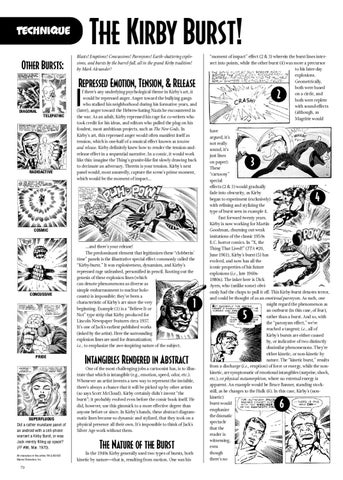
The Kirby Burst!
Technique
Other Bursts:
Blasts! Eruptions! Concussions! Paroxysms! Earth-shattering explosions, and bursts by the barrel-full, all in the grand Kirby tradition! by Mark Alexander!
Repressed Emotion, Tension, & Release f there’s any underlying psychological theme in Kirby’s art, it would be repressed anger. Anger toward the bullying gangs who stalked his neighborhood during his formative years, and (later), anger toward the Hebrew-hating Nazis he encountered in the war. As an adult, Kirby repressed his rage for co-writers who took credit for his ideas, and editors who pulled the plug on his fondest, most ambitious projects, such as The New Gods. In Kirby’s art, this repressed anger would often manifest itself as tension, which is one-half of a musical effect known as tension and release. Kirby definitely knew how to render the tension-andrelease effect in a sequential narrative. In a comic, it would work like this: imagine the Thing’s granite-like fist slowly drawing back to decimate an adversary. Therein is your tension. Kirby’s next panel would, most assuredly, capture the scene’s prime moment, which would be the moment of impact...
I DIAGONAL TELEPATHIC
RADIOACTIVE
“moment of impact” effect (2 & 3) wherein the burst lines intersect into points, while the other burst (4) was more a precursor to his later-day explosions. Geometrically, both were based on a circle, and both were replete with sound-effects (although, as Magritte would
2
have argued, it’s not really sound, it’s just lines on paper). These “cartoony” special effects (2 & 3) would gradually fade into obscurity, as Kirby began to experiment (exclusively) with refining and stylizing the type of burst seen in example 4. Fast forward twenty years. Kirby is now working for Martin Goodman, churning out weak imitations of the classic 1950s E.C. horror comics. In “X, the Thing That Lived!” (TTA #20, June 1961), Kirby’s burst (5) has evolved, and now has all the iconic properties of his future explosions (i.e., late 1960s1980s). The inker here is Dick Ayers, who (unlike some) obviously had the chops to pull it off. This Kirby-burst denotes terror, and could be thought of as an emotional paroxysm. As such, one might regard the phenomenon as an outburst (in this case, of fear), rather than a burst. And so, with the “paroxysm effect,” we’ve reached a tangent; i.e., all of Kirby’s bursts are either caused by, or indicative of two distinctly dissimilar phenomenons. They’re either kinetic, or non-kinetic by nature. The “kinetic burst,” results from a discharge (i.e., eruption) of force or energy, while the nonkinetic, are symptomatic of emotional intangibles (surprise, shock, etc.), or physical metamorphism, where no external energy is apparent. An example would be Bruce Banner, standing stockstill, as he changes to the Hulk (6). In this case, Kirby’s (nonkinetic) burst would emphasize the dramatic spectacle that the reader is witnessing, even though there’s no
3
4
COSMIC
CONCUSSIVE
...and there’s your release! The predominant element that legitimizes these “clobberin’ time” panels is the illustrative special effect commonly called the “Kirby-burst.” It was explosiveness, dynamism, and Kirby’s repressed rage unleashed, personified in pencil. Rooting out the genesis of these explosion lines (which can denote phenomenons as diverse as simple embarrassment to nuclear holocausts) is impossible; they’ve been a characteristic of Kirby’s art since the very beginning. Example (1) is a “Believe It or Not” type strip that Kirby produced for Lincoln Newspaper Features circa 1937. It’s one of Jack’s earliest published works (inked by the artist). Here the surrounding explosion lines are used for dramatization; i.e., to emphasize the awe-inspiring nature of the subject.
1
PRIDE
SUPERFLUOUS Did a rather mundane panel of an android with a cell-phone warrant a Kirby Burst, or was Jack merely filling up space? (FF #96, Mar. 1970). All characters in this article TM & ©2003 Marvel Characters, Inc.
70
Intangibles Rendered in Abstract One of the most challenging jobs a cartoonist has, is to illustrate that which is intangible (e.g., emotion, speed, odor, etc.). Whenever an artist invents a new way to represent the invisible, there’s always a chance that it will be picked up by other artists (so says Scott McCloud). Kirby certainly didn’t invent “the burst”; it probably evolved even before the comic book itself. He did, however, use this gimmick to a more effective degree than anyone before or since. In Kirby’s hands, these abstract diagrammatic lines became so dynamic and stylized, that they took on a physical presence all their own. It’s impossible to think of Jack’s Silver Age work without them.
The Nature of the Burst In the 1940s Kirby generally used two types of bursts, both kinetic by nature—that is, resulting from motion. One was his
5
6
Technique
The Evolution of the Human by Will Murray ne of the most fascinating aspects of Jack Kirby’s Fantastic Four is the evolution of the Thing over the course of the series’ early years. He goes from a shapeless brown blob to the chiseled rocky heroic Thing we know and love. This is an amazing example of how one artist can take a crude character conception and transform it into something unique and wonderful. I was as surprised as anyone when I saw in The Jack Kirby Collector #33 that Kirby had been drawing the rocky Thing as early as FF #15 (pencils shown below)— and crestfallen. I’ve long been a big fan of the “cobblestone” version of Ben Grimm as inked by Dick Ayers. The natural evolution of the 1961-66 Thing turns out to be really a tug of war between penciler and inker. Curious, I began paging backwards in search of a clue to the earliest hints of a rocky pure Kirby Thing. I found one in an expected place, and thereby made an equally unexpected discovery. Although not as granite-like as he later became, Ben Grimm’s face on the cover of FF #7 (left) shows clearly that Kirby was moving in this direction during the book’s first year. This discovery made me look at the cover to #8 more closely than I ever had. I’d always assumed this to be an Ayers ink job. On closer inspection, it clearly wasn’t; but who? It wasn’t Sinnott, or Ditko, or any of the usual suspects. Examining Sue Storm’s face, I was somehow reminded of Roz Kirby. Then it hit me: Jack Kirby himself inked this cover! You can even see a little of Jack’s face in Reed’s. I gave Mark Evanier a quick call, and he subsequently concurred with my supposition. Now I can’t pretend to intuit why or when Jack moved towards the quintessential Thing, but I can theorize. First, the creation of the Hulk might have prompted Jack to look for ways to more strongly differentiate the looks of Marvel’s two colorful man-monsters—especially if they were ever to meet, which they later did numerous times. Secondly, FF #8 follows by only a month Thor’s debut in Journey Into Mystery #83, in which the
O
(above) The Golden Age Human Torch by Carl Burgos (throwing the fireball), and Kirby’s (or Brodsky’s) version from the cover of FF #3. (below) Jack’s Torch from FF #1. (bottom, center) Kirby Thing sketch for Jerry Bails, dated July 20, 1962. Characters TM & ©2003 Marvel Characters, Inc.
72
Thunder God battles the Stone Men from Saturn. In this Sinnott-inked origin, the Stone Men display Thing-like plates. In a recap in the next issue, Ayers renders them as the Cobblestone Men from Saturn—further proof of Ayers’ smoothing of the Kirby Thing. This is pure speculation, but I wonder if Kirby borrowed the Stone Men’s more rugged look for his evolving Thing, who had more of a dinosaur or crocodile skin in his earliest appearances. To give credit where credit is due, the pile-of-rocks Thing treatment ultimately debuted thanks to George Roussos, who first inked him that way on to cover to FF #18 (left), the first Super-Skrull story. In the next issue, Roussos took over as story inker and the reign of the rocky Thing truly began. In our fascination with Ben Grimm’s evolution, it’s easy to forget that Johnny Storm also transmuted. As Kirby drew him in Fantastic Four #1, the Human Torch was an uncontrolled mass of furious flames in the rough semblance of a man. He looked nothing like the Timely Human Torch, and he was a far cry from the sleek Torch Kirby would later make famous. He might as well have been dubbed the Human Bonfire. Now I don’t know the reasons for this reinterpretation of the Torch. The simplest explanation was the Jack Kirby wanted to present his own take on the time-honored character; but there is evidence that this was not a Kirby idea, but Stan Lee’s approach. Script pages to Fantastic Four #1 reprinted in TJKC #33 clearly quote Lee as admonishing Kirby not to have his Torch throw fireballs or burn anyone because of Comics Code objections. This is why in the first few issues the Torch merely uses his flaming presence to frighten off various monsters and villains. I can only speculate if Lee wanted to avoid any resemblance to the old Torch, or if Kirby preferred to place his own stamp on the new version. If anything, Kirby’s Torch looked more fiery and dangerous than the more restrained Torch of old. Perhaps Lee was copying the formula of the updatings of the Flash and Green Lantern over at DC. Same name, similar powers, but a new look. If the plan was to drop a new version of Captain America into the FF, this strategy would make sense; but how many ways are there to draw a flaming human being? Thus, for the first two issues of Fantastic Four, Johnny Storm is clearly a Jack Kirby Torch. In his way, the Torch is as crude and misshapen a monster as the early Thing. In fact, Kirby clearly reached into his personal bag of tricks to create his Torch. Specifically, he based him on the fiery alien from Strange Tales #76 (Aug. 1960, shown above) called Dragoom, the Flaming Invader. With the issue #3, the Miracle Man
Parting Shot
Sometime in the early 1980s, Jack’s work in animation led him to produce a series of presentation boards for a proposed Wonder Woman cartoon. It never got off the ground, but not for lack of some nice work by Jack! Here’s two of the boards he produced, still in pencil. Wonder Woman TM & ©2003 DC Comics.
IF YOU ENJOYED THIS PREVIEW, CLICK THE LINK TO ORDER THIS ISSUE IN PRINT OR DIGITAL FORMAT!
KIRBY COLLECTOR #38 “HOW TO DRAW COMICS THE KIRBY WAY!” PART 2: JOE SINNOTT on how he inks Jack’s work, HUGE PENCIL GALLERY, list of the art in the KIRBY ARCHIVES, MARK EVANIER, special sections on Jack’s technique and influences, SPEND A DAY WITH KIRBY (with JACK DAVIS, GULACY, HERNANDEZ BROS., and RUDE) and more! Two UNPUBLISHED KIRBY COVERS! (84-page tabloid magazine) $9.95 abloid magazine) $9.95 (Digital edition) $3.95 http://twomorrows.com/index.php?main_page=product_info&cPath=98_57&products_id=463
80