Fully Authorized By The Kirby Estate
T
H
$5.95
E
In The US
CELEBRATING THE LIFE & CAREER OF THE KING!
A “King”-Size 68-page ISSUE on JAck’s work at DC CO MICS!!
Issue #17, Nov. 1997
C
o
l
l
e
c
t
o
r
A Rare 1971
Kirby Interview Neal Adams Greg Theakston D. Bruce Berry 1997 Kirby Tribute Panel, Featuring
Mark Evanier Steve Sherman Mike Royer Marie Severin Al Williamson Special Features:
Fourth World, Kamandi, Manhunter, Challengers, Green Arrow, Sandman & More Unpublished Art including Pencil pages Befo re They Were Inked, And Much Mo re!!
1996 & 1997 Eisner Awards Nominee Best Comics-Related Publication
1997 Harve y Awards Nominee Best Biographical, Historical or Journalistic Presentation
Kamandi and Mr. Sacker © DC Comics, Inc.
Interviews With
Issue #17 Contents: Kirby Was Here . . . . . . . . . . . . . . . . . . .4 (Jack left his mark at DC in the 1970s) From The Words & Pictures Museum . .7 (art from their permanent collection) Simon & Kirby’s Sandman . . . . . . . . .8 (a pair of Sandmen by Joe & Jack) The “Marvel”-ous Challengers . . . . .12 (forerunners to the Fantastic Four?) Challengers Checklist . . . . . . . . . . . . .13 (easy-to-find reprints abound) Challenging The Unknown . . . . . . . .14 (an in-depth analysis of the Challs) Jack Kirby’s Train of Thought . . . . . .17 (a rare 1971 interview with Jack, done just after launching the Fourth World)
Handwritten on the back of this Kamandi drawing were the words “The Real Mr. Sacker.” Our thanks to Mike Royer for taking time to ink this issue’s cover.
Mike’s selling his inked art to this issue’s cover for $700; contact TJKC if you’re interested.
Inking Contest! . . . . . . . . . . . . . . . . . .21 (the deadline’s January 1st, so enter now!) The Fourth World & Beyond . . . . . .22 (some minority opinions on Jack’s epic) Favorite Fourth World Stories . . . . .24 (you’ll love these very unique choices!) A King For A Queen . . . . . . . . . . . . . .26 (Jack’s Green Arrow was on-target) Greg Theakston Interview . . . . . . . .27 (a candid conversation) Centerfold: New Gods #10 cover . . . .34 D. Bruce Berry Speaks . . . . . . . . . . . .36 (a talk with the ’70s Kirby inker) Kamandi’s Origins . . . . . . . . . . . . . . .38 (he dates back to the 1950s) 1997 Kirby Tribute Panel . . . . . . . . .40 (with Marie Severin, Al Williamson, Mike Royer, Mark Evanier, and Steve Sherman) Jack Kirby’s X-Files . . . . . . . . . . . . . . .48 (tracking Jack’s production numbers at DC can be very revealing) On The Trail of Manhunter . . . . . . .53 (he’s not that hard to find in reprints) Neal Adams Interview . . . . . . . . . . . .54 (a realistic account of 1970s DC) Collector Comments . . . . . . . . . . . . .64 Late Breaking News! . . . . . . . . . . . . . .65 Front cover inks: Mike Royer Back cover inks: Steve Rude Cover color: Tom Ziuko COPYRIGHTS: Atlas, Batman, Ben Boxer, Big Barda, Brute, Challengers of the Unknown, Darkseid, Deadman, Demon, Desaad, Dingbats of Danger Street, Dr. Canus, Female Furies, Forager, Forever People, General Electric, Glob, Golden Age Sandman, Green Arrow, Guardian, Hunger Dogs, In The Days Of The Mob, Jed, Jimmy Olsen, Justice League, Justice Society, Kalibak, Kamandi, Kanto, Lightray, Losers, Manhunter, Mantis, Mountain of Judgment, Mr. Miracle, Mr. Sacker, Newsboy Legion, Oberon, OMAC, Orion, Sandman, Sandy, Scrapper, Soul Love, Speedy, Sultin, Superman, Tiko, Ultivac, Witchboy, Wonder Woman © DC Comics, Inc. • Captain America, Ikaris, Iron Man, Silver Surfer, Thing, Thor, Vision © Marvel Entertainment, Inc. • Kamandi of the Caves and Surf Hunter © Jack Kirby • The Last Enemy © Harvey Publications.
The Jack Kirby Collector, Vol. 4, No. 17, Nov. 1997. Published bi-monthly by & © TwoMorrows Advertising & Design, 1812 Park Drive, Raleigh, NC 27605, USA. 919-833-8092. John Morrow, Editor. Pamela Morrow, Asst. Editor. Jon B. Cooke, Assoc. Editor. Single issues: $4.95 ($5.40 Canada, $7.40 elsewhere). Six-issue subscriptions: $24.00 US, $32.00 Canada and Mexico, $44.00 outside North America. First printing. All characters are © their respective companies. All artwork is © Jack Kirby unless otherwise noted. All editorial matter is © the respective authors. PRINTED IN CANADA.
3
newly-debuted Swamp Thing, and Kirby was pressed into service with his Demon. Eschewing gore and guts, Kirby headed for the mythology of ancient Europe. Etrigan the Demon was Merlin’s (of King Arthur’s court) pit bull and was given an alter ego in Jason Blood, the immortal occultist. In contrast to Alan Moore’s poetic Demon (from Moore’s later run on Swamp Thing), Kirby’s Etrigan was somewhat less verbose. Kirby’s Demon rarely spouted lines more poetic than “Die! Die!” while pummeling his foes into the ground with tree trunks and boulders. Kirby also harkened back to the horrors of the Golden Age of cinema, retooling ghoulies like Frankenstein, The Werewolf and The Phantom of the Opera. However, Kirby’s style seemed ill-matched to these occult adventures. His heroic proportions and minimalist drawing style did not evoke the mood that pen and ink stylists like Wrightson and Tom Sutton specialized in. Royer’s line was uncommonly sensitive and light-handed on The Demon, but even that couldn’t save it from the axe. Kirby’s other post-Fourth World creation, Kamandi, was criticized by many fans for being a carbon copy of Planet of the Apes. There is certainly some truth to this accusation. DC was unable to secure the rights for the Planet of the Apes comics, so Kirby was enlisted to do a book that would vie for its audience. Kirby revived a name from a failed comic strip pitch from the late ’50s and Kamandi was born – but Kirby being Kirby, Kamandi took the premise of the Apes films and ran for the end zone, through the stands, out the stadium door and down the Interstate. Kamandi was a rocket ride of near-hallucinogenic fervor. Every conceivable form of wildlife had sentience and speech in Kamandi.
Kirby Was Here by Chris Knowles s bad as the mid-’70s were for the comic book industry, they were worse for Jack Kirby. Lured by promises of artistic and editorial control, Jack jumped ship to DC Comics and found himself working for people who neither liked nor understood his work. In five short years, Jack went from being the single most celebrated creator in the comics field to a perceived has-been, doing journeyman penciling in the service of less-celebrated writers and editors. Much has been written about the cancellation of the Fourth World books that Jack Kirby created for DC Comics in the early ’70s. After signing a lucrative contract to develop new characters, Kirby soon found himself having to do the work he intended for others. Initial successes for his New Gods family of books resulted in inflated print runs, and once sales fell beneath expectations, DC killed New Gods and Forever People. Despite the crushing humiliation Kirby felt, he soldiered on with two new series, The Demon and Kamandi. He also continued to work on Mister Miracle, the last remaining series in the Fourth World troika. A sick and dying legacy of the Fourth World, Mister Miracle was allowed to limp to its 18th issue and then was mercifully euthanized. It seemed as if all the spirit of the Fourth World had left Kirby with the cancellation of New Gods. Mister Miracle seemed carelessly written and drawn in its death march, finally ending with issue #18, which featured cameo appearances by most of the Fourth World cast. The Demon was clearly intended to cash in on the resurgent horror genre of the early ’70s. Viet Nam and the other convulsions of the ’60s had given America a dose of all-too-real horror, and by the ’70s, these ruptures in the nation’s psyche were being channeled into over-the-top escapist fare. The Hammer horror films were revived at drive-ins and midnight movies; rock bands such as KISS and Alice Cooper – who traded in Grand Guignol imagery – were wildly popular, and such grisly fare as The Last House on the Left and The Texas Chainsaw Massacre were scarring young minds across the country. Predictably, the comics field dove into the gore sweepstakes, and such books as Marvel’s Werewolf by Night, Tomb of Dracula, and Tales of the Zombie hit the stands, along with the constant stream of blood and guts from the Warren books and other, more downscale publishers. DC had its long-running mystery anthologies and the
A
Unused cover to Demon #15. 4
Golden Age Adventure With S&K’s Sandman by R. J. Vitone efore Jack Kirby had even met Joe Simon, The Sandman was a star in the comics. An early entry in DC’s attempts to duplicate the success of Superman and Batman, he arrived full-blown as the cover feature of Adventure Comics #40 (July 1939). The original concept was trite even then: A bored, wealthy playboy seeks anonymous thrills disguised as the dashing Sandman. The trappings are familiar as well: A baggy business suit, slouch hat, cape, gas gun, and scuba-style mask made up the working clothes of the first Sandman. Credited to writer Gardner Fox and drawn by Bert Christman, the strip lived up to the comic’s name: Adventure, as the Sandman ranged the world as a mysterious troubleshooter. Although competent and entertaining for its time, the strip must not have generated much response from the readers. Christman left the series (reportedly to join the Air Force in search of his own excitement) and DC artists such as Craig Flessel, Gill Fox, and Paul Norris took over. Although Sandman rated highly enough to appear in World’s Fair/World’s Finest and to sit at the fabled Justice Society table starting in All-Star #1, clearly he was falling, not rising in rank. The Hourman debuted in Adventure #48, bumping Sandman off the cover. The Manhunter jumped on with issue #58. Starman was added in #61 and finally the Shining Knight rounded out the cast in #66. Adventure became crowded with heroes fighting for space, and Sandman moved to the back of the book. Something had to be done! Joe Simon must have had the same thought, but over a different matter. Working at Timely Comics with his partner Jack Kirby on the immensely-popular Captain America had become a losing proposition. Money poured into the publisher’s coffers, who in turn squeezed just a trickle into S&K’s hands. Using the clout of Cap’s popularity, Jack and Joe met with the “big men” at DC. As recounted in Simon’s memoirs, The Comic Book Makers, a deal was quickly struck and ironed out. The team would work at the most successful publisher of the Golden Age. They would continue to produce work at Timely while developing new concepts. This stressful situation ended when a furious Martin Goodman (Timely’s publisher) found out about the deal, and fired them. Just as they had left Blue Bolt to work on Captain America, S&K were faced with a fresh start at a new home base. Sandman would be their first assignment. In a 1983 interview, Jack was asked if revamping the established hero
was his idea. “Yes,” Kirby replied. “I felt that each man has a right to innovate and to guess at what the A Kirby fan drawing character really represents, and done during WWII. the Sandman would repre(below) A Simon drawing sent something entirely done around the same time. different to me than he would to another guy. To me he represented something entirely different, and I’d get him into dreams and nightmares, and to me that’s what he meant.” So the stage was set. Sandman was ready for his new creative team – but first some changes were in order. Adventure #69 (Dec. ’41) pits Wes Dodds (wearing a new “superhero” costume) against giant insects. He also gains a new partner, Sandy, who “likes to pretend he’s Sandman.” The boy is drawn in a 1941 Bob Kane/Jerry Robinson style (Batman #8 is advertised in this issue). A story has grown among collectors that Kane had something to do with the “new look” and sidekick. While Sandy sports the “look” of Robin in some panels, in others he and the rest of the art bear little of the Batman look. It seems unlikely that Kane, riding the crest of his comics popularity at the time, would write (or draw) a 3-issue unsigned series of stories. Kane himself (never timid about accepting credit) makes no mention of the Sandman strip in his autobiographical book Batman and Me (Eclipse Books, 1989). Even when commenting on the flood of imitators that followed the introduction of Robin, Kane fails to mention Sandy, but does bring up Bucky (and the Young Allies), Toro, Speedy (from Green Arrow), Dusty (from The Shield), and even Roy, the sidekick of the Wizard. That alone does not mean that he didn’t contribute some of the changes, but it does appear highly unlikely. Adventure #70 and #71 continue in the same vein; standard super-hero hijinks, interchangeable with most other strips of the day. But that day was over! Adventure #72 still cover-featured Starman, but above the title, bold lettering called out “NEW SANDMAN!” What an understatement! A new legend headlined the strip, one that would appear frequently through the S&K run:
B
“There is no land beyond the law, Where tyrants rule with unshakable power. It is a dream from which the evil wake, To face their fate—their terrifying hour...” The Sandman! “The Riddle of the Slave Market” is an unsigned epic that may as well have been in Captain America #11! (In fact, it looks like Timely staffer Syd Shores did some “under-the-table” inks on the story.)
8
Larger panels with explosive fights or important action became more frequent. Kirby’s fabled sense of exaggerated motion almost began to look confined! Other inkers’ (supposedly DC staffers) styles showed up, signaling a decrease in S&K input in the months to come. “Dreams of Doom” in Adventure #77 added little of merit to the series, but a classic cover team-up of Sandman, Sandy, and Manhunter on Adventure #78 promised a great story. (this page and previous page) Some slam-bang action panels from World’s Finest #6. “The Strange Riddle of the Miracle Included in the package are stylistic flourishes that Jack and Joe had Maker” comes close. The Captain America-style splash takes us to begun to fully develop at Timely: Bold inking to express power; exagfamiliar Kirby territory: A carnival, where Magno the Mystic works his gerated figures bursting out of panels to emphasize speed and motion; wonder, aided by a gang of well-known felons. Sandman cracks the receding backgrounds that thrust the figures in the foreground into the riddle, and Magno, too. reader’s face; dramatic, filmic “under-lighting” of characters to portray Included in Adventure #78 was an ad for World’s Finest #7 evil, greed, or villainy; and of course, round panels spotted on pages, (Fall ’42), featuring the second and final S&K Sandman story in that large 1/4-page panels for wider action, tilted angles, jagged borders, quarterly title (the Boy Commandos would start a run in #8). “A symbolic splashes, and good old knock-down, drag-out fights as only Modern Arabian Nightmare” follows the trail of a priceless, cursed Kirby could visualize. Armed with his “Wire-poon” gun, Sandman is statue of Gori, the Protector of Thieves. Rich collectors die trying to presented as the scourge of evil-doers, so powerful that he haunts their obtain it, and Sandman has to unravel another mystery. (At one point very dreams! Sure enough, nightmares haunt the Slave-Master, and we’re treated to a “cut-away” view of Sandman’s wire-poon gun, comSandman puts his operation to sleep. plete with detailed descriptions. This diagram style would become a A classic Manhunter cover, signed by the team, adorns Adventure recurring Kirby device.) The statue of Gori winds up in a museum #73. The Sandman story, “Bells of Madness,” looks just a bit rushed showcase, and Wes Dodds speaks its epitaph: “Protection for criminals (the inking varies from page to page), but it’s a good melodrama as is a dream that never comes true...” Sandman foils a plot to swindle a girl out of her inheritance (Sandman’s “Footprints in the Sands of Time” (Adventure #79) opens with a new costume finally appears in All-Star #10, advertised in this issue). great splash of Sandman trying to free Sandy from the inside of a Adventure #74 (May ’42) would begin a string of Sandman covers, giant hourglass. (Jack must have liked the idea. The hourglass shows reflecting his “star” status. He would be featured on every cover (but up on issue #81’s cover.) Also shown in the splash is a green-skinned one) through the end of the actual Sandman series in #102. The only exception would be another classic Manhunter cover on #79! “The Man Who Knew All The Answers” is another fine entry in the run. Adventure #75, however, is a cornerstone in the Kirby saga. “The Villain from Valhalla” is indeed Thor, the mythical Norse God of Thunder. When he sails into New York harbor aboard an ancient Viking ship loaded with warriors, quite a stir results; but when he cracks a cop’s skull with his magic hammer Mjolnir and proceeds to loot banks, only Sandman and Sandy can save the day! Rallying the dispirited police into a raiding party a near-riot ensues. The “Vikings” turn out to be well-equipped thugs, and a wild free-for-all erupts. An electrifying full-page battle scene is the climax, and the wrap-up shows “Thor” battered and bandaged in the hospital. World’s Finest #6 (Summer ’42) went on sale about the same time as Adventure #75. In it was a great S&K Sandman story, “The Adventure of the Magic Forest,” featuring a vaguely Visionesque green-skinned foe called The Nightshade. His magic forest is crawling with some favorite S&K vegetation: Deadly living weeds! A burst of flame takes care of the threat. “Mr. Noah Raids The Town” (Adventure #76) opens with another nightmare, causing a man to imitate the biblical Noah and to preach destruction to skeptical masses. He seems a harmless crank until a car full of talking animals shows up in town. An ape, a vulture, and a tiger rob the bank, then battle Sandman and Sandy to a standstill. Like the Vikings, the “animals” turn out to be costumed crooks, and Mr. Noah a con man. In an odd twist of fate, the villains are killed by the real animals gathered for the “ark.” The story closes with a blurb for Boy Commandos. By this time, S&K were turning out Sandman and Manhunter for Adventure, Newsboy Legion for Star-Spangled, Boy Commandos for Detective and World’s Finest, and even Sandman chapters for All-Star #1417 and #19. Despite the workload, Jack’s art maintained a high level of quality. Slowly, from this point on, some “shortcuts” crept into the mix. Backgrounds were simplified or eliminated. Seven and eight panels per page became the norm, with more “decorative” round panels included. 9
can be lonely; he has emotions, he can be in love, he can hate people. He hates evil.
Jack Kirby’s Train Of Thought
TOT: That would be the same idea as at Marvel wouldn’t it? You know, that super-heroes have feelings and all that. KIRBY: Yes, but Superman is invincible, and Superman is the first superbeing to come into literary life. There he is alone. That’s the way I see him. If I were a Superman among two billion people, despite the fact that I was a super-being, I’d feel pretty insecure. For instance, say I was a white hunter in Africa and I were to walk into a cannibal village. Despite the fact that I had a gun and they didn’t, despite the fact that I had ammunition and they didn’t, I’d feel pretty insecure, despite the fact that I could probably shoot my way out. Superman is alone in our world.
Excerpts from the Kirby interview in Train Of Thought #5, 1971. (Editor’s Note: This interview was conducted just after Jack launched the Fourth World books, and offers a fascinating glimpse into his thoughts at this early stage of the characters’ development.) JACK KIRBY: The idea of the Anti-Life Equation is that all Darkseid has to do is say a word and you become a slave. That’s what he’s after. He likes that and the fact that he likes that makes him valid, see? Because he exists and his idea exists, so why the hell shouldn’t that be valid? That’s the way Darkseid Pencils to the looks at things, and he’s going cover of Mister to get what he wants in his Miracle #7. own way. He’s very ruthless and he’s very smart.
TOT: What about the other super-people like Supergirl and Kandor? KIRBY: That’s very little help in a world of two, three billion people. If suddenly two, three billion people developed a psychosis – say they felt you were a danger. What if Superman didn’t want to be good? What if Superman wanted to be evil? What if Superman wanted to impose his power on us? That’s the way human beings think. Did you ever feel that although you gave authority to some people they might abuse it? Suppose that someone said that Superman might abuse his powers and have reason to harm us? Suppose you believed him? What would you do? You’d try to kill Superman. That’s what Superman faces. Superman faces three billion inferior people; and not only inferior, but Superman has to make sure they don’t feel insecure about the fact that they’re inferior to him. That’s a Superman’s problem, or else he’d better take off for the moon.
TRAIN OF THOUGHT: Infinity Man seems as powerful as Darkseid, and even a lot more powerful than Superman. KIRBY: No, he’s not as powerful as Darkseid. Well, he has intense power, but Darkseid is, as the story unfolds... I mean, his powers are almost as great as Darkseid’s, but there’s something about Darkseid that is universally overpowering. He is evil itself, or what we consider evil. TOT: Is Infinity Man more powerful than Superman? There’s one scene where those robots pound Superman into the ground (Forever People #1). KIRBY: But remember, they had the strength of entire galaxies; heavy mass galaxies.
TOT: What’s this new change in Superman? Is he going to be weaker than he used to be? KIRBY: No, not weaker, but he’s going to be a real person with super-powers against other people with superpowers. And there’s not only going to be other people with super-powers but ordinary people who, although they don’t have super-powers, may have to make super-efforts. Which I think is a good thing. I think the noblest part of man is the fact that he could transcend himself if he really tried. I mean, man is a very pliable object. It’s been proven that you can put a man in 120 degrees of heat, hold him there for a certain amount of time and this guy – he’s not going to walk out chipper, but he’s going to walk out. Man has been subjected to what they might call ‘killing stress’ and he’s walked out of that. In fact, I underate stress. Man can do something we might consider a super-act. Man can bend steel, and under stress
TOT: But that other guy just sorta tossed them around. KIRBY: Well, Superman might be able to throw him around, but just not as easily as he throws everything else around. Power is relative. TOT: In about three issues of Jimmy Olsen, you’ve changed the entire image of Superman. Are you going to continue to use Superman? KIRBY: Yes I am. Superman will continue as a character in many of these stories. In the first story we thought that it would be important to use him and see how relative he would be to that kind of thing. And Superman is relative. Superman has, despite the fact that he is a superbeing, emotions just like everyone else. He’s not a robot. If I were a super-being, I’d just be a human being with super-powers, which is the way I see Superman. He’s a human being with super-powers and he 17
he might be able to bend some even more intractable object. Man with training can perform super-acts. In other words, man can transcend himself in many ways. You take a man like Leonardo Da Vinci, who transcended the ordinary by so many different accomplishments in so many different fields because he was a curious man who made a superact out of his own curiosity. He was a master painter, a master architect, and I’m not talking about an ordinary mechanic. He was a master at everything he did because he had that transcendent quality of making a super-act of whatever he did, because he had insatiable curiosity. Who is to say that man hasn’t got the power to become a superbeing because we happen to be in a time period where men certainly aren’t super-beings? The possibility exists mentally, physically, and possibly even other ways. We just can’t see right now. So why not ordinary people contending with Superman? That’s what I’ve got in the stories. I’m going to have ordinary people engaged in great efforts that make them more than they are, and super-beings with super-powers deciding that it may be more fun to be a human being. There may come times when it’s wrong to use a super-power, or weak to use a super-power. Darkseid himself – the villain of the piece – at one point decides not to use his power because he’s a professional and he feels that he’s using his powers on a second-rater, and it would demean his own profession to use that power, so Darkseid will not harm him. Darkseid lets his victim go saying that it would denigrate his own abilities to destroy that man. Darkseid, although he’s evil, is too much of an admirer of his own power or his own stature to denigrate himself. He won’t do it.
any shoes and it was 38 degrees below zero and this guy says, “Go out and get me a bologna sandwich,” you have to go through all that; you obey him automatically, you obey him meekly. You walk out without a coat and you freeze to death. He doesn’t care. You do it anyway despite the fact that you don’t want to do it. You’re dead as an individual. You have no choice. You can’t object and you have no stature as a person. You’re dead. A slave is a dead man. That’s what Darkseid wants. Darkseid wants complete subjugation of everything at a word – his word. He wants every thinking thing under his control. I believe it’s an evil concept but he doesn’t think so. Not if he’s Darkseid. If you had the power you might not dislike the idea. Everybody sees the world from where they sit. It may be uncomfortable for the next guy but you think it’s great. The right idea to Darkseid is anything that benefits him. He isn’t going to worry about you. He sees the world from where he sits, and of course what he sees is big. He’s a big man. Darkseid is a tremendous, powerful, evil figure, and he’s going to see everything in a cosmic view. He’s not going to see a view of the candy store around the corner or what’s playing at the Palladium next week. Darkseid is going to see everything in an over-powering cosmic view, and of course what else would he want but complete subjugation of everything? Earth is included in that everything, and my concept is that somewhere on Jack’s character drawing of Darkseid, for the 1980s Super Powers toys.
TOT: It seems like you’ve created another character like Doctor Doom; he’s evil, but he has his own code. KIRBY: Of course. Some of the most virtuous men are murderers by the fact that they stick to their own principles. Hitler was a virtuous man in the context of his own principles. He initiated a pretty dirty hour as far as humanity was concerned, but the idea is that he did it for his own reasons. They were mad reasons, but he felt that he was sticking to his principles. So even an insane man may have an insane code of ethics. Some people will kill for second-rate reasons and that makes their act even more monstrous. The fact that a man will kill for a little money or kill for unnecessary reasons as the thrill of it might be looked down upon by a professional killer. He wouldn’t kill for a few dollars or for the thrill of it. The professional murderer would kill for good money and good reasons and he would consider himself a craftsman. As Darkseid does. Darkseid is very evil. He’s the equivalent of a mass murderer, but he wouldn’t waste his super-powers on just one individual. He wouldn’t go out of his way just to kill one man; it would be ridiculous. He wouldn’t do it. He’d just walk away. That’s how my villains think. TOT: Why is Earth so important to him? KIRBY: Because Earth becomes a testing ground. This is where we have thinking animals, and there’s the principle of Anti-Life. If someone took control of your mind and you were not able to think as yourself any longer, you would no longer be yourself. You’d be something in his command. You as an individual would be dead. That’s Anti-Life. In other words, if you gave yourself to some cause, and gave up everything as an individual and you were at the beck and call of some leader, you would be dead as an individual. And that’s what Darkseid wants. He wants control of everybody. If it was snowing outside and you weren’t wearing 18
The Fourth World (And Beyond): Some Minority Opinions by Adam McGovern ack Kirby’s Fourth World series, and much of what came after, were sweeping sagas which can prompt a variety of readings. Mine may contrast with some which have long been held, but the essence of Kirby was to look at familiar ideas in different ways.
J
him to be second only to George Clinton, among ’70s artistic figures, in his keen ear for social psycho-babble. But Kirby’s insight goes way beyond the fact that Darth Vader is identical to Doctor Doom and “The Force” is “The Source” and the Death Star looks like Kamandi’s Tracking Site and the entire end sequence of Close Encounters is lifted directly from the coming of the Celestials in Eternals #2, and so on. What interests me most is not Kirby’s pop-culture contributions, but his social predictions. The idea of swapping children between New Genesis and Apokolips to suspend their cosmic conflict would be seriously proposed by peace advocates for the rival US and Soviet union in the mid-’80s. The New Gods’ practice of patching into the spirits of their ancestors with what would one day be familiar as hand-held computers accurately anticipated both the electronic toys and the new-age mysticism of our own decade. The high-tech Hairies indeed find their match in Jaron Lanier (“The
TheFor oneAsgardian Connection thing, to conclusively view the New Gods as heirs to the Aesir, even if that’s what Kirby intended in a strictly narrative sense, is to impoverish the full scope of his vision in creating the series. First of all, many old sources and new inventions converged in these characters’ formation. Their unspecific familiarity is just what gave them resonance, and helped make Kirby one of the few artists to successfully create modern myths for an age without mysteries. Second, the series had just as many roots in the Jewish experience (a legacy which both Kirby and I share, behind our Irish-sounding names) as in Norse tradition. Apokolips’ ideology resembles a triumphant Third Reich, and its visual presentation is unmistakable as a planet-wide concentration camp. Much of New Genesis’ names (Isaiah, Esak) and imagery (Highfather’s patriarchal raiment), its codes of vengeance and inherited burden, its times to love and times to kill (the pacifist Lightray’s transformation into a kind of warrior, and Isaiah/Highfather’s opposite course), its characters’ reliance on prophecy, are straight from the Old Testament and other Jewish lore. Interestingly, this specific reference makes the series more universal, in that the living religions of Judeo-Christianity are open to more interpretations than the closed circle of Norse myth.
Kirby’s Crystal Ball Surely Kirby’s foresight about his medium cannot be over-emphasized. This would not be the first essay to note the Fourth World’s introduction of such then-unappreciated but now-commonplace concepts as limited-run series and overlapping narratives in simultaneous publications – not to mention Kirby’s rejected plans to present the saga as a series of what would much later be known and embraced as “graphic novels.” The King was equally perceptive of current events, from his early assimilation of countercultural motifs (The Forever People, Jimmy Olsen’s “Hairies”) to his exploration of late-’70s millennial anxiety in The Eternals, to his astute and witty wordplay: Delicious puns and non-sequiturs like “Boom Tube” and “Fourth World” itself show
Steve Rude inked this piece for the deluxe hardcover collection of History Of The DC Universe. 22
Greg Theakston Interview Interviewed by John Morrow (Greg Theakston was born November 21, 1953 in Detroit, Michigan. Besides inking a number of Jack’s final comics stories, Greg founded Pure Imagination, publishing a numerous books on Jack and other comics artists. He also developed his Theakstonizing process, which bleaches color from published comics pages, leaving only the black line art for use in reprinting classic strip art. Pure Imagination has recently released the first volume of The Complete Jack Kirby, an ongoing project that will ultimately reprint thousands of pages of Jack’s work. This interview was conducted by phone on August 28, 1997 – Jack’s birthday.)
of the Simon & Kirby house style than any of Jack’s later inkers. GREG: Joe Simon once looked over my inking and said, “Where were you in 1948?” (laughter) I was very flatGreg with Jack at the San Diego Comic Con. tered. If I tend to emulate the Simon & Kirby period, it’s because I’m really trying to ink the way Kirby inks his own stuff. By studying his old comics, I’ve kind of figured out how Jack likes to ink his own stuff, and I use that as my touchstone. But there’s a huge chunk of Wally Wood in there, as well as Joe Sinnott and Frank Giacoia.
THE JACK KIRBY COLLECTOR: Did you grow up on Jack’s work? GREG THEAKSTON: Yes, my older brother Pat would scout down great stuff and introduce me to it – including Jack Kirby comics, among other things. He brought home the Green Arrow appearances in World’s Finest and Adventure, Harvey’s Amazing Adventures, Black Cat Mystery, Double Life of Private Strong and the first couple of issues of The Fly as well. TJKC: So you grew up on Jack’s solo work more than on Simon & Kirby? GREG: Yes, basically it was after they’d separated. Challengers of the Unknown was another good one. Jack’s style was so potent that you could tell his work from company to company, even though you didn’t know who the artist was. It wasn’t long before my brother started bringing home the Marvel monster books, which cleared up the mystery.
TJKC: What’s the Kirby work you were most impressed with? GREG: As a kid, the Fantastic Four was my favorite. It was a really good time to read comics. There was just no doubt that Kirby was the king. TJKC: How do you think the 1960s Marvel books hold up now, with a little hindsight? GREG: I still find them terrifically entertaining; very, very formulaic. One of the reasons they went over so well was the colorful villains and the bizarre set-ups. Lots of that’s due to the Ditko and Kirby influence in the work.
TJKC: I’ve always felt your inking style was more reminiscent
TJKC: When did you first meet Jack? GREG: I’d been interviewing Kirby since around 1970 and finally got to meet him in 1971 in New York at one of the Seuling comic conventions. Roz, Jack, the kids and I went across the street to Howard Johnson’s and had some chocolate sundaes, which Kirby always dug. (laughter) I was in awe! I was 16 or 17, and it was pretty mind-boggling.
Greg’s inks on this unused Kamandi #1 cover; the pencils are reproduced elsewhere in this issue. 27
TJKC: How did you first get into comics? GREG: My history goes back to 1969. There was an organized fandom in Detroit where I lived. It was a terrific place to be interested in comics, because Jerry Bails was there, and Shel Dorf was living in the city at the time. Shel did the first Detroit Triple Fan Fair comics con, and I worked on them for years; ultimately I ended up owning the show. In 1969 I published my own fanzine, the Aardvark Annual #1, which had an interview with Stan Lee – it was hot stuff for that period. (laughter) I printed it in the laundry room of our house on a mimeograph. There were probably 25 copies of this six-page fanzine. But it brought me to the attention of the founders of FFCG (Fantasy Fans and Comic Collectors Group) in Detroit. The FFCG had planned to do a book on Jack Kirby, and I had been accumulating a checklist of his material. I’d spoken to Kirby, so it became my project for the club. I spoke to Steranko at a 1970 convention, and invited him to write something for our book. Jim was thinking about doing his own book on Kirby, and he said, “Work with me, and I’ll absorb what-
ever you guys have done so far, and I’ll publish the book.” So I pitched my efforts in with him. We got to know each other better and he invited me to come to Reading, Pennsylvania to help him found SuperGraphics. I graduated high school in June of 1971, and eight weeks later I was helping Jim refurbish a three-story row house, and helping him move into his new building. Ken Bruzenak moved in after I got there. I spent a hot August steaming all of the wallpaper off every room in the house on all three floors. (laughter) The deal was, if we worked for him during the day, he’d give us art lessons and room and board. He would give us comics theory and make us practice in the evening hours. It was kind of like a school and a boarding house. Steranko had just quit Marvel Comics, and his new company SuperGraphics was getting a lot of attention. It was a very exciting place to be. I learned an awful lot about how to treat employees, a healthy approach to your work, and what you should and shouldn’t allow companies to do to you. Jim was and still is a very dynamic individual, and was my mentor for a long time. I stayed with Steranko from August 1971 to Ash Wednesday of 1972. After that, I went back to Detroit, and this new kid named Jim Starlin was looking for someone to ink his samples. He didn’t ink, so I inked four pin-ups for him, and it helped him get work in the comics.
said, “I want to do a checklist on you, and run some of your more interesting art.” It never got past Ellie, who had just cut a deal with Ballantine for the big full-color Frazetta books that reprinted all of his paintings. She said, “Unless you’ve got $30,000, we’re not interested in talking to you.” So being a couple of young bucks who should’ve known better, we said, “Screw this. Most of this stuff is public domain anyway.” A few years before, I had called Frazetta up and invited him to come to the Triple Fan Fair. He declined, but the calls turned into these long interview discussions. I had an interview and a checklist and public domain art, so I printed it. It’s unfortunate, because I admire the man and his work. I’m sorry something I did so long ago set this path of Frazetta being angry at me for years. The same thing happened on a book on Wally Wood. I was under the impression that Wood didn’t care. I said, “Do you want to do a book together?” He said, “No, I’ve got my own projects. Do whatever you want to do.” I took that as a signal to do it, and the next thing I know, Wood’s pissed off that I’d done a fanzine on him. On the other hand, I did the Neal Adams Treasury Vol. 1 and 2. Neal and I worked very well together, and it made a lot of money for the two of us. Then I published some more Frazetta in The Comic Strip Frazetta, and a White Indian reprint. I printed the Stuntman book, Buried Treasures #1-3, The Betty Pages, and others.
TJKC: Did you ever try to break in at Marvel? GREG: By high school, I was interested in working at Marvel, and Frank TJKC: Did you have plans to do more Giacoia was the art director in the early than one volume of Stuntman? 1970s. I had sent a bunch of inking GREG: Sure, but it didn’t sell very well. samples in, and Giacoia wrote back and Once I split the pie three ways with said, “As soon as you’re out of high Jack and Joe, what was $2400 became school, come to New York and you’ll be $800 for each of us. It was a lot of work working for Marvel Comics.” This was for $800. I’d planned to do a comic at a time when breaking into Marvel book called The Simon & Kirby Reader, was a difficult thing to do. Giacoia was reprinting old classics. It too fell to a willing to train me, but he left and John mediocre reception. The market was Romita took over. too glutted with product for it to make A guy named Al Hewetson left an impression. Jack’s note to Greg read: “I’m still a bit vague on Marvel around then, and as a going-away Green Arrow’s hat. If you could help further, please do.” TJKC: Why was there such a big time gift, John Romita did a drawing of Mary lapse between The Jack Kirby Treasurys? Jane with nothing on. We called up Romita and said, “Hewetson sold GREG: I was pursuing my career as an illustrator, so that put the prous a bunch of stuff, including the nude. Can we print it?” He said, ject on a hobby level. As you know, producing a research book is an “Absolutely not. Hewetson never should have sold that stuff to you. extremely difficult thing to do. I had certain dissatisfactions with the Send it back to me.” But we’d used FFCG funds to buy this stuff; if first one, and I wanted to make sure the second one did the job. Kirby Romita was pissed off, we wouldn’t print it, but we weren’t going to was gracious enough to do a nice big wrap-around cover. send it back to him. So I never got an inking job for Marvel. TJKC: On the pencils to that cover, there’s a handwritten note (see above) TJKC: At the time you were looking for work at Marvel, Jack was over by Jack saying something like, “I can’t remember Green Arrow’s costume; at DC. How’d you feel about the Fourth World stuff? you figure it out.” Was that pretty common with Jack at that point? GREG: It’s difficult to say, because of Vince Colletta’s inking. It had GREG: It was uncommon for him to leave me a note. The only other structure like the Marvel stuff in terms of the scope of the story, and time was on a page from the Vagabond Prince story in the Stuntman revealing so many new characters at once, but I’d have preferred book. Simon had all the original art except one page, so it seemed like something with single stories that built to make a bigger story. Too a terrific opportunity to reunite Simon and Kirby for one last piece of much too fast; but it was remarkable work. art. So Simon wrote it, Kirby penciled it, and I inked it. There was a TJKC: When did Pure Imagination come into being? panel where the hero is supposed to be jumping over some bushes GREG: Around 1974. The money I made from a 1972 convention paid into a house, and Kirby left it blank and wrote: “Greg, have fun!” my way to New York to try to break into professional illustration. I (laughter) So I had to draw that panel. did men’s magazine illustrations and the occasional commercial art But frequently during Super Powers, Kirby was drawing characters assignment, which didn’t prove particularly profitable. So I moved that he had no empathy for whatsoever. Green Lantern was consistently back to Detroit, and founded Pure Imagination with illustrator Carl wrong. He didn’t memorize the costumes; it was torture for him. At Lundgren. this point in his career, Jack was getting pretty tired of doing comics. He was used to a regimen of single concept illustrations for television TJKC: What were the first things you published? cartoon episodes, done three times up; enormous drawings. He was GREG: We reprinted Frazetta’s Johnny Comet. I had published a book back now to doing six to eight panel comic book pages, with 22-page called The Bernie Wrightson Treasury. We did a pirate book on Frazetta, stories. He swore he would never do a regular comic book again after which sunk my ship with Frank forever. (laughter) I called him up and 28
34
D. Bruce Berry Speaks Conducted by mail in August, 1997 by John Morrow (D. Bruce Berry was born on January 24, 1924 in Oakland, California. After a stint in the Air Force as a sign painter, he went on to a career in advertising art. He got involved in 1960s comics fandom, and went on to ink much of Jack’s 1970s work for DC.) THE JACK KIRBY COLLECTOR: How’d you get started in a career in art, and later in comics? D. BRUCE BERRY: What originally attracted me to artwork was the appearance of Flash Gordon in the early 1930s. As a kid, I had all kinds of daydreams and misconceptions about the cartooning business. There were no comics fan groups in those days. There weren’t even any comic books. There was no way in the world that I could find out what the comics business was really like. However, by drawing my own cartoons, I gradually developed a good artistic ability. After the war, that experience served me well. I have never been to an art school, so that was my only training. With a little searching, I found the only type of art job that was available to me: An advertising agency. I became a merchandise artist, and that was my main profession for the rest of my working life. I was what was known as a “hard-lines artist.” I drew anything that was made of metal: Jewelry, pots and pans, and machinery. You can never get rich at that sort of thing, but it was a steady business. To sum it up, I know more about advertising than I know about the comics business. Shortly after the war, I wandered into a bookstore in Oakland in search of science fiction reading material. That was where I met Richard Kyle. He was the clerk behind the counter. After I visited the store a couple more times, he offered to introduce me to some other people who were interested in science fiction. That was the beginning of a somewhat erratic connection with science fiction fandom. What made it erratic was the fact that I had no idea what the group really was. It was apparently a very serious group that had its origins among Hollywood writers. I did not find that out until twenty years later. It was not actually a ‘fan’ group in the accepted sense of the word; it was a ‘literary’ group. In the 1950s, I moved to Chicago where there was more work in advertising. I teamed up with a freelance art director and worked with him as a oneman studio. I did art, paste-ups, photo-retouching and finished layouts from the art director’s roughs. Around the end of the ’50s I came into contact with one of the last of the old pulp science-fiction magazines. It was called Imagination. I illustrated it for the last year of its existence. It was shortly after the magazine folded that Richard Kyle brought me into contact with comics fandom. I did quite a bit of work for fanzines. However, toward the end of the 1960s the art director I was working with moved to another city. The art business was getting shaky. Photography was beginning to replace line drawings in merchandise promotion. For various other boring reasons, I decided to return to California.
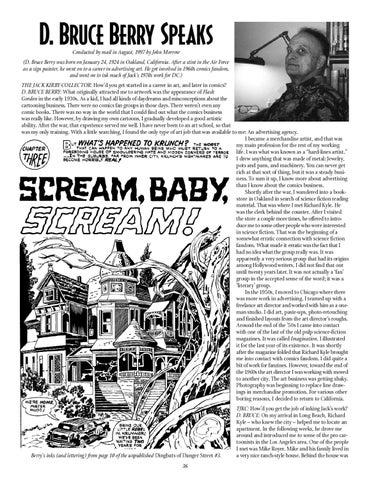
Berry’s inks (and lettering) from page 10 of the unpublished Dingbats of Danger Street #3. 36
TJKC: How’d you get the job of inking Jack’s work? D. BRUCE: On my arrival in Long Beach, Richard Kyle – who knew the city – helped me to locate an apartment. In the following weeks, he drove me around and introduced me to some of the pro cartoonists in the Los Angeles area. One of the people I met was Mike Royer. Mike and his family lived in a very nice ranch-style house. Behind the house was
The 1997 Kirby Tribute Panel featuring (from left to right) Mark Evanier, Mike Royer, Steve Sherman, Marie Severin, and Al Williamson Held at Comic Con International – San Diego on July 19, 1997 Transcribed by John Morrow (Editor’s Note: Due to bad acoustics and problems with the PA system in the hall, large parts of my tape of this panel were inaudible. I’ve transcribed it as close to verbatim as possible, but in some instances I had to fill in stray words that didn’t pick up, while trying not to alter the speaker’s intent. My apologies to our speakers for the sections I had to omit entirely, and particularly to Marie Severin and Al Williamson; most of their comments didn’t pick up on tape.)
That’s all the Kirby news for now, so I want to take this moment to introduce Roz Kirby to you all. (applause)
MARK EVANIER: In the way of announcements, DC is putting out a ROZ KIRBY: Mark, this is my grandson Jeremy. (applause) collected edition of the New Gods. It was supposed to be out next month; MARK: Also, there’s a few other people in the audience. One of my they decided that stark black-&-white looks too unfinished, so they’re favorite things Jack did was a story called “Street Code” for a magazine adding some gray tones to it. That should be out in a couple of months. called Argosy. The publisher who commissioned that work is here; (Editor’s note: It’s rescheduled for December release.) They’re poised and Richard Kyle. (applause) ready if that thing sells at all to do The person I think whose the other Fourth World books A Demon drawing from a 1975 NY convention. association with Jack dates back in that format. That day, Jack would draw any character you the most is Al’s. You had the I’m currently working requested for $20! experience of inking Jack at on a biography of Jack a time when you weren’t which I hope will an inker. approach the word ‘definitive.’ It’s now at AL WILLIAMSON: That’s 120,000 words and still correct. I went up to Harvey growing. I keep finding Publications around 1957, give or things in my files and notes. I take a couple of years. The Editor, came across notations for a Joe Simon, didn’t have any Jimmy Olsen story that was work for me, but he had a never finished. There was a Jack Kirby five-page science sequence of Jimmy Olsen fiction story, and asked if I where Morgan Edge was would like to ink them. They plotting to blow up the inked themselves; I had no Daily Planet building, but problem. I took them in, it never paid off, because they liked them, they gave DC vetoed what Jack origime three or four more, and nally planned to do with it. that was it. I don’t think they So I found this plot, and I were printed right away, because called up Steve Rude and I never saw them until the 1960s. said, “Do you want to draw MARK: You were familiar with it?” He said yes, so we’re Jack’s work already? doing it as a Jimmy Olsen Special next year. A big credit AL: Oh, sure. I lived in South line will go to Jack, and a lot of America, in Bogota, Colombia. the money will go to Roz. (applause) They didn’t do any comic books, Jack’s still got more new comics but they imported a lot of comics from coming out than a lot of people in Argentina and Mexico. The very first Jack Kirby comics. (laughter) DC is hoping to work I ever saw was a black-&-white reprint of release a reprint volume of Jimmy a character called Cosmic Carson, and I Olsen material to coincide with that, thought it was just great, just wonderful. It was so we could have a very Kirbyish year. translated into Spanish. Then I discovered In the meantime, I think we finally American comics, which didn’t get down there have solved the legal problems on the too often, maybe one or two a month. I picked up my first Kirby Tribute Book which has been looming American comic book, which was Famous Funnies, which had a out there for some time. Frank Miller is one-pager called “The Lone Rider.” That was the second strip; I knew now... I’ve done my end of it. From now on, it was the same artist. I discovered two friends who loved comics, and you nag Frank! (laughter) 40
they were visiting from Panama, where they could get American comics much easier. They sent me two comic books: One was an issue of Young Allies. It was just incredible. All I remember about it was a double-page spread of the most exciting, exquisite fight scene I’ve ever seen. I’ve never seen that comic book since; I don’t know if it exists, or if it’s my imagination. If anybody has it, I’d love to see it. Y’know, he just grabs you, right from the beginning. I think he and Wally Wood are probably two of the finest comic book artists that ever lived. Inking his work was quite a thrill for me, because first of all, he was the first artist I ever inked. He did all the work for me; I had no problem at all. I’ve been credited with inking a couple of covers and some jobs that I didn’t ink. The only jobs I ever inked of Jack Kirby’s were those science fiction stories: “The Three Rocketeers.” So my apologies to whoever inked those panels or those covers; they should’ve gotten credit.
MARK: Did you find that anything in Jack’s work applied directly to your own work? AL: He, from what I understand, credits Foster and Raymond as two of the influences he had. The funny thing is, I can see in the early work of Jack’s a little bit of the Alex Raymond; just a little bit, especially the legs. But I have to confess something. Nobody can draw a fight scene like Jack Kirby, and I was stuck for a fight scene one time, and I (whispering) swiped Jack Kirby. (laughter) I did it a little differently, but Jack came to my rescue. I have a feeling about Jack that he never looked back; he always went forward. I’ve found every real, true artist does that: Wally Wood, Alex Raymond, Foster, on to the next one. And Jack just kept going; I don’t think he looked back. He just wanted to do the next drawing. I don’t know how he did it. And prolific; if I lived to be 300, I don’t think I could turn out the work he did in ten years. And it’s all good. The proof of being so good is that, the more you look at it, the better it gets. You don’t see mistakes. It looks better every time. He’s up there with the greats, there’s no question about it. MARK: Marie, when did you first meet Jack? At Marvel? MARIE SEVERIN: Yeah. I’d heard of him, and I’d seen some of his work; wow, this guy was powerful! I’d say it was in 1964. I was in the Bullpen – well, I was the Bullpen – and I came tearing around the corner and I almost banged into him, and Sol Brodsky said, “This is Jack Kirby.” And I said, “Oh, hi!” And he looked at me and said, “Judy Garland!” (laughter) And I was so upset because I always wanted to look like Mary Astor. (laughter) And that’s a far cry from Judy Garland! MARK: That’s the same thing he said to me! (laughter) I was wearing red shoes at the time. MARIE: When I first came there, Stan didn’t even look at my portfolio; he threw me into the Bullpen to do paste-ups. When I started drawing, Stan said, “Get the feel of Kirby.” And maybe, maybe, maybe I could get the feel, but I’ll never draw like that; he’s so powerful! And as a woman, I recognized this tremendous strength – and talk about fight scenes! It was great to color it; I loved coloring the stuff. It brought out emotion. It was like you were part of it. So I finally tried to figure out why he drew it that way, and it came together. I was never skilled enough to draw the anatomy the way he did. People tried to copy him, and it looks awkward to me. He did it and it worked. When he left Marvel, Stan nearly had a heart attack. (laughter) It was supposed to be a big secret. And there was some sort of a convention the day Jack came back, and it was supposed to be an even bigger secret. I came up to the office and I saw Jack, and Stan put a page in front of my face and said, “You did not see any of this!” (laughter) And I said, “Okay, I did not see any of this” and I went out in the hall and yelled, “Kirby’s back!” (laughter) MARK: Mike was reminding us that you had one of Jack’s cigar butts. MARIE: When he left, I put it on my wall. (laughter) I should’ve had it bronzed.
Dingbats #3, page 17. 41
I didn’t know what was going on back in the states with Congress attacking comics and so forth. I just got incidental comics from the Army PX. By that time I had become a Joe Kubert fan. I was a big fan of Tor: 1,000,000 B.C., and 3-D comics. Then they died. When I came back to America I just started in again, and this time I realized that a lot of the guys had disappeared, just gone away. Somehow there weren’t that many comic books out. It started to dawn on me that this was a different time. It was as if only DC comics were available. So with Jack Kirby, what I did – along with all the other kids in America – I would notice that every once in a while Harvey Comics or Archie would come out with a series of super-hero characters that were spearheaded by Jack Kirby and Joe Simon. So I started to realize that this is a guy out there who was trying to make something happen, and I began to recognize this guy from before. I started to follow what Jack was doing – not so much as a fan, I must admit, but more as a person I recognized who was trying to crack the business back open again, though I didn’t quite know why it was closed down. Here was Simon & Kirby going to Harvey comics doing “Space Commandos” or whatever the heck it was called, and then going to this company doing a series of books for them, and then this company, disappearing and reappearing somewhere else. It was fun! Suddenly there would be Jack Kirby, Al Williamson, George Evans – all the old guys being pulled together and trying to make
Neal Adams Interview Interviewed by Jon B. Cooke (Neal Adams is one of the most highly acclaimed artists in the history of comics, inspiring nearly as many imitators as Jack Kirby. Since starting at DC as an artist for Robert Kanigher’s war books, Adams immediately rose to the top and became an instant fan favorite, drawing such classic series as The Spectre, Deadman, and the lauded Green Lantern/Green Arrow. His graphic redefinition of the campy Caped Crusader into The Batman, dark avenger of the night, remains the quintessential version that exists today. Between 1967 and ’72, Adams was the house cover artist, working on – among virtually every other title published by the company – Kirby’s Superman’s Pal, Jimmy Olsen and the occasional Fourth World title. This interview was conducted by phone on September 2 and 3, 1997. Special thanks to Arlen Schumer for facilitating the conversation.) THE JACK KIRBY COLLECTOR: Did you grow up reading Jack’s work? NEAL ADAMS: I guess everyone who read comic books more or less read Jack’s work. I must admit that I wasn’t a Jack Kirby fan as a kid. People seem to think there were the same number of Kirby fans in the ’50s before Marvel as after Marvel, but in general, Jack Kirby worked for the secondary companies. I mean, he did Fighting American and worked for DC at various times, but essentially Jack was put into the same category as guys like Bob Powell – not necessarily the mainstream of comic book guys like Alex Toth, Kubert, and the DC guys. He was sort of a “B” brand. When I grew up, as much as I bought comic books and recognized Kirby’s stuff once in awhile, I really wasn’t a fan. I got to be a fan later on – boy, a big fan when I realized what was under all that! In Jack’s early stuff – and even later on – Jack had a style that was just a little bit crude. He always had people with big teeth, screaming and yelling; drawings that you weren’t used to seeing in the other comic books which were much more sedate, much more heroic and much more pretty-boy. Jack’s stuff came off as a little bit odd. TJKC: Were you into the EC stuff? NEAL: Sure. TJKC: Would you say you were a big comics fan? NEAL: I don’t think so. In those days there were Fan Addicts for EC, but I was just a reader of comic books, a reader of comic strips, and went to the movies. My mother didn’t keep me from comic books, so I guess I was something of a collector, but not a big one. I certainly did read comics. Because of my early interest in art, I tended to keep some comics that were well drawn. I wasn’t looking for the artist necessarily, but I also had favorite comic books. I was a big fan of Supersnipe. And Captain Marvel, Superman, Batman. There’s hardly a comic book you can bring up that I don’t remember reading, because when we were kids we traded comic books. That’s how I got to read all the comic books. Powerhouse Pepper and all these oddball comics were traded back and forth. Even if it wasn’t the greatest comic, we read it. That’s pretty much the way things happened until I was ten or twelve years old. That’s when the sh*t hit the fan in the comic book business, and I went off to Germany as the son of a sergeant in the army.
Neal gives his rendition of some classic Kirby characters in these pencils from Avengers #93. 54
with Wally Wood’s delicate inking with the blacks just knocked me out, blew me away. I guess they just did three or four issues of Challengers, and then they did a comic strip called Sky Masters. It was in a New Jersey newspaper, and I would go down to an out-of-town newsstand and buy it every Sunday just to get that page. TJKC: How did you find out that it was in that paper? NEAL: I scouted around. You find stuff when you’re a teenager. I would haunt these secondhand book stores to buy science fiction books for 10¢. At this point, I was in high school and interested in art, so I was tracking this stuff and looking for what was going on. Mad Magazine was where Wally Wood found a home, and Mort Drucker went there after wasting his time being ignored by DC. Things were starting to happen, but it wasn’t happening very much. TJKC: At this time you were starting to get professional aspirations? NEAL: I was in the School of Industrial Art, now called the School of Art and Design, and I was certainly interested in drawing comic books. But in those days, people who drew comic books really were interested in drawing comic strips. In the ’50s you didn’t draw comics unless you wanted to draw comic strips. That included Jack, Joe Kubert, everybody. The idea was to get a comic strip. So you did comic books in the meantime. From 1953 on, comic books were considered toilet paper, and anyone who was producing them was considered less than human. It was not a good thing to do. This aspect was piled on you when you spoke to people in the business. The best example I can give you is the fact that there is no one in this business that is five years my junior or five years my senior. So really, what I heard was, “Oh, what a terrible place to be,” and people were getting crushed all around. And yet in the middle of it, there was Jack trying new experiments here and there, and then, by golly, he did land a syndicate strip – and thank goodness for the rest of us in comic books that it fell apart!
Another unused Kamandi #1 cover. The blurb in the top left corner would seem to indicate that Jack viewed the term “Fourth World” as a catch-all phrase for all of his new ideas, not just books related to the New Gods. something happen. When I was a later teenager, Joe and Jack did The Fly and the Shield for Archie Comics, which lasted for a certain period of time and then went down the tubes. They were down in the trenches. It would seem that Jack would go to Timely and do work, and later blast out to work with Joe again. At Marvel, Jack would work on the standard Stan Lee five plots: “Mogaam,” “Fin Fang Foom,”... (laughter) One really high point in the ’50s was when Jack went to DC and started to do Challengers of the Unknown. That was probably when Jack Kirby’s artwork really hit me right in the face, big, big, big time. Not so much in the first couple of issues inked by that guy…
TJKC: You actually drew a sample Sky Masters strip. NEAL: I did when I was in high school. I did a Sunday page. I became a fan of the Kirby/Wood combination so that even when I did it, I was doing Wally Wood lines and I was trying to do Kirby drawings. I realize now that I was failing at the Jack Kirby drawings more than the Wally Wood lines. There you go. It’s hard to see past that now. Yeah, I was a big fan of that strip. I don’t know what happened to my collection, but I had every Sunday page until I got out of school.
TJKC: You worked for a syndicate on Bat Masterson and Ben Casey. NEAL: I did backgrounds for a guy named Howard Nostrand on Bat Masterson. Later on, after I had done a whole bunch of stuff – it seemed like an eternity – I landed a comic strip with Jerry Capp, an adaptation of a TV series called Ben Casey, when I was 21. A lot of things happened in-between. I worked over at a place called Johnson & Cushing, a studio that did comics for advertising. Illustrations, comic booklets, all kinds of stuff. I worked 24 hours a day. TJKC: When I was a kid, one of my favorite magazines was Boy’s Life, and I remember a bunch of your half-pages. NEAL: There was a guy named Tom Schauer (who is now Tom Sawyer, head writer for Murder, She Wrote) and he did Chip Martin, College Reporter for Bell Telephone. In the middle of it, he decided to quit, and they looked around for someone else; and of course I was there, big
TJKC: Marvin Stein. NEAL: ...but suddenly his pages would hit me. Now I was a big Wally Wood fan, and Jack inked by Wally just blew everything away. Jack’s perspective, Jack’s attitude towards composition, Jack’s storytelling 55
IF YOU ENJOYED THIS PREVIEW, CLICK THE LINK TO ORDER THIS ISSUE IN PRINT OR DIGITAL FORMAT!
Rare 1971 KIRBY INTERVIEW, interviews with NEAL ADAMS, GREG THEAKSTON, and D. BRUCE BERRY, 1997 Kirby Tribute Panel, featuring MARK EVANIER, STEVE SHERMAN, MIKE ROYER, MARIE SEVERIN, and AL WILLIAMSON, special features on the Fourth World, Kamandi, Manhunter, Challengers, Green Arrow, Sandman, unpublished art, and more! (68-page magazine) $5.95 (Digital edition) $2.95 http://twomorrows.com/index.php?main_page=product_info&cPath=98_57&products_id=291
Mister Miracle, Big Barda, and Oberon © DC Comics, Inc.
KIRBY COLLECTOR #17