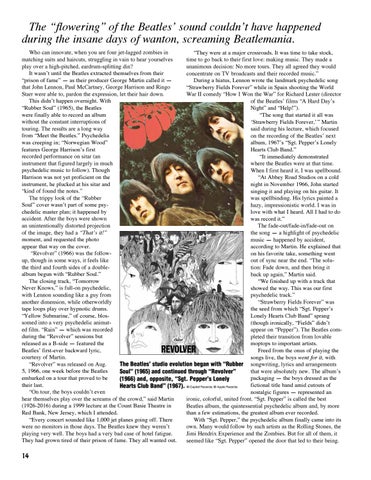
The “flowering” of the Beatles’ sound couldn’t have happened during the insane days of wanton, screaming Beatlemania. Who can innovate, when you are four jet-lagged zombies in “They were at a major crossroads. It was time to take stock, matching suits and haircuts, struggling in vain to hear yourselves time to go back to their first love: making music. They made a play over a high-pitched, eardrum-splitting din? unanimous decision: No more tours. They all agreed they would It wasn’t until the Beatles extracted themselves from their concentrate on TV broadcasts and their recorded music.” “prison of fame” — as their producer George Martin called it — During a hiatus, Lennon wrote the landmark psychedelic song that John Lennon, Paul McCartney, George Harrison and Ringo “Strawberry Fields Forever” while in Spain shooting the World Starr were able to, pardon the expression, let their hair down. War II comedy “How I Won the War” for Richard Lester (director This didn’t happen overnight. With of the Beatles’ films “A Hard Day’s “Rubber Soul” (1965), the Beatles Night” and “Help!”). were finally able to record an album “The song that started it all was without the constant interruptions of ‘Strawberry Fields Forever,’ ” Martin touring. The results are a long way said during his lecture, which focused from “Meet the Beatles.” Psychedelia on the recording of the Beatles’ next was creeping in; “Norwegian Wood” album, 1967’s “Sgt. Pepper’s Lonely features George Harrison’s first Hearts Club Band.” recorded performance on sitar (an “It immediately demonstrated instrument that figured largely in much where the Beatles were at that time. psychedelic music to follow). Though When I first heard it, I was spellbound. Harrison was not yet proficient on the “At Abbey Road Studios on a cold instrument, he plucked at his sitar and night in November 1966, John started “kind of found the notes.” singing it and playing on his guitar. It The trippy look of the “Rubber was spellbinding. His lyrics painted a Soul” cover wasn’t part of some psyhazy, impressionistic world. I was in chedelic master plan; it happened by love with what I heard. All I had to do accident. After the boys were shown was record it.” an unintentionally distorted projection The fade-out/fade-in/fade-out on of the image, they had a “That’s it!” the song — a highlight of psychedelic moment, and requested the photo music — happened by accident, appear that way on the cover. according to Martin. He explained that “Revolver” (1966) was the followon his favorite take, something went up, though in some ways, it feels like out of sync near the end. “The soluthe third and fourth sides of a doubletion: Fade down, and then bring it album begun with “Rubber Soul.” back up again,” Martin said. The closing track, “Tomorrow “We finished up with a track that Never Knows,” is full-on psychedelic, showed the way. This was our first with Lennon sounding like a guy from psychedelic track.” another dimension, while otherworldly “Strawberry Fields Forever” was tape loops play over hypnotic drums. the seed from which “Sgt. Pepper’s “Yellow Submarine,” of course, blosLonely Hearts Club Band” sprang somed into a very psychedelic animat(though ironically, “Fields” didn’t ed film. “Rain” — which was recorded appear on “Pepper”). The Beatles comduring the “Revolver” sessions but pleted their transition from lovable released as a B-side — featured the moptops to important artists. Beatles’ first-ever backward lyric, Freed from the onus of playing the courtesy of Martin. songs live, the boys went for it, with “Revolver” was released on Aug. The Beatles’ studio evolution began with “Rubber songwriting, lyrics and arrangements 5, 1966, one week before the Beatles that were absolutely new. The album’s Soul” (1965) and continued through “Revolver” embarked on a tour that proved to be packaging — the boys dressed as the (1966) and, opposite, “Sgt. Pepper’s Lonely their last. fictional title band amid cutouts of Hearts Club Band” (1967). © Capitol Records; © Apple Records “On tour, the boys couldn’t even nostalgic figures — represented an hear themselves play over the screams of the crowd,” said Martin ironic, colorful, united front. “Sgt. Pepper” is called the best (1926-2016) during a 1999 lecture at the Count Basie Theatre in Beatles album, the quintessential psychedelic album and, by more Red Bank, New Jersey, which I attended. than a few estimations, the greatest album ever recorded. “Every concert sounded like 1,000 jet planes going off. There With “Sgt. Pepper,” the psychedelic album finally came into its were no monitors in those days. The Beatles knew they weren’t own. Many would follow by such artists as the Rolling Stones, the playing very well. The boys had a very bad case of hotel fatigue. Jimi Hendrix Experience and the Zombies. But for all of them, it They had grown tired of their prison of fame. They all wanted out. seemed like “Sgt. Pepper” opened the door that led to their being.
14