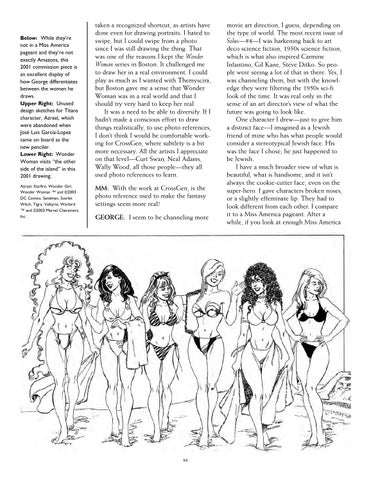
Below: While they’re not in a Miss America pageant and they’re not exactly Amazons, this 2001 commission piece is an excellent display of how George differentiates between the women he draws. Upper Right: Unused design sketches for Titans character, Azrael, which were abandoned when José Luis Garcia-Lopez came on board as the new penciler. Lower Right: Wonder Woman visits “the other side of the island” in this 2001 drawing.
Azrael, Starfire, Wonder Girl, Wonder Woman ™ and ©2003 DC Comics. Sandman, Scarlet Witch, Tigra, Valkyrie, Warbird ™ and ©2003 Marvel Characters, Inc.
taken a recognized shortcut, as artists have done even for drawing portraits. I hated to swipe, but I could swipe from a photo since I was still drawing the thing. That was one of the reasons I kept the Wonder Woman series in Boston. It challenged me to draw her in a real environment. I could play as much as I wanted with Themyscira, but Boston gave me a sense that Wonder Woman was in a real world and that I should try very hard to keep her real. It was a need to be able to diversify. If I hadn’t made a conscious effort to draw things realistically, to use photo references, I don’t think I would be comfortable working for CrossGen, where subtlety is a bit more necessary. All the artists I appreciate on that level—Curt Swan, Neal Adams, Wally Wood, all those people—they all used photo references to learn. MM: With the work at CrossGen, is the photo reference used to make the fantasy settings seem more real? GEORGE: I seem to be channeling more
88
movie art direction, I guess, depending on the type of world. The most recent issue of Solus—#4—I was harkening back to art deco science fiction, 1950s science fiction, which is what also inspired Carmine Infantino, Gil Kane, Steve Ditko. So people were seeing a lot of that in there. Yes, I was channeling them, but with the knowledge they were filtering the 1950s sci-fi look of the time. It was real only in the sense of an art director’s view of what the future was going to look like. One character I drew—just to give him a distinct face—I imagined as a Jewish friend of mine who has what people would consider a stereotypical Jewish face. His was the face I chose; he just happened to be Jewish. I have a much broader view of what is beautiful, what is handsome, and it isn’t always the cookie-cutter face, even on the super-hero. I gave characters broken noses, or a slightly effeminate lip. They had to look different from each other. I compare it to a Miss America pageant. After a while, if you look at enough Miss America