D
rawing dynamic figures requires a lot of knowledge and skills. These are skills that the professional artist is always working on. You never really get enough info or practice on drawing the human figure. It’s vital to know and understand the anatomy of the human machine in order to be able to express it in a drawing or illustration that will have a vitality and life to it—a convincingness to the reader. The young artist who is serious about his or her craft spends many hours diligently working at learning the anatomy and learning to ape the skills and styles of their favorite artists. Right now, reading this article there are young artists doing just this—learning to do rendering and detail and draw in the style of their favorite artist or the style of the day. We have all done it; I did it, as well as Bret. But the student or young artist often misses the forest for the trees at some point along the way. They might render figures well, but their figures might suffer from stiffness or proportion issues. Or they might be weak at drapery or perspective. There are a lot of skills to work on—all at the same time. Because comics is mostly drawing from imagination, we are always running on the knowledge we have stored in our memory banks, and the only way to get that knowledge in there is to draw it in there. It’s like having a good workout routine in the gym. You might rotate between arm days, leg days, and back days, maybe with some cardio days thrown in. But in every gym you see the guys
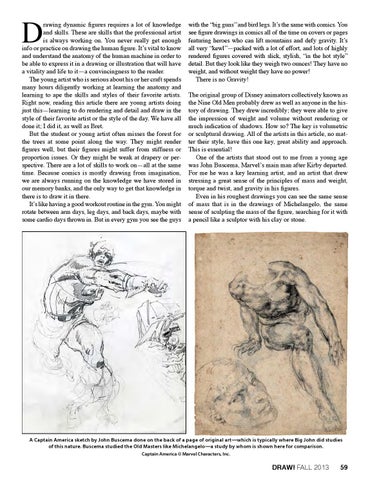
with the “big guns” and bird legs. It’s the same with comics. You see figure drawings in comics all of the time on covers or pages featuring heroes who can lift mountains and defy gravity. It’s all very “kewl”—packed with a lot of effort, and lots of highly rendered figures covered with slick, stylish, “in the hot style” detail. But they look like they weigh two ounces! They have no weight, and without weight they have no power! There is no Gravity! The original group of Disney animators collectively known as the Nine Old Men probably drew as well as anyone in the history of drawing. They drew incredibly; they were able to give the impression of weight and volume without rendering or much indication of shadows. How so? The key is volumetric or sculptural drawing. All of the artists in this article, no matter their style, have this one key, great ability and approach. This is essential! One of the artists that stood out to me from a young age was John Buscema, Marvel’s main man after Kirby departed. For me he was a key learning artist, and an artist that drew stressing a great sense of the principles of mass and weight, torque and twist, and gravity in his figures. Even in his roughest drawings you can see the same sense of mass that is in the drawings of Michelangelo, the same sense of sculpting the mass of the figure, searching for it with a pencil like a sculptor with his clay or stone.
A Captain America sketch by John Buscema done on the back of a page of original art—which is typically where Big John did studies of this nature. Buscema studied the Old Masters like Michelangelo—a study by whom is shown here for comparison. Captain America © Marvel Characters, Inc.
DRAW! FALL 2013
59