Reed Crandall: Illustrator of the Comics
who, while prospecting in Arizona, is mysteriously transported to Mars (“Barsoom” to its inhabitants). Due to the planet’s lesser gravity, Carter finds he has great strength and soon meets up with the Tharks, a nomadic tribe of the planet’s warlike, four-armed, green inhabitants. Using his newfound power with past combat experience, Carter rises in position and gains the respect and friendship of one of the chiefs. During the adventure, the Tharks capture the Princess of Helium, Deja Thoris, of the humanoid red Martian race. As the story progresses, Carter and Thoris fall in love, which results in them being thrust into political battles between the red and green denizens of the Red Planet. In October of 1917, Reed Crandall was only seven months old, when this Barsoom serial was re-titled A Princess of Mars and issued as a hardcover. Burroughs would go on to write numerous novels in this series, along with many other popular science fiction and fantasy stories, throughout his long and fortunate career. Other tales, such as “At the Earth’s Core,” part of his Pellucidar series, featured such enduring characters as David Innes and Abner Perry, who travel through the earth’s crust in an iron “mole machine” and discover a world of prehistoric creatures 500 miles below the planet’s surface. The Venus series, consisting of four novels and one novelette, follow the heroic adventures of earthman Carson Napier on Venus (known as Amtor to its human-like inhabitants).
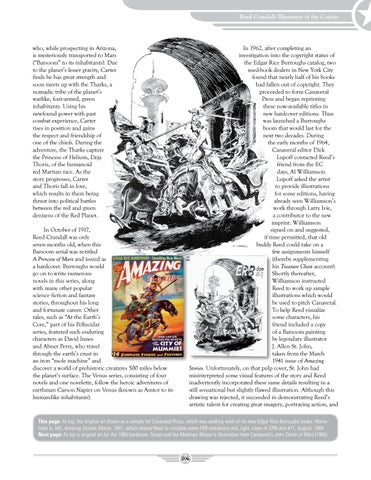
In 1962, after completing an investigation into the copyright status of the Edgar Rice Burroughs catalog, two used-book dealers in New York City found that nearly half of his books had fallen out of copyright. They proceeded to form Canaveral Press and began reprinting these now-available titles in new hardcover editions. Thus was launched a Burroughs boom that would last for the next two decades. During the early months of 1964, Canaveral editor Dick Lupoff contacted Reed’s friend from the EC days, Al Williamson. Lupoff asked the artist to provide illustrations for some editions, having already seen Williamson’s work through Larry Ivie, a contributor to the new imprint. Williamson signed on and suggested, if time permitted, that old buddy Reed could take on a few assignments himself (thereby supplementing his Treasure Chest account). Shortly thereafter, Williamson instructed Reed to work up sample illustrations which would be used to pitch Canaveral. To help Reed visualize some characters, his friend included a copy of a Barsoom painting by legendary illustrator J. Allen St. John, taken from the March 1941 issue of Amazing Stories. Unfortunately, on that pulp cover, St. John had misinterpreted some visual features of the story and Reed inadvertently incorporated these same details resulting in a still sensational but slightly flawed illustration. Although this drawing was rejected, it succeeded in demonstrating Reed’s artistic talent for creating great imagery, portraying action, and
This page: At top, the original art drawn as a sample for Canaveral Press, which was seeking work on its new Edgar Rice Burroughs books. Above inset is, left, Amazing Stories, March, 1941, which helped Reed to visualize some ERB characters and, right, cover of ERB-dom #11, August, 1964. Next page: At top is original art for the 1965 hardcover Tarzan and the Madman. Below is illustration from Canaveral’s John Carter of Mars (1964).
206