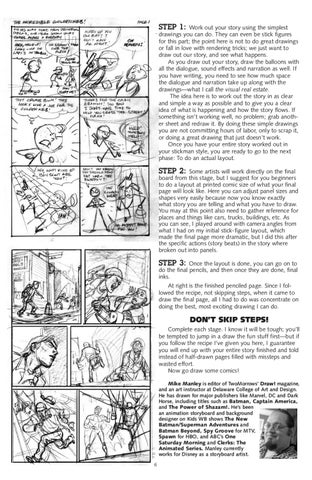
STEP 1: Work out your story using the simplest drawings you can do. They can even be stick figures for this part; the point here is not to do great drawings or fall in love with rendering tricks; we just want to draw out our story, and see what happens. As you draw out your story, draw the balloons with all the dialogue, sound effects and narration as well. If you have writing, you need to see how much space the dialogue and narration take up along with the drawings—what I call the visual real estate. The idea here is to work out the story in as clear and simple a way as possible and to give you a clear idea of what is happening and how the story flows. If something isn’t working well, no problem; grab another sheet and redraw it. By doing these simple drawings you are not committing hours of labor, only to scrap it, or doing a great drawing that just doesn’t work. Once you have your entire story worked out in your stickman style, you are ready to go to the next phase: To do an actual layout. STEP 2: Some artists will work directly on the final board from this stage, but I suggest for you beginners to do a layout at printed comic size of what your final page will look like. Here you can adjust panel sizes and shapes very easily because now you know exactly what story you are telling and what you have to draw. You may at this point also need to gather reference for places and things like cars, trucks, buildings, etc. As you can see, I played around with camera angles from what I had on my initial stick-figure layout, which made the final page more dramatic, but I did this after the specific actions (story beats) in the story where broken out into panels. STEP 3:
Once the layout is done, you can go on to do the final pencils, and then once they are done, final inks. At right is the finished penciled page. Since I followed the recipe, not skipping steps, when it came to draw the final page, all I had to do was concentrate on doing the best, most exciting drawing I can do.
DON’T SKIP STEPS! Complete each stage. I know it will be tough; you’ll be tempted to jump in a draw the fun stuff first—but if you follow the recipe I’ve given you here, I guarantee you will end up with your entire story finished and told instead of half-drawn pages filled with missteps and wasted effort. Now go draw some comics! Mike Manley is editor of TwoMorrows’ Draw! magazine, and an art instructor at Delaware College of Art and Design. He has drawn for major publishers like Marvel, DC and Dark Horse, including titles such as Batman, Captain America, and The Power of Shazam!. He's been an animation storyboard and background designer on Kids WB shows The New Batman/Superman Adventures and Batman Beyond, Spy Groove for MTV, Spawn for HBO, and ABC’s One Saturday Morning and Clerks: The Animated Series. Manley currently works for Disney as a storyboard artist. 6