#4 • Winter 2014 • Comic Book Creator
DC Special panel & Showcase TM & © DC Comics.
40
colleagues, including Alex Toth and John Severin, as well as nice work by younger artists like Ernie Colón and Walter Simonson. Sadly, despite the excellence of both issues under the editorship of Jeff Rovin, the Thrilling Adventure Stories anthology was dragged down by the total collapse of the Seaboard line in 1975. He also contributed a beautiful cover and interior art to one of the best Seaboard color comics, the evocatively titled Planet of Vampires [#3, July ’75], the story of a group of astronauts trapped on a planet that is quite literally overrun with bloodsuckers (a concept that screams to be revived, by the way.) Rounding out his contributions to the Seaboard line was his work in the black-&-white horror magazine Devilina, whose title character was the sexy sister of Satan, and was presumably intended to cash in on the popularity of Warren’s Vampirella. Aside from his realistic war, Western, crime, mystery, romance, and super-hero art, Heath demonstrated his versatility with numerous (and largely unknown) contributions to humor magazines like MAD (both in its comic-book and magazine incarnations. His art chores on the parody “Plastic Sam,” in MAD #14 [Aug. ’54] is a bona-fide classic, both in the way he referenced Jack Cole’s style, and the hilarious ways he and editor/writer/breakdown artist Harvey Kurtzman skewered the absurdity of the concept). Although Heath only contributed a single story to Kurtzman’s seminal war comic
TM & ©2014 Marvel Characters, Inc.
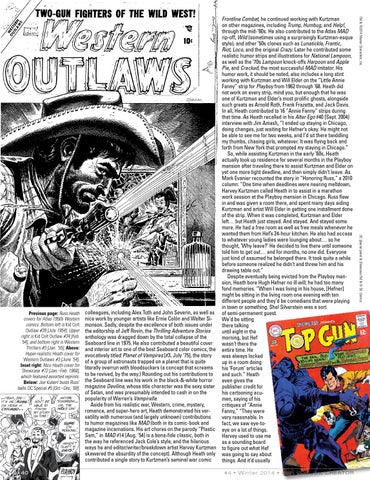
Previous page: Russ Heath covers for Atlas 1950s Western comics. Bottom left is Kid Colt Outlaw #39 [July 1954]. Upper right is Kid Colt Outlaw #34 [Feb. ’54], and bottom right is Western Thrillers #3 [Jan. ’55]. Above: Hyper-realistic Heath cover for Western Outlaws #3 [June ’54]. Inset right: Nice Heath cover for Showcase #72 [Jan.–Feb. 1968], which featured assorted reprints. Below: Joe Kubert busts Russ’ balls. DC Special #5 [Oct.–Dec. ’69].
Frontline Combat, he continued working with Kurtzman on other magazines, including Trump, Humbug, and Help!, through the mid-’60s. He also contributed to the Atlas MAD rip-off, Wild (sometimes using a surprisingly Kurtzman-esque style), and other ’50s clones such as Lunatickle, Frantic, Riot, Loco, and the original Crazy. Later he contributed some realistic humor strips and illustrations for National Lampoon, as well as the ’70s Lampoon knock-offs Harpoon and Apple Pie, and Cracked, the most successful MAD imitator. His humor work, it should be noted, also includes a long stint working with Kurtzman and Will Elder on the “Little Annie Fanny” strip for Playboy from 1962 through ’68. Heath did not work on every strip, mind you, but enough that he was one of Kurtzman and Elder’s most prolific ghosts, alongside such greats as Arnold Roth, Frank Frazetta, and Jack Davis. In all, Heath contributed to 16 “Annie Fanny” strips during that time. As Heath recalled in his Alter Ego #40 [Sept. 2004] interview with Jim Amash, “I ended up staying in Chicago, doing changes, just waiting for Hefner’s okay. He might not be able to see me for two weeks, and I’d sit there twiddling my thumbs, chasing girls, whatever. It was flying back and forth from New York that prompted my staying in Chicago.” So, while assisting Kurtzman in the early ’60s, Heath actually took up residence for several months in the Playboy mansion after traveling there to assist Kurtzman and Elder on yet one more tight deadline, and then simply didn’t leave. As Mark Evanier recounted the story in “Honoring Russ,” a 2010 column: “One time when deadlines were nearing meltdown, Harvey Kurtzman called Heath in to assist in a marathon work session at the Playboy mansion in Chicago. Russ flew in and was given a room there, and spent many days aiding Kurtzman and artist Will Elder in getting one installment done of the strip. When it was completed, Kurtzman and Elder left… but Heath just stayed. And stayed. And stayed some more. He had a free room as well as free meals whenever he wanted them from Hef’s 24-hour kitchen. He also had access to whatever young ladies were lounging about… so he thought, ‘Why leave?’ He decided to live there until someone told him to get out… and for months, no one did. Everyone just kind of assumed he belonged there. It took quite a while before someone realized he didn’t and threw him and his drawing table out.” Despite eventually being evicted from the Playboy mansion, Heath bore Hugh Hefner no ill will; he had too many fond memories. “When I was living in his house, [Hefner] might be sitting in the living room one evening with ten different people and they’d be comedians that were playing in town or something. Shel Silverstein was a sort of semi-permanent guest. We’d be sitting there talking until eight in the morning, but Hef wasn’t there the entire time. He was always locked up in a room doing his ‘Forum’ articles and such.” Heath even gives the publisher credit for his cartooning acumen, saying of his critiques of “Annie Fanny,” “They were very reasonable. In fact, we saw eye-toeye on a lot of things. Harvey used to use me as a sounding board to figure out what Hef was going to say about things. And it’d usually