From 1928
The First 75 Years of
If Philippine comic art is considered at all outside the archipelago, it is in the context of the emigrés, those cartoonists who left the islands to work for United States comic book publishers in the 1970s and 1980s. Yet, Filipino cartoons and comics are much more than that, having a rich tradition that reaches back over a century, a huge readership, and a pervasive impact on various aspects of their society, especially cinema and national development campaigns. As in many instances, the comic book (komik) was a result of an evolutionary process in the Philippines, growing from, first, humor magazines and political cartoons, and then, comic strips. Although Dr. José Rizal, the nationalist later proclaimed national hero, is often called the first cartoonist in the Philippines, cartoons probably appeared before he drew the fable, “The Monkey and the Tortoise,” in 1885. While visiting fellow Philippine physicians Trinidad and Felix Pardo de Tavera in Paris, Rizal was given an album with some blank pages by the sister of the Tavera brothers and asked to draw something. Rizal obliged, recounting in 34 panels, the story of a cheating monkey and a clever tortoise dividing a banana tree.
74 CBA V.2 #4
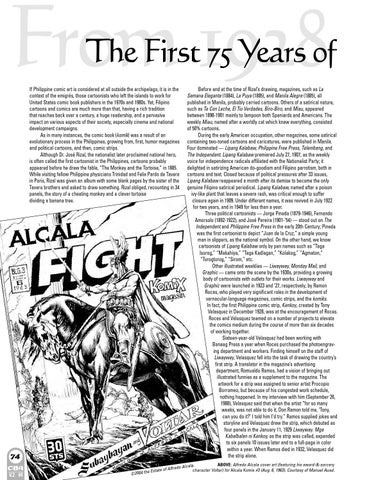
ABOVE: Alfredo Alcala cover art (featuring his sword-&-sorcery ala. lfredo Alc character Voltar) for Alcala Komix #3 (Aug. 6, 1963). Courtesy of Manuel Auad.
state of A
eE ©2004 th
Before and at the time of Rizal’s drawing, magazines, such as La Semana Elegante (1884), La Puya (1885), and Manila Alegre (1885), all published in Manila, probably carried cartoons. Others of a satirical nature, such as Te Con Leche, El Tio Verdades, Biro-Biro, and Miau, appeared between 1898-1901 mainly to lampoon both Spaniards and Americans. The weekly Miau, named after a worldly cat which knew everything, consisted of 50% cartoons. During the early American occupation, other magazines, some satirical containing two-toned cartoons and caricatures, were published in Manila. Four dominated — Lipang Kalabaw, Philippine Free Press, Telembang, and The Independent. Lipang Kalabaw premiered July 27, 1907, as the weekly voice for independence radicals affiliated with the Nationalist Party; it delighted in satirizing American do-goodism and Filipino parrotism, both in cartoons and text. Closed because of political pressures after 33 issues, Lipang Kalabaw reappeared a month after its demise to become the only genuine Filipino satirical periodical. Lipang Kalabaw, named after a poison ivy-like plant that leaves a severe rash, was critical enough to suffer closure again in 1909. Under different names, it was revived in July 1922 for two years, and in 1949 for less than a year. Three political cartoonists — Jorge Pineda (1879-1946), Fernando Amorsolo (1892-1922), and José Pereira (1901-’54) — stood out on The Independent and Philippine Free Press in the early 20th Century; Pineda was the first cartoonist to depict “Juan de la Cruz,” a simple young man in slippers, as the national symbol. On the other hand, we know cartoonists of Lipang Kalabaw only by pen names such as “Taga Isorog,” “Makahiya,” “Taga Kadlagan,” “Kolakog,” “Agmaton,” “Torogtorog,” “Sirom,” etc. Other illustrated weeklies — Liwayway, Monday Mail, and Graphic — came onto the scene by the 1930s, providing a growing body of cartoonists with outlets for their works. Liwayway and Graphic were launched in 1923 and ’27, respectively, by Ramon Roces, who played very significant roles in the development of vernacular-language magazines, comic strips, and the komiks. In fact, the first Philippine comic strip, Kenkoy, created by Tony Velasquez in December 1928, was at the encouragement of Roces. Roces and Velasquez teamed on a number of projects to elevate the comics medium during the course of more than six decades of working together. Sixteen-year-old Velasquez had been working with Banaag Press a year when Roces purchased the photoengraving department and workers. Finding himself on the staff of Liwayway, Velasquez fell into the task of drawing the country’s first strip. A translator in the magazine’s advertising department, Romualdo Ramos, had a vision of bringing out illustrated funnies as a supplement to the magazine. The artwork for a strip was assigned to senior artist Procopio Borromeo, but because of his congested work schedule, nothing happened. In my interview with him (September 26, 1988), Velasquez said that when the artist “for so many weeks, was not able to do it, Don Ramon told me, ‘Tony, can you do it?’ I told him I’d try.” Ramos supplied jokes and storyline and Velasquez drew the strip, which debuted as four panels in the January 11, 1929 Liwayway. Mga Kabalbalan ni Kenkoy, as the strip was called, expanded to six panels 10 issues later and to a full-page in color within a year. When Ramos died in 1932, Velasquez did the strip alone.