Deep Background
Secret Origins of the Direct Market Part One: “Affidavit Returns”—The Scourge of Distribution by Robert L. Beerbohm
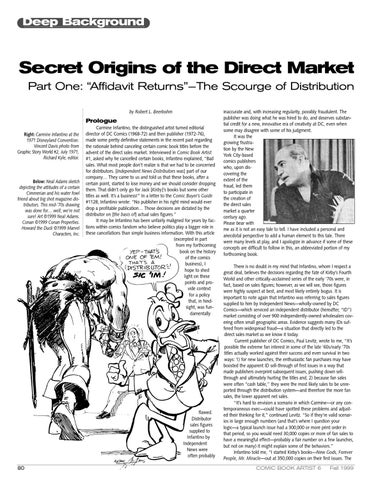
Prologue Right: Carmine Infantino at the 1971 Disneyland Convention. Vincent Davis photo from Graphic Story World #2, July 1971, Richard Kyle, editor.
Below: Neal Adams sketch depicting the attitudes of a certain Cimmerian and his water fowl friend about big shot magazine distributors. This mid-’70s drawing was done for… well, we’re not sure! Art ©1999 Neal Adams. Conan ©1999 Conan Properties. Howard the Duck ©1999 Marvel Characters, Inc.
Carmine Infantino, the distinguished artist turned editorial director of DC Comics (1968-72) and then publisher (1972-76), made some pretty definitive statements in the recent past regarding the rationale behind canceling certain comic book titles before the advent of the direct sales market. Interviewed in Comic Book Artist #1, asked why he cancelled certain books, Infantino explained, “Bad sales. What most people don’t realize is that we had to be concerned for distributors. [Independent News Distributors was] part of our company… They came to us and told us that these books, after a certain point, started to lose money and we should consider dropping them. That didn’t only go for Jack [Kirby]’s books but some other titles as well. It’s a business!” In a letter to the Comic Buyer’s Guide #1128, Infantino wrote: “No publisher in his right mind would ever drop a profitable publication… Those decisions are dictated by the distributor on [the basis of] actual sales figures.” It may be Infantino has been unfairly maligned for years by factions within comics fandom who believe politics play a bigger role in these cancellations than simple business information. With this article (excerpted in part from my forthcoming book on the history of the comics business), I hope to shed light on these points and provide context for a policy that, in hindsight, was fundamentally
flawed. Distributor sales figures supplied to Infantino by Independent News were often probably 80
inaccurate and, with increasing regularity, possibly fraudulent. The publisher was doing what he was hired to do, and deserves substantial credit for a new, innovative era of creativity at DC, even when some may disagree with some of his judgment. It was the growing frustration by the New York City-based comics publishers who, upon discovering the extent of the fraud, led them to participate in the creation of the direct sales market a quarter century ago. Please bear with me as it is not an easy tale to tell. I have included a personal and anecdotal perspective to add a human element to this tale. There were many levels at play, and I apologize in advance if some of these concepts are difficult to follow in this, an abbreviated portion of my forthcoming book. There is no doubt in my mind that Infantino, whom I respect a great deal, believes the decisions regarding the fate of Kirby’s Fourth World and other critically-acclaimed series of the early ’70s were, in fact, based on sales figures; however, as we will see, those figures were highly suspect at best, and most likely entirely bogus. It is important to note again that Infantino was referring to sales figures supplied to him by Independent News—wholly-owned by DC Comics—which serviced an independent distributor (hereafter, “ID”) market consisting of over 900 independently-owned wholesalers covering often small geographic areas. Evidence suggests many IDs suffered from widespread fraud—a situation that directly led to the direct sales market as we know it today. Current publisher of DC Comics, Paul Levitz, wrote to me, “It’s possible the extreme fan interest in some of the late ’60s/early ’70s titles actually worked against their success and even survival in two ways: 1) for new launches, the enthusiastic fan purchases may have boosted the apparent ID sell-through of first issues in a way that made publishers overprint subsequent issues, pushing down sellthrough and ultimately hurting the titles and, 2) because fan sales were often “cash table,” they were the most likely sales to be unreported through the distribution system—and therefore the more fan sales, the lower apparent net sales. “It’s hard to envision a scenario in which Carmine—or any contemporaneous exec—could have spotted these problems and adjusted their thinking for it,” continued Levitz. “So if they’re valid scenarios in large enough numbers (and that’s where I question your logic—a typical launch issue had a 300,000 or more print order in that period, so you would need 30,000 copies or more of fan sales to have a meaningful effect—probably a fair number on a few launches, but not on many) it might explain some of the behaviors.” Infantino told me, “I started Kirby’s books—New Gods, Forever People, Mr. Miracle—out at 350,000 copies on their first issues. The COMIC BOOK ARTIST 6
Fall 1999