What If Dept.
The Prisoner That Never Was A Look at Marvel’s Aborted Prisoner Comic Series
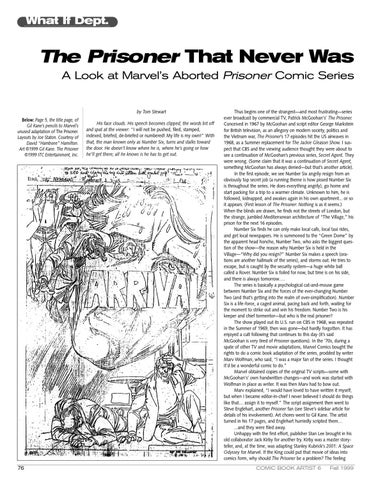
by Tom Stewart Below: Page 5, the title page, of Gil Kane’s pencils to Marvel’s unused adaptation of The Prisoner. Layouts by Joe Staton. Courtesy of David “Hambone” Hamilton. Art ©1999 Gil Kane. The Prisoner ©1999 ITC Entertainment, Inc.
76
His face clouds. His speech becomes clipped, the words bit off and spat at the viewer: “I will not be pushed, filed, stamped, indexed, briefed, de-briefed or numbered! My life is my own!” With that, the man known only as Number Six, turns and stalks toward the door. He doesn’t know where he is, where he’s going or how he’ll get there; all he knows is he has to get out.
Thus begins one of the strangest—and most frustrating—series ever broadcast by commercial TV, Patrick McGoohan's’ The Prisoner. Conceived in 1967 by McGoohan and script editor George Markstein for British television, as an allegory on modern society, politics and the Vietnam war, The Prisoner’s 17 episodes hit the US airwaves in 1968, as a Summer replacement for The Jackie Gleason Show. I suspect that CBS and the viewing audience thought they were about to see a continuation of McGoohan’s previous series, Secret Agent. They were wrong. (Some claim that it was a continuation of Secret Agent, something McGoohan has always denied—but that’s another article). In the first episode, we see Number Six angrily resign from an obviously top secret job (a running theme is how pissed Number Six is throughout the series. He does everything angrily), go home and start packing for a trip to a warmer climate. Unknown to him, he is followed, kidnapped, and awakes again in his own apartment... or so it appears. (First lesson of The Prisoner: Nothing is as it seems.) When the blinds are drawn, he finds not the streets of London, but the strange, jumbled Mediterranean architecture of “The Village,” his prison for the next 16 episodes. Number Six finds he can only make local calls, local taxi rides, and get local newspapers. He is summoned to the “Green Dome” by the apparent head honcho, Number Two, who asks the biggest question of the show—the reason why Number Six is held in the Village—“Why did you resign?” Number Six makes a speech (orations are another hallmark of the series), and storms out. He tries to escape, but is caught by the security system—a huge white ball called a Rover. Number Six is foiled for now, but time is on his side, and there is always tomorrow…. The series is basically a psychological cat-and-mouse game between Number Six and the forces of the ever-changing Number Two (and that’s getting into the realm of over-simplification). Number Six is a life-force, a caged animal, pacing back and forth, waiting for the moment to strike out and win his freedom. Number Two is his keeper and chief tormentor—but who is the real prisoner? The show played out its U.S. run on CBS in 1968, was repeated in the Summer of 1969, then was gone—but hardly forgotten. It has enjoyed a cult following that continues to this day (it’s said McGoohan is very tired of Prisoner questions). In the ’70s, during a spate of other TV and movie adaptations, Marvel Comics bought the rights to do a comic book adaptation of the series, prodded by writer Marv Wolfman, who said, “I was a major fan of the series. I thought it’d be a wonderful comic to do.” Marvel obtained copies of the original TV scripts—some with McGoohan's’ own handwritten changes—and work was started with Wolfman in place as writer. It was then Marv had to bow out. Marv explained, “I would have loved to have written it myself, but when I became editor-in-chief I never believed I should do things like that… assign it to myself.” The script assignment then went to Steve Englehart, another Prisoner fan (see Steve’s sidebar article for details of his involvement). Art chores went to Gil Kane. The artist turned in his 17 pages, and Englehart hurriedly scripted them… ...and they were filed away. Unhappy with the first effort, publisher Stan Lee brought in his old collaborator Jack Kirby for another try. Kirby was a master storyteller, and, at the time, was adapting Stanley Kubrick’s 2001: A Space Odyssey for Marvel. If the King could put that movie of ideas into comics form, why should The Prisoner be a problem? The feeling COMIC BOOK ARTIST 6
Fall 1999