CBA Interview
Rise & Fall of Rovin’s Empire A candid conversation with Atlas/Seaboard editor Jeff Rovin Conducted by Jon B. Cooke Transcribed by Jon B. Knutson I first encountered Jeff Rovin’s name when he served as an assistant editor at DC Comics in the early ’70s, and finally met the man himself within moments of also meeting Jim Warren for the first time in 1998. Since his stint as (co-?) editor-in-chief at Atlas Comics for a brief period in the ’70s, Jeff has done relatively little work in the comics field, but he is a highly successful writer, renowned for genre encyclopedias (e.g., The Encyclopedia of Superheroes), and his Op-Center series scribed for Tom Clancy. Jeff was interviewed by phone on Oct. 4 & 11, 2001, and he copyedited the final transcript.
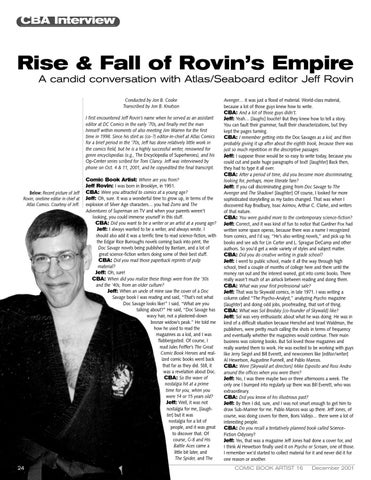
Below: Recent picture of Jeff Rovin, onetime editor in chief at Atlas Comics. Courtesy of Jeff.
24
Comic Book Artist: Where are you from? Jeff Rovin: I was born in Brooklyn, in 1951. CBA: Were you attracted to comics at a young age? Jeff: Oh, sure. It was a wonderful time to grow up, in terms of the explosion of Silver Age characters… you had Zorro and The Adventures of Superman on TV and when your parents weren’t looking, you could immerse yourself in this stuff. CBA: Did you want to be a writer or an artist at a young age? Jeff: I always wanted to be a writer, and always wrote. I should also add it was a terrific time to read science-fiction, with the Edgar Rice Burroughs novels coming back into print, the Doc Savage novels being published by Bantam, and a lot of great science-fiction writers doing some of their best stuff. CBA: Did you read those paperback reprints of pulp material? Jeff: Oh, sure! CBA: When did you realize these things were from the ‘30s and the ‘40s, from an older culture? Jeff: When an uncle of mine saw the cover of a Doc Savage book I was reading and said, “That’s not what Doc Savage looks like!” I said, “What are you talking about?” He said, “Doc Savage has wavy hair, not a plastered-down bronze widow’s peak.” He told me how he used to read the magazines as a kid, and I was flabbergasted. Of course, I read Jules Feiffer’s The Great Comic Book Heroes and realized comic books went back that far as they did. Still, it was a revelation about Doc. CBA: So the wave of nostalgia hit at a prime time for you, when you were 14 or 15 years old? Jeff: Well, it was not nostalgia for me, [laughter] but it was nostalgia for a lot of people, and it was great to discover that. Of course, G-8 and His Battle Aces came a little bit later, and The Spider, and The
Avenger… it was just a flood of material. World-class material, because a lot of those guys knew how to write. CBA: And a lot of those guys didn’t. Jeff: Yeah… [laughs] touché! But they knew how to tell a story. You can fault their grammar, fault their characterizations, but they kept the pages turning. CBA: I remember getting into the Doc Savages as a kid, and then probably giving it up after about the eighth book, because there was just so much repetition in the descriptive passages. Jeff: I suppose those would be so easy to write today, because you could cut and paste huge paragraphs of text! [laughter] Back then, they had to type it all over. CBA: After a period of time, did you become more discriminating, looking for, perhaps, more literate fare? Jeff: If you call discriminating going from Doc Savage to The Avenger and The Shadow! [laughter] Of course, I looked for more sophisticated storytelling as my tastes changed. That was when I discovered Ray Bradbury, Issac Asimov, Arthur C. Clarke, and writers of that nature. CBA: You were guided more to the contemporary science-fiction? Jeff: Correct, and it was kind of fun to notice that Gardner Fox had written some space operas, because there was a name I recognized from comics, and I’d say, “He’s also writing novels,” and pick up his books and see ads for Lin Carter and L. Sprague DeCamp and other authors. So you’d get a wide variety of styles and subject matter. CBA: Did you do creative writing in grade school? Jeff: I went to public school, made it all the way through high school, tried a couple of months of college here and there until the money ran out and the interest waned, got into comic books. There really wasn’t much of an airlock between reading and doing them. CBA: What was your first professional sale? Jeff: That was to Skywald comics, in late 1971. I was writing a column called “The Psycho-Analyst,” analyzing Psycho magazine [laughter] and doing odd jobs, proofreading, that sort of thing. CBA: What was Sol Brodsky [co-founder of Skywald] like? Jeff: Sol was very enthusiastic about what he was doing. He was in kind of a difficult situation because Herschel and Israel Waldman, the publishers, were pretty much calling the shots in terms of frequency and eventually whether the magazines would continue. Their main business was coloring books. But Sol loved those magazines and really wanted them to work. He was excited to be working with guys like Jerry Siegel and Bill Everett, and newcomers like [editor/writer] Al Hewetson, Augustine Funnell, and Pablo Marcos. CBA: Were [Skywald art directors] Mike Esposito and Ross Andru around the offices when you were there? Jeff: No, I was there maybe two or three afternoons a week. The only one I bumped into regularly up there was Bill Everett, who was extraordinary. CBA: Did you know of his illustrious past? Jeff: By then I did, sure, and I was not smart enough to get him to draw Sub-Mariner for me. Pablo Marcos was up there. Jeff Jones, of course, was doing covers for them, Boris Vallejo… there were a lot of interesting people. CBA: Do you recall a tentatively planned book called ScienceFiction Odyssey? Jeff: Yes, that was a magazine Jeff Jones had done a cover for, and I think Al Hewetson finally used it on Psycho or Scream, one of those. I remember we’d started to collect material for it and never did it for one reason or another. COMIC BOOK ARTIST 16
December 2001