CBA Interview
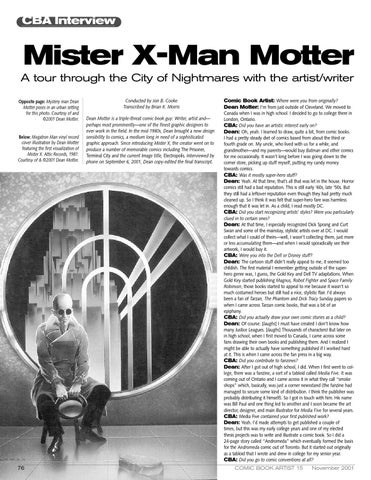
Mister X-Man Motter A tour through the City of Nightmares with the artist/writer Opposite page: Mystery man Dean Motter poses in an urban setting for this photo. Courtesy of and ©2001 Dean Motter.
Below: Megatron Man vinyl record cover illustration by Dean Motter featuring the first visualization of Mister X. Attic Records, 1981. Courtesy of & ©2001 Dean Motter.
76
Conducted by Jon B. Cooke Transcribed by Brian K. Morris Dean Motter is a triple-threat comic book guy: Writer, artist and— perhaps most prominently—one of the finest graphic designers to ever work in the field. In the mid-1980s, Dean brought a new design sensibility to comics, a medium long in need of a sophisticated graphic approach. Since introducing Mister X, the creator went on to produce a number of memorable comics including The Prisoner, Terminal City and the current Image title, Electropolis. Interviewed by phone on September 6, 2001, Dean copy-edited the final transcript.
Comic Book Artist: Where were you from originally? Dean Motter: I’m from just outside of Cleveland. We moved to Canada when I was in high school. I decided to go to college there in London, Ontario. CBA: Did you have an artistic interest early on? Dean: Oh, yeah. I learned to draw, quite a bit, from comic books. I had a pretty steady diet of comics based from about the third or fourth grade on. My uncle, who lived with us for a while, and grandmother—and my parents—would buy Batman and other comics for me occasionally. It wasn’t long before I was going down to the corner store, picking up stuff myself, putting my candy money towards comics. CBA: Was it mostly super-hero stuff? Dean: Yeah. At that time, that’s all that was let in the house. Horror comics still had a bad reputation. This is still early ’60s, late ’50s. But they still had a leftover reputation even though they had pretty much cleaned up. So I think it was felt that super-hero fare was harmless enough that it was let in. As a child, I read mostly DC. CBA: Did you start recognizing artists’ styles? Were you particularly clued in to certain ones? Dean: At that time, I especially recognized Dick Sprang and Curt Swan and some of the mainstay, stylistic artists over at DC. I would collect what I could of theirs—well, I wasn’t collecting them, just more or less accumulating them—and when I would sporadically see their artwork, I would buy it. CBA: Were you into the Dell or Disney stuff? Dean: The cartoon stuff didn’t really appeal to me, it seemed too childish. The first material I remember getting outside of the superhero genre was, I guess, the Gold Key and Dell TV adaptations. When Gold Key started publishing Magnus, Robot Fighter and Space Family Robinson, those books started to appeal to me because it wasn’t so much costumed heroes but still had a nice, stylistic flair. I’d always been a fan of Tarzan, The Phantom and Dick Tracy Sunday papers so when I came across Tarzan comic books, that was a bit of an epiphany. CBA: Did you actually draw your own comic stories as a child? Dean: Of course. [laughs] I must have created I don’t know how many Justice Leagues. [laughs] Thousands of characters! But later on in high school, when I first moved to Canada, I came across some fans drawing their own books and publishing them. And I realized I might be able to actually have something published if I worked hard at it. This is when I came across the fan press in a big way. CBA: Did you contribute to fanzines? Dean: After I got out of high school, I did. When I first went to college, there was a fanzine, a sort of a tabloid called Media Five. It was coming out of Ontario and I came across it in what they call “smoke shops” which, basically, was just a corner newsstand (the fanzine had managed to secure some kind of distribution. I think the publisher was probably distributing it himself). So I got in touch with him. His name was Bill Paul and one thing led to another and I soon became the art director, designer, and main illustrator for Media Five for several years. CBA: Media Five contained your first published work? Dean: Yeah. I’d made attempts to get published a couple of times, but this was my early college years and one of my elected thesis projects was to write and illustrate a comic book. So I did a 24-page story called “Andromeda” which eventually formed the basis for the Andromeda comic out of Toronto. But it started out originally as a tabloid that I wrote and drew in college for my senior year. CBA: Did you go to comic conventions at all? COMIC BOOK ARTIST 15
November 2001