title, Wood is universally considered the de facto editor for most of the TA material. But most freelancers still dealt with official editor Samm Schwartz at 185 Madison. One of those freelancers was none other than future comics innovator Jim Steranko who had just broken into the field in editor Joe Simon’s titles at Harvey Comics. According to Peter DePree in his article “Steranko: Narrative of Blood and Dreams” (Comic Book Marketplace #28), in 1966 the artist pitched a new title to Tower— Super Agent X—received approval, and subsequently delivered a 20page origin story and cover roughs to editor Samm Schwartz, who “savaged page after page, finally stating that he didn’t even like the shape of a female nose! (The woman scientist was patterned on Kim Novak; short platinum hair, straight nose.) Schwartz insisted it be
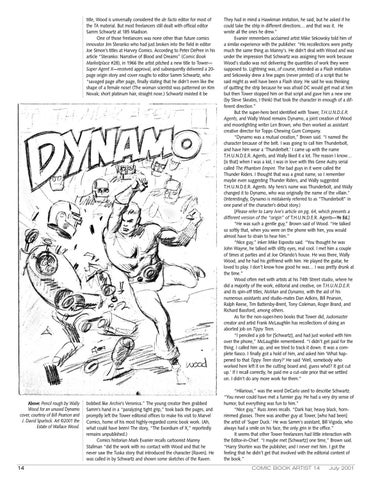
Above: Pencil rough by Wally Wood for an unused Dynamo cover, courtesy of Bill Pearson and J. David Spurlock. Art ©2001 the Estate of Wallace Wood.
14
bobbed like Archie’s Veronica.” The young creator then grabbed Samm’s hand in a “paralyzing tight grip,” took back the pages, and promptly left the Tower editorial offices to make his visit to Marvel Comics, home of his most highly-regarded comic book work. (Ah, what could have been! The story, “The Exordium of X,” reportedly remains unpublished.) Comics historian Mark Evanier recalls cartoonist Manny Stallman “did the work with no contact with Wood and that he never saw the Tuska story that introduced the character [Raven]. He was called in by Schwartz and shown some sketches of the Raven.
They had in mind a Hawkman imitation, he said, but he asked if he could take the strip in different directions… and that was it. He wrote all the ones he drew.” Evanier remembers acclaimed artist Mike Sekowsky told him of a similar experience with the publisher. “His recollections were pretty much the same thing as Manny's. He didn't deal with Wood and was under the impression that Schwartz was assigning him work because Wood's studio was not delivering the quantities of work they were supposed to. Lightning was, of course, intended as a Flash imitation and Sekowsky drew a few pages (never printed) of a script that he said might as well have been a Flash story. He said he was thinking of quitting the strip because he was afraid DC would get mad at him but then Tower stopped him on that script and gave him a new one (by Steve Skeates, I think) that took the character in enough of a different direction.” But the super-hero best identified with Tower, T.H.U.N.D.E.R. Agents, and Wally Wood remains Dynamo, a joint creation of Wood and moonlighting writer Len Brown, who then worked as assistant creative director for Topps Chewing Gum Company. “Dynamo was a mutual creation,” Brown said. “I named the character because of the belt. I was going to call him Thunderbolt, and have him wear a ‘Thunderbelt.’ I came up with the name T.H.U.N.D.E.R. Agents, and Wally liked it a lot. The reason I know… [is that] when I was a kid, I was in love with this Gene Autry serial called The Phantom Empire. The bad guys in it were called the Thunder Riders. I thought that was a great name, so I remember maybe even suggesting Thunder Riders, and Wally suggested T.H.U.N.D.E.R. Agents. My hero’s name was Thunderbolt, and Wally changed it to Dynamo, who was originally the name of the villain.” (Interestingly, Dynamo is mistakenly referred to as “Thunderbolt” in one panel of the character’s debut story.) [Please refer to Larry Ivie’s article on pg. 64, which presents a different version of the “origin” of T.H.U.N.D.E.R. Agents—Ye Ed.] “He was such a gentle guy,” Brown said of Wood. “He talked so softly that, when you were on the phone with him, you would almost have to strain to hear him.” “Nice guy,” inker Mike Esposito said. “You thought he was John Wayne, he talked with slitty eyes, real cool. I met him a couple of times at parties and at Joe Orlando’s house. He was there, Wally Wood, and he had his girlfriend with him. He played the guitar, he loved to play. I don’t know how good he was… I was pretty drunk at the time.” Wood often met with artists at his 74th Street studio, where he did a majority of the work, editorial and creative, on T.H.U.N.D.E.R. and its spin-off titles, NoMan and Dynamo, with the aid of his numerous assistants and studio-mates Dan Adkins, Bill Pearson, Ralph Reese, Tim Battersby-Brent, Tony Coleman, Roger Brand, and Richard Bassford, among others. As for the non-super-hero books that Tower did, Judomaster creator and artist Frank McLaughlin has recollections of doing an aborted job on Tippy Teen. “I penciled a job for [Schwartz], and had just worked with him over the phone,” McLaughlin remembered. “I didn’t get paid for the thing. I called him up, and we tried to track it down. It was a complete fiasco. I finally got a hold of him, and asked him ‘What happened to that Tippy Teen story?’ He said ‘Well, somebody who worked here left it on the cutting board and, guess what? It got cut up.’ If I recall correctly, he paid me a cut-rate price that we settled on. I didn’t do any more work for them.” “Hilarious,” was the word DeCarlo used to describe Schwartz. “You never could have met a funnier guy. He had a very dry sense of humor, but everything was fun to him.” “Nice guy,” Russ Jones recalls. “Dark hair, heavy black, hornrimmed glasses. There was another guy at Tower, [who had been] the artist of 'Super Duck.' He was Samm's assistant, Bill Vigoda, who always had a smile on his face, the only grin in the office.” It seems that other Tower freelancers had little interaction with the Editor-in-Chief. “I maybe met [Schwartz] one time,” Brown said. “Harry Shorten was the publisher, and I never met him. I got the feeling that he didn’t get that involved with the editorial content of the book.” COMIC BOOK ARTIST 14
July 2001