Roy Thomas’ Volcanic Comics Fanzine
PLUS:
$
6.95
In the USA
No. 77
Art ©2008 Joe Kubert
May 2008
JOE KUBERT & THE GOSPEL ACCORDING TO ARCHER ST. JOHN
Vol. 3, No. 77 / May 2008 Editor Roy Thomas
Associate Editors Bill Schelly Jim Amash
Design & Layout Christopher Day
Consulting Editor John Morrow
FCA Editor P.C. Hamerlinck
Comic Crypt Editor Michael T. Gilbert
Editorial Honor Roll Jerry G. Bails (founder) Ronn Foss, Biljo White Mike Friedrich
Circulation Director Bob Brodsky, Cookiesoup Productions
Cover Artist Joe Kubert
Cover Colorist Tom Ziuko (after Joe Kubert)
With Special Thanks to: Heidi Amash Ger Apeldoorn Matt D. Baker Michael Barnes Jerry Beck Rod Beck John Benson Nick Caputo Pete Carlsson Roger Carp Bob Cherry Gene Colan Michaël Dewally Shel Dorf Ric Estrada Lance Falk Michael Feldman Edward Gazda Janet Gilbert George Hagenauer Jennifer Hamerlinck Al Jaffee Roger Jeffries Jay Kinney David Anthony Kraft Joe Kubert Eric Larsen
Karl R. Larsen Jim Ludwig Joan Howard Maurer Leon Maurer Brian K. Morris Frank Motler Albert Moy Stephen O’Day Ken Quattro Joe Petrilak Lily Renée Phillips Jay Piscopo Trina Robbins Fred Robinson Jerome Lafayette St. John Tom Sawyer J.P. Selegue R. Daniel Stevenson Marc Swayze Dann Thomas Alfred M. Walker Stephen V. Walker Hames Ware Jim Vadeboncoeur, Jr. Dr. Michael J. Vassallo Ray Zone
This issue is dedicated to the memory of
David Gantz & Archer St. John
Contents Writer/Editorial: One Million Words Ago! . . . . . . . . . . . . . . . . 2 The Gospel According To Archer St. John . . . . . . . . . . . . . . . . 3 Ken Quattro’s history of St. John Publishing—from terror to 3-D to the Stooges!
“My God, Why Am I Messing Around With This Stuff?”. . . . 59 1950s artist Tom Scheuer/Sawyer talks with Jim Amash about drawing comics & writing TV.
Mr. Monster’s Comic Crypt! Alfred J. Walker, Part 2. . . . . . . 73 More from Michael T. Gilbert (& Steven Walker) on a most inventive Fiction House artist.
A Tribute To David Gantz – by Al Jaffee . . . . . . . . . . . . . . . . 79 FCA (Fawcett Collectors Of America) #136 . . . . . . . . . . . . . 81 P.C. Hamerlinck presents facts by Marc Swayze & fiction by C.C. Beck. On Our Cover: The cover of Tor, Vol. 1, #3 (May 1954) is one of editor Roy Thomas’ favorite comic book covers of all time. As drawn and even colored by Joe Kubert, it was used by St. John Publications to reintroduce the primordial hero to a color-comics audience after two 3-D issues. We had to take a few liberties with the smoke at the top, where the huge, stone-carved word “Tor” had been; but we hope Joe, who gave us his blessing to use the illustration, won’t mind. Actually, the central portion of this selfsame illo was utilized by then-publisher Ronn Foss on the cover of A/E (Vol. 1) #6—in black-&-white, framed in-green—as per the newly reprinted trade paperback Alter Ego: The Best of the Legendary Comics Fanzine, as seen on p. 82. Special thanks to art dealer Albert Moy; visit his website at www.AlbertMoy.com. [©2008 Joe Kubert.] Above: In 1996, Joe drew this sketch of Tor the Hunter for collector Lance Falk, who (along with Joe) graciously shared it with us. To the best of our knowledge, it has never been printed before. [©2008 Joe Kubert.] Alter EgoTM is published 8 times a year by TwoMorrows, 10407 Bedfordtown Drive, Raleigh, NC 27614, USA. Phone: (919) 449-0344. Roy Thomas, Editor. John Morrow, Publisher. Alter Ego Editorial Offices: 32 Bluebird Trail, St. Matthews, SC 29135, USA. Fax: (803) 826-6501; e-mail: roydann@ntinet.com. Send subscription funds to TwoMorrows, NOT to the editorial offices. Single issues: $9 US ($11.00 Canada, $16 elsewhere). Twelve-issue subscriptions: $78 US, $132 Canada, $180 elsewhere. All characters are © their respective companies. All material © their creators unless otherwise noted. All editorial matter © Roy Thomas. Alter Ego is a TM of Roy & Dann Thomas. FCA is a TM of P.C. Hamerlinck. Printed in Canada. ISSN: 1932-6890 FIRST PRINTING.
writer/editorial
2
One Million Words Ago! T
hat’s how many words—by a very conservative guesstimate—I’ve written since I first encountered Joe Kubert’s “caveman hero” Tor in the pages of One Million Years Ago! #1 (September 1953). And if I’m off by a few thousand—or even by a factor of ten—well, I still think it makes kind-of a nice title for this mini-editorial.
that was unleashed upon the newsstands by St. John Publications in its decade of existence. Rather, they were the apex, the epitome of the comics presided over by Archer St. John, a mystery man whose professional career— as author Ken Quattro so eloquently reveals—began and ended in a type of violence as sudden and inexplicable as the raging volcano on our cover.
The handful of titles produced by the team of Joe Kubert and Norman Maurer between 1953 and 1955—Tor, The Three Stooges, Whack, Meet Miss Pepper, and a number of 3-D issues starring Mighty Mouse and others—were by no means the first, the last, or even typical of the material
To give adequate scope to Ken’s vision, and to St. John’s quality company—as well as to our regular features FCA and “Comic Crypt” and our interview with 1950s comic artist Tom Sawyer—we reluctantly had to delay till next month several items scheduled for this issue: the final half of our coverage of 1960s Australian comics fan John Ryan… our toooften-AWOL letters section… and the second chapter of Bob Rozakis’ imaginative fantasy series “The Secret History of All-American Comics, Inc. – Book I.” But they’ll all be on hand in thirty days, I promise. See if they aren’t!
Monthly! The Original First-Person History!
Bestest,
Write to: Robin Snyder, 3745 Canterbury Lane #81, Bellingham, WA 98225-1186
P.S.: Looking forward to seeing my old pals Dick Giordano, Herb Trimpe, Joe Staton, EC's Al Feldstein, et al., at the Heroes Con in Charlotte, NC, on Saturday, June 21—not to mention A/E associate editor Jim Amash, Back Issue’s Michael Eury, and TwoMorrows’ John Morrow! Maybe you, too? Check out www.heroesonline.com.
COMING IN JUNE
#
78
DAVE COCKRUM Celebrated! He Raised THE LEGION OF SUPER-HEROES To New Heights—And Started THE X-MEN On Their Trajectory To Glory!
Characters, Inc.] [X-Men TM & ©2008 Marvel
• Great DAVE COCKRUM cover featuring a whole mess of X-Men! • DAVE COCKRUM interviews, tributes, & toasts—with scarce DC, Marvel, and other art by the co-creator of Nightcrawler, Colossus, & Storm! Extra—artistic salutes to Dave by NEAL ADAMS, TERRY AUSTIN, BOB McLEOD, et al! • Golden Age Timely/Marvel artist MARION SITTON interviewed by DR. MICHAEL J. VASSALLO—and Famous Funnies/Judge Parker artist HAROLD LeDOUX talks to JIM AMASH! • MICHAEL T. GILBERT on ALBERT J. WALKER, part 3—FCA starring MARC SWAYZE & the one and only BASIL WOLVERTON! • And, delayed from this issue: JOHN WRIGHT on JOHN RYAN—and “The Secret History Of All-American Comics, Inc. – Book I, Part 2 – The Bill Gaines Years!” by BOB ROZAKIS! Edited by ROY THOMAS
SUBSCRIBE NOW! Twelve Issues in the US: $78 Standard, $108 First Class (Canada: $132, Elsewhere: $180 Surface, $216 Airmail). NOTE: IF YOU PREFER A SIX-ISSUE SUB, JUST CUT THE PRICE IN HALF!
TwoMorrows. Celebrating The Art & History Of Comics TwoMorrows • 10407 Bedfordtown Drive • Raleigh, NC 27614 USA • 919-449-0344 • FAX: 919-449-0327 • E-mail: twomorrow@aol.com • www.twomorrows.com
3
The Gospel According To Archer St. John A History Of St. John Publishing (1947-1958)— The Little Comic Book Company That Could by Ken Quattro
I
Foreword
t was Mark Hanerfeld’s tribute to Kubert’s Tor in Alter Ego #10 way back in 1969 that first tipped me to St. John comics. Kubert I knew, of course… but who was this caveman Hanerfeld raved about? I eventually acquired 1,000,000 Years Ago! #1 (the unwieldy real title of that first issue of Tor) and came to know that Mark spoke the truth. Over time, various St. John Publishing books drifted in and out of my collection. While they never attained the consistent quality across the board that EC had, there was a determined streak of originality running through the line. I began seeking out information about the company and was surprised by much of what I learned—particularly regarding Archer St. John himself. The man and the company are
The Last Shall Be First Archer St. John (kneeling; see closeup in insert) clowns around amongst the famous footprints immortalized at Grauman’s—now Mann’s—Chinese Theatre in Hollywood, California, in the early 1950s, accompanied by his star artist Matt Baker. This photo was provided by the latter’s half-brother Fred Robinson and nephew Matt D. Baker for our coverage of the elder Matt’s career in Alter Ego #47—which is still available from TwoMorrows (see pp. 90-96). Lined up below are the first and last comic books issued by St. John Publishing. (Left:) Comics Revue #1 (June 1947) featured reprints of Charlie Plumb’s 1925-1961 newspaper comic strip Ella Cinders—whose name was basically Cinderella spelled sideways. It’s not certain whether he drew this cover, however. (Center & right:) Atom-Age Combat, Vol 2, #1 (cover artist uncertain) and Secrets of True Love #1 (cover by Matt Baker) were both dated Feb. 1958. Latter scan courtesy of Frank Motler; unless otherwise stated, all photos and art accompanying this article were supplied by author Ken Quattro. [©2008 the respective copyright holders.]
4
A History Of St. John Publishing
virtually inseparable, and I found I couldn’t tell the story of one without also telling about the other. My research led me down paths, and a few cul de sacs, I had never expected.
The dominant force in her children’s lives, Canadian-born Amy had strict Episcopalian roots that dictated not only their upbringing, but also Archer’s education.
Certain aspects of the St. John story may be familiar and have been told in detail elsewhere. Those facts I give only cursory attention. Whenever feasible, I tried to direct the reader to the other sources. This article isn’t intended to be the last word on the St. John story, but hopefully it is a starting point. I can be connected with further information at kquattro@comcast.net. —Ken Q.
Robert left school to get a job and eventually joined the Navy to fight in World War I. Meanwhile, his mother remarried (circa 1920-21), had another son, and Archer was sent off to boarding school at St. Albans Episcopal Academy in Sycamore, Illinois. This marriage didn’t last, though, and she returned to using the last name of St. John.
Acknowledgements
Robert St. John. With special
Robert’s narrative doesn’t give any further details of Archer’s schooling. The next time he is mentioned is in the account of the two brothers’ coinciding encounters with the Capone mob.
thanks to John Benson. In addition to the specific sources cited within this article, I’d like to give special thanks to: Matt D. Baker, Bullets And Ballots Michael Barnes, the late Jerry Bails, Jerry Beck, Roger Carp, Gene Colan, Arnold Drake, Ric Estrada, Michael Feldman, George By the early 1920s, both St. Johns had become journalists. Robert was Hagenauer, Joe Kubert, Eric Larsen, Joan Howard Maurer, Leon employed as editor and writer with the Cicero Tribune, while Archer had Maurer, Frank Motler, Stephen O’Day, Lily Renée Phillips, Trina started his own newspaper in a neighboring town, the Berwyn Tribune. Robbins, Fred Robinson, R. Daniel Stevenson, Jerome Lafayette St.John, The older brother had continually angered the infamous gangster Al Dr. Michael Vassallo, Jim Vadeboncoeur, Jr., and Ray Zone. Extra Capone with a series of revealing articles about his nefarious activities. special thanks to Roger Jeffries for his uncommon generosity. For his part, Archer incurred Scarface’s wrath when he announced a Cited sources (other than the individual comic books) are noted by special edition of his paper would expose Capone’s planned infiltration the digits linking to the Endnotes page following this article. Additional into Berwyn’s government by the manipulation of the upcoming mayoral sources are located on that page, as well. election.
The Brothers St. John He shouldn’t have become a comic book publisher. If his mother had had her way, Archer Anthony St. John would have been a military man, an officer in the Army or Navy. That was expected of the second son. That was the tradition in her family. “…Archer, which had been my mother’s maiden name.”1 The fact was that, although Archer would found the publishing company that bore the family name, he lived in the shadow of a more famous sibling. His older brother Robert, who would have become a clergyman if he had obeyed his mother’s wishes, instead became a worldfamous war correspondent and author. Despite his peripheral role in Robert’s 1953 autobiography This Was My World, it is through the words of his brother that we can glean most of the known details of Archer’s early life. The St. John family was solidly middle class when they moved to suburban Oak Park, Illinois, from Chicago in 1910. Archer, born Oct. 15, 1904, was two years younger than Robert. The father, Joseph (strangely, Robert never named his parents in his memoir; their names and other genealogical information come from other sources), was a chemist, a pharmacist in today’s parlance, who moved his family to the upscale suburb to escape the encroaching squalor of the big city and to open a second drugstore. The children, however, quickly learned that they fell into the lower caste within the privileged community. They lived “south of the trolley tracks” and a world apart from those on the north side, like their family physician, Dr. Hemingway (who had a son named Ernest). The St. Johns’ financial situation worsened when young Archer was in an automobile accident. He was thrown from the vehicle and his skull was crushed on a manhole cover. His mother, Amy, who had been a nurse prior to marriage, insisted that the surgeon allow her to assist in the operation that saved Archer’s life. Out of necessity, she returned to nursing when Joseph died from cancer in 1917. In the aftermath of his death, the family lost both drugstores.
On the same day, April 6, 1925, Capone and several of his thugs beat Robert severely in broad daylight, while Archer was kidnapped off a public street and “taken for a ride.” Later that day, he was released, too late to publish his exposé, too late to influence the voters. Robert wrote: He had been handcuffed, blindfolded, and kept in a shack somewhere, then taken to a woods and set free. When he finally found his way home, his wrists were cut and he talked incoherently.2 With Robert’s book as a guide, I asked George Hagenauer, comic historian, crime expert, and good friend, to conduct searches of contemporary Chicago newspapers for me. Surprisingly, the Chicago Daily Tribune for April 7, 1925, told a somewhat different story than Robert had. Although the two versions agreed on Robert’s assault, when it came to Archer’s attack they diverge. Noting that the incidents were “said to be co-related,” the Tribune reporter wrote: [Robert] St. John’s brother Arthur [sic] and an advertising man on his paper, the Berwyn Tribune, were fired upon by a carload of men. Witnesses said that one of the bullets pierced St. John’s right arm.3 Confused eyewitness accounts are quite common, and nothing in Robert’s book supports this story. If Archer was shot, it seems logical that Robert would have mentioned it. The Tribune article further states: St. John staggered and several men dashed out and pulled him into the car. Hiding behind the closed curtains, they dashed away and St. John hasn’t been seen since.4 The most sensational coverage of the incident occurs in the April 7th edition of the Chicago Herald and Examiner. Spread over seven columns, “EDITOR VANISHES IN SHOOTING MYSTERY” screamed across the top of the front page. Robert had remembered a similar headline in his book, but he attributed it to the Chicago Tribune. As often happens, his memories of over a quarter century earlier were faulty. The accompanying story,
The Gospel According To Archer St. John
5
however, made the same error as the Tribune in naming the Berwyn editor as “Arthur.” One detail reported here that is missing from the Tribune account was that Archer had been assaulted on Ogden Avenue just outside of Berwyn. The supposed shooting “was believed to be a sequel to an attack in Cicero earlier in the day.”5 An intriguing aspect of the story is that it appears that Archer “had incurred the enmity of the mayor of Berwyn, Fred H. Rudderham, by editorial attacks on the mayor’s management and handling of public funds.” This “enmity” apparently extended to the police department. The closing lines of the article matter-of-factly state that “Berwyn police said they were not handling the investigation.” And, not to be outdone, “Cicero police said the same.”6
Ripped From Screaming Headlines Newspaper accounts of the kidnapping and shooting involving the St. John brothers. The headline and (partial) column of the front page of the Chicago Herald and Examiner for April 7, 1925, are juxtaposed here with two paragraphs from later in the article. [©2008 the respective copyright holders.]
Soon after these incidents, Capone purchased the Cicero Tribune in order to silence Robert. Faced with an obviously impossible situation, Robert quit and went into partnership with Archer on the Berwyn paper: “Archer was a good businessman, but it was a shoestring operation.”7 That required them to perform every aspect of publishing from the writing and editing to setting type: “But we had no capital and had to go to extreme measures to keep our creditors from closing us out.”
Still, the brothers found time for things besides work: “Archer and I would go off for an evening to Chicago’s Near North Side and forget payroll and publication problems by taking part in semi-professional plays. Archer played some major roles in the Little Theater productions.”8 Eventually, he says, “Archer and I won our Berwyn campaign, for
Capone finally gave up his ideas of a westward expansion and even stopped his sniping of us.” That battle won and with the brothers now apparently bored, “[t]here were also financial reasons for moving on,” Robert wrote. “As long as Archer and I had been content to live on black coffee and cigarettes, we had been able to get along….”9 In 1927, Robert leaves the Berwyn Tribune for a job as managing editor of a paper in Rutland, Vermont. At this point, except for a passing mention, Archer departs from Robert’s memoir.
Model Railroading For Fathers And Sons
Air’s Looking At You, Kid Cover of St. John’s Air News, Vol. 1, #1 (May 1941).
Sometime in the early 1930s, Archer resurfaces. Now married, he, his wife Gertrude (nee Adams), and young son Michael lived in the affluent bedroom community of Darien, Connecticut. Obviously, unlike most Americans suffering hardships due to the Great Depression, St. John was doing quite well in New York, as advertising manager of Lionel Trains Corporation. Seeking details, I contacted Roger Carp, senior editor of Classic Toy Trains Magazine. Carp replied: His was an executive position, editing its magazine for hobbyists, placing ads in national publications, and overseeing production of the annual consumer and dealer catalogs. St. John’s editorial hand can best be seen in the Model Builder magazine Lionel began publishing in January 1937. The magazine was a mix of toy train layouts, true railroad stories, and ads for Lionel products. The beautifully colorful covers were illustrated by top-notch artists such as Gordon Ross and John Rogers and were obviously influenced by concurrently published comic books. While the content was comprised mainly of photographs, over time St. John apparently realized the potential of the comic book form. Indeed, he often employed future comic book artists. Years before he would draw “The Pie-Faced Prince of Pretzelburg” in Jingle Jangle Tales, veteran illustrator George Carlson was doing spot drawings for Model Builder. A page entitled “Toots ’n Whistles” in the October 1942 issue, featured artwork by August M. Froehlich. Froehlich was a frequent Classics
10
met a genre he didn’t like. Or publish. Humor was first. The earliest comics of his eponymous company (indeed, the indicia credits Archer St. John solely and not yet St. John Publishing) were composed of reprints of comic strips from the United Features Syndicate (UFS) stable.
A History Of St. John Publishing
Treasury Department The first St. John comic, so far as Ken Q. can determine, is either Comics Revue #1 (see p. 3) or A Treasury of Comics #1, both of which are simply dated “1947.” In 1948, St. John published a second A Treasury of Comics #1 (see right)— a giant-size anthology, spine and all, which Ye Editor remembers owning and, yes, treasuring for a number of years. It was made up of 16 remaindered comics such as Abbott and Costello, Ella Cinders, Mopsy, Little Audrey, Little Annie Rooney (a more realistically written and drawn answer to Little Orphan Annie, complete with canine companion), et al. Hey, anybody got a copy for sale? [©2008 the respective copyright holders.]
Probably the first book published under his imprint, Comics Revue #1, premiered sometime in 1947. (A Treasury of Comics, with no number, may also have been published at the same time, but it, too, has no certifiable date.) Although the Overstreet Price Guide lists a publication date of June, no date can be found in the comic itself.18 The entire issue is devoted to reprints of Charlie Plumb’s Ella Cinders. Some, if not all, of the strips reprinted are from 1942-43 continuities, which leaves opens the possibility that the comic book was printed even earlier than the June ’47 guess in Overstreet. Succeeding issues reprinted UFS stalwarts Hap Hopper, Iron Vic, Gordo, and Jane Arden. A notable exception to the UFS stable of strips was Associated Newspapers’ Mopsy, which first appeared in Pageant of Comics #1 (Sept. ’47). Gladys Parker’s stylish gal Mopsy was also the most successful of the reprinted strip features for St. John. She not only appeared in 19 issues of her own title, a long run by St. John standards, but also as a back-up page in some of their romance comics. Spunky and sexy, Mopsy was an independent single girl far ahead of her time. Parker’s unique drawing style, owed in part to her other career as a clothing designer, set Mopsy apart from the predominately maledrawn cheesecake in other comics. Parker apparently began producing original stories for the comic books early in the title’s run, with longer 3- and 4-page stories filling out the issues’ daily panel, Sunday strip, and paper doll reprints. (As an aside, Mopsy #12, cover-date Sept. 1950, contained the first comic art of future Atlas/Marvel artist Joe Sinnott on “Trudi,” a 5page back-up story.)
Mopsy Just Growed Writer/artist Gladys Parker’s cover for St. John’s Mopsy #1 (Feb. 1948). As per the photo at right, the long-lived (1937-1965) heroine of the humorous newspaper comic strip was clearly based on Parker’s own likeness. [©2008 the respective copyright holders.]
The Gospel According To Archer St. John
11
Just A Guy Called Joe (Left:) This “Trudi” one-pager in Mopsy #12 (Sept. 1950) is reportedly the first professionally published work by Joltin’ Joe Sinnott, who went on to become a longtime Timely/Marvel artist and the most celebrated embellisher of Fantastic Four. [©2008 the respective copyright holders.]
The fortuitous (for St. John) strike by the Terrytoons animators in 1947 seems to have been key in the production of his first comics titles containing new artwork. The New Rochelle (NY)- based animation studio was notoriously cheap by industry standards, and in 1947 its animators went on an eightmonth-long strike. During that time, the licensing agreement with Timely comics ran out or else was somehow voided by the strike. In any case, the last Terrytoons properties produced by Timely were dated Summer 1947, while the first St. John Mighty Mouse (#5) appeared with an Aug. ’47 cover date. Whereas the Timely Terrytoons books were produced in-house under the editorship of Vince Fago, the St. John comics had art by Terrytoons animators such as the legendary Jim Tyer, J. Conrad (“Connie”) Rasinski, and Art Bartsch. Bartsch in particular drew many of the covers for the Terrytoons books, as well as the “Mighty Mouse” stories. He is even slyly
Match Point Above, animation studio head Paul Terry (standing) and artist Jim Tyer—at right, artist Conrad (“Connie”) Rasinski—followed by a matchbook cover advertising Terrytoons Comics. Clearly, Terry and/or St. John believed in promotion. Guess it never occurred to them what might’ve happened if some kid had used those matches to set a house on fire—and the telltale matchbook had been found at the scene. Ol’ Doc Wertham would’ve been off on a whole nother crusade! [©2008 the respective copyright holders.]
14
A History Of St. John Publishing
What’s Up, Tiger Lily? Lily Renée & Eric Peters’ cover for Abbott and Costello Comics #2 (March 1948), which featured one of editor Roy Thomas’ favorite stories starring the comedians— titled, if memory serves a-right, “So Near and Yet Safari.” (Hey, anybody got a copy of that for sale?) The lass at right echoes Tiger Girl and other such furclad lovelies that the lady drew for Fiction House’s jungle comics. [©2008 the respective copyright holders.] The vintage photo of Lily above left was provided by Trina Robbins, and appeared with a short article on the Golden Age artist in A/E #70.
ingly, her Abbott and Costello covers often featured an attractive young woman along with the comic’s stars. This obviously eye-catching device became the standard for the genre and was followed by Owen Fitzgerald on the Bob Hope comic and perfected by Bob Oksner on the Dean Martin and Jerry Lewis book. “Eric drew Abbott and Costello,” wrote Renée in describing their various roles. “I drew the girls and everything else and did all the inking.”
Who’s On Third? This page from Abbott and Costello #20 (Sept. 1953) was drawn by future Mad artist par excellence Mort Drucker. With thanks to Bob Cherry. [©2008 the respective copyright holders.]
Eventually, a young Mort Drucker took over the majority of the art chores on Abbott and Costello. In an odd bit of placement, there was even a “Son of Sinbad” back-up story by Joe Kubert in issue #10 (Aug. 1950), which appeared six months after the one and only issue of that comic had been published. Already a veteran comic book artist at a very young age, Kubert saw the new company as an opportunity. “I came to him [St. John]. He was a publisher and I was an aspiring packager.”
The Gospel According To Archer St. John
Another Genre Heard From! Bob Lubbers’ cover for The Texan #1 (Aug. 1948) —which among other features spotlighted “Buckskin Belle.” Artist of the latter is uncertain. Thanks to Rod Beck for the scan of the splash page. [©2008 the respective copyright holders.]
Here, Kitty! Lily Renée’s cover for the teenage humor comic Kitty #1 (Oct. 1948). [©2008 the respective copyright holders.]
15
The Gospel According To Archer St. John
21
Count The Coppers (Above:) Matt Baker’s cover for Authentic Police Cases #18 (1948), and his splash for one of that issue’s stories. But if there are any actual policemen on the cover, they’re definitely out of uniform! As for Baker, he can be seen on p. 3—and in numerous photos in Alter Ego #47. Thanks to Michaël Dewally. [©2008 the respective copyright holders.]
A Baker’s Romance St. John early on realized the potential of the romance comic boom and began publishing its first comics of that genre in 1949. Teen-Age Romances #1, dated January of that year, established Baker immediately as the source of the de facto “look” of their line. Baker not only drew all of the line-drawn covers for the romance titles; he also penciled most of the interior stories. It is noteworthy that several of the early issues of Teen-Age Romances were of a slightly larger size, had photo covers, and were partially filled with articles, ads, and columns befitting a magazine. It seems that once again St. John employed the tried and true format that he had used on Flying Cadet and that Timely was currently using on Miss America Magazine. Apparently the experiment didn’t work, as the St. John title soon went back to being a pure comic book.
The Fugitive Kind (Left:) One of the artists hired to spell Matt Baker was a young Gene Colan, who drew this splash for an issue of the St. John crime comic Fugitives from Justice. Thanks to Ger Apeldoorn. [©2008 the respective copyright holders.]
22
“…A Teen-Ager’s Romance That Goes On And On!” Baker was one busy lad in the lovecomics department! Above, his covers for Teen-Age Romances #1 (Jan. 1949) and #43 (May 1955) flank a page of original art from issue #21 (April 1952). Note that, in between the two covers, the St. John eagle symbol had come into being. [©2008 the respective copyright holders.]
Get Those Glass Slippers Ready! The cover of Cinderella Love #25 (Dec. 1954) was another Baker triumph—as was that of Wartime Romances #5 (Jan. 1952). Thanks to Michaël Dewally for the latter scan. [©2008 the respective copyright holders.]
The Gospel According To Archer St. John
23
Report To St. John Publications! Archer St. John also liked crime reporters, apparently—since he had been one. One of his earliest comics was the “Jane Arden, Crime Reporter” issue (#2) of Pageant of Comics, dated Oct. 1947, with cover by Russell E. Ross, featuring reprints of a newspaper comic strip. And in Oct. 1948 came Crime Reporter #2, with its Matt Baker cover. [©2008 the respective copyright holders.]
Of all the comics published by St. John, the romance comics were routinely its most successful. There were as many as 20 different romance titles published over the life of the company. The distinctive storylines of the romance comics led John Benson to state in Romance without Tears that the strong-willed heroines and the guilt-free tone of the stories were a conscious theme suggested by Archer St. John himself and manifested by the ubiquitous writing of Dana Dutch. It should be noted, though, that Baker, as well as the other romance artists and writers, worked under the editorship of Marion McDermott, who was also editor of Authentic Police Cases and Fightin’ Marines. In a publisher sorely lacking an identity, she maintained consistent quality in each of her comics, in all genres. Starting with Baker as her primary artist, McDermott’s books featured work by a small, but talented, group of freelancers. Apparently, she brought out the best in each. As artist Ric Estrada wrote me: “I walked into St. John’s Publications [sic] and was lucky enough to meet romance editor Marion McDermott, who loved the way I drew pretty girls and gave me an assignment on the spot.” He fondly recalled the “lovely Marion McDermott,” who assigned him “scads of stories for Teen-Age Temptations, Teen-Age Romances, and others. She praised the fashionable dresses I drew on my girls as opposed to the humdrum styles by other artists.” Gene Colan, who was hired by McDermott to work on Fightin’ Marines, described her as being “very very nice,” and remembered “trying different techniques while working for her.” Joe Kubert recalls “only a nodding acquaintance. Very business-like.” When asked, Lily Renée offered the intriguing evaluation: “Marion was an efficient editor [who] later became Archer’s girlfriend.”
One Pictorial Is Worth A Thousand Words Archer St. John must’ve liked that word “pictorial”! Here’s a Baker page from Pictorial Romances #15 (Sept. 1952). [©2008 the respective copyright holders.]
24
A History Of St. John Publishing
Getting Graphic (As In “Novel”) The late great comics writer Arnold Drake and his beloved wife Lillian are both gone now… but several years ago Arnold sent us this photo of portraits of the two of them, hoping we’d print it—and we said we would. Both Arnold’s mock-up sketch for the proposed One Man Too Many and Matt Baker’s cover for It Rhymes with Lust were printed in A/E #19, in conjunction with an interview with Arnold—and the latter proto-graphic novel has recently been reprinted by Dark Horse Books (and everyone interested in comics history should pick it up!). On the top of this page, however, we’ve printed, for the first time ever, some of Arnold’s own individualistic page layouts for One Man which he used to sell Archer St. John on the “Picture Novel” concept—and at right, a single black-&-white page of Lust, with script by Drake and Waller, art by Baker and Ray Osrin. [©2008 the respective copyright holders.]
42
A History Of St. John Publishing
The Strange And Weird World of William Ekgren The three published St. John horror covers by the mystery-man whose particulars were tracked down by Ken Q: Strange Terrors #4 and Weird Horrors #6 & #7. [©2008 the respective copyright holders.]
Sidebar by Ken Quattro:
T
Who Is WILLIAM EKGREN?
here are mysteries, big and small, haunting comic book history.
Who inked Jack Kirby’s pencils on Fantastic Four #1? That qualifies as a big one.
Somewhat smaller: Who is William Ekgren? William Ekgren? His career, if it can even be called a career, in comic books was apparently comprised of only three covers rendered for St. John Publishing in a span of several months in 1952-53. The content, the media, and the thought process involved in these covers defy easy explanation. Strange Terrors #4 (Nov. 1952) is a fever dream of disparate images. A headless, limbless torso, several candles, and an abstract Mona Lisa head atop a suggestively phallic neck. All are delineated by swirling, obsessively drawn, maze-like lines. The effect is dizzying. The color scheme is unlike any other contemporary comic book cover, with varying hues of red and pale yellow. As a comic book cover its value is questionable. As a work of art it is unforgettable. Weird Horrors #6 & 7 (Feb. & April 1953, respectively) made up the last two parts of the Ekgren trinity. Thematically, the cover for issue #6 seems to relate somewhat remotely to the blurb, “Monsters from Outer Space,” since the creature pictured definitely looks alien. An Aztec sacrifice of a chicken appears to be the subject of #7, but only in the most abstract way. Each cover looking as if drawn with multicolored spaghetti. Each similarly, well, weird. Who was this guy? Finding the answer to that question became something of an obsession for me. There is no revealing interview with the rediscovered artist; no fan who had made his acquaintance at some longago convention; no website featuring his biography.
One comics historian I contacted called Ekgren “the most obscure of obscure artists,” and could offer nothing more. Joe Kubert was both an editor at St. John and a frequent artist on Strange Terrors and Weird Horrors—surely he would know something about Ekgren, so I sent him an inquisitive letter. “Sorry, Ken,” his written reply began, “but I never met Mr. Ekgren, nor do I know anything about his work or methods. I remember the covers, of course, but that’s about it.” And that was about it, until I discovered the archives of the New York Times. My searches led to a solitary result in a dusty corner of the September 16, 1947, edition. Deep within resided Edward Alden Jewell’s short review of an inconsequential art exhibition opening “to the public today at the Riverside Museum,” which featured work “by members of the Norwegian Art and Craft Club [and] brings into prominence… canvases, largely expressionistic in handling, by… William Ekgren (who has evolved a plangently dizzy technique)….” He existed, this phantom, this cipher, this man nobody knew! (I looked up “plangently” so you don’t have to: it usually refers to a sound, and it either means loud and reverberating, or plaintive and sad. Take your pick; I guess either applies to Ekgren’s work.) Reassembling comic book history is very much like archeology. Digging through dirt and finding shards that you hope fit together to form something. Then the tiniest shard can be the key to everything. This barest mention of the elusive Mr. Ekgren, a crumb of information, became my Rosetta Stone.
The Gospel According To Archer St. John
Logic dictated that if he was exhibiting at the Norwegian Art and Craft Club, he was most likely… Norwegian. For the next year and a half, I checked with any art source I thought might have a lead on this (apparently) Norwegian abstract artist. One dead end after another, as too many of my Googled searches led to indecipherable Scandinavian sites with nary a William Ekgren.
43
They Had Faces Then Photo of William Ekgren—and the drawing he apparently did in 1953 for a comic book cover, which was never published. With thanks to Eric and Karl R. Larsen. [©2008 the respective copyright holders.]
Eventually, however, perseverance paid off. On July 6, 1918, William Ekgren was born in Oslo, Norway. Although his mother was Norwegian, his father was Swedish, and they moved to Sweden when William was two years old. He attended school there until he was 15, at which time he became an itinerant artist, studying and exhibiting in South America as well as Europe. Eventually, Ekgren made his way to the US, where he became an art instructor. Two sources provided the majority of the biographical details. First, the Vesterheim Norwegian American Museum in Decorah, Iowa, which not only supplied much of the background information, but also houses 11 pieces of Ekgren artwork in its collection. The head archivist was kind enough to provide me with copies of the 11 works from their catalog. Even though the small size of the photographs makes it difficult to see details within the artwork, the frenzied style of his work comes through. (See next page.) A painting thought to be a depiction of the Titanic sinking (1949) is described in the catalog’s notes as: “reds, oranges and yellows, descending into blue and grey water… [the] entire piece is of deep watercolor patches delineated by black painted outlines.” This description could be applied almost verbatim to the cover of Strange Terrors #4. Of another oil titled The Grotto at Rainbow’s End (1958), it’s noted that the “entire canvas is overlaid with close, black concentric circles,” yet another form of patterning that recalls his comic covers. Ekgren’s work has a somber quality, with isolated figures and dreamlike landscapes. It’s not a huge stretch to assume that Ekgren was influenced by the work of his legendary countryman Edvard Munch, painter of the iconic The Scream. Munch passed away in 1944 and was a pioneer in the Expressionistic style that Ekgren obviously embraced. My second source was the Norwegian American Historical Association (NAHA), which provided even more detail about Ekgren’s career. Within their archives were Art Journal entries for the years 1950-52, which revealed that Ekgren worked at the Norheim Studio at 6007 18th Avenue in Brooklyn, New York. A brief summary of his career notes the various galleries at which he had presented work, and that he was “a constant exhibitor at the Greenwich Village Outdoor Art Exhibition.” Nestled next to his write-up was a photograph of the artist, with a jaunty bowtie and pencil-thin mustache, looking vaguely like Vincent Price. Included in the NAHA archives were several postcards in Ekgren’s handwriting to friends in the United States. In one, dated Dec. 6, 1983, he thanks a friend for forwarding him a copy of the Vesterheim catalog containing his paintings. An intriguing postscript informs his friend that a book of his poetry was being published by Vantage Press “around New Year.” Indeed, it was. In 1984, Vantage Press released a book of Ekgren’s “whirling, almost psychedelic poetry.” No surprise, I suppose, given his
artwork. The press release for the book Out of Six Attitudes goes on to breathlessly credit him with “virtually reinventing language.” Without comment, here is an excerpt from one of his poems: As long as a clear ex-gladness of precise anti-self-madness derived from the lineage twin-string, is powerfully directing our course with obstructing sadness, and subsight range, with worse badness, moral-viewed, nothing seems worth issuing.
Esoteric poetry aside, one interesting piece of information also appearing in this press release is that Ekgren returned to Sweden in 1959, where he married and fathered two boys. Nothing, though, about his comic book work. How did this Scandinavian Expressionist painter come to draw comic books covers? Serendipity is finding something unexpected. Sometimes, though, something unexpected finds you. Over the years, I’ve littered several online discussion groups with e-mail posts casting about for any William Ekgren information. One day an e-mail appeared in my In Box with the promising subject line, “Ekgren original.” It came from an Eric Larsen, and his words floored me: “I have an original William Ekgren color drawing that he did in 1953 as a design for a comic book cover. I also know some biographical infor-
59
“My God, Why Am I Messing Around With This Stuff?” TOM SAWYER On Drawing Comics—And Writing Television Interview Conducted by Jim Amash
T
om Sawyer’s time in comics was relatively brief, spent working for Timely, Hillman, Famous Funnies, Ziff-Davis, Crestwood, Mainline, and Standard Publications, as well as ghosting on newspaper strips such as On Stage, Li’l Abner, Rip Kirby, Flash Gordon, and The Heart of Juliet Jones. His real claim to fame is his television work on the popular Murder, She Wrote series, serving as head writer and showrunner (day-to-day producer). Tom may not remember much about the comic books he did, but he gives us a real look behind the scenes into some of the characters who crafted the comics. A bawdy, irreverent, and fascinating storyteller, Tom really puts a human face on those times. Special thanks to former comic book artist Martin Thall [who was interviewed in AE #52] for putting me in touch with Tom. For more on Tom Sawyer, check out his website: www.ThomasBSawyer.com. —Jim.
“I Got All The Tom Sawyer Jokes” JIM AMASH: Tell me when and where you were born. TOM SAWYER: I was born in Chicago, Illinois. And September 17th is as specific as I can get. [mutual laughter] JA: Do you think your parents refused to tell you the year? [laughs] SAWYER: No, but I’ve been lying about my age ever since I got to Hollywood, where I was already too old to get into the business. I didn’t write my first television script until I was in my 40s, but nobody in the biz knows that. [mutual laughter] JA: Well, they will now.
Transcribed by Brian K. Morris A Pretty Girl Is Like A Melody Tom Sawyer, in a recent photo he sent us—above two of his covers done for Timely/Marvel. (Below left:) That of Love Romances #55 (circa 1955—exact date uncertain) is sometimes attributed to Vince Colletta, but Tom not only drew it—but signed his real name, “Tom Scheuer,” to the “photo” thereon—which may well be a self-portrait! Thanks to Dr. Michael J. Vassallo & Ger Apeldoorn, both of whom sent this one. (Below right:) Tom also drew one of the handful of “Leopard Girl” tales, which starred a secret-identity answer to Sheena in Jungle Action #6 (Aug. 1955). He told Stan Lee he wanted to get some practice so he’d improve at drawing beautiful women. Looks like he was making progress. Thanks to Doc V. [©2008 Marvel Characters, Inc.]
60
Tom Sawyer On Drawing Comics—And Writing Television
SAWYER: They better not. [more mutual laughter]
“Perhaps It Was Famous Funnies”
JA: Your original name—I’m not sure how to pronounce it.
JA: How did you get into comic books?
SAWYER: My original name was Scheuer, pronounced “S-h-o-y-e-r.” I was named “Tom” because it sounded like “Tom Sawyer,” so I got all the Tom Sawyer jokes. But no one could ever pronounce my last name, and I figured by the time I was about 35 or 40, I had probably spent a year of my life explaining my name to people. So just out of waggishness, on my very first television script, I signed it “Tom Sawyer,” and it made my life so much easier that I changed it legally. JA: What got you interested in art? SAWYER: I was an only child. I was precocious; I drew from the time I could first hold a pencil. I spent a lot of time by myself as a kid, and by the time I was seven, my parents, bless their hearts, didn’t know what to make of me. Nobody in the family had ever shown any creativity whatsoever—I had 26 first cousins—they sent me to the Art Institute when I was seven, and really indulged my gifts. So I was always drawing and always telling a story. I guess I was a writer at the same time without realizing it in that, in my early drawings, the figures always had dialogue balloons over their heads. I was always putting words in their mouths. Nothing’s changed, except I don’t have to sit there and draw them. I started going to the Chicago Academy of Fine Arts on Saturday mornings when I was about twelve. From that time on, I had one goal in life and that was to be Milton Caniff. I guess one of the reasons it took me a long time to realize I was a writer was that the challenge of learning how to draw well was so formidable, that I figured the writing was easy. Who knew? [mutual laughter] By the way, I started getting paid for drawing pictures when I was eleven, drawing gag cartoons for a bakers’ trade journal in Chicago at $5 a pop. And while I was in high school, I had a comic strip that ran in the weekly newspaper, The Hyde Park High School Weekly. It was sort-of a Tom Sawyer-ish type thing, and I forget the name of the character, but I remember he was running around in overalls. It was a period piece. JA: You also went to Northwestern University and Purdue University. SAWYER: I went to Purdue for a year because my father wanted me to have “something to fall back on,” i.e., be an engineer like he was. I lasted about a year and a half there. I quit about four minutes before they were going to throw me out anyway. I was a terrible student, but I studied while I was going to the Chicago Academy of Fine Arts full time. After Purdue, I was going to Northwestern Night School of Journalism. That was the extent of it.
SAWYER: Well, I went to New York when I was twenty and started freelancing. I worked for Timely Comics, and I also worked for ZiffDavis. Ziff-Davis was a pulp publisher. In 1950, they decided to publish comic books, so they hired Jerry Siegel of “Superman” fame. I brought my samples up there one day and they took them inside. I’m sitting in the waiting room and pretty soon this little guy comes out and says, “Are y-yyou T-t-tom S-s-sawyer?” I said, “Yeah.” He said, “Hi, I’m J-j-jerry Siegel and I l-l-love your work.” They had signed him for, I think it was a hundred grand a year, and he wasn’t really a natural as a comic book editor. For instance, they’d do an issue of a romance book which had four stories in there, and three of them were the same story, but with different settings, and Jerry didn’t get it. They couldn’t fire him because he was locked into this contract. What they did was... his desk was out in the middle of this big editorial floor, so they built a partition around it, and nobody paid any attention to him. I came in one day and he was gone. JA: [pained] I also interviewed someone who worked at Ziff-Davis named Herb Rogoff. He essentially replaced Siegel, and told me they squeezed Jerry out. SAWYER: Oh, I knew Herb. And Herb was how they squeezed him out. The squeeze was justified, because he didn’t know what the hell he was doing. But anyway, I started freelancing and probably the most significant thing that happened to me was, one day I was in the waiting room at some place—perhaps it was Famous Funnies—sitting next to a tall, lanky guy about six and a half feet tall with huge ears and we struck up a conversation. His name was Tex Blaisdell. There was one editor—I’ve forgotten his name—who took a cigar out of his mouth and said, “Jesus, kid, your stuff isn’t very good. You really ought to go back to Chicago.” Now you have to understand there’s a point to this story. Probably the greatest gift my parents gave me was a bulletproof ego. My assumption, upon being rejected all my life was that anybody who rejected me was out of his mind, and I never had to do any gymnastics to get there, you know? I mean, I just looked at him and knew he was crazy. [mutual laughter] So I took it for granted. I figured everybody’s like this. I didn’t realize a lot of people are really vulnerable to rejection. Anyway, Tex Blaisdell strikes up a conversation with me: “You’re looking for work? I’m doing some backgrounds for a guy who’s really
Getting A Little Rusty When he sent us this comic strip daily, Tom wrote: “Rusty Robbins, my first in print, appeared in the Hyde Park H.S. [High School] weekly in Chicago. I was 15 years old.” [©2008 Tom Sawyer.]
(Right:) Soldier Al wearing the patch he designed for the US Fifth Army Battalion.
[Glory Forbes art Š2008 the respective copyright holders.]
74
Alfred J. Walker, Artist—Part 2: The War Years
Introduction by Michael T. Gilbert In Part 1 of Al Walker’s biography, last issue, Stephen Walker took us back to March 1938, when his Uncle Al started working at Disney Studios in California. Homesick and concerned over his mother’s failing health, Al soon returned to the East Coast, where, in December 1940, he began drawing comics for Fiction House. Part 2 of Stephen’s tale begins shortly before that event.
Alfred J. Walker, Artist By Stephen V. Walker
Part 2: The War Years Alfred Walker’s cartoon legacy flourished not only in the pages of his employer’s comic books, but also in the hearts of the local community. He liked drawing Mickey Mouse on his pals’ yellow “slickers,” and his cartoon-covered automobile caused quite a stir in Oyster Bay. Many homes, as well as public gathering places, had original Al Walker cartoons on their walls, from the Trio Bar on South Street to the SeawanhakaCorinthian Yacht Club on Center Island. Both Oyster Bay fire companies invited Al to their yearly clambake in appreciation for the innumerable plaques and programs he drew for them. He also provided clever program covers and elaborate sets for plays and dances at St. Dominic’s Church and the Matinecock Lodge of Masons. In January 1943, Alfred Walker entered the United States Army and trained as an MP [Military Policeman] in the First Rifle Squad of the 803rd M.P. Battalion (Third Platoon) at Camp Swift, Texas. In addition to his rigorous MP training, he designed his battalion’s insignia. Shipped overseas from New York Harbor on August 21, he was denied a promised furlough at the last minute. As a result, he missed his last chance to see both of his parents before he left.
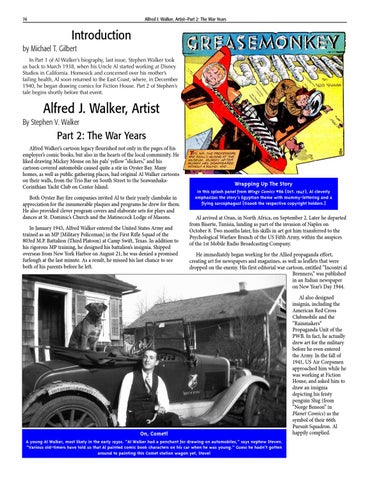
Wrapping Up The Story In this splash panel from Wings Comics #86 (Oct. 1947), Al cleverly emphasizes the story’s Egyptian theme with mummy-lettering and a flying sarcophagus! [©2008 the respective copyright holders.]
Al arrived at Oran, in North Africa, on September 2. Later he departed from Biserte, Tunisia, landing as part of the invasion of Naples on October 8. Two months later, his skills in art got him transferred to the Psychological Warfare Branch of the US Fifth Army, within the auspices of the 1st Mobile Radio Broadcasting Company. He immediately began working for the Allied propaganda effort, creating art for newspapers and magazines, as well as leaflets that were dropped on the enemy. His first editorial war cartoon, entitled “Incontri al Brennero,” was published in an Italian newspaper on New Year’s Day 1944.
On, Comet! A young Al Walker, most likely in the early 1930s. “Al Walker had a penchant for drawing on automobiles,” says nephew Steven. “Various old-timers have told us that Al painted comic book characters on his car when he was young.” Guess he hadn’t gotten around to painting this Comet station wagon yet, Steve!
Al also designed insignia, including the American Red Cross Clubmobile and the “Rainmakers” Propaganda Unit of the PWB. In fact, he actually drew art for the military before he even entered the Army. In the fall of 1941, US Air Corpsmen approached him while he was working at Fiction House, and asked him to draw an insignia depicting his feisty penguin Slug (from “Norge Benson” in Planet Comics) as the symbol of their 66th Pursuit Squadron. Al happily complied.
Mr. Monster’s Comic Crypt!
Messing Around Corporal Al chows down in the mess hall. Yum?
In May of 1944, at Santa Maria, Italy (outside Naples), Al Walker was given an assignment to design the cover and musical score for a new Irving Berlin song entitled “The Fifth Army’s Where My Heart Is,” which was included in Berlin’s This Is the Army overseas show. Al always treasured the memories of that special time, and shared some thoughts in letters sent to relatives.
(Above& below:) In 1941, pugnacious Slug the Penguin (seen in Al’s splash from Fiction House’s Planet Comics #16, Jan. 1942), become the Air Force’s 66th Pursuit Squadron’s mascot! [©2008 the respective copyright holders.]
Several US Army Air Corps insignia designed by Al Walker—and a photo of a 1937 Norge refrigerator. Could that popular brand have inspired Norge Benson’s name?
75
[Art Š2008 The Estate of C.C. Beck.]
83
Mac Raboy, eh? … the quiet guy over next to the windows. Okay, Mac … two can play that game. So, for months our “fellowship” consisted of a courteous coolness … equally balanced on both sides … and apparently of no further concern to anyone. Except, possibly … the new executive editor of the comics department. France E. Herron had left the company earlier in the year, and in his place was a writer who had been producing impressive Captain Marvel scripts consistently since the departure of originator Bill Parker in 1940 … a matter of special interest, that being the very period in which the World’s Mightiest Mortal was reported to have become the world’s mightiest superhero … in readership … and in sales.
By
[Art & logo ©2008 Marc Swayze; Captain Marvel © & TM 2008 DC Comics]
[FCA EDITORS NOTE: From 1941-53, Marcus D. Swayze was a top artist for Fawcett Publications. The very first Mary Marvel character sketches came from Marc’s drawing table, and he illustrated her earliest adventures, including the classic origin story, “Captain Marvel Introduces Mary Marvel (Captain Marvel Adventures #18, Dec. ’42); but he was primarily hired by Fawcett Publications to illustrate Captain Marvel stories and covers for Whiz Comics and Captain Marvel Adventures. He also wrote many Captain Marvel scripts, and continued to do so while in the military. After leaving the service in 1944, he made an arrangement with Fawcett to produce art and stories for them on a freelance basis out of his Louisiana home. There he created both art and stories for The Phantom Eagle in Wow Comics, in addition to drawing the Flyin’ Jenny newspaper strip for Bell Syndicate (created by his friend and mentor Russell Keaton). After the cancellation of Wow, Swayze produced artwork for Fawcett’s top-selling line of romance comics, including Sweethearts and Life Story. After the company ceased publishing comics, Marc moved over to Charlton Publications, where he ended his comics career in the mid-’50s. Marc’s ongoing professional memoirs have been a vital part of FCA since his first column appeared in FCA #54, 1996. Last issue Marc told of two individuals at Fawcett Publications who left a lasting impact on his career and life. In this installment he reflects on another pair of memorable Fawcett gentlemen. —P.C. Hamerlinck.]
The presence of affable, jovial Rod Reed made a difference around the place. His response, at the slightest suggestion among the employees for shuffleboard at lunchtime or bowling after work, described the very nature of the man: “Count me in!” And he made it a point to share thoughts with everyone … even the quiet guy over next to the windows. He and Mac Raboy could be seen chatting pleasantly during coffee breaks and eventually at the ball games. When I mentioned to Reed that the courteous coolness so carefully conducted between me and Mac over the months seemed to have mellowed, Rod chuckled: “He thought everyone from the South was a bigot!” And I knew Rod had settled that issue. I honestly believe that in that brief period I witnessed a turning point in the life of another human being. Mac Raboy had become a different
“W
hy don’t you just cut it out and paste it in?” Word for word I can hear it now!
It was late in the day, my first in the Fawcett offices … the year, 1941. There being nothing ahead for the evening other than the hotel room or a movie, I had offered to assist a late worker, who promptly requested that I copy a subject from a magazine he handed me. It was an airplane. I could have improved on it, but the man had said “copy.” I had no idea we were being watched from behind, until the voice came over my shoulder. Without turning I began a detailed explanation of how such a move might be considered unethical, unprofessional, unlawful … and a few other “uns” … when I realized that as I spoke, the observer had quietly donned hat and coat, and disappeared. Then it dawned on me that his remark was pure sarcasm. It really didn’t matter much … but you can understand my curiosity as to which member of that large art department it was. My fellow lateworker had the answer: “It wasn’t the kind of remark you’d expect from Mac, though!”
Yankee Doodle Came To Town Mac Raboy’s cover for Captain Marvel Jr. #9 (July 1943). Raboy took the familiar image of the marching musicians from the Revolutionary War—and turned it sideways. [©2008 DC Comics.]
86
Merciful Heavens A Short Story by C.C. Beck
“W
Illustrated by Beck self-caricatures Edited by P.C. Hamerlinck
hat’s the matter with you, Walter? I love it here. Why don’t you?” Gladys Dribble shrilled angrily. “Well … it’s dull. There’s nothing to do,” Walter Dribble
said wearily. “How can you say that? There’s bingo, dancing, hobby projects … everything a person could want. You ought to join the choir, Walter. Just think, there are a thousand voices in the choir, all singing like angels. You can hear it from here. Why don’t you get into it?” “I’m tone deaf,” Dribble said, as if hoping to put an end to the discussion. “Didn’t they fix you up when we came here? Mrs. Everard’s husband was deaf and they fixed him up,” Dribble’s wife pointed out, not giving up. “That’s different. He was just deaf. I can hear fine, always could. Just never could tell one damn note from another. Still can’t, dammit.” Dribble’s wife looked horrified. “Watch your language, Walter. You’re not supposed to swear here.”
[©2008 Estate of C.C. Beck.]
“I wasn’t swearing. I was cursing.” “There’s a difference?” “Of course. When you swear you say ‘by God’ or ‘Holy Jesus’ and so on. When you say ‘damn’ you’re just cursing.” “Shush! They’ll throw us out if you say such things,” Gladys Dribble whispered, looking around nervously. “Good. I wish they would. I’m sick of this place.” “After all we went through to get here? And all it cost?” “That’s another thing. It’s too fancy here. I wish I had my old job back and could do an honest day’s work. I tried to get a job here, but nobody would hire me.” “But we both worked hard for fifty years, Walter. Now we’ve earned our reward. Nobody has to work here … they have attendants to take care of everything. Just think, we’ll never have to life a finger again as long as we live. It’s as if we’d died and gone to Heaven!” “Well, this may be your idea of Heaven, but it ain’t mine. I suppose you’ll have me taking harp lessons next, eh?” “Oh, don’t be silly, Walter. All I’d like is for you to relax and enjoy yourself. I’ve felt wonderful ever since we got here, haven’t you? Look at me … I don’t feel a day over sixteen!” Dribble snorted with disgust as his wife got up lightly from the bench on which they had both been sitting and went into a little dance by herself. “Stop that, Gladys! You look ridiculous … you’re over eighty! You look like you’ve gone into your second childhood.”
“Maybe I have,” his wife laughed. “Tra la la … here we go gathering nuts in May.” “Sit down and act your age, Gladys. If anybody sees you they’ll send for the nut wagon,” Dribble snarled. His wife stopped dancing and looked around at the beautiful park-like setting. “It’s always springtime here, Walter. Look at all the flowers and trees and the sunshine. This whole place is a dream come true.” “More like a nightmare, to me. Sometimes I think we’ve been here for a hundred years already, but how can you tell when there ain’t any clocks or calendars or seasons? They never even turn the lights off around this damn joint. The whole place stinks!” Dribble’s wife finally gave up her efforts to cheer her husband up. She turned away from him and drew a deep breath of the softly scented air. Then she turned to face him once more. “You’re impossible! What do you want, Walter?” she asked in desperation. “Well … a good stiff drink would help. A guy can’t even buy a drink here.” “Of course not. Everything’s free.” “They don’t even have liquor here, Gladys. No booze, no tobacco, no nothing. I think I’ll go for a walk.” “Suit yourself. I’m going to play cards,” Dribble’s wife said in a tired voice. “Okay, have a good time,” Dribble said sourly. “Bring back your winnings and I’ll help you count ’em. It’ll give me something to do.”