Comic Fandom Archive
3
Fandom Before TBG
A Quick Look At “The Way We Were” Before Alan Light Launched The Buyer’s Guide For Comics Fandom by Bill Schelly
omicdom was established long before The Buyer’s Guide for Comics Fandom began arriving with clockwork regularity in our mailboxes. Indeed, TBG’s debut in spring of 1971 occurred almost exactly ten years after the spring 1961 debuts of Alter-Ego #1 and Comic Art #1. Thus, the beginning of fandom’s second scintillating decade was marked by the appearance of Alan Light’s phenomenal new publication.
C
How did comics fans get along pre-TBG, without a weekly or biweekly advertising vehicle? Since fandom developed not by any organized plan, but organically to fill the needs of aficionados and collectors of comic books and strips, it’s worth reviewing our history to see how that growth led to TBG (which, of course, eventually became CBG)…. The most basic force that fueled the formation of comic (or comics) fandom in 1960 and 1961 was fans’ desire to read and collect old comic books.
That, in turn, fueled the craving for information about comics of the past, because collectors needed to know the titles, dates, key issues, and contents of those sought-after, elusive issues.
Thus, when Jerry Bails (with a certain rascally co-editor) published the first, then-hyphenated issue of Alter-Ego on March 28, 1961, he was met not only with letters from fans hungry for more articles and data—but also with requests from fans to run their want lists and “for sale” lists in the next issue. And so, in A-E #2 in June, there appeared an ad for old comics sent in by Claude Held, who had been dealing funny-books for several years from his base in Buffalo, New York. Other advertisers were Frank H. Nuessel of Chicago, Red’s Book Shop of Dayton, Ohio, and Charles Crum of Jacksonville, Florida.
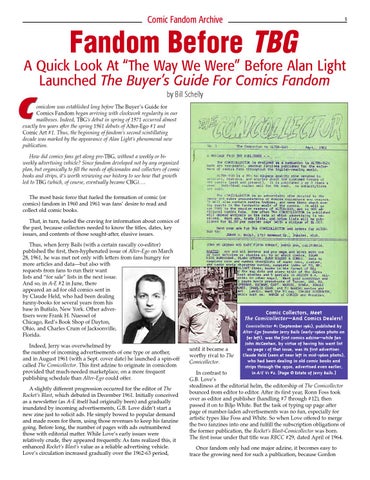
Indeed, Jerry was overwhelmed by the number of incoming advertisements of one type or another, and in August 1961 (with a Sept. cover date) he launched a spin-off called The Comicollector. This first adzine to originate in comicdom provided that much-needed marketplace, on a more frequent publishing schedule than Alter-Ego could offer.
A slightly different progression occurred for the editor of The Rocket’s Blast, which debuted in December 1961. Initially conceived as a newsletter (as A-E itself had originally been) and gradually inundated by incoming advertisements, G.B. Love didn’t start a new zine just to solicit ads. He simply bowed to popular demand and made room for them, using those revenues to keep his fanzine going. Before long, the number of pages with ads outnumbered those with editorial matter. While Love’s early issues were relatively crude, they appeared frequently. As fans realized this, it enhanced Rocket’s Blast’s value as a reliable advertising vehicle. Love’s circulation increased gradually over the 1962-63 period,
Comic Collectors, Meet The Comicollector—And Comics Dealers!
until it became a worthy rival to The Comicollector.
Comicollector #1 (September 1961), published by Alter-Ego founder Jerry Bails (early-1960s photo on far left), was the first comics adzine—while fan John McGeehan, by virtue of having his want list on page 1 of that issue, was its first advertiser. Claude Held (seen at near left in mid-1960s photo), who had been dealing in old comic books and strips through the 1950s, advertised even earlier, in A/E V1 #2. [Page © Estate of Jerry Bails.]
In contrast to G.B. Love’s steadiness at the editorial helm, the editorship of The Comicollector bounced from editor to editor. After its first year, Ronn Foss took over as editor and publisher (handling #7 through #12), then passed it on to Biljo White. But the task of typing up page after page of number-laden advertisements was no fun, especially for artistic types like Foss and White. So when Love offered to merge the two fanzines into one and fulfill the subscription obligations of the former publication, the Rocket’s Blast-Comicollector was born. The first issue under that title was RBCC #29, dated April of 1964. Once fandom only had one major adzine, it becomes easy to trace the growing need for such a publication, because Gordon