Roy Thomas Collected Comics Fanzine
THE
COLLECTION
All characters TM & Š2006 DC Comics.
VOLUME 1
Reprinting the first two issues of the acclaimed magazine, plus new material!
4
THE
™
COLLECTION VOLUME 1
Table of Contents A/E COLLECTION, VOL. 1, EXTRA!
Writer/Editorial For Collected Edition: . . . . 3 Editor
From Alter Ego V3 #1:
Associate Editor
Covers. . . . . . . . . . . . . . . . . . . . . . . . . . . . 6-7
Roy Thomas Bill Schelly
Original Design & Layout
Chris Knowles, Rich Grasso, & John Morrow (V3#1) Jon B. Cooke (V3#2)
Design & Layout (New Material) Christopher Day
Consulting Editor John Morrow
The original covers of our first issue (in black-&-white this time) as rapturously rendered by Jerry Ordway and Irwin Hasen, respectively.
Writer/Editorial: Silver Age Forever! . . . . . . 8 Roy Thomas & Bill Schelly welcome you to the new Alter Ego.
The Stan Lee Roast. . . . . . . . . . . . . . . . . . . . . . . . . . . . . . . . . 10 The Man gets skewered by David, Buscema, Romita, Thomas, Claremont, Shooter, & Schwartz— but it’s all in fun, right, fellas? Right, fellas?
Production Assistant
A/E COLLECTION, VOL. 1, EXTRA!
Comic Crypt Editor
Remembrance Of Things Past. . . . . . . . . . . . . . . . . . . . . . . . . . . . . . . . . . . . . . . . . . . . . . . . 23
Eric Nolen-Weathington Michael T. Gilbert
FCA Editor
P.C. Hamerlinck
Editors Emeritus
Jerry G. Bails, Ronn Foss, Biljo White, Mike Friedrich
Cover Art (This Volume)
Nick Cardy, Ramona Fradon, Joe Giella, Dick Giordano, Joe Kubert, George Pérez, & George Tuska
Cover Color (This Volume) Tom Ziuko
Contributors (To Original V3 #1-2):
Neal Adams • Phillip Anderson Thelmon Baggan • Bob Bailey Mike W. Barr • Steve Billnitzer Mike Bise • Bill Black Ray Bottorff, Jr. • Jack Burnley Sal Buscema • Chris Claremont Ernie Colón • Pierre Comtois Carla Conway • Ray A. Cuthbert Peter David • Craig Delich David Delich • Al Dellinges Will Eisner • Nancy Ford Carl Gafford • Paul Gambaccini Jeff Gelb • Jean Giraud (Moebius) Ron Goulart • Richard “Grass” Green Martin Greim • Mark Hanerfeld Ron Harris • Irwin Hasen Roger Hill • Richard Howell Gil Kane • Robert Kanigher Jon B. Knutson • David Anthony Kraft Stan Lee • Larry Lieber Jean-Marc Lofficier Russ Maheras • Lou Mougin
More fabulous photos from the 1995 Stan Lee Roast.
Da Frantic Four! . . . . . . . . . . . . . . . . . . . . . . . . . . . . . . . . . . . . . . . . . . . . . . . . . . . . . . . . . 26 Bill Schelly presents Grass Green’s classic 1962 FF parody.
The Secret Origins of Infinity, Inc. . . . . . . . . . . . . . . . . . . . . . . . . . . . . . . . . . . . . . . . . . . . . 32 The 1982 creation of the JSA’s heirs apparent, courtesy of Thomas, Ordway, & Machlan.
Vive Le Silver Surfer!. . . . . . . . . . . . . . . . . . . . . . . . . . . . . . . . . . . . . . . . . . . . . . . . . . . . . . . 42 Jean-Marc Lofficier on two 1980 issues of Silver Surfer—published only in France!
Writer/Editorial: Golden Age Forever!. . . . . . . . . . . . . . . . . . . . . . . . . . . . . . . . . . . . . . . . 47 “So I Took The Subway And There Was Shelly Mayer!” . . . . . . . . . . . . . . . . . . . . . . . . . . 48 An interview with Golden Age (and newspaper comic strip) great Irwin Hasen.
Two Touches Of Venus . . . . . . . . . . . . . . . . . . . . . . . . . . . . . . . . . . . . . . . . . . . . . . . . . . 60 Never-seen Wonder Woman/All-Star Comics scripts from 1942—plus rare H.G. Peter art.
Mr. Monster’s Comic Crypt: “There’s Money In Comics!” . . . . . . . . . . . . . . . . . . . . . . . . 71 Michael T. Gilbert presents Stan Lee’s how-to article from the 1947 Writer’s Digest.
FCA (Fawcett Collectors of America) #60 . . . . . 77 P.C. Hamerlinck showcases Marc Swayze—& that Brazilian Capt. Marvel/Human Torch crossover.
From Alter Ego V3 #2: Covers . . . . . . . . . . . . . . . . . . . . . . . . . . . . . . . . 88-89 In glorious black-&-white! Two cavortin’ covers—by Gil Kane and Jack Burnley.
Writer/Editorial: Silver Threads Among The Gold (& Bronze & Even Beyond) . . . . . . . . . . . . . . . . . . .90
Article
5 Will Murray • Jerry Ordway Jon E. Park • John G. Pierce John Romita • Arlen Schumer Julius Schwartz • Jim Shooter Jeff E. Smith • Robin Snyder Marc Swayze • Richard Deane Taylor Daniel Tesmoingt • Dann Thomas Joel Thingvall • Marv Wolfman • Lynn Wooley
Additional Contributors (To This Volume):
Splitting The Atom . . . . . . . . . . . . . . . . . . . . . . . . . . . . . . . . . . . . . . . . . . . . . . . . . . 92 Roy Thomas tells all (we hope!) about the 1960-61 origins of the Tiny Titan—starring Gil Kane, Julius Schwartz, Gardner Fox, and Jerry Bails.
A/E COLLECTION, VOL. 1, EXTRA!
The Justice League—Cheaper By The Dozen . . . . . . . . . . . . . . . . . . . . . . . . . . . . 103 Twelve great Silver Age artists’ takes on one of the great Silver Age concepts—the JLA!
Splicing The Atom. . . . . . . . . . . . . . . . . . . . . . . . . . . . . . . . . . . . . . . . . . . . . . . . . . . 115 Pro writer Mike W. Barr talks about finding one of Gil Kane’s 1960 concept drawings.
“Stan Made Up The Plot…And I’d Write The Script” . . . . . . . . . . . . . . . . . . . . . . 117 A conversation with artist Larry Lieber—one of the most important scripters of the Silver Age.
Mr. Monster’s Comic Crypt: The Legendary “Lost” Spirit Story!. . . . . . . . . . . . . . . 131 About that ultra-rare 1966 Spirit adventure by the immortal Will Eisner.
A/E COLLECTION, VOL. 1, EXTRA!
The “Found” Spirit Art . . . . . . . . . . . . . . . . . . . . . . . . . . . . . . . . . . . . . . . . . . . . . . . 133 A few tidbits from the “lost” story—and other Eisner goodies.
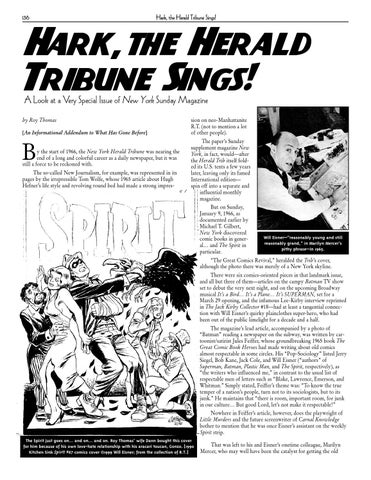
Hark, The Herald Tribune Sings! . . . . . . . . . . . . . . . . . . . . . . . . . . 136 A most extraordinary 1966 issue of the Trib’s New York magazine.
Fandom’s FAN-tastic Past—from the ’60s To The ’90s . . . . . . 138 A guided tour of photos and other artifacts of comic fandom’s early movers and shakers.
re: [Letters From Stan Lee & A Few Other Folks] . . . . . . . . . . . . . . . 143 “It Was Only Starman I Paid Attention To!” . . . . . . . . . . . . . . . . . . . 146 Actually, interviewee (& Golden Age icon) Jack Burnley lavished attention on Superman & Batman, too!
How Marv Wolfman And Co. Saved (A Bit Of) The Golden Age . . 160 On how the future scripter of Tomb of Dracula & New Teen Titans did it!
A/E COLLECTION, VOL. 1, EXTRA!
“Written Off 9/30/49” – The Special Edition. . . . . . . . . . . . . . . . . . . . . . . . . . . 163 Three more pages’ worth of 1940s DC art that escaped oblivion—never before printed!
The Sky Wizard’s Lost Origins. . . . . . . . . . . . . . . . . . . . . . . . . . . . . . . . . . . . . . . . 166 Will Murray unearths the story of the creation of an obscure (but real!) Golden Age super-hero!
Kanigher On Kanigher! (And Everything Else!) . . . . . . . . . . . . . . . . . . . . . . . . . . . 169 The fabled Golden & Silver Age writer/editor writes—and Ye Editor responds.
FCA (Fawcett Collectors of America) #61 . . . . . . . . . . . . . . . . . . . . . . . . . . . . . . 177 Captain Marvel artist/co-creator C.C. Beck—Marc Swayze—and an interview with 1940s Fawcett artist Richard Deane Taylor.
Jim Amash • Bob Bailey • Daniel Best Robert Weinberg • Dominic Bongo Jerry K. Boyd • Mike Burkey William Cain • R. Dewey Cassell Gary Colabuono • Shelton Drum Michael Dunne • Shane Foley Arnie Grieves • Heritage Comics, Inc. George Hagenauer • Denis Kitchen Larry Lieber • Ralph Macchio • Dan Makara Don Mangus • Edwin & Terry Murray Ethan Roberts • Robert Weinberg Marv Wolfman • Gregg Whitmore Eddy Zeno
About Our Cover: For several years now, collector Arnie Grieves has been persuading Silver Age artists who’d done “Justice League” tales at one time or another to draw one figure each of a “JLA Jam” illustration. Arnie has his own vision, though: in lieu of Aquaman, he asked merman artists Ramona Fradon and Nick Cardy to sketch other heroes—in Ramona’s case, Black Canary instead of true charter JLAer Wonder Woman—and he asked Joe Giella to garb Green Arrow in his second set of threads. No matter. It’s a great illo, first printed in Michael Eury’s Justice League of America Companion, Vol. 1, a few months back—and now, for the first time, in full and fabulous color! Art by Joe Kubert, George Pérez, Dick Giordano, Nick Cardy, Ramona Fradon, Joe Giella, & George Tuska. [Hawkman, Atom, Martian Manhunter, Flash, Black Canary, Green Arrow, & Green Lantern TM & ©2006 DC Comics.] Art On Contents Pages: (Clockwise from top left:) Penciler John Romita, one of Stan Lee’s rhapsodic 1995 roasters, teamed up with inker Murphy Anderson for this sketch of Spider-Man playing buckin’ bronco with The Vulture, as per the program book for Shelton Drum’s 2004 Heroes Convention (Charlotte, NC). [Art ©2006 John Romita & Murphy Anderson; Spider-Man & Vulture TM & ©2006 Marvel Characters, Inc.] Spidey (almost) meets the Hulk, in this panel from the Spider-Man daily comic strip for Oct. 11, 1989. Script by Stan Lee… pencils by Larry Lieber… inker uncertain (maybe the late John Tartaglione?). Thanks to Larry L. [©2006 Marvel Characters, Inc.] The Silver Age Atom’s getting smashed— could it be by his 1940s counterpart on the facing page? Art by Gil Kane (pencils) & Murphy Anderson (inks), from Showcase #36 (Jan.-Feb. 1962). [©2006 DC Comics.] Yep—could be! Irwin Hasen’s Golden Age Atom swings a mean left, from the cover of All-Star Comics #43 (Oct.-Nov. 1948). [©2006 DC Comics.]
Concept & dialogue: Roy Thomas after Stan Lee.
10
Stan Lee Roast
The Stan Lee Roast Held at the ’95 Chicago Comicon Transcribed by Dann Thomas Edited by Roy Thomas Introductory Note by Nancy Ford: The Chicago Comicon, coordinated by Robert Weinberg, Gary Colabuono, Larry Charet, and me, had been running for many years before we started our own awards presentation. We decided to honor people who had been pivotal in the comics and related fields, and who had done their work in an entertaining and classy manner, so we instituted the toast/roast banquet. At first the other speakers at the banquet were nervous about the possibility of their remarks being interpreted as being mean-spirited, but we assured all who participated that they had the choice of what to say, and that all humor would be based in respect. Our first honoree, in 1993, was Julius Schwartz, followed by Harlan Ellison in 1994, and Stan Lee in 1995. Not only were the honorees spectacular, but the roasters were also in a class of their own. The awards were held for about four years, until the Chicago Comicon was bought and the awards dropped. Note by Ye Editor: For the most part, I have not indicated when or to what extent the audience applauded, or laughed, or booed good-naturedly, or whatever, leaving that to the reader’s good sense. Suffice it to say, there was a lot of applause and
laughter, in particular. The transcription has been abridged slightly, in the interests of space, although probably 75-80% of what the major eight parties involved said is included... no easy task, since the videotape of the roast was not intended for transcription. No official photograph of the dais where were seated the seven—eight, counting Stan Lee— people who composed the group seems to exist; but hopefully the accompanying photographs, generously provided by Nancy Ford, will give an added feeling to what transpired in late June of 1995. Alas, Nancy was unable to recall the name of the photographer, but if he’ll make himself known, we’ll credit him in a future issue. For the most part, the comments made by roasters and roastee need little explanation to a reasonably knowledgeable comics fan audience—and would often be utterly unintelligible to anyone else. Thus, the only elaboration we’ll make at this point is to say by 1995 the socalled “Marvelution”—read, “downsizing”— had begun, as Marvel’s market share eroded and its financial troubles moved into high gear (and onto the front pages). This was also the period during which it was wrongheadedly (but mercifully briefly) decided that many years’ worth of Spider-Man adventures had actually happened to a clone of Peter Parker; hence the various “clone” references. And now, without further ado.... [To applause in the packed banquet room, the seven roasters are escorted to their seats on the dais by young ladies. At this point SpiderMan enters, strides to the microphone.]
“I’d like to introduce a man who’s been like a father to me...”
11 SPIDEY: I’d like to introduce a man who’s been like a father to me. Ladies and gentlemen... Mr. Stan Lee! [Stan Lee is ushered in, to thunderous applause, and hops onto the dais.] STAN LEE: Thank you... thank you! [Throws up his arms, shouts:] EXCELSIOR! [Sits. Gary Colabuono walks to the podium.] GARY: Our master of ceremonies tonight is a dear friend of mine, who’s our guest of honor this year. [At this point Peter briefly falls off his chair, but regains it with reasonable aplomb.] All of us in the business end of comics are envious of Peter David, because he started in the business end of comics, and now he’s doing what we’ve all wished we could do. Peter David... PETER: Ladies, gentlemen, disgruntled former Marvel employees—and we’ll be having a “Count the Former Marvel Editors-in-Chief Contest” after dinner—last year the Chicago Comicon had Harlan Ellison as the guest of honor, and they had a Harlan Ellison Tribute Dinner. This year I am the guest of honor... so naturally we’re having a Stan Lee Tribute Dinner. I’m actually a “special guest,” which is kind of like “special Olympics,” I suppose. At any rate, ladies and gentlemen, try and have a fun evening. [After dinner, Peter takes the podium again; he blows one of the noisemakers provided to each guest; its tongue juts out, then dips straight down] Look, it’s Marvel market-share toys! [Mixture of groans, laughter, applause] We begin tonight’s symposium with my favorite Stan Lee anecdote. I regret that it is customary, indeed almost an obligation, that when you are telling a Stan Lee anecdote, you have to do a Stan Lee impression. This is actually fairly easy because, to get Stan, you do kind of a cross between Mr. Rogers and Maxwell Smart. You know, like [in high-pitched voice:] “Would you believe, three Peter Parkers!” I was on a convention panel with Stan, and I was supposed to ask him all kinds of interesting questions, which, ideally, he would answer. And just before we start, Stan says to the audience: “I just want to tell you guys about this young, fabulous writer”—this is a few years ago—he says, “This young man has written one of the best graphic novels Marvel has ever published!” I knew I was in trouble, because at the time I had not written any graphic novels. And Stan drapes his arm around me and he says, “Ladies and gentleman, this young man, the writer of Greenberg the Vampire!” The audience goes like this... [Imitates someone starting to applaud, then slowing his clapping, halting, puzzled] I’m sitting there dying, and I say to the audience, “Should I tell him?” And they say, “I think you’re going to
12
Stan Lee Roast podium]
M.C. Peter David: “When you are doing a Stan Lee anecdote, you have to do a Stan Lee impression....”
SAL: Thank you. What a night! Peter, I know a guy named Guido in Brooklyn that’ll pay you a visit. He’s got a nose like this. [Indicates broken nose] I was absolutely thrilled when I was asked to come here to this banquet honoring this living legend...
Hulk © 1999 Marvel Characters, Inc.
STAN: He forgot my name!
have to.” And Stan says, ”What?” And I have to explain to him that I am, in fact, not Marc de Matteis. Stan actually had a fairly good explanation as to why he’d screwed up, an explanation of which I think I speak on everyone’s behalf when I say: “WE DON’T CARE!” At any rate, I’d like to introduce, one by one, our speakers. [Looks toward Sal Buscema] What can I say? When it comes to discussing master storytelling, dynamic rendering... when it comes to discussing the true artistic greats of the super-hero genre, what can I say that has not already been said about—Sal Buscema’s brother? I remember as a kid, many, many, many, many years ago, the first time I opened a comic and saw the name “Sal Buscema.” And I thought, “Wow! John Buscema has a sister!” Ladies and gentlemen, a man who needs no introduction, and, I would hazard a guess, would have preferred none to this one... Ms.-ter Sal Buscema! [Sits down, as Sal walks to the
SAL: ...whatever his name is. I left Virginia, left my lovely wife and family to come here to make you laugh with some funny remarks about this guy. And believe me—believe me—there is nothing funny about this man! Absolutely nothing! So where do I start? I guess at the beginning. Many, many years ago, more than I like to remember, I had an appointment with Stan, and I was very nervous. You know, when you’re going to meet a living legend, you get very nervous. I was ushered into his office. He asked me to sit down, and proceeded to give me the Stan Lee Five-Minute Crash Course on How To Do Comics the Marvel Way. He started leaping around his office—on the chair, up on the desk, back onto the floor, back up onto the desk, super-heroes from the right, super-villains from the left—I was absolutely terrified! I didn’t know what was going on! Scared the hell out of me! Just about the time when I was ready to run out of the room, he was finished. But then, I had a vision... Can you imagine this man in a Spider-Man costume? That scared me even more! He asked me to step outside and talk to Sol Brodsky—the late Sol Brodsky, delightful man—about a page rate, and then to come back after we had settled on it. Sol and I bantered back and forth, and we came up with a figure. I went back into Stan’s office, and he said, “What did you settle on?” And I told him the price. And he said, “Well, it’s probably more than you’re worth.” True story.
What a confidence-builder this was! Stan, it’s been 27 years. Can I have a raise now? But, you know, in reality, I really have not worked with Stan that much! And from what I understand, this is probably the best thing that’s ever happened to my career! Look at the guys that he has worked with: John Romita... Roy Thomas... Tom DeFalco. These guys are still in their prime, and it’s all over for them! [Looks at John Romita] I think Guido’s gonna be paying me a visit! A couple of years ago, Stan and I were both at a convention in Texas—it was part of a Marvel Megatour, and all the Marvel people were housed in the same hotel. And Stan and I sort of gravitated together, I guess because we were surrounded by a bunch of teenyboppers. You know, Stan’s older than dirt, and I’m almost as old as dirt, so it was sort of the natural order of things. STAN: And I had no one else to talk to. SAL: And he had no one else to talk to. They were all ignoring him. So anyway, our host brought us to this very nice Mexican restaurant and we had a wonderful conversation. “Conversation.” He talked... I listened. As a matter of fact, this is the first time I have been in the same room with this man that I’ve been able to say anything more than, “Hi, Stan, how are you?” I’ve never been able to get a word in edgewise. Now we get serious. I think everybody here is familiar with this man’s credits. They’re a mile long, they’re endless, they go on forever, he’s done everything. To me, the thing that is most significant—the contribution that he’s made to this industry, this crazy industry that we’re in, his vision, his seemingly boundless energy, his considerable talents—I think what I’m trying to say is that there’s probably not anyone in this industry today—any artist,
Sal Buscema: “[Stan] started leaping around his office... I was absolutely terrified!”
26
Comic Fandom Archive
You’ve heard of the Bestest League of America? Get ready to meet FUMIN’ SCORCH… INVISIBUBLE GIRL… THANG… and MISTER FRANTIC-otherwise known as…
Da
Frantic Four! A fond look back at one of the silliest chapters in the annals of comic fandom
by Bill Schelly
T
here is a famous, and telling, anecdote about the death of a venerable actor. A man approached the bedside of his dying friend and asked, “What you’re going through... is it very difficult?” The actor opened his eyes and whispered, “Dying is easy. Comedy is hard.”
Indeed. Whatever the medium—stage, screen, the printed page—humor rarely gets the same respect as serious material... yet the practitioners of these arts have always held that laughs are harder to evoke than tears. I submit that this is no less true for the comic book medium. Consider the case of Richard “Grass” Green, one of the premier artists to emerge in the classic comics fanzines of the early 1960s. Though he was well known for his funny stuff, it took the straight-ahead adventures of Xal-Kor, the Human Cat (in the pages of the long-running Star-Studded Comics), to cement his reputation. In retrospect, however, it seems obvious to this writer that Green’s greatest talent— where he outshone all others in the super-hero fanzine field, and indeed could stand comparison to the great parodists in the pro comics— was his genius for comedy. And it was “Da
Frantic Four” comic strip that is presented here, and which originally appeared in the fanzine The Comicollector #8 (Oct. 1962), that introduced Green’s facility for parody to fandom in general. Before we get to that, we must first back up to the early 1950s for some vital background information. We can’t discuss “Grass” Green or Da Frantic Four without discussing his boyhood friendship with another major artist from the Golden Age of comic fandom, Ronn Foss. It was Ronn who, at some time during their days as junior high pals in Fort Wayne, Indiana, gave Richard the nickname Grasshopper, later shortened to just Grass. The nickname stuck, and so did their friendship, leading to many collaborations over the years. Did the fact that Grass Green was an African-American make their relationship in
any way difficult? In a recent interview, Ronn stated that it was never a factor. “We were more like brothers than friends,” he said. “As soon as we discovered each other’s mutual interest in comics, and drawing, we were inseparable. We would spend hours on the phone, excitedly talking about our ideas for comic book characters.” When Grass completed a hitch in the U.S. Air Force and was discharged in Southern California, he naturally made his way north of San Francisco to visit his buddy Ronn, who had moved there with his young bride Myra Left: Fandom’s favorite Green creation: Xal-Kor, the Human Cat. Above: The first Frantic Four cartoon, by Ronn Foss, from the cover of The Comicollector #7.
Da Frantic Four
just months before. In the summer of 1962 Foss introduced Grass to comics fandom. It was perfectly natural that these two budding talents would collaborate on an idea for the fanzines. That’s exactly what happened, and the result was “Da Frantic Four.”
27
Grass, Ronn, and Myra, though evidently Myra did not actually contribute to this project.)
parodies in Mad magazine drawn by Mort Drucker were visually sedate affairs, relying principally on his uncanny caricatures of popular actors, along with clever scripting. Green clearly fell into the Kurtzman camp.
Within the realm of parody, many artistic approaches are possible. Harvey Kurtzman’s parodies in the early color Mad comics (laid out by Kurtzman, then finished by Elder, Wood, Davis, et al.) were broad and highly energetic, often getting laughs from slapstick. In contrast, by 1962 the movie
From Grass’ pencil flowed an FF who were like something out of the Keystone Kops. Green worked quickly—instinctively—with little pre-planning, and the result was his highly spontaneous, farcical brand of lunacy. The strip is chaotic, even anarchistic, basically eschewing a semblance of narrative, or even conventional comedy construction. This is Grass at his unbridled, unselfconscious best:
Foss’ discovery of the infant comics fandom movement of the early ’60s had come when a friend had sent him a copy of Alter Ego #2 (June 1961). He shared this and A/E #3 (Nov. 1961) with Grass. Those issues featured, among a number of groundbreaking articles on the history of comics, Roy Thomas’ Kurtzman-influenced parody of the JLA called “The Bestest League of America.” Is it unreasonable to conclude that Da Frantic Four was directly inspired by—a sort of answer to— Thomas’ BLA? If so, there is a certain symmetry, since the LeeKirby Fantastic Four comic was Marvel’s attempt to capture some of the lightning Julius Schwartz had found when he launched the re-tooled Justice Society in The Brave and the Bold #28. Lightning had indeed struck twice. The self-styled “World’s Greatest Comic Magazine” became the sensation of 1962. The FF received the Alley Awards from fandom for “Best Comic Book of the Year” and “Best Group of Heroes” for that year, toppling the JLA, who had been the winners the year before. It’s a testament to the early impact made by Fantastic Four that the spoof presented here was understood by all, less than a year after Lee and Kirby’s team comic debuted. “Da Frantic Four—The World’s Most Greatless Heroes!” began as a single gag panel in the form of a cover, drawn by Foss for The Comicollector #7 (Sept. 1962), Ronn’s first issue after taking over the editorial reins from Jerry Bails. Using that cartoon as a creative springboard, Foss and Green co-plotted a six-page strip for the next issue of CC. (The “Triad” credited on the strip itself was a name meant to include
Top:!A 1998 self-caricature by!Grass. Above: Splash page to “Da Frantic Four”; the rest of the story follows. Just turn the mag sideways...
32
Two Co-Creators Reveal—
Two Co-Creators Reveal—
The Secret Origins
of Infinity,
Inc.
by Roy Thomas (with the special input of Jerry Ordway)
I. A Concept a-Borning The sons and daughters—the natural children and spiritual heirs—of the Justice Society of America! Turns out this may be one of the oldest ideas in the so-called Silver Age of Comics, and I’m just lucky I’m the guy who got to write it first. Luckier still that, when I got my shot, I had two of the most talented young artists around to do it with me! Let’s backtrack a bit: In Bill Schelly’s 1995 book The Golden Age of Comic Fandom, Larry Ivie, a comics/ science-fiction fan as well as a talented artist and writer, reported that in the late ’50s he spoke to a DC editor about an idea he had: “Ivie’s great disappointment was that National wasn’t interested in his proposed revival of the Justice Society of America, to be called the Justice Legion of the World, which would be made up of the sons and daughters of the original JSA.”
America from All-Star Comics. It was quite a different group from what Larry had envisioned, but his “sons and daughters” concept was an idea that was bound to surface again. It was, as they say, “in the air.” In 1975, having resigned the previous year as editor-in-chief, I was still employed by Marvel as a contractual writer/editor (its first, after Stan Lee). One night, at the Manhattan apartment of my friend Gerry Conway, who had recently stopped writing for Marvel to return to DC, the two of us were kicking around ideas, as was our wont. And suddenly I heard myself suggesting a few pet notions I’d like to see DC publish, even if I wasn’t free to write them myself.
Larry moved on to other projects, including his own magazine Monsters and Heroes, and has promised that one of these days he’ll tell Alter Ego the full story of his “Justice Legion,” a concept that was perhaps a bit ahead of its time. In 1960, of course, under editor Julius Schwartz, National (as DC was then officially known) launched the Justice League of America, an updated version of its 1940s Justice Society of
This Mike Machlan-penciled, Jerry Ordway-inked illustration became the cover of Infinity, Inc. #1. ©1999 DC Comics.
The Secret Origins of Infinity, Inc. One of those ideas was the return of AllStar Comics, with the Justice Society of America. Gerry sparked to the idea at once and carried the ball from there, with no further input from me. All-Star Comics #58 (Jan.-Feb. 1976), the first of the new series, was of course set on Earth-Two. And if you have to ask what Earth-Two was, you’re probably too young to be reading this, but: From 1963-1985, the JSA existed on a parallel world of that name, from which they made annual forays into the pages of Justice League of America. Writer/editor Gerry took them out of that limited guest-star sphere and into their own magazine again, though still set on Earth-Two. To add a youthful accent to a bunch of heroes who after all had been around since World War Two and before, he added to the JSA an “All-Star Super Squad” composed of three heroes who hadn’t been JSAers in the old days: the Earth-Two Robin, the Star-Spangled Kid (from 1940s Star-Spangled Comics)—and Power Girl, a new heroine he created as the cousin of that world’s Superman, and thus the alternate Earth’s equivalent of Supergirl. Power Girl, named Kara (Gerry and Carla Conway would later name their only child Cara; she also happens to be my godchild), proved instantly popular. Of course, her stunning figure and cut-out bust, as drawn by Ric Estrada and Wally Wood, probably didn’t hurt any. Later Gerry offered me a chance to ghostwrite an issue or two of All-Star. I thanked him, but told him that if I ever did a comic about the JSA, I wanted my name on the splash page. He understood. Soon afterward, when Stan and I lured Gerry back to Marvel, Paul Levitz of Legion
33
of Super-Heroes fame took over the scripting of All-Star. In issue #70 (Jan.-Feb. 1978), he and artists Joe Staton and Bob Layton introduced The Huntress. In the 1940s this had been the name of a Wildcat villainess, but this one was different: She was the daughter of the Earth-Two Batman! Thus, the notion of the sons and daughters of the JSA picking up the torch from the older heroes was slowly and unconsciously taking form, even if Power Girl was Superman’s cousin rather than his daughter. When the great DC Implosion of 1978 led first to cancellation of the revived All-Star and then of the Adventure Comics into whose many pages the JSA had retreated, Power Girl and The Huntress went mostly into mothballs. But not for long.
II. Elements Assemble! In 1980 I reluctantly ended my 15-year stay at Marvel and (not at all reluctantly) signed a writing contract with DC. Among other things, I was allowed to create a new title—All-Star Squadron, set during the World War II years—to utilize the many EarthTwo super-heroes of that era (including but not limited to the JSA). My longtime colleague Len Wein was assigned as the book’s editor and chose the artists, though it was understood that the story direction of the series would be left to me. With art by Rich Buckler and inker Jerry Ordway, and a brilliant cover concept by Len, All-Star Squadron #1 (Sept. 1981) had a very good sale of 250,000+ copies; and while it soon fell from those lofty heights, the comic fared well for some time. A primary reason for that was Jerry Ordway.
Squadron. But as soon as I saw his embellishing of Rich’s pencils on the 16-page preview slated to appear as a teaser in JLA #193, I fell in love with his work. As an inker, anyway. Nineteen issues later, after Rich had long since departed and Jerry had spent more than a year inking the pencils of Adrian Gonzales, Len forced Jerry on me again—this time as penciler as well as inker. Since again I hadn’t seen specimens of Jerry’s work in this area, I back-pedaled, but it was Len’s decision. (Jerry told me recently that actually he’d been trying to get penciling work from DC for some time. He once agreed to ink Joe Staton on JLA, being led to believe that he was being groomed to take over as penciler; but he quickly learned Staton wasn’t going anywhere, so Jerry left JLA instead. Finally, he says, he announced that if he wasn’t made penciler of All-Star Squadron, he would have to leave the title. He got the job.) I’ll admit to initial misgivings when I pored over the first few pages of Jerry’s pencils for #19 (March 1983). Not that they weren’t good—in some ways they were very good. I was especially impressed by his renderings of the Trylon and Perisphere and other artifacts left over from the 1939-40 New York World’s Fair. Still, I wasn’t quite 100% sold— —until I flipped over Page 8, and saw his powerful full-page panel of six All-Stars staring
I won’t go into rhapsodies here about Jerry’s talent, because I’ll admit that, no less than twice, he was thrust upon me by editor Len Wein.
Top: Gerry Conway’s 1976 revival of All-Star Comics featured an adult Robin, the Star-Spangled Kid—and a very pneumatic Power Girl, drawn by Ric Estrada and Wally Wood. © 1999 DC Comics.
First it was as an inker. Now, I had nothing against Jerry—it’s just that Len hadn’t shown me any samples of his inking, so to me Jerry was an unknown quantity when he was made inker of All-Star
Left: Hippolyta Trevor had made her debut in Wonder Woman #300 only months before the confrontation with her mother (left) in Infinity, Inc. #1, as penciled by Jerry Ordway and first seen in Amazing Heroes #36, Dec. 1, 1983. © 1999 DC Comics.
Vive Le Silver Surfer! An American Super-Hero In Paris (Well, Anyway, France)
by Jean-Marc Lofficier
A
freakish, wandering celestial body threatens to collide with the planet Earth. Even the Silver Surfer is powerless to divert its course. But his numerous acts of charity and mercy raise the spiritual level of humanity as it waits for the Day of Judgment. This naturally upsets Mephisto, who dispatches his demons Belzebuth and Astaroth to spread new evil on Earth.
If you read every one of the eighteen original issues of The Silver Surfer when that Marvel comic was published between 1968 and 1970 and can’t recall the above plotline—and if you don’t recognize it from the hundred or so issues of the recent series, or even from the TV cartoon— Don’t worry, Frantic One! Seek not for a missing issue in your Silver Surfer collection. For this adventure, entitled “La Porte Étroite” (“The Narrow Gate”), was published for the first and only time in two issues of a French comic book called Nova. To understand how this came to be, we must now flash back to 1940s France.
I. From The Ashes of Defeat The Nazis had taken over most of France in 1940. Even though the Axis powers and the United States were not yet at war, a side effect of the German occupation was the discontinuation of the import of popular American comic strips such as Flash Gordon, Brick Bradford, Prince Valiant, et al. French publishers scrambled to replace this material, and quickly turned to native French talent—and Italian imports, despite the fact that Mussolini’s Italy was the ally of Hitler’s Third Reich. In the French city of Lyons, during the War, a young writer named Marcel Navarro was asked by the president of the publishing company S.A.G.E. to translate some Italian comics. While working for S.A.G.E., Navarro met writer-artists Pierre Mouchotte and Robert Bagage, both heavily influenced by American strips. These three men were later almost singlehandedly responsible for a publishing explosion that produced a myriad of inexpensive monthly or bimonthly comic magazines, intended to satisfy the demand for harder-edged, more violent, more fantastic, American-style stories. In 1946 Mouchotte started his own publish-
ing company, but was ultimately driven out of business by a censorship law passed in July 1949 at the behest of Catholic educators and parents to monitor the contents of comic books. As a result of that law, most magazines were forced to go to a black-and-white, digest-size format and became known as the petits formats (small formats). Meanwhile, Navarro had joined Éditions Sprint, for which he created the character of Secret Agent Z.302, drawn by Bagage under
the pseudonym “Robba.” In 1946 Bagage left Sprint to create his own publishing company, the Éditions du Siècle (which would be renamed Imperia in 1952). Artist J.Y. Mitton’s Buscema-cloned cover for Nova #25.!The Surfer’s figure is a swipe from!Silver Surfer #6 (June 1969), page 2, though with a bit more sheen. Silver Surfer ©1999 Marvel Characters, Inc.
Vive le Silver Surfer
43
the first translations of Marvel Comics in France, in a magazine entitled Fantask. Unfortunately, Lug had repeated run-ins with the censors, who objected to the super-hero violence, the bright colors (deemed “garish”), and the various monsters, creatures, and assorted super-villains. The French censors had the power to decide that material was unsuitable for children, and force it to be labeled “for adults.” In addition to keeping such magazines out of younger hands, the VAT (Value Added Tax) on adult material was twice that of material produced for children, making many marginal publications suddenly unprofitable. As a result of these factors, Fantask was cancelled after only six issues. In fact, it would seem the magazine was banned outright! (For a much fuller account of French comics censorship during this period, see articles in The Collected Jack Kirby Collector, Volume Two, published in 1998 by TwoMorrows.) During these six issues, Fantask reprinted Fantastic Four #1, 3-10, 12, 14-18; Amazing Spider-Man #1-3; and The Silver Surfer #1-2, 4-6. The latter series in particular (“Le Surfer d’Argent” in French), was tremendously well-received.
In 1947 Navarro, too, left Sprint, to go to Aventures & Voyages, another petits formats publisher, for which he created “Yak” and “Brik” for artist Jean Cezard. Finally, in 1950, Navarro teamed up with would-be publisher Auguste Vistel to create Éditions Lug, which was also based in Lyons. (Lug was the ancient Gauls’ god of commerce and trade, and the original Latin name of Lyons had been Lugdunum, “City of Lug.”) At first, Lug published the traditional mix of French and Italian series. But, unlike its competitors, Navarro (who used what he considered the American-sounding pseudonyms “Malcolm Naughton” and “J.K. Melwyn-Nash”) actually created many of the characters, which were then entrusted to Italian studios to script and draw.
II. O Bitter Victory In 1969 Claude Vistel, Auguste Vistel’s daughter, who had just returned from a trip to the United States, convinced Navarro to publish
Top: The cover of Fantask #4, utilizing the Buscema art for the cover of the U.S. Silver Surfer #5 (April 1969). Silver Surfer ©1999 Marvel Characters, Inc. Left: A comics convention sketch of an airborne Norrin Radd by renowned French illustrator Moebius. See a near-future issue for more previously-unpublished Moebius Surfer art. Art ©1999!Starwatcher Graphics Silver Surfer ©1999 Marvel Characters, Inc.
48
F
!
or most of the 1940s, with time out for World War II, Irwin Hanan Hasen was a major artist at National/DC Comics’ sister company All-American Comics. While he is noted mostly for his two stints as a primary artist of the Golden Age Green Lantern, between 1946-49 he also did some of the best work in All-Star Comics, before becoming the original artist (and later writer, as well) of the longlived Dondi newspaper comic strip. The following phone interview was done in late 1998.—RT ALTER EGO: In his Who’s Who of American Comic Books, Jerry Bails lists your nickname as “Zooie.” How did that happen? IRWIN HASEN: I was working in the bullpen in the late ’30s—1939— with Charlie Biro, Irv Novick, Mort Meskin—for Harry Chesler, an entrepreneur type. I was a kid doing fill-in pages, and I sort of got friendly with the group, and Charlie Biro called me Zooie. To this day I have no idea why. A/E: This must be an error in Jerry’s book. It says you were born in 1918. But you can’t be eighty years old. IRWIN: I’m eighty years old. A/E: That’s amazing. You don’t look it. You don’t act it. IRWIN: I don’t feel it, thank God. A/E: Where did you grow up, and how did you get interested in art— comic book or otherwise? IRWIN: I grew up on the West Side of Manhattan. We moved from Brooklyn to 110th Street and Amsterdam Avenue. And across the street was the National Academy of Design, a huge structure like a garage, an airplane hangar. One of the oldest art schools in America... one of the most prestigious. Classical art. I was always drawing. I was drawing in the backs, on the empty pages, of books. So my mother, God bless her soul, took me across the street and enrolled me in a course of drawing. A/E: You had to go all the way across the street, huh? IRWIN: Across the street. Honest to God. Around the corner. I was there for three years, every night during the week, drawing in charcoal all the statues of Michelangelo and all the Bernini and all the classics. And it was something that I couldn’t believe later on—how the hell did I get into that? Because during the day I would hawk, sell, drawings of prizefighters down in New York. That was my first job—boxing cartoonist. I made a very small, very slight living. I was 19-20 years old. I sold my cartoons to the Madison Square Garden Corporation. They were printed all over New York, in different newspapers. It was like public relations for the fights. A/E: What years did you go to the National Academy of Design? IRWIN: 1939—when I got out of DeWitt Clinton High School. And after that came the Art Students League, in Manhattan. You know, so many of these young kids who go into comics never really learn how to draw. A/E: You’ve said your influences, instead of the usual comic book and comic strip artists, are Gustav Dore, Heinrich Kley... and Willard Mullin. I’m afraid I’m not familiar with the last name. IRWIN: Willard Mullin was the greatest sports cartoonist that ever lived. He worked for the New York World Telegram from 1930 to 1935. And I loved him from afar. And then one day after I graduated, I snuck in their offices and I waited for the receptionist to turn her heard and I walked into the city room. And there was my hero sitting at his desk. He allowed me to come down there a few times. It’s funny—when you really want to do something, you do it. I had a lot of audacity as a kid. I was a pushy little fella. And I sat at his desk. We became friends. He liked my work, whatever. That started me off, and then I went in to DC—or National, as we called it then. A/E: Joe Kubert tells me he and Lee Elias and Frank Giacoia and
Carmine Infantino all worshiped Alex Raymond and Hal Foster and Milt Caniff—but Caniff was the one they could copy easiest, because he had the most direct style for comic books. Did you have that feeling, too? IRWIN: Yeah, absolutely. Caniff was one of my idols. He was a great transference into comic books because he kept it simple and he knew how to tell a story. But my greatest idol is Roy Crane, who did Wash Tubbs. He was the first adventure cartoonist in the newspapers. I think he is the ultimate cartoonist’s cartoonist. A/E: You started out freelancing for comics shops like Chesler and Bert Whitman—and Lloyd Jacquet—that was Funnies, Inc., right? Did you know Bill Everett and Carl Burgos there? IRWIN: They were there, but I didn’t deal with them. I didn’t travel in that company. And there was another shop—Phil McClide; that was for Archie Comics—MLJ, then. We all hustled in those days, Roy. It was the Depression. You had to try to make a living, a buck. We were selftaught when it came to comics, where today you’ve got these schools—
49
“So I Took The Subway And There Was Shelly Mayer...”
An Interview with Golden Age artist Irwin Hasen Conducted by Roy Thomas, transcribed by Carla Conway
the Joe Kubert School, the School of Visual Arts, etc.
Building in New York. We became very close friends.
A/E: Some of your earliest strips were for Holyoke and such companies, strips like “The Ferret” and “Secret Agent Z-2.” Were these through the shops, or were they direct clients?
A/E: You found out only in the past few years that you did the very first Cat-Man story for Holyoke, didn’t you?
IRWIN: Oh, that’s what I did with Bert Whitman and Lloyd Jacquet. I would go from one publisher to the other, but mostly through the shops at first. I did mostly sports fillers. At Chesler, guys like Novick, myself, Mort Meskin—we worked like schoolkids at desks, and he would sit at the front of the desks. He’d ask each of us to come up like a student: “How much do you need to live on?” That was the wonderful way he paid us. It was pretty rotten. A/E: A lot of people started with comics shops, but within a short period of time figured they were better going off on their own. Who’s Who says you did a Green Hornet strip or two. IRWIN: That was with Bert Whitman. I worked in his office at the Times
IRWIN: Yes. I saw it in a magazine. I think I was working with Whitman then, but I really don’t remember. But it’s my artwork. A/E: Since the Batman, Superman kind of heroes obviously weren’t what drew you to comics, what did you think of the idea of drawing that kind of character? Did it make any difference to you? IRWIN: No. All I did was take samples up to National at 480 Lexington— that was when Donenfeld owned it. Jack Liebowitz was the main accountant then. I’ll never forget, he used to wear shiny black suits. Jack was Donenfeld’s right-hand man, and my uncle knew Jack, so my uncle said, “Go down there. I made an appointment for you. Show some samples.” So I went to National and Jack looked at my work and he didn’t know. He said go down to 225 Lafayette Street, M.C. Gaines....
50
Irwin Hasen A/E: That was the All-American branch. IRWIN: Right. So I took the subway and there was Shelly Mayer and M.C. Gaines, and that’s how I started in comics. And later they went up to 480, too. A/E: You were the first artist after Martin Nodell to do Green Lantern regularly, though E.E. Hibbard did one or two in ’41, too. How did it come about that you wound up doing GL stories? IRWIN: I don’t know. In those days, you didn’t ask. Bill Finger was the genius behind some of those characters, because he created the motifs. He did Batman. He wrote all the stories and he practically created it in spite of what a lot of other people might say. He was the best of all of them. He died young. But a lovely talent. A very talented guy. A/E: I met him once or twice in the 1960s. I’m sorry I didn’t get to know him better. It took years for him to get his proper due. One of the first times he had a credit on a strip was when you and he created Wildcat together for Sensation Comics #1 in ’41. He became the second most successful feature in it, after Wonder Woman. IRWIN: Wildcat—Ted Grant—in real life was a prize-fighter. And they knew I did cartoons for the prize-fight business. That’s the only reason I got involved in that. Shelly Mayer and I at that point became very close. In those days cartoonists weren’t stars. We didn’t get our names on anything. A/E: But it says “Irwin Hasen and Bill Finger” on Wildcat, for the first couple of issues. IRWIN: I insisted on that. It was kind of a joke. Shelly said, “You want a byline?” I said, “Yeah, sure. Why not?” A/E: Someone told me once that DC might have wanted to make sure Finger got a byline because they felt he’d gotten a little bit of a shaft by not getting one on Batman. IRWIN: You’re absolutely right. So that’s why I was very proud to have my name with his. A/E: After two or three years, when you went into the service, you were succeeded by Joe Gallagher as Wildcat artist. And then you sort of succeeded him when you returned to Wildcat for a little while after the war. Did you know Gallagher? IRWIN: No, I never met him. But he was a damn good artist. A/E: He got sketchier and sketchier as time went along, but back from ’42-’44 he did some nice work. What kind of guy was Shelly Mayer to work for? IRWIN: Shelly Mayer was almost—well, not quite a genius, but he was a brilliant, perceptive guy. A damn good editor. He baby-sat all the cartoonists and he sometimes became irrational. In other words, he would be—a character. He was a character. A/E: I think it was Alex Toth who told how as a young man he was in Mayer’s office and suddenly you popped in, and you and Mayer began fencing with invisible swords for several minutes, up on furniture, all over the desk. Did this happen more than once, or was it just to impress Toth?
Top: The debut of Catman (here Cat Man, later Cat-Man) in Crash Comics #4 (Aug. 1941)—half Batman, half Tarzan. Art ©1999 Irwin Hasen. (Special thanks to Bill Black’s AC Comics for the vintage page.)
IRWIN: It happened a few times. Shelly would look at my work and he would sort of nurse me. He really was one of my great influences, and when I would screw off, he would straighten me out. But once he took my pages, looked at them, and threw them all up at the ceiling. And people—in those days the offices had windows, there were no doors. So everybody would look, and they’d see this little guy—me—standing there, and my drawings were all over the ceiling, floating down. That’s one of the worst things he did. He was an erratic, strange young man. He wanted to be a cartoonist. A/E: He was a cartoonist. IRWIN: He was a damn good cartoonist, but he was outdated. His heroes were
60
Two Touches Of Venus
Two Touches Of Venus Wonder Woman Gets “Shanghaied Into Space”—Twice Over! by Roy Thomas
O
f the multitude of pages of comic book art produced since 1935, only a figurative thimbleful of original art still exists. This is particularly true of the period prior to the 1970s, when Marvel, DC, and others began returning the artwork to artists (and occasionally even to writers).
Of course, there are at least some hundreds of pre-’70s pages floating around out there in private collections—and wouldn’t it be great if somebody could inventory them all one day? But that’s still a pitiful percentage of the total pages produced. Pre-Code pages (i.e., before 1955) are rarer, naturally, than later ones, even allowing for the cache of EC pages put on the market a few years back by the late Bill Gaines. Though less sought after, rarer still are comic book scripts, for obvious reasons. Once a story was drawn, there was no reason for editor or artist to hang on to them, and writers rarely asked for their return (and usually threw away any carbon copies they’d made). So when a pair of comic scripts turn up from as early as 1942, it’s something of an historical find. Back in the 1960s Dr. Jerry Bails, one of the founders of comics fandom (and creator of Alter Ego), began corresponding with Mrs. Elizabeth H. Marston. She was the elderly widow of Dr. William Moulton Marston, the man who had conceived the idea of Wonder Woman in 1941 and had written nearly all of the Amazon’s adventures until his death in 1947. In 1970 Mrs. Marston gave Bails a few items related to her husband’s comics career, which will be dealt with in a future issue.
Ride ’em, cowgirl! Rare, perhaps neverpublished Wonder Woman art by H.G. Peter, circa 1943. Courtesy of Martin Greem. ©1999 DC Comics.
[NOTE: In the original edition, this piece was mis-attributed as being by courtesy of Jerry G. Bails.]
Most significant was a matched pair of items: the carbon copy of Gardner F. Fox’s script for the six-page Wonder Woman chapter of the Justice Society of America story in All-Star Comics #13 (Oct.-Nov. 1942), and the carbon of a six-page script of Dr. Marston’s which was a total rewrite of Fox’s!
Two Touches Of Venus
61
One script by the co-creator of The Flash, Hawkman, Dr. Fate, the JSA, and other major early features—and another by the originator of Wonder Woman, the most successful female super-hero of all time—both written for one of the most influential titles of all time, the comic which the Overstreet Comic Book Price Guide has rightly called “a break-through concept, second in importance only to the creation of the super-hero” in the history of the industry. This is the meat which fanzines like Alter Ego were created from 1961 on to devour. As everybody who is anybody knows, Wonder Woman burst upon the comics scene in late 1941, her origin shoehorned in after the 56-page JSA story in All-Star #8 (Dec. 1941-Jan. 1942). Her creators were Dr. Marston (under the byline “Charles Moulton”) and artist Harry G. Peter. She was also the cover feature of Sensation Comics #1 (Jan. 1942), which went on sale only a few weeks later. I have a theory, based on analysis of internal evidence, that Wonder Woman’s nine-page origin may actually have started out as a 13-pager slated for Sensation #1, and then been truncated so she’d get advance exposure in the popular JSA title—but that’s a speculation for another day and issue. Be that as it may: By All-Star #11 (June-July 1942), Wonder Woman appeared in an actual JSA story as “guest star in a national emergency”—this being the first issue written after the Japanese attack on Pearl Harbor on December 7, 1941. Following the Sheldon Moldoff-drawn Hawkman chapter came a one-page interlude (drawn by Jack Burnley, not by Moldoff, as credited in the generally excellent All Star Archives, Volume 3), in which Diana Prince meets fellow army nurse Shiera (Hawkgirl) Sanders and Hawkman himself on board an American convoy ship. Immediately afterward, Wonder Woman has a sixpage, H.G. Peter-drawn battle with Japanese troops assaulting the Philippines. At issue’s end, Dr. Fate tells the other JSAers she ought to be a member of their group. In All-Star #12 (Aug.-Sept. 1942), she is named and pictured on the cover, but isn’t mentioned on the splash page roll call, which even lists honorary members Superman, Batman, Flash, and Green Lantern, none of whom so much as appears in the issue! Nor does she have a solo chapter in #12. With the Amazon at his side, Hawkman tells his fellow male JSAers she has volunteered “to be our secretary while we are at war.” This suggests the DC bigwigs were still uncertain whether or not she should become a full-fledged “fighting member” of the Justice Society (which had been re-christened the “Justice Batallion,” allegedly for the duration of the War).
An unused mid-40s Wonder Woman cover. The original was sold at auction by Sotheby’s in 1997. ©1999 DC Comics.
With All-Star #13 (Oct.-Nov. 1942), Wonder Woman is again shown and named on the
Above: This just in—from The Key Reporter, Autumn 1942, the official publication of the Phi Beta Kappa! Wonder Woman ©1999 DC Comics., Text ©1998 Phi Beta Kappa.
72
Mr. Monster’s Comic Crypt
There’s Money In Comics! by Stan Lee, Editor and Art Director, Timely Comics, Inc.
W
ell, what are you waiting for? They’ve been publishing comic magazines for more than 10 years. They’ve been buying scripts for these magazines from freelance writers for that same length of time and paying good rates for them. There are 92 comic magazines appearing on the stands every single month—and each magazine uses an average of 5 stories. It’s a big field, it’s a well-paying field, and it’s an interesting field. If you haven’t tried to crack the comics yet, now’s the time to start.
No matter what type of writing you specialize in—adventure, detective style, romantic stories, or humorous material, there is some comic magazine which uses the type of story you’d like to write. And, once you’ve broken into the field, you’ll find that your assignments come to you at a fairly steady pace.
Stan Lee has been Marvel’s most famous editor and writer since the 1940s, when the company was still known as Timely. This article was written around the same time as Stan’s behind-the-scenes book, Secrets Behind The Comics, and was designed to show would-be comics writers how to break in. It first appeared in the November 1947 issue of Writer’s Digest. The only piece of art illustrating the original article was Syd Shores’ Blonde Phantom page—a page chosen to demonstrate the correct way to write comics. However, I find it a very odd choice. This page (not scripted by Stan, strangely enough!) strikes me as the perfect example of comics storytelling at its worst! If you can figure out where to go after panel one, you’re a better man than I, Gunga Din! That minor quibble aside, the article is filled with solid information, and Stan’s infectious enthusiasm. I’m sure you’ll enjoy it! By the way if you have any rare old comics articles you’d like to see reprinted in future installments, please send copies to me at: Mr. Monster’s Comic Crypt, P.O. Box 11421, Eugene, OR 97440. Letters (or requests for my Mr. Monster back-issue catalog) can be sent to the above address, or via e-mail at jgilbert@efn.org ’Til next time, Michael T. Gilbert
The pay is good. A competent writer can write about 10 pages a day for $6 to $9 per page, depending upon the strip he is writing and the quality of his material. So, this comic field certainly bears a pretty close scrutiny from any writer who’s interested in receiving meaty checks, and in receiving them often. (And I’ve yet to see the writer who isn’t interested!) “But I’m not good at drawing! How can I work with an artist on a comic strip?” How often I’ve heard that said by writers! Look! You don’t have to be able to draw flies! You do need an imagination, and the ability to write snappy dialogue and to describe continuity. And what writer won’t lay claim to those talents? Comic strip writing is very comparable to radio writing, or to writing for the stage. The radio writer must describe sound effects in his script, and the playwright must give staging directions in his play. Well, the comic strip writer also gives directions for staging and sound effects in his script, but HIS directions are given in writing to the artist, rather than to a director. He must tell the artist what to draw, and then must write the dialogue and captions. A sample page from a script of The Blonde Phantom follows. This is an actual page, just as it was typed by Al Sulman, the writer. You will notice that the page is roughly divided into two sections, the left-hand section containing the instructions for the artist, and the right-hand section containing the dialogue. There are no set rules as to margins and borders, the important consideration being to make sure that the script is written clearly and can be easily understood by the editor and the artist. One interesting aspect of writing a comic strip is seeing how the artist finally interprets your script. Syd Shores used the above copy to draw one page for Blonde Phantom Comics, issue #15. As you can see, the artist relied on the instructions that Alan Sulman typed on the left side of the script. BUT there’s more to comic strip writing than just knowing on which side of a page to type artist’s instructions. Let’s try to analyze some of the factors which go into the making of a good script: 1. Interesting Beginning. Just as in a story, the comic strip must catch the reader’s interest from the first. The very first few panels should show the reader that something of interest is happening, or is about to happen. 2. Smooth Continuity. The action from panel to panel must be natural and unforced. If a character is walking on the street talking to another character in one panel, we wouldn’t show him horseback riding in the next panel with a different character. There ARE times when it is necessary to have a sudden change of scene or time, however, and for such times the writer uses captions. For example, if we have Patsy Walker lying in bed, about to fall asleep, in one panel, and want to show her eating breakfast in the next panel, the second panel would have an accompanying caption
There’s Money in Comics!
73
Artist Syd Shores’ version of the instructions given to him by the author, Alan Sulman, whose play-by-play description of what to draw and what the characters are talking about, appears below. Panel 1. Scene in office, as Louise clears up her desk. Mark faces her.
1. Louise: (thought) He never notices me! All he ever thinks of is the Blonde Phantom!
Panel 2. Louise, hands outward, looking at the reader, as if her thoughts in the previous panel were just proven true by what Mark has said.
2. Louise: See what I mean?
Panel 3. Louise, ready to leave office. Mark sits on desk and smiles at her as if he has just thought of a wonderful idea.
3. Louise: Well, everything’s finished for today, Mark! See you in the morning!
Panel 4. Louise alone, suddenly looking interested and excited, expecting Mark to ask her for a date.
4. Louise: Huh? Yes, what is it, Mark?
Panel 5. Mark lights his pipe, expressionless, as if he has changed his mind. Louise seems plenty angry.
5. Mark: Well, I... er... never mind! It wasn’t important! Good night, Louise!
Panel 6. Door slams shut as Mark looks at it, slightly surprised and bewildered.
6. Balloon from Louise: Good night!
Mark: Gosh, if I could only find where the Blonde Phantom lives! We could have a night of it together!
Mark: Say, wait a minute, Louise! How would you like to...
Louise: (thought) That’s what I call a quick brushoff, you, you... Mark: Huh? Now what’s she so mad about? Sound effects: SLAM! reading something like this: “The next morning, after a sound night’s sleep, Patsy rushes to the kitchen to do justice to a hearty breakfast.” Thus, by the use of captions, we are able to justify time and space lapses in our panels. 3. Good Dialogue. This is of prime importance. The era of Captain America hitting the Red Skull and shouting “So you want to play, eh?” is over! Today, with the comic magazine business being one of the most highly competitive fields, each editor tries to get the best and snappiest dialogue possible for his characters. In writing a comic strip, have your characters speak like real people, not like inhabitants of a strange and baffling new world! 4. Suspense Throughout. Whether you are writing a mystery script or a humorous script, the same rule applies: Keep it interesting throughout. Any comic strip in which the reader isn’t particularly interested in what happens in the panel following the one he’s reading, isn’t a good comic strip. All of the tricks you have learned and applied in writing other forms of fiction can be used in comic writing insofar as holding the reader’s attention is concerned. But remember, giving the reader well-drawn pictures to look at is not enough; the reader must WANT to look at the pictures because he is interested in following the adventures of the lead character. 5. Finally, a Satisfactory Ending. An ending which leaves the reader with a smile on his lips and a pleasant feeling that all the loose strings of the story have been neatly tied together can cover a multitude of sins. It has always been my own conviction that a strip with an interesting beginning, good dialogue, and a satisfactory ending, can’t be TOO bad, no matter how many other faults it may have.
[©2006 Marvel Characters, Inc.]
One point which I can’t stress too strongly is: DON’T WRITE DOWN TO YOUR READERS! It is common knowledge that a large portion of comic magazine readers are adults, and the rest of the readers who may be kids are generally pretty sharp characters. They are used to seeing movies and listening to radio shows and have a pretty good idea of the stories they want to read. If you figure that “anything goes” in a comic magazine, a study of any recent copy of Daredevil Comics or Bat Man will show you that a great deal of thought goes into every story; and there are plenty of gimmicks, subplots, human interest angles, and the other elements that go into the making of any type of good story, whether it be a comic strip or a novel.
no. 60 Featured Artist: MARC SWAYZE
78
Fawcett Collectors of America
26 Years... and Counting!
Welcome to FCA #60 and to our new home in Alter Ego! FCA (Fawcett Collectors of America), the long-running publication devoted to Captain Marvel and the rest of the Fawcett Comics lineup and to the talented people who created them, was founded in 1973 by Bernie McCarthy.
As a 1940s kid and a member of the Captain Marvel Club, Bernie had consumed the adventures of Cap, Ibis, Bulletman, Spy Smasher, and all the rest. His FCA provided articles on rare Fawcett comics, superb interviews with Fawcett creators, plus want ads for other Fawcett collectors to connect and trade. With issue #12 in 1980 the publication became FCA/SOB (Some Opinionated Bastards), with Captain Marvel’s chief artist, the legendary C.C. Beck, stepping in as editor. Beck’s incarnation of the publication went beyond merely being a nostalgic zine to one filled not only with C.C.’s wonderful artwork, humor, and wit, but also his hard-hitting essays, commentary, and opinions—most of them concerning art, writing, and his views on then-current comics. Beck’s health diminished, and with #31 in 1984 Bill and Theresa Harper became the editors, renaming the ’zine FCA & ME, Too, because of their inclusion and excellent coverage of Magazine Enterprises’ western comics alongside the Fawcett-related features. I took over as editor with issue #54 in 1996, returning the zine to its original name and focus on Fawcett’s Golden Age. Fawcett artist Marc Swayze’s outstanding column sets the tone for each issue, as he recalls what it was really like back in the 1940s. During my tenure I’ve had the opportunity to interview, illustrate, and write articles about many fine individuals who played vital roles in the history of Fawcett and/or the Captain Marvel mythos. This type of coverage will continue in our new home in A/E, in addition to presenting a wealth of unpublished material by C.C. Beck, with whom I enjoyed a great friendship during the last eleven years of his life. I would like to thank Alter Ego editor Roy Thomas and publisher John Morrow for the opportunity to present the world of the Marvel Family and their pals, and the history of Fawcett Comics, to a larger audience, young and old. I promise you we’re in for a fun, magical ride. —P.C. Hamerlinck
Above:!When Marc Swayze left his Fawcett staff job, C.C.!Beck gave him this Beck-drawn original from Whiz Comics #19; note the inscription. © DC!Comics Inc.
Marcus D. Swayze
Education: NE Center LSU (music); Louisiana Tech (art, BA); NE Louisiana U. (art, MA) 1939-41: Assistant to Russell Keaton on syndicated comic strip “Flyin’ Jenny,” daily and Sunday 1941-42: Staff artist, comics dept., Fawcett Publications. Captain Marvel: story art, covers, some writing. Mary Marvel: first visual conception, early story art, covers 1943-44: Military. Freelance writing, Fawcett: Captain Marvel 1944:
Civilian, NYC. Freelance art, Fawcett: Ibis, Mr. Scarlet, others. Mary Marvel, paper conservation ads
1944-53: Freelance, Fawcett—all work produced in Monroe, LA. Regular assignments: The Phantom Eagle in Wow Comics, art, much writing, through #69, 1948, total 37 stories; romance titles, 1948-53, art only—10 titles, 80 stories 1944-46: “Flyin’ Jenny,” Bell Syndicate, Sunday page, art only. Daily strip taken also upon illness of Russell Keaton, creator. Contract for both daily and Sunday signed following death of Keaton, as a professional courtesy (i.e., no pay involved, as Swayze considered Keaton a best friend and mentor) 1954-55: Charlton Publications, Derby, CT. Editorial work, freelance work: mystery/suspense art and writing; romances, westerns, art only To the surprise of many, Marc Swayze left the comics field for good in 1955, despite finally achieving a lifelong goal: a syndicate contract (with Bell) to write and draw a newspaper comic strip he created, “The Great Pierre”
We Didn’t Know... It Was The Golden Age!
79
“C.C. Beck called us the unknowns. Rod Reed had called us the forgotten ones. I am said to be the most forgotten of the unknowns, or the most unknown of the forgottens. Like the rest of the comic book people at the time I had no idea it would become the Golden Age. Had we known, would we have done anything differently? I doubt it.”
—Marc Swayze FCA #54, January 1996
( )
d
“We Didn’t Know... It Was the Golden Age,” a regular feature in FCA, first appeared in issue #54, Winter 1996. Its previous installments have offered readers a view of the comic book field as it impressed its author, Fawcett staff artist Marc Swayze, in the 1940s and ’50s. They tell of his arrival at Fawcett Publications, meeting comics editor Eddie Herron, art director Al Allard, and others (including artist C.C. Beck), and his awe at the size of the company and its large art department, library, and location in Times Square. Marc has recollected chats with C.C. Beck on many subjects, particularly the drawing of Captain Marvel, and how he landed the job of drawing Cap, along with the myth of Cap’s likeness being based on actor Fred MacMurray... plus his apprenticeship with comic strip veteran Russell Keaton (Flyin’ Jenny) before coming to work for Fawcett.
Marc has also talked about his affiliation with Fawcett, and the friendships he developed there, and how he both wrote and drew Captain Marvel stories. He discussed covers he illustrated for Captain Marvel Adventures, Whiz Comics, and Wow Comics, as well as the tools and techniques he used to create those classics. Marc covered
such subjects as the day Keaton met Beck; the average work day of Beck’s longtime assistant Pete Costanza; the music combo he and Beck played in; the great increase in the Captain Marvel workload; the change of editors from Eddie Herron to Rod Reed (who also wrote many of Cap’s earlier, more humorous adventures). In FCA’s 25th-year Anniversary Issue (#59, 1998), Marc gave tribute to his first editor, Eddie Herron, and told the inside story behind the creation of Mary Marvel; his ongoing syndicate ambitions; the baseball games the Fawcett staff played against the Jack Binder Shop (which supplied artwork to Fawcett); etc. Which brings us to Marc’s latest installment! I hope you’ll enjoy reading his amazing first-hand accounts of the Golden Age of Comics as much as I have enjoyed presenting them. He and the others may not have known it was a Golden Age... but I know I love his column and I’m glad to know a true gentleman and to have a good friend like Marc Swayze. —P.C. Hamerlinck
T
here could have been no better place to serve apprenticeship than with Russell Keaton. With a decade of comic strip experience behind him, and abundant talent to start with, he was an expert. He could do it all... write, pencil, ink, and letter. Furthermore, he was easy to work with... agreeable, considerate, patient, witty.
Now it was 1940. He had moved family and studio to a district where he could take flying lessons. When he suggested that I present Judi to the syndicates, he wasn’t kidding. “Take a week off,” he said. “More, if necessary.” When I boarded a bus in Memphis, Tennessee, bound for New York City, I had the artwork for eight Sunday pages of Judi the Jungle Girl tucked away in a homemade portfolio of brown corrugated board. I also carried a small, inexpensive suitcase. My budget was limited. Having never set foot in New York City, I had studied a map of the community, and a hotel register, and reserved a modest room near what I took to be the greatest number of newspaper syndicates. I must have been the world’s worst salesman. I didn’t even know that a proper procedure in making a presentation was first to arrange an appointment. Instead, I barged into the offices of King Features so early in the morning the receptionist was still on her first cup of coffee. On the wall behind her was a beautiful painting of Prince Valiant, signed by Hal Foster. I wondered how a nice painting of Judi the Jungle Girl would look on the opposite wall, signed by you-know-who. When she looked up, I blurted that I had come a long way with a comic strip idea and wanted to show it to someone. Marc Swayze on staff at Fawcett, circa 1941-42. Note the Bulletman page in the corner! Photo courtesy of Marc Swayze. Bulletman ©1999 DC Comics.
It worked. I was ushered into the plush office of Bradley Kelley, no less. Electric razors must have just come out, for he was sitting back in a red leather chair running a buzzing little gadget over his face. He continued
80 it as we talked. I am grateful for the attention and courtesy shown me that morning. I think I must have left King Features with my head a little higher, feeling as though I’d grown a couple of inches, all because of the cordiality of Bradley Kelley, the top banana at the top syndicate. I didn’t get a contract, of course, but I was encouraged to bring the Judi work back after I’d made the rounds. And it was suggested I consider a job on their staff... “rescaling,” he said. I knew he meant revising their comics to conform to the several popular newspaper formulas. I politely declined. My parting words were, “I’ll be back!” And I was, time and time again, for 12 or 13 years. And so it went, syndicate after syndicate... United Features, the New York News, McNaught, McClure’s... my list was long. So were the days... and Manhattan east-west blocks. I became accustomed to the city buses and the subways, but not the taxicabs. Too expensive. In the evening there were movies, stage plays, vaudeville shows, and big name bands, but my budget didn’t include them. Anyway, in the evening I was tired.
Marc!Swayze created the original approved design of Mary Marvel’s costume. Mary!Marvel ©1999 DC Comics.
Fawcett Collectors of America Occasionally I made a few alterations to the Judi art, using an inverted dresser drawer as a drawing board—a trick I had learned from Russell Keaton. Generally my spirits were up, but now and then doubts nagged at me: “What am I doing here? Even with a college degree, I’m country. How comfortable life was... loading out a milk wagon... hitching up a horse... covering a regular route. Good old routine, that’s what it was! And more... old Dolly knew the way back to the dairy, and that enabled me to lay the reins aside and practice on my violin... oh, well...” And so to sleep. Judi and I didn’t get our contract and I didn’t “leave the art,” as some syndicate suggested. Why? Because I had begun to realize I wasn’t ready. I had some learning yet to do... in both writing and drawing. Judi had been prepared for children, as one might expect Sunday comics to be, but already Sunday comics were being slanted to include an older readership. In the preparation of Judi I had been in a hurry... for success, I suppose... and I shouldn’t have been. And there were some important principles to be learned about salesmanship... about perseverance... about downright persistence. My crude philosophy had been, if the work wasn’t good enough to sell itself, it just wasn’t good enough. That’s not the way to sell! I learned a few things about the syndicates. Some preferred to see daily strips, others Sunday pages. A few features editors liked the art I presented, but were cool toward the story, others just the opposite. It was confusing, but enlightening. At one syndicate several assistants surrounded the feature editor at the presentation. One made a remark that stayed with me. “I notice,” he said, “that in some of your pictures of Judi her open mouth shows depth and teeth beyond the lips, while in others, after the lips there is nothing.” I don’t know how I evaded the subject, but you can bet I did! The female mouth! The one subject on which I had disagreed with Russell Keaton from
The great Otto!Binder in the early 1960s. That’s Bill Ward in the background.
the day I went to work for him... but not openly, mind you. His portraits of Jenny, beautiful though they were, were toothless. It was simply the way he drew girls, and they looked great. I didn’t like them drawn that way, but being the assistant, that’s the way I drew them. I suppose in preparing Judi I swung back and forth between the two approaches. Ironically, a few years later I drew a shot of Mary Marvel with her mouth open and for some reason never finished the mouth. It seemed as though any time I saw a picture of Mary after that, it was a reproduction of that shot, wide open mouth, no depth, no teeth. On the ride back to Memphis, the decision was made to put Judi the Jungle Girl away... for good. But was I discouraged? I guess not, for on the bus I began to formulate my next syndicate try... a strip featuring her canine companion. I would call it “Jango.” When Jango emerged again, secretly, of course, it would be in a different world... the world of Fawcett Publications... the world of comic books... the world of Captain Marvel! The Golden Age comic book guys were not a bunch of sissies. Rod Reed told of an incident on a subway train where a rider was creating a disturbance with loud, profane language. Soft-spoken Otto Binder, seated across the aisle chatting with a friend, cautioned him politely several times that in the sparsely occupied car were several ladies. Finally, his requests repeatedly ignored, Otto leaned across the aisle and, without a break in his conversation, delivered a neat right cross to the chin of the offender. Then, as the foul-mouthed rider slumped over, Otto waddled back into his seat, continuing his discussion as though nothing had happened. When they left the car a few stops later, the cause of the disturbance was still sleeping peacefully. I don’t know just when Gene McDonald joined the Fawcett forces, but he was around when I returned from the military in 1944. Mac was a squarely built man of medium height,
When Marvels Clashed!
83
When Marvels Clashed! When The Original Captain Marvel Met The Original Human Torch! by John G. Pierce
W
ith all the hoopla surrounding recent inter-company crossovers, starting with DC vs. Marvel (or Marvel vs. DC, if you prefer), it’s important not to lose track of an earlier effort in the same vein.
No, I’m not talking about the Superman/ Spider-Man team-ups of the 1970s, or even of the cross-company Wizard of Oz adaptation that preceded it. I have in mind a DC/Marvel crossover that took place much earlier than that—in 1964, to be exact—a team-up you probably never saw: The pairing of Fawcett’s original Captain Marvel with Timely’s original Human Torch! Oh, I know what you’re going to say: That Captain Marvel was discontinued by Fawcett in 1953, and didn’t reappear until the early 1970s, when DC acquired the rights of publication of the World’s Mightiest Mortal— and Timely’s first Human Torch disappeared in the late ’40s, resurfaced briefly in the ’50s, then did not return until a totally new version debuted in Fantastic Four #1 in 1961. You’re dead right, on both accounts. But—you can be forgiven for not knowing that Captain Marvel and the Human Torch both lasted well into the 1960s, because it didn’t happen in U.S. comics. Instead, both features enjoyed long lives in a country now garnering a bit of attention for having provided comics with such artists as Mike Deodata, Jr., and Roger Cruz, among others. I refer, of course, to Brazil. The Human Torch had his beginnings in Brazilian comics in 1940, in the pages of a comic book entitled O Globo Juvenil Mensal (which might be roughly translated from Portuguese as Kids’ World Monthly, or Kid’s World Monthly—take your pick). In the years that followed, the amazing android creation of Professor Horton (and Carl Burgos) would also turn up in other comics titles there, as well as in the comics sections of Brazilian newspapers. Other Timely characters who could be seen in Brazil Just imagine—your favorite heroes— “Capitáo Marvel” and “Tocha Humana”— in one adventure together! Captain Marvel © 1999 DC Comics.; Human Torch ©1999 Marvel Characters, Inc.
included Sub-Mariner, Captain America, Sun Girl, Miss America, The Angel, The Patriot, and the Young Allies, among others. (By contrast, the Stan Lee line of heroes whom we know today as the Marvel lineup didn’t start in Brazil until 1967!) Fawcett’s Captain Marvel enjoyed a 25year career in Brazil, beginning in 1943 and stretching all the way into 1968, which was 15 years after he had been discontinued in the USA as a result of declining sales and the DC lawsuit! (And, since DC revived the Fawcett
characters in late 1972, with Brazilian reprints thereof appearing in 1973, Brazilian readers were minus the Marvel Family for only about five years—not for twenty years as in the States.) Captain Marvel first appeared in Brazil in Gibi Mensal #34, dated October 1943. Oddly, he was actually preceded one month earlier by his sister Mary Marvel, who had begun appearing in O Guri (which, ironically, translates as Oh Boy) #71, dated Sept. 1, 1943. Gibi, where the Captain made his debut, was a standard-sized 100-page book with most of its
84
Fawcett Collectors of America
features in black-and-white. It was one of the first Brazilian publications in comic book format, as well as one of the first to present complete stories. The popularity of this publication was so great that even today the name Gibi is used as a synonym for comic books. There’s even an idiomatic expression, “Não está no Gibi!”
(“That isn’t a comic!”—or perhaps “You wouldn’t even find that in a comic book!”), to designate something fantastic. Since U.S. features were purchased from a central agency, Agencia Record, it was not at all unusual to find strips from a variety of U.S. sources collected by one Brazilian publisher under one set of covers. Features as diverse as Pafuncio (Bringing up Father), HomemBorracha (Plastic Man), Zorro (the Lone Ranger!), O Rei da Policia Montada (King of the Royal Mounted), Dr. Kildare, Tim e Tom (Tim Tyler’s Luck), Pinduca (Henry), Don Winslow, and many others shared space in the Brazilian titles. A Brazilian reader accustomed to seeing Captain Midnight, Captain America, and
Top:!The cover of the 1964 issue of O Globo Juvenil in which Captain Marvel met the Human Torch. Captain Marvel © 1999 DC Comics. Above:!O Guri—“Oh boy!”—here comes the Mary Marvel Marching Society! Mary Marvel © 1999 DC Comics. RIght: Another splash from the Cap-Torch story; the Torch is the guy hanging! Human Torch © 1999 Marvel Characters, Inc.
Batman all in the pages of one magazine would think nothing of it, for no references were made to the original U.S. publishers (except, occasionally, in tiny, barely visible copyright notices). So the idea of a team-up between two characters from different strips, while perhaps a novelty simply because it was a crossover, would not strike the Brazilian reader as strange unless he happened to be acquainted with the originals. The teaming of Captain Marvel and the Human Torch occurred in the 1964-dated Almanaque do O Globo Juvenil (“Kids’ World Annual” or “Kids’ World Special”). The cover gave no hint of the surprise within, featuring as it did simply a montage of various heroes from its pages, including Captain Marvel, Billy the Kid, Robin Hood, Wyatt Earp (by Stan
Splitting The Atom
93
Splitting The Atom More Than You Could Possibly Want to Know about the Creation of the Silver Age Mighty Mite! by Roy Thomas
#34 (cover-dated Dec. 1961, but actually on sale several months earlier). After appearing also in #35-36, he graduated at once to his own bimonthly magazine, The Atom (#1, June-July 1962).
L
AST YEAR AT RASHOMON DEPT.: Back in A/E V2#2, Ye Editor offered the classic 1950 Akiro Kurosawa film Rashomon, whose theme is the impossibility of ever knowing the whole truth about any event, as a template for comics (or any other kind of) history. Then there’s New Wave director Alain Resnais’ 1961 masterpiece Last Year at Marienbad, in which the male protagonist confronts the heroine again and again to insist the two of them had an affair “last year at Frederiksbad, perhaps at Marienbad.” In its own way, the French film plays with truth and memory every bit as much as does Rashomon—which, believe it or don’t, brings us to the creation of the Silver Age Atom.
Ray Palmer wasn’t the first DC hero called The Atom, of course. The original one appeared from 1940-1951 in All-American Comics, Flash Comics, Comic Cavalcade, and All-Star Comics. The Mighty Atom, as he was called in his origin in AllAmerican #19 (Oct. 1940), was a short, red-headed Calvin College student named Al Pratt who had been trained to physical perfection. Until 1948 this Atom had no superpowers, just a rather odd, leather-girdled outfit with a full face mask. Then, still early in the Atomic Age, DC decided a crimefighter with so timely a name needed powers to match; so The original, non-super-powered Atom, overnight, in a 1945 panel drawn by Jon Chester with no explaKozlak. [Art courtesy of Jerry Bails; nation, he Atom ©1999 DC Comics.] gained “atomic strength” and, soon afterward, a new costume with a stylized atom emblazoned on its tunic. The first Atom’s last Golden Age appearance was in All-Star #57 (Feb.-March 1951). A few facts about the creation of the second Atom are pretty much set in concrete: Scripted by Gardner Fox, penciled by Gil Kane (with Murphy Anderson inks), and edited by Julius Schwartz, he debuted in National/DC’s Showcase
The first Mighty Mite gained “atomic strength” in 1948: a detail from the cover of All-Star #52 (April-May 1950) by Arthur Peddy and Bernard Sachs. [Atom ©1999 DC Comics.]
Alas, almost everything else about the origins of the six-inch stalwart is up for grabs. Fact is, a study of The Atom’s less than immaculate conception is a textbook example of how difficult, if not downright impossible, it is to reconstruct comics history—even when most of the people involved in a particular creation are still alive. Maybe especially then, because it’s harder for anyone to make sweeping assumptions without someone else arising to vociferously deny them! Offered for your consideration:
Background image: Jerry Bails’ 1960 concept of The Atom— like the one that eventually appeared in this panel from Showcase #35—called for a hero who shrank from 6’ tall to 6”! [Original artwork by Kane & Anderson courtesy of Mike W. Barr; Atom ©1999 DC Comics.]
The Silver Age versions of Flash, Green Lantern, and Hawkman, for all the science-fictional trappings which set them apart them from their 1940s forebears, were still basically “revivals,” as DC editors and fans alike called them back then. However, the star of Showcase #34 was destined to have virtually nothing in common with the old Atom except his name. The new hero’s main schtick would be that he fought crime while shrunk to a height of six inches. For the first time, DC would take one of its “revivals” off in a radically different direction from the original, making him in effect a totally new character. Ever wonder why? In attempting to reconstruct the creation of the Silver Age Atom, we must examine the potential contributions of four principals. In alphabetical order: Jerry G. Bails, in 1960 a young associate professor of natural science at Wayne State University, Detroit, and soon to become the first editor/publisher of Alter Ego (Volume 1) and a founding father of comics fandom;
Jerry G. Bails, circa 1960-61. [Reprinted from Alter Ego V1#5 by way of the 1997 trade paperback The Best of Alter Ego.]
Gardner F. Fox (1911-1986), writer/co-creator of the Golden Age Flash, Hawkman, Dr. Fate, and Justice Society, among others—who by late 1960 had likewise co-created the Silver Age Justice League, Hawkman, and Adam Strange; Gil Kane, a professional comics artist since 1942, best known in late 1960 as the illustrator of the Silver Age Green Lantern—a perennial
94
Splitting The Atom in comics history. Much as the four protagonists of Rashomon relate widely varying recollections of the same event, the saga of the Silver Age Atom is fraught with questions about precisely what was done when, by whom, and how important it was to the development of the new hero. Fortunately, we don’t have to rely overmuch on current memories of an episode now nearly four decades old, because there exists a surprising amount of relevant correspondence from late 1960 and early 1961. Rarely before or for some years afterward was the development of any comics character so well (if contradictorily) documented. To wit:
In Strange Adventures #140 (May 1962), writer Gardner Fox and editor Julius Schwartz got caught up in one of their own stories. [Special thanks to Mike W. Barr; ©1999 by DC Comics.]
talent who remains active in the field even today; Julius Schwartz, in 1960 the editor and de facto co-creator of comics starring the new Flash, GL, JLA, and Hawkman, and a DC editor from 1944 until—well, I was about to say “until he retired,” but in 1998 he edited the first Green Lantern Annual ever, thus extending his editorship into a second halfcentury. Quite a cast! With talents like those behind him, small wonder the Small Wonder has endured for nearly four decades! And certainly the last thing I’d want to do is denigrate any of them: I began corresponding with Julie, Gardner, and Jerry (in that order) in late 1960, several years before I met any of them in person; and Gil has been both collaborator and friend since 1969. For that reason, all four are generally referred to below by their first names. In the interests of full disclosure, I should state here that I myself played a part in events, though hardly one to rank with these four fathers (forefathers?) of the incredible shrinking Atom. Think of me more as a spear-carrier, at most a supporting character with an interest
Jerry Bails saved most letters he received from Gardner Fox (beginning in 1953!), Julius Schwartz (starting in mid-1960), and myself (as of November 1960). He also kept carbon copies (remember them?) of some of his early missives to Gardner and Julie. Gardner Fox, too, tended to save letters he received, though seldom carbons of those he wrote. Many of the former are now archived in the library of the University of Oregon (in Eugene). Letters in this collection from Jerry and me were photocopied for us by Mr. Monster creator Michael T. Gilbert, bless him, while working on his own Fox-related pieces for A/E, Volume 2. Gil Kane’s initial but crucial contribution to the Atom’s development was a series of conceptual illustrations, long since scattered to the winds; fortunately, we have access to 1961 comments made by Gil, Gardner, Julie, and Jerry about those drawings. I also discussed the hero’s creation with Gil by phone in 1998.
Julius Schwartz generally didn’t save correspondence, but he’s well represented anyway—by early-’60s letters squirreled away by Gardner and Jerry. In addition, he spoke with me at length by phone in spring of 1998 about the “Atomic Matter.” And me? I saved relatively little correspondence, but luckily, in 1964, Jerry mailed back my early letters to him so I could use them to write a piece called “The Alter Ego Story.” Among other things, that unfinished history of Roy Thomas circa 1961 A/E’s first incarna(not that he’s particularly tion recounted his proud of the photo). and my connection with The Atom’s genesis, then a mere 3-4 years in the past. Most of my article finally saw the light of day in the 1997 Best of Alter Ego volume from Hamster Press, but much of the Atom-related material was omitted there as irrelevant; so some of it is printed here for the first time. Below: Detail from the cover of The Atom #1 (June-July 1962). [©1999 DC Comics.]
103 An Alter Ego Collection Vol.
Extra!
The Justice League--Cheaper By The Dozen Twelve Great Silver Age Artists’ Takes On One of the Great Silver Age Concepts
T
he 1959-60 debut of the Justice League of America in The Brave and the Bold #28 and its own title helped inspire Dr. Jerry G. Bails to edit and publish Alter-Ego (Vol. 1) #1 in March 1961. Since All-Star Comics with its Justice Society of America was/is his (and “co-editor” Roy Thomas’) all-time favorite comic book, A/E’s first incarnation became a celebration of the JSA concept in its
Mike Sekowsky “Big Mike,” of course, was the very first penciler of the “Justice League” feature, originally with inking by Bernard Sachs, who had also worked on the late Golden Age “Justice Society.” Sekowsky JLA art that hasn’t been seen before is particularly scarce, since his entire run of the comic is on view in the nine volumes published to date of DC’s Justice League of America Archives—and he rarely did fan sketches and the like. But here, so you can appreciate the Sekowsky-Sachs team in black-&-white instead of color for a change, is a page from issue #17 (Feb. 1963)—reproduced from full-size copies of the original art, courtesy of Edwin & Terry Murray. Note the directions to the colorist in the left and bottom margins. [©2006 DC Comics.]
revised JLA form, as edited by 1940s All-Star editor Julius Schwartz and written by JSA co-creator Gardner Fox. Thus, in honor of that team, whose Silver Age Atom was dissected in the preceding 1999 piece, we present this new 12-page section of rare artwork by an even dozen JLA artists—including the seven who contributed to this volume’s “JLA Jam” cover. So let’s get started with…
104
The Justice League
Dick Dillin Dick Dillin took over penciling of Justice League of America with #64 (Aug. 1968), and drew the feature until his death in 1980, spelled on only a very few issues. His pencils for two unused pages done for JLA #184 (Nov. 1980) were seen for the first time in Alter Ego #30. Specimens of Dillin’s uninked work are nearly as rare as Sekowsky’s, so here’s a wonderful page from JLA #150 (Jan. 1978), repro’d from photocopies courtesy of Lynn Walker, featuring more than a dozen Justice Leaguers! [© 2006 DC Comics.]
Splicing The Atom
115 15
Splicing The Atom by Mike W. Barr [NOTE: This short piece serves as a footnote to the foregoing article—but what a footnote! —R.T.]
I
’m told that a 19th century scientist named John Dalton was the first man to gather evidence for the existence of the atom, although many had theorized of it for centuries. In a way, I know how he feels.
In October 1977 I moved from my native Ohio, leaving my job as night maintenance man at a local Sears & Roebuck (which taught me the real value of a B.A. in English) to take a position as the staff proofreader at DC Comics in New York. The hours were long; the pay was, to be diplomatic, meager ($125 a week—which, after taxes, shrank to about $99 a week— to live in New York? I was making less than that in Ohio, but the money went farther there); and the benefits weren’t much. But, like many before me, I was glad to have made at least a foothold in becoming a fulltime comics pro. I realized much later that I had come into comics at a crucial time. In 1977 the business of comics—printing, distribution, payment, rights—had remained essentially unchanged since the dawn of comics, over forty years before. It could not have been predicted with any reliability that within a few years the entire business—with the advent of the direct market, some tentative steps toward creators’ rights, the payment of royalties, among other, long-overdue innovations—was about to change forever. (More to the point, several old pros were convinced the business was dying. And from the quality of the work they were turning out, you couldn’t say they were wrong.) As remarked, my lowly job didn’t have much in the way of perks. I had to proofread the original art for each and every DC comic (which, in the days of This double-page pinup by Gil Kane from The Atom #26 (Aug.-Sept. 1966), Mike tells us, is quite similar to the late100-page all-new comics, 99 of which 1960 concept drawing which he returned to the artist while on staff at DC. (©1999 DC Comics.) often seemed cranked out by the aforementioned “old pros,” was not ipso facto a But the job did have its advantages, though none of them were of a bed of roses, though it was better than waxing floors at Sears), as well as financial nature. I really wanted to be a fulltime writer, so meeting make copies for the editors, fetch lunches, and run errands for the higher scripters I’d always admired, like Robert Kanigher, was a genuine thrill. echelon of the editorial staff. (Remind me to tell you the time DC art I was also in charge of returning original artwork, which I enjoyed, as it director Vinnie Colletta tried to get me fired because I refused to do his put me in direct contact with a number of pencilers and inkers who supjob by writing critiques on a seeming mountain of unsolicited art samplied a different perspective on comics from that of the writer. And if a ples and signing his name to them. [Hey, I guess I just did.])
117
“St “Stan an M Made ade U Up p the the Plot Plot... ... and d Write Write tthe he S Script cript... ...”” and I I’d
A Conversation with Artist-Writer Larry Lieber Conducted & Edited by Roy Thomas, Transcribed by Jon B. Knutson
118
Larry Lieber
I
t’s hardly a secret that Marvel’s premier writer/editor, Stan Lee, was born Stanley Lieber… or that Larry Lieber, early Marvel artist and writer, is his younger brother. The splash pages of a number of major early-1960s Marvel super-hero tales give Stan credit for “plot” and Larry credit for “script.” However, what this actually means, and the brothers’ method of working together, has only rarely been touched upon, even in passing. Over the years, even after becoming the artist of the long-running Spider-Man newspaper comic strip written by Stan, Larry has preferred to keep a low profile, but I will readily admit that, besides liking Larry on a personal basis, I have always felt a certain kinship with him because he was the only person besides Stan to write any real volume of Marvel stories before I wandered in in July of 1965. Alter Ego is grateful for the privilege of interviewing Larry. —R.T.
ROY THOMAS: Larry, when did you decide—if you ever did, exactly—that you wanted to be an artist? LARRY LIEBER: Oh, God, that would be years before I was doing it professionally. I must’ve been a kid, a teenager, in school. I guess it was when Stan was a young man, first working for Timely Comics. I knew my brother was a writer for that company, and I was interested in comics—all the kids were. It was during the war, and I remember Kirby, when Captain America began. I remember having a “Sentinels of Liberty” card
and badge. As a kid I liked to draw, and for most kids, liking to draw then—maybe it’s the same thing today— I turned to comics. So that was the beginning of it. RT: Where were you born? LIEBER: In Manhattan, in 1931. Six months later we moved to the Bronx. I lived there A sketch of our friendly neighborhood wall-crawler, by the man who’s drawn his newspaper comic strip adventures longer than anyone else. [Spider-Man ©1999 Marvel Characters, Inc.]
until I was about ten and a half, then we moved back to Manhattan, up in Washington Heights. During that time, Stan went into the Army, and I was just going to school and drawing. When I was in junior high, I tried to get into the High School of Music and Art, but I couldn’t. I asked the teacher why, and he said something about my attendance not being good. It wasn’t true; I was always there. Anyway that was a big disappointment, because I felt I could probably draw as well as the other guys. So I went to George Washington High School in Manhattan, and the years passed…. RT: It’s been reported you did your first professional work around 1950, when you were nineteen or twenty. LIEBER: In 1951 I went into the Air Force, for four years, during the Korean War. I spent two of them on Okinawa. Before I went in, I was working for Magazine Management…. RT: When I walked in the door there for the first time in 1965, I’d never heard the name “Magazine Management.” Turned out that was the umbrella name for Martin Goodman’s company, which included Marvel Comics, which then was at most one-third of the company… but also men’s magazines, true confessions, detective, puzzles, movie mags, a little bit of everything.
Larry may have had a Sentinels of Liberty badge, but within a year or two Uncle Sam—who outranked even Captain America—had commandeered the metal in them. [©1999 Marvel Characters, Inc.]
LIEBER: Right. Back then Marvel was Timely Comics. At the time I worked there, Magazine Management was big when the comics were big… it was small when the comics were small. At one time in the late ’50s it was just an alcove, with one window, and Stan was doing all the corrections himself; he had no assistants. Later I think Flo [Steinberg, secretary] and Sol Brodsky [production manager] came in. But a few years before, I was working for Magazine Management, doing paste-ups,
Larry Lieber
119
Three splashes from Strange Tales #99 (1962)—by Kirby & Ayers, Heck, and Ditko. Only the latter had a writer’s credit for Stan Lee, so the other two were quite probably dialogued by Larry Lieber. [©1999 Marvel Characters, Inc.]
and I wanted to be an artist, an illustrator. I was working during the day, and I went to Pratt Art Institute the evening. RT: In ’50-’51, would you have been drawing or writing or both? LIEBER: The writing I didn’t do. When I came out after the service, I went to the Art Students’ League, and I still wanted to be an artist and do comics, but I had in mind to eventually become an illustrator. I was drawing, but I was slow. I didn’t have the skill to draw quickly, and in 1958 I had to earn a living. And Stan, at the time—well, things were bad. He had almost nobody working for him.
doing the lead story, and Don Heck was there. Ditko used to do the story at the end of the books, and later he and Stan did Amazing Adult Fantasy. At the time I had a room in Tudor City, and I was writing stories for Jack to draw. Jack was so fast, and I was learning to write. You can appreciate this, I’m sure: I didn’t really know how, and Stan was giving me a writing course!
RT: That was right after the American News collapse, when Goodman’s comics almost closed down for about a year.
LIEBER: Just in general. The change in his style really came, I think, with Fantastic Four and Spider-Man. Before that, he didn’t have that kind of style; and with me, it was just the principles, you know: just how you write, and “This is too many words” and “Put in less words, because even if it’s well-written they won’t want to read it,” that kind of thing. I learned a lot of the basics.
LIEBER: Wait a minute—I did do some comics then. I did some romance comics. I was penciling them. And there was a point where I did writing, because I remember Stan saying to me, “You write romances really well,” so I must have written some. In 1958 Stan said he wanted somebody to help him write, and he had nobody then; he was doing it all himself. I said, “I’m really not a writer.” He said, “Oh, I’ve read your letters.” So I probably wrote the romances sometime after that.
Later on, he got his style, and I didn’t particularly want to go with that style myself. I continued to write whatever way I did write. Later, when I did the westerns, they were not written in Stan’s style. I remember that Kirby was so fast he could draw faster than I was writing! Stan would say to me, “Jack needs another script!” I was on 41st, and I used to sit there Saturday and Sunday, and there was the Grand Central Post Office that was open all the time.
RT: When the comics were just getting started up again. LIEBER: Well, they were putting out… let’s see… Journey into Mystery… Tales to Astonish.… I remember Jack Kirby was usually
RT: I had that advantage, too—as only one or two other people did—of working closely with Stan, in the mid-’60s. I got the impression that, as he was developing this new mutation of his style, he just had an irresistible impulse to teach you to write in his style, or just in general.
In 1961-62 Amazing Adult Fantasy became the outlet for the LeeDitko “O. Henry”-style tales. [©1999 Marvel Characters, Inc.]
RT: I used to take cab rides down there from the East 80s at midnight or later,
Mr. Monster’s Comic Crypt
131
132
Mr. Monster’s Comic Crypt presents—
133 An Alter Ego Collection Vol. 2 Extra!
The “Found” Spirit Section W e very definitely wanted to reprint the two preceding pages prepared by Michael T. Gilbert in this Collection—as well as the short piece by Ye Editor which appears on pp. 136-137. However, we aren’t re-presenting the five-page 1966 Spirit story itself, because Denis Kitchen, on behalf of the Will Eisner Estate, has
[Spirit story & art ©2006 Will Eisner Studios, Inc.]
informed us that DC Comics intends to reprint it as part of its excellent ongoing Spirit Archives. So we’re featuring just a tantalizing foretaste of panels from that epoch-marking tale below—and, on the following two pages, some additional Eisner art that wasn’t in A/E V3#2….
136
Hark, the Herald Tribune Sings!
Hark, the Herald Tribune Sings! A Look at a Very Special Issue of New York Sunday Magazine by Roy Thomas [An Informational Addendum to What Has Gone Before]
B
y the start of 1966, the New York Herald Tribune was nearing the end of a long and colorful career as a daily newspaper, but it was still a force to be reckoned with.
The so-called New Journalism, for example, was represented in its pages by the irrepressible Tom Wolfe, whose 1965 article about Hugh Hefner’s life style and revolving round bed had made a strong impres-
sion on neo-Manhattanite R.T. (not to mention a lot of other people). The paper’s Sunday supplement magazine New York, in fact, would—after the Herald Trib itself folded its U.S. tents a few years later, leaving only its famed International edition— spin off into a separate and influential monthly magazine. But on Sunday, January 9, 1966, as documented earlier by Michael T. Gilbert, New York discovered comic books in general… and The Spirit in particular.
Will Eisner—“reasonably young and still reasonably grand,” in Marilyn Mercer’s pithy phrase—in 1965.
“The Great Comics Revival,” heralded the Trib’s cover, although the photo there was merely of a New York skyline. There were six comics-oriented pieces in that landmark issue, and all but three of them—articles on the campy Batman TV show set to debut the very next night, and on the upcoming Broadway musical It’s a Bird… It’s a Plane… It’s SUPERMAN, set for a March 29 opening, and the infamous Lee-Kirby interview reprinted in The Jack Kirby Collector #18—had at least a tangential connection with Will Eisner’s quirky plainclothes super-hero, who had been out of the public limelight for a decade and a half. The magazine’s lead article, accompanied by a photo of “Batman” reading a newspaper on the subway, was written by cartoonist/satirist Jules Feiffer, whose groundbreaking 1965 book The Great Comic Book Heroes had made writing about old comics almost respectable in some circles. His “Pop-Sociology” listed Jerry Siegel, Bob Kane, Jack Cole, and Will Eisner (“authors” of Superman, Batman, Plastic Man, and The Spirit, respectively), as “the writers who influenced me,” in contrast to the usual list of respectable men of letters such as “Blake, Lawrence, Emerson, and Whitman.” Simply stated, Feiffer’s theme was: “To know the true temper of a nation’s people, turn not to its sociologists, but to its junk.” He maintains that “there is room, important room, for junk in our culture… But good Lord, let’s not make it respectable!” Nowhere in Feiffer’s article, however, does the playwright of Little Murders and the future screenwriter of Carnal Knowledge bother to mention that he was once Eisner’s assistant on the weekly Spirit strip. The Spirit just goes on… and on… and on. Roy Thomas’ wife Dann bought this cover for him because of his own love-hate relationship with his aracari toucan, Gonzo. [1990 Kitchen Sink Spirit #67 comics cover ©1999 Will Eisner; from the collection of R.T.]
That was left to his and Eisner’s onetime colleague, Marilyn Mercer, who may well have been the catalyst for getting the old
138
Fandom’s FAN-tastic Past!
Fandom ’s FAN-tastic Past... from the ’60s to the ’90s Photos and Other Artifacts of the Founders of Comics Fandom Commentary by Bill Schelly
I
f few people once thought that old comic books would ever be sought after as prized items, fewer still ever anticipated that photographic images of the early gatherings of comics fans would be treasured as they are today—let alone that these photos, often taken with early portable cameras “on the fly,” are studied like rare artifacts of an ancient culture.
Almost forty years have passed since Jerry Bails set in motion the twin wheels that became comics fandom and Alter Ego. Before this, no one except the late Don Thompson seems to have imagined that a fandom for admirers of comic art could exist apart from science-fiction fandom—let alone that it would become a self-sustaining phenomenon, with sufficient impetus to propel us into the next millennium. Such photos provide a portal to a time before anyone had heard of price guides, autograph fees, or signed editions—or the word “comicon”! In the early 1960s, just bringing together a handful of fans from different cities was an unbridled thrill. A new fraternity of comics aficionados was busy being born. Or, as a well-known troubadour of the day sang, “The times, they are a-changing!” Let us begin our travels back in time with… Spring 1963. Bill J. (“Biljo”) White was visited at his new home in Columbia, Missouri, by fan-artist Ronn Foss, who showed him a Grass Green drawing which inspired Biljo to launch his own super-hero, The Eye. (Ronn and writer Drury Moroz’ creation, The Eclipse, would debut in the Foss-edited A/E #5, which was at the printer even as Ruth White snapped this photo.) In the cinder-block “White House of Comics” built in his backyard to house his collection of rare comics and art, Biljo showed Ronn the original Kubert cover of The Brave and the Bold #35. Only a few days later, Biljo hosted the first face-to-face meeting of A/E cofounders Jerry Bails and Roy Thomas. This photo appeared postage-stamp size in Voice of Comicdom #4 (Apr. 1965) from Golden Gate Publishers. Reproduction is far from ideal, but it remains the only photo of the three and their ladies together. (L-to-R: Roy Thomas, Linda Rahm, Jerry & Sondra Bails, Biljo & Ruth White.) Surprisingly, Biljo also has home movie footage of the visits of Ronn, Jerry, and Roy!
[Above] As Jerry and Sondra examine the White House treasures, can you identify the pieces of original art adorning the walls? (Biljo ruefully informs us he has parted with most of this artwork in the ensuing years.) [At right] “Fannish Love in Bloom.” Ronn Foss and Illinois fan Coreen Casey married in 1965 and co-edited the fanzine Pandora: The Romance of Adventure. Their own romance produced two talented children, Scott and Alexandra, now grown and living in Oregon.
Fanzine writer Glen Johnson lounges on the porch of Magnus artist Russ Manning in 1964, soon after assuming editorship of The Comic Reader from Jerry Bails. Then a school teacher, Glen now makes his home in Brigham City, Utah.
Fandom’s FAN-tastic Past!
139
Like other cities across the country, Chicago spawned its own comics club in response to the fan movement spearheaded by Alter Ego, Comic Art, Xero, and a few other early fanzines. The 1962 World Science Fiction Convention held in the Windy City also helped bring area comics fans together. Don Glut (later the writer of novelization of The Empire Strikes Back and creator of Dr. Spektor, et al., for Gold Key) and his friend Dick Anderson (right) flank Forrest J Ackerman, editor of Famous Monsters of Filmland, at the ’62 ChiCon. Forry’s probably displaying a copy of Don’s movie fanzine Shazam!
[Above] Many out-of-towners were drawn to Chicago’s fan meetings. (L-to-R:) Bob (Keith) Greene, Bob Butts, Alex Almaraz, Chuck Moss, Russ Keeler, and Larry Raybourne. Those who visited Ross and Larry in Cleveland never failed to be shocked upon meeting their pet python! [Left] Don Glut was known for his Captain America costume, but here’s a rare look at him garbed as another Golden Age hero. Yet another publicity shot for his fanzine Shazam!?
{Above] Members of the Chicago Comics Club, 1964. (L-to-R:) Ed Navarrete, Bob Noga, Paul Thompson, Greg Feldoman, Ronn Foss, Ann Foss, Ross Kight (behind Ann), Marti Beck, Bill Placzek, John-somebody (behind Bill), and (kneeling) Alex Almaraz.
[Left] The Eclipse (created by Drury Moroz & Ronn Foss; TM 1999 Bill Schelly)
[Left] Later Warren/Marvel/DC writer Doug Moench at a mid-’60s meeting of the Chicago Comics Club. Like just about everyone else, Doug published his own fanzine, called Review. Copies are as scarce as hen’s teeth!
[Right] Bill (then Billy) Placzek and Ed Navarrete pose with some vintage comics, circa 1964. Bill had been given a huge collection by a family friend, and his small attic couldn’t accommodate many people at one time, lest someone step on a vintage issue!
“It Was Only Starman I Paid Attention To!”
A Conversation with Jack Burnley Conducted & Edited by Roy Thomas Transcribed by Jon B. Knutson
A
s a kid in the late 1940s, I ran across an “old” (i.e., 1942) copy of Superman #19 at my grandparents’ farm. Inside were advertised the covers of other DC comics—including All-Star Comics #13, wherein the Justice Society were “Shanghaied into Space.” I spent years yearning to see the comic that went with that ad. But it would be more than a decade before I’d see it—or would learn that the artist of that stunning cover (and, as it happened, of quite a few pages inside) was one Jack Burnley… who was also responsible for some of the most beautiful Superman, Batman, and Starman artwork ever done, including much of the 1940s Superman and Batman newspaper comic strips. In the final, 150th issue of his pace-setting Comics Interview magazine in 1995, David Anthony Kraft presented a lengthy talk with the artist, ably conducted by Lou Mougin, and I urge readers to seek out a copy. I was tempted to reprint it here, with Dave’s permission, but decided that, because I had a few questions of my own, it would be better to accept Jack Burnley’s kind offer to be interviewed again. However, Lou’s interview for CI blazed the trail I followed, and I hereby acknowledge that debt, with thanks. Thus, on July 10, 1999, I phoned Mr. Burnley (who quickly insisted I call him “Jack,” which I found a bit difficult, given my upbringing) and taped the following interview.—RT.
ROY THOMAS: You were born Harden Burnley. How did you get “Jack” out of that? JACK BURNLEY: Well, my middle name is John, so I used Jack. Harden Burnley’s a family name. When I first became a syndicated sports cartoonist with King Features, I was eighteen. That sports cartoon, which was syndicated to the Hearst newspapers, or to any newspaper throughout the country, used the name “Harden Burnley” for a year or two. But then I had them change the byline to just “Burnley.” By two years before I went into comics, I was using the name “Jack Burnley” professionally. RT: Where were you born? BURNLEY: New York City. We lived in a large apartment house on Riverside Drive, just across from Grant’s Tomb. It’s been torn down, and now there’s the Riverside Church there. RT: You were born in 1911. Your older brother, Depree, who was called Ray…. BURNLEY: I’d like to correct that, if I may. His name was Dupree. With a “u.” It’s pronounced “dew-pray.” It’s a French name. He didn’t use “Ray” until he went into comics with me. RT: I understand both of you got into comics around the same time, in 1939. BURNLEY: He never settled into any particular art line. He was interested in fine arts. He liked the French impressionists, and he liked to do This page: Superman, Batman, and Starman—the Big Three of Burnley’s comic book career. [Superman-Batman illo ©1999 Jack Burnley; Superman, Batman, Starman ©1999 DC Comics.]
Jack Burnley
times after that. I didn’t see his actual fights—I was too young—but I saw him work out in the gymnasium.
illustrations, but he was never really successful. When I left King Features and went into comics, I took him with me, and he worked as my assistant. He did penciling and inking of some of the backgrounds.
RT: Jim Steranko’s History of Comics says you got into sports cartoons professionally because your sister took you up to King Features.
RT: He was never interested in a separate comics career for himself?
BURNLEY: Her name was Martine. My other sister, Elizabeth—who goes by the name of Betty—did the lettering for several years.
BURNLEY: He just got into it with me; he didn’t have a regular job otherwise, and it just turned out he was able to become a successful inker. But that was only through the association with me. He knew nothing about comics otherwise.
RT: So you were an artistic family.
RT: Comics Interview mentioned that some of your influences included one of my favorites, George Herriman, who did Krazy Kat, and Billy DeBeck on Barney Google… also Alex Raymond on Flash Gordon, and William Gould…. BURNLEY: Will Gould was a sports cartoonist. He spent a A past master holding a past masterpiece: This photo, taken a few years ago, shows year at King Features before I Jack Burnley holding a copy of the 1940 edition of World’s Fair Comics—the first time Superman and Batman appeared on a comic cover together, and containing took over the job. He later did his first Superman story. a Dick Tracy type of strip called Red Barry. But his influence on me was only as a sports cartoonist. apprenticeship. RT: You also mentioned Bill Ripley…. RT: Was it your idea, BURNLEY: He was originally a sports cartoonist with the New York or your sister’s, to Globe in the ’20s. I was still a sports cartoonist when he started doing show your cartoons? Believe It or Not, which started out as a sports cartoon. But it became so Were you pushing popular that he dropped the sports part. this, or was it just something she RT: You did a lot of boxing cartoons. Was boxing a special favorite, or saw and said, did you like all kinds of sports? “People ought BURNLEY: When I was quite young, I was interested in boxing and to see this”? baseball. I’m one of the only persons around who can say they saw Ty BURNLEY: Cobb, Walter Johnson, Tris Speaker, and of course Babe Ruth. I used to I wanted to go to ballgames at Yankee Stadium; we weren’t living too far from there. be a cartoonIt was the old Polo Grounds where the Yankees played, and from the ist! I wanted time I was around nine or ten years old, I used to go there, sitting in the to get out of bleachers. school! I felt I RT: The 1920s are often called “The Golden Age of Sports.” Do you could go right agree that it was a particularly golden time? in and start a comic strip BURNLEY: I think it was probably the most colorful time…. RT: You’ve said you saw Jack Dempsey fight. BURNLEY: I saw him work out in an open air stadium, when he was training for a fight with Bill Brennan in 1921, and I saw him a number of
147
Jack Dempsey, heavyweight champion 19191927, as drawn by Jack Burnley.
BURNLEY: I guess. Martine had done some modeling for an illustrator who used to do work for The Saturday Evening Post and Collier’s, which had short stories with some illustrations. She showed an artist some of my cartoons when I was about thirteen. He liked them and suggested she take them to Jack Lait, who was an editor at King Features. Lait liked the stuff. He said, “Just sit in the art department there, and do whatever you want. Watch the cartoonists work; eventually you’ll learn and go on from there.” It was just like an
How Marv Wolfman & Co. Saved (a Bit of) the Golden Age
160
You’ve Heard of the Book Titled “How the Irish Saved Civilization.” Now Read—
How Marv Wolfman and Co. Saved (a Bit of) The Golden Age by Roy Thomas
W
e can’t get around it. We have to begin with what seems like an unabashed plug. And maybe it is:
In the works is a new book from TwoMorrows Publishing: The All-Star Companion, compiled by Ye Editor with the help of several other prominent fans of the Justice Society of America.
One of the highlights of that volume will be more than a dozen pages’ worth of art panels from a never-published JSA story written and drawn circa 1946: “The Will of William Wilson,” with script by JSA co-creator Gardner Fox, and art by Martin Naydel, Jon Chester Kozlak, Stan Aschmeier, and Paul Reinman. The story of how so many pages of this story—and literally hundreds of other pages of Golden and even Silver Age art—came to be salvaged and preserved is virtually a comic book epic in and of itself. It’s a story that deserves telling. Circa 1967-68, a young New York fan named Marv Wolfman was just edging into the comic book field. Such scripting triumphs as Tomb of Dracula and The New Teen Titans still lay several years in his future. In the late ’60s he worked for a couple of summers as an “intern” (gopher) at DC Comics, performing whatever odd jobs needed doing around the offices. One of which was to cut up original comic book artwork to prepare it for incineration. For, believe it or not: Until the early 1970s, DC (and doubtless other companies, as well) routinely burned all original art once it had been printed, presumably so that no unscrupulous artist or writer (or editor!) could sell entire covers and stories to some Godless foreign land which might re-publish same without paying for the privilege. Also incinerated on such occasions was unpublished artwork, which was often stamped “WRITTEN OFF”: i.e., DC had decided not to print it, either because a feature had been canceled or for some other reason. Actually, we need to back up a little, because the
This “Written Off” page of a 1940s Dr. Mid-Nite story, most likely by Arthur Peddy (pencils) and Bernard Sachs (inks), is unusual in having four tiers rather than three, but was rescued during the episode recounted here. Only one piece at the bottom right was missing from the photocopies sent to A/E by Mark Hanerfeld. [Dr. Mid-Nite ©1999 DC Comics.]
163 An Alter Ego Collection Vol.
Extra!
The Special Edition
G
olden Age DC pages (or, for the most part, thirds of pages) that were rescued from the paper-cutter and incinerator by a young Marv Wolfman (and occasionally, we’ve learned since, by other intrepid souls) continue to surface. Sometimes these pages or tiers are from stories that survived intact, either in original art or Photostats—long enough for DC to utilize them in its invaluable
reprint comics of the late 1960s and early ’70s; more often they’re from tales that were never printed and for which much of the art may well be lost forever. Here’s a sampling of a few previouslyunpublished tiers of DC art and story from the 1940s that deserved salvaging:
Back In A Flash! After the article in A/E V3#2, we took up the theme again in #10, with the first of a multi-part series we call “Written Off 9-30-49.” Its first installment featured half a dozen pages’ worth of Infantino-penciled, Sachs-inked “Flash” art—including an atypically-intact splash page—for a story titled “The Garrick Curse!” On this page are the bottom tier of p. 6, plus two more panels from that tale, reprinted from photocopies of the original art graciously supplied by Don Mangus on behalf of Heritage Comics, with special thanks to Dominic Bongo. Check out their website at <www.HeritageComics.com>. And A/E V3#10 is still available from TwoMorrows, if you wanna read more of the story! [Flash TM & © 2006 DC Comics.]
166
The Sky Wizard’s Lost Origins
The Sky Wizards ’ Lost Origins The Golden Age Hero That Time—and Everybody Else—Forgot! by Will Murray
C
ontroversies aside, the stories behind the creations of the major Golden Age super-heroes are pretty well documented. We know how Superman, Batman, Captain America, The Human Torch, and The Sub-Mariner were created, among others. But what about the also-rans and the second-stringers?
Come on, admit it. Wouldn’t you just love to have been a fly on the wall when they were brainstorming the likes of The Red Bee or Spider Widow? Bulletman or Bob Phantom? Not to mention The Claw and The Comet? We’ll probably never get the inside scoops on the more minor super-heroes of that era. But once in a while, we do get lucky. It just so happens that the lost origin of one obscure super-character of the Golden Age of Comics was documented. The Sky Wizard, Master of Space, had a relatively short run as a comics character. He debuted in Hillman’s Miracle Comics #1 (Feb. 1940). The strip was signed Emile C. Schnurmacher. The Sky Wizard was not exactly the most illustrious creation of the Golden Age. He lasted only four issues—the entire run of that brief title, which happened to mark Hillman’s first, brief foray into the four-color field. But The Sky Wizard’s origin has come down to us, thanks to an article Miracle Comics #1 cover. penned by Schurmacher himself—not an artist, as you might expect from his prominent signature, but a forgotten writer of that period who scripted large chunks of Miracle Comics. In “Action, and How!” (Writer’s Digest, Feb. 1940), Emile C. Schnurmacher gives his contemporaries a glimpse of what it’s like to be
a comic book scripter during the early Golden Age: “After some fifteen years of freelancing on four continents, doing features for newspaper and magazines, I thought, reasonably enough, that I knew what action meant. I’ve bumped guys off in anything from 500-word shorts to 7,500word features, depending on what the traffic would bear. But that was before I began writing for the action comics, a field which during the past year or so has zipped along almost as fast as the contents of its own publications.
Miracle Comics #2 cover.
“Take that phone call this morning from Tony Feldman. Tony, who ordinarily seems like a nice quiet gent, edits the new line of action comics for Hillman Publications, 7 East 44th Street, New York, an outfit which started with Crime Detective a couple of years ago and has branched out plenty. “‘That last installment of Sky Wizard is static, no action at all,’ Tony growled. ‘Hop over and fix it up!’ “‘Look here,’ I answered indignantly. ‘On page one the terrible giant Snow Men abduct the heroine. On page two, three of them are blown to bits by sky mines. On page four the villain makes a 50,000foot parachute jump, and on...’ “‘Yeah!’ hooted Tony. ‘But page three! What about page three? Whatcha trying to do, cheat our readers?’ “Incredulous? A couple of months ago I would have said so, too. But that was before I discovered this new and fast-moving market which pays decent prices and pays ’em promptly for reasons which I’ll point out.” Tony Feldman was one of the many pseudonyms for the improbably-named Anatole France Feldman. In his pulp days, Feldman created the notorious Gangster Stories hoodlum-cum-hero, Big Nose Serrano, as
Kanigher on Kanigher
169
Kanigher on Kanigher (and Everything Else!) A Long Letter from “RK”—and Ye Editor’s Response
O
ne of the foremost writers from the 1940s through at least the 1960s, no doubt about it, was Robert Kanigher, longtime DC editor and writer.
Recently, via e-mail, JSA expert Jerry Bails and I were discussing 1947’s All-Star Comics #36 (“Five Drowned Men”), when Jerry came up with a tentative theory about its authorship—generally attributed as one of three JSA stories scripted by RK—as well as a few thoughts on what counts as “creating” a comic book hero. Jerry felt that internal evidence indicated that in #36 Kanigher might have been rewriting an earlier, unpublished Gardner Fox script called “The Men of Magnifica.” (For more about this, see TwoMorrows’ and my forthcoming trade paperback The All-Star Companion.) I duly sent a copy of Jerry’s musings to RK, hoping to prod him into thinking a bit about those bygone days, and received a lengthy missive—a welcome one, despite some of its more arguable opinions. Here is that letter, followed by a few comments from Ye Writer/Editor.— R.T. Dear Mr. Thomas: I received your deluge of detritus yesterday. I’m restless. So I’m going to reciprocate in my own fashion....
work part-time. Later it became full-time. I supported them in their own flat (without their asking me), paying for everything from chewing gum to their coffins, 28 years later. I didn’t mind the money. My wife Bern’s income as a principal of a NYC high school was always greater than mine. What haunted me all those years was that I had become the parent of my parents. I was forced to make decision of life and death at any moment without warning. Economic circumstances forced me to answer [Victor] Fox’s ad in the New York Times for a writer. After one sentence from me, he sent me to W.W. Scott, his editor, as he “liked a man who can think on his feet.” It was 1940. I never plotted. One summer I wrote 100 pages a week. I never forgot to write poetry, short stories, plays, novels. And later to paint oils and water colors. Fox eventually folded, and I was introduced to Dick Hughes [at Better/Standard/Nedor/Pines]. All I knew is that he never rejected any of my ideas; but I grew tired of his having to go somewhere in the back and get permission to give me the assignment; so I left.
Snyder knows the name of the woman editor who called me to write for Fox again. We “plotted” in her Mr. Bails’ objection that creator-writers’ opinions about their brownstone apartment in the Village and had a merry time, work isn’t carved in stone and that readers can disagree segues with an with her hilarious tales of the people she lived with in the objection that Rich Morrissey raised in the latest Florida Keys, who became addicted to Coca-Cola edition that [Robin] Snyder sent me of his Comics. I and waited for each ship’s delivery like panting Robert Kanigher, as depicted by artist was moved to reply. Ernie Colon. [Art ©1999 Ernie Colon] sheep dogs. To Mr. Rich Morrissey: I read your highly intelligent and challenging question in Robin Snyder’s Comics—shot into the air like a bowman at Agincourt. Since of two writers you mention my name, and I had my first short story titled “The Night God Rode the El,” published in the Phoenix, a literary magazine in New York, when I was an American schoolboy of eleven and I have been writing ever since, I owe you this answer: I light the lamp In the darkness And leave the light behind me For you to see. RK My father was destroyed by the Great Depression. At 12 I had to
Fox failed again, and I walked into Fawcett’s offices on Broadway. I wrote for Stanley J. Kauffman. Captain Marvel. No plotting. He quit when Fawcett in an economy move made editors out of secretaries. And I with him. He became drama critic, temporarily, for the New York Times, and I don’t know how I wound up at the abbatoir that Harry Shorten conducted at MLJ. One day I came in—Shorten was hysterical. Irv Novick was on the phone. He hadn’t received his Steel Sterling script. Shorten asked me whether I could dictate a finished script over the phone to Irv. I said: “Give me a chair and a glass of water.” The script is reprinted in my book on writing, asked for by my friend (whose name escapes me for the moment) who was the general manager for Cambridge House, New York, in 1943. My title was Breakthrough. The publisher changed it to How to Make Money Writing for Newspapers and Magazines, Radio, Movies, Stage, Comics
170
Kanigher on Kanigher waiting room at DC at the other end of the hall. Larry handled the funnies. I wrote super-characters for Schwartz. Less than two or three minutes for plotting. I don’t plot. I don’t use a computer. My mind is a computer. Ben timed me. I composed scripts at sixty words a minute. With two fingers. Hardly any errors. Except when two keys came up at the same time and got entangled. Bern said I could always get a job as a typist. Yes, Larry mentioned to me that he had a brother he called Marty, a cartoonist, who died at the age of fifty from a heart attack. Larry followed in his heartbeats much later. Everyone worshiped Shelly. I thought he was more of a performer than creator. When he wanted us, he blew on a police whistle. When he asked for more visual dramatics, according to my Comics Journal interview (on Page 70, illustrated): “Kanigher’s first use of a ‘cinematic device,’ a series of panels that is part pan, part zoom.” On Page 7 [of that same interview]: “The triptych, another classic Kanigher cinematic device: three panels consecutive in time, but with a continuous background. (From Our Army at War #150.)” We moved. Larry had an office to himself. Schwartz and I shared the same office, our desks back to back. I erected a “Chinese Wall” of books so I wouldn’t have to see his lemon face each morning. But, unlike Mort and Schiff, we never quarreled. We simply had nothing in common. Except when he needed scripts. An Eskimo and a polar bear had more in common.
This page and next: Two pages from the unpublished third meeting of the Golden Age Flash with first Thorn, then her alter ego Rose, circa 1948. Alas, the glitches in copy and art exist in the photocopies which are all that remain of the story; they were printed in Robin Snyder’s The Comics! a few years ago. Note that Thorn retains here original, scantier costume on p. 4, panel 4. Doubtless it would have been changed if the story had seen print. [Story by R. Kanigher, art by J. Kubert. Flash, Rose & Thorn ©1999 DC Comics.]
Magazines, Popular Novels. I could regurgitate when I think of the sheer nerve of it. And yet, each paperback sold out at one dollar each. And so did the following hardcover at three dollars for all of them. Robin told me some time ago that it cost him thirty dollars for a single tattered paperback. I loaned him my only copy until he could xerox it. I haven’t read it. My friend Ben Raeburn quit and became general manager of Arco Publishers, whose offices were next door to National’s. Bails says they’re “AA” [All-American]. So be it. What did I know about comics? I never heard of Marvel! Either Ben—or Ben induced one of the partners at Arco, Dave (whom I later met socially) to do so—introduced me to Shelly Mayer. Ted Udall had quit. His editors were Larry Nadle and Julius Schwartz. There were no assistant editors or secretaries or even a switchboard operator. We received our calls from Phyllis Reed, in the
We never co-edited a single book. Because I created and wrote the western Johnny Thunder and The Trigger Twins, and designed all the covers, fans thought we co-edited AllAmerican Western. But Schwartz was the editor. Toth illustrated Johnny Thunder. He used to come in at lunchtime for his check, when Schwartz was playing cards with Miltie Snappin. Toth’s check was in Schwartz’ desk drawer. It would have taken him two seconds to open it and give Toth his check. A yelling match ensued. Schwartz gave Toth his check and fired him. Thus did DC lose a great talent.
A demonology began to spring up about me. Fans thought I fired Toth. Schwartz kept a craven silence. Snyder finally questioned Toth about what happened. Alex agreed with me. If the fans had a brain they would have seen I couldn’t fire Toth. (Schwartz was the editor, not I.)
Shelly asked me to write a Wonder Woman. I did. He threw it on the floor and jumped up and down on it. (My first rejection!) He did his Jumping Jack routine on my second and third scripts publicly. I said: “F—- you!” And left. He phoned me that night and said he and Liebowitz wanted to see me. I deliberately waited a few days and then came in. Shelly and [co-publisher Jack] Liebowitz wanted me to be the editor and sole writer of Wonder Woman. They offered me the same salary as Nadle and Schwartz. I said: “I could make more money at home, writing, without getting out of my pajamas.” Liebowitz said: “We want
An All-Star Sensation!
173
An All-Star Sensation! An Examination of the First Two Wonder Woman Stories by Roy Thomas When Wonder Woman burst upon the comic book scene in autumn of 1941, she quickly became one of the hottest tickets in the field.
the Golden Age, either before or after? That move, after all, cost DC good money. In a day when a dime was all it could charge for 64 interior pages, the page count of All-Star #8 was raised by one halfsignature to 72 pages.
As noted last issue, the amazing Amazon was conceived by Dr. William Moulton Marston, eminent psychologist who briefly held an official position on DC’s “Editorial Advisory Board” made up of educators, psychologists, specialists in children’s literature, and ex-heavyweight boxing champ Gene Tunney. Her exploits were drawn, in a studio operated by Marston, by H.G. Peter.
(A “signature” is a printing term which refers to a sheet of newsprint which, in the process of printing, becomes 16 different pages of a comic; thus, a half-signature would be eight pages. This is why most comics, by the early 1950s, had dropped from 48 interior pages to 32, and not 40 or some other number in between. When a half-signature was used, I’ve been told the other half-sheet of newsprint often had to be thrown away as wastage. Even if it weren’t, DC was definitely spending extra money to add eight interior pages to All-Star #8.) The inclusion of Wonder Woman’s origin couldn’t have been done to “help” All-Star. Not only was the JSA-starring title one of DC’s new smash hits, but—even more tellingly—there isn’t the slightest mention of the Amazon on the cover, let alone a picture!
Her debut came in All-Star Comics #8 (cover-date Dec. 1941-Jan. 1942), as a nine-page backup to the lead feature, The Justice Society of America. Within a few weeks at most, Sensation Comics #1 (Jan. 1942) went on sale, with Wonder Woman as the issue’s cover (and longest) feature. Sensation was the right word, because her rise was almost unprecedented. By spring of ’42 (with a “Summer” cover date) she already had her own fourstory Wonder Woman quarterly. She had started out a year or two behind The Flash and Green Lantern, but would soon have every DC hero except Superman and Batman eating her Paradise Island dust! And yet…
Nor was there any announcement at the end of the 56-page Justice Society story about the backup feature. You simply turned the page—and there it was. (Many a regular All-Star reader must have been quite surprised to see a backup feature of any kind in All-Star, since there had never been one before.) So what does the lack of fanfare both on the cover and even inside All-Star #8 indicate? Wonder Woman ©1999 DC Comics.
One lingering mini-mystery of Wonder Woman’s beginnings is that first story in All-Star #8. Its existence raises several intriguing questions… and it seems that, at last, we may be able to answer some of them with a bit more than guesswork and farfetched surmises.
So why in All-Star, and not in some other comic?
The premier question about that origin has long been:
Well, for one thing, Gaines was partnered with DC publisher Harry A. Donenfeld in his All-American Comics line, which was published under the DC symbol. Thus, the pure-DC titles (such as the five Superman and/or Batman mags, but also Adventure, More Fun, and Star Spangled) were probably offlimits, since Wonder Woman (like Gaines’ two mainstays, The Flash and
If publisher Max C. Gaines truly believed Wonder Woman was going to be the hottest thing since sliced bullets, then why was her origin put into the back pages of another comic before her first regular story saw print—unlike any other “star” feature DC introduced in ©1999 DC Comics.
Most likely, that Wonder Woman’s origin was a last-minute inclusion, with no opportunity—maybe even no inclination—to change any cover copy or interior captions.
©1999 DC Comics.
174
An All-Star Sensation
Green Lantern) was strictly an AA character. All-Star had originally been created to showcase the DC/AA heroes who didn’t have their own titles, so it was an even more logical choice than Flash Comics or AllAmerican, let alone All-Flash or Green Lantern Quarterly. If Gaines was hedging his bets by shoehorning the first Wonder Woman story into the back of one of his most popular titles, that suggests he had perhaps a bit less faith in the Amazon’s pulling power than he could have had. I can see why. After all, Wonder Woman wasn’t the first costumed heroine in comics: August 1941, for instance, had been the cover date of comics introducing (a) Quality’s Miss America (in Military Comics #1); (b) Quality’s Phantom Lady, as well, in Police Comics #1; and (c) Holyoke’s Miss Victory in Captain Fearless #1. Phantom Lady’s had even been one of several cameo heads featured on the Police #1 cover. However, Princess Diana was the first super-heroine who would be the star of both cover and comic—the focal point, the obvious raison d’être of the new magazine.
emblazoned on its cover. In addition, it may have occurred to Gaines and/or Mayer that Diana only appears as Wonder Woman in the origin story in the final panel. While, in 1940, Green Lantern hadn’t appeared in costume till the end of his first story (and The Atom not till his second one), Gaines may have wanted the readers to see more of Wonder Woman in her colorful costume when they picked up Sensation #1, not a lot of derring-do by Steve Trevor and some nondescript Amazons running around chasing deer and stopping bullets with their bracelets. Okay, so let’s say the decision to forcefeed Wonder Woman’s origin into All-Star #8 was made more or less along these lines—and that Gaines figured the extra expense for the eight-page half-signature was a necessary business expense. Let’s assume he didn’t even mind that, because of a 1/3-page ad for a Lionel Trains Catalog, for the first time the house ad for DC’s monthly anthologies had to take up less than a full page— in the very month that those house ads plugged Star Spangled Comics #1, “featuring The Star Spangled Kid!! by Jerry Siegel, creator of Superman!” Still, why that particular Wonder Woman story? Why her origin, which naturally belonged in Sensation Comics #1 (and would be fully told later in Wonder Woman #1), not as what radio’s Hit Parade called in those days “A Lucky Strike Extra.”
She might well bomb. Gaines and company could hardly have failed to know that the main audience for comic book super-heroes was young boys. That’s where my theory Would they relate to comes in. a super-heroine— Last issue, amid comespecially since, in mentary about the Fox and those days, she Marston scripts for the couldn’t be drawn Splash page from a (never-published) Wonder Woman story circa 1943-45. Wonder Woman chapter in [Art courtesy of Jerry Bails; ©1999 DC Comics.] with her eagle and All-Star #13, I wrote a star-spangled panties throwaway line: barely covering what the law disallowed? DC clearly had no intention of trying to appeal to the possible prurient interests of pre-adolescent “I have a theory, based on analysis of internal evidence, that (or even older) males, as Phantom Lady and others would do a few Wonder Woman’s nine-page origin may actually have started out as a years hence. 13-pager slated for Sensation #1, and then truncated so she’d get advance exposure in the popular JSA title….” Ah, but if those selfsame little boys just happened to stumble upon Wonder Woman’s origin in the same book as the all-male JSA, they To my own shock and delight, I have even more faith in that theomight get intrigued by her before they had a chance to think, “Hey, ry now than when I voiced it three short months ago. she’s a girl!”—let alone “Hey, she’s only a girl!” And for good reason! This, in turn, might make them more predisposed to purchase, shortly afterward, the first issue of Sensation, with Wonder Woman First, though, let’s take a fast look at the “internal evidence” I
no. 61
C.C. Beck
178
Fawcett Collectors of America
“C.C. Beck called us the unknowns. Rod Reed had called us the forgotten ones. I am said to be the most forgotten of the unknowns, or the most unknown of the forgottens. Like the rest of the comic book people at the time I had no idea it would become the Golden Age. Had we known, would we have done anything differently? I doubt it.”
—Marc Swayze FCA #54, January 1996
( )
d
From 1941 through 1953, Marcus D. Swayze was a major artist for Fawcett Publications, specializing in Captain Marvel and The Phantom Eagle, but also being the first artist to visualize Mary Marvel—as he details below. His ongoing professional memoirs have been an important part of FCA since #54 in 1996.—PCH
W
hen I was a schoolboy, I got a job with the city, painting signs. An uncle, who just happened to drive along where I was creating some “Caution, Men Working” masterpieces, stopped with a little advice. All my uncles had advice.
“D—” (he called me “D”) “—when you paint a sign, first plan it. Decide which word or words are of greatest importance and emphasize those most… then, the next in importance, and so on. That way you’ll have some parts of your message in big letters, in the more prominent locations, and others on down the line.” Uncle Delly was right. He had never painted a sign or rendered a work of visual art in his life, but he was smart. He was talking about an order of emphasis. I finished my signs that morning with “CAUTION” in big red letters and “Men Working” in smaller black letters. That incident has stayed with me. Some years later, in packaging graphics where the “order” was important, I translated it as: “Get the shoppers’ attention first… then tell them the good things about the contents.” What does all this have to do with comics? Well, Uncle Delly’s advice came to mind when I was drawing Captain Marvel. C.C. Beck and I were talking about the heavy contour line… as it, in our work, took prominence over details within the contour. We got around to shading the figure. Beck, the number one proponent of the bold contour, said, “When too many muscles are put on the guy, he’s gonna look more like a Charles Atlas ad than a super-hero… and the reader is gonna pay more attention to the muscled figure than what the muscled figure is doing! Heh, heh, heh!” Beck rarely failed to throw in that little chuckle. My uncle’s advice carried with it another thought: “First, plan it!” In our business that translated to layout, preliminary composition… to thinking before you act.
you have to do it. That was the case in the creation of Mary Marvel. Creating Mary was a fairly simple task… a face, a figure, a costume… all influenced in one way or another by Captain Marvel. And right away she was plopped into her first story, then another, then another. There were no conferences, no joint skull sessions of any kind. I don’t recall ever being aware of who the first writer was. Everybody, however, seemed happy with the new feature. Everybody but me. I wasn’t ready for it. Mary wasn’t ready. She had been hastily sketched for approval, but in my opinion she wasn’t ready for the road… wasn’t ready for panel after panel of appearances under inconceivable comic book circumstances.
Marc Swayze on staff at Fawcett, circa 1941-42.
Of course, there are instances where there is no time to plan… where you just have to do the best you can in the time
Marc writes: “This was
Call it methodical plandiscovered recently in ning. I never liked to let my old sketches of go of a character until, 1942… was never published.” Well, then, it’s through ample prelimiabout time… because nary sketches, I knew the character pretty it’s a real beauty! [Art well. I suppose it was a natural ©1999 Marc Swayze; desire to take care of probMary Marvel ©1999 DC lems likely to demand Comics.] resolution later. But, in Mary’s case, there wasn’t time for that. It was 1942. Despite its being our first full year of participation in World War II, Captain Marvel was selling like the proverbial hotcakes. Things in the Fawcett comics department were hectic… but good. My idea for Mary Marvel was that she be of light heart, light hand, light step… a wisp of a teenager, never a grim super-person who might joy in bashing an opponent into a senseless mass, but who pleasantly and gracefully clipped him with her dainty fist or foot into slumberland. In the evenings at home… I called it home, my tiny quarters up Broadway… I began to sketch and make notes… Mary’s features, expressions, angles, lighting.
Her costume… that cape! During phone conversations I
We Didn’t Know... It Was The Golden Age! found myself doodling sketches of that confounded cape. I felt that Mary’s cape should serve as an identification with Captain Marvel… should therefore be displayed more prominently, particularly the floral design down the left shoulder. I pictured it as being of much lighter material than the Captain’s, and I attempted in my sketches to suggest that lightness with smaller ripples.
minute flight as a nervous guest in a Piper Cub. I was so naive as to begin the syndicate idea with an American bomber crew in action, over enemy territory, wearing dress uniforms with neckties! Oh well… who would have known? Or cared? I ignored the daily mail that lay on my little drawing stand that had once belonged to fellow artist Irwin Weill, to shuffle through the Lucky Bill work. I had six daily strips in various stages of completion, some panels inked and lettered, some partly inked, others only penciled. I had completed three weeks of scripts in longhand, with not the slightest idea how I would resolve the plot.
Her hair in the original sketches had been hastily done and offered very little to suggest how it might behave under different circumstances. I hoped in my nightly sketches to show it as billowing away from her ears at the slightest forward step or breeze. Ironically, little benefit came from those efforts. All of us were so busy at the office that the notes and sketches of the evenings before were ignored or forgotten. I drew the first Mary stories and was doing my regular Captain Marvel work at the same time. Writer Bill Woolfolk was heard saying to Mercy Schull of the editorial department, “Marc is in there drawing Captain Marvel with one hand and Mary with the other!” Not exactly accurate, but you get the idea.
179
Then I looked at the mail. Holy Moley, Billy would have said… here was a message from Whitehaven, Tennessee. The Selective Service guys there had decided not to be so selective, and were inviting me to come on down and see what they had in store for me! I couldn’t refuse!
A page from Captain Marvel Adventures #18 (Dec. 1942)—the first appearance of Mary Marvel, drawn by Marc Swayze. [©1999 DC Comics.]
It was just not in the cards that I continue Mary Marvel. In the first place, my job was Captain Marvel. Secondly, I was a prime target for the military… healthy, unmarried. Perhaps executive editor Rod Reed suspected that, although he never mentioned it. Instead, he somewhat apologetically explained that I couldn’t be spared from the efforts to get the increasing load of Captain Marvel material to the presses. It really didn’t matter all that much. Flying around in my head and landing on my drawing board on West 113th was my newest idea, with which I intended to stun the New York newspaper syndicate… “Lucky Bill”… an American flyer… stranded in Nippon! During my years in comics I made about 14 stabs at the newspaper syndicates before finally getting the contract I wanted. Most of the features were, in one way or another, based in concept on my own experiences. “The Great Pierre,” for example, came from a hunting incident in a Louisian swamp, “Neal Valentine” from experiences as a professional musician, “Judi of the Jungle” from the profound impressions upon me by the writings of Edgar Rice Burroughs. Lucky Bill O’Brien, on the other hand, got on the drawing board simply because I thought a background like his might appeal to the 1942 newspaper readers. My own flying experience consisted of a single 20-
In our family we’ve always tried to look on the bright side of things.
During my growing-up years there were many times when we had to… and, believe it or not, I’m thankful for those days. Now, how could one, here in 1942, find anything to be thankful for in being yanked out of a civilian life he loved… to go into
A recent sketch of Mary Marvel by Marc Swayze. The master clearly hasn’t lost his touch! [Art ©1999 Marc Swayze; Mary Marvel ©1999 DC Comics.]
182
The Richard Deane Taylor Interview Conducted by P.C. Hamerlinck P.C. HAMERLINCK: Richard, tell me briefly about your upbringing, schooling, and when you became interested in art. RICHARD DEANE TAYLOR: I was born on the Lower East Side of Manhattan in 1925, the youngest of three brothers and two sisters. I attended Brooklyn Technical High School, a 45-minute trip from my home in the Bronx. After the first two years of classes, studying mechanical and free-hand drawing among other technical subjects, my art teachers encouraged me to select the art program as my major for the remaining two years. Their arguments were all the more persuasive as they had rewarded me with numerous citations and a medal for my first two years of art. PCH: How did landing a job with Fawcett Publications come about? Who were you interviewed by? How old were you? When did you meet C.C. Beck and the other staff artists? TAYLOR: During my junior year in high school, a Dr. Aposdorf, having seen some of my illustrated and lettered notebooks, suggested I get in touch with Frank Taggart at Fawcett Publications and show him my work. Taggart was a former student of Dr. Aposdorf and a graduate of Brooklyn Technical High School where I attended. I called him a few days later and he invited me to come up and see him at Fawcett’s offices with samples of my work. He looked at my portfolio with great interest, but what caught his eye was my lettering. At Tech we were required to letter all our notebooks and, needless to say, after three years of lettering, I could letter faster than I could write.
proofread all his work and devote valuable time to correcting his many errors and omissions. After this initial job, Allard began giving me more and more pages to letter. During this period, which was in the early spring of 1942, I met C.C. Beck and the Captain Marvel staff, as well as Captain Marvel Jr. artist Mac Raboy. As the months went by, I found myself spending more and more afternoons at the Fawcett offices, chatting with C.C. Beck and the staff, while watching and studying them closely as they worked. Within a few months I got up enough courage to begin badgering Beck about the possibilities of joining the Captain Marvel staff. At first he scoffed at the idea, but after I wore him down, he acquiesced and gave me a tear sheet of directions to follow to take “The Captain Marvel Test,” which consisted of showing how I could handle a watercolor brush with India ink. Beck wanted to see whether I could produce an interpretative contour line, and if I could draw a figure in action, etc.
I practiced at home until I felt confident in doing a finished brush-and-ink page. When I brought it in for Beck’s inspection, he was delighted and offered me a staff job just as the summer of 1942 began. This was my first job. I was only seventeen, and my Fawcett artist Richard Deane Taylor salary was to be $37.50 a week. Because of my —a recent self-portrait. age, an official from the state labor department came to check the working environment to Taggart was so enthused with the quality of my ascertain that the child labor laws were not being violated. work that he suggested we both go in and meet with Fawcett’s art director, Al Allard. Upon reviewing my lettering samples, he asked if I would PCH: After joining the Captain Marvel staff, what, besides lettering, be interested in doing some speedball lettering for Fawcett. He promptwere your exact job duties? ly handed me a set of eight penciled pages of a Whiz Comics Lance TAYLOR: My job duties with the Captain Marvel stories were working O’Casey story, along with a typewritten script. Since I was still a stuon foregrounds, backgrounds, villains, and minor figures, inking them dent at Tech, I did the lettering in the evenings and brought back the from approved pencil layouts, and proofing the lettering to correct any finished pages to his office the following week, after school. The next errors with opaque white. One of the stories I worked on and still afternoon I received a call from Allard expressing amazement and pleasremember was “Captain Marvel and the Lie Detector” [Captain Marvel ure at a job well done. What delighted him was the fact that there was Adventures #23, 1943]. I had a ball inking Captain Marvel tied up in not one error or correction needed on all eight pages. Their regular letrope from head to toe. This was such a memorable story that even C.C. tering man was so careless that they had to have someone on their staff
Richard Deane Taylor
183
The Captain Marvel art staff of Fawcett Comics—Paramount Building, New York City, 1942. Richard Deane Taylor (a.k.a. Meyer Tuckschneider) is the gent seen front and center, drawing away… while fellow artist Jack Keats holds up a page of original Captain Marvel art for C.C. Beck to peruse. Marc Swayze is seen at left. This photo was originally published in FCA #54.
Beck remembered it much later, in a letter he wrote to me in the ’70s from his studio in Florida.
only seventeen when you started working for Fawcett, did you feel intimidated or pressured amongst the other, more experienced artists?
PCH: What were the commonly-used tools of the trade in creating the Captain Marvel character?
TAYLOR: As a teenager, I was somewhat intimidated by Beck and the rest of the very talented staff at Fawcett. I was in awe of everyone: Beck, Swayze, Raboy, etc. I was also very serious and conscientious and a little insecure, especially since Beck was situated right behind me and could observe my every move.
TAYLOR: As you can see from the classic photo of C.C. Beck, Marc Swayze, Jack Keats, and myself, I had a large drawing board at my disposal, with a taboret at my side containing a bottle of India ink, a water jar for rinsing brushes, a jar of clear water for opaque white retouching, Windsor and Newton No. 2 watercolor brushes, a palette, pencils, and a cleaning rag hanging from my lamp. PCH: Did you enjoy working on comics, or was it merely breaking ground for higher aspirations? TAYLOR: As a teenager I enjoyed that period tremendously. In fact, I was a fan of the comics during that period, even before my job at Fawcett. Although I was planning to continue my comic book career after my Army service, I found after the three years I spent at a reproduction plan in World War II, creating posters, training charts, and illustrated manuals, that I really began to waiver regarding the direction I wanted to take. When I was finally discharged in 1946, I began thinking seriously of specializing in commercial and advertising art. PCH: What was it like working with Beck, Swayze, and others? Being
PCH: Who were some other Fawcett artists you admired? TAYLOR: Ed Robbins, who was a terrific layout artist and sat directly in front of me. Every so often he would stop working, leisurely take out his pipe, ream it, put fresh tobacco in, and light it. For the next few minutes he would lean back and puff away and then put the pipe down and slowly get back to work. Carefully peering over my drawing board, I watched him for the next few days going through this same ritual. It occurred to me that, although he looked very busy and completely occupied, he was literally going on five- to ten-minute breaks every so often. It hit me like a rock! Why not get a pipe and a tobacco pouch and do the same thing? I, too, could take an occasional break without appearing to be goofing off. Besides, I would look so much more mature, especially since I was very self-conscious about being looked upon as a kid. I got the courage to speak to Ed about what I should look
186
The Captain ’s Chief The Original, Genuine, Golden Age Captain Marvel, the World’s Mightiest Mortal As Remembered by C.C. Beck, Chief Artist, Captain Marvel, 1940-53, Fawcett Publications Edited by P.C. Hamerlinck (with special thanks & love to Jenny) I. ABOUT MYSELF My first paying job as an artist was drawing cartoon figures on lampshades. Rather than print pictures of popular comic characters of the time (1928) on their custom-made lampshades, the company for which I worked hired artists like myself to draw figures taken from work by the top syndicated cartoonists, whose permission to do so they had obtained.
on his books disappeared. III. CAPTAIN MARVEL CHARACTERS BILLY BATSON AND CAPTAIN MARVEL The first character to appear in the first Captain Marvel story in the first issue of Whiz Comics was Billy Batson, a homeless newsboy. (Although Captain Marvel appeared in the title splash preceding the story, he didn’t appear in the story itself until later.) Billy Batson was, although the publisher wasn’t ever aware of it, the real hero of all the Captain Marvel stories from the first issue till the last. A previously unpublished Captain Marvel head by C.C. Beck. [Captain Marvel ©1999 DC Comics.]
Actually, it was cheaper to draw the characters than it would have been to print them, for the work was done at rather low piecework rates. I made a very good living at the job, however, and got a good education in cartooning at the same time.
At one time, believe it or not, the publisher sent down word to drop Billy from the stories, saying that he was only taking room that could have been used to show Captain Marvel instead, and that he wasn’t
This education enabled me to get a job with Fawcett Publications later, working on their humor magazines Captain Billy’s Whiz Bang, Smokehouse Monthly, and other titles. In 1939 Fawcett got into the comic book field and I was assigned the job of illustrating three stories in the first issue of Whiz Comics. These stories, featuring Captain Marvel, Ibis the Invincible, and Spy Smasher, had all been written by Bill Parker, and I simply put them into picture form. When Captain Marvel was discontinued in 1953, I went back to being what I had always wanted to be: a commercial artist and copywriter. Over thirty years later, however, people still remembered me for my work on Captain Marvel. II. FAWCETT COMICS Fawcett’s Captain Marvel was produced by writers and artists working separately. The scripts were prepared by the editorial department, the drawing by the art department. The writers, who worked under the supervision of a managing editor, had nothing to say about the art, and the artists, who worked under the direction of an art director, had nothing to say about the stories they were given to illustrate. In the thirteen years I spent drawing Captain Marvel, I wrote only one story (“The Temple of Itzalotahui,” Whiz #22), which had to be submitted in typed form and edited and approved before I was allowed to illustrate it. As Fawcett’s writers, artists, and editorial and art directors were all professionals with years of experience in their trades, Fawcett’s comic books quickly took over the market, and Captain Marvel and his family of characters became famous all over the world. Captain Marvel was a big hit for thirteen years. Then, as times changed, his style of comedy and old-fashioned storytelling went out of fashion. Loose morals and unrestrained behavior patterns took over, and Captain Marvel and all the editors, writers, and artists who had worked
Beck drew this page especially for the 1974 Orlandocon. See later in the article for references to Dr. Sivana’s penchant for transparent disguises. [Captain Marvel and Billy Batson ©1999 DC Comics.]
The Captain’s Chief
187
Previously unseen (and still pretty darn hard to see) treasure: Unfinished C.C. Beck extraterrestrial panorama featuring Billy, the Big Red Cheese, Sivana, and the wicked (if loveable) Mr. Mind! [All characters ©1999 DC Comics.]
contributing anything to the stories. Fortunately, the editors paid no attention to so ridiculous a memo and Billy Batson continued to appear in every story. Without Billy Batson, Captain Marvel would have been merely another over-drawn, one-dimensional figure in a ridiculous costume running around beating up crooks and performing meaningless feats of strength like all the other heroic figures of the time who were, with almost no exception, cheap imitations of Superman. It was always Billy Batson who got into trouble and had to call Captain Marvel to the rescue by saying the magic word “Shazam!” As silly as this bit of childish magic was, it was accepted without hesitation by readers all over the world who really didn’t believe that comic book stories were actual accounts of events in the real world, but knew that they were nothing more than entertaining fiction. As a fictional character, Billy Batson didn’t have to look like a real boy at all, but was definitely a cartoon character. He had dots for eyes in the best tradition of comic characters from Felix the Cat to Charlie Brown. A March 1970 Beck sketch of Billy Batson, done for fan John Ellis. [Billy Batson ©1999 DC Comics.]
When other artists than those under my supervision drew Billy
Batson, they never got him quite right. Fawcett farmed out some of the early Captain Marvel stories and Billy came back looking like a wooden puppet or a witless imbecile. In the DC Captain Marvel stories, and also in the movie and TV versions, Billy Batson appeared as a rather stupid young man about twenty years old. Why he appeared this way I have never been able to understand. Perhaps it was because A Beck drawing previously published only in other people didn’t the Legion Outpost fanzine. [Captain Marvel understand that the con©1999 DC Comics.] trast between a 14-yearold boy and a grown man was a more effective literary and artistic device than presenting the same character in disguise or two characters who didn’t look anything like each other.
All characters TM & ©2006 their respective owners.
$21.95 in the US ISBN 1-893905-59-4
Editor ROY THOMAS’ highly acclaimed magazine ALTER EGO first took the world by storm in the 1960s as the premier ’zine about comics. After abandoning it for a twodecade career as a major writer and editor for Marvel and DC Comics, Roy resurrected it in 1999, and this trade paperback collects the first two issues, plus 30 pages of new material! Behind a new JLA Jam Cover by JOE KUBERT, GEORGE PÉREZ, DICK GIORDANO, GEORGE TUSKA, NICK CARDY, RAMONA FRADON, & JOE GIELLA, you’ll find: GIL KANE, JULIUS SCHWARTZ, & GARDNER FOX on the creation of the Silver Age Atom! “The STAN LEE Roast” co-starring SAL BUSCEMA, JOHN ROMITA, PETER DAVID, CHRIS CLAREMONT, JIM SHOOTER, et al.! MICHAEL T. GILBERT on WILL EISNER’s 1966 Spirit story! ROY THOMAS, JERRY ORDWAY, & MIKE MACHLAN on creating Infinity, Inc.! Interviews with LARRY LIEBER, IRWIN HASEN, & JACK BURNLEY! Wonder Woman rarities, with art by H.G. PETER! How MARV WOLFMAN rescued Golden Age art! Plus ROBERT KANIGHER, BILL SCHELLY on comics fandom, FCA (Fawcett Collectors of America) with MARC SWAYZE, C.C. BECK, MAC RABOY, & RICHARD DEANE TAYLOR—and more, including special NEW SECTIONS featuring scarce art by GIL KANE, WILL EISNER, CARMINE INFANTINO, MIKE SEKOWSKY, MURPHY ANDERSON, DICK DILLIN, plus all seven of our TwoMorrows Publishing super-star cover artists! Raleigh, North Carolina