Original artwork was auctioned off and autographs were sold. Approximately $1,500 was collected, and this money went to Kitchen’s now officially named Comic Book Legal Defense Fund (CBLDF). Several other fundraising efforts sprang forth, more portfolios were auctioned off, and the address of the CBLDF was printed in comics-related publications for interested parties to contribute to the cause (Powers 6). Ultimately, the CBLDF gave its financial support to help hire Burton Joseph, a Chicago attorney with 36 years of constitutional law experience. On November 16, 1989, Correa’s conviction was overturned on appeal. The appellate judge found the specific comics “bizarre” but not obscene (“CBLDF Case Files — Illinois v. Correa”). For his part, Kitchen had a surplus of $20,000 from his money raising efforts. He used that money to incorporate the Comic Book Legal Defense Fund as a non-profit organization, which, according to its website, is dedicated to “the preservation of First Amendment rights for members of the comics community.”
A Creators’ Bill of Rights As 1988 began, Diamond Comic Distributors had already taken steps to protect its retailers from the kind of legal troubles Friendly Frank’s found itself in. The previous year Diamond president Steve Geppi explained to his retailers why Diamond was deliberately steering clear of books he found morally questionable:
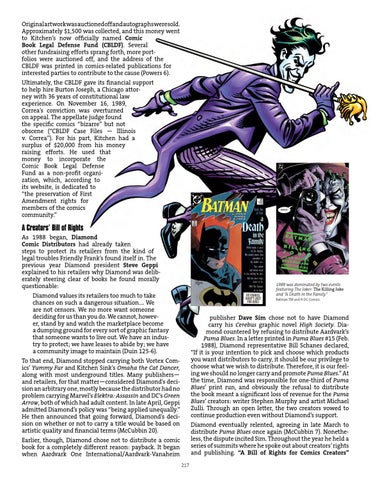
1988 was dominated by two events featuring The Joker: The Killing Joke and “A Death in the Family.”
Diamond values its retailers too much to take chances on such a dangerous situation…. We are not censors. We no more want someone deciding for us than you do. We cannot, however, stand by and watch the marketplace become a dumping ground for every sort of graphic fantasy that someone wants to live out. We have an industry to protect; we have leases to abide by; we have a community image to maintain (Duin 125-6).
Batman TM and © DC Comics.
publisher Dave Sim chose not to have Diamond carry his Cerebus graphic novel High Society. Diamond countered by refusing to distribute Aardvark’s Puma Blues. In a letter printed in Puma Blues #15 (Feb. 1988), Diamond representative Bill Schanes declared, “If it is your intention to pick and choose which products you want distributors to carry, it should be our privilege to choose what we wish to distribute. Therefore, it is our feeling we should no longer carry and promote Puma Blues.” At the time, Diamond was responsible for one-third of Puma Blues’ print run, and obviously the refusal to distribute the book meant a significant loss of revenue for the Puma Blues’ creators: writer Stephen Murphy and artist Michael Zulli. Through an open letter, the two creators vowed to continue production even without Diamond’s support.
To that end, Diamond stopped carrying both Vortex Comics’ Yummy Fur and Kitchen Sink’s Omaha the Cat Dancer, along with most underground titles. Many publishers— and retailers, for that matter—considered Diamond’s decision an arbitrary one, mostly because the distributor had no problem carrying Marvel’s Elektra: Assassin and DC’s Green Arrow, both of which had adult content. In late April, Geppi admitted Diamond’s policy was “being applied unequally.” He then announced that going forward, Diamond’s decision on whether or not to carry a title would be based on artistic quality and financial terms (McCubbin 20).
Diamond eventually relented, agreeing in late March to distribute Puma Blues once again (McCubbin 7). Nonetheless, the dispute incited Sim. Throughout the year he held a series of summits where he spoke out about creators’ rights and publishing. “A Bill of Rights for Comics Creators”
Earlier, though, Diamond chose not to distribute a comic book for a completely different reason: payback. It began when Aardvark One International/Aardvark-Vanaheim 217