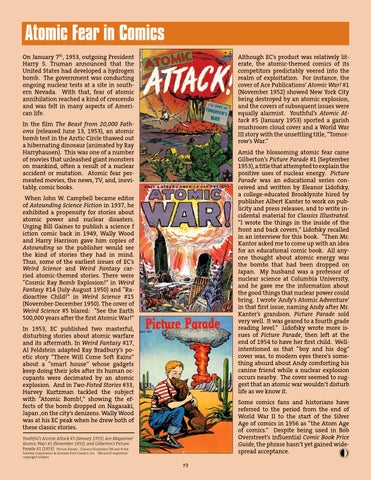
Atomic Fear in Comics Although EC’s product was relatively literate, the atomic-themed comics of its competitors predictably veered into the realm of exploitation. For instance, the cover of Ace Publications’ Atomic War! #1 (November 1952) showed New York City being destroyed by an atomic explosion, and the covers of subsequent issues were equally alarmist. Youthful’s Atomic Attack #5 (January 1953) sported a garish mushroom cloud cover and a World War III story with the unsettling title, “Tomorrow’s War.”
On January 7th, 1953, outgoing President Harry S. Truman announced that the United States had developed a hydrogen bomb. The government was conducting ongoing nuclear tests at a site in southern Nevada. With that, fear of atomic annihilation reached a kind of crescendo and was felt in many aspects of American life. In the film The Beast from 20,000 Fathoms (released June 13, 1953), an atomic bomb test in the Arctic Circle thawed out a hibernating dinosaur (animated by Ray Harryhausen). This was one of a number of movies that unleashed giant monsters on mankind, often a result of a nuclear accident or mutation. Atomic fear permeated movies, the news, TV, and, inevitably, comic books.
Amid the blossoming atomic fear came Gilberton’s Picture Parade #1 (September 1953), a title that attempted to explain the positive uses of nuclear energy. Picture Parade was an educational series conceived and written by Eleanor Lidofsky, a college-educated Brooklynite hired by publisher Albert Kanter to work on publicity and press releases, and to write incidental material for Classics Illustrated. “I wrote the things in the inside of the front and back covers,” Lidofsky recalled in an interview for this book. “Then Mr. Kantor asked me to come up with an idea for an educational comic book. All anyone thought about atomic energy was the bombs that had been dropped on Japan. My husband was a professor of nuclear science at Columbia University, and he gave me the information about the good things that nuclear power could bring. I wrote ‘Andy’s Atomic Adventure’ in that first issue, naming Andy after Mr. Kanter’s grandson. Picture Parade sold very well. It was geared to a fourth grade reading level.” Lidofsky wrote more issues of Picture Parade, then left at the end of 1954 to have her first child. Wellintentioned as that “boy and his dog” cover was, to modern eyes there’s something absurd about Andy comforting his canine friend while a nuclear explosion occurs nearby. The cover seemed to suggest that an atomic war wouldn’t disturb life as we know it.
When John W. Campbell became editor of Astounding Science Fiction in 1937, he exhibited a propensity for stories about atomic power and nuclear disasters. Urging Bill Gaines to publish a science f iction comic back in 1949, Wally Wood and Harry Harrison gave him copies of Astounding so the publisher would see the kind of stories they had in mind. Thus, some of the earliest issues of EC’s Weird Science and Weird Fantasy carried atomic-themed stories. There were “Cosmic Ray Bomb Explosion!” in Weird Fantasy #14 (July-August 1950) and “Radioactive Child!” in Weird Science #15 (November-December 1950). The cover of Weird Science #5 blared: “See the Earth 500,000 years after the first Atomic War!” In 1953, EC published two masterful, disturbing stories about atomic warfare and its aftermath. In Weird Fantasy #17, Al Feldstein adapted Ray Bradbury’s poetic story “There Will Come Soft Rains” about a “smart house” whose gadgets keep doing their jobs after its human occupants were decimated by an atomic explosion. And in Two-Fisted Stories #33, Harvey Kurtzman tackled the subject with “Atomic Bomb!,” showing the effects of the bomb dropped on Nagasaki, Japan ,on the city’s denizens. Wally Wood was at his EC peak when he drew both of these classic stories.
Some comics fans and historians have referred to the period from the end of World War II to the start of the Silver Age of comics in 1956 as “the Atom Age of comics.” Despite being used in Bob Overstreet’s influential Comic Book Price Guide, the phrase hasn’t yet gained widespread acceptance.
Youthful’s Atomic Attack #5 (January 1953), Ace Magazines’ Atomic War! #1 (November 1952), and Gilberton’s Picture Parade #1 (1953). Picture Parade - Classics Illustrated TM and © the Frawley Corporation & licensee First Classics, Inc. TM and © respective copyright holders.
73