Black Comic Book Creators of the 1950s While some black cartoonists worked in the comic book production shops of the 1940s, the field was almost all-white. Despite gains made by African Americans in the post-war years, and the integration of U. S. armed forces during the Korean War following President Truman’s 1940s decision, there were few black writers and artists in 1950s comic books. The race of the person creating comic books meant nothing to the readers, of course, because they had no way of knowing if a book was produced by black or white hands. Nevertheless, it took an African American with considerable confidence and ability to knock on publishers’ doors, knowing that racial discrimination was widespread. The men of color discussed here—most of them working in the comic book industry during the 1940s as well as the 1950s—were persons of fortitude and should properly be considered pioneers in the field. Matt Baker is rated a “superstar” comic book artist who was largely considered the best “good girl artist” of his day. He was born Clarence Matthew Baker in North Carolina on December 10, 1921 and began working in comics in the S. M. Iger comic book production shop in New York City in 1944. He started out by assisting on the “Sheena” feature in Fiction House’s Jumbo Comics. Before long, he handled the finished work himself. It immediately became apparent that Baker depicted the female form exceptionally well. While at Iger’s shop (which supplied completed stories to Fiction House, Fox and others), Baker drew features starring a plethora of
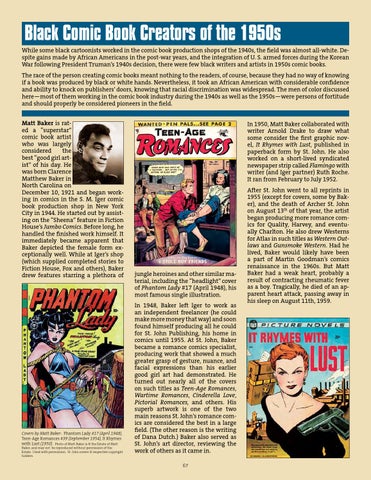
Covers by Matt Baker: Phantom Lady #17 (April 1948), Teen-Age Romances #39 (September 1954), It Rhymes with Lust (1950). Photo of Matt Baker is © the Estate of Matt Baker, and may not be reproduced without permission of the Estate. Used with permission. St. John covers © respective copyright holders.
In 1950, Matt Baker collaborated with writer Arnold Drake to draw what some consider the first graphic novel, It Rhymes with Lust, published in paperback form by St. John. He also worked on a short-lived syndicated newspaper strip called Flamingo with writer (and Iger partner) Ruth Roche. It ran from February to July 1952.
jungle heroines and other similar material, including the “headlight” cover of Phantom Lady #17 (April 1948), his most famous single illustration. In 1948, Baker left Iger to work as an independent freelancer (he could make more money that way) and soon found himself producing all he could for St. John Publishing, his home in comics until 1955. At St. John, Baker became a romance comics specialist, producing work that showed a much greater grasp of gesture, nuance, and facial expressions than his earlier good girl art had demonstrated. He turned out nearly all of the covers on such titles as Teen-Age Romances, Wartime Romances, Cinderella Love, Pictorial Romances, and others. His superb artwork is one of the two main reasons St. John’s romance comics are considered the best in a large field. (The other reason is the writing of Dana Dutch.) Baker also served as St. John’s art director, reviewing the work of others as it came in. 67
After St. John went to all reprints in 1955 (except for covers, some by Baker), and the death of Archer St. John on August 13th of that year, the artist began producing more romance comics for Quality, Harvey, and eventually Charlton. He also drew Westerns for Atlas in such titles as Western Outlaws and Gunsmoke Western. Had he lived, Baker would likely have been a part of Martin Goodman’s comics renaissance in the 1960s. But Matt Baker had a weak heart, probably a result of contracting rheumatic fever as a boy. Tragically, he died of an apparent heart attack, passing away in his sleep on August 11th, 1959.